


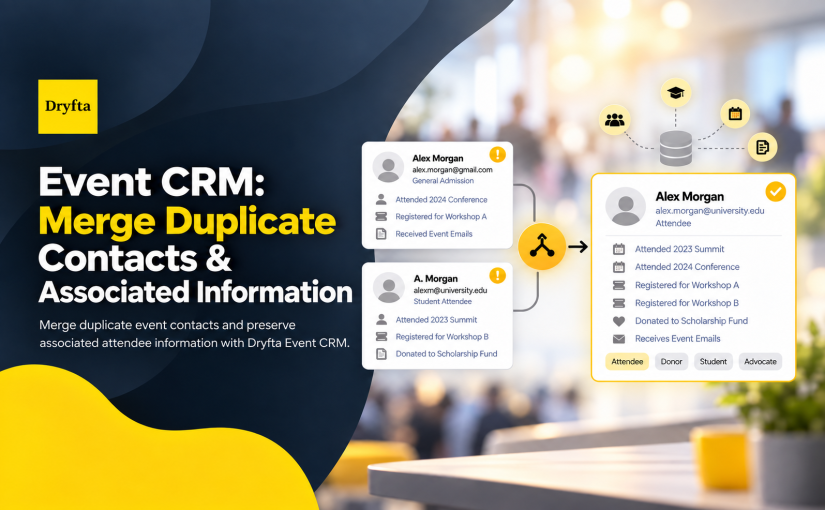
How to Merge Duplicate Contacts in Dryfta Event CRM

One person can end up with two contact records for perfectly ordinary reasons. They may register with a second email address, return as a speaker after attending an earlier event, or have an assistant create an account for them. Soon, their tickets, submissions, meetings, and messages sit in different profiles.

Dryfta’s Event CRM helps administrators review and merge duplicate contacts into one primary record. This guide explains how the merge works, which record to keep, and what to check before you confirm it.
Continue reading

AI-Assisted Abstract Review for Research Conferences

AI-Assisted Abstract Review for Research Conferences

AI-assisted abstract review uses software to support defined parts of a conference review process, such as submission checks, topic classification, reviewer assignment and advisory analysis. It should not replace expert assessment of scientific merit or a programme committee’s final decision.

That distinction matters when a university, scholarly society or research conference receives hundreds or thousands of submissions. The administrative burden is real, but so are the consequences of a poor reviewer match, an exposed identity, a missed conflict of interest or an unexplained rejection.

The useful question is not, “Can AI review abstracts?” It is, “Which tasks can it support, who checks the output and what evidence will the committee keep?”

Continue reading

Common Abstract Mistakes To Avoid During Submissions

Abstract

In academic and professional writings and submissions, an abstract plays a very important role. It provides the essence of a research or scientific paper, report, thesis, or presentation. Its main purpose is to give a complete summary or overview of the project to the reader. It gives a glimpse of the objectives, methods, key findings, and conclusions of the study carried out by the scholars.

Continue reading

UX Features That Make or Break Abstract Submission Rates

UX Features That Make or Break Abstract Submission Rates

Conference organizers today watch submission numbers the way investors track the prices of their shares in the stock market. Similarly, when abstract submission numbers drop by double digits, panic sets in for conference planners. On the other hand, when they do climb, there is perhaps no better feeling in the world.

Continue reading

11 Signs Your Abstract Management Process Needs an Upgrade

11 Signs Your Abstract Management Process Needs an Upgrade

You became an academic conference organizer because you believed in bringing researchers together. You wanted to create spaces where abstract ideas could collide and collaborations could form. You saw yourself shaping programs that would contribute to scaling up a field and subsequently, broader mankind.

Continue reading

KPIs to Monitor the Efficacy of Abstract Management Process

KPIs to Monitor the Efficacy of Abstract Management Process

Managing conference abstracts feels like conducting an orchestra. You are coordinating reviewers and tracking submissions while you maintain quality standards and keep everyone informed on a tight timeline. However, you might wonder how to determine if your process actually works.

Continue reading

Strategies for Late-Break Abstracts and On-Site Submissions

Strategies for Late-Break Abstracts and On-Site Submissions

Late-break abstracts and on-site submissions play an important role in academic events. Many conferences use these two channels to capture new findings, new project updates, and new insights that may not be ready during the main submission window. This type of abstract submission adds energy to the program. They also keep the event fresh, current, and in line with the fast pace of research. Continue reading

Strategies to Use Submission Data to Improve Future Events


Strategies to Use Submission Data to Improve Future Events

Every​‍​‌‍​‍‌​‍​‌‍​‍‌ year, conference organizers gather a whole lot of data. Abstracts, papers, author profiles, topic tags, reviewer scores, and session interests all go into the system way before the conference starts. However, what most organizers fail to realize is the power of this data. Abstract submission data is not just a record of abstracts received. It is the loudest signal from your community. It tells what they care about, what they will study next, and how your field might change. Continue reading

10 Must-Have Features in Modern Abstract Management Systems

10 Must-Have Features in Modern Abstract Management Systems

The academic conferences run on abstracts. These are brief proposals that determine who speaks, what gets discussed, and which research reaches the broader community. When the system for managing them breaks down, everything else falls apart. Deadlines get missed, and even the most potent submissions slip through review cracks.

Continue reading

12 Best Peer Review Software Platforms for Paper Submissions


12 Best Peer Review Software Platforms for Paper Submissions (2026)

The world of academic peer review and abstract submissions can sometimes be overwhelming. Fortunately, a number of websites have been developed that assist with these processes and help researchers and scholars communicate their work more easily. The right platform will transform your experience, making navigation a breeze and the whole process easy. Continue reading

How to Create the Best Call for Papers for Conferences

Call for Papers

Creating a good Call for Papers (CFP) for your academic conference can have a huge impact. They act as the backbone that makes or breaks your academic event. The CFP is a powerful invitation. They are not just an announcement. They are a doorway to the academic conference. A well-written CFP is your conference’s first impression. As the old saying goes, first impressions matter the most.  It sets the tone, attracts the right speakers for your academic conference, and boosts the overall engagement rates.

Continue reading