


Top 10 Invoicing Tools for Events and Conference Organizers (2026)

 Top-10-Invoicing-Tools-for-Event-and-Conference-Organizers

The budget may look healthy in a spreadsheet, but late deposits and unpaid balances can quickly put an event under pressure. Organizers need to know more than the total amount due. They need to see who owes it, when it should arrive and exactly what it covers.

An event invoice provides that clarity by listing the services delivered, their costs, payment terms and due dates. Invoicing software for events makes the process easier by helping organizers create invoices, track outstanding amounts and collect payments at different stages. These may include registration fees, initial deposits, planning instalments and the final balance due before the event begins. Continue reading
Top 10 Badge Builders for Events and Conferences (2026)

Top 10 Badge Builders for Events and Conferences (2026)

Badges. Everyone likes badges, these tiny wearables that instantly make the day brighter for everyone involved. It’s whimsy, but for events. And no matter how formal a gathering you may be hosting, slipping on a little badge makes everyone belong a little more within the venue. It’s fairly simple: the human need to feel a sense of community. 

Continue reading

Abstract Review Scoring Matrix Template for Academic Conferences (2026)

Abstract Review Scoring Matrix

The abstract review is a cornerstone of academic conferences. It ensures the quality, relevance, and integrity of the content. An abstract review scoring matrix gives the academic conference organizers an easy way to evaluate submissions by setting the required standards. Instead of each reviewer depending solely on personal judgment. They get a clear set of instructions, which include criteria, a scoring scale, and a clear shared process. This keeps the review stage well-organized and much easier to manage, especially when there are a huge number of submissions.

Continue reading

A Complete Guide to Double-Blind Review for Academic Events

A Complete Guide to Double-Blind Review for Academic Events

The double-blind review is a process that is used in academic conferences. In this style of review process, the identities of the author and the reviewer are hidden. If the author’s identity is not visible to the reviewer, it helps to prevent the reviewer from creating any partiality or bias. According to a study conducted by the Publishing Research Consortium (PRC), 71% of respondents said the double-blind abstract review process is highly effective.

For example, Reviewer gets to see: Paper #ABC.

Similarly, the author gets to see: Reviewer 123 (anonymous comments)

In this blog, let’s get a clear understanding of the most popular and widely recognized abstract review model: Double-Blind. Know its purpose, advantages, disadvantages, importance and best practices for organizers.

Continue reading

Ex Ordo Alternatives: Better Options for Academic Events

best ex ordo alternatives

There is no single Ex Ordo alternative that makes sense for every conference. The better question is what you need the platform to do once the abstract deadline has passed. 

Do you want your platform to take care of peer review and registration? Do you need session planning and attendee management as the conference gets closer? And if you want all of that under the same roof, Dryfta is worth a look. 

Of course, there is no reason every conference should use the same setup.

Oxford Abstracts and Fourwaves could be a better match for teams after a simpler academic conference setup. ConfTool and EasyChair are worth a look if submissions and peer review are where most of your work happens. Larger organisations may need something more specialized, in which case Cvent is your best bet.

So which Ex Ordo alternatives should you consider? Start with your event size. Think about your budget. Then look at the work you want the platform to take off your team’s plate.

A quick heads-up: Dryfta publishes this comparison. Keep that in mind as you read through the recommendations.

Conference Fit Finder

If your main priority is Start by looking at
You want one dedicated platform to manage most of the conference Dryfta and Cvent
You mainly need abstracts and peer review Oxford Abstracts and EasyChair
You care about scientific posters and attendee interaction Fourwaves
You need more control over conference administration ConfTool
You manage large events with lots of onsite activity Cvent
You handle applications, grants, or awards alongside abstracts OpenWater
You want academic event management with registrations and a CRM Dryfta

Is Ex Ordo Still a Good Choice?

Looking for Ex Ordo alternatives does not automatically mean Ex Ordo is the wrong platform.

Ex Ordo now covers much more than abstract submissions. You can use it for abstract collection, peer review, registration, programme building, and virtual or hybrid events. It also supports panels and symposia, SSO, real-time reporting, and mobile app connections. Ex Ordo’s platform page reports 99.97% uptime.

Ex Ordo may still be the sensible choice if:

  • Your team is comfortable with Ex Ordo and there’s no major problem with the way you use it today.
  • Abstract submissions and scholarly peer review are a big part of your events, and Ex Ordo already handles both.
  • Your membership or publication integrations already work with Ex Ordo without creating extra work for the team.
  • The Ex Ordo alternatives you’re considering have extra features, but not enough to make switching worth the effort.

Switching platforms is worth considering when the new one fixes a problem your team is currently dealing with.

Look at Ex Ordo alternatives when your current setup is causing unnecessary work. Maybe your team keeps running into the same limitations or your event needs have become more complex. If the platform is still doing what you expect, sticking with it may be the easier choice.

A fair comparison should look at both sides. Ex Ordo may not fit every academic conference, but it can be a good platform for organisations that already have the features they need.

When Should You Consider an Alternative?

There’s no need to fix something that isn’t causing problems. But conference needs can change over time. Here are four signs that it may be time to explore your options.

1. Your conference has outgrown an abstract-first workflow

Abstracts might have been the heart of your event when you first chose your platform. Now you may also be dealing with registration, ticketing, event websites, session attendance, networking, surveys, or ongoing community activity. When your team needs attendee information to carry across registration, communication, and other event tasks, Ex Ordo alternatives may be worth considering.

2. Your current workflow contains too many handoffs

Accepted submissions shouldn’t send your team running back and forth between multiple spreadsheets.

There can be a lot to update once submissions are approved. Speaker details, schedules, registration checks, and attendee emails may all need the same information. If your team is constantly copying it around, Ex Ordo alternatives may be worth a look.

3. You need a different pricing or procurement model

Don’t judge event management software by the plan price alone. Check for extra licences, add-ons, payment fees, setup costs, support, and the time your team needs to spend on the platform. The cheaper option on paper may not be cheaper in practice.

4. Your organisation needs different governance

The event may be your main concern, but procurement will have its own checklist. Make sure the platform covers accessibility evidence, data location, SSO, user permissions, integrations, audit history, support, and data exports. All these details are easy to overlook when you’re focused on the event.

How We Evaluated the Alternatives

There are plenty of Ex Ordo alternatives out there, and comparing them feature by feature only tells you so much. We used the same criteria for each platform and looked at how well they handle the everyday work of an academic conference.

Every platform was reviewed against the same seven workflows:

  • Submission setup: How easy is it to set up different submission types and the requirements for each one?
  • Reviewer assignment and conflicts: How are submissions assigned to reviewers? How does the platform handle reviewer conflicts?
  • Decisions and author communication: How easy is it to record decisions and keep authors informed through notifications and other modes of communication?
  • Accepted content to program: How easily can accepted submissions move into sessions?
  • Registration and payment: What options are available for setting up registration and handling payments?
  • Attendee delivery and engagement: What tools are available after registration to help teams communicate with attendees and manage the event as it gets closer?
  • Reporting, integrations, and data export: How easily can teams access event data, connect other systems, and export the information they need?

We also considered how much effort it takes to get the platform up and running, along with accessibility, security, privacy, support, pricing transparency, data ownership, and what happens if you eventually decide to make a switch. 

We applied the same practical approach to AI by including features that are currently available, while leaving out beta and in-development features from the comparison.

Research date: September 5, 2026.

One small but important note: Pricing and product features can change, sometimes faster than you would expect. For that reason, the prices and capabilities mentioned in our Ex Ordo alternatives comparison reflect what was available or publicly documented at the time of research. Always confirm the latest details with the vendor before making a purchasing decision.

Best Ex Ordo Alternatives for Academic Conferences

According to the American Express 2026 Global Meetings & Events Forecast, attendees’ expectations have changed over the last five years. Today, they look for 42% more interactive sessions. e.g. Academic Conferences 

1. Dryfta: Best for connected academic events

DRYFTA HOMEPAGE

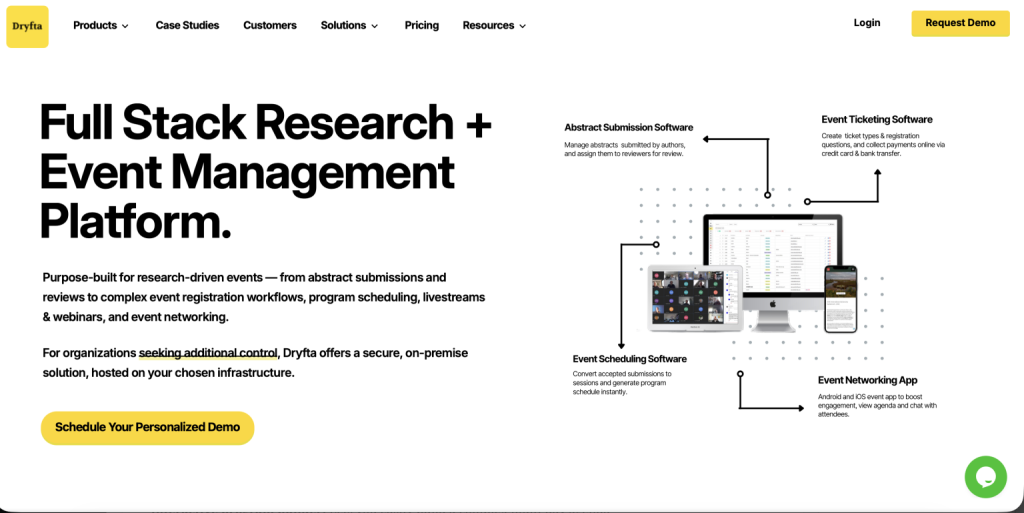
Best for: Academic conferences that want submissions and peer review connected to registration, scheduling, attendee management and reporting.

Why it deserves a place? Dryfta ties the academic side of a conference with the practical work that happens after submissions are accepted. 

Workflow strength: You can set up submission forms and use double-blind review with conflict management. Once decisions are final, accepted abstracts can move into the event schedule. Organisers can then work on speakers, sessions, registrations, tickets, check-ins, surveys, and reports. There is also an event CRM for managing information about attendees.

Main trade-off: The more an event platform covers, the more there may be to configure. A simpler tool built around abstracts and reviews may be quicker to get up and running.

Pricing approach: 

Choose it if: You want an academic-first platform that goes beyond submissions and reviews.

Verify during the demo: Ask your team to take one accepted submission through review, scheduling, speaker updates and registration.

2. Oxford Abstracts: Best for straightforward academic workflows

Oxford Abstracts

Best for: Academic teams that want submissions and review at the heart of their conference.

Why it deserves a place? What makes Oxford Abstracts interesting is the balance. You get abstract management alongside ticketing and conference features without losing sight of the academic process.

Workflow strength: You can customize submission forms around your requirements. From there, you can move through reviewing and decisions before getting into ticketing and reviewer progress. Paid plans also bring in features such as multi-stage submissions and symposia. You can also get detailed reports and instant abstract books.

Main trade-off: Some conference features only come with the higher-tier plans. You may need to move beyond the basic package for the full setup.

Pricing approach: 

Choose it if: You are looking for a focused academic conference platform that can take you from submissions to presentations without stopping at abstract collection.

Verify during the demo: Ask how a multi-stage submission moves from review into the final session and attendee-facing event site.

3. Fourwaves: Best for scientific posters and interaction

Fourwaves

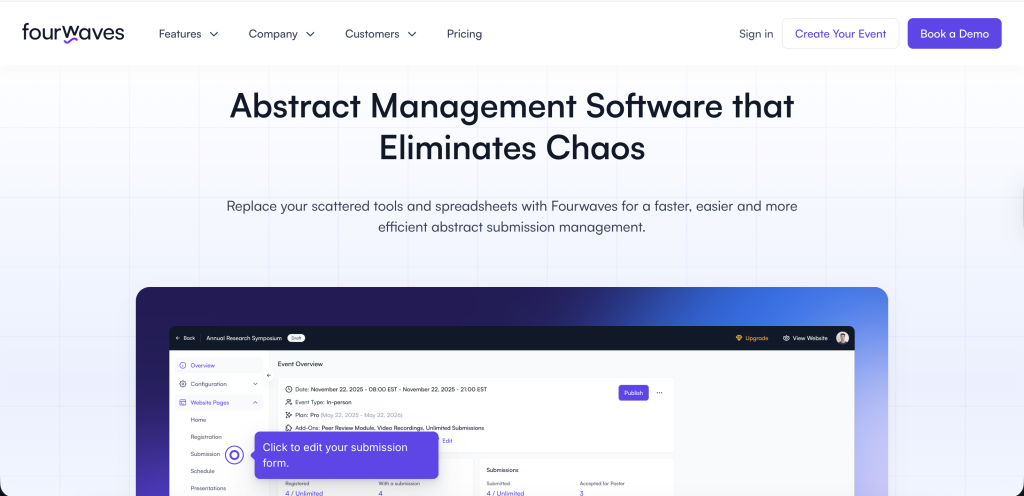
Best for: Scientific and academic conferences where virtual posters and attendee interaction are a big part of the experience.

Why it deserves a place? Fourwaves is worth a look if posters are a major part of your conference. It combines abstract management with registration and online event presentation.

Workflow strength: You can manage abstracts and registration while taking payments online. Conference schedules and website content are also part of the platform. A mobile experience is available too. Need peer review? That comes as an add-on. The virtual option adds poster sessions plus live chat and Q&A. 

Main trade-off: Peer review and virtual delivery are separate add-ons. Unlimited submissions can be another added cost.

Pricing approach: 

Choose it if: Your academic conference needs strong options for scientific posters and virtual participation.

Verify during the demo: Ask for a complete example covering abstract review, poster publishing, registration and virtual participation.

4. ConfTool: Best for detailed administrative control

ConfTool

Best for: Organizers who want detailed controls across the academic and administrative side of a conference.

Why it deserves a place? ConfTool takes the academic side of conferences seriously. There are plenty of conference-specific settings.

Workflow strength: You can set up submission processes and invite reviewers based on your needs. Reviewer bidding and automatic assignment are available too. Review forms and conflict-of-interest checks are part of the system. Registration can include payments and invoices.

Main consideration: If you want a very straightforward setup then ConfTool may take more time to get comfortable with.

Pricing approach: 

Choose it if: You would rather have detailed conference controls than the simplest interface possible.

Verify during the demo: Ask if reviewer assignment, conflict handling, registration, invoicing, payment are included in the specific ConfTool edition you would purchase.

5. EasyChair: Best for submission-led conferences

EasyChair

Best for: Submission-heavy conferences where paper review and committee work take centre stage.

Why it deserves a place? EasyChair makes sense for teams that want their conference software centered around papers and peer review. Licence levels vary depending on what you need.

Workflow strength: You can customize submission and review forms. Reviewer assignment and paper bidding are available too. The platform also includes conflict-of-interest checks and double-blind reviewing. Reviewer discussions and author rebuttals are part of the setup.

Main trade-off: You will want to look closely at the licence options. Not every feature comes with every level.

Pricing approach: 

Choose it if: Papers and reviewers make up most of what your conference team needs to manage.

Verify during the demo: Check the licence first. Then test a real paper from submission through review.

6. Cvent: Best for enterprise event portfolios

Cvent

Best for: Enterprise teams with complex events and plenty of onsite logistics to think about.

Why it deserves a place? Cvent is built for much bigger event requirements. Venue sourcing and housing sit alongside registration.

Workflow strength: Cvent includes registration and event websites as well as attendee communications. Onsite check-in and attendee tracking are also available. Teams can use mobile experiences, surveys and reporting too. 

Main trade-off: For a smaller academic event, Cvent can feel like a lot for a relatively simple job.

Pricing approach: 

Choose it if: Your organization runs large events and needs enterprise-level event operations.

Verify during the demo: Ask which Cvent products and integrations you would need for your event.

7. OpenWater: Best for applications and awards

OpenWater

Best for: Teams that need to manage conference abstracts alongside grants and scholarships.

Why it deserves a place? OpenWater makes sense for organizations that want their conference submissions to fit into a more complex application process.

Workflow strength: OpenWater gives conference teams tools for collecting abstracts and running peer review. Session scheduling and mobile app integration are also available. 

Main trade-off: If abstracts are your only concern, some of OpenWater’s features may go unused.

Pricing approach: 

Choose it if: Your organization runs conferences alongside awards and grants.

Verify during the demo: Ask to see the exact setup for abstracts, review stages, session scheduling and external integrations.

Which Platform Fits Your Conference?

A small research meeting will have different needs from a large international event. Use the shortlist below to narrow down the options that may make the most sense for your event.

The shortlist is meant to help you narrow things down. Your submission process may point you toward one option, and your registration setup may favour another. Integrations and budget can narrow the choice further.

Run the Same Demonstration With Every Vendor

With Ex Ordo alternatives, it can be more useful to give every shortlisted platform the same tasks and see how easily your team can handle them.

  1. Try setting up two submission types with different rules and see how flexible the setup feels.
  2. Add a co-author and edit a submission to see how easily changes can be made.
  3. Assign reviewers while checking their expertise and any conflicts.
  4. Change an acceptance decision and see how easily the submission can move into a session.
  5. Check whether speaker and room clashes can be caught before the event goes live.
  6. See whether the presenter’s registration status is easy to check.
  7. Export the event data and see what the export includes and what it doesn’t.

Score each task from 0 to 3

  • 0 means the platform cannot handle the task.
  • 1 means your team will need to do some of the work manually or use another tool.
  • 2 means the task is supported but takes some setup.
  • 3 means your team can complete the task without much effort.

You can also make the scorecard a free download without putting it behind a form. That way, your team can use it when weighing up Ex Ordo alternatives.

Compare Total Cost, Not Licence Price

It is easy to look at two price pages and think you know which one is cheaper. That can change once you start using the platform. Paid add-ons and extra tools can all push the final cost up. Before choosing between Ex Ordo alternatives, work out what the platform will cost you over the full contract period. 

Include things like:

  • Main licence
  • Paid add-ons
  • Registration
  • Payment processing fees
  • Setup and integrations
  • Internal time spent managing the platform
  • Data migration when you import
  • Data export when you eventually decide to switch

Once you have the headline price, ask what you are getting for it. Does the quote cover abstract and review management, session scheduling, the website, mobile experience, virtual experience, and proceedings? Are features such as SSO and API access included? What about training or priority support?

One more thing to keep straight: When you compare Ex Ordo alternatives, a quote-based product should not be labelled expensive until you have a comparable quote in hand.

How to Migrate From Ex Ordo

Your conference data has a history. Submissions lead to reviews. Reviews lead to decisions. Files and emails follow along the way. Miss one piece and you may not notice the problem until your next conference is in full swing. If you’re exploring Ex Ordo alternatives, don’t rush straight into the new platform. First, figure out all the data that needs to be exported before you start setting up the new platform.

Before you move

  • Export the submissions along with their files. Make sure author details, reviewer records, scores, and decisions are included too.
  • Note who had which user role. Save the conflict rules while you can still see how they were configured.
  • Save the email templates your team relies on. Note what each submission status meant in your process.
  • Make a list of every integration that connects to Ex Ordo. Don’t forget payment records or other systems that rely on the platform.
  • Separate the information your team needs from older data that can stay safely archived.

During configuration

  • Before importing records, match each old field with its new equivalent. It is much easier to fix those differences now than after the data has moved.
  • Pick a real-time submission and follow it from the first step through review and the final decision. You’ll quickly spot anything that does not work as expected.
  • Test the setup from an author’s view. Then switch to a reviewer and organiser account. Make sure each person can access what they should.
  • Don’t move everything at once. Import a small set of records first and compare them with the originals in Ex Ordo. Check the files too.
  • Do a quick numbers check after the test import. If something is missing, you want to catch it before the full migration.

Before you launch

  • Keep your old and new system running side by side for a realistic test. Use actual conference scenarios.
  • Ask a few authors and reviewers to go through the tasks they will use. Their feedback can reveal problems your internal testing misses.
  • Don’t shut down access to the old system just yet. Keep your archives available until everyone has signed off on the move.
  • Decide what you will do if something goes wrong after launch. Write down how you would return to the old setup and what needs to happen first.

Your migration plan for Ex Ordo alternatives should leave no confusion about who checks what. It is also better to avoid promising a “seamless” migration until the data it covers is tested and confirmed.

Final Decision

There’s no single winner here.

  • Go with Dryfta if you want an academic-focused platform that can handle submissions, review, registration, scheduling, and the attendee side of the event.
  • Stick with Ex Ordo if your current setup already works well for scholarly events and moving to another platform would mean more work without a meaningful payoff.
  • Look at a specialist option if one requirement drives the whole decision, whether that’s interactive posters or large-scale onsite event management.

Want to see whether Dryfta fits your conference in practice? Book a free demo today and walk through your requirements with our team.

FAQs

1. What is the best alternative to Ex Ordo?

If you’re looking at Ex Ordo alternatives, Dryfta is worth considering for academic conferences that need support beyond abstract and peer review management. It covers submissions, reviewing, registration, program planning, and attendee experience, making it a practical option when you want fewer separate tools to manage the conference. 

2. Is Dryfta better than Ex Ordo?

Dryfta can be a better fit when your conference needs more than submissions and peer review. Ex Ordo may make sense if its current setup already suits your team. The better choice comes down to what you need your platform to handle.

3. Which Ex Ordo alternative is best for small conferences?

Dryfta and EasyChair can suit events focused heavily on submissions and peer review, while Fourwaves offers a broader academic event setup covering registration and scheduling. Dryfta is also worth considering when you need end-to-end setup.

4. Which platforms support double-blind peer review?

Several platforms support double-blind review, including Dryfta, Ex Ordo, Fourwaves and ConfTool. Dryfta specifically documents a double-blind option that hides author details from reviewers. Ex Ordo supports single or double-blind review, while ConfTool provides dedicated double-blind settings. Fourwaves also lists double-blind review among its academic conference features.

5. What should an academic conference platform cost?

There is no single sensible price because conference size, submission volume, registration needs and extra modules can change the bill considerably. Published options range from free plans to annual or per-event pricing. Enterprise platforms may use custom quotes. Compare the complete package, including add-ons, payment fees, implementation, support and migration, rather than the headline licence price.

6. Can Ex Ordo data be migrated to another platform?

It can be exported. However, migration is not simply a matter of pressing an “import” button. Ex Ordo provides exports for most conference data. Before switching, check which files and records can be exported and confirm what the new platform can import.

7. Which platform is best for scientific posters?

Fourwaves is particularly worth considering when scientific posters are central to the event. Its platform includes a dedicated virtual poster experience with poster galleries, presenter conversations, Q&A and engagement tracking.

8. Should abstract management and registration use the same system?

They do not have to, but using one platform can make things easier for your team. When accepted submissions move into sessions and registration is handled separately, extra coordination may be needed. Event management platforms like Dryfta can be useful when you want the academic and registration sides of the event handled all at once.

9. What should I test during a conference-software demo?

Ask the vendor to show how a real-time conference would work. Test submission setup, reviewer assignment, decisions, session building, registration, payments, attendee access, reporting, and data export. If possible, give the vendor a few realistic scenarios and see how they handle them.

Cvent vs Bizzabo: A Detailed Comparison for Enterprise Events

Enterprise teams organize more events, in different formats, and across several regions. The rise of hybrid work, global audiences, and data-driven marketing has pushed to prioritize event technology. In this landscape, choosing the right platform matters more than ever because it will automate registration, prove ROI, and give sales warm leads the moment a session ends. However, choosing the wrong tool leads to slow processes, data silos, clunky workflows, sponsor complaints, and a weakened event ROI.

Continue reading

Hybrid Event Planning Checklist: How to Seamlessly Combine In-Person and Virtual Experiences

Hybrid Event Planning Checklist

Hosting and executing a premier hybrid event require more than just a standard approach. It demands a detailed, phase-by-phase master hybrid event planning checklist that anticipates challenges and offers a seamless experience for every individual. They have become highly popular due to its ease-of-access, visibility, and broadcasting content. In this guide, we’ve drafted a comprehensive approach that will help the event organizers execute a world-class hybrid event with confidence and precision.

Continue reading

Event Registration Process – Step-by-Step Guide + Checklist

Event Management Registration

Event registration is the backbone for organizing successful conferences and events. The process draws attendees’ attention while capturing essential details for better execution. Focusing on event registration will result in gaining many small details without missing the important ones. 

Continue reading

How Event Management Platforms Help with Attendee Engagement

How Event Management Platforms Help with Attendee Engagement

When it comes to hosting or organizing events, focusing on attendee engagement must be given a top priority. Academic events offer more than just speaking and presenting research on complex topics. They are the perfect platforms to get connected with the customers. To achieve this, it is important to focus on making the event interactive and fun as well as engaging. Many academic event management platforms today face growing expectations from the audience. 

Continue reading

5 Event Platforms for Hybrid Academic Conferences Compared

Hybrid

The academic event industry has historically faced significant challenges, but the digital world has presented it with a wealth of opportunities. If the conference organizers are stuck between hosting an in-person and virtual conference, then a hybrid format is the perfect option they can choose. The concept of “hybrid” includes the combination of two or more different technologies or approaches. 

Continue reading

Challenges of Hosting Virtual Events in Universities

Virtual Events

Universities and other educational institutions host various virtual eventsEach of these events consists of its own challenges, and tackling them wisely is vital for the event organizers. The outbreak of the global COVID-19 pandemic in 2020 has opened the doorway to several forms of virtual events. The event industry has come a long way since then. 

Continue reading

Dryfta Vs Oxford Abstracts Vs PheedLoop – Complete Comparison


Dryfta Vs Oxford Abstracts Vs PheedLoop- A Detailed Comparison

Academic conferences have unique needs that are impossible to manage with normal tools. These conferences handle a huge volume of abstract submissions, organize strict peer reviews, publications, feedback collecting and many more. The need for specialized software is essential to simplify the tasks, reduce errors and save time for conference organizers.

Continue reading