


When you’ve settled into a routine way of working and your stratagem has turned static, upscaling can feel like resistance. However, such resistance and aversion to change is what often precedes true development.
As a modern event planner, one ought to keep consistently raising the bars. And hitting them. Bars that are raised but without practical effort amount to nothing more than another unchecked item on your company’s 10-year vision. Say you are an academic event organizer and hope to augment your presence and operations. The upper hierarchy has finally approved bigger, better events. However, you may find yourself constrained by limited resources and a fiscal inability to draw in more. You want to manage hundreds of thousands of abstract submissions for a mega event headlined by a prestigious educational institution. But you can’t afford to hire hundreds of new employees to manually sift through submissions that run in the 1000s.
When event planners find themselves wanting to manage abstract submissions at scale, what do they do?
Why High-Volume Abstract Management Breaks Standard Workflows
Your routine abstract management workflow may have worked flawlessly well for your organization thus far. But bigger dreams come with greater stakes. When you manage abstract submissions at scale, handling 1000s of entries, you will find that your time-tested abstract management workflow will crumble and give in. It will collapse from the weight of high volume abstract submissions. There are several notable operational bottlenecks that have academic event organizers in the chokehold when transitioning into abstract submission management 1000 submissions. Some of them include but are not restricted to the following:
- Reviewer assignment becomes a full-time job: A manual workforce that somehow tackles high volume abstract submissions will likely find themselves obturated in reviewer assignment. Most peer review mechanisms are now automated for fairness. Individual reviewer assignment comes with a whole set of challenges that will be difficult to overlook in the long run. The job does not end when a reviewer is assigned. Rather, manual employees will have to consistently coordinate and keep track of the status for abstracts for everyone involved. Reviewers will need to be reminded of deadlines and authors will demand to know of peer review progress. Managing this entire workflow without a software tool can feel like asphyxiating your workforces capabilities.
- Status communication consumes the team: Closing relating to the previous bottleneck is the broader choke of status communication. While the previous bottleneck focused on external communication, internal coordination also goes for a toss when a team is to manage abstract submissions at scale.
- Manual errors can compound: When humans oversee a high density workflow as abstract management, man-made errors are likely to appear. In addition to this, concerns of bias and conflict-of-interest also crop up during the reviewer assignment phase. When employees assign reviewers for accepted abstracts by hand, it may be difficult to establish impartiality in allocation.
The 7 Automation Priorities That Scale Abstract Management
The future of intelligent abstract management is here. And it looks a lot like convenience, efficiency, clarity and transparency.
A research paper on IEEE Xplore authored by Preetha M and colleagues notes how incorporating AI into preliminary abstract screening and reviewer assignment is helping save 77% of manual administrative effort.
We now know that automation works, both in research and in practice. Scores of event management professionals are saving considerable time and money by adopting automated workflows. Abstract submission management involving 1000+ submissions is only one among the functions that are benefiting from automated abstract management softwares. Let’s take a closer look into what these functions are and how they are benefitting from automation.
1. Automated Submission Confirmation and Status Tracking
At 1,000 submissions, you cannot manually confirm receipt of every abstract and you shouldn’t have to. The moment someone hits ‘submit,’ they should get an email confirming it went through, with a reference number and a summary of what they sent. That single automation eliminates one of the most predictable sources of coordinator email volume: the “did you receive my submission?” message. Multiply that by a few hundred anxious first-time authors and you’re looking at a full-time job that doesn’t need to exist.
Dryfta fires automated submission confirmations the instant an abstract is submitted, with no coordinator involvement required.
2. AI-Powered Reviewer Assignment with Workload Balancing
Manually assigning reviewers at scale means matching each of a thousand papers to two or three qualified reviewers by topic, then checking that no single reviewer ends up buried under 40 papers while others get five. Doing this by spreadsheet is technically possible. Doing it well, on deadline, is not.
Automated reviewer matching solves this by assigning reviewers based on expertise keywords and topic tags submitted with each paper, rather than a coordinator manually cross-referencing a reviewer list against a submission list. Workload balancing means the system tracks how many papers each reviewer already has and stops piling more on once they hit a configured cap so review quality doesn’t erode simply because someone was matched to everything.
Dryfta’s AI-assisted reviewer matching assigns based on topic keywords with configurable workload caps, so coordinators set the rules once and let the system apply them consistently across every submission.
3. Automated Reviewer Reminders and Chase-Up Communications
At the end of review cycle, coordinators are likely to be dealing with reviewers who jus5 haven’t done their jobs. Not all reviewers complete and turn in their assigned reviews within the stipulated deadline. Reviewers need consistent reminders to keep going, particularly the busy ones who are likely to lose track of time. Therefore, if chasing them down falls to a manual coordinator sending individual emails, that looks like hours spent on a task that a scheduled fix could handle automatically.
Dryfta supports configurable automated reminder sequences to reviewers. This means that event coordinators only have to set the cadence and rhythm a single time for an entire conference and automation will ensure that it takes off throughout smoothly.
4. Self-Service Reviewer Dashboards (Eliminate Reviewer Email Volume)
A large share of coordinator email during the review period has nothing to do with the actual content of reviews, it is reviewers asking what they’ve been assigned, how to access submission files, or where to enter their scores. A self-service dashboard fixes this by giving each reviewer a login where they can see their assigned papers, download or view submission files, enter scores and comments, and flag conflicts of interest, all without emailing anyone. Once that exists, coordinators stop fielding individual queries and instead monitor aggregate completion rates, which is a far better use of their time and a much clearer signal of where the review cycle actually stands.
Dryfta’s author and reviewer self-service dashboards lets each reviewer log in to access assigned abstracts, score them, leave comments, and declare conflicts, all from one place.
5. Bulk Accept/Reject with Personalised Author Notifications
Once the review phase closes, every one of a thousand authors needs to hear back and they need to hear back with a decision that reads as personal, not a form letter. Sending those one at a time is not feasible when working manually. For many organizers, sending identical mass emails is a matter of risking looking impersonal and like spam.
Bulk decision-making is an automated feature that helps resolve this challenge by allowing coordinators to either accept or reject decisions across groups of submissions at once. Dryfta supports bulk accept/reject decisions with configurable automated notification templates. As a coordinator, you will be reporting to your work desk with half of the logistical overhead put in place for you, ready to be moved on to the next phase of academic conference management.
6. Conflict-of-Interest Detection at Assignment (Not After)
In academic and research communities, reviewers and authors frequently know each other, they’ve co-authored papers, sit on the same committees, or work at the same institution. If a conflict of interest surfaces after a reviewer has already scored a paper, the damage is done: that review is compromised, and depending on how far along the process is, it may be too late to fully undo. The better approach is catching conflicts at the assignment step, before a reviewer is ever matched to a paper, rather than relying on a post-review audit to catch what should never have happened in the first place. This is what prevents the most common peer review integrity failure at high-volume conferences.
Dryfta is one software tool that comes embedded with this kind of conflict management software that can prove efficient when management high volume abstract submissions.
7. Abstract-to-Schedule Conversion (Eliminate the Last-Mile Data Entry Crisis)
Once 400 abstracts clear review, they need to become an actual conference programme with sessions, tracks, rooms, time slots and speaker assignments. The most straightforward way to get there looks like someone manually copying every figment of data from accepted abstracts out of the review system and into a separate scheduling tool. Although this seems rather straightforward, when one is to manage abstract submissions at scale, can turn into nightmarish process.
The automated solution to this problem is direct abstract-to-schedule conversion that removes this step entirely. With Dryfta’s abstract to schedule converter, accepted abstracts are channelized into programme slots automatically.
The High-Volume Abstract Management Workflow: Phase by Phase
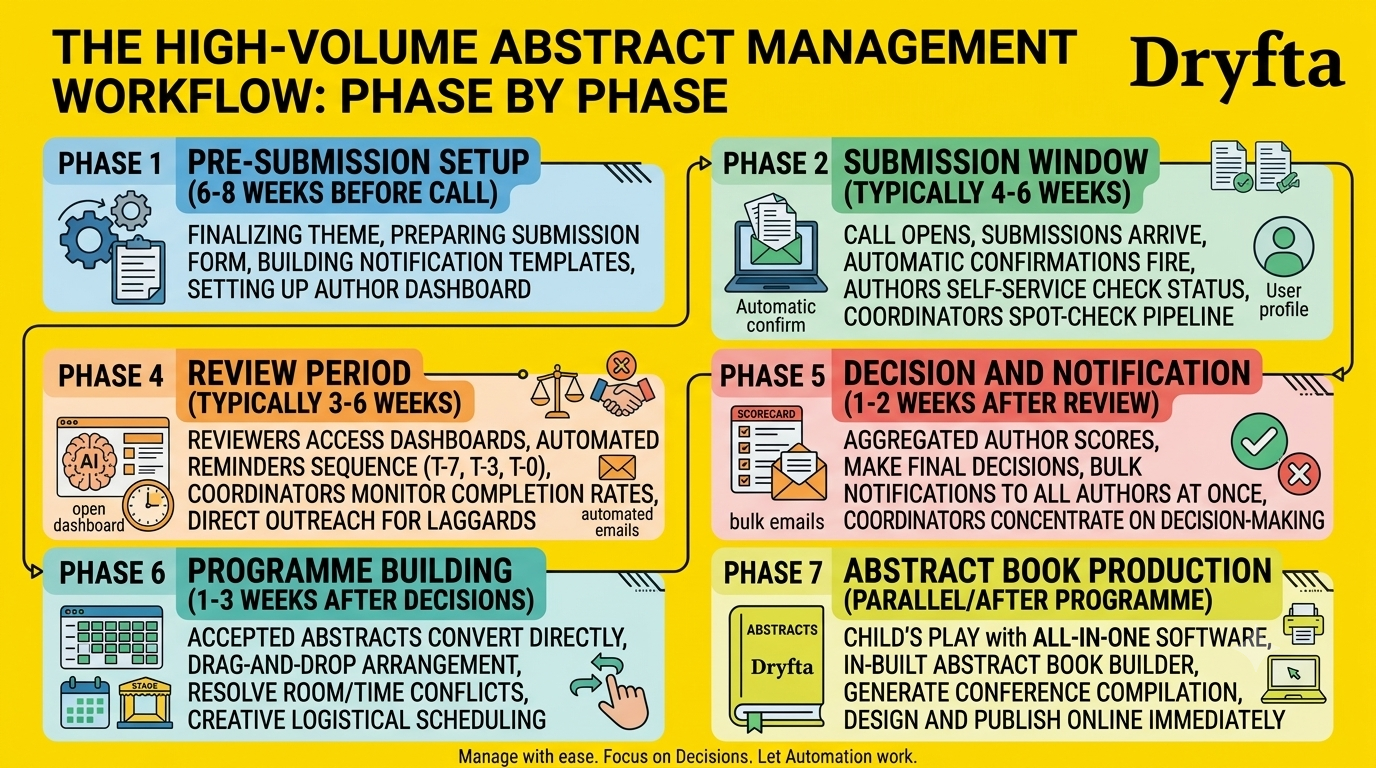
When you begin to manage abstract submissions at scale, one task can blur into another, one function wrapped into another. It can be perplexing to figure out where to start and when to draw the finish line. When to work and when to relax and let automation do the job. Typically, the management of high-volume abstract submissions can be segmented into the following stages:
Phase 1: Pre-Submission Setup (6–8 weeks before call opens)
This is the most important phase where you and your teammates lay the groundwork for how authors and the general public will perceive your conference. In phase 1, after having finalized a theme or two for your conference, you’ll be jumping right in to prepare things like the submission form, building notification templates and setting up the author dashboard among other things.
Phase 2: Submission Window (4–6 weeks typically)
Once the call opens, phase 2 begins and submissions start arriving over a window that typically runs four to six weeks. Confirmations fire automatically as each entry comes in, and authors can check their own status using self-service tools rather than emailing a coordinator directly. Coordinators, in turn, spend this period watching submission volume and spot-checking the pipeline instead of confirming every entry by hand, which keeps their workload noticeably light.
Phase 3: Review Assignment (1–2 weeks after submission deadline)
Phase 3 arrives one to two weeks after the submission deadline and brings AI reviewer matching, conflict-of-interest checks and workload balancing together in a single automated pass, followed by assignment confirmation emails sent out to reviewers. Coordinators step in mainly to review the automated matches for edge cases, and because the assignment list builds itself, nobody starts from a blank spreadsheet.
Phase 4: Review Period (typically 3–6 weeks)
Reviewers access their dashboards, automated reminder sequences fire at set intervals, commonly T-7, T-3, and T-0 relative to the deadline and coordinators track completion rates rather than chasing individual reviewers. Coordinator time is largely monitoring, with direct outreach reserved for reviewers who fall well behind.
Phase 5: Decision and Notification (1–2 weeks after review closes)
When one is to manage abstract submission at scale, decision and notification make up phase 5, which happens one to 2 weeks after review closes. This is the point wherein author scores get aggregated such that final decisions can be made. Bulk notifications then go out to every author at once, and because that step runs largely on its own, coordinators have the privilege of concentrating almost entirely on the decision-making, leaving the logistics to automation.
Phase 6: Programme Building (1–3 weeks after decisions)
Programme building is the next big step that takes center stage in phase 6. If typically onsets about 1-3 weeks after decisions are finalised, and accepted abstracts convert directly into programme slots without anyone re-entering data. Coordinators use drag-and-drop tools to arrange the schedule, resolve room or time conflicts and place sessions where they make the most sense, so their time here leans creative and logistical rather than administrative.
Phase 7: Abstract Book Production (parallel with or after programme building)
If you are using an all-in-one abstract management software like Dryfta, phase 7 is basically child’s play. Dryfta has an in-built abstract book builder that generates a compilation of conference and allows you to design and publish it online almost immediately.
What to Look for in Abstract Management Software at Scale
- Tested capacity: Always ascertain the propensity of a software tool in action. Ask for a free demonstration or a dummy of its key features. Take advantage of free tiers and limited-period offers. These will help you establish the tested capacity od the abstract management software you are eyeing. In theory, most software tools appear perfect and infallible. But in real-world conditions, when placed in charge of running an academic conference in real-time, is when some important flaws begin to show up.
- Workload balancing: Simply put, the abstract management software you choose to manage abstract submissions at scale should work better than your human boss. While your higher ups could sometimes care the least about big terms as ‘workload balancing,’ it ought to be a priority feature for intelligent assignment tools. Peer reviewers should have papers distributed to them evenly and per their capacity.
- Automated notification depth: Confirmations for authors submissions and reminders about approaching deadlines are some good stuff. But they are only one part of automated notifying. In fact, there is a lot more to it. When working eith high volume abstract submissions, automation must be stretched into phases beyond just the routine deadline warnings and do-not-reply-to emails. Contemporary and state-of-the-art conferences softwares are employing AI into things such as attendee matchmaking, conflict-of-interest flagging and even triple-blind review.
- Real-time completion dashboard: Without this facility, it becomes close to impossible for event planners and academic event coordinators yo manage abstract submissions at scale. A dashboard that tracks progress across the entire event lifecyle and workflow is central to flawless operations. It also means that little time needs to be spent into double-checking and verifying progress across abstract management functions.
- Abstract-to-schedule conversion: Accepted submissions should be attuned to flow directly into the program important details such as their metadata intact. Intelligent automation features allow you to achieve this without any human interference at all. Your team will not have to sit down and sift through to compile accepted abstracts and trash rejected ones.
- Self-service for authors and reviewers: Self-service dashboard should allow both authors and reviewers to check status, access files and take action without needing to rely on a human coordinator. This cuts off significant administrative overhead.
- Blind review configuration: Determine what kind of peer review you will be incorporating to manage your abstract submissions at scale. Single, double and triple-blind review, each come with their own characteristic facets. However, ultimately, all kinds of blind peer review are aimed at ensuring fairness in review. It is up to you and the standard of your conference to determine the degree to which you want your submissions to be evaluated fairly.