
The academic event industry has historically faced significant challenges, but the digital world has presented it with a wealth of opportunities. If the conference organizers are stuck between hosting an in-person and virtual conference, then a hybrid format is the perfect option they can choose. The concept of “hybrid” includes the combination of two or more different technologies or approaches.
Hybrid academic conferences are a perfect mix of in-person events (held at a real-world venue) and virtual events (organized online via the internet), adding advantages to both worlds. The way an entire hybrid conference is getting organized is where the real secret lies. Several conference organizers usually prefer the hybrid format to be the ideal way so that they can maximize the number of attendees and create opportunities for better interactions and fruitful networking.
In this blog, let’s dive deeper and understand hybrid formats redefining academic conferences, the benefits of organizing academic conferences in a hybrid format, and an in-depth comparison between Dryfta, vFairs, Oxford Abstracts, OpenWater, and EventsAir.
What Is a Hybrid Academic Conference Platform?
A hybrid academic conference platform is software that helps organizers manage both in-person and virtual conferences in one place. Instead of using different tools for submissions, registration, online sessions, and attendee communication, everything is managed through a single platform.
In simple words, it brings your entire conference together.
A good hybrid academic conference platform helps you manage every part of your event, not just what happens during the live sessions.
It helps you:
- Accept abstract submissions and manage the peer review process.
- Handle registrations for both online and in-person attendees.
- Host virtual sessions while supporting the on-site conference experience.
- Make networking easier through attendee messaging or scheduling a meeting.
- Manage the event website, schedules, speaker information, emails, certificates, and other conference activities from one dashboard.
The biggest advantage is flexibility.
Some attendees may travel to the venue, while others join from different cities or countries. A hybrid academic conference platform ensures both groups have a smooth experience without feeling like one audience is getting less than the other.
No matter if you’re organizing a small research symposium or a large international conference, the right platform gives everyone a better experience.
Why Hybrid Formats Redefine Academic Conferences?
Academic conferences are actively adopting hybrid formats to overcome geographical barriers, budget limitations, and scheduling conflicts that are tough to achieve in traditional in-person gatherings. Organizers choose the hybrid format to host live-streamed keynotes from physical venues alongside virtual poster sessions. This is helpful for the researchers, irrespective of their location, to contribute to the conference without the need to travel.
What Should You Look for in a Hybrid Event Platform?
Don’t choose a platform just because it can host online sessions. Choose one that helps you manage the entire conference from start to finish.
Here are the features worth looking for.:
- Easy abstract submission with a built-in peer review system so you don’t have to switch between different tools.
- Registration that supports both virtual and in-person attendees with different ticket types if needed.
- Live streaming that is simple for speakers and attendees to use, without complicated setup.
- A conference website builder that lets you publish schedules, speakers, sponsors, and important updates.
- Networking features that help online and on-site attendees connect through discussion spaces.
- An agenda where everyone can easily find the information they need.
- Speaker management that makes it easy to collect presentations.
- Email tools to send ticket confirmations and event updates from the same platform.
- Reporting and analytics so you can see attendance and session participation.
- Mobile-friendly access because many attendees join a hybrid academic conference from their phones or tablets.
Benefits of Organizing Academic Conferences in a Hybrid Format
Universities and educational institutions set up a hybrid format to boost attendance and attract people from diverse backgrounds. In a hybrid conference, in-person sessions promote deep collaborations, while virtual sessions attract early-career scholars and enable global participation. Some of the benefits of organizing an academic conference in a hybrid setup are the following:
- Higher Engagement: The audience of both in-person and virtual sessions get connected just as they would face-to-face. The attendees can identify the right conversation partners and network effectively—even remotely. The presence of a digital environment also supports meaningful chats and encourages interaction.
- Greater Reach: While the number of attendees at a physical conference is limited by the size of the venue, virtual events have no such constraints. Hybrid formats are especially useful for people who can’t or prefer not to attend in person.
- Better Cost Control: Hybrid formats provide more flexibility in terms of financial planning. If a few or all of the attendees are participating virtually, a smaller space is sufficient. At the same time, the total number of participants (and therefore ticket revenue) can be more without significantly increasing prices for catering, travel, or accommodations.
- Data Gathering: One of the most crucial benefits of organizing academic conferences in a hybrid format is that it allows conference organizers to gather and analyze data in a very streamlined manner. There’s absolutely no need for any kind of printed feedback forms anymore.
The feedback can be taken by using interactive polls and recording the Q&A sessions. All this can be done automatically, and the attendees’ data as well as statistics can be easily collected and analyzed after concluding the academic conference.
Top Event Platforms for Hybrid Academic Conferences
If you are a conference organizer and are looking for the best hybrid platforms for hosting your academic conferences, then check out the top and highly recommended 5 academic conference management software solutions that will handle your hybrid conferences with ease.
Dryfta
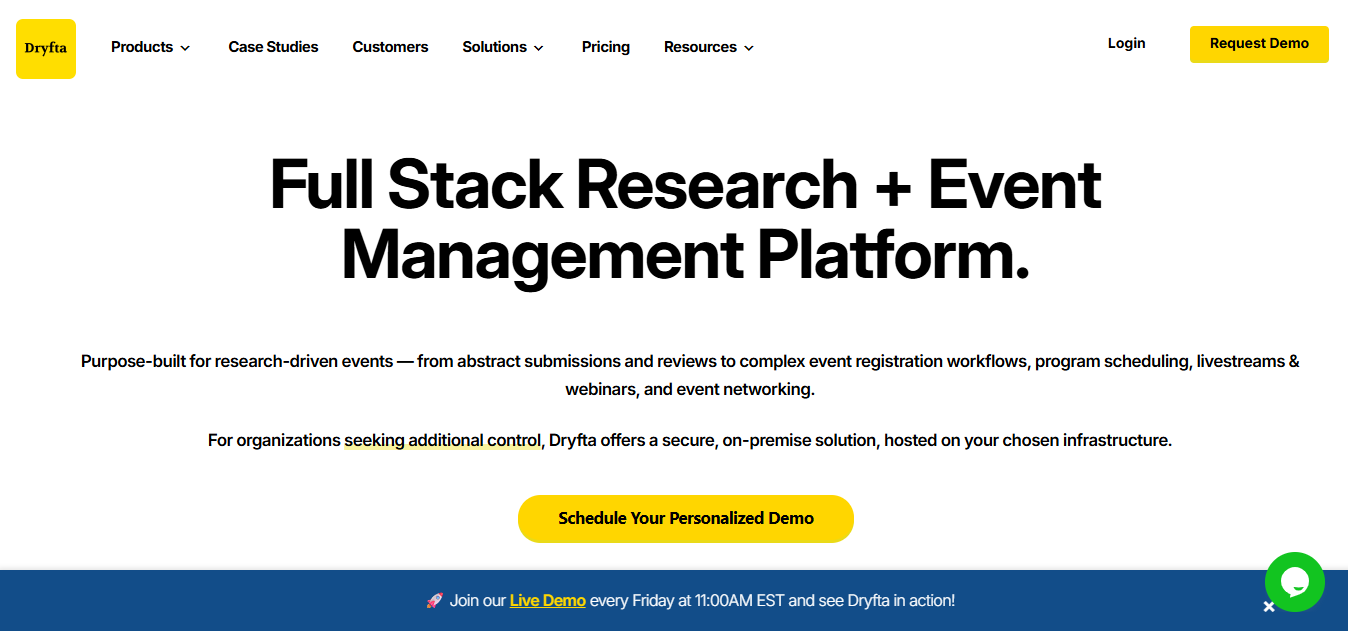
Dryfta is an innovative all-in-one academic event platform. It offers a seamless hybrid academic conference experience. It provides innovative solutions that help organize virtual and hybrid academic conferences with online ticketing, abstract submissions, virtual meetings, pre-recorded videos, and event scheduling. The platform has an intuitive design with a user-friendly interface.
It also allows the conference organizers the freedom to choose the tools they require. There are several tools like abstract review workflows, mobile event app, interactive agenda builders, and virtual networking lounges that are tailored for and online attendees. It provides hybrid conference engagement tools that allow up to 500 interactive attendees per virtual session with up to 50 concurrent meetings. The attendees can join a live meeting via any modern web browser and interact through audio, video, and screen-sharing.
If you are an academic conference organizer, then you should have a good understanding of how every aspect of conducting a conference will work properly when they are all together. This can be really challenging if it is your first time, especially for hosting a hybrid academic conference.
Dryfta hybrid conference software will help you to get all the details you need. It gives key insights such as where the attendees spent most of their time and who the most popular sponsors are. The industries they work in, their interactions with speakers, and the questions they ask during live chats or video presentations. It consists of several innovative and customizable features that give information and excellent insights that are necessary for improving your hybrid academic conference.
vFairs

vFairs provides an excellent immersive event environment that creates customizable virtual venues, exhibition halls, and branded digital spaces. This helps the event attendees to interact virtually and physically with presenters and sponsors. It comes with great features, including registration, analytics, networking, and engagement tools. It is best suited for events that want to engage their virtual attendees.
vFairs offers a bunch of packages with add-on features to build a hybrid event platform. The event organizers can also pick and choose the features they need for a hybrid event within their budget. You can design and manage your hybrid event with a seamless virtual and in-person integration. It also supports gamification elements such as badge earning, scavenger hunts, and leaderboard incentives. These are helpful to increase attendees’ interest and participation. It also makes the attendees dive deeper into content exploration and gain more knowledge.
Oxford Abstracts

Oxford Abstracts has been providing academic conference management software for over 20 years. It consists of an intuitive design and delivers an outstanding conference, alongside creating your own website to host it on, with your academic conference at the core. It provides all the tools the event organizers require to host a conference (in-person/hybrid or virtual) in one place.
The event organizers can use this software to automate reminders and enable author dashboards for edits. The system also provides tools to integrate ticketing for hybrid itineraries with session bookmarks and feedback. It fits well for any size and setup of a hybrid event, handling complex peer processes effortlessly.
It excels majorly at scholarly content workflows. However, event organizers who are planning a hybrid conference must integrate their platform with external systems for live streaming, attendee engagement, social networking, and sponsor interactions.
OpenWater

OpenWater combines abstract and paper submission workflows with peer review management, scholarship evaluation, award nominations, and grant review processes. It is considered a versatile choice for hybrid academic conferences with multiple evaluation needs. However, this platform may present a learning curve for academic conference organizers who are not aware of configurable logic, advanced reviewer settings, and custom form design.
Setting up OpenWater requires a thoughtful approach to match academic conference goals. This platform is best suited for hosting awards programs, fellowships, scholarships, and grants. It offers features that can be used in a hybrid mode, such as recreating the exhibition hall by designing a virtual version, complete with virtual exhibitor booths. This is useful to make the virtual or hybrid event fun and productive for whoever is involved.
EventsAir
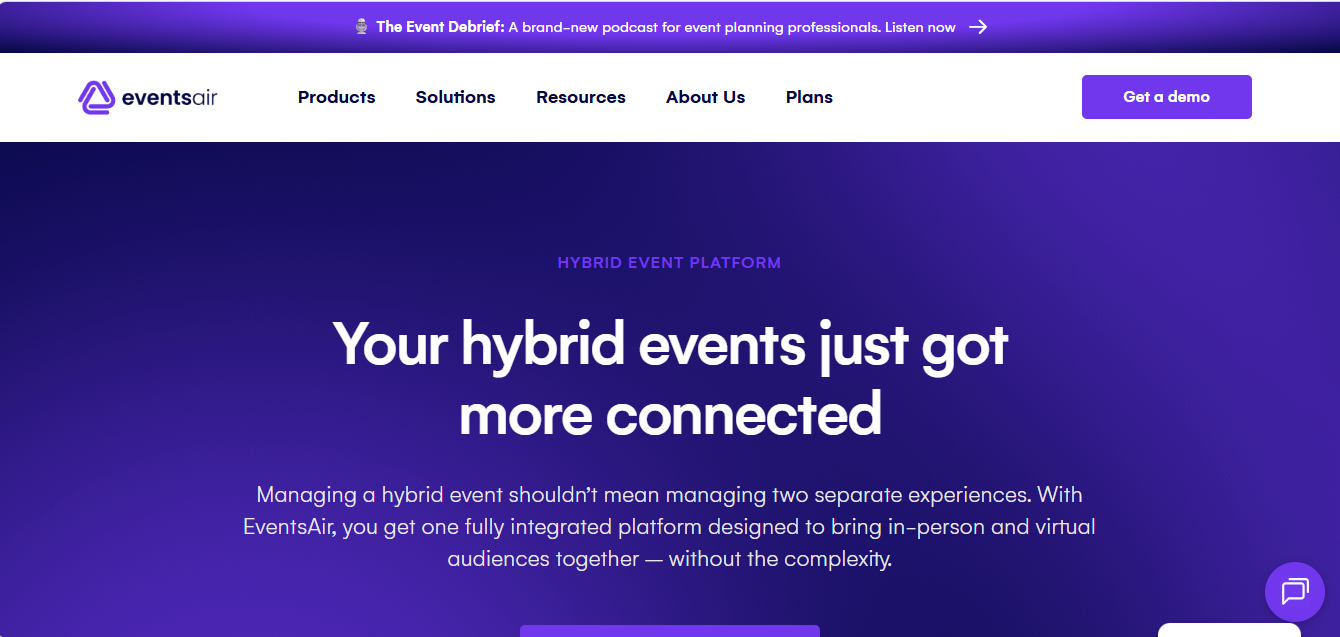
EventsAir offers one fully integrated platform designed to bring in-person and virtual audiences together without any complexity. This platform manages the hybrid event so flexibly that the event organizers don’t feel that they are handling two separate experiences. It tackles the unique challenges and removes the friction that hybrid events face, such as balancing two audiences, ensuring better engagement, and managing both onsite and remote logistics.
EventsAir helps plan, produce, and deliver and truly memorable connected hybrid experience. The event organizers who are seeking opportunities to drive real results can use this platform because it focuses on delivering measurable success every time in hybrid events.
It offers hybrid-ready streaming tools that help manage live sessions and control multiple camera feeds and audio sources. It also offers features to use synchronized pre-recorded content sessions to simulate a live experience with real-time engagement and on-demand access, so attendees can revisit content and real-time interactions effortlessly.
Best Hybrid Event Platforms by Use Case
Not every platform is built for the same kind of event. Some work better for universities, while others are a better fit for large associations or medical conferences. Here’s a quick guide to help you choose the right platform for your hybrid academic conference.
Universities
Dryfta – Built specifically for universities managing a hybrid academic conference, with abstract management, peer review, registration, scheduling, and a conference website in one platform.
Scientific Conferences
Dryfta – Ideal for research-focused conferences with complete abstract and reviewer workflows.
Oxford Abstracts – A good choice for abstract submissions and academic review.
EventsAir – Suitable for large scientific conferences with hybrid event features.
Medical Events
Dryfta – Great for medical conferences that need structured submissions, peer review, registration, and session management.
OpenWater – Useful for medical societies managing submissions and speaker information.
EventsAir – Supports complex medical meetings with virtual and in-person attendees.
Associations
vFairs – Well suited for association events with strong virtual and hybrid experiences.
OpenWater – Helps associations manage memberships, awards, and conference submissions.
EventsAir – A flexible option for large association conferences.
Professional Education
vFairs – Good for training events and online learning sessions.
EventsAir – Supports continuing education events with hybrid features.
Research Symposiums
Dryfta – A strong choice for small and mid-sized research symposiums with complete hybrid academic conference management.
Oxford Abstracts – Great when the main focus is abstract collection and peer review.
OpenWater – Suitable for symposiums with submission and review requirements.
Why Universities and Research Organizations Choose Dryfta?
Universities and research organizations have a lot riding on every conference. They need a platform that is easy to manage and built around the way academic events actually work.
That’s why many of them choose Dryfta.
It gives organizers the flexibility to set up their conference the way they want. Whether it’s a small departmental symposium or a large hybrid academic conference, Dryfta can be adapted to match different event types.
Managing hundreds or even thousands of participants also becomes much easier. Organizers can keep track of submissions, communicate with different groups, monitor progress, and access reports from a single dashboard. It helps teams stay organized without spending hours on manual follow-ups.
Dryfta also grows with your event.
You can start with the features you need today and expand as your conference becomes larger or more complex. That makes it a practical choice for institutions that organize a hybrid academic conference every year or host multiple academic events throughout the year.
How to Choose the Right Hybrid Event Platform?
The hybrid event solutions market has grown rapidly, especially post-COVID-19 pandemic. It is important to understand which platform truly meets your requirements. Choosing the best hybrid academic conference software requires considering the following factors:
Ease of Use
The hybrid academic conference software must be intuitive and require very minimal prior knowledge, for both event organizers and attendees. If there is a poor user experience, then it results in attendees being dissatisfied, lower engagement, and high drop-off rates.
Data Privacy and Security
Protecting the data related to attendees, speakers, volunteers, and staff members is very important. The onus is on the conference organizer. Choose a hybrid academic conference software that is transparent about what data is collected and how it is processed. It is also equally essential to know where the data is being stored (for example, server location). The hybrid software should also provide end-to-end encryption and password protection.
Cost Effectiveness
The conference organizers must look for a hybrid software that provides various pricing options, such as according to package, custom pricing, and more.
Size of the Conference
Global academic conferences need better scalable functionality to handle the large number of attendees. This can be achieved by using hybrid software that easily hosts conferences irrespective of their size.
Customizable Design with Interactive Features
Every conference is different and has its own requirements. In hybrid conferences, ensuring participants stay actively engaged, mainly for longer hours, is one of the biggest challenges. Choose a good hybrid software that allows customization of both design and functionality and works really well by emulating interactive features like polls, chats, and gamification elements. All these aspects will draw the attention of the participants and turn the hybrid conference into a memorable experience.
Software and System Integrations
A hybrid platform should not only be extendable with third-party tools. It should also integrate well into the organization’s existing software, systems, and workflows. This interoperability is quite essential to embedding the conference seamlessly into the greater marketing as well as communication strategy.
Networking Expertise
Networking is often one of the most exciting aspects of any academic conference. In a hybrid atmosphere, it’s crucial that both in-person and remote participants can network freely. The conference organizers must select a hybrid software solution that well-aligns with the team’s comfort level and consists of smart matchmaking features. These attributes are useful to connect people depending on shared interests, subjects, and profiles. If there are breakout rooms and private chat spaces, then it can add a useful layer that encourages meaningful conversations.
Common Hybrid Conference Challenges
Running a hybrid conference means thinking beyond the venue. You need to create a seamless experience for attendees in the room and those joining remotely, which takes the right planning and the right tools.
Here are some of the most common ones organizers face:
- Keeping both in-person and virtual attendees equally engaged so nobody feels left out.
- Managing registrations for different attendee types while making the registration process simple for everyone.
- Coordinating speakers who are presenting from different locations and time zones.
- Handling last-minute schedule changes and making sure updates reach attendees without delay.
- Running abstract submissions and peer reviews while also managing the many moving parts of the conference.
- Bringing together multiple tools for registrations, websites, emails, virtual sessions, and communication.
- Making networking feel natural for online attendees, even when they can’t meet people face to face.
- Providing quick support when attendees have technical issues or questions during the event.
- Tracking session engagement across both virtual and in-person audiences to understand what worked well after the conference ends.
The Bottom Line
Choosing Dryfta means choosing to work with a simple, organized, yet well-structured, user-friendly interface. This platform is an all-in-one hybrid academic conference platform. It is the perfect choice for the event organizers who are looking for a software solution that understands the participants’ needs, meets the sponsors’ expectations, and prioritizes engagement and scalability. This platform promises to deliver the best hybrid academic conference experience without getting compromised on quality.