


The double-blind review is a process that is used in academic conferences. In this style of review process, the identities of the author and the reviewer are hidden. If the author’s identity is not visible to the reviewer, it helps to prevent the reviewer from creating any partiality or bias. According to a study conducted by the Publishing Research Consortium (PRC), 71% of respondents said the double-blind abstract review process is highly effective.
For example, Reviewer gets to see: Paper #ABC.
Similarly, the author gets to see: Reviewer 123 (anonymous comments)
In this blog, let’s get a clear understanding of the most popular and widely recognized abstract review model: Double-Blind. Know its purpose, advantages, disadvantages, importance and best practices for organizers.
Purpose of Double-Blind Review
The main purpose of a double-blind review is to guarantee that research published is of high standards. It serves as the foundation of all respectable scholarly papers and is a reliable review model at the heart of successful academic publishing. The reviewers carefully evaluate all the paper submissions. At the initial stage, all papers are carefully evaluated by the reviewers. Though sometimes the greatest work will not get accepted and will be rejected.
It is important to fulfill the basic needs so that the evaluation process can be carried out smoothly. Usually, works of authors get rejected if the basic criteria and prerequisites aren’t met. They get notified about the status of their submissions that got rejected or will be given recommendations for resubmissions. Without going through the basic review process, papers that have plagiarism or high technical errors get rejected. Papers that do not fall within the scope of the academic conference may also get rejected at this level.
The author will get an update related to the acceptance of their work, such as, whether it is accepted or rejected. They will also get details if there are any kind of recommendations from the reviewers, which may consists of comments from the editorial team. The authors will also be given a chance to appeal a double-blind review decision. They can contact the respective team and discuss their issue. These appeals will only be considered if the reviews were inadequate or unfair. In this case, the paper will be given to new reviewers by hiding all the details related to the authors and previous reviews.
Adherence to Double-Blind Review
The academic conference’s organizing committee must carefully adhere to the double-blind abstract review process. They should not disclose the details of the author or the reviewer. They should give clear guidelines related to the comments from reviewers. The authority should be with the editorial team to make the final decision when it comes to publishing a paper; based on this, the corresponding author will be notified.
If there are any changes, the corresponding author must send an orderly response to reviewers’ comments, and a revised version of the abstract must be submitted. The abstract will only be accepted for publishing once it has been approved by the reviewers. The abstracts will be thoroughly checked for grammar, punctuation, print style, and format if they get accepted. Page proofs will be given to the appropriate author and are required to be returned within the given time.
During the abstract submission and review process, the corresponding author or designated coauthor (if there is more than one author) will be considered as the main point of contact. This is decided by the editorial team on behalf of all the co-authors.
What the Research Actually Shows About Double-Blind Review
Having discussed the double-blind review briefly, it is safe to say that what we’ve scratched is just the surface. Double-blind peer review has much more nuance and potential to it that the contemporary research space is still exploring. In this section, we’re helping further substantiate this research that spans into disciplines such as computer science, medicine, and linguistics, among others.
WSDM (Web Search and Data Mining) 2017 Conference
As an instance, let’s take a look at WSDM (Web Search and Data Mining)’s 2017 program committee. The peer review model that this particular edition of the annual academic conference uses. The peer review design particularly stands out for the following reasons:
- Each paper submitted for review was received by four experts in the field. Two peer reviewers, employing a single-blind review method, could see the name of the author. The remaining two authors, as part of a double-blind review model, were barred from doing so, ensuring complete anonymity.
So what did the organizing discover by the end of this split peer review model? What were the results?
- Reviewers who saw author information turned out to be 1.76 times more likely to recommend accepting a paper written by a famous author.
- Additionally, they were also 1.67 times more likely to do the same when a paper originated at a top institution.
6th International Conference on Learning Representations (ICLR 2018)
In 2018, during the 6th edition of its annual conference, ICLR decided to take the plunge and switch from a single-blind review process to a double-blind one. In doing so, the review process that year yielded some very interesting patterns.
After reviewing nearly 5,027 author submissions in a double-blind arrangement, scores for the most prestigious authors had dropped significantly.
This went on to show that once identities were dropped and names of universities and affiliations intentionally erased, the cumulative peer reviewer numbers were much lower than in the years before (when the conference was using a single-blind review model)
Interestingly, it was also found that those papers rejected under double-blind review went on to earn fewer citations than papers rejected under single-blind review.
This suggests the newer system was better at separating weak submissions and merely unfamous ones, rather than simply pulling every score toward the middle.
2016 JAMA study by Okike et al.
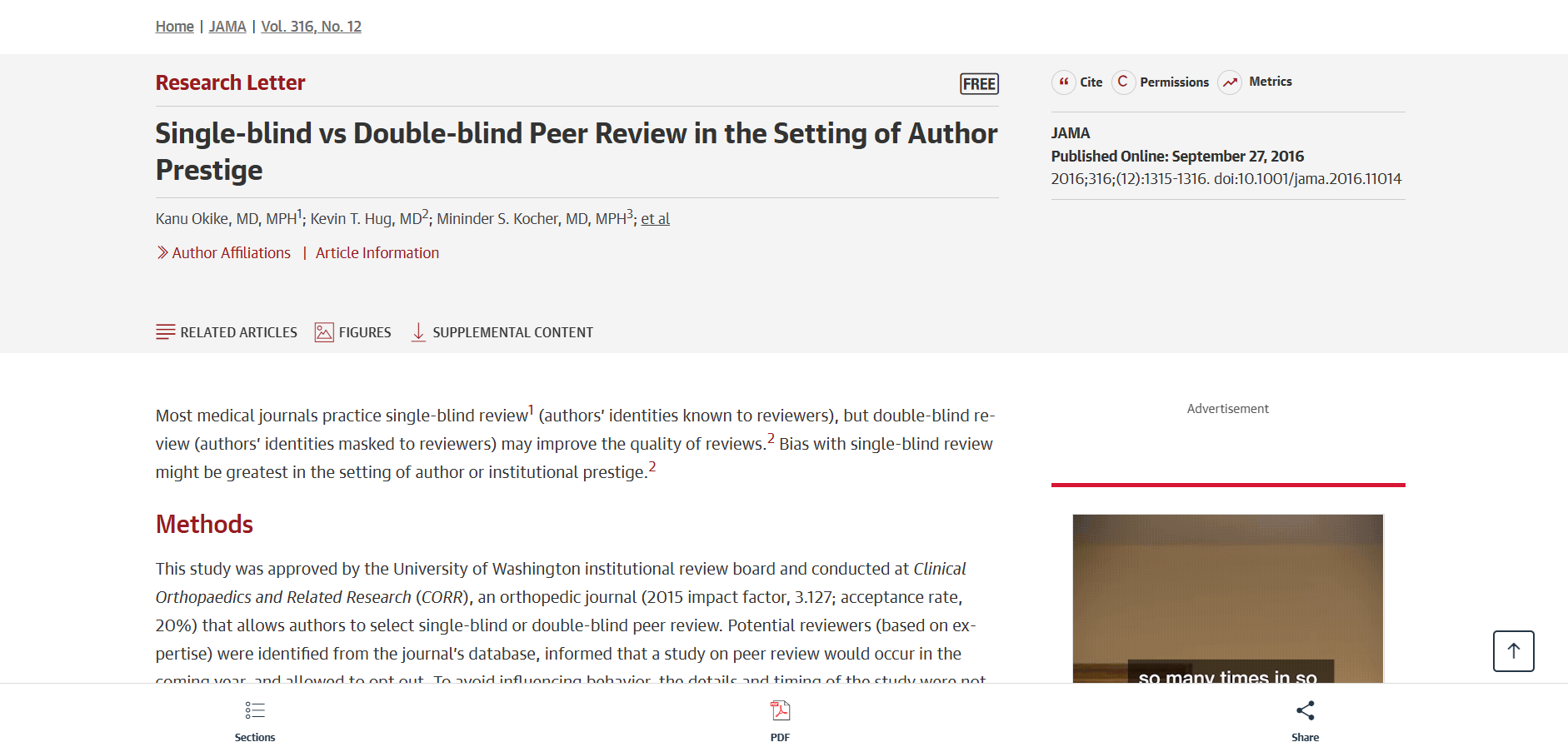
Researchers attempting to study the magnitude and impact of reviewer bias in academic conferences in this 2016 study embarked on a whole new ball game altogether.
- Okike et al. built a fabricated manuscript containing 5 deliberate errors and also listed two past presidents of a major orthopedic surgery association as its authors.
- Following this, the paper was sent to 119 reviewers under randomly assigned single- or double-blind conditions. The results argued a compelling case, that author-prestige bias is real. And that the name of an author and his/her affiliation holds much more significance in swaying peer review scores than research has previously picked up.
This experimental endeavor, in particular, came out with the following results:
- 87% of reviewers recommended acceptance when the prestigious names stayed visible.
- This figure dropped to 68% once the names had disappeared.
Reviewers in both groups caught the same number of planted errors regardless of which condition they were assigned. The manuscript itself never changed, only the recommendation did.
Other Factors at Play in Double-Blind Review
Gender is a factor that produced an equally sharp result in a separate 3-year study of a language-evolution conference. It was found that:
- Papers with a male first author scored 19% higher whenever reviewers could see author identities.
- Papers with a female first author scored 4% lower under those same visible conditions.
This gap that the researchers picked up on appeared to narrow considerably once single-blind review was replaced with double-blind review, removing traces of author names and affiliations.
Not every useful policy needs to be mandatory either and this 2022 study makes that point clearly. Researchers examined a journal policy that merely encouraged authors to anonymize their own work rather than requiring it, and even that modest option increased positive reviews by 2.4 percent for authors at less prestigious institutions. Acceptance climbed 5.6 percent for that same group. Both numbers dipped slightly for authors at more prestigious institutions, so a voluntary policy, adopted by only some authors, still pushed outcomes in a predictable direction.
The research cases we’ve gone over in this section and the previous do not essentially make anonymization foolproof. Studies measuring how often reviewers correctly guess an author’s identity despite anonymization confirm what researchers in small, specialized fields already suspect.
A paper’s methodology, dataset, or writing style can act like a fingerprint, giving reviewers cues about the author even when stripped of any personal identification.
Double-blind review, however, can and has lowered reviewer bias considerably. But what it has not cracked just yet is how to erase recognition altogether. If you are a program committee weighing this option, this is a consideration worth looking into. Before we switch from single-blind review to double-blind review, gauge if it solves your conference’s biggest grievances relating to peer review. If it doesn’t, consider exploring methods like triple-blind review, which afford far more weight to anonymization than double-blind review can.
Advantages of Double-Blind Review
The double-blind review is mainly used as part of academic publishing, with an aim to eliminate bias in the review process. Many researchers taking part in conferences are always in favor of double-blind peer review and consider it positive. Some of its advantages include:
-
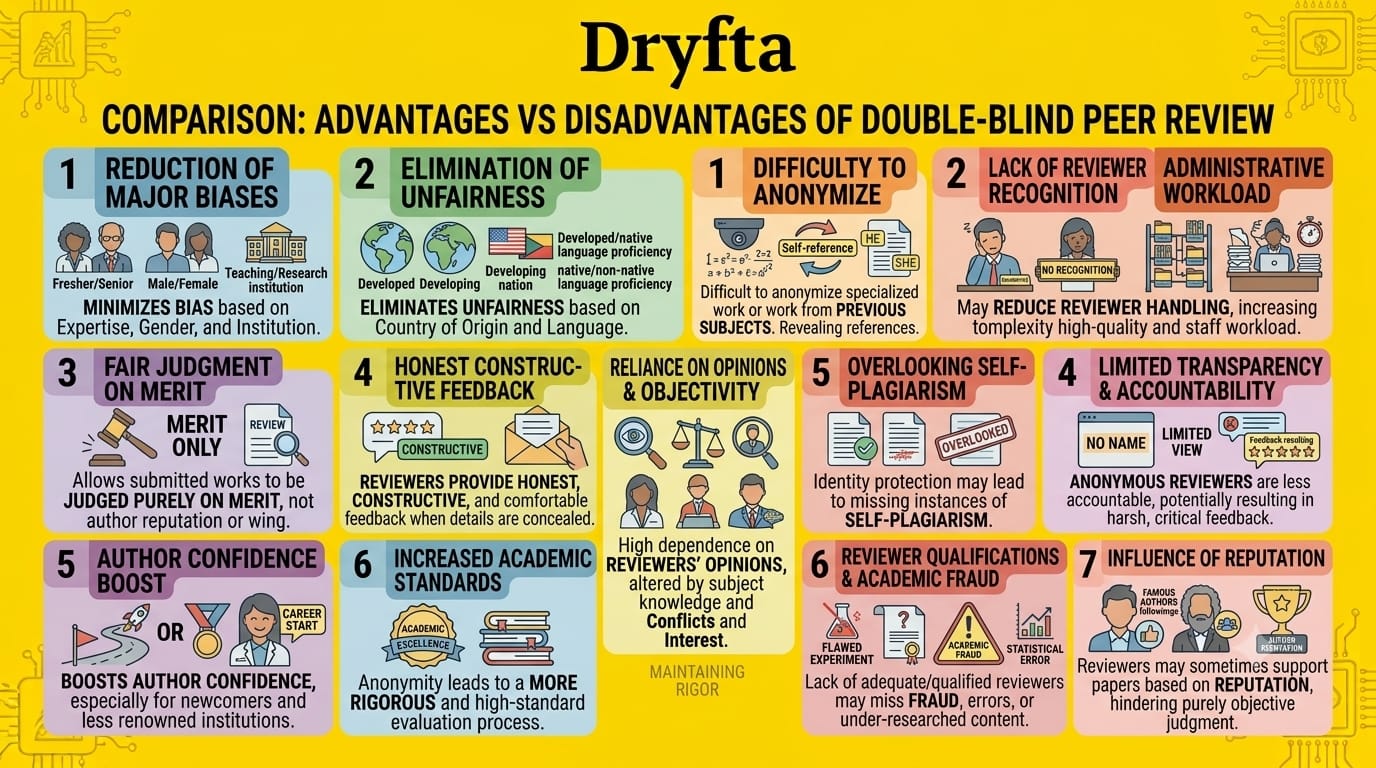
- Double-blind review minimizes the potential for partiality and bias depending on the author’s expertise (fresher vs. senior and novice vs. expert), gender (male vs. female), and institution (teaching-intensive vs. research-intensive).
- It also eliminates the unfairness that happens based on country of origin (developed vs. developing/underdeveloped), language proficiency (native English speakers vs. non-native speakers)
- It decreases the chances for favoritism on the basis of research wing (well-established vs. unrecognized), income (high vs. middle/low), nationality (author’s vs. reviewer’s), religion, and/or any type of political identity.
- Reduction of bias is crucial because it allows the submitted works to be judged based purely on merit rather than the author’s background. Additionally, it hinders the reviewers from being influenced by the author’s reputation.
- Reviewers will usually give more honest, comfortable, and constructive feedback when the author’s details are concealed, leading to an increased fairness in the review process.
- Authors’ confidence boosts when their work gets evaluated based only on its content, especially if they have just started their careers or come from less renowned institutions. Their work gets evaluated without any preconceived notions.
- Anonymity plays a crucial role in the double-blind review. It levels up the academic conference standards. This leads to a more rigorous evaluation process.
Disadvantages of Double-Blind Review
The double-blind review is not completely blind. It is simple to make an informed estimation as to the author’s identity when research areas are limited. An author may self-reference from earlier writing when attempting to make a point in their research. In certain instances, the author’s details are clear. An author would need to exclude any references related to them and their work in the abstract to guarantee that it is totally blind. This could damage the research in the paper. A closer look at the key disadvantages:
-
- In some areas, it gets difficult to anonymize a paper from end to end. For instance, if the work is specialized or if the authors have previously published on the same subject. Moreover, reviewers can also make assumptions about the authors based on their writing styles, content, certain methodologies, self-citations, and references. These aspects can easily reveal the authors’ identities to the well-experienced reviewers.
- Reviewers do not get enough recognition for their work. This might reduce their morale to actively engage in the review process as well as to provide high-quality reviews.
- Implementing a double-blind review system requires careful handling of research papers to maintain anonymity. This process is time-consuming and increases the workload and complexity for administrative and editorial staff.
- Here, reviewers are anonymous, so there is limited transparency, and they are less accountable for the quality and constructiveness of their reviews. This potentially results in being unfair, giving harsh or more critical feedback.
- Due to the identity protection, reviewers sometimes miss important aspects to recognize the instances of self-plagiarism, without knowledge of the authors.
- There is also a lack of an adequate number of reviewers or qualified reviewers. The reviewers may be unable to detect academic fraud, such as plagiarism, AI content, under-researched content, statistical, methodological, and interpretation shortcomings in the papers.
- Reviewers support papers depending on the author’s reputation rather than relying solely on the quality of the research
- This system is not a completely objective process because it highly depends on reviewers’ opinions. Those opinions might get altered based on several factors such as their knowledge related to the subject, level of expertise, their experience related to the topic of the paper. The opinions are sometimes influenced by previous judgements, any conflicts of interest, and many more attributes.
Who Actually Uses Double-Blind Review and Who Doesn’t
Computer science, machine learning and NLP conferences are among those predominantly using the double-blind peer review model. But researchers who sought to answer precisely this same question of who is most likely to use double-blind review as well as what is keeping some others from using it, discovered the existence of a certain kind of gap.
Researchers studying 128,454 manuscripts submitted to Nature-branded journals found that authors at less prestigious institutions chose double-blind review more often whenever journals offered it as an option rather than a requirement.
Only 12% of authors opted in overall, yet that small minority still skewed clearly toward researchers who stood to gain the most by hiding their institutional affiliation. What this goes on to show is that:
- Anonymity helps some researchers more than others.
- And the ones who gain the most tend to choose it. Whereas researchers from prestigious affiliations, who do better under visible review tend to decline it.
So, what can close in on this divide? The obvious answer here is to make anonymization in peer review as default rather than optional. The peer review process can benefit from being universal throughout.
How to Actually Anonymize a Submission: A Technical Checklist
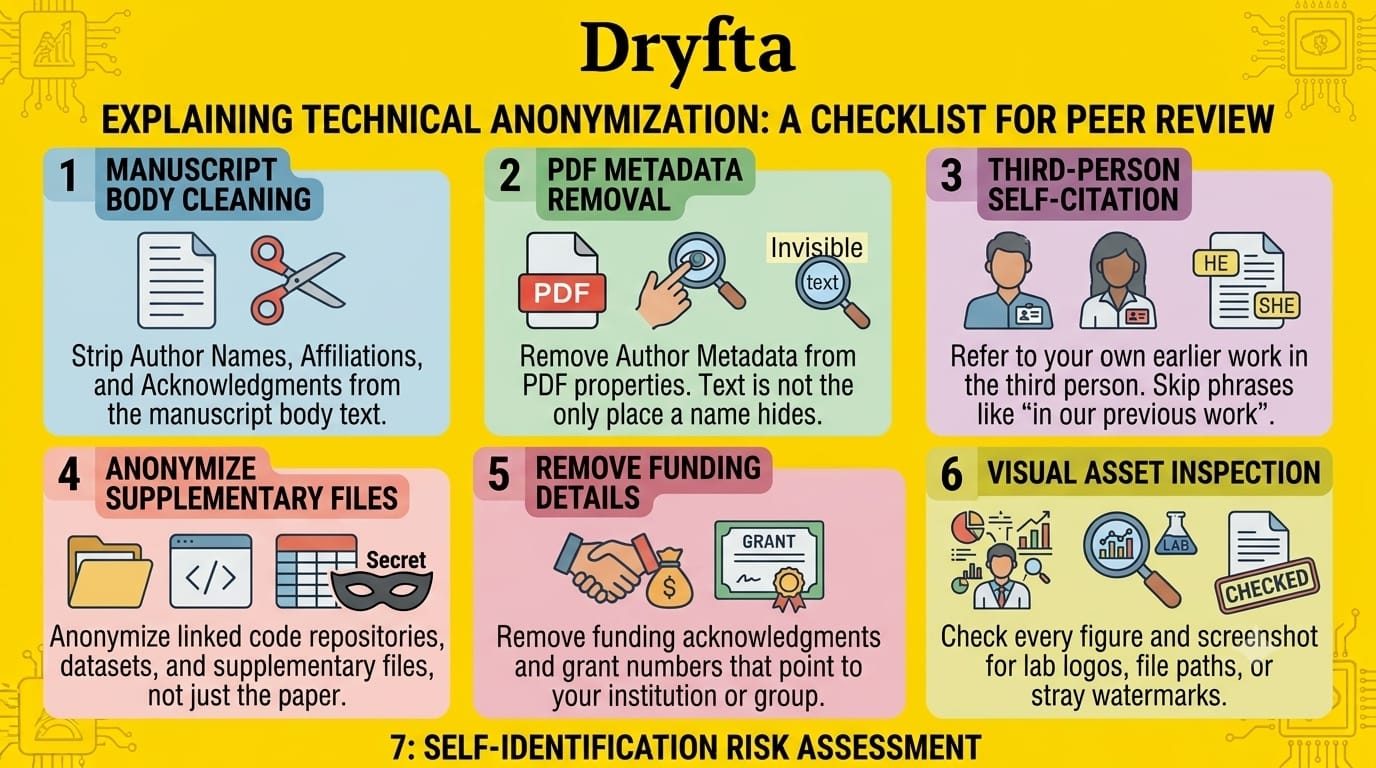
Speaking of anonymization, it looks and sounds simple until event planners get into the details. Call it evolution or simply reviewer smarts, experts can usually tell, even under double or single-blind review conditions, who wrote a particular paper and their level of expertise. So, what can event professionals do to make this even tougher for peer reviewers?
In this section, let’s work down a few items that can add some extra anonymization to your peer review drill. Tread carefully because all the information, it’s classified! Just kidding, getting right into it:
- Make sure to strip author names, affiliations, and acknowledgments out of the manuscript body
- Remove author metadata out of the PDF file properties, since visible text is rarely the only place a name hides.
- Refer to your own earlier work in the third person and skip phrases such as ‘in our previous work‘ that give the author away instantly.
- Anonymize linked code repositories, datasets and supplementary files and not merely the research paper itself.
- Remove funding acknowledgments and grant numbers that could point at your institution or research group.
- Check every figure and screenshot for identifying details such as a lab logo, a visible file path or even a stray watermark.
- Ask whether the specific method and dataset you’re using could lead you to identify yourself independent of any name or affiliation, especially if your field stays narrow.
Implementation of the Double-Blind Review Model
Thinking of using a double-blind review model is one, and applying it successfully is another. For an academic conference organizing committee, this process is all about thorough planning and using the right software that supports the double-blind review model. Dryfta is one of the best platforms that maintains anonymity, eliminates bias, ensures fairness, and improves overall workflow.
Guidance for Reviewers
The organizing committee must take full ownership to provide proper guidance to the reviewers. They must remind them about their role in the double-blind review process and offer them a set of clear and simple guidelines. The guidelines should consist of all the information related to what needs to be taken into consideration, such as content quality, being professional and actively engaging in editing, maintaining double-blind integrity.
The guidelines must also focus on what must be avoided, like compromising on anonymity, not focusing on the papers and not highlighting the loopholes in research. Reviewers must also advise on the important areas for expansion or reduction and avoid seeking ways to reveal the identity of authors.
Submission Instructions for Authors
Give explicit and clear submission instructions to the authors on the ways to anonymize their research paper submissions. Provide them with details that minimize their identification, such as names, affiliations, and self-referential statements. Give them information about their research papers’ overall structure and flow of content, acknowledgements, and eliminating or rephrasing content that creates a possibility to reveal their identity.
Give the authors all the essential guidelines that they must adhere to before submitting their papers, such as avoiding any kind of:
-
- Grammatical mistakes
- Placing incorrect punctuation
- Confusion in the usage of spellings and stylistic errors
- Following specific style guides, misspellings, formatting issues, typographical errors, and removing self-identifying details
- Carefully anonymizing self-citations, references, and acknowledgements
Role of the Chairperson
Based on the reviewers’ feedback and the revised papers, the chairperson should take responsibility for looking into the whole process. They should maintain the highest standards of academic integrity and fairness, especially in abstract distribution. They should also make final decisions based on anonymized reviews on whether to accept a submitted paper for further processing.
Single-Blind vs. Double-Blind vs. Triple-Blind vs. Open Review
There are only about 4 major peer reviewing mechanisms that dominate much of abstract management today. In this section, we’re placing them right alongside each other for a brief overview. The common thread running through all of them is anonymity and to what degree.
| Model | Author Identity | Reviewer Identity | Best For |
| Single-blind | Visible to reviewer | Hidden from author | Fields where reviewer expertise is narrow and identifiable regardless |
| Double-blind | Hidden from reviewer | Hidden from author | Most competitive academic conferences; the current default at top ML/NLP/CS venues |
| Triple-blind | Hidden from reviewer | Hidden from author and from area/programme chair | High-stakes review where even chair-level bias is a concern |
| Open review | Visible to reviewer | Visible to author (often published alongside the paper) | Venues prioritizing transparency and accountability over anonymity (expanding at journals like eLife, F1000Research) |
How Dryfta Supports Double-Blind Review
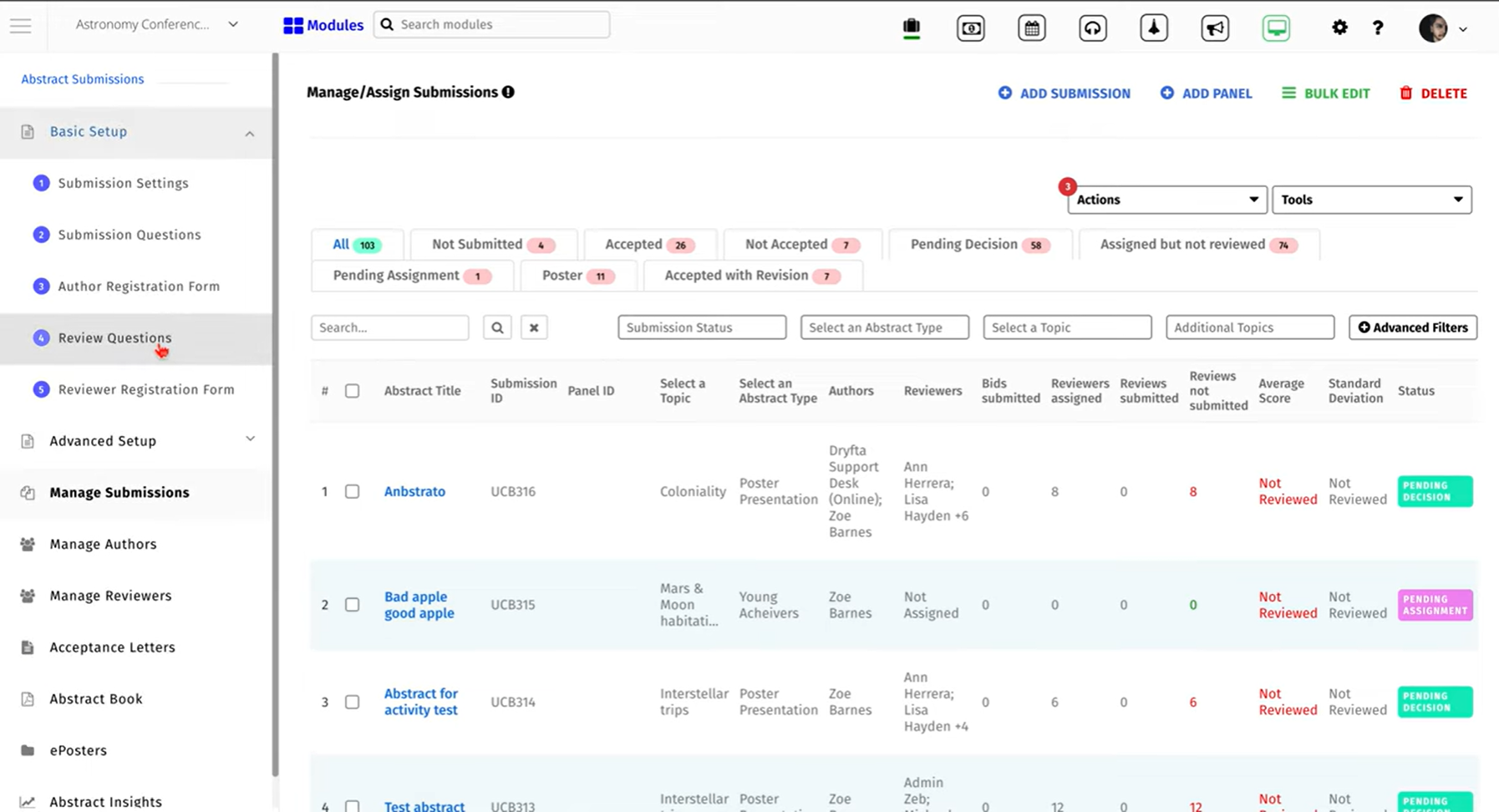
Modern event management software tools like Dryfta are innovating with the double-blind review method in stunning new ways. Powered by artificial intelligence and the human intellect, all-in-one-event management tools like Dryfta, are changing the peer reviewing space altogether. Keeping both human novelty and the current limitations of AI in mind, Dryfta’s abstract management system (AMS) offers the following features in peer reviewer assignment and anonymity.
- Configurable blind review settings: Committees can turn on configurable blind review settings and choose among single-blind, double-blind, and open review for each track, or even for each submission type inside one conference, instead of forcing one policy onto an entire event whose subject areas may need different approaches.
- Automated conflict-of-interest detection at assignment: This kind of conflict detection runs the moment reviewers get assigned, catching the same shared employment and recent co-authorship conflicts a manual process tends to miss once submission counts climb into the hundreds. No conflicted reviewer ever receives a paper to evaluate under this kind of setup.
- Consistent anonymization applied at the platform level: Every submission gets identical treatment because anonymization runs at the platform level instead of depending on each author’s personal diligence. Names, affiliations, and file metadata all get handled the same way every time, closing the exact gap a checklist alone cannot guarantee, namely, the distance between knowing what needs removing and actually removing every piece of it under time pressure.
- A single system for the full review lifecycle: One single system carries the whole review cycle, covering submission, assignment, review, decision, and notification, without a break in between. Nothing passes between a submission tool, a spreadsheet, and a separate manual anonymization step that somebody has to run by hand. That continuity is what makes consistent anonymization achievable across hundreds or thousands of submissions rather than just a handful, and it is exactly the kind of infrastructure decision that determines whether fairness stays a stated goal or becomes an actual outcome.
Bias in peer review will never disappear completely, regardless of which model a program committee chooses to run. To further augment your peer review efforts, sign up for a free demo with Dryfta today. Watch us in action every Friday! This Friday might as well change the way your event committee looks at double-blind peer review or event management altogether. No commitments, no hidden costs. Try a free demonstration today.
To Sum Up
The double-blind review model is useful to preserve the integrity of academic publishing by ensuring that the submitted papers are solely judged based on their content. It strives to promote fairness and objectivity in each scholarly evaluation. Though it has its own challenges, it still balances the benefits of reducing the overall bias. However, maintaining the end-to-end anonymity can be tough, and the administrative requirements of the process are quite high.
For authors, double-blind offers a great platform to showcase their research work and get reviewed without any influence of personal or institutional biases. This review model explores the most effective ways of evaluation, with its practical implementation obstacles that need to be focused on.
The academic conferences provide a vast scope for continuous and quality research work. An author should ensure that their submitted papers are free of identifying any kind of details, well-organized, and professionally polished. This will not just protect the integrity of the whole review process but also boost the overall quality and impact of the work and raise the bar of the academic conference.
Frequently Asked Questions (FAQs)
Is double-blind review actually fairer than single-blind review?
In theory, yes. Since double-blind review levels anonymity for both reviewers and authors alike, the peer review is likely to be much more bias-free in comparison to single-blind. However, in practicality, double-blind review also comes with its own challenges in execution. Automated and software-based tools like Dryfta are helping make the double-blind process much more rigid and tougher to crack for reviewers. When employed manually, mistakes can be bound to crop up. If a team member forgets to strip a manuscript of cues relating to institutional affiliation anywhere in its content, the peer review process could be compromised altogether.
Do I need to remove all self-citations from my submission?
No, authors are not mandated to remove all self-citations from their manuscript. Instead of citing your previous work in first-person, authors are encouraged to cite in third-person so as to conceal their identity. Some experts advise avoiding self-citations altogether. However, the majority verdict is that it should be approached cleverly, stripping it off any identifying markers that can point at an author’s name, institution or some other affiliation.
Can reviewers still figure out who wrote a double-blind submission?
Yes, it is certainly possible for skilled, expert reviewers to be able to put their finger on who turned in a given abstract despite it being bound by a double-blind review item. Reviewers are still able to extract some information about the identity of an author from things like a document’s metadata. Additionally, self-citations, when not inserted in the third person, can be a facile giveaway of an author’s identity.
Are all academic conferences double-blind?
No, not all academic conferences approach peer review in a double-blind arrangement. Some event organizers appear satisfied with single-blind review, which takes much less effort to set up and execute than a double-blind review. For other conferences needing much more nuanced peer review, something that is a lot tougher to crack even for expert reviewers is the triple-blind review method. Herein, the identities of all individuals involved in the peer review process- authors, reviewers and editors, are concealed from one another. In direct contrary to this is the open peer review model, wherein no identities are anonymized.
How does AI affect double-blind review in 2026?
Artificial intelligence is now being used by several conferences in supporting the peer review process. While there exist both proponents and critics of AI-backed peer reviewing in the research community, the role it occupies in the discipline today becomes undeniable. Some organizers are experimenting with AI peer reviewers with little to no human intervention. Others, denouncing AI as being incapable of picking up originality in research thought and perspective, have restricted it to strictly mechanical tasks like reviewer assignment.