If Hopin vs Eventbrite went to spare, who’d win? Would one platform be able to comfortably knock out the other and triumph on the event management performance ring? Or will both underperform only for a third, bigger, better and more sophisticated platform to take over?
The verdict here is nuanced. And here’s the thing: we may arrive with no clear winner. This is not a piece wherein we elevate one platform and subdue another. We’re simply putting the facts, key figures and user reviews in order for you to examine. We’re bringing it up, the ultimate and most comprehensive virtual event platform comparison of the year for you. It looks at what each platform does well, where each one falls short, and for which categories of organizers neither is appropriate at all. By the end of this article, you’ll find yourself resonating with either of the two alternatives. In case you don’t, well, we got your back then too. Want more Hopin alternatives? We got you. Need more Eventbrite alternatives? We got you too. Let’s get into what these platforms lack in actual functionality, backed by independent user reviews and our own analysis of their features.
What Is Hopin (Now RingCentral Events)?

According to LATKA, Hopin grew to $73.6 million in revenue in 2024, a stunning 5 years after its founding back in 2019. The popularity of hybrid event platforms during the platform proved to turn the tide toward the favor of Hopin, a firm just a year old at the time of the pandemic’s onset.
Hopin was acquired by RingCentral and rebranded as RingCentral Events in 2023. Despite this, the original name of Hopin continues to be used widely in reviews and organizer communities, often interchangeably with its successor. The platform’s core proposition is that of an all-in-one virtual venue with features such as a intuitive networking rooms and virtual expo booths for exhibitors in virtual trade shows. Where most video conferencing tools ask attendees to join a call, Hopin asks them to enter a space. This infrastructure is the differentiating feature. It attempts to recreate the texture of a physical conference rather than simply stream it.
The platform is built for marketing teams, enterprise event organizers and corporate conference planners who require a professional, branded experience and have the internal resources to configure it properly. In more recent iterations, Hopin has invested considerably in artificial intelligence capabilities. The AI Writer assists with generating speaker bios and session descriptions. AI Clips, as an addition, produces highlight reels from recorded content. Creator Lab allows event teams to repurpose sessions into short-form video.
What Is Eventbrite?
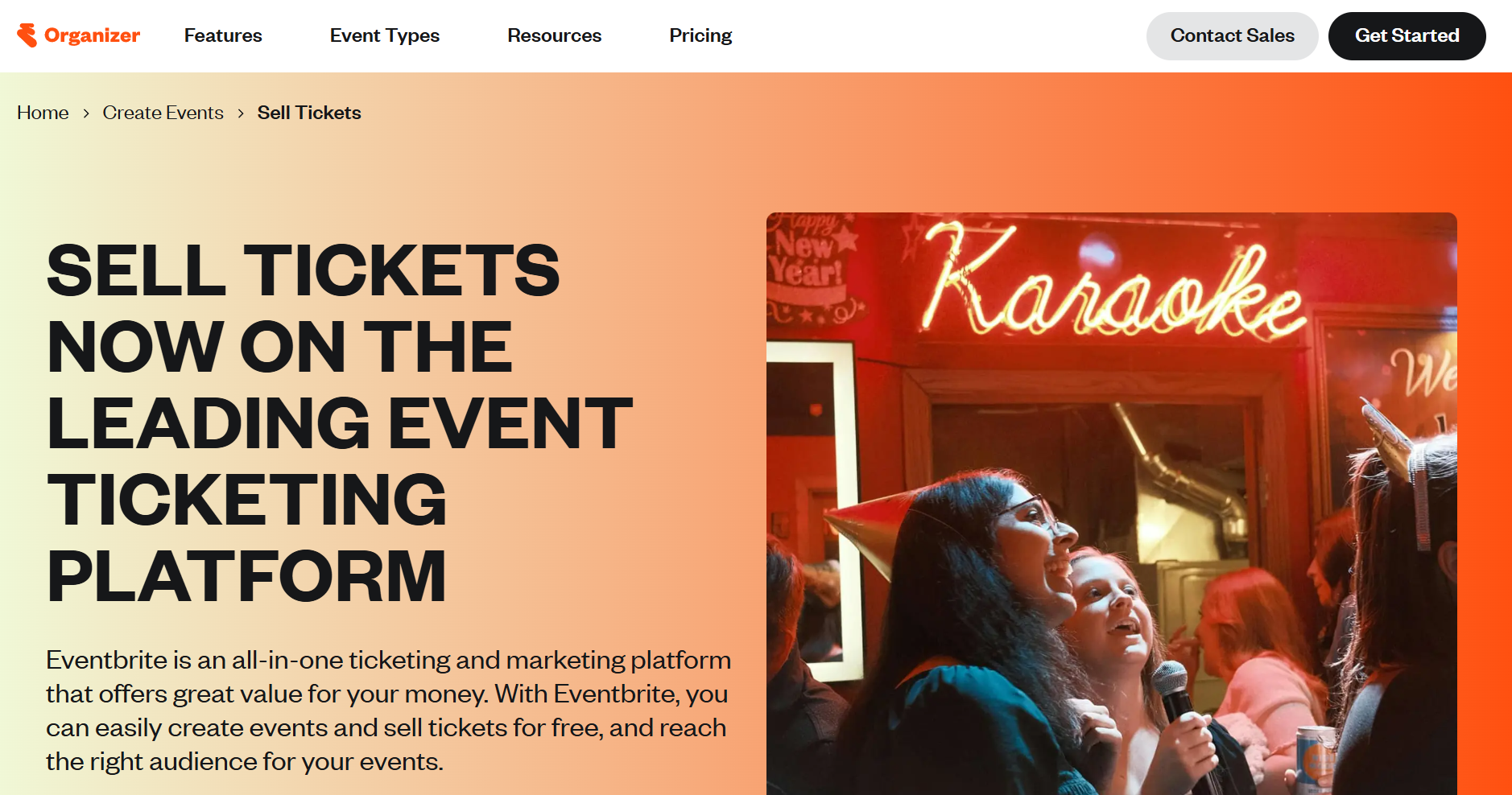
Eventbrite was founded in 2006 by Kevin and Julia Hartz, with the latter serving as the present CEO of the ticketing company. Eventbrite is one of the most widely recognized names in the event ticketing space. Its product is built around two things, a registration and payment infrastructure and a discovery marketplace.
The platform is built for community organizers, small and mid-sized businesses, workshop hosts, musicians and local venue operators who need a fast setup and are not equipped to handle sophisticated technical tasks. Eventbrite’s simple interface makes setting up an event easy and configurable in less than an hour. The platform’s social integrations, including TikTok, support organic promotion without requiring a separate marketing stack. Reserved seating, a mobile check-in application and straightforward ticket type management round out the core feature set.
Eventbrite is free for free events. For paid events, the platform charges a service fee of approximately 3.7 percent plus $1.79 per ticket, which the organizer can either absorb or pass on to buyers. There is no monthly subscription requirement, which removes financial risk for organizers who run events infrequently.
Hopin vs Eventbrite: Feature Comparison
In the below table, let’s delve into the key features of Hopin vs Eventbrite and establish the pros
| Feature | Hopin (RingCentral Events) | Eventbrite |
| Primary Use Case | Virtual & hybrid event hosting | Ticketing & event discovery |
| In-Person Event Support | Limited (hybrid tools available) | Strong |
| Virtual Venue | ✅ Full virtual venue (stages, booths, networking) | ❌ Basic streaming only |
| Event Discovery / Marketplace | ❌ No public event directory | ✅ Yes, 90M+ buyer network |
| Networking Tools | ✅ Speed networking, 1:1 video, breakout rooms | ❌ Limited |
| Abstract / Paper Management | ❌ Not available | ❌ Not available |
| Registration & Ticketing | ✅ Built-in | ✅ Core feature |
| Attendee Engagement | ✅ Polls, Q&A, chat, gamification | ✅ Basic (RSVP, reminders) |
| CRM Integrations | ✅ Salesforce, HubSpot, Marketo, Pardot | ✅ Mailchimp, HubSpot (basic) |
| Mobile App | ✅ Yes | ✅ Yes |
| White Labelling | ✅ Custom domains, branded venues | ❌ Limited |
| Analytics & Reporting | ✅ Advanced engagement analytics | ✅ Basic attendance tracking |
| AI Features | ✅ AI Writer, AI Clips, Creator Lab | ❌ None |
| Content Hub / On-Demand | ✅ Yes | ❌ No |
| Free Plan | ✅ Up to 100 attendees, 2-hour limit | ✅ Free for free events |
| G2 Rating | ⭐ 4.5/5 | ⭐ 4.4/5 |
Hopin vs Eventbrite: Pricing Compared
In this section, we’re laying bare the numbers involved in the Hopin vs Eventbrite discussion.
Which pricing model might br more economical in the longer run?
Does a small investment now compound as industry standards change in the future?
We’re answering all your burning questions. Read on to know the verdict. In this section, we’re laying bare the numbers involved in the Hopin vs Eventbrite discussion.
Which pricing model might br more economical in the longer run?
Does a small investment now compound as industry standards change in the future?
We’re answering all your burning questions. Read on to know the verdict.
Hopin / RingCentral Events Pricing
Hopin operates on a subscription model. Paid plans grant access to unlimited events and registrations within the tier. Commission on ticket sales applies on certain tiers, with things like Stripe processing fees being added separately.
- Free plan: The free plan supports up to 100 attendees and imposes a 2-hour event limit with basic analytics, which can suffice for basic, small events but fall short in most real-world use cases.
- Events Pro: The Events Pro tier begins at $99 per organizer per month and is billed annually
- Business tier: The Business tier is priced at $6,000 for a 3-month period and includes enterprise features, single sign-on and dedicated support
- Enterprise tier: Pricing for enterprise-size events is available only on a custom, quote basis. This plan offers over 40 integrations and a dedicated customer success manager who stays connected throughout for event assistance.
Eventbrite Pricing
Eventbrite’s structure is built around per-event fees rather than a monthly or annual commitment such as that of Hopin.
- Free plan: Free events incur no cost when registered on Eventbrite.
- Flex plan: The Flex plan begins at $9.99 per event and offers basic features for organizers.
- Pro plan: Priced at approximately $29.99 per event, the pro plan gives organizers access to unlimited ticket types, email marketing as well as exlcusive features like reserved seating.
- Fee structure: The per-ticket service fee of approximately 3.7 percent plus $1.79 applies to all paid ticket transactions.
Pricing Verdict
If you an organization or company running multiple events annually, a flat subscription fee model such as that of Hopin can be more economical in the long run. However, if you’re an event planner running an one-off event, are looking at advertising your event or are associated with the entertainment niche, Eventbrite is the verdict. Scrutinizing the financial implications of the choice, a per-event model removes the need to invest for the long-term. This can be a comparatively low-stakes investment for starters
Hopin vs Eventbrite: Pros and Cons
Hopin (RingCentral Events)
Pros:
- Hopin’s most defensible advantage is the depth of its virtual venue infrastructure. No comparable platform offers the same set of features including stages, breakout rooms, expo booths, networking tools or on-demand content under a single interface.
- Its CRM integrations span Salesforce, HubSpot, Marketo, Pardot and Eloqua, which positions it well for enterprise marketing teams that need event data to flow into existing systems.
- White-label options allow organizers to present a fully branded experience without Hopin’s identity appearing anywhere in the attendee-facing environment.
- The growing suite of AI features and a built-in on-demand Content Hub add post-event content value. Immersive virtual venue experience
Cons:
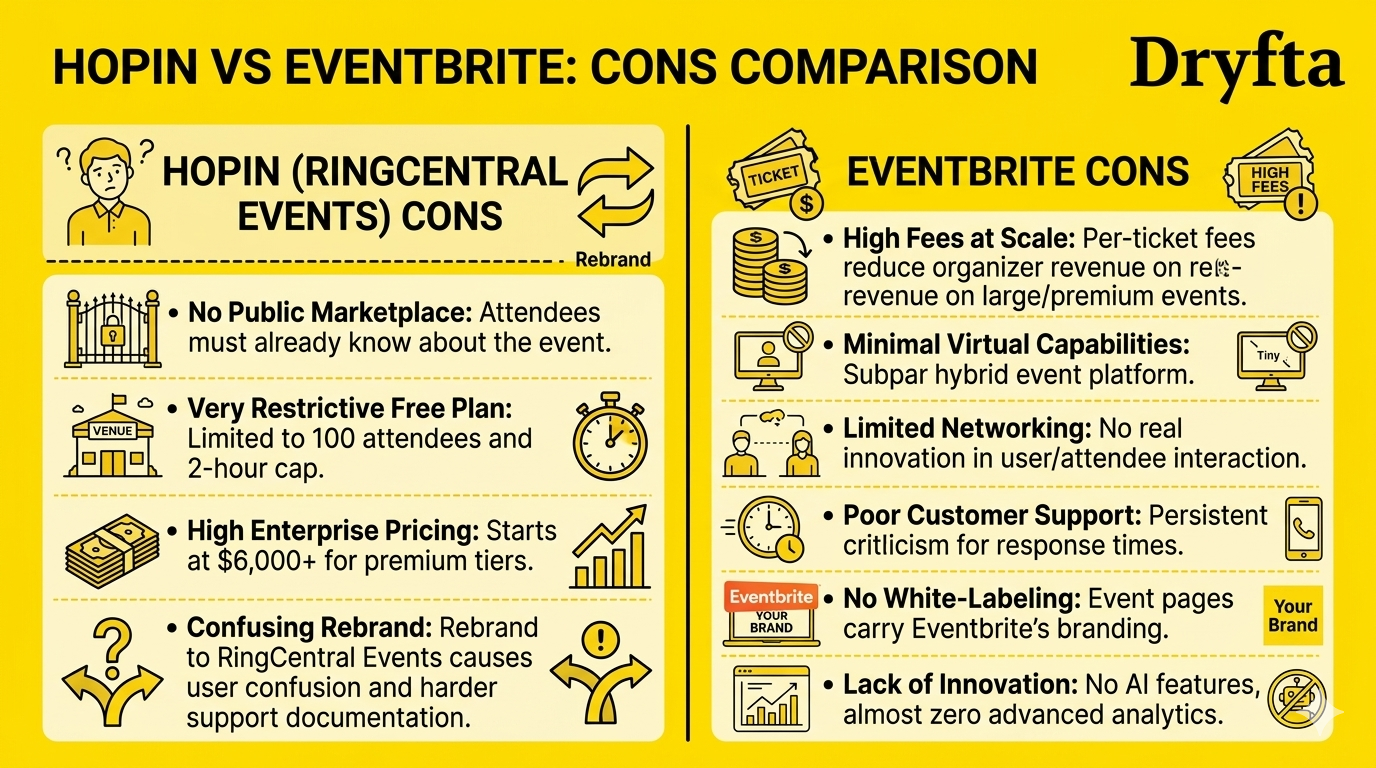
- The platform has no public event marketplace. This means that attendees must already know about an event to find it.
- The free plan’s limits of 100 attendees and a 2-hour cap are too restrictive for most legitimate use cases.
- Enterprise pricing at $6,000 or more for premium tiers places the platform out of reach for smaller, lower budget teams.
- The rebrand from Hopin to RingCentral Events has introduced confusion among existing users and has made navigating support documentation harder than it needs to be.
Eventbrite
Pros:
- The built-in discovery network of over 90 million active buyers is Eventbrite’s most significant asset.
- The setup process is fast and accessible and the technical set-up is fairly navigable for beginners.
- The pay-as-you-go structure means there is no financial commitment prior to an event taking place.
- In-person event management features such as reserved seating, door scanning and day-of check-in are well-developed.
- Social and TikTok integrations that are in-built within Eventbrite’s existing marketing workflow helps buyers start advertising from within the established user base rather than from zero.
- Eventbrite lets event posters publicize their free-entry events on the platform completely free of cost.
Cons:
- Per-ticket fees accumulate at scale in ways that reduce organizer revenue on large or premium-priced events.
- Virtual event capabilities offered by Eventbrite are minimal, making it a subpar option as a hybrid event platform.
- Eventbrite falls short when it comes to user and attendee networking. Beyond just attendee lists, the platform offers no real or innovative substance.
- Customer support has been the subject of persistent criticism for response times as per independent reviews on G2 and Capterra.
- There is no feature for white-labelling within the system. What this means is that virtually every event page will inevitably carry Eventbrite’s branding as a result, diminishing the host organization’s face and putting Eventbrite as the poster child.
- Pointing to a lack of updation and innovation on Eventbrite’s part, there are no AI features and almost zero advanced engagement analytics.
Who Should Choose Hopin?
Hopin is the appropriate choice for organizers who are running virtual or hybrid events where the experience itself is the primary product being delivered. This means events where attendees are expected to network, move between sessions, visit sponsor environments and leave with a sense of having participated rather than merely observed.
Who it is for: The platform is well-suited for enterprise marketing teams producing virtual summits or product launch events, corporate conference planners who need branded environments and deep CRM integration and B2B conference organizers who need robust post-event analytics. Organizations that are already invested in the RingCentral ecosystem will find the integration between products to be a meaningful operational advantage. Teams that intend to repurpose event recordings into ongoing content will benefit from Creator Lab and AI Clips in ways that other platforms presently cannot match. For events with attendee counts above 500 where networking infrastructure is a core deliverable, Hopin’s feature set is difficult to replicate. For smaller or infrequent events, it is likely more than what is needed.
Who Should Choose Eventbrite?
Eventbrite is the appropriate choice for organizers running in-person, ticketed events where the discovery marketplace represents genuine value. The platform’s 90 million active buyers are primarily seeking local and community events, live performances and in-person experiences. An organizer whose event fits that profile gains meaningful organic exposure simply by listing on the platform.
Who it is for: The platform is well-suited for community event organizers running local workshops, meetups or fitness classes, musicians and performers selling tickets to live shows, small businesses running paid courses or pop-up experiences and nonprofits running fundraising events where the setup needs to be fast and the cost minimal. Organizers who run events infrequently and do not wish to commit to a monthly subscription will find the pay-as-you-go model well-suited to their situation. Eventbrite performs best when the event is in-person, the audience is local or regional and the organizer’s promotional strategy benefits from marketplace visibility.
When Neither Platform Is the Right Fit
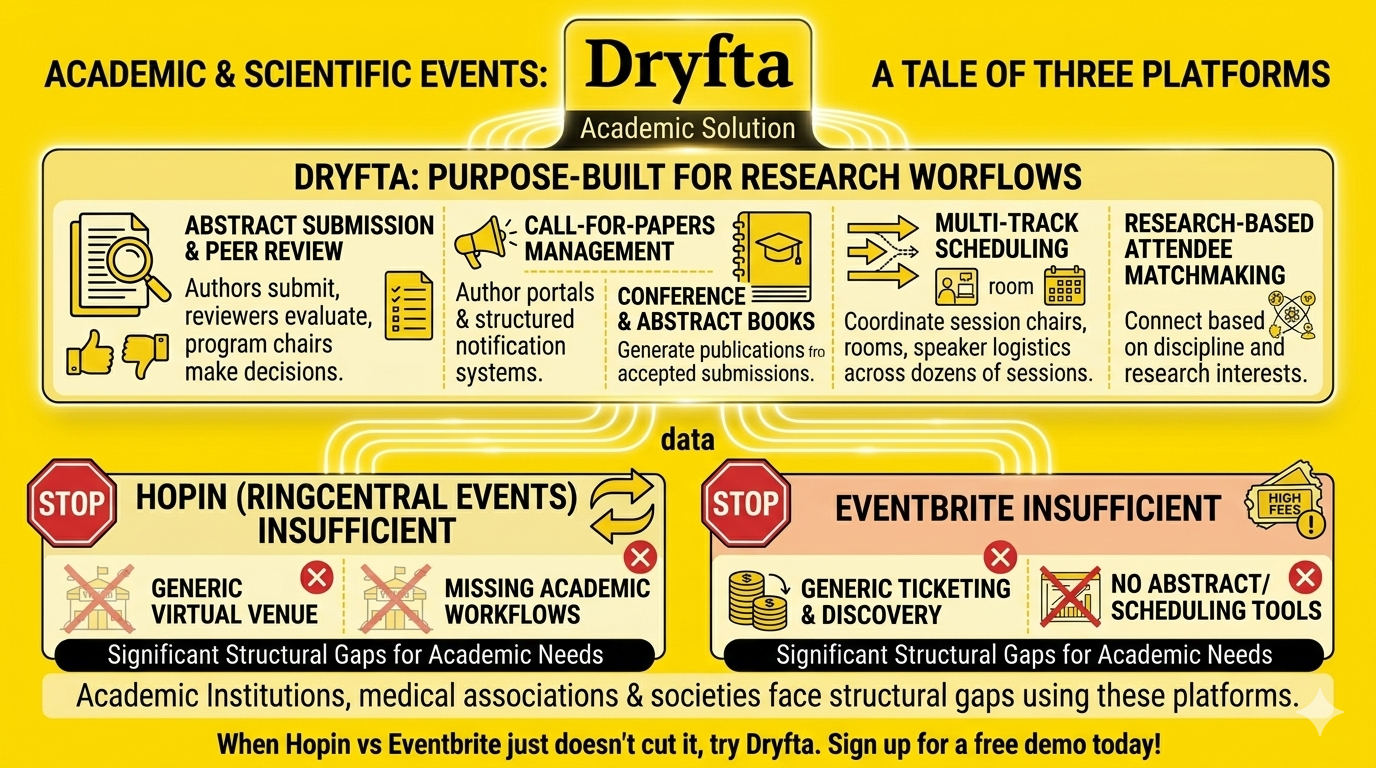
There is a category of events for which both Hopin and Eventbrite are functionally insufficient, and it is one that is often overlooked in platform comparisons. Academic conferences, scientific symposia and research-oriented events require operational infrastructure that neither platform offers at a competitive measure.
The workflows specific to this category, that are not efficiently covered by Hopin vs Eventbrite, include the following:
- Abstract submission and automated peer review, where authors submit papers and designated reviewers are assigned to evaluate them before program chairs make acceptance decisions.
- Call-for-papers management with author portals and structured notification systems.
- Generation of conference proceedings and abstract books from accepted submissions.
- Multi-track event management and scheduling wherein session chairs, room assignments and speaker logistics must be coordinated across potentially dozens of parallel sessions.
- Attendee matchmaking based on research interests or academic discipline rather than professional role.
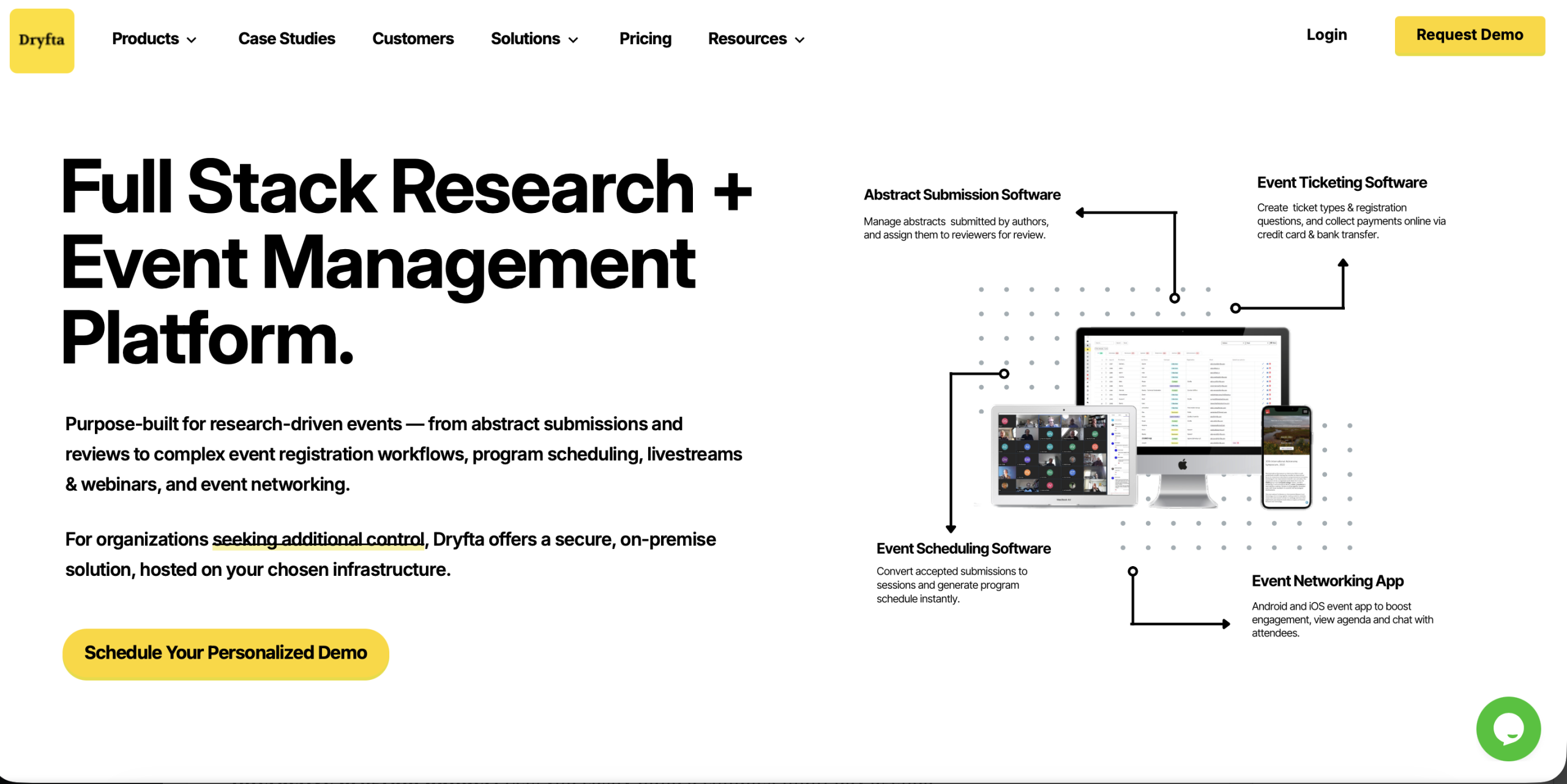
Neither Hopin nor Eventbrite was designed with any of these workflows in mind. Organizers from academic institutions, medical associations or scientific societies who attempt to use either platform for this category of event will find themselves working around significant structural gaps. Purpose-built platforms for abstract management for conferences like Dryfta exist precisely to address this. Dryfta effectively encompasses all the workflows mentioned above, making it among the qualified and sought-after Hopin and Eventbrite alternatives. When Hopin vs Eventbrite just doesn’t cut it for you, try Dryfta. explore Dryfta’s most intuitive features, sign up for a free demo today.
Hopin vs Eventbrite: Quick Verdict
The article is long enough. If you’re running out of time, here’s a quick verdict. If you’ve read it all and are still confused about your options, this can be a good place to begin with.
When to choose Hopin?
Hopin wins the Hopin vs Eventbrite to take the verdict when it comes to hosting virtual and/or hybrid events. Hopin, now part of RingCentral Events, was built as a hybrid event platform, whereas Eventbrite leans more toward being a self-service ticketing platform. This is not to imply that Eventbrite does not double as a hybrid event platform. It certainly does. But Hopin’s features lean more toward end-to-end virtual event management with more dedicated networking features than Eventbrite. Hopin offers better hybrid event support and is equipped with state-of-the-art features as virtual expos for trade shows and event live streaming. This kind of virtual event experience can be a much more economical avenue for bootstrapped event planners such as those planning on behalf of non-profits, charities or startups. Hopin is priced starting at $99 per month while Eventbrite employs a per-ticket costing model.
When to choose Eventbrite?
Eventbrite is estimated to see a footfall of 89 million users every month.
If your event is in-person and ticketed and if you want your event to benefit from organic discovery, then Eventbrite is the sure shot winner. The platform is said to be the largest self-service ticketing platform in the globe. If you’re hosting a free event, Evenbrite allows registering your event on their site for discovery at zero cost. Their very own event management platform starts at 3.7% + $1.79 service fee per ticket.
When to choose neither?
Ditch the Hopin vs Eventbrite debate if the focus of your event is academic or scholarly and involves abstract management for high-volume submissions, blind peer review and a nuanced event registration software. Dryfta emerges as the top platform in this arena, offering all-in-one event management and networking features for academic events.
Frequently Asked Questions (FAQs)
Is Hopin the same as RingCentral Events?
Yes, Hopin was acquired by the American firm RingCentral back in 2023. Hopin then merged into Ringcentral, a cloud-based communications firm, to become RingCentral Events. However, despite the accession, the purpose of Hopin has remained fairly consistent. Branding itself as a ‘virtual platform for human connection,’ Hopin boasts 4.8 stars on G2 reviews. A significant volume of existing reviews and third-party documentation continues to reference the Hopin name despite it now officially being RingCentral Events.
Is Eventbrite free to use?
Eventbrite charges nothing for posters of free events. As for paid events, the event ticketing platform charges a set service fee as well as a variable ticket fee. The service fee is approximately 3.7 percent, in addition to the standard $1.79 per ticket charge. The platform also offers annual paid tiers called Flex, starting at $15 per month and Pro, a custom quote-based subscription.
Can Hopin handle in-person events?
Hopin offers certain hybrid tools, but in-person event management is not a core capability of the platform. Its structural strengths are oriented toward virtual experiences: the main stage, networking rooms, expo booths and on-demand content hub are all built for online delivery. Organizers whose primary requirements are in-person logistics such as check-in management, door scanning and reserved seating will be better served by Eventbrite or a platform designed specifically for in-person event operations.
Which platform is better for conferences?
For virtual or hybrid corporate conferences where networking and content delivery are central to your attendee experience, Hopin or RingCentral Events is better equipped and wins the Hopin vs Eventbrite game. For in-person ticketed conferences, Eventbrite’s established platform is the smarter choice to make, particularly if you do not have the capacity to market your event vigorously. For academic or scientific conferences that need abstract submission, peer review and program management, both fall short and prompt users to surf for Hopin alternatives and Evenbrite alternatives. Herein comes a purpose-built solution: Dryfta’s intuitive and intelligent academic event management software, a platform that is elevated with the most latest of tech inventions including AI-based features.
Does Hopin have a free plan?
Hopin offers a free plan that supports up to 100 attendees with a 2-hour event limit and basic analytics. For most real-world event formats, these constraints are too restrictive for regular operational use. The free plan, realistically, could only prove useful for those wanting to evaluate the platform’s interface and feature set in live action before committing to a larger, enterprise-scale purchase. The free tier can also be useful for small university or corporate events hosting under 100 attendees.
What are the best alternatives to both Hopin and Eventbrite?
The most appropriate alternative depends on what is missing from either platform relative to the organizer’s specific requirements. For virtual and hybrid events where Hopin’s pricing is prohibitive, a number of credible alternatives offer strong networking infrastructure at lower cost. See our roundup of the best event networking tools here. For academic conference organizers who require abstract submission and peer review capabilities, dedicated conference management platforms like Dryfta mitigates the gap that both Hopin and Eventbrite leave wide open.