

Events not only build an organization’s reputation but also unite people. Whether it’s a world conference, college seminar, business meeting, or a trade fair, the main worth of these events is decided after the presentations and sessions. Attendees come to events to relate, brainstorm, and lay down foundations for future cooperation.
As events have become more extensive and complicated, it is no longer feasible to depend on normal meetings or manual coordination. Hence, there has been a surge in the popularity of event networking tools that allow event guests to identify who might be of more use to them, arrange productive face-to-face meetings, and engage at the right time with the right groups. Whether the events are purely in-person, virtual, or hybrid, networking technology has been embedded in the fabric of the contemporary event experience.
Why Event Networking Tools Matter More in 2026
The deliberate engineering of networking at events is no longer a nice-to-have addition for events and conferences today. Rather, it is a function that has cemented itself in importance that can put it on par with other, more fundamental features like registration and ticketing. Getting people to register for an event is one thing but encouraging them to network, and subsequently clinch the connection deal, is another. Increasingly, the latter is what determines the effectiveness of the event for organizers. Networking return on investment, or networking ROI, is the hottest metric in town today. This type of ROI includes everything from the number of connections that were successfully made at your event to the absolute potential of that connection.
Event networking tools are also uniquely taking on the hybrid formats. The constitution of the hybrid pattern, including an online audience as well as an offline one, demands a special set of digital networking tools. It is in this regard that state-of-the-art features like AI-based attendee matching are gaining the upper hand. Artificial Intelligence, now a part of and soon enough, will turn into an inextricable part of the event management space, is equipping networking in stunning, futuristic ways. It is noteworthy that networking tools are steadily increasing and retaining attendance amongst participants. Organizers are seeing repeat registrations from loyal attendees who choose their offerings again and again. Intelligent features like AI matchmaking for attendees and intelligent sponsor management, everyone involved is positioned to make the most out of an event or conference. For stakeholders, this is an advancement worth celebrating. Now sponsors and investors can access measurable, near-precise data on networking performed, leads generated and ROI turned over.
Eventiqs fascinatingly notes that the use of AI-powered attendee matchmaking increases networking ROI by 214%
That’s a large figure and a goldmine waiting to be tapped into. So, what are you waiting for? Let’s get you hooked onto one of these event networking tools before your next big event day.
What to Look for in an Event Networking Tool
Let’s look into the things that matter most for an organizer prioritizing a capable event networking software in 2026.
AI Matchmaking Quality
Not all AI matchmaking operates on the same principles, and the difference between a strong implementation and a weak one is felt immediately by attendees. The most capable platforms move well beyond matching job titles and industry tags. They draw on behavioral data, including session attendance, content interactions, and goals explicitly stated at registration, to surface connections that feel relevant rather than arbitrary.
Meeting Scheduling Automation
The ability to book, manage, and complete 1:1 meetings without placing that burden on the organizer is a key function to watch out for in an event networking software. Meeting schedules are one of the most promising use cases of automation in event networking and management. Therefore, do not miss out on that facility. Automated reminders can reduce no-show rates, and clean availability management prevents double-booking.
Hybrid Networking Capabilities
Hybrid events are a standard format now and platforms that treat virtual attendance as secondary will produce a measurably inferior experience for a portion of their audience. Hybrid networking capability at its finest does not mean HD video calling. What it means is a framework to make an event just as valuable for virtual attendees as it is for those in the flesh.
Mobile Event App Experience
The networking platform lives or dies on the quality of its mobile app because that is where attendees actually use it. They discover profiles between sessions, send messages in real time, receive push notifications about upcoming meetings and scan QR codes to connect with someone they have just met in the venue. Platforms with slow or cumbersome mobile apps see lower networking participation across the board. This underperformance holds regardless of how sophisticated the matchmaking engine running beneath the surface may be.
Sponsor and Exhibitor Networking ROI
Sponsors have, over time, shifted toward evaluating event ROI through the lens of networking outcomes rather than simple brand visibility, and the platforms that understand this shift are the ones worth serious consideration. Dedicated lead capture tools, sponsored meeting slots that give exhibitors priority access to matched attendees, and booth engagement tracking together create a value proposition that sponsors can actually report on internally. CRM integrations with Salesforce, HubSpot and comparable platforms allow sponsor teams to move event leads directly into pipeline without manual data entry, which is in practice what transforms participation from a marketing expense into a commercial activity.
Networking Analytics
Organizers who want to improve their events year over year need data that goes beyond headline numbers. The most useful platforms report on meetings booked versus meetings completed, overall connection rates, individual attendee engagement scores, and sponsor-specific lead metrics. This same data also serves a secondary purpose. It gives sponsors the post-event reporting they need to justify renewed participation, which is a conversation that becomes significantly easier when the numbers are already prepared.
Pricing Model and Scalability
Pricing structures across this category vary considerably and that variation has consequences for how early in the planning cycle an organizer can make an informed decision. Per-attendee pricing scales predictably but can become expensive for larger events. Annual subscription and enterprise licensing models frequently require a sales conversation before any number is disclosed. This can complicate internal budget approval processes. Hidden costs are also worth watching for. Dryfta is a notable exception here, publishing its pricing transparently.
GDPR and Data Privacy
Data privacy is sturdy groundwork for events today. Networking is also firmly planted upon this foundation. Make it a point to confirm that a platform supports proper consent management, gives attendees genuine control over their own profile visibility, and clearly documents where attendee data is stored and processed. Platforms that approach GDPR as a compliance checkbox rather than a design principle create real legal exposure for organizers, and that risk is concentrated most heavily in academic, public sector and international events where the attendee base is diverse and data expectations are high.
5 Best Event Networking Tools in 2026
1. Dryfta
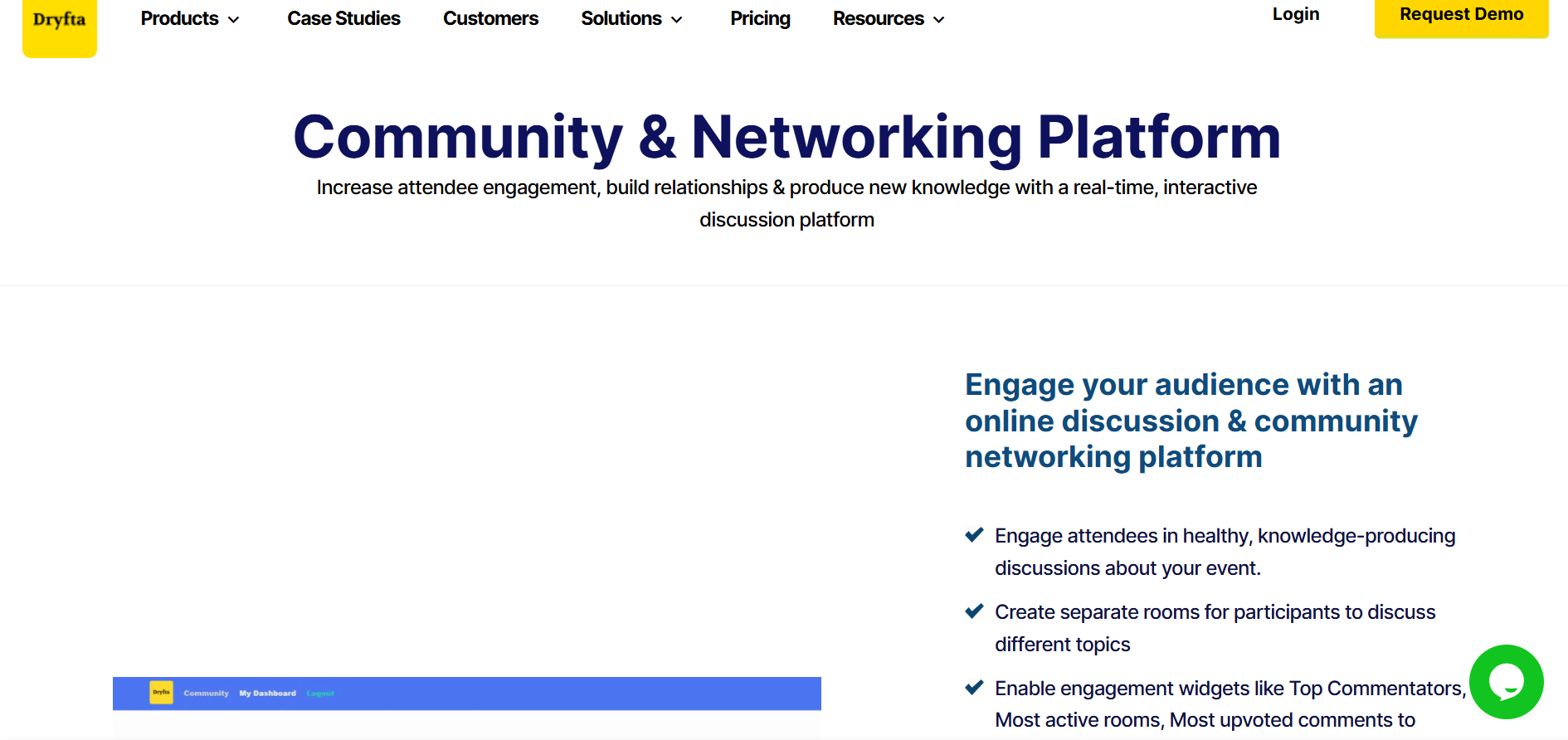
Dryfta offers much more than a networking tool. It is a sophisticated event platform that is designed to support the entire lifecycle of an event, enterprise and professional gatherings. The event tool manages event registration and ticketing systems, collects data of the attendees for the ease of organizers, provides the users with engagement tools to keep the networking ongoing and provides high-quality marketing tools.
The abstract management system makes the collection and review process easy. And its personalized event app keeps all the data and user facilities in one place without the need to constantly log into the website.
Top 3 Features
-
- Community Networking Platform: The users can build agendas, send private messages and have personal meetings with other participants using the app. This also helps them keep all their data, personal schedules and event information in one place.
-
- Personalized Attendee Experience: Attendees are allowed to create their personal profiles and set reminders for sessions. They can also receive updates on their submissions and view their status.
-
- Mobile Event App with Messaging: The mobile event app lets users join topic-focused conversations, build agendas, and post questions for their queries. This keeps them connected to the event and gives them a sense of purpose.
2. Brella
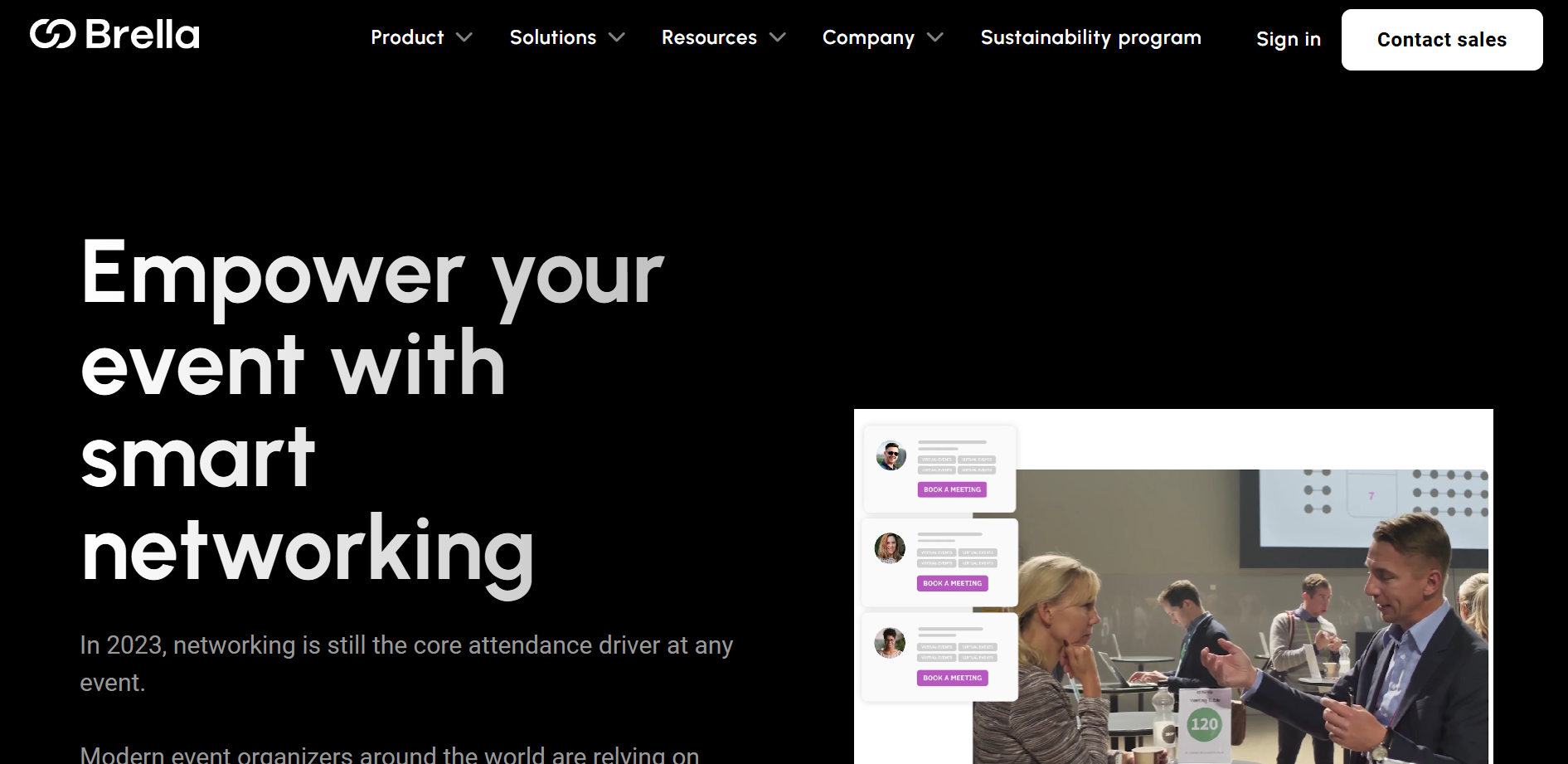
Brella is a networking platform that is designed mainly for business and professional events. It primarily focuses on helping the attendees connect with the right people based on their shared goals and interests. Organizers can use the event tool when the goal of their event depends on partnerships or deal-making. The platforms also help in event setups and add a structured networking layer that encourages prescheduled meetings and purposeful engagement. This works best with conferences and summits where the attendees expect networking with clear value and outcomes.
Top 3 Features
-
- AI-driven Matchmaking: Attendees can provide their interests and goals, and depending on that information, Brella matches them with other participants who share similar interests.
-
- Meeting Scheduler and Contacts: Users can book personal or group meetings directly, manage their schedules and store attendee contact information within the application.
-
- Integrated Networking and Engagement: The tool offers live chat options, real-time notifications and customizable event branding that makes the experience more lively.
3. Whova
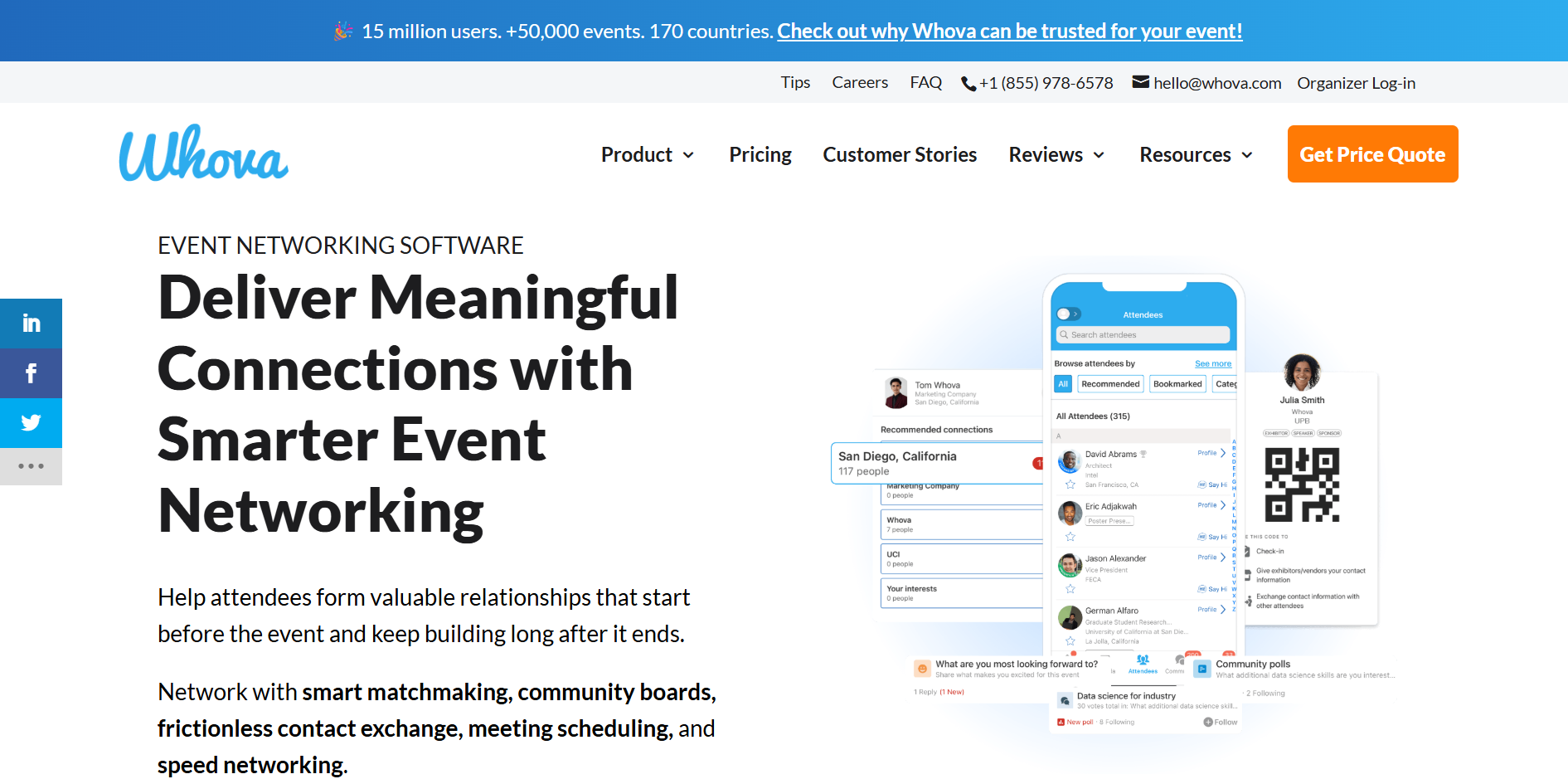
Whova has a balanced approach towards event networking, and it combines community interaction with practical event management tools. It focuses mainly on making the attendee engagement feel natural with the help of its discussion boards, shared interests and easy communication tools. It emphasizes participation and visibility, which allows the attendees to connect with people of similar interests.
Organizers can use the event tool for its simplicity and easy application. It is especially useful for conferences, workshops, and association events where interaction plays a central role.
Top 3 Features
-
- Smart Attendee Matchmaking: To make sure that meetings are meaningful and productive, Whova finds people who have things in common, such as interests, roles, and affiliations.
- Community Boards and Messaging: People can participate in conversations on different topics and share their thoughts even before the event starts. This way, they get more involved and are also better prepared to network in person.
- Effortless Contact Exchange: Scanning QR codes and effortlessly exporting contacts can help to lower the barriers, and thus, it is almost certain that each connection is kept and well-ordered.
4. Bizzabo
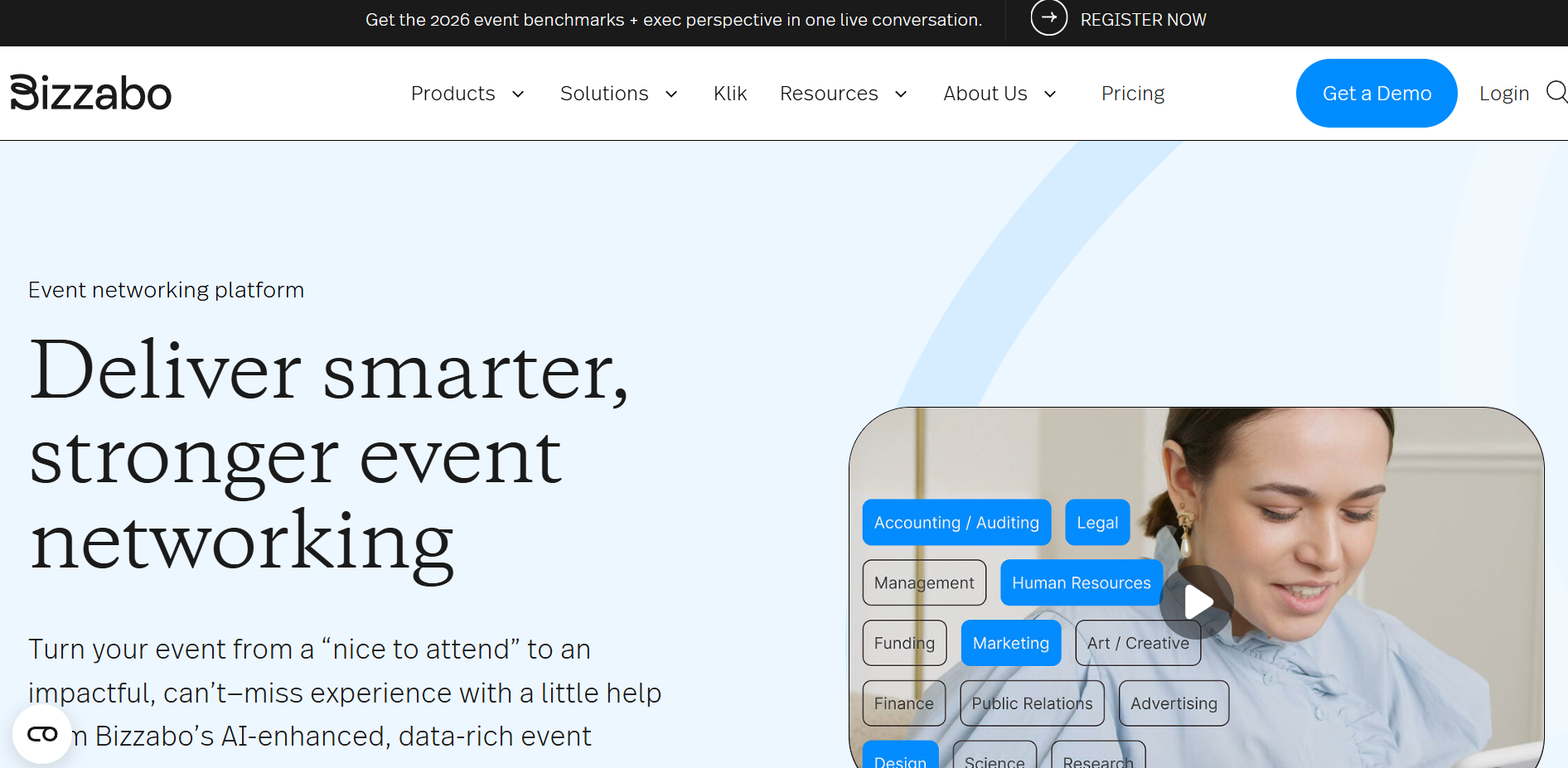
Bizzabo is mainly for large-scale enterprise-level events and works on data-driven engagement. It integrates closely with event marketing, registration, and analytics to make the experience more fulfilling. The platform supports proper interactions and gives organizers insights into the attendee behavior and engagement patterns. This helps them understand the needs of the attendees properly and make the experience more catered to their needs. The tool is suitable for events where networking is tied directly to performance metrics, sponsorships hold much value and are business-oriented.
Top 3 Features
-
- AI Matchmaking Engine: The platform uses attendees’ interests and behavior as input to suggest potential connections; thus, it helps attendees to find value faster.
- Enhanced Profiles and Conversations: Attendees can check in, create in-depth profiles and start chatting or set up a meeting request straight away.
- Mobile Networking On Every Device: Regardless of the operating system, iOS or Android, attendees can stay in touch, check out the suggestions, and take advantage of the networking options even if they are on the move.
5. Grip
Grip focuses on intelligent networking for exhibitions, trade shows, and sponsor-led events. This tool places emphasis on connecting the attendees with exhibitors and partners based on their relevance and intent. The platform supports events where networking becomes a source for future leads and meetings.
The organizers who want to offer value to sponsors while maintaining a structured networking experience for attendees usually go for this software tool. Its approach suits a business environment where business discovery, product exposure and follow-up conversations define the success of the event.
Top 3 Features
-
- AI-Powered Matchmaking and Lead Prioritization: The platform seamlessly matches attendees with exhibitors based on shared interests and engagement data, resulting in higher-quality meetings.
- Exhibitor Focused Analytics: Exhibitors are able to clearly measure their ROI through detailed reports on meetings, visitor interactions, and contacts.
- Scalable Networking Suite: Grip is capable of scaling up or down networking and scheduling features for various event sizes, from huge worldwide expos to small industry trade events.
Detailed Comparison
| Tool | Best Suited For | Strength |
| Dryfta | Hybrid and research-oriented events | All-in-one event management with high-quality networking |
| Brella | B2B networking events | AI matchmaking and meeting scheduling |
| Whova | Community and mid-size events | Simple matchmaking and QR contact exchange |
| Bizzabo | Enterprise events | Intelligent matchmaking and real-time analytics |
| Grip | Trade shows and sponsor events | Exhibitor networking and lead insights |
Dryfta is an all-in-one event platform that integrates networking tightly with registration, abstract submissions, and engagement features. Its networking tool is considered one of the best in the event management space.
Brella and Grip mainly concentrate on AI-powered matchmaking; Brella is effective for B2B meetings, and Grip focuses more on helping exhibitors and sponsors to connect. On the other hand, Whova emphasizes community with very easy matchmaking and discussion boards, whereas Bizzabo is more for big enterprises with data-driven networking and high-level analytics.
Organizers looking for a suitable platform can choose from these 5 platforms based on their specific requirements and event type.
Quick Comparison- The Best Event Networking Platforms at a Glance
In the below section, let’s take a brief, comparative look into the five event networking platforms delineated in this article.
Which Event Networking Tool Is Right for Your Event?
There is no single platform that is the right choice for every event, and any comparison that suggests otherwise is, at best, oversimplifying a decision that has real consequences for attendee experience and sponsor relationships. The most useful way to approach the question is not to ask which tool is objectively best, but which tool is best aligned with the specific profile of your event: its size, format, audience expectations, and the outcomes you are actually trying to produce.
- For Academic and Research Conferences: Dryfta is the clearest choice for universities, professional associations and research institutions, for one specific reason: it is the only platform in this comparison that combines abstract submission management, peer review workflows and attendee networking in a single system. That integration eliminates the need to operate separate tools for different parts of the conference program, which is a meaningful operational advantage for teams running on limited staff and grant-cycle budgets. Transparent pricing further reduces the friction of evaluation, which matters for organizations that cannot enter enterprise sales timelines.
- For Enterprise B2B Conferences: Brella, Grip and Swapcard are each built, in different ways, for environments where the quality of a matchmaking recommendation has direct commercial implications. All three offer sophisticated AI-powered meeting suggestions, sponsor ROI dashboards and the infrastructure required to run multi-track events at scale. Grip leads in the technical depth of its matchmaking; Brella produces the cleaner attendee-facing experience; and Swapcard sits at an intersection of B2B depth and hybrid capability that makes it particularly versatile for events where attendee formats are mixed.
- For Hybrid Conferences: Swapcard and Whova both handle hybrid with a degree of genuine parity between in-person and remote participant experiences that many platforms claim but few deliver. Swapcard’s virtual networking lounge and cross-format meeting tools are particularly well-suited to events where virtual attendance is not a supplementary track but a primary audience segment. Whova’s consistently high G2 rating reflects performance across a wide range of hybrid conference types, which makes it a lower-risk choice for organizers without prior experience running hybrid programs at scale.
- For Small and Mid-Sized Events: For events in the 200 to 1,500 attendee range, Whova offers the most accessible entry point: faster to deploy, lower on operational complexity and less demanding of the technical capacity that enterprise-focused platforms assume their customers have. EventMobi and Eventzilla round out this tier, offering solid core networking functionality at a price and scale that independent organizers, regional associations and smaller conference producers can realistically work with.
- For Sponsor and Exhibitor Networking: If sponsor ROI is the primary success metric against which the event will be evaluated, Grip and Brella are the strongest candidates. Both offer dedicated lead retrieval tools, sponsored meeting slots that give exhibitors structured access to matched attendees, and analytics dashboards formatted for post-event sponsor reporting. Swapcard also performs well here, particularly for events where exhibitors need to engage meaningfully with both onsite and virtual participants across the same program.
- For Budget-Conscious Organizers: Dryfta’s published pricing, starting from $1,499 per year, is a genuine differentiator in a category where most enterprise platforms require a sales conversation before any number is disclosed. That transparency has practical value for organizers who need to secure internal budget approval before they can advance a procurement decision. Eventzilla and Airmeet also offer accessible published pricing tiers and are worth evaluating for events where a full-featured enterprise platform would represent genuine overkill relative to the size and complexity of the program.
How to Improve Networking Engagement at Events
Deploying a networking platform addresses only half of the problem. The other half, turning that platform into genuine attendee value, requires deliberate decisions made before, during and after the event, and it is precisely in those decisions that the gap between a well-run networking program and a forgettable one tends to open up.
Use AI Matchmaking Before the Event
The most effective networking programs begin weeks before attendees arrive. Attendees who book at least one meeting before the event begins tend to show higher overall participation rates and report stronger satisfaction with the networking experience.
Segment Attendees by Goals and Interests
Surface-level networking only produces generic results. Platforms like Dryfta, who understand this distinction between networking and is average and that which is excellent, approach segmentation differently. They look into attendee goals, whether someone is attending to find investors, evaluate vendors, hire talent or develop partnerships and then offer the matchmaking engine inputs that produce qualitatively different recommendations than industry tags alone.
Encourage Networking Before Event Day
Community features like discussion boards, attendee introductions and pre-event messaging channels warm the networking environment before anyone steps into the venue, and that warmth has a measurable effect on participation once the event begins.
Use Gamification to Increase Participation
Leaderboards, meeting completion challenges and sponsor engagement rewards consistently increase platform activity. Even simple mechanics, such as publicly recognizing the event’s top connectors or offering a draw entry for completing a networking checklist, create social proof and a degree of positive competitive pressure that benefits the broader attendee community. The point is not competition for its own sake but the removal of the friction that keeps otherwise willing participants on the sidelines.
Optimize Sponsor Networking Opportunities
Giving sponsors more than a logo placement in the app is, in practice, the difference between a sponsor who renews and one who does not. Sponsored meeting slots, priority matchmaking placement and branded virtual networking lounges create genuine value for sponsors while ensuring that the connections they facilitate are relevant and purposeful for attendees rather than intrusive. Briefing sponsors on profile optimization and training booth teams to use lead capture tools effectively is work that pays back reliably. Well-prepared sponsors generate better results, report stronger ROI and are more likely to re-invest in subsequent editions of the event.
Measure Networking ROI
Every event should close with a comprehensive review of its networking data. Track things like meetings booked against meetings completed, connection rates by segment, engagement scores by attendee type and sponsor-specific lead metrics. At the organizer level, the aggregate picture across events is what allows for meaningful benchmarking and benchmarking is what separates programs that improve from those that simply repeat the same patterns.
Common Problems With Event Networking Tools
Finding your carefully chosen event networking tool lacking? Don’t worry. As much as the software that you invested into failing can bring the spirit of your event down, it is fairly common. However, it shouldn’t be. This is precisely why it is crucial, in 2026, to commit to event networking platforms like Dryfta who offer consistent customer support and assistance. On the contrary, when you opt for platforms with limited or even nil customer support as is the case with Whova, who only offer live assistance for extra charges. Free assistance remains limited to email chat that takes a few business days to receive responses to.
We’ve seen why it is important to choose an event networking tool that is reliable. But what is it that can go wrong really? In this section, we’ll break it down for you. The first step to countering these challenges is to know them and be able to recognize them.
Poor Match Recommendations
Organizers often complain that the event networking tool they signed up for does not do what it promised: AI-based attendee matches. A complaint that keeps popping up about AI matchmaking is that the suggestions feel irrelevant. This sometimes traces back to incomplete attendee profiles as opposed to a total failure of the platform, particularly if it holds up well in other contexts.
Low Attendee Participation
Many organizers make the damaging mistake of assuming that their attendees will discover their event automatically. In reality, unless you are a large conglomerate, they will not. What attendees who signed up for your platform will also not acknowledge unless you enlighten them is your event networking app. They won’t know that there is an attendee profile to be filled unless you do so. Attendees participation remains lukewarm at best if you don’t encourage them.
Networking Fatigue
Networking fatigue is a real phenomenon. First proposed by researchers Thara Ravindran et.al., back in 2014, this kind of fatigue that appears as a result of dense, often performatory networking, extends to virtual formats too increasingly. To counteract this, it helps to set up meeting request limits and build in buffer time between scheduled sessions. Ensure that the networking flows naturally and is not forced down attendees’ throats like it is yet another part of the agenda.
Hybrid Networking Gaps
Virtual attendees remain routinely overlooked in hybrid networking and this is an unfortunate fact. The core reason for this challenge is that most networking tools were built with the traditional format in mind, conveniently leaving out those tuning in remotely. This overlooking is convenient given the fact that engaging these attendees can be much harder than setting up networking at physical events.
Sponsor ROI Tracking Issues
Sponsors who cannot see clear meeting data and lead attribution after an event are unlikely to renew their contract with your event. If they don’t see the ROI, they’ll simply choose not to return for another year. They might as well regret their association with you thus far. Hence, it is important to prioritize this aspect when it comes to stakeholder management. Ensure that your networking software is not accidentally underperforming where it truly matters.
Enterprise Pricing Complexity
When networking tools refuse to publicize their prices and conceal their enterprise figures under the label of ‘quote-only,’ what they are doing is actually driving away potential customers. Networking tools that are priced exorbitantly can be a challenge when it comes to access for organizers. While some platforms justify their pricing, the larger issue remains with transparency. No matter what level of pricing yardstick a certain firm is, it is important to disclose that.
Parting Thoughts
Networking at events has become one of the major ways through which modern-day events gain and justify their value. In addition to the sessions and speakers, the attendees also want to be able to meet and connect with the folks who share the same interests, goals, and challenges as them. The right networking solution can significantly influence the mood of these meetings, determine the level of engagement, and ultimately, it may even be a major factor in an event being recalled long after it has ended. Request your free demo from Dryfta today and see how our solutions help you network in a smarter way.
Frequently Asked Questions (FAQs)
What is the best AI-powered event networking platform?
Presently, Dryfta stands out as a prominent and the best AI-powered event networking platform in the market. What makes Deyfta’s automated capabilities particularly conspicuous is that it solved the problem of attendee mismatches in networking quite early on as Artificial Intelligence began to emerge. Dryfta’s commitment to consistently raising the bars in AI-powered event networking makes it a sturdy competitor in the field who is here to stay.
Which event networking platform is best for hybrid events?
Dryfta includes a number of features designed especially with the hybrid event format in mind. Most notably, Dryfta has developed and implemented as part of its event networking software, tools for micro-interactions. These are important drivers that keep virtual audiences engaged throughout and are key to sustaining attendee productivity at hybrid events.
What networking features should an event app include?
In an age of AI, it is non-negotiable for event apps to have networking features like AI-powered attendee matching, 1:1 meeting scheduling with calendar sync, in-app messaging, push notifications and attendee profile discovery. Dryfta embodies all of these features and more within a native app that is available for quick download across Android and IOS devices globally
Are networking tools worth it for small events?
Certainly. As a matter of fact, networking tools can be all the more important within smaller groups. It is here that organizers possess the greatest potential for meaningful networking. Therefore, regardless of size or scale, it is crucial to treat networking tools as a priority. Good networking doesn’t just come about much of the time. What you need is a software like Dryfta actively nudging for the connections to materialize.
What is the difference between event management software and networking software?
An event management software concerns itself with more logistical, organizational aspects of the event. This comprises functions like registration, ticketing and proceedings management among other things. A networking software, on the other hand, focuses its resources heavily into helping attendees network with one another. It includes features such as matchmaking, meeting scheduling, and messaging. and engagement tools. Often, all-in-one event management softwares like Dryfta also acts as excellent networking softwares. This takes away the need for organizers to purchase multiple software tools and integrate them.
Which event networking platforms offer transparent pricing?
Dryfta is among few platforms that publicize its pricing transparently, from start to finish. The software, employing a flat-fee model, starts at $1,499 per year. Dryfta, further sticking to its promise of customer transparency, also offers a demo that interested users can sign up for completely free of cost.
How do AI matchmaking tools work at conferences?
AI matchmaking tools like Dryfta work by analyzing attendee profile data and professional demographics and creating a coherent networking profile. It is based on this that the AI matchmaking tool calculates the compatibility between and among conference attendees. These scores surface as ranked match recommendations, which attendees can browse and convert into meeting requests. More sophisticated platforms also update recommendations in real-time as attendees interact with the event app during the conference, continuously improving suggestion quality.