
Businesses, organizations and pretty much any entity that sells a product or service for-profit warrants visibility. A spectacular product that never reaches the right audience is simply a failed invention. A life-changing service that no one signs up for is, yet again, a failed proposition. What distinguishes success and failure for players across industries has a lot to do with how and where they position themselves.
Trade shows have long been a highly rewarding arena for players in the B2B arena, particularly to showcase their products and services. In this blog, let’s understand what is a trade show and why you need to pay attention to one if you are a business in 2026.
What Is A Trade Show?
A trade show, also commonly referred to as a trade fair or exposition, is an event whose key purpose is to bring in members of a particular industry in a singular space, physical or sometimes even virtual. Herein, exhibitors are able to display and discuss their latest products and services with potential investors, retailers, exporters and even general customers.
What Happens at a Trade Show?
If you’ve ever wondered why it is that companies are spending hundreds and thousands of dollars to set up booths in massive trade shows, the answer to your skepticism is fairly simple: it is because trade shows work. Perhaps the most stunning part about these trade shows and industry showcases is that they benefit business players coming in from across experience levels.
A startup looking for its first key investor, an already popular manufacturer launching a new product line, whosoever you may be, a trade show can put you face-to-face with the people that matter the most to your business.
So, what happens at a trade show, exactly? And more importantly, how do you make one work for your company?
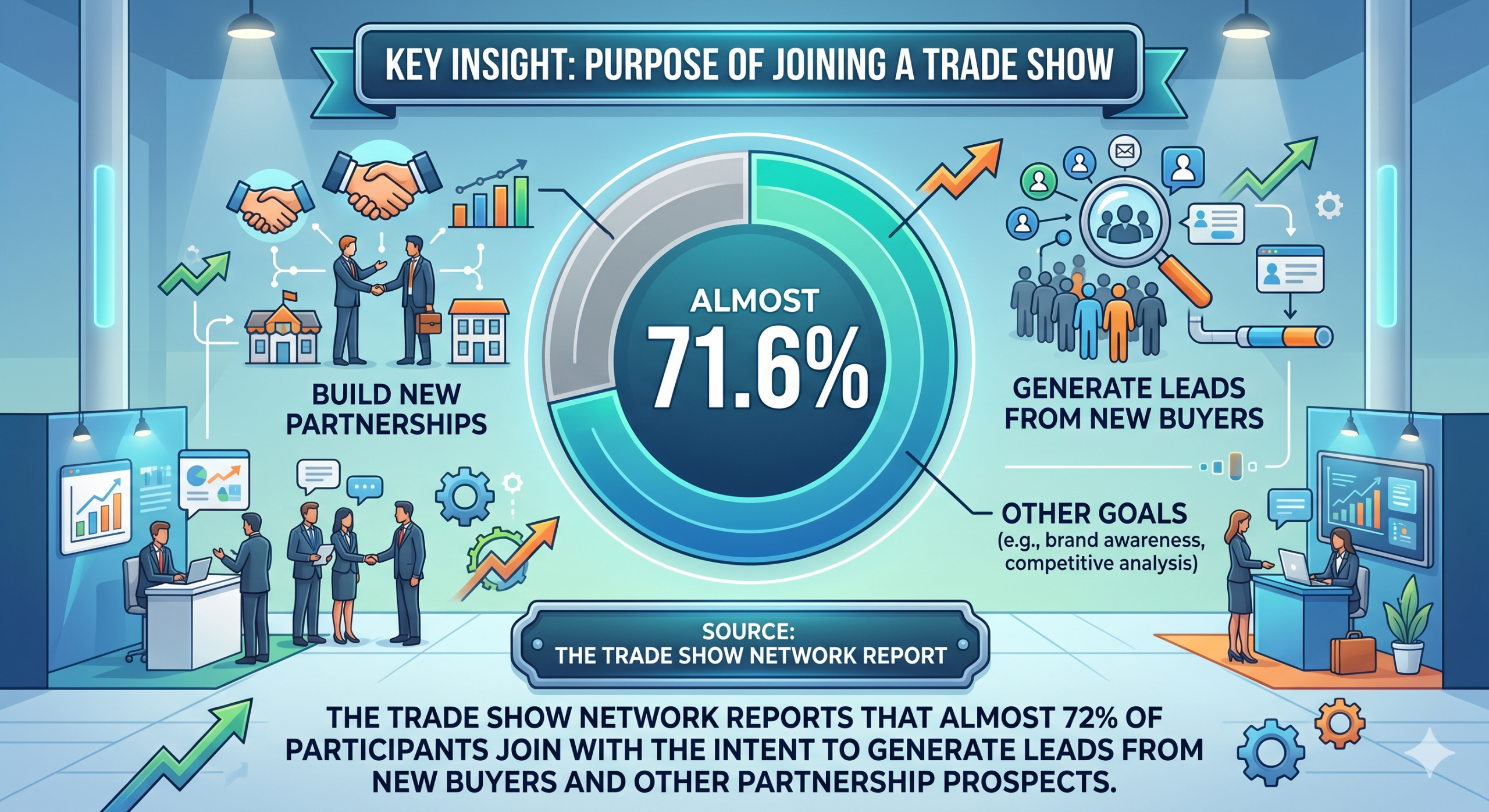
The Trade Show Network reports that almost 71.6% of participants join with the intent to generate leads from new buyers and other partnership prospects.
Major trade shows usually last anywhere between several days to a month and are often organized in convention centers in larger cities. More local trade shows may be held at local arenas or hotels and allow businesses in the area to connect with prospects on a smaller scale.
Key Elements of a Trade Show
- Exhibitors: Companies and brands that pay for booth space to display their products or services to a targeted audience.
- Attendees: Buyers, decision-makers, industry professionals and curious observers who register to visit the event.
- Booths: The physical or virtual spaces exhibitors use to present their brand, demonstrate products and collect leads.
- Sponsors: Organizations that fund portions of the event in exchange for prominent visibility across signage, sessions and digital channels.
- Sessions and workshops: Structured programming that adds educational value and draws attendees who may not otherwise visit an exhibitor’s booth.
- Event organizers: The teams that plan, coordinate and execute the trade show, managing everything from venue logistics to the registration system.
- Registration and ticketing: The system that manages how attendees sign up, what access they receive and how exhibitor data is collected pre-event.
- Lead capture tools: Badge scanners, QR codes and digital forms that allow exhibitors to record attendee details during conversations on the floor.
Types of Trade Shows
Having understood what is a trade show, it is also equally pertinent to know its various types. While the central purpose of a trade exhibition remains the same, not all trade shows function the same way. Here are some of the most common types and how they distinguish themselves from the others:
-
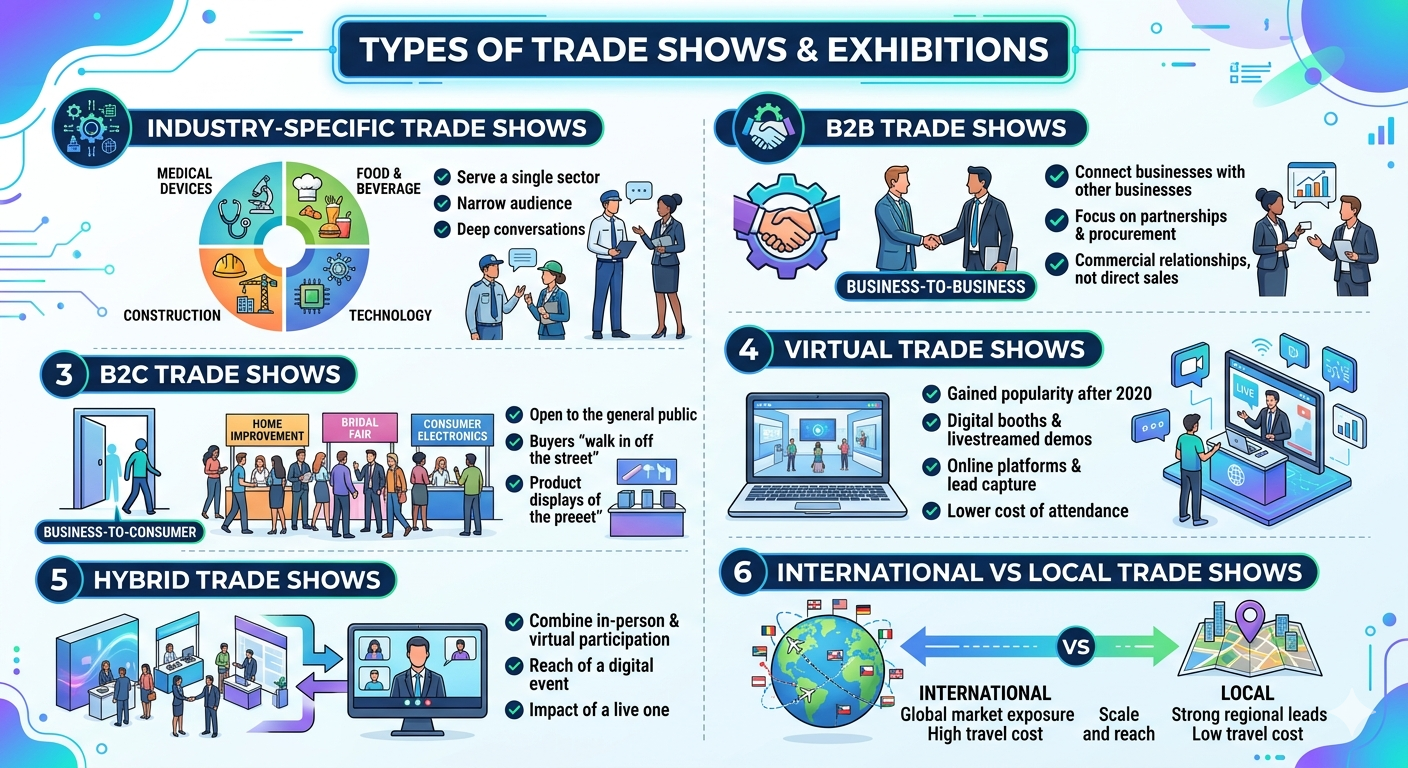
- Industry-specific trade shows: The most common format of trade shows and are popular in niches like packaging, consumer electronics and even defense. They attract highly targeted audiences and visitors who walk through the doors of an industry showcase have a specific reason to be there, which is why the quality of leads tends to be higher than at broader events.
- B2B trade shows: Trade shows that connect businesses with other businesses. The focus is on partnerships, procurement and commercial relationships rather than direct consumer sales.
- B2C trade shows: These trade shows open their doors to the general public. It includes things like home improvement expos, bridal fairs and consumer electronics shows where the buyer walks in off the street.
- Virtual trade shows: A format that moved from niche to mainstream after a worldwide pandemic in 2020. Exhibitors host digital booths, run livestreamed demos and capture leads through online platforms without the cost of physical attendance.
- Hybrid trade shows: An alternating combination of in-person and virtual participation. It gives organizers the reach of a digital event alongside the impact of a live one.
- International vs local trade shows: The key differentiator here is the scale of audience reach and demographics. A local show, although limited in reach, generates sturdier regional leads. An international one, on the other hand, puts your brand in front of a global market.
Trade Show vs Conference vs Expo vs Exhibition
Benefits Of Trade For Exhibitors
According to Giant Printing (2025), the US B2B trade show market reached $15.8 billion in 2014 and is only projected to grow further. These numbers show that trade shows globally are thriving. They also prompt to ponder upon the noted benefits of hosting such trade show exhibitions and industry showcases.
Benefits of Trade Shows for Attendees
The trade show format is beneficial not just for exhibitors but also for attendees. In fact, the benefits are even more plenty for attendees. Some of them include:
- Attendees are able to discover new products in the market.
- Meeting potential vendors opens up several doors for attendees seeking variety in products or services.
- For the attendee that cannot choose, a trade show is both bane and boon. Attendees can evaluate dozens of solutions in a single day and compare features, pricing and people.
- Seminars and workshops at trade shows give attendees access to speakers and perspectives they would not otherwise encounter in their day-to-day work.
Trade Show Costs For Exhibitors and Attendees
Costs For Exhibitors:
The primary costs involved in organization can add up quickly if not well planned for. Here are some costs to account for in your budgetting:
- Booth space: Booth prices can range anywhere from $2,000 for a small shell scheme at a regional event to $50,000 or even more for a large custom build at a major international show.
- Travel and accommodation: For multi-day events in major cities, flights, hotels and meals for a team of three can easily reach $5,000 to $10,000.
- Booth design and production: Custom stands, signage, furniture and AV equipment can cost between $3,000 and $30,000 depending on size and complexity.
- Marketing materials: Printed brochures, branded merchandise and giveaways typically run $1,000 to $5,000.
- Sponsorships: Additional visibility through sponsored sessions, lanyards or app placements ranges from $500 to $25,000.
Costs For Attendees:
Costs can include registration fees (free to $1,500 depending on the event) plus travel and accommodation if the show is not local.
Trade Show Marketing Strategy (Before, During, After)
Showing up at a trade show is not, by itself, a strategy. Effective trade show marketing is a discipline that begins weeks before the event opens and continues long after the last booth is dismantled. Here’s what to do before, during and after your trade exhibition to make it truly count.
-
- Before the show: Only a small portion of exhibitors are proactive enough to kickstart their event marketing at least a month ahead of the show. The rest is all panicked last-minute prep. Don’t be among those who plan in the final weeks. Start further in advance, secure better booth locations, stronger branding and better-prepared staff.
- During the show: Live product demonstrations are the single most effective conversion tool on the show floor. Be sure to use them to the fullest. Visitors who interact with a product are far more likely to engage in a follow-up conversation than those who simply receive a brochure.
- After the show: This is where most companies fall short. The logistics of trade show leads are never followed up on. Therefore, making prompt and systematic follow-up one of the highest-return activities your sales team can prioritize following a trade exhibition.
How to Choose the Right Trade Show
There are tons of trade shows and industry showcases that happen throughout the year. However, if you are attending all of these showcases or a handful based on arbitrary, momentary choices, you’re making a grave mistake. You are exhausting your company’s marketing spend by participating and exhibiting in trade shows that mean nothing to you or your industry. Here are things to carefully consider before committing to a trade showcase:
- Check for industry relevance: Ask yourself if this show might puts you in front of the exact buyers or vendors your business needs. Figure who these vendors are and research if they will be there.
- Test your audience quality: A smaller, regional show with no more than 500 qualified decision-makers sometimes outperforms a larger one with that might have 2000+ general visitors in a day. Determine which is more likely to put the spotlight on your product or service.
- Go over the venue’s location: Proximity reduces costs for you significantly as exhibitors. But some markets only open when you show up in person, internationally.
- Balance the books: Factor in every line item before committing. Booth space might seem the costliest but it is rarely the largest cost. Check for miscellaneous costs and account for them meticulously.
- Roughly map your ROI: Look at any past exhibitor testimonials if available. Go through any information available about the average attendee’s value for your brand, in terms of sale and purchase. Whatever return on investment means to you, make sure to check for that. See if this trade show will deliver the ROI you are seeking. This can be different for each company.
How to Measure Trade Show ROI
On the question of ROI for exhibitors on trade shows, here are some questions to ask yourself:
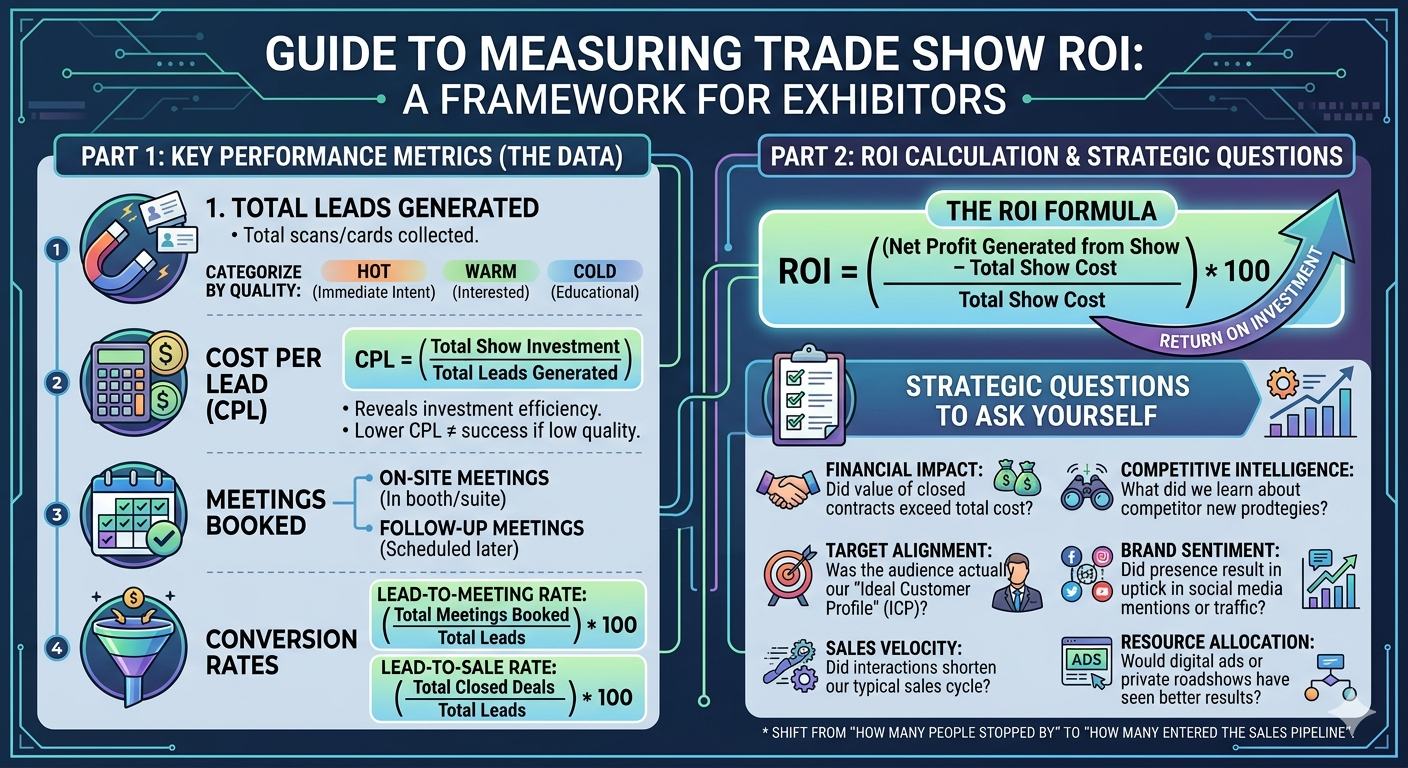
- How many leads did we generate? Leads are the total number of contacts collected at the event, qualified by interest level.
- What what our cost per lead? Total event spend divided by the number of leads collected. This single number tells you a great deal about whether the show was worth it.
- How many meetings did we manage to book? Pre-scheduled and on-site meetings with qualified prospects are a stronger signal of ROI than badge scans alone.
- What is our noted pipeline value? Pipeline value is the total potential revenue of deals that originated at your event. This can be tracked through your CRM in the months that follow.
- What are our conversion rates? Of the leads collected, how many became customers? This is the number that determines the success of your investment and justify that of next year’s.
Common Trade Show Mistakes to Avoid
- Poor booth planning: A booth that is hard to find, visually unclear or staffed by people who cannot answer basic questions loses leads before a conversation begins.
- Weak follow-up: Most trade show leads go cold because nobody follows up quickly enough. The window is short. 48 hours is the outer limit.
- No clear goals: Attending without defined targets, number of leads, meetings booked, partnerships explored, makes it impossible to measure success or justify the cost.
- Undertrained staff: Product knowledge is not enough. Booth staff need to qualify leads, handle objections and capture contact details cleanly and consistently.
- Ignoring ROI tracking: If you cannot measure what the event produced, you cannot make a better decision about the next one.
What is a Virtual Trade Show?
As the events industry expanded beyond physical venues, a parallel format grew alongside it. Virtual trade shows. These are online events that replicate the core functions of an in-person trade show. So, you have exhibitor booths, product demos, live presentations and networking, but via a screen and a digital platform that is accessible from anywhere in the world.
That being said, the virtual trade show format has not replaced in-person events. According to Passivesecrets (2026), approximately 95% of regular exhibitors still prefer in-person trade shows over virtual alternatives.
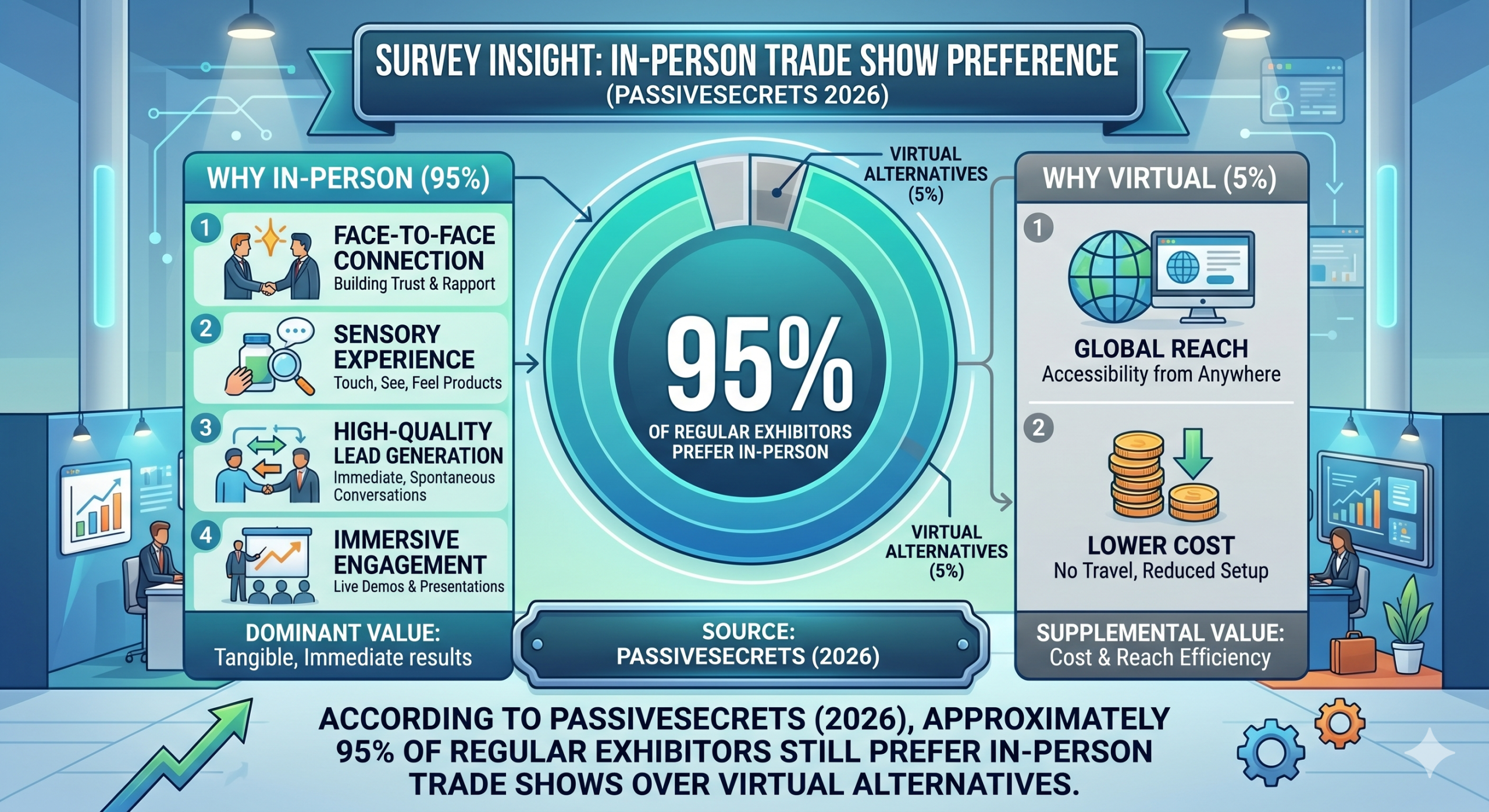
The difference comes down to trust and tactility. Face-to-face interaction builds relationships at a speed and depth that a video call or digital booth simply cannot replicate. The most forward-thinking companies are not choosing between the two formats. Rather, they are striking a balance and settling for a hybrid model that pairs the strengths of both, scale and accessibility of a virtual trade show and the conversion power of in-person presence.
How Event Management Software Helps Trade Shows
Running a trade show without dedicated software means managing complexity through spreadsheets, email threads and manual coordination. The gaps show up on event day, and they show up in front of attendees. Dryfta’s all-in-one event management software is built to offer trade show organizers a single platform to manage the entire event. The need to stitch two dozen separate tools together is eliminated altogether. Dryfta is convenience is one place.
Registration management: Custom registration forms with multiple ticket types, early-bird pricing and group bookings, all in one place with payment processed directly to your account.
Booth allocation: Assign and manage exhibitor booth spaces with a clear view of who is where and what they need before the event opens.
Attendee management: A built-in CRM tracks every attendee from registration to check-in, giving organizers and exhibitors a complete picture of who attended and when.
Lead capture: Digital tools that allow exhibitors to scan badges, log notes and capture contact details in real time during conversations on the floor.
Analytics and reporting: Post-event dashboards that show registration numbers, check-in rates, session attendance and lead activity, giving organizers the data to report on outcomes and plan better events.
Trade shows are sophisticated and miniscule in organizational nature. There are several different aspects to be set in line prior to the final day as an exhibitor for brands. Using a smart, automation-backed event management software eliminates this complexity. The miniscule logistical tasks become much more manageable. And you can finally focus on the bigger things. These are the things that truly matter for your organization, your ROI, your pipeline value, conversion rates etc. An event management software lets you ponder over these things without relentlessly worrying if you have secured the right pass to the trade show.
Final Thoughts On The Trade Show Format
Trade shows have been around in the global business space for decades on end. And the main reason is because of their viability and potential for visibility. On a broad scale, hosting trade shows can be sustainable. For individual exhibitors who may be bootstrapped, the preparation phase can be expensive. However, the ROI is significant for even fresh entrants and new players seeking market visibility.
If trade show management still feels like a logistical maze, Dryfta is built to change that. Dryfta is an all-in-one event management platform that brings registration, attendee management, booth assignments, lead capture and post-event reporting under one roof. Start your free demo today and see how much smoother your next trade show can run!
Frequently Asked Questions (FAQs)
What is a trade show in modern business strategy?
It is one of the few marketing channels that compresses lead generation, brand building, competitor research and partnership development into a single, time-bounded event. The US B2B trade show market exceeded $15.8 billion in 2024 and 85% of business executives have identified trade shows and events as non-negotiable to their company’s success, according to Passive Secrets.
What is trade show management?
Trade show management refers to the operational and logistical organization of the event. In other words, all exhibitors do both before, during and after a live trade show. Good trade show management is the key to any successful exhibition. It comprises everything from initial budgeting and booth design to logistics, staffing, lead capture as well as post-event follow-up.
How is technology being used at trade shows?
Increasingly, exhibitors are now tapping into modern technology to attract visitors to their booths. AI-powered lead capture tools that include features such as instant badge scanning, conversation notes and follow-up prompts are now growing standard at large trade shows. Using them systematically can also help solve the problem of failing to follow up on potential customers and onlookers who submitted some contact information.
How do trade shows benefit market intelligence?
Trade shows concentrate market intelligence that would otherwise take months of individual research to gather, making things such as live competitor comparisons, product announcements and buyer sentiment all visible in a single visit for the attendee. Sometimes, all it takes is to simply show up at a trade show and observe the exhibition carefully to gauge the current demands of a market.
