An outstanding, even potentially groundbreaking research paper, sometimes simply never materializes. Perhaps the author may never get down to writing it and the paper remains an idea. Or even worse, a promising paper, written and pruned, simply never reaches the right platform. There is a particular kind of disappointment that comes in circumstances such as this. It is also one that conference organizers, just as much as promising authors, know all too well. You’ve spent weeks if not months planning a research conference. Building something you believe in. You’ve dedicated your time and effort into perfecting it. However, once the Call For Papers is ready to go out, you’re confronted with a bitter realization: that submitters didn’t nearly believe in your research conference as much as you did.
Let’s face this truth. It can be a bitter pill to swallow. Authors don’t arrive with pre-installed faith in your research conference or scientific event. In 2026, an era where falsification is rising on the internet, what they are guaranteed to arrive with is skepticism.
Is this a trustworthy Call For Papers?
Or is this a scam to perform intellectual theft?
Will my work be safeguarded?
Is this conference even worth submitting to?
These are the questions that pop up in the minds of submitters on the internet. Unless you are a reputed journal or organization, it is easy for authors to look past. But what can make them stop and consider, is your Call For Papers (CFP). The way you write it, that’s the magic. That is the secret sauce. In this blog, we’re telling you exactly how to write your next Call For Papers to make the average internet user stop and stare. Let’s dive right in.
What Is a Call for Papers (CFP)?
A Call for Papers is best defined as a formal invitation that’s extended to the public. Herein, the public refers to the larger research community, comprising scholars, practitioners and thinkers, who may be willing to submit their work for consideration at your research conference or symposium. Typically, a CFP is anywhere between 200 and 500 words in length. For more specialized conferences with multiple tracks or themes, it is acceptable for the word count to touch 1000 words. Anything above this can be lengthy and likely to fall victim to reader fatigue. What this means is a potential author may simply quit reading an unnecessarily tedious Call For Papers. Or perhaps they may save it to be read at a later time and forget about it altogether. All of these are plausible and very likely possibilities particularly when it comes to Call For Papers published over the internet.
What’s The Purpose of Call For Papers in Academic Conferences?
The purpose of Call For Papers, as the name suggests, can look fairly straightforward. It’s just another advertising tool. Just like businesses advertise their products, conferences advertise themselves to be able to reach the right kind of writers. An excellent Call For Papers should pull all the nerds toward you. In extraordinary cases, your proposition might as well motivate someone to expand on a research idea that has occupied their head for too long. Certainly, the internet is a strange place.
What Are the Types of Submissions Accepted By A Call For Papers?
Most CFPs specify whether conferences accept full papers, extended abstracts or presentations. The most common type of submissions include:
- Full-length research papers
- Essays and opinion pieces
- Abstract reviews
- Meta-analysis
- Visual presentations
- Brief pitches outlining solutions or innovation.
Ultimately, the type of paper accepted comes down to the particular theme, goal or objective of the conference or symposium being submitted for.
What’s the Relationship Between CFPs and Peer Review?
The relationship between Call For Papers and the peer review process is inextricable from one another. In most conferences, submissions are subject to what is called the ‘peer review process.’ Peer reviewers are qualified experts who screen submitted research papers. Sometimes, the ultimate decision of whether a paper gets accepted is taken after peer review by multiple experts. Techniques like triple blind review are commonly exercised by research organizations to ensure that the selection and screening process is free of any bias, be it implicit or explicit.
How a CFP Influences the Way Your Conference is Positioned
The Call For Papers is the first impression of both your event as well as your organization. A sloppy CFP is likely to signal credibility and non- professionalism. In simpler words, you’ll come across as a scam.
But when you position your CFP neatly, concisely and to the point, backed by a credible organization, you will warrant attention that turns into interest and later, author action. If you are reaching out to busy researchers in a field, it is important to publish a CFP that is worth their time. If you are accepting from freshers and newbies with profound ideas, make that clear as well. Make the criteria crystal clear at first glance. This is one of the best indicators of a good, professional-looking Call For Papers. It also helps to attach a link or contact to your host organization or some other entity.
A Call For Papers without a clear call-to-action is simply a futile web advertisement.
Why Some Calls for Papers Fail to Attract Quality Submissions
The core problem that makes some Call For Papers fail miserably is to do with the attitude and insight of the organizers. Often, perhaps even without conscious realization, organizers tend to overestimate the importance and relevance of their conference. The truth is that your conference is just one among too many in the market. That being said, this is not a ploy to discourage you. It is certainly important to respect your work before others can. However, many CFPs today are written as though the researchers reading them have no other options. Thid assumption is the source of most of the damage.
Some other common reasons why your CFPs may have fallen short of intended reach include the following:
- Your CFP lists vague or overly broad conference topics that fail to attract researchers.
- Poorly written or incomplete submission guidelines that leave authors uncertain about basic requirements
- The CFP harbors review criteria that are unclear or irrelevant, instantly giving researchers the ick.
- The website has zero credibility markers such as committee names, institutional affiliations or indexing information.
- The content you’ve written is missing key publication and proceedings details that matter very much to researchers who are building academic careers, brick by brick.
- The deadlines you’ve proposed are either unrealistically compressed or so loosely structured that nothing is communicated clearly.
- Weak promotional strategies that limit the CFP’s reach within the target research community.
- A conference website that is disorganized or difficult to read on mobile devices.
- Research themes so broad that no specialist feels the event was designed with their work in mind.
- Lack of transparency in the peer review process that erodes trust before a single submission arrives.
Define Clear and Focused Conference Topics
One of the more counterintuitive truths in academic conference planning is that narrowing your scope tends to increase the quality of submissions rather than reduce their volume. It is important to be as clear and as focused as is possible when it comes to choosing conference topics.
Know some simple ways to keep your conference topics focused but accessible to the broader research community:
- Choose specific research themes: Be specific rather than attempting to accommodate every direction within a broad field
- Give prominent placement to what’s trending: Keep to date with academic topics and current methodological debates that your committee finds compelling.
- Limit theme broadness: Avoid subject areas that are so wide so wide that no specialist feels the conference was designed for their particular work
- Ensure consistency with overall conference themes: Make sure the themes selected are consistent with the conference’s stated objectives and its history
- Consider interdisciplinary opportunities: Address interdisciplinary opportunities carefully, specifying how cross-field submissions will be evaluated on fair terms
- Offer scope for rapidly growing fields: Include areas of research that are actively developing and generating new scholarly conversation
- Incorporate jargons: Use language that the target researchers themselves use, so the CFP reads as written for them specifically
- Be precise: Define the conference scope with enough precision that a researcher can immediately tell whether their work belongs
Clearly Explain Submission Guidelines
A researcher sitting down to prepare a submission should never have to guess what format is expected of them. The guidelines section is not a place for ambiguity, yet it is where ambiguity most reliably lives in conference CFPs. Word counts buried in footnotes, formatting requirements scattered across separate pages and submission platform details mentioned without any instructions for using them are all forms of friction, and every point of friction is a point at which a potential contributor may decide the uncertainty is not worth their time.
- State abstract and paper formatting requirements explicitly, including citation style and accepted file formats.
- Specify word count limits for each submission category without leaving room for interpretation.
- List all submission categories clearly, distinguishing full papers from short papers and work-in-progress submissions.
- Provide all important deadlines in one place, including abstract, full paper and camera-ready dates.
- Explain the review process so authors understand how their work will be handled after submission.
- Describe presentation format options and clarify whether authors may express a preference between oral and poster formats.
- Clarify proceedings and publication arrangements, including whether accepted work will appear in indexed venues.
- State language requirements for submissions, presentations and any accompanying materials.
- Provide clear instructions for the submission platform, including account creation and file upload procedures.
Write a Compelling Conference Description
- Explain the conference mission and goals in concrete terms rather than abstract aspirational language.
- Draw on the conference’s history and track record wherever that history is a genuine strength.
- Reference the success of previous editions, including submission volumes, acceptance rates and geographic reach of attendees.
- Include confirmed or representative keynote speaker information, since speaker lineups communicate intellectual standards efficiently.
- Name academic partnerships and institutional affiliations that establish credibility for the organizing body.
- Mention indexing arrangements and publication opportunities that matter to researchers building academic careers.
- Describe what attendees gain by participating, beyond the presentation of their own submitted work.
- Speak directly to the networking and scholarly exchange opportunities the conference creates
A conference description that offers this kind of information earns a different quality of attention than one that merely announces its own ambitions. The credibility signals that we’ll go over in the next section are what will turn this attention that you catch into author action.
Include Strong Credibility Signals
Scientific committee details: Name the members of the scientific committee along with their institutional affiliations and areas of expertise.
Reviewer expertise: Provide information about reviewer qualifications so authors understand who will be assessing their submitted work.
University partnerships: List university partnerships and institutional endorsements that establish the conference’s standing in the field.
Professional association support: Include support from professional associations or disciplinary bodies where that support exists.
Previous conference statistics: Share previous conference statistics such as submission numbers, acceptance rates and geographic reach of attendees.
Publication partnerships: Describe publication partnerships and the journals or proceedings with which the conference is affiliated.
Indexed proceedings information: State whether proceedings are indexed and in which databases, since this is often a deciding factor for academic contributors.
Past keynote speakers: Reference past keynote speakers where their names carry genuine weight in the relevant scholarly community.
Research impact highlights: Speak to the research impact of work published or presented at previous editions of the conference.
Make Deadlines Clear and Realistic
A rushed review process is one of the most reliable ways to lose the trust of people who submitted in good faith. A reputation for poor deadline management spreads through research communities with a speed like no other. It is, therefore, important for you to clearly specify deadlines affirmatively and not gloss over them. Here’s what you need to be setting concrete deadlines for:
- Abstract submission deadline: State the abstract submission deadline prominently and early in the document.
- Full paper submission deadline: Provide the full paper submission deadline with enough lead time for serious scholarly preparation.
- Reviewer notification timeline: Include the reviewer notification timeline so authors know exactly when to expect a decision.
- Registration deadlines: List registration deadlines separately so they are not confused with submission cutoffs.
- Camera-ready submission dates: Give the camera-ready submission date clearly so authors can plan their final revisions accordingly.
- Avoid running on overly short timelines: Avoid compressing your timelines in a way that make peer review impossible to conduct well.
- Allow enough review time: Give enough time between each stage for reviewers to engage carefully with submitted work.
- Make sure to send reminders just before a deadline: Build a reminder schedule and state it explicitly so authors can plan their own preparation around it.
- Mention late-breaking abstract policies if any: Include a clear policy on late-breaking submissions for researchers working on fast-moving topics.
How To Optimize Your Call For Papers for Better Visibility?
A well-crafted Call For Papers that reaches no one is functionally the same as a poor one. It is important to make your CFP searchable and more shareable across the platforms your target researchers frequent. Below are some tips to optimize your call for greater visibility:
- Use SEO-friendly conference pages: Build conference web pages that are clearly organized and use the language researchers apply when searching for publication opportunities in your field.
- Play with relevant academic keywords: Include relevant academic keywords in page titles, headings and descriptive text so the site performs well in search results.
- Share your call across academic platforms: Share the CFP on academic platforms such as ResearchGate and Academia.edu where your target community is active. The first step here is to determine what places your audience frequently.
- Promote through university networks: If this is a call for student researchers, make sure to distribute announcements across university department mailing lists and faculty networks.
- Use LinkedIn and research communities: Take advantage of professional social media platforms such as LinkedIn and other discipline-specific research communities to reach applied and interdisciplinary audiences.
- Email past conference attendees: Send targeted emails to past conference attendees and previous submitters who have already expressed interest in your event.
- Partner with associations and journals: Partner with professional associations and journals to distribute the CFP to their membership and readership.
- Submit you call for papers to conference directories: Submit the CFP to established conference directory websites and academic listing platforms to extend reach beyond existing contacts
Explain the Peer Review Process Transparently
Researchers who decide your conference as an avenue to invest their time and scholarly effort into also want to understand one important thing: How their work will be reviewed.
Double-blind or single-blind?
Assigned on what basis?
Evaluated against which criteria and weighted in what proportion?
These are not only a few among dozens of questions that submitters are prone to have. And no, these are not unreasonable questions. Rather, a Call For Papers that declines to answer these questions is likely to make submitters wary of your conference. So make sure leave no gaps and no stone unturned. Pay attention to these aspects:
- Specify whether the review process is double-blind or single-blind and explain what that means for the treatment of author information.
- Describe how reviewers are assigned to submissions, including the role of expertise matching and conflict-of-interest protocols.
- State the evaluation criteria explicitly so authors understand what dimensions of their work will be assessed.
- Explain the standards for acceptance, including whether conditional acceptance with revision is part of the process.
- Include ethical review policies for research involving sensitive populations or contested methodologies.
- Describe conflict-of-interest policies so both authors and reviewers understand how impartiality is protected.
- Explain what authors can expect if their submission requires changes before a final acceptance decision is issued.
- State the decision timeline as a commitment rather than an approximation and be prepared to honor it.
Mistakes to Avoid When Writing a Call for Papers
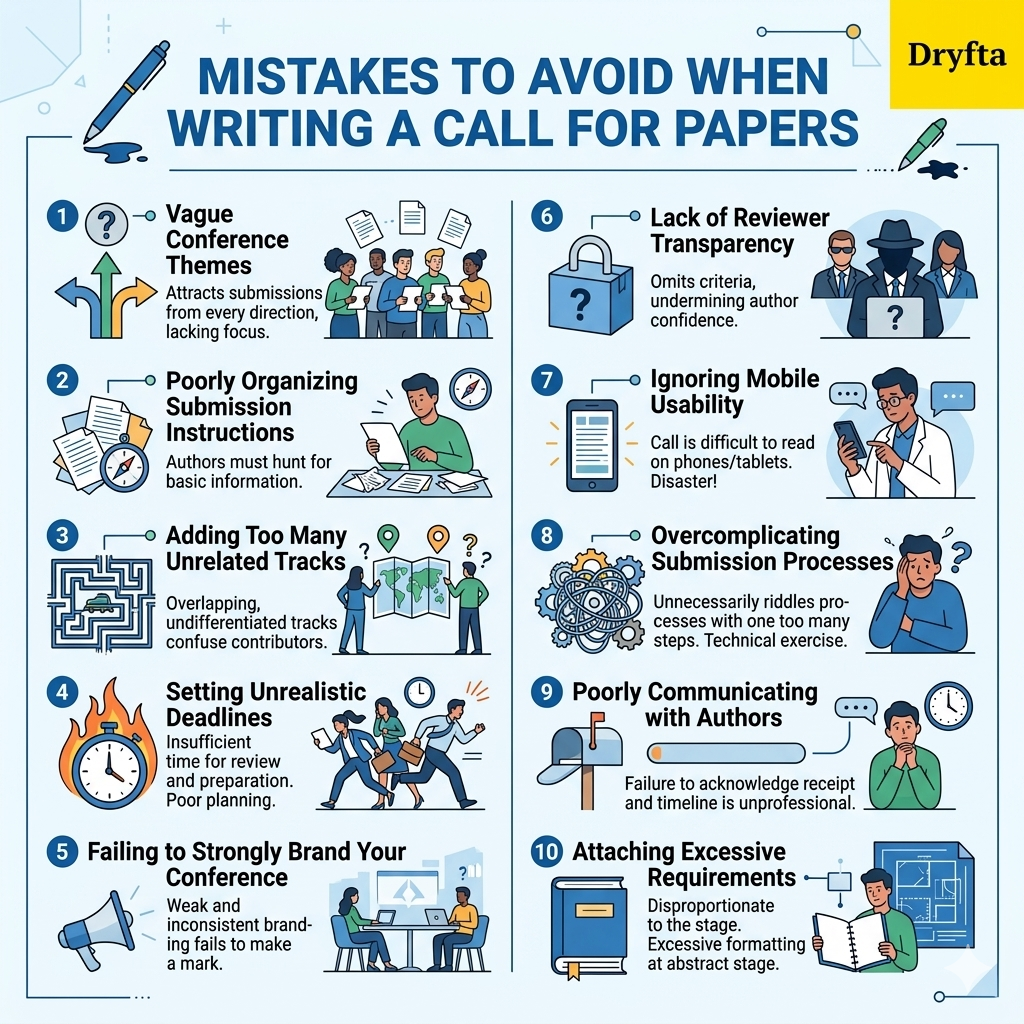
Don’t use vague conference themes: If you use vague conference themes, you’ll attract submissions from almost every direction and no one direction in particular.
Avoid poorly organizing submission instructions: Presenting submission instructions in a disorganized way will have your authors hunting for even the most basic information.
Refrain from adding too many unrelated tracks: Creating too many overlapping or undifferentiated tracks can confuse rather than guide your potential contributors.
Setting deadlines that are just plain unrealistic: If you set deadlines that leave insufficient time for meaningful peer review or careful submission preparation, that’s just poor planning.
Failing to strongly brand your conference: When you push out a Call For Papers that is weak and riddled with inconsistent branding, your conference failing to make its mark.
Lack of reviewer transparency: Omitting information about reviewers and evaluation criteria in a way that undermines author confidence is heavily discouraged.
Ignoring mobile usability: Neglecting mobile usability so the call for papers is difficult to read on phones and tablets is a recipe for disaster. These are the devices where many researchers are likely to first encounter it.
Overcomplicating your submission processes: Building submission processes that are unnecessarily riddled with one too many steps looks like a technical exercise more than a call for research abstracts.
Poorly communicating with your authors: Failing to communicate with authors after submission regarding acknowledgment of receipt and the review timeline is unprofessionalism.
Attaching submission requirements that are excessive: Imposing submission requirements that are disproportionate to the stage of the process, such as full formatting at the abstract stage is unnecessary, excessive and uncalled for.
How Dryfta Helps Organizers Manage Calls for Papers
Modern conference management platforms exist because the administrative and logistical challenges that come with research conferences and symposia are one too many. In 2026, it is too large a load to handle reliably without dedicated infrastructure like Dryfta. Dryfta is built exactly around these specific operational needs of academic conference organizers. Some of its most impressive features include but are not restricted to the following:
- All-in-one abstract management software: An online abstract submission system that centralizes all incoming work in one manageable interface
- Intelligent research submissions: Automated submission workflows that reduce manual handling at every stage of the intake process
- Smart reviewer allocation: Reviewer assignment automation that matches papers to qualified evaluators based on expertise and availability
- Fair peer review: Peer review management tools that keep the entire evaluation process visible and accountable to all parties
- Intuitive and personalizable submission forms: Customizable submission forms that can be adapted to different submission categories without separate administrative processes for each
- Email communication: Automated email notifications that keep authors and reviewers informed at every stage without requiring manual follow-up
- Reminder scheduling: Deadline and reminder management tools that send scheduled communications to all relevant parties on time
- Third-party integration: Conference website integration that connects the submission system directly to the public-facing event page
- CRM dashboards: Author and reviewer dashboards that give each party a clear and current view of their obligations and status
- Support for hybrid and virtual conferences: Hybrid and virtual conference support for events that span both in-person and remote participation
- Tracking in real-time: Real-time submission tracking so organizers always know where things stand as deadlines approach
- Proceedings and scheduling support: Support that carries accepted work through the entire lifecycle up until final publication and presentation planning.
Best Practices for Promoting Your Call for Papers
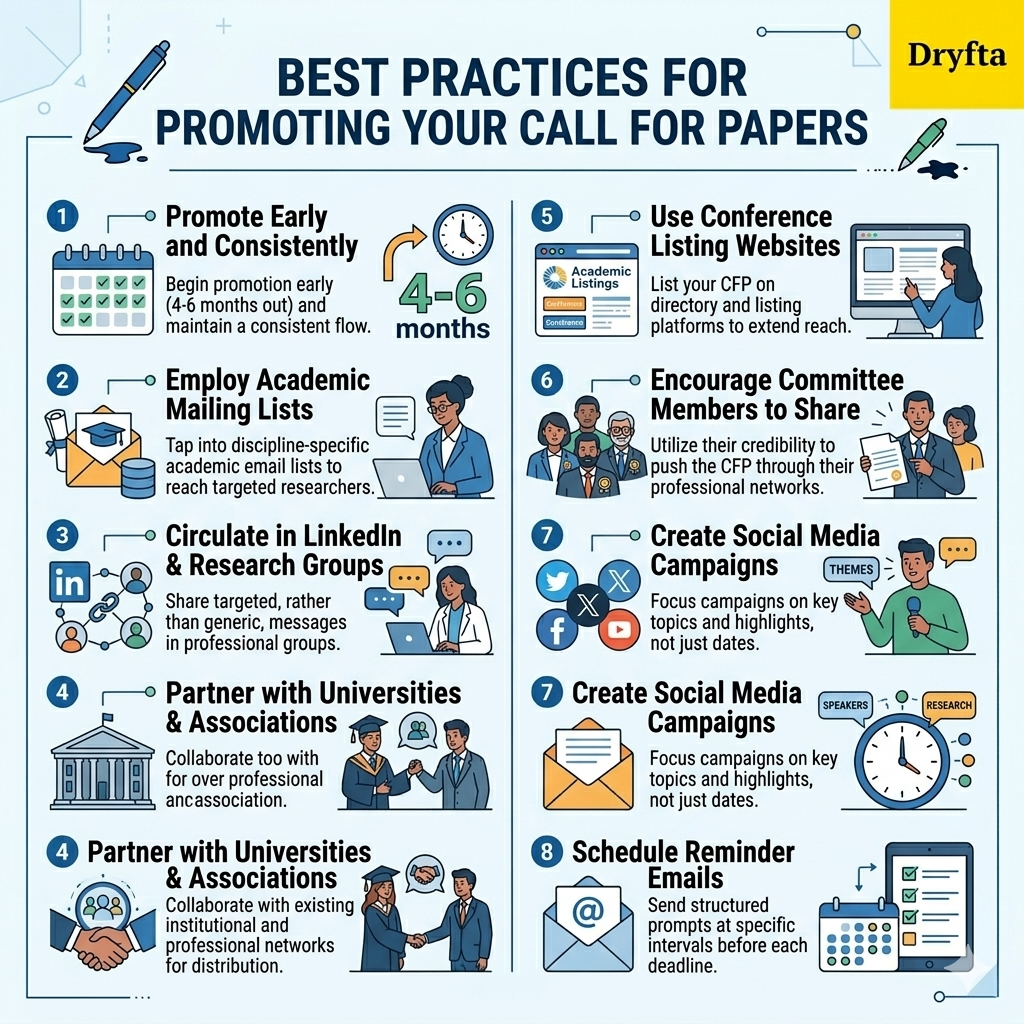
Promote early and consistently: Begin promoting the CFP early, ideally four to six months before the submission deadline.
Employ academic mailing lists: Use academic mailing lists in your discipline to reach researchers who are actively seeking publication opportunities.
Circulate in LinkedIn and research groups: Share the CFP in LinkedIn groups and discipline-specific research communities with targeted rather than generic messaging.
Partner with universities and associations: Partner with universities and professional associations to distribute the announcement across their established networks.
Use conference listing websites: List the CFP on conference directory websites and academic listing platforms to extend reach beyond existing contacts.
Encourage committee members to share Call For Papers: Encourage scientific committee members to share the CFP within their own professional networks, since their credibility travels with the message.
Create social media campaigns: Build a social media campaign that calls attention to specific themes, speakers and research questions rather than simply repeating deadline dates.
Schedule reminder emails before deadlines: Send out reminder emails at structured intervals before each deadline, since researchers often need multiple prompts before they act.
On Acing Your Next Call For Papers
A Call for Papers is, at its core, a statement of what your conference believes it can be. It is a lot like a Statement of Purpose that students write for universities. The point of an SOP is to show the student’s drive to join the institution or program and their larger goals. Similarly, a Call For Papers is a few hundred words that either showcases your event’s potential to the viewer or sabotages it altogether.
What a CFP should do is tell a researcher what your organizing committee’s values are and what kind of intellectual exchange you are trying to create. The conferences that see the best quality submissions work are not always the largest or the most generously funded. Sometimes, it is small-scale conferences with a solid purpose and a well-optimized Call For Papers that seize the day. It is the ones that are able to communicate with clarity and honesty what they stand for. Their content will read as though it was written by an institution that truly respects the researchers that they are asking to trust them with their work.
Frequently Asked Questions (FAQs)
What is a Call for Papers?
A Call for Papers is the formal invitation that academic conferences issue to researchers inviting them to submit their scholarly work for consideration. The CFP outlines submission requirements, review processes, important deadlines and conference topics that help researchers determine whether their work fits the conference scope.
How do you write an effective CFP?
Writing an effective Call for Papers needs research organizations to put on a balancing act. You must put out comprehensive information but without being unnecessarily tedious. Your CFL should be readable and presented in a way respects the time of busy researchers’. Start by clearly defining focused conference topics rather than listing broad themes that could apply to any conference in your field. Provide explicit submission guidelines covering formatting requirements, word limits, acceptable submission types and all relevant deadlines.
What should be included in a conference CFP?
A comprehensive Call for Papers should include several essential elements that help researchers decide whether to submit. Conference description explaining the event’s mission, themes and intended contribution to the field provides context for potential submissions. Submission guidelines and important deadlines for abstract submission, full papers if required. Finally, contact information for organizing committee members who can answer questions not addressed in the CFP itself is an important addition.
How do conferences attract quality submissions?
Conferences can attract quality submissions by communicating credibility and putting across clear value propositions.Strong credibility signals like accomplished scientific committees, university partnerships and previous conference success also convince researchers that presenting at your conference will advance their careers. Moreover, conferences employing transparent peer review processes by qualified reviewers are also likely to attract quality submissions.
How long should a Call for Papers be?
A Call for Papers should be long enough to provide all the mandatory information but concise enough that researchers read it completely. Most effective CFPs run between 200-1000 words and encompass things such as the conference’s description, key submission guidelines, clarity on review processes and deadlines.
What deadlines should be included in a CFP?
Some important deadlines that every Call for Papers should include cover the complete submission timeline from initial abstract through final camera-ready manuscript. Abstract or paper submission deadline tells authors when their initial work must be submitted for review consideration. Review notification date communicates when authors can expect to receive acceptance decisions so they can plan accordingly. Registration deadline for accepted authors specifies when presenters must register and pay conference fees to secure their presentation slots. Early registration deadline if applicable lets authors know when discounted registration rates expire.
How do peer review workflows work?
Peer review workflows for conference submissions typically follow structured processes that organizing committees define based on their field’s norms and conference goals. Authors submit their work through an online submission system that collects manuscripts along with author information and topic classifications. Organizing committee members or program chairs then assign these submissions to qualified reviewers based on expertise areas and conflict-of-interest considerations. Reviewers evaluate submissions using criteria specified in the CFP such as originality, methodological rigor, clarity and contribution to knowledge. Most conferences use either double-blind review where both authors and reviewers remain anonymous or single-blind review where reviewers know author identities but not vice versa.