University events today are no less sophisticated than full-blown professional gatherings of the highest order. The agendas for many varsity-organized events are now just as packed as those of corporate events. This is, in part, a reflection of serious business taking place within these venues. College students and graduate researchers have much to say, share and do for the world ahead of them. Certainly, no one is too young to make a difference, as the popular adage goes. Event scheduling softwares for universities have thus turned into powerful tools at enabling these gatherings as opposed to minimizing them in impact, scale and intensity. It’s 2026 and university events demand the kind of advanced and state-of-the-art event management infrastructure that other, more purportedly serious kinds of events possess. As event organizers, your job is to be where the gatherings are. And no one gathering is one too small and no one university event is insignificant.
College event scheduling software, just like other kinds of tools, benefit when they are fashioned in a centralized manner. Intra or inter college events tend to attract participants from around the campus or city. This means the number of attendees and consequently, the scale or organization needed, can be massive. And this is regardless of the theme or purpose of the university event. Whether it be an annual cultural event, a thinktank or a model MUN, each of these university-level events have earned their own position within student society. Delivering a consistent and centralized event experience for these aspiring, young talent must be at the top of the list for organizers and campus event management softwares.
Universities hold many events, from academic conferences and student workshops to orientation weeks, alumni reunions, guest lectures, and community outreach sessions. Managing all these events using spreadsheets and manual calendars becomes overwhelming. For this reason, top universities invest in event scheduling software that brings event planning into one place, automates repetitive tasks, and enables real-time interdepartmental communication. In this detailed guide, we examine 11 event scheduling software solutions that higher education teams can use to organize campus events more efficiently and to enhance the attendee experience and reduce paperwork.
What Is Event Scheduling Software for Universities?
Event scheduling software for universities can be best defined as a tool or digital, cloud-based platform product or service that assists universities in organizing events for student audiences within campus. digital infrastructure for the planning, coordination and publication of campus events across an entire institution. It is the system through which administrators, faculty, staff and student organizations can request spaces, avoid conflicts, allocate resources and communicate event information to those who need it. Its function is fundamentally operational. Not decorative, not supplementary, but structural to how a campus functions on a daily basis.
What distinguishes purpose-built campus event scheduling software from general productivity tools is its understanding of academic life as a specific context with specific demands. Universities do not simply run events. They run events within the constraints of academic calendars, examination periods, semester transitions, departmental hierarchies and layered approval structures. A lecture theatre being used for a postgraduate research conference carries different approval requirements and resource implications than the same theatre being booked by a student dramatic society for a rehearsal. Generic tools do not account for this. But purpose-built platforms do. Modern university event scheduling software extends well beyond the mechanics of booking a room. It integrates resource allocation, audiovisual equipment, catering and accessibility accommodations with the scheduling system itself, so that what is booked is not just a space but a fully resourced event. It publishes to public-facing institutional calendars. It communicates with student information systems. It produces utilization data that allows institutions to understand and optimize how their spaces are actually being used.
For large universities managing several thousand events annually, the value of these platforms is less in any single feature and more in the cumulative effect of consolidation. The replacement of fragmented, siloed and error-prone manual processes with automated, conflict-aware and centrally visible workflows.
Why Universities Need Professional Event Scheduling Software
Event management in a university environment is complex. The events range from small meetings to conferences with several attendees. Scheduling software has a great deal of benefits for universities, as it offers these facilities:
- Smooth Event Planning: Organize calendars and avoid the mess of unconnected events and emails.
- Automate Registration and Notification: Automatically process registration, reminders, or updates.
- Avoid Double Bookings: Real-time availability pushes out unavailability of rooms, improves location access, and resolves conflicts.
- Enhance the Event Experience: Make registration for an event, check-in, and personal schedules more straightforward with the help of software that keeps all the data in a single place.
- Provide Insights: Analyze and report on event data to improve future events.
Event Scheduling Software vs Event Management Software
These 2 categories are related but they are not the same. Misidentifying which one your institution actually needs, or failing to recognize that you may need elements of both, leads to software investments that leave important issues without redressal.
Event Scheduling Software
Event scheduling software is concerned with the logistical infrastructure that makes events possible. Its focus is on:
- Calendaring: a unified and conflict-free institutional schedule of campus events
- Room and venue booking: centralized space requests, approval workflows and confirmations
- Resource allocation: tying equipment, catering and support services to specific events and venues
- Academic calendar integration: respecting the hustle and bustle of semester timelines, examination periods and institutional blackout dates
- Facilities management: tracking venue usage, setup requirements, turnaround times and maintenance needs
- Platforms like 25Live and Ad Astra comprise this category well: purpose-built for the mechanics of campus space management, with deep integration into the institutional systems that govern how spaces are assigned and used.
Event Management Software
Event management software extends the function of scheduling into the attendee experience itself. It adds:
- Online registration and ticketing: customizable forms, payment processing and waitlist management
- Attendee management: check-in workflows, badge printing and participation tracking
- Event websites and landing pages: branded and publicly accessible event information for participants
- Mobile apps: personalized agendas, real-time notifications and networking functionality
- Analytics and reporting: registration data, session attendance and audience behavior
Communication tools: automated email campaigns, reminders and post-event surveys
Why Universities Often Need Both
The honest answer is that most universities do not have the luxury of choosing one category or the other. A research conference needs abstract management, peer review workflows, multi-track scheduling, attendee registration and a mobile app for international delegates. An orientation week needs room booking across multiple venues, resource coordination and mass communication tools for thousands of incoming students. A career fair needs registration, exhibitor management and high-volume check-in capability. Each of these is a different event type, a different operational challenge and a different software requirement.
This is the institutional reality that platforms offering both scheduling and event management functions were built to address. It is the primary reason why Dryfta has become the platform of choice for universities that want to manage the complete lifecycle of both functions in a single place. Built specifically for academic institutions, Dryfta covers room scheduling, abstract submission and peer review, registration, speaker management, mobile event apps and post-event analytics in a coherent and purpose-built platform.
How Universities Choose Event Scheduling Software
Selecting the right campus event management software is not a straightforward exercise in feature comparison. Universities are among the most complex institutional settings in which any software must operate. Their governance structures are layered, their stakeholder needs are divergent and their tolerance for operational disruption during evaluation and implementation is low. Understanding what actually matters in this selection process requires looking beyond marketing materials.
Campus-Wide Scheduling Requirements
The most fundamental requirement is also the most commonly underestimated: the ability to handle institution-wide event volume without breaking down. A system that works admirably for one department will not necessarily scale to serve an entire campus with integrity. Real-time conflict detection across all venues simultaneously, centralized space request workflows and multi-location booking are not premium features. They are the minimum viable capabilities for any university considering this kind of investment.Academic Event NeedsThe academic conference is a creature unlike almost any other event type. It involves abstract submissions, blind peer review processes, multi-track scheduling across parallel sessions, speaker coordination at scale and attendee management spanning international delegates. Generic event software was not built for this. The consequences of deploying it anyway, workarounds, parallel spreadsheets and frantic emails to speakers the week before, are familiar to anyone who has organized a research conference on inadequate tools. Platforms built specifically for academic events manage these workflows natively, which is an entirely different experience.
Student Organization Management
Student groups are frequently the most active event organizers on any campus and they are also often the least resourced. The right software gives them a self-service interface, one that does not require an IT department to operate, while still routing their requests through appropriate institutional approval chains. Accountability and accessibility are not in conflict here. They are both achievable with the right system.
Venue and Resource Booking
A room reservation that does not automatically trigger requests for the equipment, catering and support services the event requires is only half a booking. The most consequential failures in campus event management tend not to happen at the planning stage. They happen at 8am on the day of the event, when a conference venue is set up for a lecture but the AV team was never notified. Platforms that integrate resource booking with space booking eliminate this class of failure entirely.
Faculty and Department Coordination
Different departments have genuinely different scheduling cultures, approval processes and competing priorities for shared spaces. Good university event management software accommodates this without forcing institutional uniformity on units that do not need it. Role-based access, department-specific workflows and shared visibility into campus availability are the mechanisms by which coordination becomes possible without bureaucratic overreach.
Integration Requirements
A university’s technology ecosystem is rarely simple. Student information systems, learning management systems, financial platforms, HR databases and institutional communication tools all form part of a pre-existing infrastructure into which any new software must integrate. Single Sign-On support is often a non-negotiable requirement for institutional IT approval alone. Platforms that cannot connect to what already exists do not solve problems. They add to them.
Reporting and Analytics
Data is, in this context, a serious operational asset. Utilization reports inform decisions about space investment. Attendance trends reveal which programming is and is not reaching its intended audience. Departmental event volume data equips leadership with the evidence needed to make resource allocation decisions with confidence.
Event Scheduling Software For Universities
University events are an important part of the curriculum now. For making an event a success, apart from planning, proper software development is required. This makes the planning of the events easier and takes the workload off the organizers. A proper event management software gives the event a boost and helps in keeping track of the data and analytics all in one place.
1. Dryfta
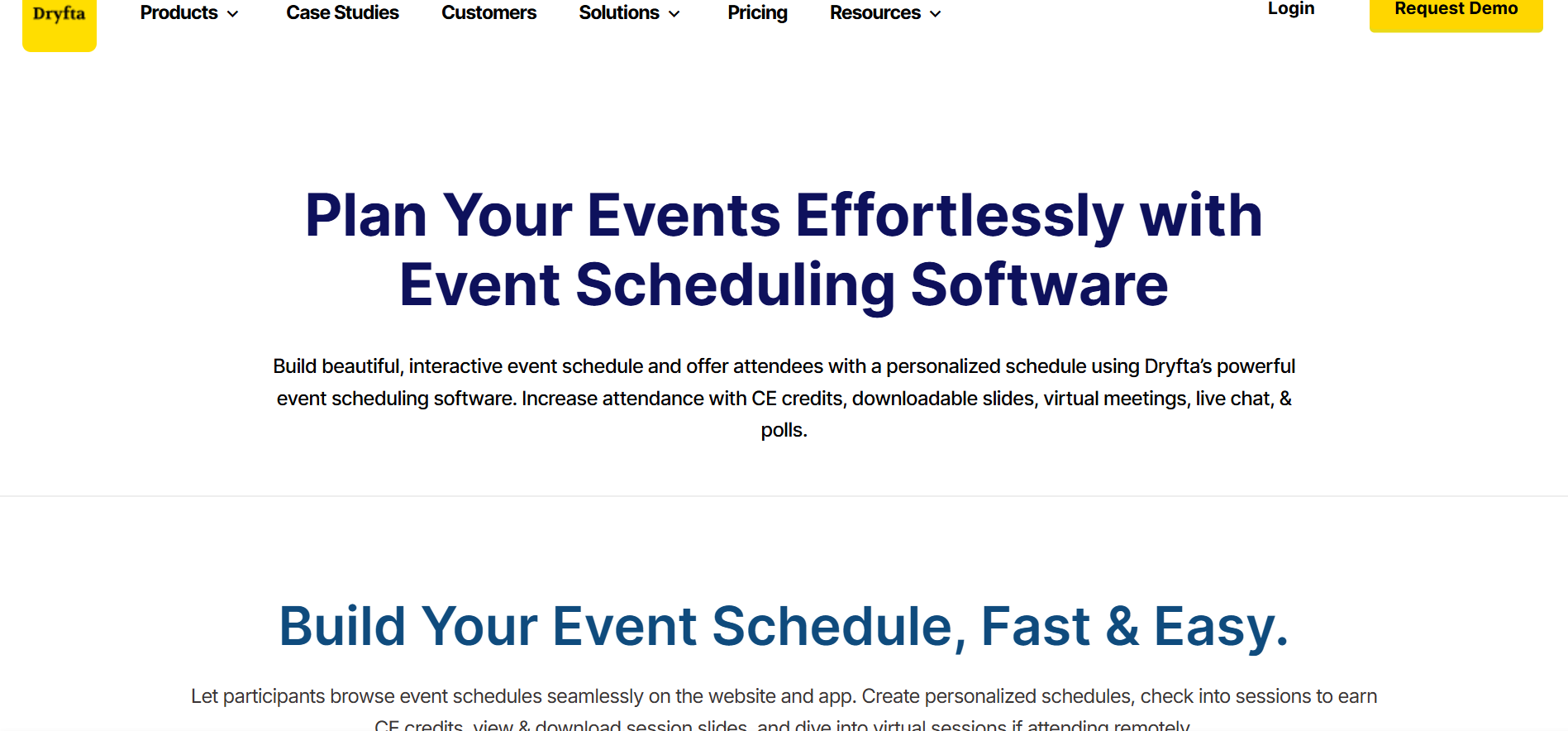
Dryfta allows for a highly effective event scheduling management system, which is designed for university events, research events, hybrid conferences, and academic meetings. This platform allows event planners to efficiently handle registrations, abstracts, and scheduling, along with other aspects of events under a single system.
The system offers customized event schedules with drag-and-drop features, real-time scheduling conflict management process, and personalized agendas for attendees help make the work easier. It helps host physical, virtual, or a combination of the two types of events, including live streaming and recording, and interactive discussions.
The mobile event app allows attendees to experience the event and access the schedule while on the go!
2. 25Live by CollegeNET
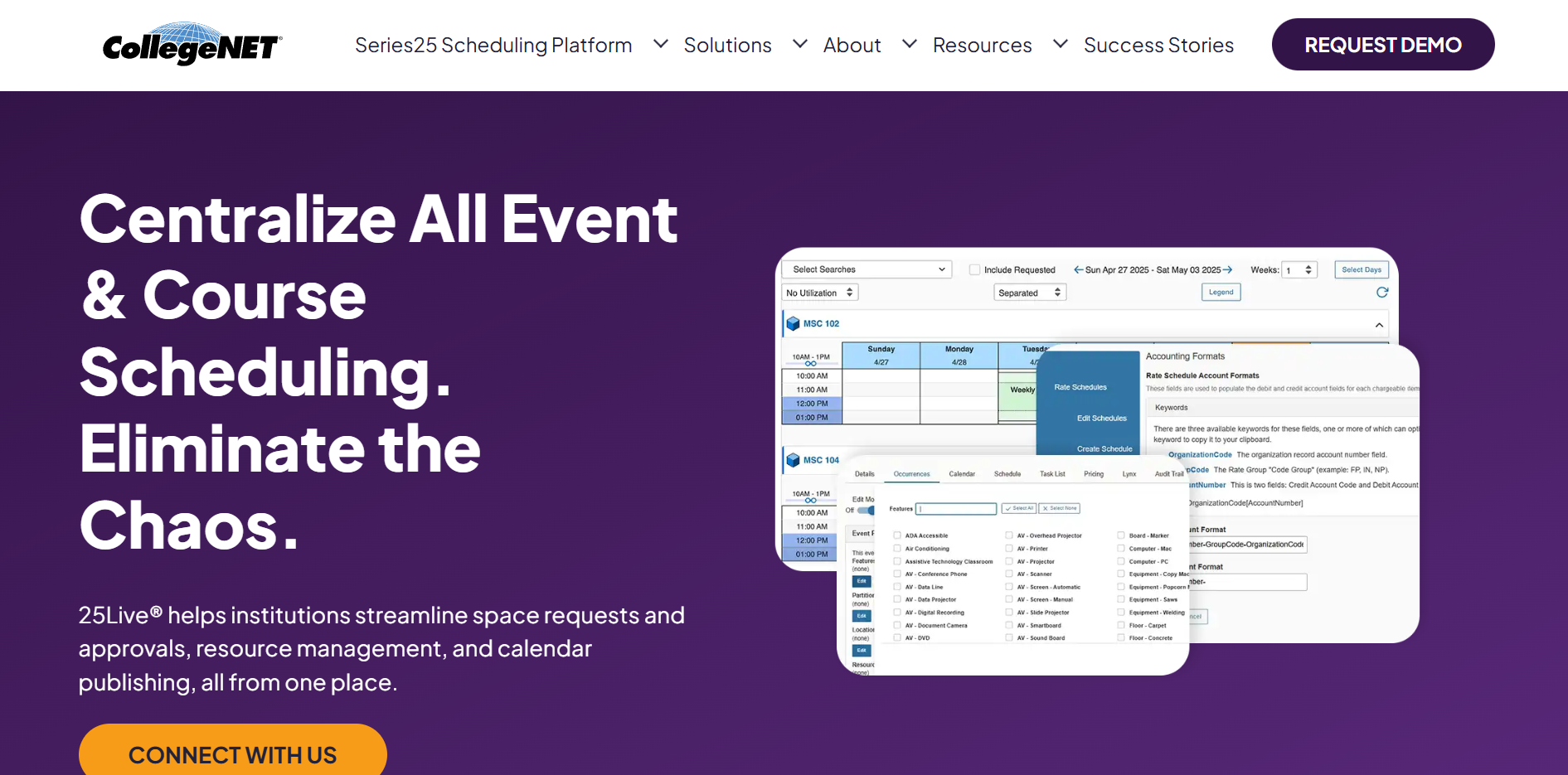
The solution, called 25Live, was specifically built for the higher education industry and could prove beneficial to universities, as it helps in centralizing space requests, approvals, and bookings, to ensure that these university spaces are utilized without conflicts. This solution also has good integration with student information systems.
It allows the departments to define their own forms and resource requests. Also, the live conflict alerts option helps to make sure that two events cannot be booked in the same room or at the same time.
3. iVvy
iVvy handles venue and calendar management for the event venues on the campuses. It streamlines the process by reducing contract and equipment management work. The platform helps coordinate the room availability, contract and resources such as audiovisual equipment, and ensures that every scheduled event has the necessary infrastructure. iVy is especially suited for institutions that host a mix of internal academic events and external bookings.
4. EventsAir
EventsAir allows universities to host hybrid and virtual events, enabling registration, QR check-ins, badge printing, and sessions, along with other features that track and engage attendees. It is designed so that organizers can schedule sessions, assign the virtual or physical rooms and track attendance using the QR codes provided. The platform makes sure that the scheduling information is consistent throughout the online and offline components. This makes it ideal for conferences that include both virtual and in-person participation.
5. idloom
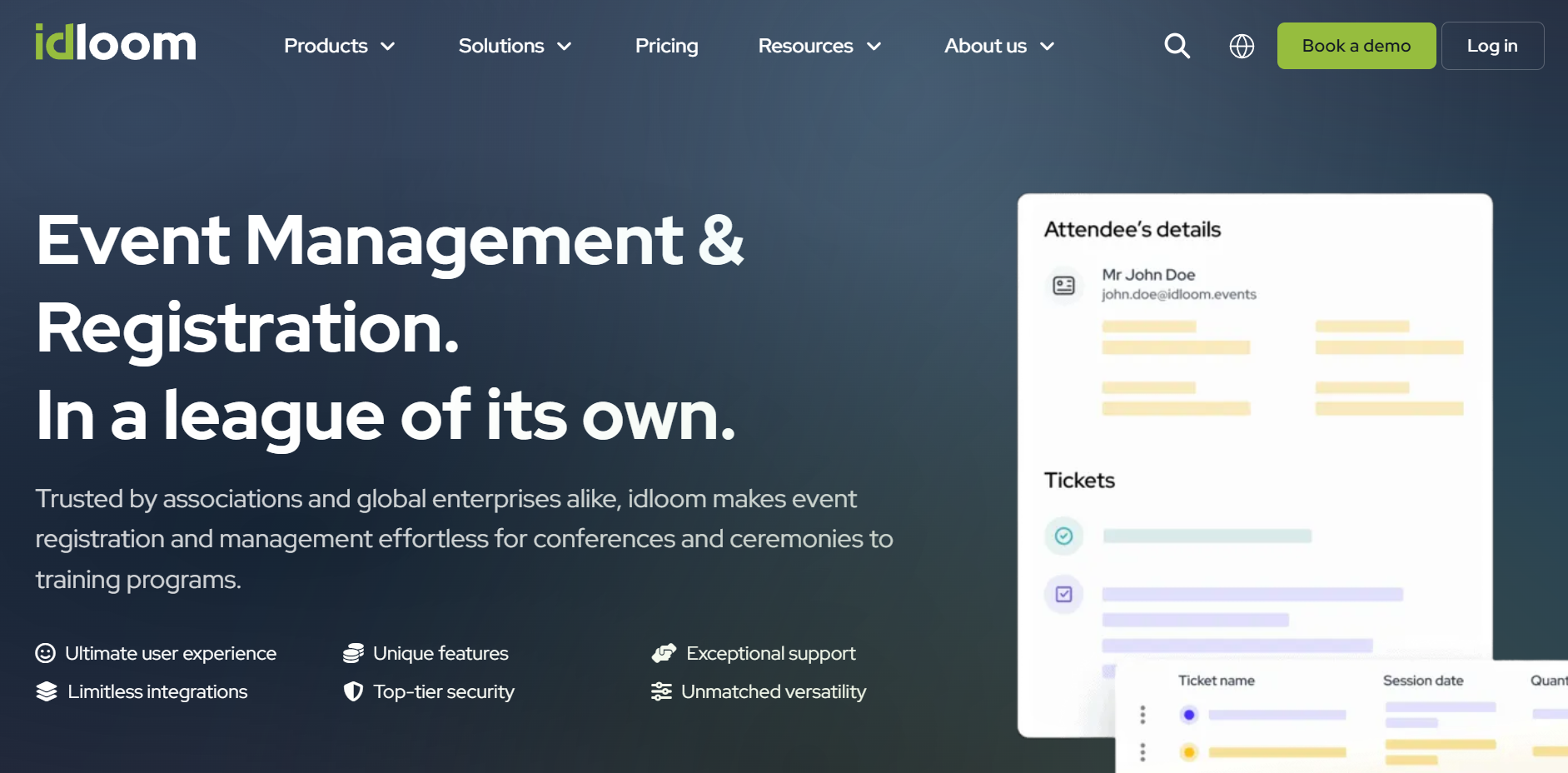
The scheduling and registration tool provided by idloom has deep integration capabilities with university systems, making operations more streamlined. It provides flexible scheduling and registration capabilities that can be used as per the requirements of the university. The platform allows the organizers to control session availability, manage time slots, and limit capacity based on registration data. Its integration capabilities make sure that the data syncs with other institutional systems and reduces manual work. It is a strong option for universities that need customized scheduling workflows and control over the event programming.
6. Cvent
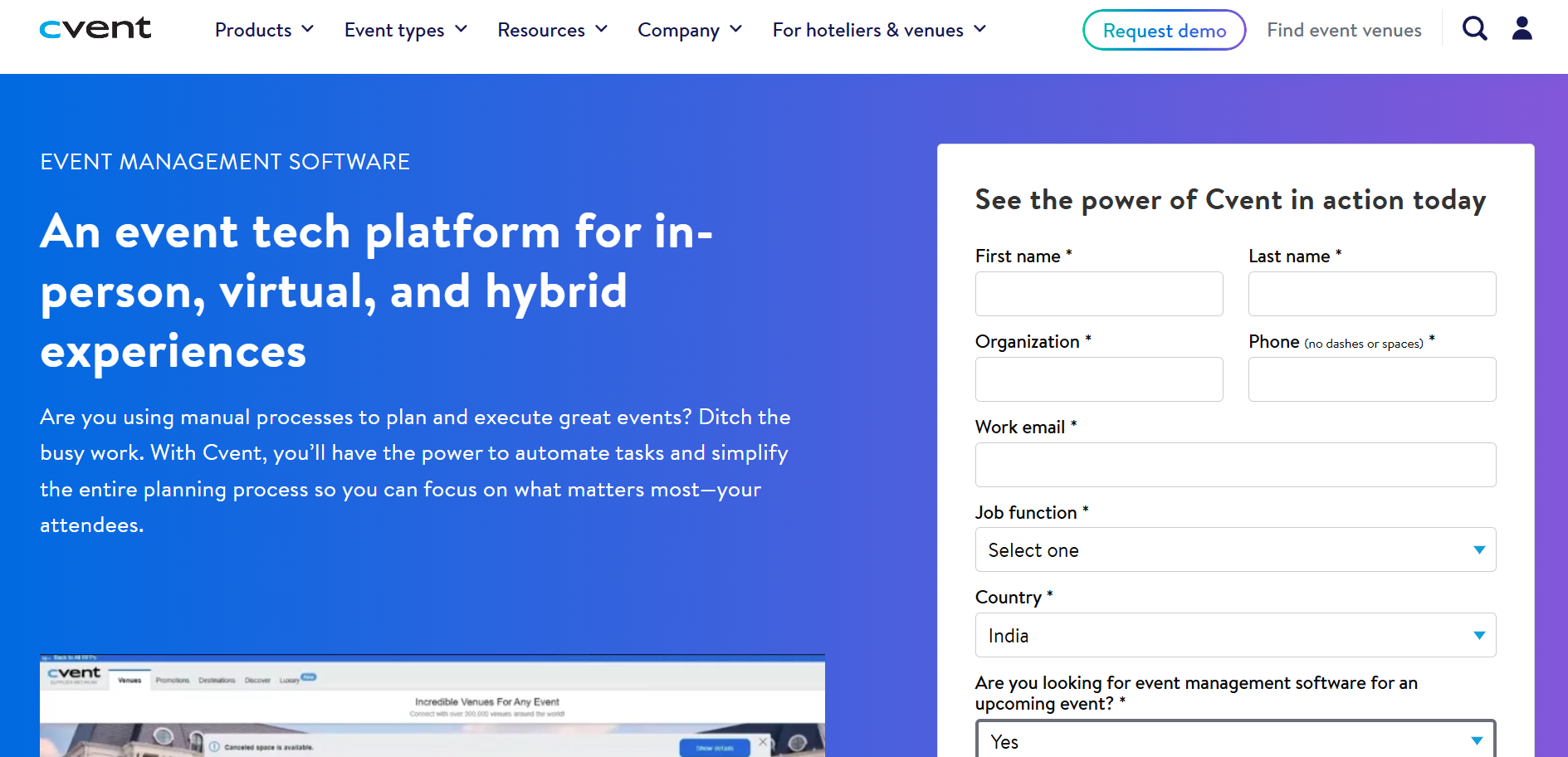
Cvent is a well-known organization that provides several facilities to various big universities. Cvent also offers other facilities such as advanced registration, mobile events, agendas, event analysis, etc. It is a robust enterprise-level platform that is used by many large universities and academic institutions.
Universities can manage complex event structures, parallel sessions, and speaker schedules. The software also provides advanced reporting and analytics that allow universities to evaluate a session’s performance and attendance trends.
7. Eventleaf
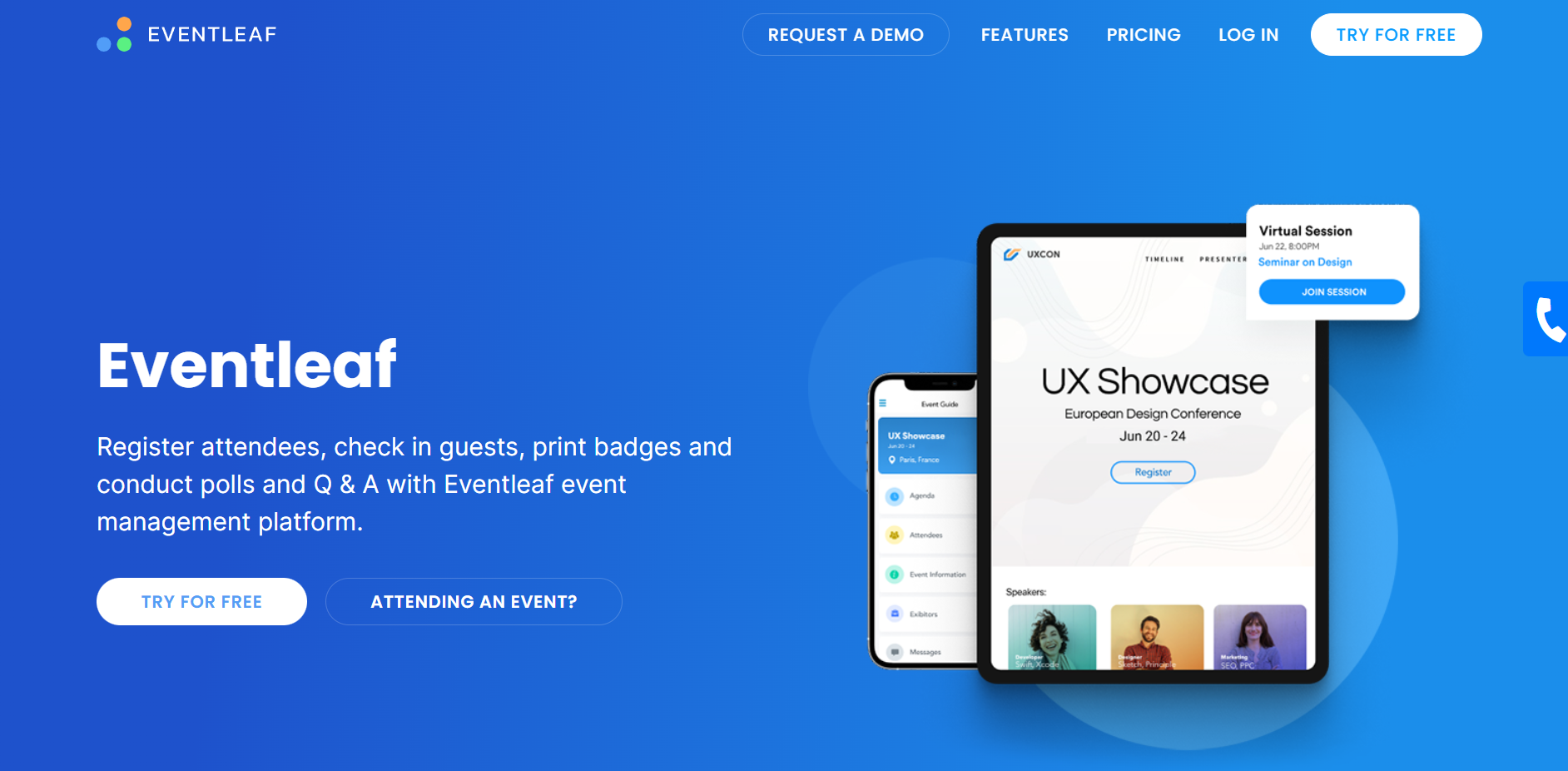
Eventleaf is a friendly interface for scheduling sessions, registrations, and interactions with the audience. It offers affordable membership plans with mobile capabilities, ideal for campus situations. It offers a simple and cost-effective approach to event scheduling for universities and enables organizers to manage registrations, publish agendas and access the data of the event throughout the event.
8. Eventtia
Eventtia effectively manages physical or virtual event schedules, including strong support for registration and publishing to sites. This is particularly well-suited for organizing detailed academic program schedules with personalized attendee tools. The platform supports personalized attendee data and integrates registration and communication tools with scheduling. The software works best for institutions that host mixed-format events and need flexible scheduling.
9. Momentus
Momentus is a unified platform for campus event management and scheduling. It handles event requests, venue bookings, and real-time space availability so that organizers can coordinate programs from one place. The automated workflows and shared calendars help universities streamline event planning and make it easier to communicate across all departments.
10. Coursedog
Coursedog is a powerful scheduling platform that is designed for higher education institutions. It supports event scheduling and classroom scheduling. It also provides a unified view of the campus activities. The system presents room conflicts by showing real-time availability and supports approval of custom workflows based on university policies.
Best Event Scheduling Software for Universities Compared
How to Choose the Right Scheduling Software
It is important to select an effective event scheduling system depending on your university’s goals and objectives. The factors to be considered include:
Scope of Events: Small department meetings need vastly different tools than international academic conferences.
Integration Needs: Are integration capabilities with student information systems or CRM applications a requirement? Well-rounded software should have strong integration capabilities.
Hybrid and Virtual Support: For hybrid and virtual activities, Dryfta, EventsAir, and Eventtia provide strong support.
Budget Support: Pay-as-you-go options can help support the adoption of various scheduling tools by smaller programs.
Common Event Scheduling Challenges Universities Face
There is a particular kind of institutional pain that comes from knowing exactly what is going wrong and why, and still lacking the tools to address it. Universities that have not yet invested in purpose-built scheduling software tend to recognize the following challenges with uncomfortable familiarity.
- Multiple Departments Organizing Events: When every department manages its own calendar independently, what results is not autonomy. It is fragmentation. Events overlap. Rooms are simultaneously requested by two departments who have no visibility into each other’s plans. Leadership cannot see a coherent picture of what is happening across the institution on any given day. The problem is not that departments are acting in bad faith. It is that the absence of a centralized system makes coordination structurally impossible, regardless of goodwill.
- Venue Double Bookings: A double booking is among the more embarrassing and disruptive failures a campus can experience. It is also almost never the result of human carelessness alone. It is the predictable consequence of disconnected systems: a facilities request form processed here, an email confirmation sent there, a shared spreadsheet that two people updated simultaneously. Real-time conflict detection removes this problem at the architectural level. It cannot occur in a system that checks availability before confirming a booking.
- Student Participation Tracking: Universities increasingly want to understand, and prove, the relationship between campus programming and student outcomes. Which events are students attending? Which sessions are generating meaningful participation? How does involvement in campus life correlate with retention and satisfaction? Without an integrated platform that captures this data consistently across all event types and organizers, these questions cannot be answered with any reliability.
- Academic Conference Scheduling: The scheduling of an academic conference is a logistical undertaking that’s quite heavy. You have hundreds of of submitted abstracts and reviewer assignments potentially across dozens of subject specialists. None of this is manageable at scale through email and spreadsheets.
- Resource Allocation: Events do not run in rooms alone. Rather they run on and via people, equipment, services and supplies. All of this must be confirmed, coordinated and in place before the event begins. When resource booking is handled separately from space booking, things fall through the cracks. Not because anyone failed to plan. Because the system made it structurally easy to miss something.
- Event Communication: Sending the right information to the right people at the right time is deceptively difficult when the people in question include students, faculty, external delegates, facilities staff, catering teams and senior administrators, all of whom need different information at different stages. Without automated communication workflows that can segment by audience and trigger on event milestones, event organizers spend enormous amounts of time on manual correspondence that software could handle reliably.
- Reporting Requirements: Institutional leadership requires event data. Accreditation bodies require it. Budget committees require it. The inability to produce consistent and reliable reports on event activity, venues used, attendees served, departmental event volume and resource expenditure will undermine the credibility your event.
Why Universities Choose Dryfta
Among the platforms examined in this guide, Dryfta occupies a position that is qualitatively distinct from the others. Not because it offers more features by raw count, though its scope is genuinely comprehensive, but because it is the only platform in this category built entirely around the specific operational reality of academic institutions. Every other platform on this list either serves the corporate enterprise and accommodates universities as a secondary use case, or specializes in one dimension of the university event problem, scheduling, registration or participation, but not the full picture.
Dryfta was built for the full picture. And that architectural decision has consequences that go well beyond any individual feature comparison.
Academic Conference Management
Running an academic conference is a particular kind of logistical undertaking. It involves a program committee reviewing hundreds of submitted abstracts, a scheduling process that must place dozens of sessions across multiple tracks without creating conflicts for key speakers or delegates and a communications workflow that must reach an international audience across multiple stages of the program lifecycle. Dryfta’s drag-and-drop multi-track schedule builder, with automated conflict detection, addresses this not as a workaround but as a designed capability. The distinction matters.
Event Registration
University registration scenarios are rarely simple. The same conference may offer different pricing for student delegates, faculty members, early registrants and international attendees. Group bookings arrive alongside individual registrations. Payment must be processed with appropriate receipt for institutional finance teams. Dryfta’s registration system handles all of this within a branded and customizable flow, one that reflects the institution’s identity and meets the expectations of professional academic attendees.
Campus Event Scheduling
The value of Dryfta beyond the academic conference context is sometimes underappreciated. Universities running orientation programs, alumni events, faculty development workshops and departmental gatherings can manage all of these in the same centralized platform, with shared visibility across the institution, consistent reporting and no need to maintain separate systems for different event types. The consolidation itself is a benefit, independent of any individual feature.
Speaker Management
A research conference with 200 presenters is, among other things, a speaker coordination challenge of significant scale. Dedicated speaker portals, through which presenters can upload slides, manage their session details, confirm participation requirements and receive communications, is a structural necessity. Dryfta provides this as a native capability, saving event coordinators hours of individual email correspondence per speaker.
Abstract Management
This is, in many ways, the feature that most clearly marks Dryfta as a platform built specifically for academia rather than adapted from another context. Its abstract submission and peer review tools support single, double and triple blind review protocols; automated reviewer assignment; configurable scoring criteria; and automated author notifications at each stage of the review process. All of this feeds directly into the scheduling system that builds the final conference program. The workflow is end-to-end. The data does not need to be exported, reformatted or manually transferred between systems.
Student Participation
The measure of a campus event is not simply how many people attended. It is the quality of what those people experienced and what they took away. Dryfta’s attendee-facing features, personalized agendas, live polling, networking tools and community functionality built into the mobile app, produce the conditions for meaningful participation rather than passive presence. For universities that want their programming to contribute to a genuine campus culture of intellectual community, this matters.
Mobile Event App
For multi-day academic conferences in particular, the mobile app is not a supplementary convenience. It is the primary interface through which most attendees navigate the event, checking session times, receiving updates, connecting with other delegates and accessing speaker information. Dryfta’s app delivers this experience with the level of reliability and polish that international academic attendees expect. It also reduces the operational and environmental cost of printed programs, a consideration increasingly present in institutional event planning.
Event Analytics
The post-event period is, in many institutions, the most neglected stage of the event management lifecycle. Dryfta’s analytics cover registration patterns, session attendance, attendee participation and speaker performance, equipping event organizers with the kind of evidence that makes the case for continued investment in campus programming, informs future scheduling decisions and allows program committees to understand which sessions drew the most genuine interest.
Multi-Department Collaboration
Role-based access controls allow different institutional stakeholders, faculty event coordinators, student affairs staff, facilities managers and external-facing conference organizers, to each interact with the platform in ways appropriate to their function. No one sees more than they need to, and no one is locked out of what they do. Administrators retain institutional visibility and control, while departments retain the operational autonomy they require. This is not a feature to be taken for granted. It is one of the genuinely difficult problems in campus event management, and Dryfta addresses it with architectural intentionality.
Virtual and Hybrid Events
The expectation that academic events will accommodate remote participation, whether for international delegates who cannot travel, early-career researchers without institutional travel budgets or colleagues in different time zones, has become structural rather than exceptional. Dryfta’s virtual and hybrid capabilities, including live streaming integration, virtual poster galleries, on-demand video archives and AI-produced session summaries, mean that institutions are not compelled to deploy separate tools for in-person and virtual formats. The platform serves both in a unified system, without the data fragmentation that comes from running two different event environments in parallel.
What Dryfta offers, ultimately, is not a list of features. It is the answer to a question that universities with complex event portfolios have been asking for some time: whether it is possible to manage the full lifecycle of academic and campus events, scheduling, abstract management, registration, speaker coordination, attendee participation and analytics, in a single platform built specifically for the environment in which they operate. The answer, with Dryfta, is yes.
Book a free demo to see how Dryfta can be put to work for your institution’s specific event management needs.
Final Thoughts
Event planning and scheduling software is no longer a luxury; it’s a necessity, particularly to those academic institutions that wish to incorporate the precision of planning, the power of engaging attendance, and the wisdom of data analysis. What sets Dryfta apart is that it integrates scheduling, abstract management, registration, hybrid events, and engagement tools that can be used by academic institutions at any stage of the process.
Bring order and clarity to your university events with our event scheduling and management solution. Request a free demo Today! See how Dryfta can help you streamline event scheduling, create better attendee experiences, and take your university events to the next level.