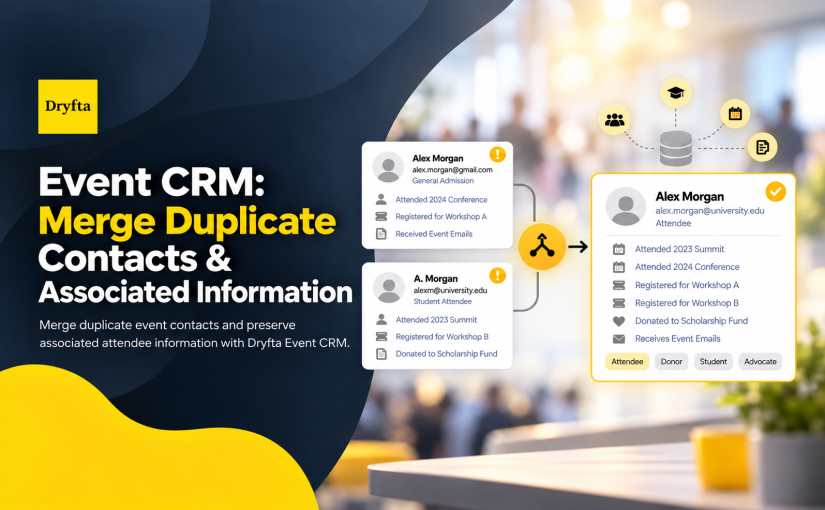
How to Merge Duplicate Contacts in Dryfta Event CRM

One person can end up with two contact records for perfectly ordinary reasons. They may register with a second email address, return as a speaker after attending an earlier event, or have an assistant create an account for them. Soon, their tickets, submissions, meetings, and messages sit in different profiles.

Dryfta’s Event CRM helps administrators review and merge duplicate contacts into one primary record. This guide explains how the merge works, which record to keep, and what to check before you confirm it.

Continue reading

Event Schedule : Complete Guide for Creating an Event Schedule

create event schedule


There are a lot of details to nail down when you are organizing an event or conference. What structure do you use, how do you handle a networking event, how long should speakers be on for, and how many intervals should you include? These are all excellent questions that deserve an answer, and while there is no single ideal way to run an event, you can use scheduling best practices to create event schedule for your next conference and ensure your guests get what they need out of their attendance.
Continue reading

The Power of Cloud Technology for Abstract Management

The Power of Cloud Technology for Abstract Management

In only the last few decades, the academic and research world has managed to pull off an almost impossible feat. Formerly reliant on paper-based systems and manual processes, abstract management has now carved a mark for itself in the digital era. All thanks to modern cloud technology and its integration into conference planning systems.

Continue reading

AI-Assisted Abstract Review for Research Conferences

AI-Assisted Abstract Review for Research Conferences

AI-assisted abstract review uses software to support defined parts of a conference review process, such as submission checks, topic classification, reviewer assignment and advisory analysis. It should not replace expert assessment of scientific merit or a programme committee’s final decision.

That distinction matters when a university, scholarly society or research conference receives hundreds or thousands of submissions. The administrative burden is real, but so are the consequences of a poor reviewer match, an exposed identity, a missed conflict of interest or an unexplained rejection.

The useful question is not, “Can AI review abstracts?” It is, “Which tasks can it support, who checks the output and what evidence will the committee keep?”

Continue reading

Integrate Dryfta with HubSpot Using Zapier: A Complete Guide

Integrate Dryfta with HubSpot Using Zapier: A Complete Guide

If you are organizer who has been manifesting better data organization for your event, this blog is the sign you’ve been looking for. With greater ambitions for your event company also comes the necessity to segment and arrange your data better. Perhaps you’ve been exporing your options for a while now. In this piece, we’re offering you one more to add to your list. You can integrate Dryfta with HubSpot using Zapier so that your selected event contact data reaches HubSpot without a manual CSV import. A controlled one-way workflow forms the safest starting point, built around a verified Dryfta contact trigger, an optional formatting or filter step, and a HubSpot find or create and update action.

Continue reading

Event Platform Migration: Moving Event Platforms Without Losing Conference History

Moving Event Platforms Without Losing Conference History

Moving on is never easy. And that’s true of event platforms migrating all their data into a new system. The goodbyes can be messy and sometimes hard to come to terms with. Your team may have spent years or perhaps even decades settling into the familiarity of an event management platform. They know it like the back of their hand. Therefore, in short, event platform migration can be a tough choice to make. However, it can be your new beginning, too. 

It can be frightening to look at all the data you’ll have to transfer into your new platform of choice. You are at risk of dropping the ball at any point in time. The bandwidth for mistakes to occur, for any data to be lost or compromised during event platform migration, remains broad. Yes, things can go sideways. 

Continue reading

How to Test Abstract Forms for Accessibility

How to Test Abstract Forms for Accessibility

Accessibility, when installed only superficially into your event management experience, is merely an oxymoron. It claims to be within reach for all but still falls short in important places, ultimately rendering it futile. This is the story of many abstract forms today. Designers believe they have created it with accessibility and PwD in mind, but only upon use do they realize that there are gaps leaking through. Abstract submission form accessibility is, therefore, only complete when you’ve tested it thoroughly before it goes live for the public. It is certainly not a great feeling for individuals to realize halfway through filling your abstract submission form that the form fields never truly accounted for their special needs.

Continue reading

SSO for University Conferences: A Comprehensive Guide

SSO for University Conferences: A Comprehensive Guide

No one enjoys logging in multiple times within a single interface. This is the core reason why university conference SSO, or single sign-on authentication, exists. To break down, in practical terms, what SSO really means, let’s look at an analogy that university goers find most relevant. They go through it on the daily. The university you attend is likely to have allotted a physical or digital identity card for you that the institution expects you to use throughout your time there. There may be an individual or something automated like a biometric system that verifies, authorizes, and lets people into campus.

Continue reading

What Event Data Should You Delete After a Conference?

What Event Data Should You Delete After a Conference?

What do you do when something that has given you a lot to remember…finally ends. How to you decide what to keep and what to discard? And no, this isn’t about your last failed relationship. The similarities can be quite uncanny but what we’re talking about are events. Conference data retention, or choosing what to retain from the bulk of that which remains after an event.

Continue reading

How to Build a Reserve Reviewer Pool for Abstract Review

How to Build a Reserve Reviewer Pool for Abstract Review

You have an academic event coming up and you and the team are now working through the toughest, often trickiest part of the planning: abstract management. All academic and scientific events hope for their selected submissions to be the best out of the lot. So, you set up a three-step review process. But the catch is that you have a reserve reviewer pool that doesn’t quite match the workload your team is looking at. Therefore, you are forced to find qualifies reviewers in the last minute when you realize that the magnitude of your submissions far outweigh the reviewer reserve in hand. Suffering from success, eh?

Continue reading

How to Build a Conference Operations Dashboard

How to Build a Conference Operations Dashboard

Is your room always messy despite you making a mental note to keep it tidy and organized? Does your living space become cluttered all over again only a few days after tidying it? And do you hate it? You probably do. This curse of having things all over the place is something that the majority dislikes. And wants to fix. But mostly they don’t know how to. Anything changes that they do make become lost to routine and the demands of everyday life. Data generated in your conference works similarly. No event planner enjoys having to work with information that’s in disarray. Information gets held up in silos and the team is left scatterbrained in trying to simply make sense of operations.

Continue reading