Top 10 Academic Event Platforms for Speaker and Session Management (2026)

Top 10 Academic Event Platforms for Easy Speaker and Session Management

What do you think organizers look for when organizing an event? If your answer is event platforms that simplify speaker and session management, then you are likely correct. Managing an academic event can be challenging, given the multiple important elements that need attention. The appropriate platform effectively prioritizes all these elements. Continue reading

10 Event Ticketing Platforms: Build Your Supplier Shortlist

10​‍​‌‍​‍‌​‍​‌‍​‍‌ Leading Event Ticketing Platforms in 2026

Use this ten-platform comparison to build an event ticketing supplier shortlist. Start with your event format, registration requirements and buying constraints, then compare the candidates against the same brief. The output is two or three suppliers to investigate further, with the reason for including each one. Continue reading

10 Hacks for Better Google Scholar Rankings of Your Academic Conferences

10 Hacks for Better Google Scholar Rankings of Your Academic Conferences

Conference proceedings are a lot like a billboard for your academic community. If they look authoritative and are easy to find, scholars will want to publish with you, too. On that note, Google Scholar is an incredible platform to build your conference’s credibility.

Continue reading

Why Researchers Prefer Dryfta for Abstract Submissions


Why Researchers Prefer Dryfta Abstract Management System

If you’ve ever submitted an abstract to a conference, you probably still remember the stress of it; the multiple tabs open on your laptop, the endless scrolling through instructions, the panic of wondering whether you uploaded the right file. Sometimes the submission portal feels more complicated than the research itself.

Continue reading

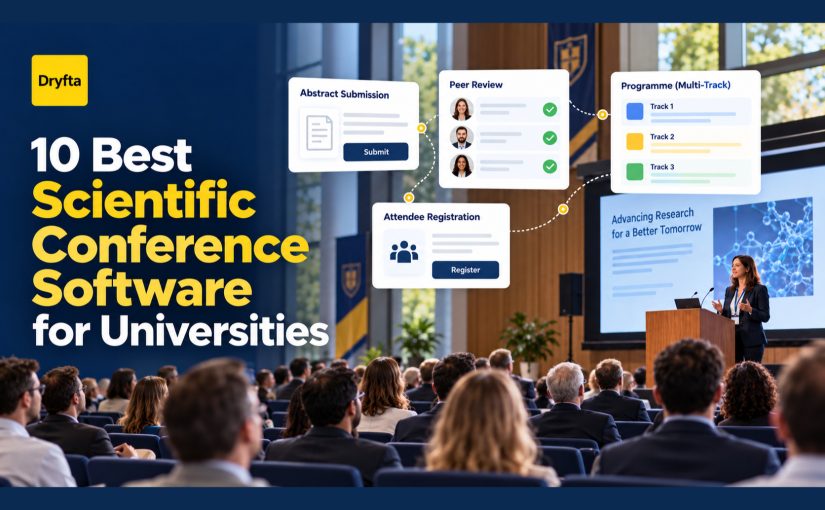
10 Best Scientific Conference Software for Universities in 2026

Choosing scientific conference software for universities starts long before registration. Researchers answer a call for papers, reviewers assess submissions, track chairs make decisions, speakers confirm, and organizers turn accepted work into a program. If those stages live in separate systems, the same names, titles, files, and decisions get copied again and again.

The best scientific conference software for universities keeps that chain intact. The right platform connects submissions and peer review with registration, scheduling, communication, onsite delivery, and reporting. It should also work for the people who use it only a few times a year, including volunteer reviewers, faculty chairs, student organizers, and visiting researchers.

This guide compares ten platforms through that university lens. It is not a ranking based on the longest feature list. It is a practical shortlist for research conferences, academic symposia, annual meetings, poster events, and other scholarly gatherings.

This comparison stays deliberately narrower than a full campus-event software review. If your institution needs one system for admissions, alumni, career, ceremonial, and student events, start with Dryfta’s university event management software page. For a broader comparison without the university procurement lens, read our guide to scientific event management platforms.

Editor’s note: Dryfta publishes this guide and appears in the comparison. We reviewed official product and help information available on October 5, 2026. Features, limits, services, and prices can change. We have not run identical hands-on tests on all ten platforms, so ask every shortlisted vendor to demonstrate the same real university workflow.

Continue reading

How to Make Abstract Submission Forms More Author-Friendly

How to Make Abstract Submission Forms More Author-Friendly.

Abstract submission forms help authors share their work with event teams. Authors work faster when the forms are easy to read. Clear forms reduce delay and help authors understand each step they need to follow. 

Continue reading

How​‍​‌‍​‍‌​‍​‌‍​‍‌ to Make Your Event Website Branding Work

How to Make Your Event Website Branding Work

Your event website is the first step to building your event’s brand. This is where the attendees will find the schedules, understand the purpose of the event, meet the speakers, and decide whether to register. Such is the effectiveness of branding; therefore, it is not only helpful but it is a necessity. Continue reading

Choosing the Best Software for Event Planning- A Guide

How to Choose the Best Event Management Software

The academic world isn’t short of conferences. From research presentations and forums to seminars and webinars, these are just a few of the many events that require careful preparation and flawless coordination to ensure everything goes smoothly. However, managing an academic conference using traditional techniques can prove to be not only time-consuming but inefficient. Adopting the latest technological innovations has been a blessing. The academic event management systems help the organizers ease the whole process of conducting and executing a conference.

Continue reading

10 Best Ways to Build a Thriving Academic Event Community

Academic Event Community- 10 Ways to Build a Strong Network

How does an academic event grow from a simple gathering into a strong community you feel part of right away? Academic events bring people together to share ideas and learn. A strong academic event community makes these events even better. It helps its members settle in right away, with clear steps and simple layouts guiding them throughout the process. These practices help the teams maintain order and keep things easy for all users from start to finish.

Continue reading

Practical Early Bird Event Registration Strategies for University Events

Practical Early Bird Event Registration Strategies for University Events

Organizing a university conference can be exciting, bringing in many new possibilities. You’re finally getting that symposium approved, securing speakers you’ve admired for years or hosting your department’s flagship annual event. However, for half of all event organizers in universities, come unpredictable attendance numbers and budget uncertainty.

Continue reading

10 Must-Have Tools for Academic Conference Planning

10 Must-Have Tools for Academic Conference Planning

Planning an academic conference isn’t just picking a date and locking down a venue. It’s a full-on adventure that needs sharp coordination, constant communication, and smooth execution from start to finish. If you use the proper academic conference tools, you will drastically cut down your working hours and reduce the chance of errors. These tools also make it easy to manage registrations, abstract reviews, scheduling, attendee engagement, and report generation. Continue reading