


Let’s own up to it. Half of us haven’t the slightest inking as to what B2B is. Or what a B2B event is for matter. And let alone an even chunkier word ‘B2B event marketing.’ Don’t worry though, from this moment onward, you’re going into society as someone with an understanding of what a B2B event is and how this connects to marketing. Because we’re about to tell you. Buckle up and read on.
Before I get into the nitty gritty of B2B event marketing, the writer of this article has a confession to make: I also had to look up what a B2B event is and what in the world it’s got to do with marketing. The bad part about this is I would then go on to spend a whole hour learning what ‘B2B’, ‘B2B event’ and ‘B2B event marketing’ meant. Almost like a game of puzzle, I had to place each word against the other and Google what they meant as a whole. Each combination seemed to carry a different meaning altogether. Now, here’s the good part to come out of my tedious inquest: I’m going to make sure the rest of you don’t have to scrabble for the meaning of B2B event marketing. In this article, I’m laying out everything about B2B event marketing- what it is and more acutely, what it isn’t.
What You’ll Be Reading in This Article
If you’ve read this far, it is at this point that you decide whether or not to continue. So let me save your time and detail the contents of this lengthy, educational piece. In this blog, you will:
- Understand what B2B event marketing is and why this is a strategy worth attempting in 2026.
- See for yourself why it is that B2B buyers and sellers still choose to concern themselves with event-based marketing despite the easier leeway: social media.
- Have an awakening about how the job of B2B event marketing is more than conventional buyer-seller formalities. It also, in more ways than one the relationships, exerts an important influence on stakeholder relationships across levels in the supply chain.
- Familiarize yourself with the virtual avatar of traditional B2B marketing events and how this is a format that is here to remain.
- Finally, also understand the significance of metrics and measures as ROI (Return on Investment) in the fields of B2B event marketing.
What Is B2B Event Marketing?
Event marketing that focuses on promoting products and services between businesses and other commercial entities is B2B or business-to-business event marketing. Most typical event marketing originates from businesses and centers on its direct customers and consumers. This is called B2C or business-to-customer marketing.
How B2B and B2C Event Marketing Differ From One Another
The distinction between the two can be a little perplexing to catch immediately. However, they’re different in a few fundamental ways: how they operate and who they work to cater to. Both B2B and B2C event marketing work on behalf of businesses selling something, a product, service or some other for-profit entity. The people that their event marketing targets, is what differs.
- B2B marketers want other businesses to buy from the company they are promoting. For instance, a marketer who hosts a trade show on behalf of an automobile spare parts company, works to attract potential businesses like car or bike manufacturers that may use their products.
- B2C marketers’ efforts and event showcases are aimed at their retail buyers at the first level. This is usually employed by businesses selling finished products or services ready to be purchased by customers. A pop-up show hosted by a cosmetic company to advertise its new range of beauty items is a great example of B2C event marketing.
Types of B2B events
B2B events aimed at marketing take a few different forms. Each of them possess their own objectives and are targeted at attracting different kinds of business customers.
- Conferences: Industry conferences are the broadest-reaching format in the B2B event space and attracts buyers, vendors, practitioners and media in large proportions.
- Trade shows: Trade shows are specialized visibility events that put exhibitors in the direct view of buyers. Exhibitors showcase their products or services for viewing by industry stakeholders and the general public.
- Webinars: Online or virtual avatars of traditional ‘seminars’ that comprise programs like keynotes, speeches and lectures by experts. The lectures are often followed by reflective discussions and Q&A. In the context of B2B events for marketing, webinars can take the form of live, virtual demonstrations or pitches to potential buyers.
- Roundtables: Roundtables involve an intimate gathering of 8-12 VP or C-suite decision-makers and the discussion is structured around novel business strategies, analysis of existing ones or identifies common challenges.
- Executive summits: Simply put, these types of summits see all the most important people within one room. It’s the executive-level professionals, from CEOs and other key decision-makers who come together to talk business. Executive summits are straightforward and often waste less time on pleasantries, rather choosing to dive right into the things like matter.
- Product launches: Herein, a live and dedicated launch event is set up with the core objective of launching a new product line or service solution. The event shows urgency being a limited occasion, often taking place over a single day. The buzz that it generates helps carry the momentum for other marketing efforts that can fasten the B2B sales cycle.
- Networking events: Venues and programs deliberately curated to get professionals in a particular industry or broader field network with one another. It is a format that simultaneously forms connections and creates an organic pipeline for commerce. This makes it one of the most efficient events available to any B2B organization with a moderately established presence. Brand new businesses may have to work their way up to form that trust that is often exchanged at networking events. Nonetheless, all kinds of businesses, at any degree of market presence, find networking events to be productive in their own right.
What Marketing Events Can Do For Long B2B Sales Cycles
On an average, a single B2B sales cycle can take 60 to 120 days to turn into a completed purchase action.
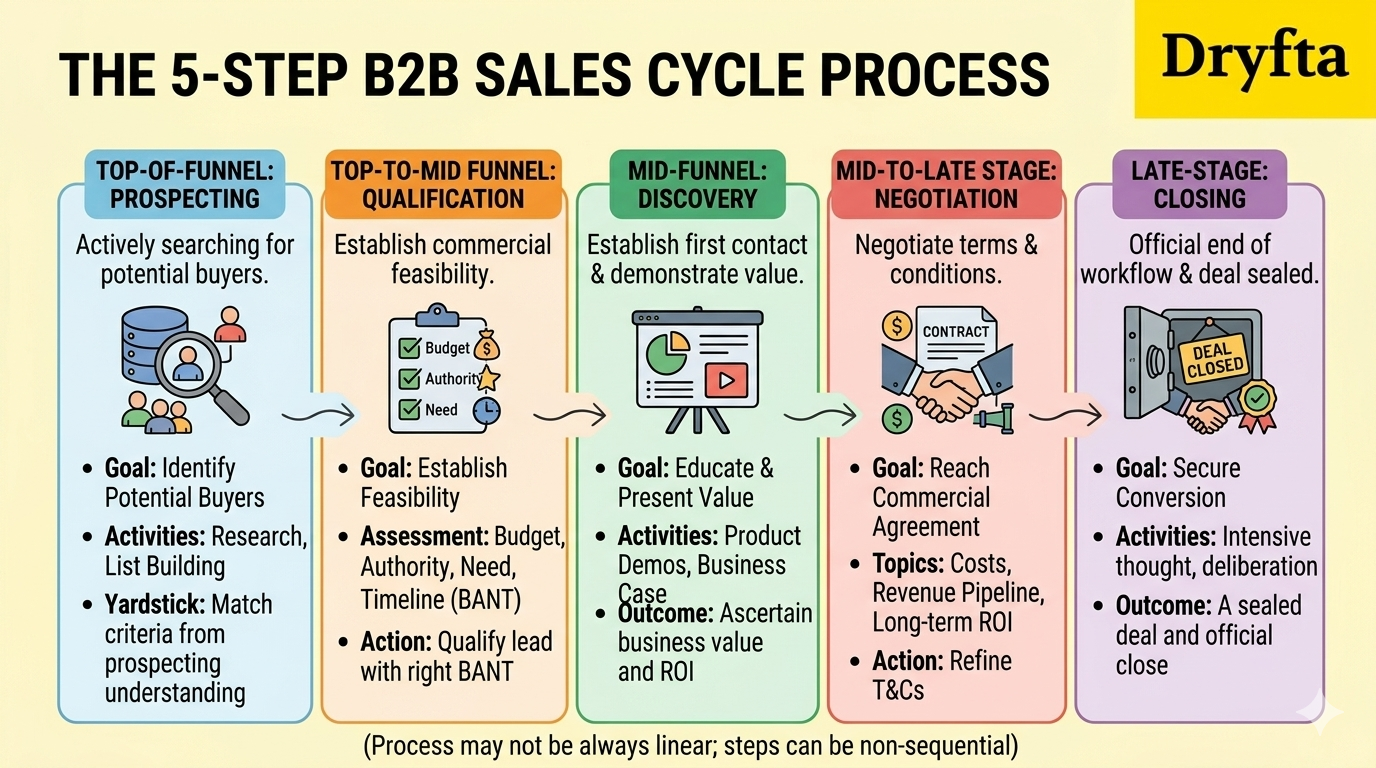
A B2B sales cycle refers to all the steps that go into the business-to-business commercial process. It roughly involves the following steps. The process, however, is not always linear. Some businesses may squarely jump from step 1 to step 5 while other firms may find themselves moving back and forth between the first few steps before achieving progress. The broader B2B sales cycle can be compressed into the below 5 steps:
- The Prospecting Stage: Businesses begin actively searching for potential buyers, comparing and contrasting them against a yardstick of criteria developed by the prospecting Understand.
- The Qualification Stage: Once a few latent buyers have been identified, businesses work to establish the commercial feasibility and practicality of the purchase. A client that is ready to progress to the next step must qualify with the right budget, authority, need and timeline (BANT) for your business proposal.
- The Discovery Stage: Having qualified and deemed fit by the prospecting business, first contact is then established with the buyer. This is the stage wherein the customer hears about the product or service and how it may be of commercial use to their business. Interested buyers watch demonstrations of the product or service to better ascertain its business value and ROI.
- The Negotiation Stage: The seller and buyer of the B2B cycle engage in negotiating terms and conditions pertaining to the commercial relationship. This can include aspects like negotiating for costs to be brought down or raised as well questions about the revenue pipeline and long-term ROI.
- The Closing Stage: The final and most rewarding stage of the B2B sales cycle. It marks the official end of the workflow and a deal is sealed after intensive thought, deliberation and negotiation from the part of the buyer.
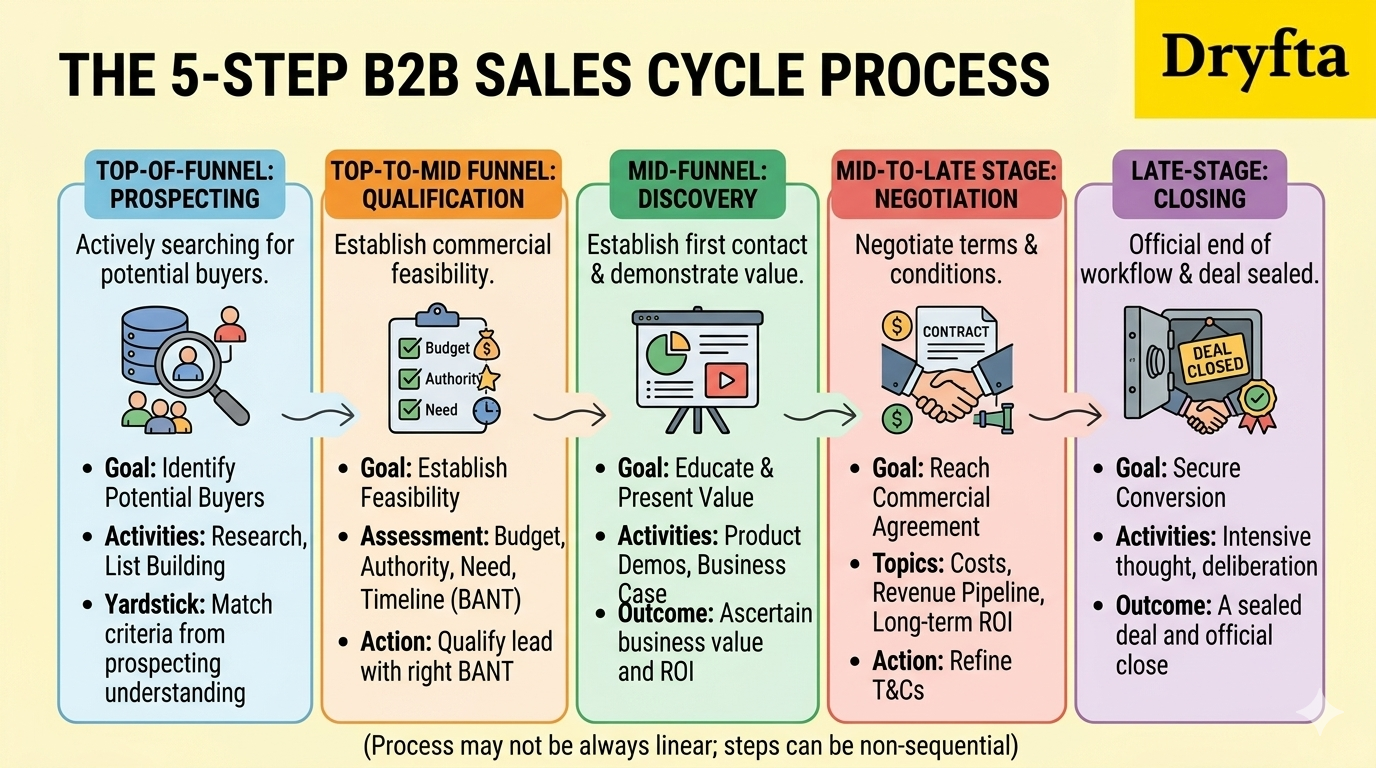
The duration that it takes for sellers to arrive from stage 1 to stage 5 varies for each individual buyer-seller use case. What B2B marketing events do is significantly reduce the time involved in the cycle, which are otherwise long and tedious journeys that feel more like legal battles than a commercial function. B2B events build trust and encourage buyers to take action within days as opposed to months.
According to Prospeo, a successful B2B marketing event can reduce the sales cycle’s duration by a notable 30%.
Why B2B Event Marketing Still Matters in 2026
Business-to-business e-commerce in the USA is skyrocketing at the pace like never before.
The USA market alone is expected to grow at a CAGR of 18.5% from 2026 to 2033, as per reports from Grand View Research. This makes B2B event marketing both vital and called for.
It can be tempting, in a world saturated with marketing technology and automated outreach sequences, to assume that the B2B event has had its era and is now in decline. But the data vehemently refuted this assumption. According to studies, 78-80% of event organizers described in-person conferences, summits, and conventions as their organization’s single most impactful marketing channel.
What events do that nothing else can is worth examining carefully, because it is precisely this capacity that justifies their continued importance in B2B marketing efforts.
- Face-to-face trust building is a core tenet of B2B marketing events. It builds a kind of trust and creates reach that digital communication or social media fails to match up to.
- Higher-quality lead generation is a structural advantage of B2B events that the cost-per-lead calculation does not always fully capture. The average cost per lead at a trade show is $112, versus $259 for a field sales call. More importantly, event leads arrive pre-qualified in a way that inbound leads rarely are.
- Stronger buyer engagement at B2B events is a function of the medium itself. Events like trade shows and pop ups create multi-sensory, immersive experiences that occupy the full attention of buyers.
- Account-based marketing chooses to take focused action rather than casting a wide net. There’s plenty of fish in the sea but we are looking at what are a handful of ‘high-value’ individuals. These are high-fidelity engagements with the specific individuals whose signatures are what will lock deals and close the B2B sales cycles for you.
- Thought leadership positioning through conference speaking and moderated discussions is another efficient strategy to gain credibility. Standing on a stage and offering useful insight to an audience of peers is a form of trust-building that operates on a different timescale and at a greater depth than superficial content marketing.
- Faster enterprise sales conversations are among the most commercially significant outcomes of well-executed events. A prospect who has spent two days at your summit, heard your vision, met your team, spoken with your customers and formed a human connection will be more likely to make a purchase decision as opposed to someone who has only received cold outreach. Events compress the sales cycle by doing, in two days, what the pipeline otherwise takes 6 months to accomplish.
- Community building is perhaps the most underappreciated long-term outcome of sustained B2B event programs. The annual conference that creates alumni communities, LinkedIn groups, peer networks, and year-round professional relationships is building a commercial ecosystem that generates referrals, advocacy.
- Hybrid events have expanded the boundaries of B2B event marketing in amazing ways. And they’ve managed to do so without diminishing its effectiveness. According to Dreamcast, 86% of B2B organizations report positive ROI from hybrid events.
Types of B2B Events That Generate the Best ROI
In this section, let’s take a closer look into the most effective B2B marketing events in 2026. You will also read, in this section, how each format turns into lead generation and pipeline value for buyers and sellers. Pipeline value is best defined as the total estimated commercial worth of deals, contracts, or business relationships that are at some stage of active progression following a B2B marketing event.
Industry conferences
Industry conferences are the broadest reaching format in the B2B event toolkit, attracting buyers, vendors, practitioners and the media. The lead generation potential is high by volume. However, the quality of these leads also depends on the quality of your audience.
Use case: The cosmetic industry regularly holds industry-wide conferences, often convened by larger brands or popular firms. The event serves as a venue for buyers and vendors in the industry to acquaint themselves with one another as well as explore product or service offerings.
Pipeline value: Pipeline value is high when the audience pool is carefully picked to ascertain their commercial viability.
Trade shows and expos
Trade shows place exhibitors in direct proximity to active buyers who have, by virtue of attending, self-selected into a category of interest. The lead generation potential is strong and the opportunity for real time qualification is unmatched
Use case: The automobile manufacturing circle hosts a trade event to put on show the newest and most appealing products in the market. This showcase then motivates vendors to buy from exhibitors they find commercially efficient.
Pipeline value: High to very high pipeline value.
Customer advisory boards
Customer advisory boards are a format that simultaneously deepens retention, generates advocacy and creates an organic pipeline. This makes it one of the most commercially efficient events available to any B2B organization with an established customer base. Businesses invite their most valued customers for what is an advisory session. In the course of just a single day, customer advisory boards are able to collect product feedback that can materially shape the next few quarters of business development.
Use case: A mid-market SaaS company convenes its longest-standing enterprise customers like heads of operations and VP-level technology leaders for a customer advisory session. These are leaders who use the platform on the daily.
Pipeline value: Pipeline value is high, especially with regard to revenue expansion.
Executive networking events
Executive networking events are curated, high-access gatherings designed particularly for C-suite leaders, senior decision-makers, and board-level stakeholders.
Use case: Managerial consultancy hosts an executive networking dinner for Chief Financial Officers across the financial services sector. The dinner is structured around discussions about capital allocation and pitches for new sales.
Pipeline value: The concentration of decision-making authority in the room makes the pipeline value potential high.
Webinars and online summits
Webinars and online summits are B2B virtual events that bring together professional audiences without the friction of travel, venue logistics and geographic limitation.
Use case: A webinar commemorating ‘World Environment Day,’ hosted by a plumberware brand, uses the primarily awareness-oriented platform as a way to promote its climate-resistant plumbing material.
Pipeline value: Moderate to high at scale.
Hybrid conferences
Hybrid conferences are, in a sense, the most ambitious format in the B2B event manager’s portfolio. When executed thoughtfully, hybrid conferences, occurring both online and offline, are the most expansive in their commercial reach.
Use case: On-site attendees of a hybrid conference hosted by a pharmacology retail firm participate in closed roundtables and demonstrations of new drugs. On the other hand, virtual attendees access keynote sessions by professionals who worked behind the scenes. The audience base here is targeted at members of the healthcare and allied sciences community as well as corporate firms who work in the pharmacology supply chain.
Pipeline value: High for the on-site cohort and moderate for those tuning in from home or elsewhere.
Product launch events
Unlike general events, the agenda of product launches are unambiguous. The host organisation has something to unveil or show and the attendee list is assembled on the basis of who most needs to see it the most.
Use case: A supply chain software business invites its top 50 prospects, all currently in active sales conversations, to an exclusive half-day launch event for its new inventory intelligence module.
Pipeline value: Extremely latent and very high, particularly when the invite list is drawn from an existing pipeline.
Workshops and training sessions
Workshops and training sessions are hands-on, practical events that run over the course of a few days. The core objective herein is to get attendees to gain proficiency in a particular professional skill or a commercial forte.
Use case: A data analytics consultancy runs a week long in-person workshop for senior analysts who work for a prospective enterprise the firm is hoping to sell its tech to.
Pipeline value: Moderate to high and associated with a longer conversion arc.
Partner events
Partner events are best defined as programs co-hosted with another business entity, often as a means of sharing commercial partnership. In doing so, these host organizations who work as a team are able to effectively double their potential audience, split the cost and benefit from the B2B endorsement of their brands.
Use case: A legal technology firm may co-host a partner forum with a mid-market law firm association. In doing so, the partner firms jointly target managing partners across regional practices.
Pipeline value: Moderate given that the pipeline value is influenced by the quality of the partner relationship.
User conferences
User conferences are annual or periodic gatherings convened specifically for an organisation’s existing customer base. The primary audience is people who have already bought and the commercial objective herein, rather than acquisition, is retention, expansion and product adoption.
Use case: A technology retail company invites its existing user base for a user conference packed with activities as product roadmap previews, peer-to-peer learning sessions and access to senior product and engineering leadership.
Pipeline value: Pipeline value is high with greater possibilities in recurring revenue.
How to Build a Successful B2B Event Marketing Strategy
Define clear event goals
Your B2B event marketing strategy should start out with a clear purpose and at least a handful of measurable goals. Anything other than this simply produces the effect of an ambiguous and moderately effective internet webinar. Ask questions and set important goals on brand visibility, pipeline acceleration, customer retention and partner development. Defining your event goal with specificity at the outset is what will raise your event’s marketing potential from ordinary to extraordinary.
Align events with sales pipeline stages
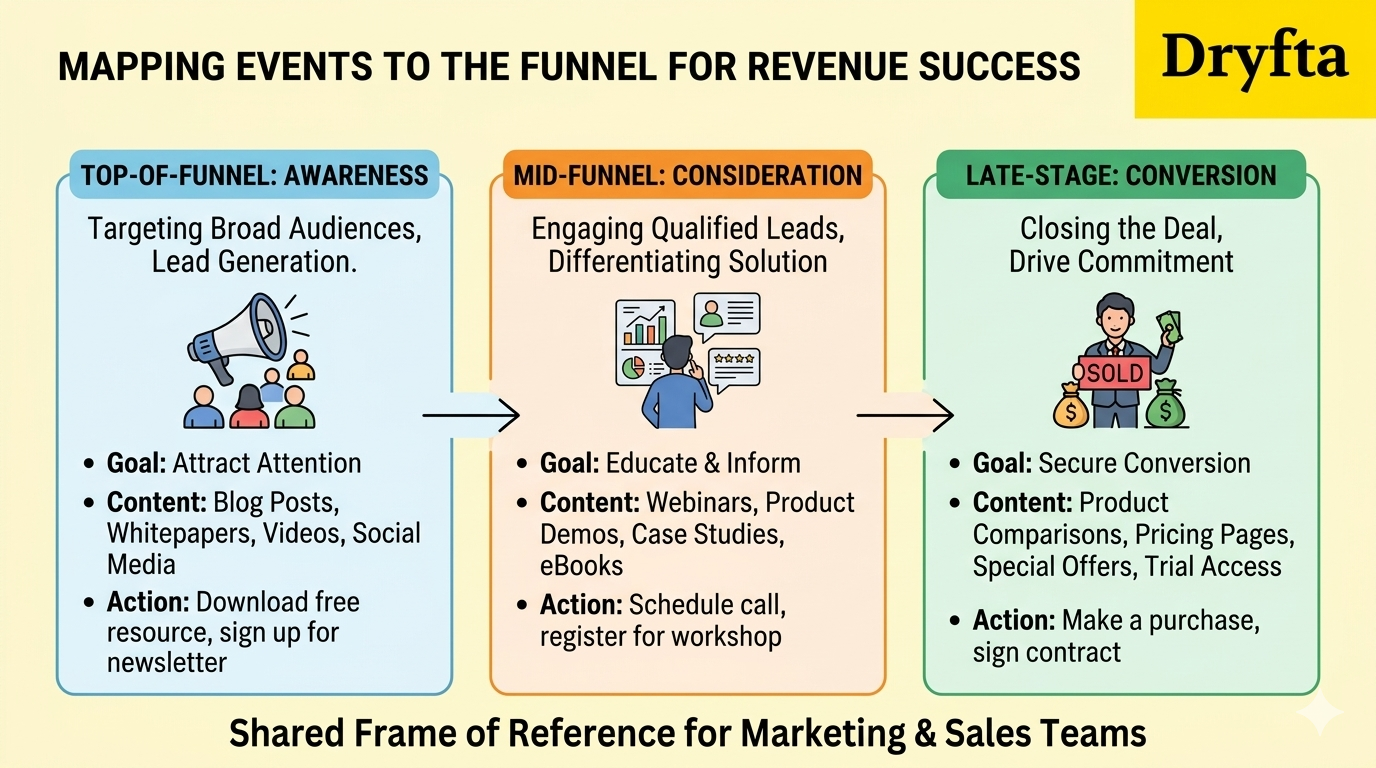
B2B events do not operate in a commercial vacuum. They sit inside a sales process, and their placement within that process determines the role they are equipped to play. An event designed to generate early-stage awareness should not be evaluated on the same terms as one designed to accelerate a deal that is already in negotiation. Mapping each event to a specific pipeline stage, be it top-of-funnel, mid-funnel or late-stage, gives your marketing and sales teams a shared frame of reference for both design and follow-up.
Identify target audience and buyer personas
The commercial value of a B2B event is largely a function of who is in the room. A precisely defined target audience allows every subsequent decision about content, format, venue, and even promotional channels to be made with purpose. Buyer personas should extend beyond job titles to include the priorities, pressures and decision-making authority of the individuals the event is designed to reach.
Choose the right event format
The format of your B2B marketing event has a lot more to do than just convenience. You shouldn’t be picking virtual events to save your firm some cash, no. While it is okay to plan your B2B event marketing strategy per your budget, there are other important considerations to make that have more to do with your audience. A roundtable of senior executives has a very fundamentally different commercial purpose than a virtual summit of a 1000 people. Choosing your format before defining your KPI parameters is one of the more common and costly missteps in B2B event planning.
Build account-based marketing campaigns
Account-based marketing and B2B events are partners in efficiency. Whereas ABM identifies and prioritises high-value accounts for commercial profitability, events are a fertile ground to further these relationships in person. Building ABM campaigns around specific events can produce a measurably more qualified attendee list and a more commercially productive event experience.
Create pre-event demand generation campaigns
Pre-event demand generation campaigns serve two purposes simultaneously. Firstly, they build anticipation among prospective attendees. Number two, they kickstart the process of commercial qualification before anyone has even walked through the door. A well-sequenced pre-event campaign including avenues like email, paid channels and direct outreach prepares the audience and put across the event’s value proposition early on.
Coordinate marketing and sales teams
The division between marketing and sales is one of the more persistent sources of wasted potential in B2B event programmes. A B2B event marketing strategy builds the audience but sales is what truly converts it. When these 2 functions operate in parallel without coordination, the commercial opportunity that an event creates is simply lost in the gap that opens up between them. Shared briefings, agreed handover protocols and joint accountability for post-event outcomes are metrics that keep marketing and sales teams in the right pace.
Set measurable KPIs
B2B conference marketing without defined KPIs is an event without a standard of success. The key performance indicators chosen should correspond directly to the stated goals of the event. Determine if your focus is registrations, attendance rates or some other factor like marketing-qualified leads.
Build post-event follow-up workflows
The period immediately following an event is, commercially speaking, the most important. It is the window in which relationships formed in person can be advanced into active sales conversations. Follow-up workflows should therefore be designed before the event takes place and segmented by attendee behaviour and level of interest.
B2B Event Marketing KPIs You Should Track
According to CallBox Inc., in 2026, only 40% of organizers report difficulty proving event ROI, down from 70% just two years prior.
The question of how to measure a B2B event’s success is one that has long frustrated marketing teams and their leadership in equal measure. The difficulty is not, as it is sometimes characterized, a function of events being inherently unmeasurable. It is a function of measuring the wrong things. Here are the B2B event marketing metrics that truly matter that you should be measuring at your next event, conference or trade show.
B2B Event Marketing Channels That Drive Attendance
The effectiveness of your B2B event marketing efforts are determined in part by the channel you use to execute it. Some channels, in 2026, are deemed largely ineffective. While others are continuing to grow rapidly. The latter are the channels to take the best advantage of. Let’s take a look at what these channels are and how to make the best use of them.
- Email marketing campaigns: These continue to exert their dominance as among the highest-ROI promotional channels for B2B events. However, this is only true when your email campaign is built around smart attendee segmentation.
- LinkedIn account-based marketing: A powerful digital channel that’s available for reaching B2B decision-makers at specific target companies. Sponsored content, message ads, and conversation ads can be utilized to create a sustained presence in the feeds and inboxes of the accounts that are most important to your event’s commercial objectives.
- Outreach by sales teams: Perhaps the most underutilized event promotion channel there is. B2B marketing teams in 2026 are failing to tap into this strategy to the fullest.
- Partner and sponsor promotions: Two channels that extend into adjacent audiences that a company’s channels cannot efficiently access on its own. A co-hosted event effectively doubles the total target audience and lends the implicit endorsement of a brand the attendees already trust.
- Retargeting campaigns: An underrated channel that can fetch you the best possible digital audience. These are the buyers who have already engaged with your brand through content downloads, webinar attendance, or website visits and who have therefore already crossed the threshold from anonymity to awareness.
- Industry communities and associations: To gain promotional reach into the professional networks where ideal attendees already gather. Placing event announcements in relevant Slack communities, LinkedIn groups, and industry newsletters reaches buyers based on their professional identity.
- Speaker and influencer promotion: A channel that uses your existing database of keynote speakers and featured panelists. A well-briefed speaker who promotes their session to their own LinkedIn following can drive hundreds of highly qualified registrations.
- Webinar promotion campaigns: Virtual undertakings that work to publicize your B2B event marketing. This can be a precursor to a larger B2B event or a component of your long-term B2B event marketing strategy.
How B2B Events Generate Qualified Leads
The mechanism by which B2B events generate qualified leads is not passive. It is not the equivalent of a display ad that washes over a buyer as they scroll through their news feed and leaves a faint impression of your brand’s name, no. It is active, intentional and personal. And it is precisely this quality of engagement that differentiates event-generated leads from virtually every other category of marketing-sourced contact in a B2B organization’s database.
- High-intent attendee targeting makes sure that the leads you churn out at an event have already cemented their relevance. This is even before your attendees have managed to do anything stupid your event.
- Buyer qualification opportunities must also be well embedded in a well-designed B2B event. A live product demonstration is a gold mine. The questions that your prospect asks after a demo tell a sales team more about where this buyer is in their B2B sales cycle and what it is that they value.
- Real-time engagement features from modern event management platforms like Dryfta offer marketing and sales teams a golden window into buyer intent. Which sessions did a prospect attend? Which polls did they engage with? Which exhibitors did they spend time with? Which networking meetings did they request? These behavioral signals are captured in real-time and routed to the CRM.
- Personalized networking interactions have the capacity to create the kind of one-on-one engagement that has no digital equivalent.
- Executive relationship building at B2B events build commercial momentum at the highest levels of target organizations.
- In an era of increasing privacy regulation and diminishing third-party data availability, the rich behavioral and relational data that comes out of a well-run event is one of the most commercially useful data assets a B2B marketing team can put their hands on.
- Intent-driven follow-up workflows ensure that the commercial momentum generated at an event does not dissipate in the days that follow. Companies that follow up within 24 hours generate three times the pipeline value of those that wait a week, which is one of the most striking statistics in B2B event marketing research, and one of the most commonly ignored in practice.
- Sales and marketing alignment is far less discussed than it should be. The two are inextricable functions and linked to one another in important ways. When marketing and sales approach an event with shared goals, B2B events exert their full lead generation potential.
- Not all event-generated values look like new leads. Some may look like a prospect already a few steps into the B2B sales cycle taking the next step to completed purchase. For prospects already in an active sales process, a well-organized B2B marketing event can be that final push to take it forward.
Common B2B Event Marketing Mistakes to Avoid
The mistakes that undermine B2B event marketing programs are, with a depressing consistency, the same ones that have undermined them in the past. It’s almost like professionals never really learn when it comes to B2B event management. While it can be easy to look past some mistakes, the repetition of which can be damaging to your event’s core goals. Here are mistakes to avoid like the plague at your B2B event marketing extravaganza.
- More is not always productive: Focusing only on attendance numbers is the original and most persistent failure mode of B2B event marketing. A 1000-person conference attended by the wrong audience delivers less pipeline than a 10-person roundtable with your top target accounts. Prioritize quality over quantity.
- Don’t let the momentum die out: Weak post-event follow-up is where the majority of event ROI is lost and not in the event itself. But in the days that follow it. The energy and investment you’ve poured into a well-executed conference can be entirely squandered by no post-event action.
- Sales and marketing must be in touch with each other: Poor sales and marketing alignment is particularly costly at events, which are among the few moments when these two functions must operate as a single, synchronized team. When marketing generates leads and hands them to sales without context and when sales follows up without any knowledge of which sessions a prospect attended or which conversations they had, fresh leads turn lukewarm and eventually die out.
- Engage your attendees: Lack of attendee engagement strategy is a failure that is invisible during event planning and painfully obvious on event day. Without structured networking sessions, interactive workshops, facilitated roundtables, live polling, and curated meeting programs, attendees merely consume content passively and leave without any efficient takeaways.
- Specific not generic: No account-based marketing integration means that your event is a one-time thing. It’s unlikely to exert any more influence than its immediate objective. Events that are disconnected from ABM target account lists, from personalized outreach sequences, and from CRM workflows produce leads that have no context, no prioritization, and no follow-up motion. Which is to say, they produce very little of commercial value in the long run.
- Keep an eye on your ROI: Without the ability to show the pipeline value you generated and influenced and the rate at which you closed the B2B sales cycle, you are being unhelpful to your marketing team. They cannot make intelligent decisions about which events to invest in, which to scale or which to retire without knowing about Return On Investment (ROI).
- Virtual attendees’ lives matter: Ignoring your hybrid attendee experiences is a grave error as virtual attendance continues to grow as a proportion of total event participation. Online attendees who receive a substandard experience with poor stream quality and no networking opportunities, will not convert into pipeline at anywhere near the rate of their in-person counterparts.
- Simplify registration: Overcomplicated registration processes cause measurable drop-off at the point when buyer intent is highest. For every unnecessary field you add, a potential lead is lost.
How Hybrid Events Are Changing B2B Event Marketing
The hybrid event has had something of a complicated reputation since the pandemic years made it a necessity and no longer a choice. In the race to keep up with B2B event marketing when in-person gatherings became impossible, many organizations began hosting hybrid B2B conferences that were, in truth, live-streamed conferences with an online audience. These basic, rudimentary virtual experiences at the time did little to benefit neither the in-person audience nor the virtual one. However, in the years that followed since, hybrid events have evolved in stunning ways to make B2B event marketing more inclusive, engaging and scalable.
- Expanding the scope of your audience beyond the geographic ceiling of your venue and going global is one of the most immediately visible advantages of hybrid events. But it is far from the only one. A company that might cost-effectively host 500 people in-person can potentially reach 5,000 qualified buyers globally when a virtual event is added in.
- Longer attendee engagement lifecycles differentiate hybrid events from their purely in-person counterparts in ways that have implications for pipeline generation. In-person events end when attendees go home but hybrid events can continue to extend the impact by creating on-demand content libraries and community platforms.
- Improved event analytics are one of the most practical advantages of hybrid formats. Because every virtual interaction is trackable in ways that in-person interactions are not, hybrid events generate behavioral data that feeds into buyer intelligence profiles of commercial value.
- Virtual networking opportunities have matured considerably since the awkward early experiments of the pandemic era. AI-powered matchmaking tools, structured virtual breakout rooms and curated online meeting programs have leveled up in-person and online networking experiences in ways that were difficult to imagine even a few years ago.
- Cost optimization for attendees who cannot justify travel creates a form of inclusivity with direct commercial value.
- Hybrid B2B events open up plenty of opportunities for sponsor visibility. Sponsors may choose to participate with their branding, either virtually or in-person. Or sometimes both for maximum gain in ROI.
- The hybrid format makes space for B2B events that are much more scalable in practicality. With two different sets of audiences comes greater pipeline value latency ROI potential.
How AI Is Transforming B2B Event Marketing
AI is doing specific things in the event context, things like matchmaking, personalization, content summarization, lead scoring, follow-up automation. These were previously either impossible or impractically labor-intensive before.
Platforms using AI matchmaking report up to a 44% increase in in-person meetings generated at events.
- AI-powered attendee matchmaking is, commercially, the most immediately valuable AI application in the B2B event space.Clarion Events, to take one specific example, achieved a 44% increase in in-person meetings through AI matchmaking implementations.
- Personalized event experiences driven by AI move beyond the blunt instrument of persona-level segmentation to individual customization and personalization. This makes B2B marketing events more appealing for attendees.
- Predictive lead scoring at events gives sales teams a tool for prioritizing their time that has no equivalent in the pre-AI event environment. Rather than chasing every badge scan with equal energy, sales can focus their limited time on attendees whose behavioral data suggests pipeline opportunity.
- The majority of session content effectively disappears the moment it is delivered. However, AI-generated session summaries and personalized highlight reels now successfully solve this very problem that the event industry has faced for years.
- Automated event communication powered by AI allows event teams to maintain personalized, timely dialogue with hundreds of registrants simultaneously.
- Real-time engagement analytics give event teams and sponsors a live view of session performance, exhibitor traffic patterns and networking activity.
- Marketing workflows, now powered by automated intelligence, are simpler to activate and even simpler to measure progress of. Dryfta, for instance, offers state-of-the-art automated B2B event marketing infrastructure that cuts down on manual workload.
- AI-powered post-event insights are a unique feature of the last decade and a piece of technological advancement unlike any other. Artificial Intelligence now uses data it captured throughout your event to convert them into actionable insights and B2B marketing strategies.
It bears noting, as Gartner has observed, that digital fatigue may push CMOs to allocate as much as 70% of their budgets to offline channels by 2028.
If this prediction proves accurate, AI will be the infrastructure that makes those offline events more measurable, more personal, and more commercially effective than the in-person programs of any previous era. The human connection will remain the point. Artificial Intelligence is what makes delivering it at scale possible.
How Dryfta Helps B2B Event Marketing Teams
Behind every well-run B2B conference is an operational infrastructure that most attendees never think about. And rarely appreciate it until it fails.
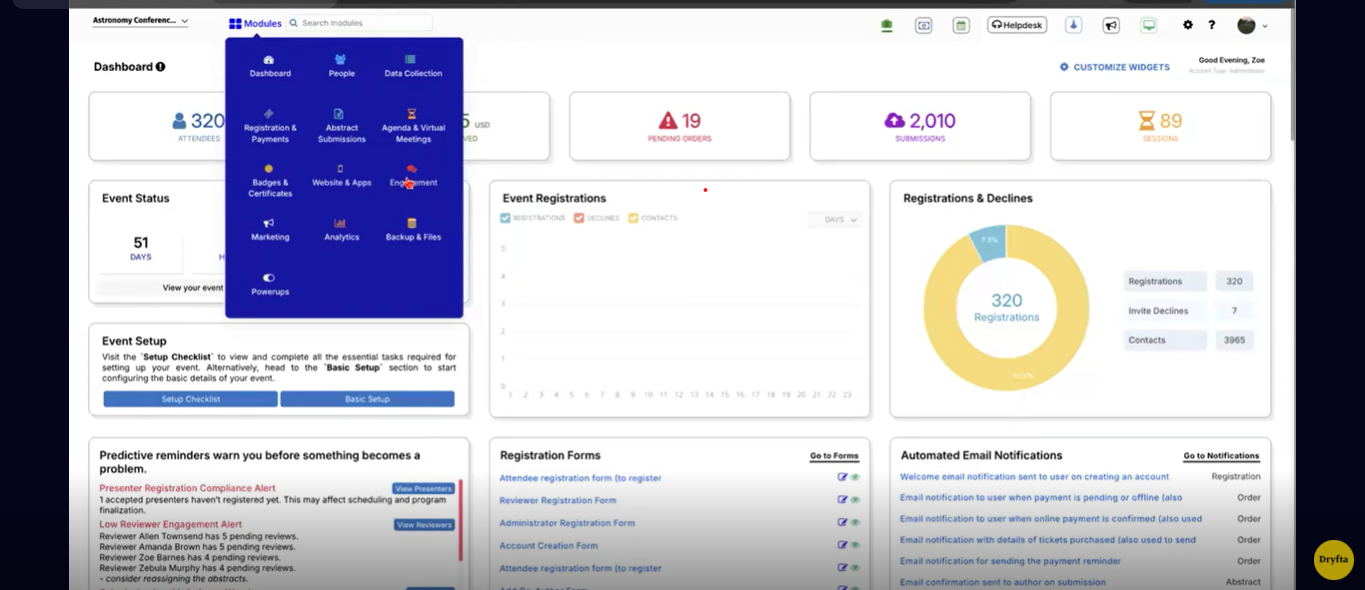
Dryfta is an end-to-end B2B event management platform designed specifically for the operational demands of your B2B marketing events. Whether you’re hosting an enterprise-grade conference, a multi-track summit or participating in a trade show, Dryfta will make life easier for your marketing and sales teams. Read on to know what Dryfta does and how it does it efficiently.
- B2B event management: Conference and trade show management at the scale of enterprise events are all handled end-to-end within Dryfta. Starting at just $1,499 per year.
- Registration forms and ticketing workflows on Dryfta’s platform are built around conditional logic and features like tiered pricing, group discounts, sponsor passes and persona-specific registration paths.
- Hybrid and virtual event support under the wing of a single platform like Dryfta means inclusivity. Your remote attendees will receive live stream access, virtual networking capabilities, on-demand content and a fully integrated mobile experience powered by Dryfta. Mobile event apps like that of Dryfta are changing the B2B event management industry in incredible ways.
- Networking and attendee engagement tools built into Dryfta’s platform allow event teams to design intentional, high-value networking experiences. AI-powered matchmaking, structured meeting scheduling, and curated networking session management pave way for peer-to-peer engagement.
- Sponsor and exhibitor management capabilities equip sponsors the visibility tools, lead retrieval systems, and ROI measurement data they need to justify their investment to their own leadership
- Real-time attendee analytics delivered through live dashboards give event teams the data they need to make decisions during the event itself.
- CRM-friendly workflows through native integrations and open API connectivity allow Dryfta event data to flow directly into the CRM that your sales team can tap into.
- Dryfta replaces the patchwork of disconnected event tools with a single operational platform that gives enterprise marketing teams complete visibility across the entire event lifecycle.
Why B2B Companies Are Choosing Dryfta for Conferences
80% of Dryfta’s first-time users return to the platform for their next event.

The B2B event technology space is, by any honest accounting, overcrowded. It’s populated with platforms that solve 1 problem well but need a dozen additional tools to solve the rest. Dryfta’s appeal for event organizers and B2B event marketers rests precisely here. Dryfta’s all-in-one event management platform has previously been chosen by esteemed organizations and institutions around the globe including Erasmus University Rotterdam and Newcastle University.
- Scalable platform: Scalability for enterprise and mid-sized events means that Dryfta performs with equal reliability whether the event is a 150-person executive summit or a 5,000-person annual conference.
- Hybrid and virtual conference support: Support for hybrid, virtual, and onsite B2B events from within a single operational infrastructure is made possible with Dryfta.
- Flexible workflow: Flexible workflows that are designed specifically for B2B marketing events and comprising features as multi-track agendas, corporate group registrations and pipeline-focused analytics.
- Centralized event operations: This replaces what is, in most organizations, a fragmented collection of registration tools, agenda builders, mobile apps, sponsor portals, and analytics dashboards with a single platform like Dryfta.
- Personalization: Customizable event experiences through white-labeled websites, branded mobile apps, and persona-specific registration flows make sure that each of your audience’s attendees receive the fullest B2B marketing event experience.
- Suitability across the B2B event spectrum: Dryfta’s all-in-one event management platform is trusted by organizers hosting B2B events across the broad spectrum including but not limited to conferences, expos and executive events.
Frequently Asked Questions (FAQs)
What is B2B event marketing?
B2B event marketing is best defined as events hosted with the primary purpose of promoting, advertising or highlighting a brand’s products or services. While fastening the B2B sales cycle and closing the sequence with a purchase remains the core goal for many, some others hosting B2B marketing events also focus on qualitative factors like strengthening the commercial relationship that will eventually turn into revenue. In some other cases, B2B marketing events are targeted at retaining existing customers and expanding revenue.
Why are events important for B2B marketing?
B2B marketing events sow the seeds for a human element called trust. This element is at the very foundation of any and all human relationships, including commercial buyer-seller ones. Buyers will not care to purchase from a seller whose sales proposition appears murky or incomplete. Part of the B2B sales cycle is getting your prospective clients to trust in your firm and in your product.
Which B2B events generate the best ROI?
Executive roundtables and customer advisory boards are two B2B marketing event formats that generate the quickest results. This is wholly because the individuals being dealt with are among key decision-makers moving the important pieces on the board. That being said, these formats may be inaccessible for beginner businesses or those still building in credibility. In such cases, B2B marketing events to attempt include exhibiting at showcases, hosting a pop-up show, joining an industry-wide conference or organizing an online webinar for starters.
How do B2B events generate leads?
B2B marketing events help organizers generate leads by beginning the right kinds of networking relationships with the right audience. This begins by approaching your invitee list in a manner that is high-intent and specific. You narrow down on people who are mostly likely to turn into finished commercial deals for your business. Once identified and invited, your B2B event’s offerings will decide the course of their action. If you pull off a convincing live product demonstration that prompts them to take interest and ask a few questions, that’s a good sign. Modern event management platforms like Dryfta are built to effectively capture all this engagement data and route it to your CRM systems. This makes it easier for you to follow-up on the leads that took interest during the tour event.
What KPIs should B2B marketers track for events?
The most commercially meaningful B2B event marketing KPIs to pay attention include pipeline generated, pipeline influenced, marketing-qualified leads, sales-qualified leads, cost per lead, attendee engagement depth, session attendance rates, post-event conversion rates and revenue influenced. Organizers also look into other qualitative indicators like attendee satisfaction and sponsor visibility if their B2B event objectives are inclined towards customer relationships and commercial networking
What is hybrid B2B event marketing?
Hybrid B2B event marketing is the practice of designing and executing events that cater to both in-person and virtual audiences simultaneously. Most event organizers who have hosted hybrid events in the past note the format for its inclusivity and accessibility. It is a relatively easier B2B marketing event to host and the costs involved are also marginal in comparison to other B2B events. For this economical investment, B2B organizations report substantial positive ROI, making it a B2B marketing event strategy worth looking at.
How does AI improve B2B event marketing?
Artificial Intelligence is shaking up the event management industry in a number of ways. And B2B event marketing has also been gripped by this wave. AI can be used to level up the latency of your B2B sales throughout the cycle. When it comes to B2B events in particular, AI can simplify functions before, after and during your event. Using intelligent audience targeting and personalized outreach, AI makes it possible to pick the right audience who will be most potent to making a purchase. During the event using features like attendee matchmaking and real-time analytics, personalizing attendee engagement is feasible. Post-event through follow-up communication can also be commenced using automated emails as well as on-demand content generation and summarization.