
It is the norm of the scientific world to share findings with fellow members of the world of research, innovation, and discovery. And what better way to do so than to get your research outcomes published in a prestigious academic or scientific journal for scholars around the globe to read.
But there is somewhat a predicament when deciding which journal to go with when publishing your article since there are numerous publications across multiple disciplines.
That’s why we’ve selected the top scientific journals in the world that will give your findings maximum exposure. Let’s take a quick look at what they are.
What Is a Scientific Journal and Why It Matters Where You Publish
A scientific journal is best defined as an academic, research-driven journal that publishes original scholarly findings by authors. Scientific journals are typically publications that go out on a periodical basis, often annual or biannual. Some scientific journals are tougher to get a spot to publish your research findings than others. Each also carries its own set of writing requirements and scientific prerequisites. Scientific journals, apart from disseminating original content, also push out abstract reviews and scholarly commentary within a specific discipline or a set of disciplines.
What Are The Stakes?
One may ask what difference does it make to choose between journals in a discipline. Still and all, the purpose of a scientific journal, regardless of the publisher or publication press attached to it, is to disseminate original research-oriented content. But the stakes are large and high when it comes to choosing a scientific journal in the real-world. To understand why it matters, you’ll need to gauge this important aspect about the reviewing involved in scientific journals first. Unlike an educational textbook or a weekly magazine, a scientific journal operates on a principle called ‘peer review.’ Peer reviewers are experts in your discipline who will evaluate the quality of your work and prescribe it to be published. If your work fails to meet their standards, they’ll toss it into the bin. That’s how it works. Jokes apart, good peer reviewers offer valuable feedback that’s important for aspiring and growing researchers to build upon. Peer reviewers, as the name itself suggests, involve more than one individual. This is done to ensure that the reviewing is fair, unbiased and exposed to multiple specialist opinions.
A Difference Worth Knowing
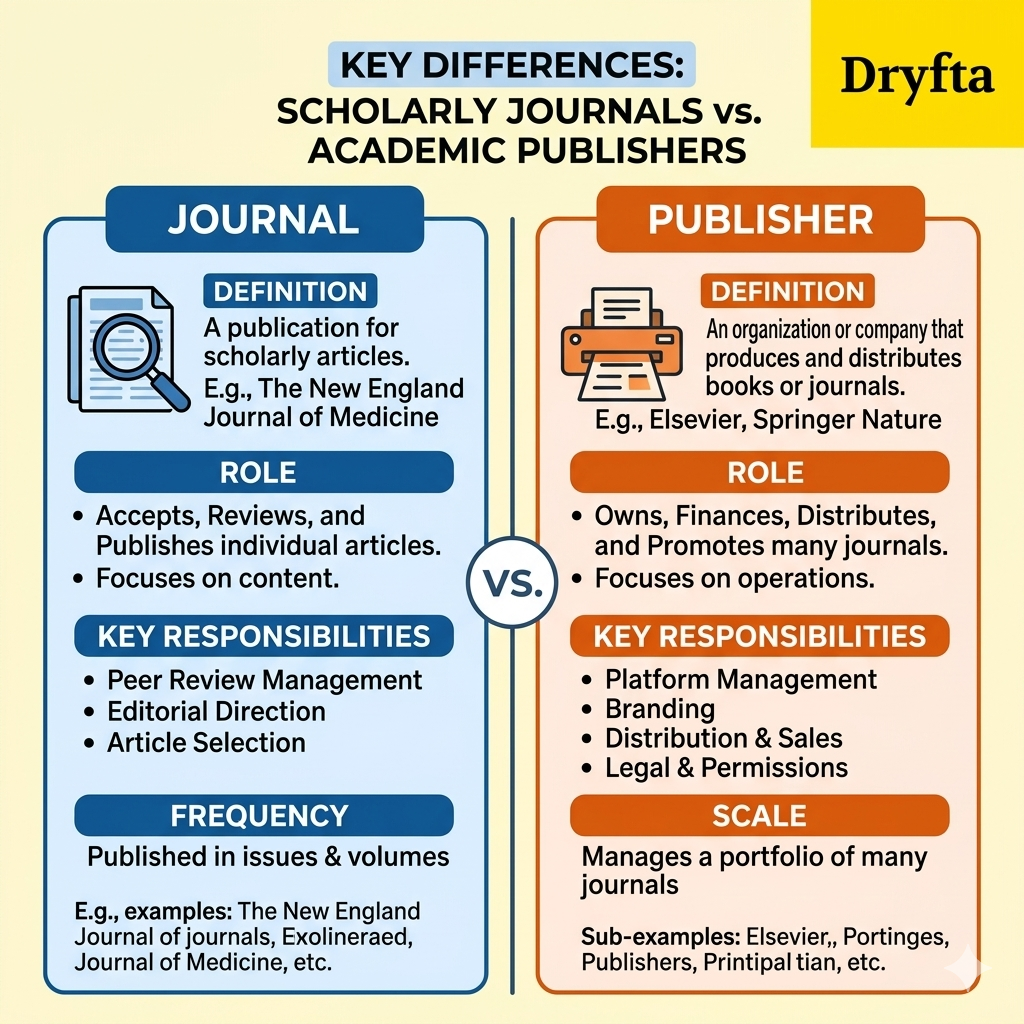
When dealing with the scientific journal space, you’ll come across two words often used synonymously. ‘Journal’ and ‘publication.’ Elsevier, Springer Nature and Wiley, for instance, are publishers. These are large commercial entities that own and operate dozens or even hundreds of journals. On the other hand, journals are the specific titles printed or hosted by the publishers. The Lancet, Cell and Physical Review Letters are all good examples of journals. It is very important to not conflate these two. Typically, researchers submit their work to specific journals. Publishers also sometimes accept entries on behalf of a particular journalistic entity under their wing. If you are eyeing a particular journal, watch out for all their specific titles. If you have your eyes set on a certain journal, prepare according to their prerequisites to maximize your chances of acceptance.
Key Metrics for Evaluating Scientific Journals
Numbers are what either make or break your journal entry. Not any numbers but specific and often systematized metrics. Let’s take a look into some of the most evaluated metrics by popular scientific journals.
- Journal Impact Factor (JIF): The JIF is a metric that takes into account the average number of citations that is received by articles published in a journal in the last two years. Within a single field, the JIF works reasonably well as a rough indicator of where a journal sits in the pecking order.
- h5-index: The h5-index is a metric built by Google Scholar, the Google search engine’s one-stop place for research articles. The h5-index measure the number of articles published in a journal that have received citations over the last 5 complete years.
- CiteScore: Elsevier’s competing metric, published via Scopus, uses a 4-year citation window rather than 2. It also includes a wider range of document types like articles, reviews and conference papers. The wider window and broader scope tend to produce higher scores than JIF for the same journal.
- SCImago Journal Rank (SJR) and SNIP: SJR is a prestige-sensitive indicator built on Scopus data and a logic similar to Google’s PageRank. A citation from Nature counts for more than a citation from a low-traffic specialist journal. A chemistry journal and a mathematics journal who carry the same SNIP score tend to have equal impact within their respective fields.
- Acceptance rate: The proportion of submitted manuscripts that reach publication. Flagship generalist journals like Nature and Cell accept fewer than 10 percent of submissions. Many leading clinical journals sit 5 percent or below. Low acceptance rates signal selectivity. They do not automatically signal the best fit for every paper. A genuinely excellent specialist paper may do more meaningful work in a rigorous niche journal with a 25% acceptance rate than as a rejection statistic at a journal whose scope was never quite right.
- Time to decision: Peer review takes time. But not the same amount of time everywhere. Some journals return a first decision within two weeks. Others can take even 4-6 months. For researchers under grant deadlines or working in fast-moving competitive fields, the calendar matters as much as prestige. Check recent author accounts and not advertised estimates before committing.
- Indexing: A paper published in a journal but that is not indexed or linked to a searchable database like PubMed or Web of Science, for instance, may never surface upon usersearch. And this is regardless of its quality and no matter how important your findings are. Indexing is the floor-level requirement for legitimacy and verifying it takes under 5 minutes. Don’t skip it.
Top Scientific Journals by Discipline
In this section, let’s look into an exhaustive list of the most popular.scientific jounrqls segmented by discipline and specialist areas. Starting out, let’s look 4 journals that among the most premier entities in the scientific publishing space.
- Nature (founded 1869): Nature is a scientific journal that periodically publishes research that is of exceptional capacity for scholarly dissemination across fields like biology, physics, chemistry and climate science. The acceptance rate is presently less than 10%, making it one of the hardest journals to make the cut for.
- Science: Published by the American Association for the Advancement of Science, Science is another acclaimed publication that can be placed at the same stature as Nature. Also carrying a very menial acceptance rate and a rigorous review process, a publication that successfully gets through into Science is guaranteed to reach researchers across every discipline at once.
- PNAS (Proceedings of the National Academy of Sciences): PNAs sits as a similar multidisciplinary scientific with a somewhat higher acceptance rate than Nature or Science. This is often an important journal for researchers who think that their work does not fit into the standard threshold of journals like Nature and Science. This is a space for high-quality work that addresses broader scientific questions that may not suit the narrow disciplinary focus that titles sometimes prefer.
- Nature Communications: An open-access flagship within the Nature portfolio itself, Nature Communications is freely available to any reader worldwide, with no subscription required. It publishes groundbreaking research across the natural sciences that meets demanding standards but is also marked by a disciplinary scope that is much narrower than its parent journal.
Medicine and Clinical Research
- New England Journal of Medicine (NEJM): With an Impact factor of 78.5, NEJM accepts roughly 5 percent of submissions from the 35,000+ submissions that it receives annually. The editorial filter and peer review framework here is precise and unsparing.
- The Lancet: Currently ranks first in general and internal medicine globally with an Impact factor of 88.5. Work accepted by The Lancet must carry significance for the larger health industry, as explicitly stated to be an editorial priority.
- JAMA (Journal of the American Medical Association): Impact factor for JAMA is approximately 50 and boasts its comprehensiveness in evidence-based medicine and US healthcare policy publishing. It is one of the longest-standing medical journals in the world and has a readership that includes clinicians, researchers and policy professionals.
- BMJ (British Medical Journal): distinguishes itself from the rest of its counterparts by its focus on publishing methodology papers and clinical education commentary in addition to just original research. BMJ has a broader readership than most other comparable titles.
- CA: A Cancer Journal for Clinicians: Impact factor regularly exceeds 500, the highest of any journal in any field. Driven by oncology’s extraordinarily high citation rates and the journal’s focus on authoritative clinical reviews that practitioners return to repeatedly.
Biology and Life Sciences
- Cell (Elsevier): Cell is the apex publication in the field of Biology and Life Sciences, published by the acclaimed Elsevier group. Rather than the same run-of-the-mill content, Cell pushes out something novel each time.
- PLOS Biology: An open-access alternative that is used by an overwhelming number in the field. PLOS Biology is also among the first major biology journals to embrace the open access format. In doing so, it has expanded inclusivity in research and scientific readership.
- eLife: eLife prioritizes constructive peer review over binary accept or reject decisions. It is a journal that has housed some certainly outstanding work among researchers who value scrutiny over gatekeeping in molecular and cell biology fields.
- The EMBO Journal: Published by the European Molecular Biology Organization, the EMBO journal traces back to a history of publishing mechanistic studies that have since evolved into research across modern fields like genetics, cell biology and biochemistry.
Chemistry
- Journal of the American Chemical Society (JACS): Flagship of the ACS. One of the oldest chemistry journals in the world. Covers all sub-disciplines with consistently high citation counts. The default submission target for significant work across synthetic, physical and computational chemistry.
- Angewandte Chemie: Published by Wiley on behalf of the German Chemical Society. Particularly respected for communications, short high-impact papers reporting new reactions, synthetic methods or structural discoveries that need to reach the community quickly. Speed of dissemination is a defining feature.
- Nature Chemistry: Applies the Nature publisher’s selectivity and editorial supremacy to the field of Chemistry. Although, it publishes work of exceptional conceptual novelty only. A Nature Chemistry paper typically redefines a question rather than answering an existing one. Incremental advances belong elsewhere.
- Chemical Science: Chemical Science is the Flagship of the Royal Society of Chemistry and operates on an open access model. It has grown significantly in standing over the past decade, attracting synthesis, physical chemistry and chemical biology papers that meet a high bar for originality.
Physics and Mathematics
- Physical Review Letters: Published by the American Physical Society, this is the journal of record for short communications of major importance across all of physics. A PRL paper announces a finding before the longer account appears anywhere else. The first stop for physics results that cannot wait.
- Nature Physics: Covers all areas of physics with the Nature standard’s characteristic emphasis on broad significance alongside technical depth. Publishes work that speaks beyond a single physics sub-community and carries implications the field needs to address.
- Physical Review X (PRX): Fully open access and publishes longer, more comprehensive work than PRL. Particularly strong in condensed matter, quantum information and interdisciplinary physics. The open-access option for work that warrants a fuller treatment.
- Annals of Mathematics: Published by Princeton University and the Institute for Advanced Study. Sits at the summit of pure mathematics. The acceptance rate here is extremely low. Papers are often decades in development. A publication there carries weight no other mathematics title can match.
Engineering and Computer Science
IEEE Transactions journals: The most alluring journal that is on the bucket list of all aspiring researchers in the field of Engineering and Computer Sciences. IEEE is a large publication that branches out to cover almost every other sub-discipline in the field. IEEE Transactions on Neural Networks and Learning Systems, IEEE Transactions on Image Processing and dozens of others are examples of specific sub-niched journals.
- Nature Machine Intelligence: A journal headed by the premier Nature group and caters almost exclusively to research work in the field of Machine Intelligence. The journal, like most other Nature journals, have a very selective acceptance rate and accept extraordinary work with lasting implications in the field.
- Journal of Machine Learning Research (JMLR): JMLR is a free to read and open access journal that is accessible to be read and submitted to by all who are interested in machine learning research. Submitters are not barred by any APC charges and there are no paywalls for readership. This makes it one of the most downloaded journals in the field.
- ACM journals: Covering the theoretical and systems facets of Computer Science, the ACM set of journals host research on a rather unique element of the mechanical sciences. It’s highly discoverable owing to its sturdy indexing and has an existing established readership across the industry.
Social Sciences and Humanities
- Nature Human Behavior: Extends the Nature family into fields such as psychology, economics, sociology. A journal that publishes interesting work pertaining to these fields or that which sits in their intersection. Like all other Nature titles, Nature Human Behavior is also highly selective but boasts an interdisciplinary reach like none other.
- American Economic Review: The flagship journal of the American Economic Association. American Economic Review finds itself in the list of the most selective journals in all of the social sciences. If you manage to break in and make a publication here, it is often described as career-defining for economists. However, the peer review process is just as detailed and demanding.
- Psychological Science: Published by the Association for Psychological Science, the journal, as the name suggests, disseminates research in the broader field of functional psychological sciences. It’s a journal that has often been at the centre of insightful discussions about methodology in Psychology over the past decade. That being said, it is also a widely read publication by readers beyond academic psychology.
What Are the Top 10 Scientific Journals?
Based on impact factor, global reach and academic standing, the top 10 scientific journals are: Elsevier (RELX Group), Springer Nature, Wiley (Wiley-Blackwell), Taylor & Francis (Informa), SAGE Publishing, Oxford University Press (OUP), Cambridge University Press (CUP), Wolters Kluwer (Lippincott Williams & Wilkins and MDPI(Multidisciplinary Digital Publishing Institute. Each one leads its respective field and is held in high regard by researchers, clinicians and academic institutions worldwide.
Top 10 Scientific Journals For Researchers
Here’s a closer look at some of well known journals around that researchers all around the world frequently read.
Elsevier (RELX Group)

Elsevier (RELX Group) is the largest publisher with over 2,700 journals, including prolific publishing groups such as Lancet and Cell. The Lancet is associated with material on clinical and global health and Cell gravitates more toward specific disciplinary denominations like molecular biology.
Specialization: Elsevier covers the full spectrum of academic research with particular a focus in medicine, life sciences, physical sciences and engineering. It operates the ScienceDirect platform which is one of the world’s largest online repositories of peer-reviewed literature.
Accepted Disciplines:
-
- Medicine, Clinical Research and Public Health
- Life Sciences, Biology and Biochemistry
- Physical Sciences, Chemistry and Physics
- Engineering, Technology and Computer Science
- Social Sciences, Psychology and Economics
Pros
-
- Largest journal portfolio in the world, offering submission options across virtually every discipline
- ScienceDirect provides massive global reach and discoverability
- Strong institutional partnerships and library subscriptions ensure wide readership
- Offers both subscription and open-access publishing models
Cons
-
- High article processing charges for open-access publishing
- Frequently criticized for expensive journal subscription bundles
- Some researchers and institutions have boycotted Elsevier over pricing practices
Springer Nature
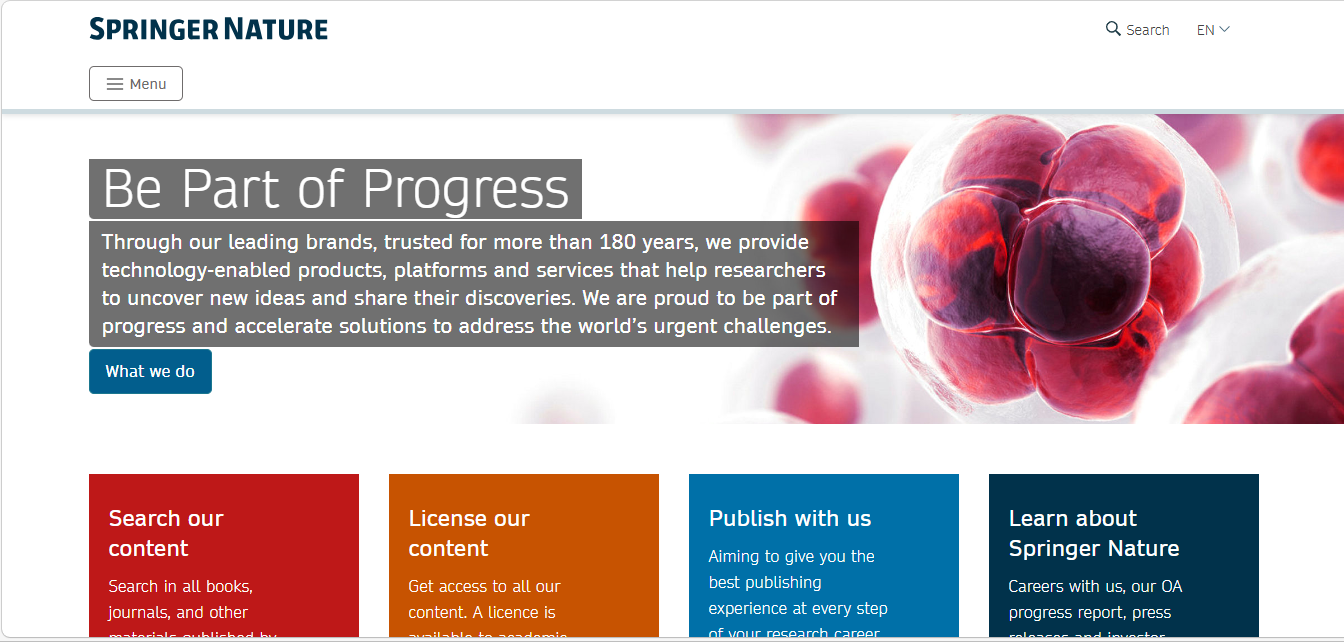
Springer Nature is a major publication in scientific academia and boasts a stunning portfolio of over 2,800 journals. Nature Reviews Drug Discovery, for instance, is a particularly well-cited peer-reviewed pharmacology resource.
Specialization: This journal is one of the leading review publications in pharmacology and drug development. It covers the entire pipeline from basic research to clinical application, publishing authoritative reviews written by leading experts in the pharmaceutical field.
Accepted Disciplines:
-
- Pharmacology and Pharmaceutical Sciences
- Drug Discovery and Development
- Biochemistry and Molecular Biology
- Biotechnology and Therapeutic Technology
- Translational Medicine
Pros
-
- Home to Nature, one of the most prestigious scientific journals ever published
- Broad portfolio spanning thousands of journals across all major disciplines
- Strong open-access options through Nature Portfolio and BioMed Central
- High global visibility and citation rates across its journal family
Cons
-
- Most reviews are commissioned by invitation and unsolicited submissions are rarely considered
- Article processing charges for Nature-branded journals are among the highest in publishing
- The prestige of the Nature brand creates an extremely high bar for acceptance
- Merger of Springer and Nature has led to some overlap and inconsistency across journals
Wiley (Wiley-Blackwell)

Wiley is a leading organization that is renowned for its publication of high-quality journals across science, health and academic disciplines. A Cancer Journal for Clinicians, as an example, holds one of the highest impact factors of any academic publication in the world, currently sitting at an impact factor of 254.7. This journal is published and maintained by Wiley-Blackwell.
Specialization: Wiley publishes extensively across the sciences, with notable strength in chemistry, medicine, engineering and the social sciences. It manages journals for many professional societies including the American Cancer Society.
Accepted Disciplines
-
- Chemistry and Materials Science
- Medicine, Nursing and Health Sciences
- Engineering and Applied Sciences
- Life Sciences and Environmental Science
- Social Sciences, Business and Education
Pros
-
- Society journal partnerships add credibility and disciplinary authority
- Wiley Online Library offers strong global discoverability
- Publishes some of the highest impact factor journals in medicine and chemistry
- Flexible publishing options including open access
Cons
-
- Article processing charges can be costly without institutional agreements
- Some journals in the portfolio have lower selectivity than competitors
- Customer support and submission systems have received mixed feedback from authors
Taylor & Francis (Informa)
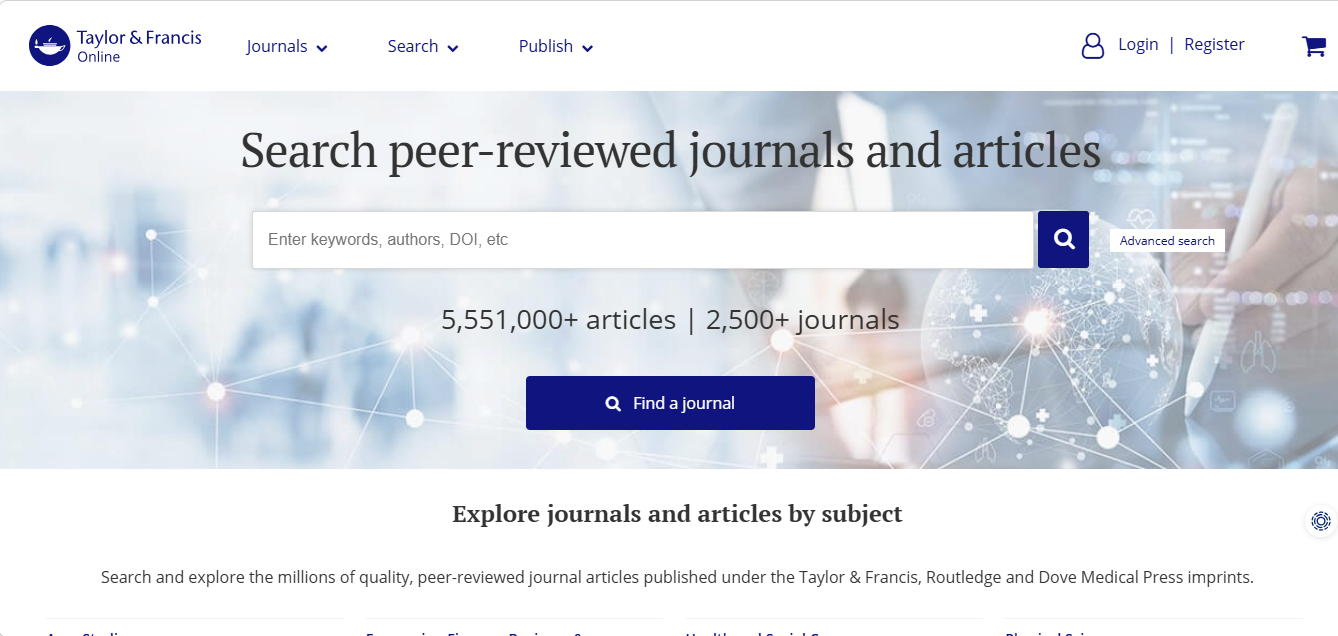
Taylor & Francis (Informa) is a global publisher offering a broad range of scientific and academic journals.
Specialization: Taylor & Francis has particular depth in the humanities, social sciences and education, alongside a strong presence in physical sciences and engineering. It operates the Taylor & Francis Online platform hosting over 2,900 journals.
Accepted Disciplines
-
- Humanities and Arts
- Social Sciences, Political Science and Sociology
- Education and Psychology
- Physical Sciences, Engineering and Technology
- Medicine, Public Health and Life Sciences
Pros
-
- One of the most diverse publisher portfolios, covering disciplines that other major publishers underserved
- Strong presence in humanities and social sciences
- The platform is cogent and provides affordable open-access publishing options
- Large volume of society-owned journals adds authority across disciplines
Cons
-
- Impact factors across the portfolio vary widely in quality
- Less dominant in high-prestige natural sciences compared to Elsevier or Springer Nature
- Some journals have faced criticism over turnaround times and editorial responsiveness
Sage Publishing

Sage is a major academic publisher with a large portfolio of social science and scientific journals. The publisher also has a global presence with principal offices in Washington, USA, New Delhi, India, Singapore City, Singapore as well as Melbourne, Australia.
Specialization: The SAGE group is best known for their strength and variety in social and behavioral sciences, including sociology, political science, education and psychology. It also publishes in health sciences and technology.
Accepted Disciplines
-
- Social Sciences, Sociology and Political Science
- Psychology and Behavioral Science
- Education and Communication Studies
- Health Sciences and Nursing
- Business, Management and Public Administration
Pros
-
- Leading publisher in the social sciences with strong disciplinary authority
- Independent publisher, which gives it more editorial flexibility than large commercial groups
- Sage Journals platform gives research article strong discoverability and visibility
- Competitive article processing charges compared to larger publishers
Cons
-
- Less prominent in natural sciences, limiting its appeal for STEM researchers
- Smaller portfolio than the Big 5 counterparts
- Impact factors in some social science journals are lower than equivalent STEM titles
Oxford University Press (OUP)

Oxford University Press is a premier publisher that is associated with the prestigious University of Oxford in England. Having published a little over 500 academic journals so far, OUP lists its scientific publications under Oxford Academic Journals.
Specialization: OUP is one of the oldest and most respected academic publishers in the world. It has particular strength in medicine, law, humanities and the social sciences. Its medical journals, including Brain and Nucleic Acids Research, are widely cited.
Accepted Disciplines
-
- Medicine, Clinical Research and Public Health
- Humanities, History and Literature
- Law and Political Science
- Life Sciences and Genetics
- Social Sciences and Economics
Pros
-
-
- University press status lends strong academic credibility
- Long publishing history dating back to the 15th century
- Oxford Academic platform provides broad institutional access worldwide
- Several OUP journals rank among the most cited in their respective fields
-
Cons
- Smaller journal portfolio compared to commercial publishers like Elsevier or Springer Nature
- Open-access article processing charges are high for a university press
- Less diversity in STEM disciplines compared to commercial counterparts
Cambridge University Press (CUP)

Cambridge University Press is a well-established publisher that is known for its academic quality across a wide range of disciplines. In 2021, Cambridge University Press merged with Cambridge Assessment and now exists as a collective publication under the name of Cambridge University Press and Assessment.
Specialization: Cambridge University Press, part of the University of Cambridge, publishes across the humanities, social sciences, sciences and mathematics. It is particularly well-regarded in mathematics, physics and the humanities.
Accepted Disciplines
- Mathematics and Statistics
- Physics and Astronomy
- Humanities, Philosophy and History
- Social Sciences, Economics and Law
- Life Sciences and Environmental Science
Pros
- University press affiliation adds strong institutional credibility
- Cambridge Core platform consolidates journal and book access in one place
- Well-regarded across both STEM and humanities disciplines
- Exhaustive open-access options through its Cambridge Open initiative
Cons
- Smaller journal portfolio than major commercial publishers
- Less visibility in clinical medicine compared to Elsevier or Wiley
- Brand recognition in STEM is lower than Springer Nature or ACS among practicing researchers
Wolters Kluwer (Lippincott Williams & Wilkins)
Wolters Kluwer (Lippincott Williams & Wilkins) is a specialized publisher focused on medical and health science journals. The publication remains an important place of research, scientific inquiry and peer facilitation for clinicians and researchers from around the globe.
Specialization: Wolters Kluwer is by far one of the most focused of the major publishers. It concentrates almost entirely on health sciences, medicine, nursing and law. Its Lippincott portfolio is widely used in clinical education and professional practice.
Accepted Disciplines
- Clinical Medicine and Surgery
- Nursing and Allied Health Sciences
- Pharmacology and Drug Research
- Cardiology, Oncology and Neurology
- Law, Compliance and Healthcare Management
Pros
- Deep specialization in health sciences gives it unmatched authority in clinical publishing
- Lippincott journals are widely used in medical education and clinical training
- Strong institutional adoption in hospitals, medical schools and healthcare organizations
- Trusted by practicing clinicians and medical professionals worldwide
Cons
- Very narrow focus and hence is unsuitable for researchers outside medicine, law or health sciences
- Smaller digital discoverability compared to larger platforms like ScienceDirect
- Open-access options are more limited than those of larger publishing groups
American Chemical Society (ACS) Publications
ACS is a premier society publisher that is known for their top-tier research in Chemistry and allied disciplines. First published in 1924, Chemical Reviews is a popular biweekly journal of the American Chemical Society.
Specialization: ACS publishes authoritative findings in organic, inorganic, physical, analytical, theoretical and biological chemistry. It manages over 60 journals branching out into all sub-disciplines in chemical science, including organic, analytical chemistry, biochemistry, materials science and energy research.
Accepted Disciplines
- Organic, Inorganic and Physical Chemistry
- Analytical and Computational Chemistry
- Biochemistry and Chemical Biology
- Materials Science and Nanotechnology
- Energy Science and Environmental Chemistry
Pros
- ACS is one of the Big 5 publishers, which lends exceptional credibility
- Publishing history dating back to 1924 gives it a deep legacy and citation base
- Covers virtually all sub-disciplines of chemistry under one publication
- Society ownership means profits are reinvested into the scientific community
Cons
- Scope is concentrated in chemistry and the journal can be unsuitable for most other disciplines
- Article processing charges for open-access publishing can be expensive
- Invitation-only review articles in flagship journals limit access for many researchers
- Publication timelines can be lengthy due to the depth of peer review required
Multidisciplinary Digital Publishing Institute(MDPI)
MDPI (Multidisciplinary Digital Publishing Institute) is a major open-access publisher based in Switzerland.It publishes across a very wide range of disciplines with a focus on speed, accessibility and open science.
Specialization: Operating on a reading model that is massively funded by author-paid Article Processing Charges (APCs), MDPI has made its way up to become one of the most reliable peer-reviewed open access platforms today.
Accepted Disciplines
- Life Sciences, Biology and Environmental Science
- Medicine, Public Health and Pharmacy
- Engineering, Technology and Computer Science
- Chemistry, Physics and Materials Science
- Social Sciences, Humanities and Education
Pros
- Fully open-access model means published work is freely available to all readers
- Fast peer-review and publication timelines compared to traditional publishers
- Large portfolio with journals in nearly every academic discipline
- Lower article processing charges than many competing open-access publishers
Cons
- Has faced criticism over the quality and selectivity of its peer-review process
- Some MDPI journals are not indexed in major databases like Web of Science
- Perceived by some academic communities as a predatory or low-prestige publisher
- High volume publishing model raises questions about editorial standards across its portfolio
These 10 scientific journals are some of the must-reads of many within the academic circle, hence are the best options for you to publish your paper in. Not only will your research and findings be receiving the exposure it needs, but it will also be open for debate and critique of some of the finest minds in the scientific field. Who knows, you might even be called upon to be a part of an even greater scientific research mission sometime in the nearest foreseeable future?
How to Avoid Predatory Journals
As of 2024, there are an estimated 18,000 predatory journals on the internet.
This number only seems to grow every year in a field like scientific publishing that is tough to moderate. Predatory publications are journals that look just like your acclaimed ones, making it difficult to tell the difference. They mimic the structure of legitimate journals, editorial boards, ISSN numbers, and peer-review language on their websites. They may also often college Article Processing Charges in exchange for publication. The red flags need no specialist knowledge to recognise. Here are some telltale signs of predatory journals on the internet today:
Unsolicited email invitations written in flattering language: A legitimate journal does not typically email individual researchers to praise their previous work and invite a submission. Predatory journals do this at an enormous scale. The emails are templated. ‘Highly significant.‘ ‘Of great interest to our readers.‘ Grammatical errors, urgency cues and generic sender addresses from free email providers. These are not subtle signs.
Publication promises that are unrealistically fast: Peer review at a credible journal takes weeks to months. A journal promising publication within days, or advertising twenty-four-hour peer review, has told you directly that no meaningful review is happening. This is the clearest single indicator of the entire category.
Vague or absent descriptions of the review process: Legitimate journals describe how review works, single-blind, double-blind, the number of reviewers required. Predatory journals omit this information or provide descriptions too vague to be meaningful. Scrutinising the ‘for authors’ section of any unfamiliar journal takes 5 minutes.
Editorial boards that cannot be verified: Predatory journals frequently list prominent researchers as board members without those researchers’ knowledge or consent. Checking two or three listed editors, searching their names and confirming their institutional affiliations match what the journal claims takes minutes. Researchers who discover their names on predatory editorial boards often report it publicly. A web search reveals these complaints more often than one might expect.
Fees disclosed only after acceptance: Reputable open-access journals always state their APCs upfront before submission. It is the manner of predatory journals to conceal fees until after they’ve declared your manuscript as accepted. This is done to ensure that you, the author, feels the pressure to pay rather than forfeit your work. If a journal’s fee structure makes you feel like Sherlock Holmes trying to crack the number, it’s probably wise to step back and assess the journal’s veracity.
Absence from the indices and membership lists that underpin legitimate publishing: A journal absent from databases like DOAJ, unlisted in Scopus or Web of Science and not a member of COPE is operating entirely outside the quality frameworks the field depends on. Not showing uo on even one of this is a near-definitive indicator that you should take seriously.
An ISSN that cannot be verified: Every legitimate journal has an ISSN registered with the ISSN International Centre. Cross-checking a stated ISSN at portal.issn.org takes under a minute and shows you if the number is real and matches the journal claiming it.
The verification tools worth bookmarking
If you are suspicious about the authenticity of a specific title, make sure to use the below tools to ascertain its place in the scientific publishing space.
- The DOAJ maintains a whitelist of vetted open-access journals.
- COPE maintains a membership list of publishers committed to its ethics guidelines.
- Think.Check.Submit at thinkchecksubmit.org provides a free structured checklist any researcher can apply to any unfamiliar journal.
- Beall’s List, however no longer updated since 2017, is also a useful historical reference alongside more active, up-to-date tools.
- The Scopus Sources list and the Web of Science Master List can also help confirm indexing directly.
From Conference Abstract to Journal Publication- The Full Research Dissemination Path
Up until your novel idea for a conference abstract is published in a reliable, discoverable journal, your work is simply a personal portfolio. Performing research only to keep it under wraps defeats the purpose of doing so. It is important to begin your scholarly journey with an understanding of the steps involved in research dissemination. And contrary to popular belief, you don’t begin climbing the ladder to publication once you have completed your research. Rather, if publication in a top journal is one of your key goals, you must draw out your path right from the beginning. In the upcoming passages, we’ll take a quick dive into submitting for a research journal and getting your work published.
Prune your research findings: The submission and layer publication pathway occurs in a few recognisable stages. Research is completed. The first stage begins soon after you’ve wrapped up your research formally and have results that can be shared.
Work on your abstract: Once you’ve conceived your results and compartmentalized it, fully understanding its implications for your research and the broader field, you work on submitting what is called an ‘abstract.’ An abstract is a document that offers a brief overview of your research, putting a spotlight on its key findings and significance. It is usually about 250 to 500 words and allows research journals to prime the quality of your work before going all in into the peer review.
Prepare for an oral presentation: If you have made it this far, congratulations. Your abstract has officially been given the green light. Now it is time to patiently wait until your labor of love is evaluated by a team of experts in your field. In the meanwhile you may as well prepare for your research to be presented as an oral talk, a poster or a symposium contribution.
Take inputs from audience questions: If the scientific journal you submit to has a physical conference or symposium associated with its publisher, you may be directed to present your inferences to a crowd. When delivering your research proposition and demonstrating its place in the larger field, pay close attention to the kind of questions that come out of the audience arena. Do not dismiss them as only momentary probing. Take it seriously and work on any flaws that may be showing up in your work.
Enhance research as per session feedback: Session feedback is a valuable facet of research conferences that one must not forfeit. It shows you just how well your findings managed to land with an informed but external audience. All of this will then help inform your final, full manuscript. This is the developed account of your work that will eventually go into formal journal peer review. A peer-reviewed conference paper is a recognised and respected output that may precede or in some cases substitute for, a journal article. In other fields, proceedings are treated as preliminary and the journal paper will remain your final definitive record.
Frequently Asked Questions (FAQs)
What is the best scientific publisher?
The best publisher depends on your field, your goals and the type of research you are sharing. Based on portfolio size, impact and global influence, Springer Nature and Elsevier (RELX Group) consistently rank as the two most dominant publishers worldwide. Springer Nature is home to the Nature family of journals, and Elsevier publishes more than 2,700 journals including The Lancet and Cell. For chemistry, the American Chemical Society is the standard-bearer. For medical research, the Massachusetts Medical Society (NEJM) and Wiley-Blackwell (CA Journal) hold the top positions by impact factor. For open-access publishing, MDPI is the fastest-growing option available to researchers today.
Who are the Big 5 journal publishers?
The Big 5 in academic and scientific publishing refers to the five largest commercial publishers that control a significant share of peer-reviewed output globally. They are Elsevier (RELX Group), Springer Nature, Wiley-Blackwell, Taylor & Francis (Informa) and SAGE Publishing. These publishers are often discussed in the context of subscription costs, open-access policies and their broader influence on academic publishing. Despite ongoing debate, their journals remain the most widely read and cited in their respective fields.
How do I choose the right scientific journal for my research paper?
Choosing the right journal is critical to maximizing the impact of your work. Several factors are worth evaluating before you submit. First, check that your research fits within the journal’s stated aims and scope. Second, look at the impact factor and target journals with a strong score in your discipline. Third, consider the audience and match your paper to the journal’s readership, whether clinical, academic or industry-focused. Fourth, factor in the acceptance rate and weigh the competitiveness of the journal against the novelty of your study. Fifth, review the open-access policy and check any article processing charges. Sixth, look at typical turnaround times if your findings are time-sensitive. Tools like Elsevier’s Journal Finder, Springer Nature’s Journal Suggester and the JANE tool can help you identify the most suitable journals for your manuscript.
What is the acceptance rate of top scientific journals?
Top scientific journals maintain notably low acceptance rates. Nature and Science each accept approximately 7 to 8 percent of submitted manuscripts. NEJM and The Lancet accept fewer than 5 percent. JAMA operates at a similar rate. Chemical Reviews and Nature Biotechnology are highly selective for unsolicited work, with rates in the range of 10 to 15 percent. These figures underscore the importance of submission quality, methodological precision and the originality of your findings. Submitting to specialty sub-journals such as Lancet Oncology or JAMA Cardiology can improve your chances in a more focused competitive field.
Can early-career researchers publish in top scientific journals?
Yes. Early-career researchers can publish in top scientific journals and many do. The quality and originality of the research carry far more weight than the seniority of the author. Devising specific strategies targeted at each of the above mentioned publishers will better your chances as an early-career researcher. More generally, collaborating with established researchers helps with both credibility and network access. Additionally, taking advantage of journal-specific mentorship programs, such as those offered by EMBO for early-career biologists and submitting to open-access journals like MDPI, where acceptance is based on scientific soundness rather than perceived novelty alone, is another viable path. Many of the most widely cited papers in science were first authored by graduate students or postdoctoral researchers.