



“We regret to inform you that we need to withdraw our accepted abstract.” This sentence catches many organizers off guard, even though accepted abstract withdrawal happens on a fairly regular basis across scientific conferences of every size. And abstract withdrawal after acceptance is not always intentional, no. Most times it’s due to something unforeseen. The presenter may have fallen ill or could be unable to make it to the conference, or perhaps their work has been accepted elsewhere.
Before we begin talking about said abstract withdrawals, here are two important things we want you to remember.
- Managing withdrawn abstracts is possible without wrecking your entire schedule. It is doable and, as a matter of fact, demands your attention, whether or not your event has encountered one before. Author withdrawal requests are likely to happen.
- No, the author is not a villain who had set a timer to withdraw their submitted work at exactly the moment in time that causes the most inconvenience for your team. 9 on 10 times, it’s just an individual caught up in a series of unprecedented circumstances.
It is also likely that the author feels just as terrible as you do after withdrawing their submitted work. Well, at least you’re not alone on that.
Why Abstract Withdrawal After Acceptance At Conferences Happens
Abstract withdrawal after acceptance rarely trace back to carelessness, and organizers who assume otherwise tend to handle these situations poorly. Understanding the real reasons behind an author withdrawal request helps a program committee respond with judgment instead of suspicion.
- Sickness and illness, the usual suspects are at the top of the list. Always waiting to sabotage big days, like that pimple that comes up the night before an event.
- Visa rejection is also a reason that comes up quite frequently. Especially at international conferences where approval timelines run right up against the event date itself. Yeah, weak passport problems.
- Funding sometimes disappears just as unexpectedly. A grant gets cut, a department reallocates its travel budget, or an employer changes course on conference support after the abstract has already been accepted, and the presenter suddenly has no way to cover travel or registration.
- Occasionally a duplicate submission surfaces, where the same research quietly appeared at another venue, and the author withdraws to avoid a conflict rather than risk it getting flagged later.
More serious reasons can show up too. The most odd ones too. Maybe an author’s dog backspaced their conference notes. Or…sometimes, well, one might just not feel like it. The reasons are plenty. But the only thing that event organizers can do about abstract withdrawal after acceptance is, well, deal with them. Bonus points if you do so without having a meltdown.
Why Last-Minute Withdrawals Create Bigger Problems Than Most Organizers Expect
Whether you go full-blown mental breakdown or take on a more zen attitude in dealing with abstract withdrawal after acceptance, a few things remain true. A withdrawal request that comes in 2 months before a conference perhaps causes mild inconvenience. But the same withdrawal, when it comes in 3 days before an event, is enough to make a grown man cry sometimes. We know that abstract withdrawal after acceptance causes problems, that’s for sure. But what exactly are these ‘problems,’ and how can one solve them?
- Empty presentation slots create the most visible problem, since attendees who planned their schedule around a specific talk show up to find nothing there, and that disappointment lands poorly on the conference regardless of whose fault the gap actually was.
- Printed programs can exacerbate the issue further, because a schedule already sent to the printer cannot simply be edited, leaving organizers stuck between an expensive reprint and a program that quietly contradicts what actually happens on site. To avoid this problem altogether, it is advised to switch to mobile or cloud-based apps, ditching the printed agendas that come with many other challenges.
- Digital systems, well, they make their own version of the same headache. Mobile apps need updating the moment a session changes, and a stale listing sends attendees toward a room with nothing happening in it.
- Session timing can get disrupted too, since removing one speaker off a panel often means adjusting the remaining talks to fill the gap gracefully rather than leaving an awkward pause in the middle of a session block.
- Reviewer effort also takes a quieter hit. Someone spent real time evaluating that submission, scoring it against dozens of competitors and helping a committee decide it deserved a place on the program, and all of that effort evaporates the moment the withdrawal arrives.
- Proceedings need correcting as well, particularly if a volume has already gone to layout, and CME accreditation can carry its own separate complications when an approved session no longer matches what actually occurred.
Create a Clear Policy for Abstract Withdrawal After Acceptance
A conference without a written withdrawal policy makes decisions on the fly every single time a request comes in, and that inconsistency tends to surface exactly when an organizer can least afford it, during a public dispute with an unhappy author. Building a conference abstract withdrawal policy before acceptance letters go out removes that risk entirely, since every future decision can simply point back to a rule the author already agreed to.
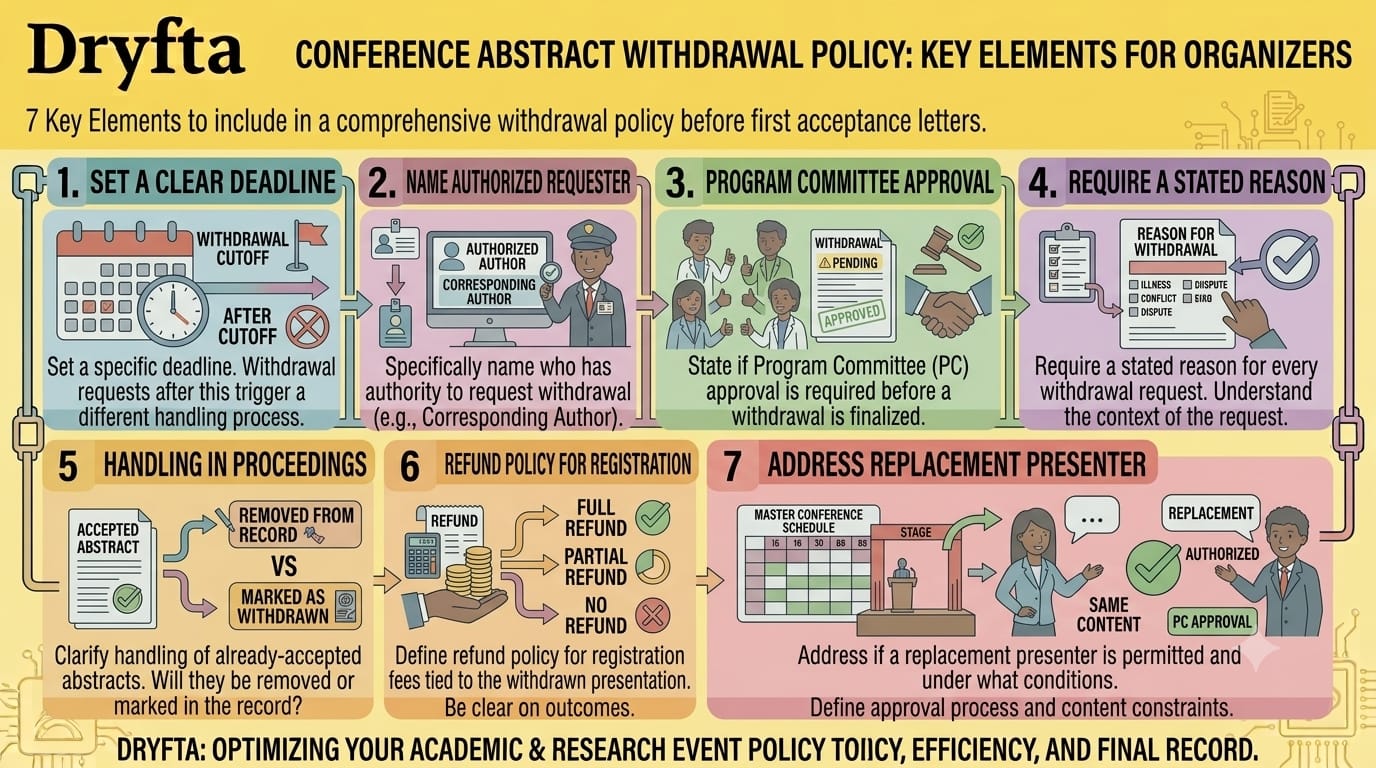
A solid policy answers several questions in advance rather than leaving them to be improvised. It states a clear withdrawal deadline, the point past which a request triggers a different, more disruptive process than one submitted early. It names exactly who may request a withdrawal, since a policy silent on this point invites confusion when a co-author, rather than the corresponding author, tries to pull a paper without proper authorization. It specifies whether formal approval must come out of the program committee or whether withdrawal requests submitted before the deadline get accepted automatically without further review.
The policy should also require a stated reason, not because every reason needs public justification, but because that information helps a committee decide whether a replacement makes sense and whether any broader pattern is worth watching for future events. It should spell out publication implications clearly, addressing whether an abstract already included in preliminary proceedings gets removed, marked as withdrawn, or left exactly as it was.
The refund policy deserves its own clear line as well, since a presenter’s registration fee often depends entirely on presenting, and ambiguity here creates exactly the kind of dispute a documented policy exists to prevent. Finally, a policy should address whether a co-author or colleague may step in as a replacement presenter, since this single decision affects everything covered in the workflow ahead.
A complete conference abstract withdrawal policy should cover the following ground before the first acceptance letter ever goes out:
- Set a clear deadline after which withdrawal requests trigger a different process
- Name specifically who has the authority to request a withdrawal
- State whether program committee approval is required before a withdrawal is finalized
- Require a stated reason for every withdrawal request
- Clarify how an already-accepted abstract will be handled in the proceedings
- Define the refund policy for registration fees tied to a withdrawn presentation
- Address whether a replacement presenter is permitted and under what conditions
Once this policy exists in writing and gets communicated clearly at the point of acceptance, the actual workflow for handling a withdrawal request becomes far simpler to execute consistently.
A Simple Workflow for Abstract Withdrawal After Acceptance
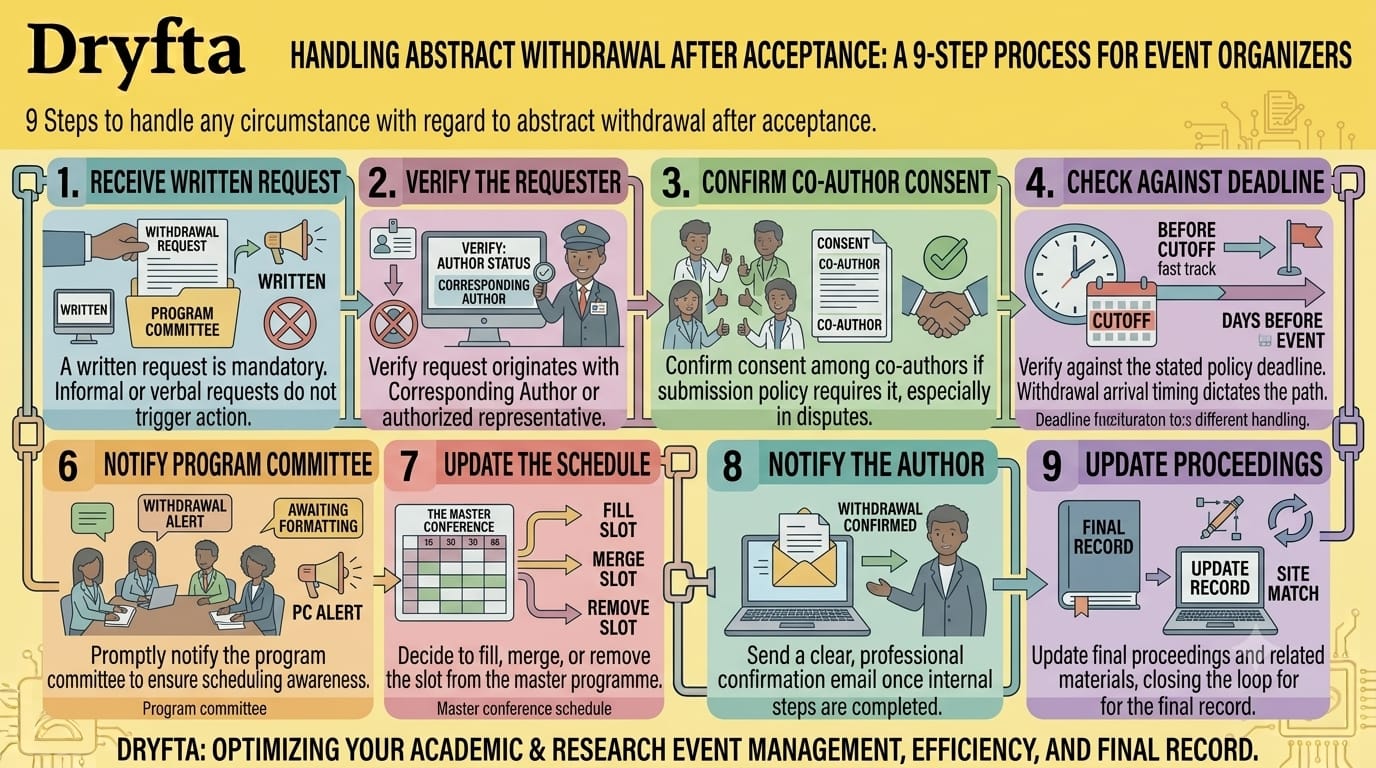
With a policy already in place, the actual response to any individual request becomes a matter of following a sequence rather than starting a judgment call fresh every time. In the 9 steps we’re going over in this section, event organizers will be well-equipped to handle any circumstance with regard to abstract withdrawal after acceptance.
- The process begins the moment the program committee receives a written request, since a verbal or informal mention should never trigger action on its own.
- Verify that the request actually originates with the corresponding author or an authorized representative, since accepting a withdrawal out of the wrong person creates its own set of problems.
- Confirm consent among any co-authors if the submission policy requires it, particularly when a dispute or disagreement may be the reason the request appeared in the first place.
- Check the request against the stated policy deadline, since a withdrawal submitted well ahead of the cutoff follows a very different path than one arriving days before the event.
- Determine the publication status of the abstract, since a paper already included in preliminary proceedings needs different handling than one still awaiting final formatting.
- Notify the program committee promptly so the people responsible for the schedule are not the last to learn that a session has changed.
- Update the schedule itself, deciding at this point whether the slot gets filled, merged, or simply taken off the program.
- Notify the author with a clear, professional confirmation once every internal step above has been completed.
- Update the proceedings and any related conference materials, closing the loop so the final published record matches what actually happened on site.
Skipping any one of these nine steps, or completing them out of order, tends to be exactly where things go wrong. A withdrawal notified to the author before the schedule gets updated internally, for example, risks an author sharing news externally that the rest of the team has not yet acted on.
Should You Replace the Withdrawn Presentation?
Handling abstract withdrawal after acceptance well is only half the job. Deciding what happens to the empty slot afterward is the other half, and not every empty slot needs filling. Ignoring the question entirely usually looks worse than making a deliberate choice either way, and four options cover most real situations, each working best under different circumstances.
Promoting the highest-ranked waitlisted abstract works well when a strong pool of qualified submissions was already narrowed down during review, and a waiting list maintained since the start makes this option available without any scrambling. Extending discussion time for the remaining speakers on a panel works better when no suitable replacement exists nearby, and it often improves the session rather than simply patching over the gap, since attendees frequently value more depth on the last speaker over a rushed, undercooked replacement talk.
Merging two thinly attended sessions covering closely related topics can solve the problem at a structural level, particularly useful when several withdrawals cluster around the same track rather than a single isolated case. Leaving the slot empty rarely counts as anyone’s first choice, though it sometimes remains the most honest option, especially close to the event when no dignified replacement can be arranged in time. A visibly empty slot, clearly marked in the programme rather than awkwardly hidden, causes far less confusion than attendees discovering the gap only once they arrive at the room.
Choosing among these 4 paths depends heavily on timing, subject overlap and how many other conference abstract replacement decisions a committee is already managing at once during the same event cycle.
Keep Every System in Sync
A withdrawal processed correctly on paper but left unupdated everywhere else creates a strange kind of half-finished chaos, where the official decision exists but nobody outside the program committee actually knows about it yet. 9 separate places typically need updating, and organizers frequently forget at least one of them under deadline pressure.
The abstract database itself needs its status changed first, since everything downstream depends on that single record being accurate. Reviewer records should also show the outcome, both to keep historical data clean and so a withdrawn submission does not accidentally resurface in a future review cycle. The conference website needs updating promptly, since a listed session that no longer exists actively misleads anyone checking the schedule online. The mobile app requires the same correction, and because attendees increasingly build their entire day around the app rather than a printed sheet, this update carries real urgency.
The speaker portal needs adjusting so the withdrawn presenter and any replacement see accurate information matching what actually happened. The printed program presents the hardest case, since a physical document already at the printer cannot be changed after the fact, which is exactly why a documented withdrawal deadline matters so much earlier in this process. Digital signage inside the venue needs the same correction applied as the mobile app and website. Certificates awarded for presenting should never go to someone who withdrew, an easy mistake if certificate generation runs on autopilot unconnected to the withdrawal record. Finally, the proceedings themselves need correcting, since accurate scientific conference abstract management depends on the published record matching reality months and even years after the event has ended.
Communicating With Authors Professionally About Abstract Withdrawal After Acceptance
How a conference communicates a withdrawal often matters as much as the decision itself, since authors remember how they were treated during a difficult moment long after they forget the specific policy language involved. Four templates cover most of the situations a program committee will face.
A withdrawal confirmation should acknowledge the request without unnecessary friction, confirming what happens next to the schedule and proceedings without making the author repeat their explanation multiple times to different staff members. A rejected late withdrawal request needs more care, since telling someone their withdrawal request arrived too late requires clarity about the policy alongside genuine empathy for whatever situation prompted the request. A replacement presenter approval should confirm the new speaker’s details plainly and note any adjustments to session timing or format the change requires. A program update notification, sent to affected attendees or the wider audience when appropriate, should explain what changed without dwelling on internal details the audience has no real need to know.
Consistency across all four situations matters more than clever wording in any single message. An author withdrawal request handled with a professional, predictable process and communicated the same way every time regardless of who happens to be on staff that week builds far more trust than a beautifully written message that happens to be the exception rather than the rule.
How Dryfta Supports Abstract Withdrawal After Acceptance
None of the steps that we’ve discussed thus far demand the need for any software assistance, let alone that of a specialized one. But, in practice, handling hundreds and perhaps thousands of abstract submissions today is a task that is best left to the machines. The degree of its interference, whether you want to go completely automated or want to choose a semi-automated setup, is a choice that’s entirely up to your team. Adding on to the already sophisticated and mechanized task of handling abstract submissions is the far more mistake-prone function of author withdrawal requests. And it turns out, abstract withdrawal after acceptance is fairly common in academic and scientific event management.
Centralized abstract records mean a withdrawal gets logged once, in the same place reviewers, program chairs, and staff all already check for status, rather than living in someone’s inbox where the rest of the team has no visibility into it. Status tracking marks a submission as withdrawn immediately and consistently, removing the risk of a stale spreadsheet showing a presenter as confirmed weeks after they already pulled out.
Configurable permissions let an organization enforce its own conference abstract withdrawal policy directly inside the system, meaning only authorized staff can approve a withdrawal, exactly matching whatever rule the organization already wrote down. Author communication tools keep every notification, confirmation, rejection or replacement approval documented in one place, so nobody has to reconstruct what was actually said to an author out of memory months later during a dispute.
Session management tools update the schedule the moment a withdrawal gets processed, supporting conference abstract replacement decisions without a separate manual step of editing a spreadsheet and then remembering to push that change everywhere else it needs to appear. Program updates flow out automatically to the website and app once a session change gets approved, keeping conference program changes visible everywhere attendees actually look.
Audit history preserves a complete record of who approved what and when, which matters considerably if a withdrawal decision ever gets questioned later by an author, a sponsor, or an accreditation body reviewing the event afterward. Reviewer records stay intact and properly connected to the outcome, so historical data remains clean for next year’s planning. Automated notifications handle the repetitive parts of managing withdrawn abstracts, the confirmations, the internal alerts to program chairs, and the routine updates, freeing staff to focus on judgment calls that actually need a human making the decision rather than administrative follow-up that a system can handle reliably on its own.
Best Practices to Reduce Future Withdrawal Requests
Reducing withdrawal volume matters even with an efficient process in place, since fewer disruptions always beat a well-handled disruption, no matter how smoothly the workflow runs. Several practices meaningfully lower how often these requests appear in the first place.
- Ask for presenter confirmation: Requiring presenter confirmation shortly before the event catches a likely no-show earlier, when there is still time to plan around it, rather than discovering the problem at the last possible moment.
- Set and abide by clear deadlines for registration: Setting an early registration deadline tied to presenting creates a natural checkpoint where a presenter who has quietly lost funding or institutional support reveals that fact before the schedule gets locked in.
- Schedule reminder emails at a pre-decided frequency: Reminder emails sent at sensible intervals catch problems early too, prompting an author to flag an issue proactively instead of waiting until the situation becomes an emergency.
- Bind abstracts to presenter agreements: Presenter agreements, signed at the point of acceptance, set clear expectations early and reduce the chance that someone assumed a different process applied to them.
- Verify co-authorship thoroughly: Co-author verification during submission heads off a whole category of disputes before they surface later, since confirming everyone’s involvement upfront closes the door on the kind of disagreement that often triggers an abstract acceptance withdrawal after the fact.
- Keep a waiting list: Maintaining a waiting list throughout the review cycle, rather than assembling one only after a withdrawal has already happened, means a replacement is always available the moment a slot opens.
- Make your publication terms and conditions transparent: A transparent publication policy, stated clearly before submission opens, prevents the kind of surprise that leads an author to withdraw once they realize a rule applies differently than they assumed.
- Don’t fumble with deadlines and key dates: Transparent deadlines throughout the entire cycle and not just for the withdrawal policy itself. This will reduce confusion broadly and cut down on the category of withdrawal requests that trace back to simple miscommunication rather than a genuine change in circumstances.
For Fuss-Free Abstract Withdrawal After Submission, Choose Dryfta
The best of event management platforms are those that account not merely for what can go right but also for where and when things can go about. And what one can do about it. At Dryfta, we stay true to our promise of delivering contemporary event management tools that make challenges, such as dealing with author withdrawal requests, easier to deal with and recover from.
Sign up for a free demo with Dryfta today and experience the full feature set and capabilities of our state-of-the-art event management software.
Frequently Asked Questions (FAQs)
Can an accepted abstract be withdrawn?
Yes, and it happens regularly enough that most established conferences build a specific process around it rather than treating each case as a one-off exception. An accepted abstract withdrawal usually still requires a written request and some form of committee acknowledgment, even when the reason behind it seems straightforward.
Should withdrawn abstracts remain in conference proceedings?
That depends entirely on the policy a conference set in advance and the reason behind the withdrawal itself. An abstract withdrawn for a scheduling conflict might stay listed with a note. One withdrawn over an ethical concern or a data error should generally be removed entirely rather than left standing in the published record.
Can another presenter replace the original author?
Often yes, provided the conference’s policy allows it and the replacement genuinely qualifies to present the material responsibly. A co-author already listed on the submission usually makes the most defensible replacement, since they already share ownership of the underlying research.
Should registration fees be refunded after withdrawal?
This depends on the refund policy established before acceptance letters went out, and clarity here means a straightforward process problem does not also turn into a dispute over money. Many conferences tie the refund decision to timing, offering a full refund for early withdrawals and a partial or no refund closer to the event date.
What happens if an abstract is withdrawn after the program is published?
This is the hardest version of the problem, since a published program already sits in print, online, and inside a mobile app, and every one of those needs correcting once a withdrawal arrives this late. Most conferences handle this by adding a clear notation rather than attempting to erase the listing entirely, since a visible correction reads as more transparent than a session that simply vanishes without explanation.
How can conference software simplify withdrawal management?
Software built around the full abstract lifecycle keeps every downstream system connected automatically once a withdrawal gets processed, updating the schedule, the website, and the proceedings out of one single action rather than requiring staff to repeat the same update across several disconnected tools. This is precisely what turns a 9-step manual process into something a small team can execute reliably every single time.