



Virtual events now play a much bigger role in the B2B industry. The reality is, busy enterprise executives join virtual events because they want immediate access to industry insights without spending much time and money on travel. And guess what? B2B virtual events help exactly with that.
That is why digital engagement nowadays has become a key part of building a more consistent sales pipeline. On top of that, hybrid-first event strategies help brands connect both online and in-person audiences through a unified experience.
So, if you wish to unlock the full potential of these virtual events for your brand, keep reading.
But first…
What Are B2B Virtual Events?
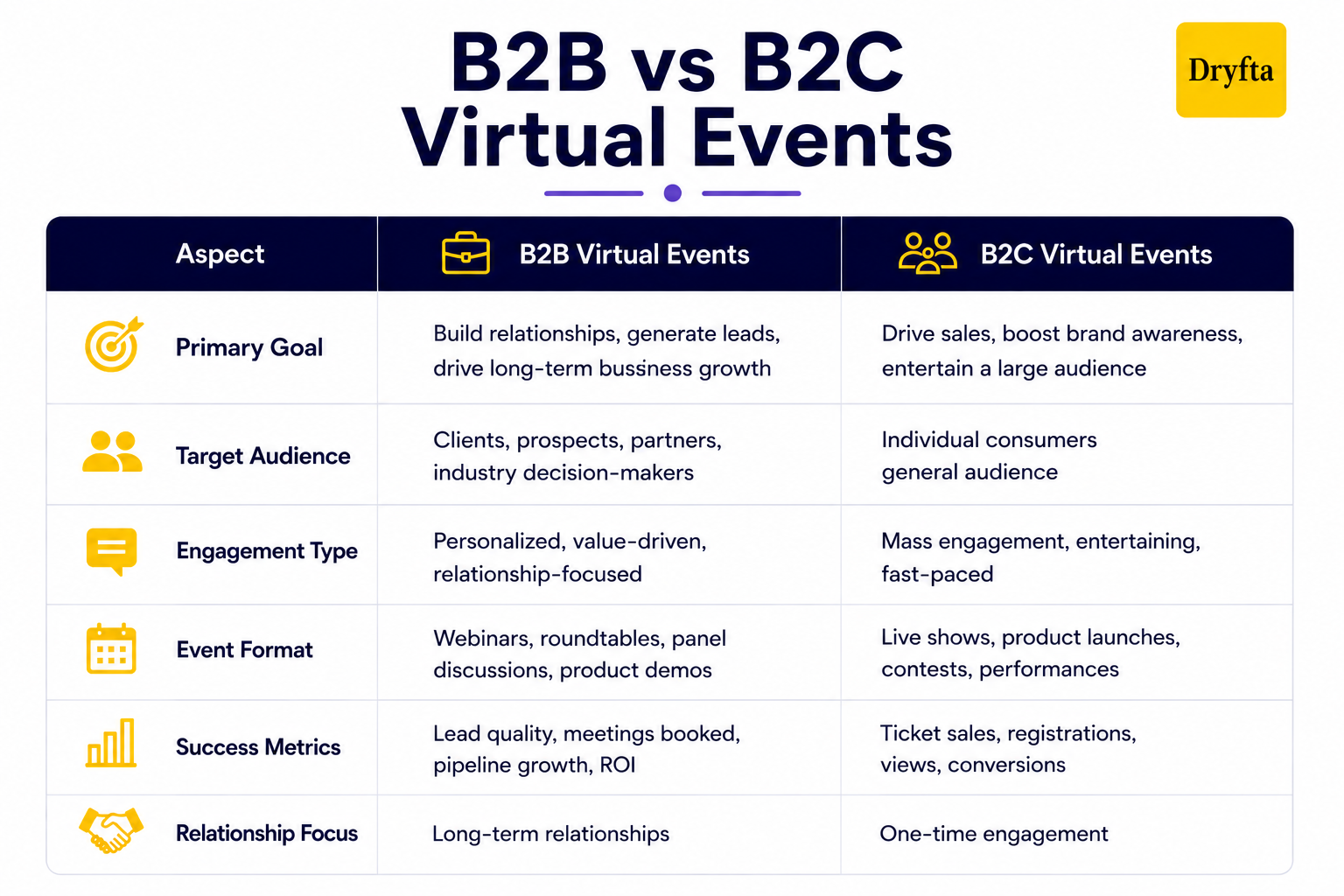
B2B events, or business-to-business events, have undergone a complete transformation in the digital era. Simply put, B2B virtual events are online events that help companies reach out to their clients, prospects, partners, and industry decision-makers via a virtual platform. However, here’s the catch: they’re quite different from B2C events.
The key difference between B2B and B2C virtual events is that B2C events are more about mass entertainment and fast consumer sales, whereas B2B events are more about long-term relationships and continuous engagement with buyers.
Examples of B2B virtual events:
- Virtual conferences
- Webinars
- Virtual trade shows
- Online summits
- Executive roundtables
- Product demos
- Customer events
- Virtual networking sessions
Realistically speaking, trust is the key in corporate sales. This is precisely why it’s essential to pick the right B2B virtual event platform. It supports more engaging networking and collaborative conversations instead of basic broadcast-style communication.
Consequently, the role of virtual events in enterprise marketing has skyrocketed. Now, a robust B2B virtual conference is a lead generation engine, a branding tool, and a pipeline-building machine all in one.
Did you know? According to research, B2B organizations increased webinar volume by 225% year over year, based on analysis of 19,531 webinars across 418 brands.
Why B2B Virtual Events Still Matter in 2026?
Although the post-pandemic rise in virtual B2B events has slowed, they are no longer considered an alternative to in-person events. Virtual events are now the new normal of how B2B organizations interact.
Consider this:
- You can connect with people around the world in a matter of moments, rather than waiting for busy executives to travel.
- Reducing participation barriers opens up the possibility for participants to attend sessions with minimal effort from anywhere.
- Brands can scale much faster with digital events than with in-person events.
- Every click and session view will be automatically captured, improving first-party data collection.
- Enterprise buyers benefit from the flexibility of a virtual B2B conference, as they can access content whenever they can.
- Your CFO will love the highly cost-effective event marketing that doesn’t require venue rental fees.
- Recorded sessions have a long-term value after the event.
- Marketing teams get stronger digital engagement tracking to see exactly which topics resonate with the target audience.
- Virtual events create faster lead generation through real-time attendee interaction and engagement.
- Hybrid event integration bridges the gap by connecting your physical and online attendees.
More importantly, the right B2B virtual event platform helps your conference gain trackable ROI.
Types of B2B Virtual Events That Generate the Best ROI
At the end of the day, the success of your B2B virtual events depends heavily on choosing the right format for your audience and business goals.
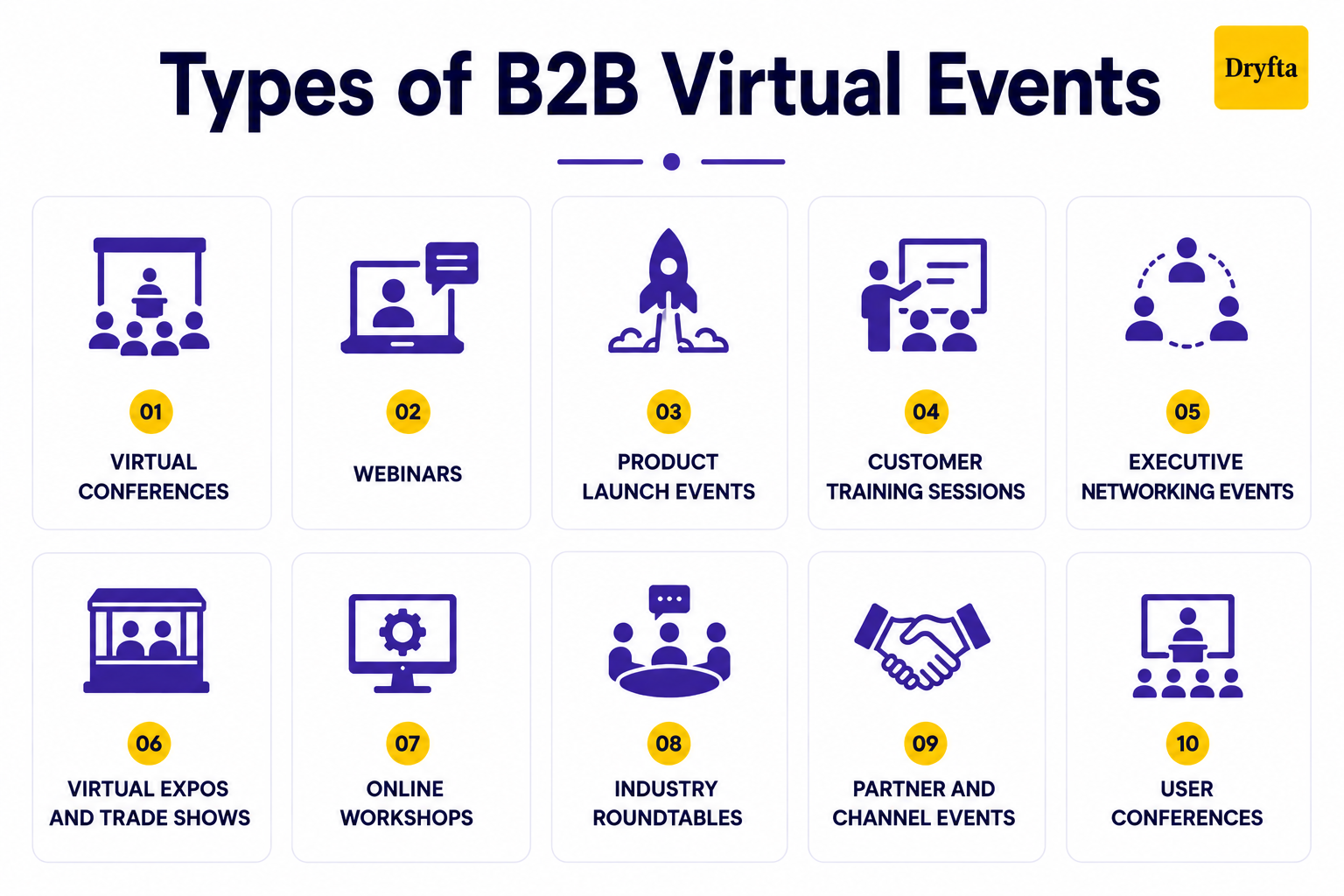
Below are the types of B2B virtual events:
1. Virtual conferences
Best use case: Enterprise networking and thought leadership
Engagement level: High
Lead generation potential: Opportunities to generate quality leads with strong follow-ups
Pipeline impact: Long-term pipeline growth
2. Webinars
Best use case: Product education and demand generation
Engagement level: Moderate
Lead generation potential: Mid-funnel lead quality
Pipeline impact: Helps qualify leads faster
3. Product launch events
Best use case: New product launches and demos
Engagement level: High
Lead generation potential: Strong sales opportunities
Pipeline impact: Accelerates buyer decisions
4. Customer training sessions
Best use case: Customer onboarding and retention
Engagement level: Highly interactive
Lead generation potential: Retention-focused rather than lead-focused
Pipeline impact: Improves long-term customer value
5. Executive networking events
Best use case: C-level networking and partnerships
Engagement level: Moderate but highly valuable
Lead generation potential: High-value business opportunities
Pipeline impact: Supports enterprise deal cycles
6. Virtual expos and trade shows
Best use case: Exhibitor visibility and sponsor engagement
Engagement level: High across booths and demos
Lead generation potential: Strong lead capture opportunities
Pipeline impact: Expands top-of-funnel reach
7. Online workshops
Best use case: Hands-on learning and collaboration
Engagement level: Very high
Lead generation potential: Strong intent-driven leads
Pipeline impact: Builds trust faster
8. Industry roundtables
Best use case: Expert discussions and niche networking
Engagement level: Moderate
Lead generation potential: Smaller but targeted opportunities
Pipeline impact: Strengthens business relationships
9. Partner and channel events
Best use case: Partner and reseller enablement
Engagement level: Moderate to high
Lead generation potential: Strong partnership opportunities
Pipeline impact: Expands indirect revenue channels
10. User conferences
Best use case: Customer engagement and community building
Engagement level: Extremely high
Lead generation potential: Focused on upselling and expansion
Pipeline impact: Improves retention and customer loyalty
Fun fact: Some businesses now launch products through virtual events before announcing them anywhere else.
How to Build a Successful B2B Virtual Event Strategy?
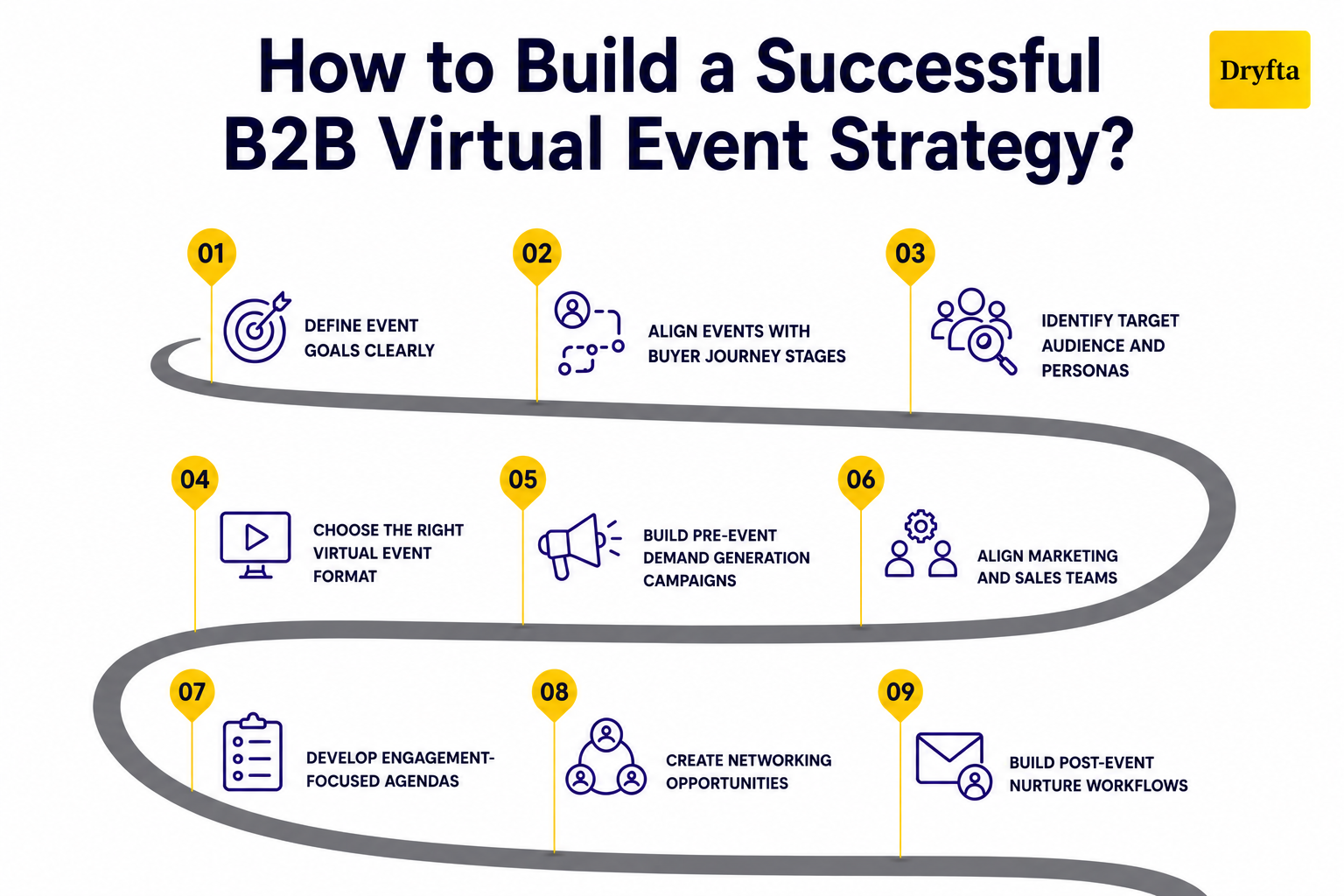
Organizing a mediocre webinar won’t cut it anymore. To stand out, you need a framework that helps B2B virtual events drive consistent business growth.
Define event goals clearly
First things first, define what success means for your business. Identify the top goals, such as pipeline development, lead generation and customer retention.
Align events with buyer journey stages
Do not pitch a hard sale at demos to people who have never heard of your company. The information presented at your events should match where your prospect is in their buying cycle. For example, prospects in the research stage usually need educational content. Buyers in the evaluation stage respond to information that helps them compare options and make decisions.
Identify target audience and personas
To generate ROI from your B2B virtual events, you must know who your attendees are. Tailor your message to the problems your attendees face.
Choose the right virtual event format
The different types of virtual events have different business objectives. Large conferences are great for visibility, while smaller roundtables are ideal for in-depth enterprise conversations. Select your B2B virtual conference format based on your desired results.
Build pre-event demand generation campaigns
Without enough qualified attendees, even the best B2B virtual events will fail. Get your event out there in advance, through various communication channels, to the right target audience.
Align marketing and sales teams
Your sales and marketing team should already know how leads will be qualified before the event even starts.
Develop engagement-focused agendas
Attendees lose interest quickly when sessions are too long. You can combine live polls, shorter presentations and interactive Q&A throughout the event to keep the attention intact.
Nurture leads after the event
The effort you put into what happens after an event can be almost as important as the actual event. After the event, send participants something relevant and helpful.
B2B Virtual Event Features That Improve Engagement
Keeping online audiences focused is undeniably the toughest challenge in B2B virtual events. A modern event platform cannot rely solely on video streams to keep attendees from tuning out.
Features to look out for in a B2B virtual event platform:
- AI-based networking will match target buyers with relevant peers automatically based on their profiles.
- Live chat and messaging spark instant community conversations and peer-to-peer interactions.
- Interactive Q&A sessions help speakers connect with audiences and keep presentation segments very dynamic.
- Polls and surveys gather immediate feedback on pressing corporate challenges while generating real-time data.
- Virtual breakout rooms divide large crowds, which is perfect for workshops.
- Gamification lets attendees explore your B2B virtual conference via leaderboard points and digital rewards.
- Session recommendations direct participants toward content tailored to their pain points.
- One-on-one meeting scheduling lets sales reps book private discovery calls.
- Virtual sponsor booths deliver measurable ROI to your partners through event analytics.
- Live attendee analytics let marketing teams monitor user behavior in real time and adjust their B2B virtual events mid-broadcast.
How B2B Virtual Events Generate Qualified Leads?
Your pipeline is completely dependent on good leads. Thankfully, hosting a B2B virtual conference gives you the exact engagement analytics of your event.
- Intent-based attendee targeting attracts high-value enterprise decision-makers who are looking for your specific solutions.
- Buyer behavior insights reveal a prospect’s true pain points based on their chat participation.
- Personalized follow-up happens naturally when sales reps mention the exact virtual sessions an attendee watched.
- Product demos qualify interested buyers instantly by showcasing your features live on the B2B virtual event platform.
- Executive networking creates private digital spaces where top prospects can comfortably speak about issues.
- Data capture and lead scoring automatically rank your top prospects based on their interactions.
- Marketing automation triggers instant email campaigns the moment a targeted lead logs in.
- Sales-ready lead identification can help your business identify the right accounts to target for a direct sales pitch.
Best Channels to Promote B2B Virtual Events
LinkedIn is one of the most effective channels for promoting B2B virtual events, thanks to its exact targeting capabilities. You need to use a mix of organic reach, paid amplification and outbound channels to maximize your registration numbers.
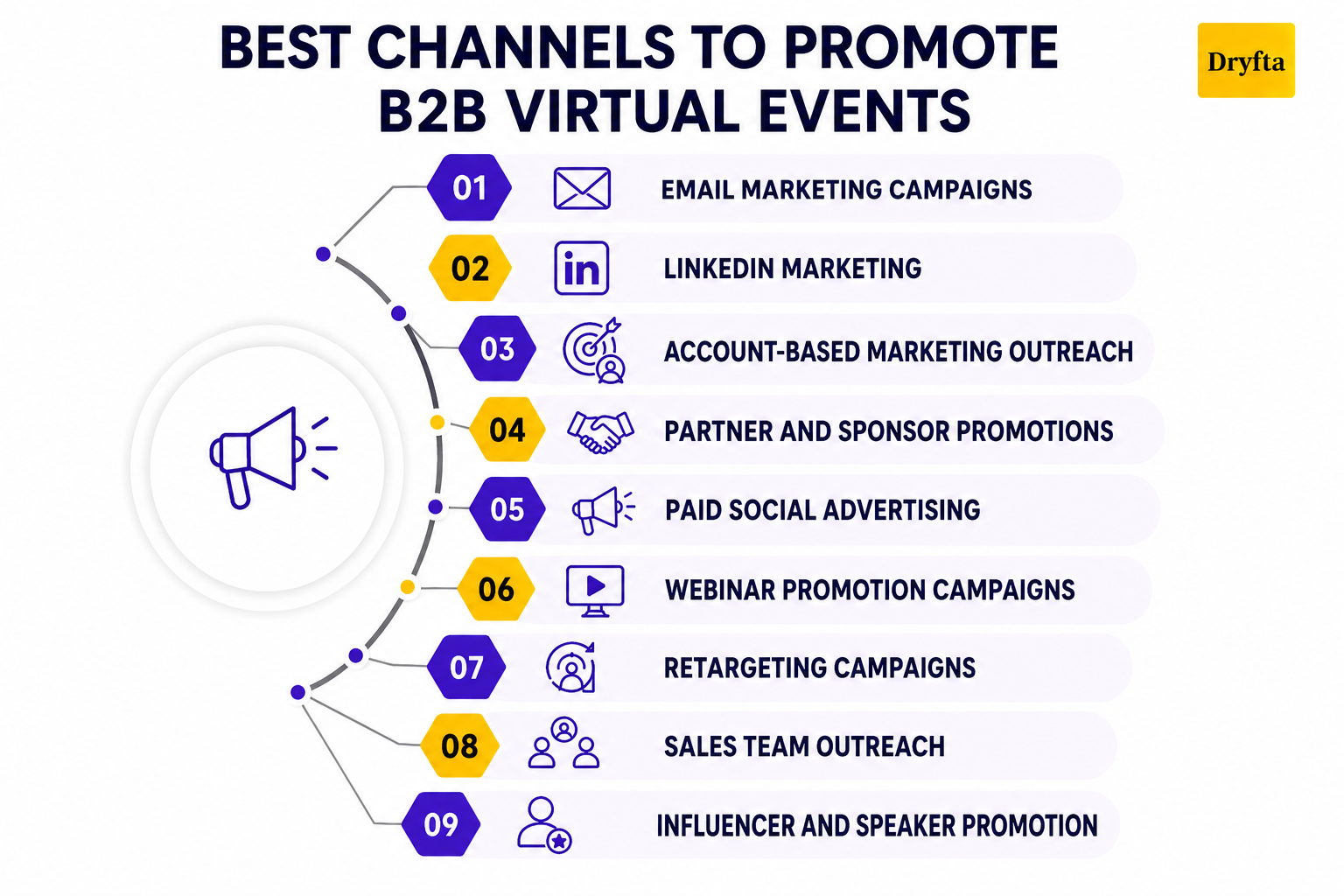
Top promotion mediums:
- Email marketing campaigns: Send personalized emails to your current subscriber base to encourage instant sign-ups.
- LinkedIn marketing: Target specific corporate job titles and industries with organic thought leadership posts.
- Account-based marketing outreach: Focus your promotional resources entirely on high-value accounts to guarantee their presence at your events.
- Partner and sponsor promotions: Take advantage of your event partners’ existing digital networks to grow your audience several times over.
- Paid social advertising: Advertise hyper-targeted video ads to new audiences on professional platforms.
- Webinar promotion campaigns: Promote your B2B virtual events in webinars to drive interested viewers up the sales funnel.
- Retargeting campaigns: Display targeted banners to visitors who left your website without completing the registration process.
- Sales team outreach: Let your sales team send personalized calendar invites to prospects in your pipeline.
- Influencer and speaker promotion: Give your keynote presenters ready-to-use social media swipe files to promote your event.
Common B2B Virtual Event Mistakes to Avoid
The truth is, even experienced marketing teams stumble when hosting enterprise virtual events. Avoiding these critical missteps keeps your B2B virtual events profitable.
- Webinar-style sessions with no interaction lead to instant tab-switching and lower attendee retention.
- Poor networking strips away the core reason professionals log into a B2B virtual conference.
- Weak post-event follow-up destroys the momentum your marketing team built during the broadcast.
- Generic event messaging does not effectively communicate with decision-makers.
- Overcomplicated registration processes trigger form abandonment before users even sign up.
- Lack of attendee engagement strategies leaves your digital audience feeling completely isolated.
- Poor speaker preparation on your B2B virtual event platform results in awkward technical pauses.
How AI Is Transforming B2B Virtual Events
You might be wondering how artificial intelligence changes the game. This technology completely redefines how organizations host B2B virtual events by replacing manual work with smart automation.
Notable pros:
- Attendee matchmaking connects the right buyers and sellers automatically based on shared corporate goals.
- Personalized session recommendations suggest to participants the exact presentations that solve their queries.
- Predictive lead scoring ranks your most interested prospects instantly by analyzing their interaction.
- Automated event communication delivers timely, customized reminders to boost event hype.
- Smart networking recommendations introduce like-minded professionals.
- AI chatbots for attendee support resolve technical issues around the clock without draining your internal resources.
- Engagement analytics and insights decode audience sentiment mid-broadcast to help teams optimize live programming.
- Automated content summaries transform long video playbacks into quick, digestible takeaways for busy enterprise executives.
- Marketing automation integrations sync deep interaction data straight into your CRM system.
B2B Virtual Event KPIs You Should Track
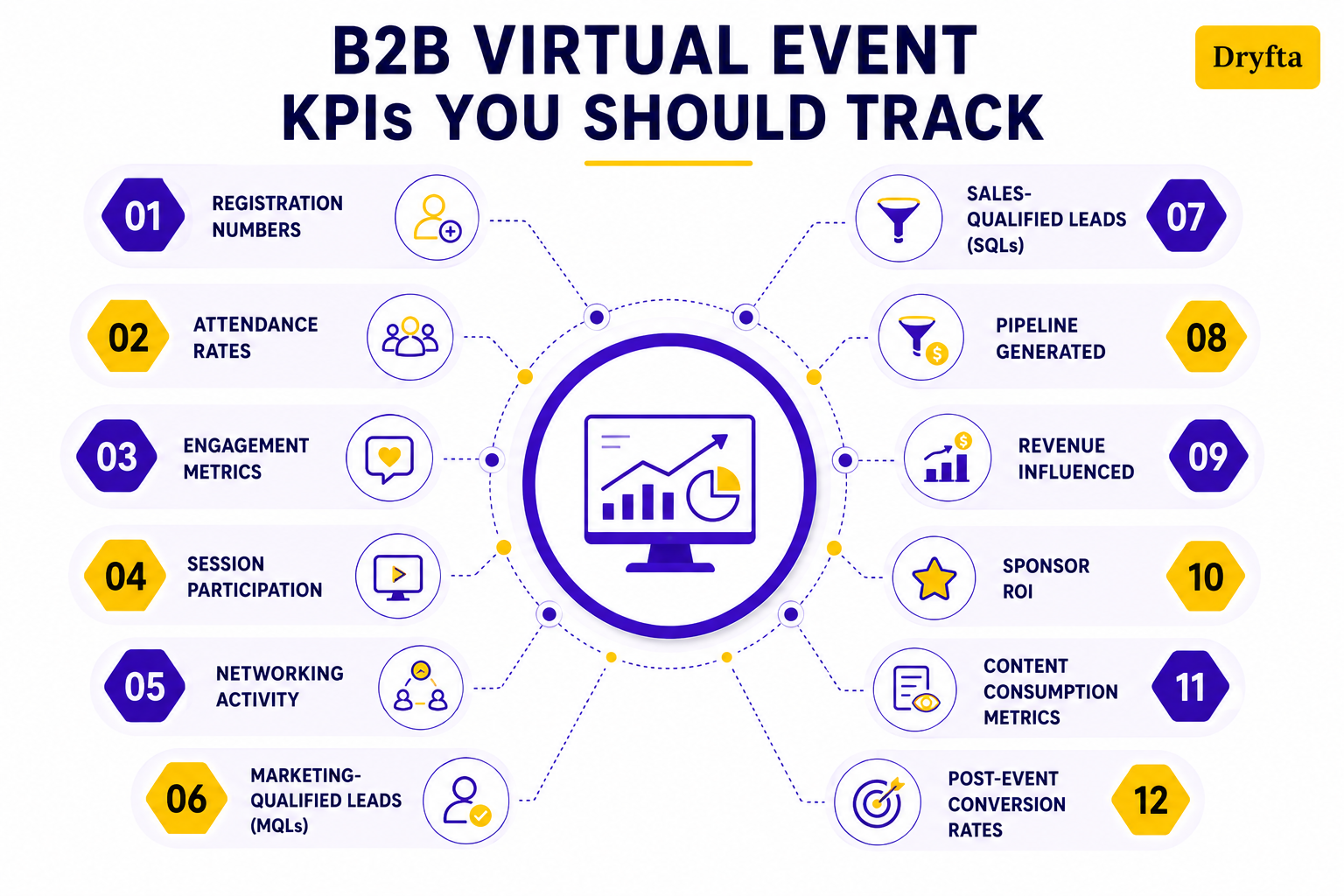
Because virtual events have zero travel barriers, they see much higher drop-off rates than in-person events, which means an extensive tracking strategy is crucial.
Top 11 performance KPIs:
- Registration numbers reflect the overall market demand and the effectiveness of your early promotional campaigns.
- Attendance rates show the number of registrants who logged in to your live B2B virtual conference platform.
- Engagement metrics measure real-time audience actions like poll responses, chat questions, and survey completion rates.
- Session participation points out your most valuable topics by monitoring average watch times per presentation.
- Networking activity is measured by tracking business card exchanges and private message counts.
- Marketing-qualified leads (MQLs) track warm leads that meet your interaction criteria.
- Sales-qualified leads (SQLs) highlight buyers who requested direct booking with your executives.
- Pipeline-generated calculation determines the total dollar value of each new sale.
- Revenue influenced ties closed-won deals back to prospect touchpoints across your enterprise virtual events.
- Sponsor ROI validates partner investments by reporting digital booth visits and lead counts.
- Content consumption metrics show how viewers interact with on-demand videos.
How Hybrid Events Are Changing B2B Virtual Event Strategies?
As it turns out, the future of corporate events is no longer purely digital or physical. Organizations now blend both formats to create more engaging events.
- Combining virtual and in-person events bridges the gap between online and onsite attendees.
- Expanding global audience reach welcomes international participants who cannot travel.
- Improving attendee flexibility lets professionals choose exactly how they want to participate in your event.
- Increasing content accessibility opens up learning opportunities for people with different schedules or physical needs.
- Better sponsor visibility provides partners with double the exposure across physical booths.
- Enhanced attendee personalization delivers tailored content for both remote and live participants.
- Better analytics and reporting track physical and digital data more accurately.
- More scalable event experiences grow your registration numbers without venue costs.
How Dryfta Helps B2B Virtual Event Teams?
Dryfta is an enterprise-grade, all-in-one event management platform built to streamline the complex logistics of hosting B2B virtual events.
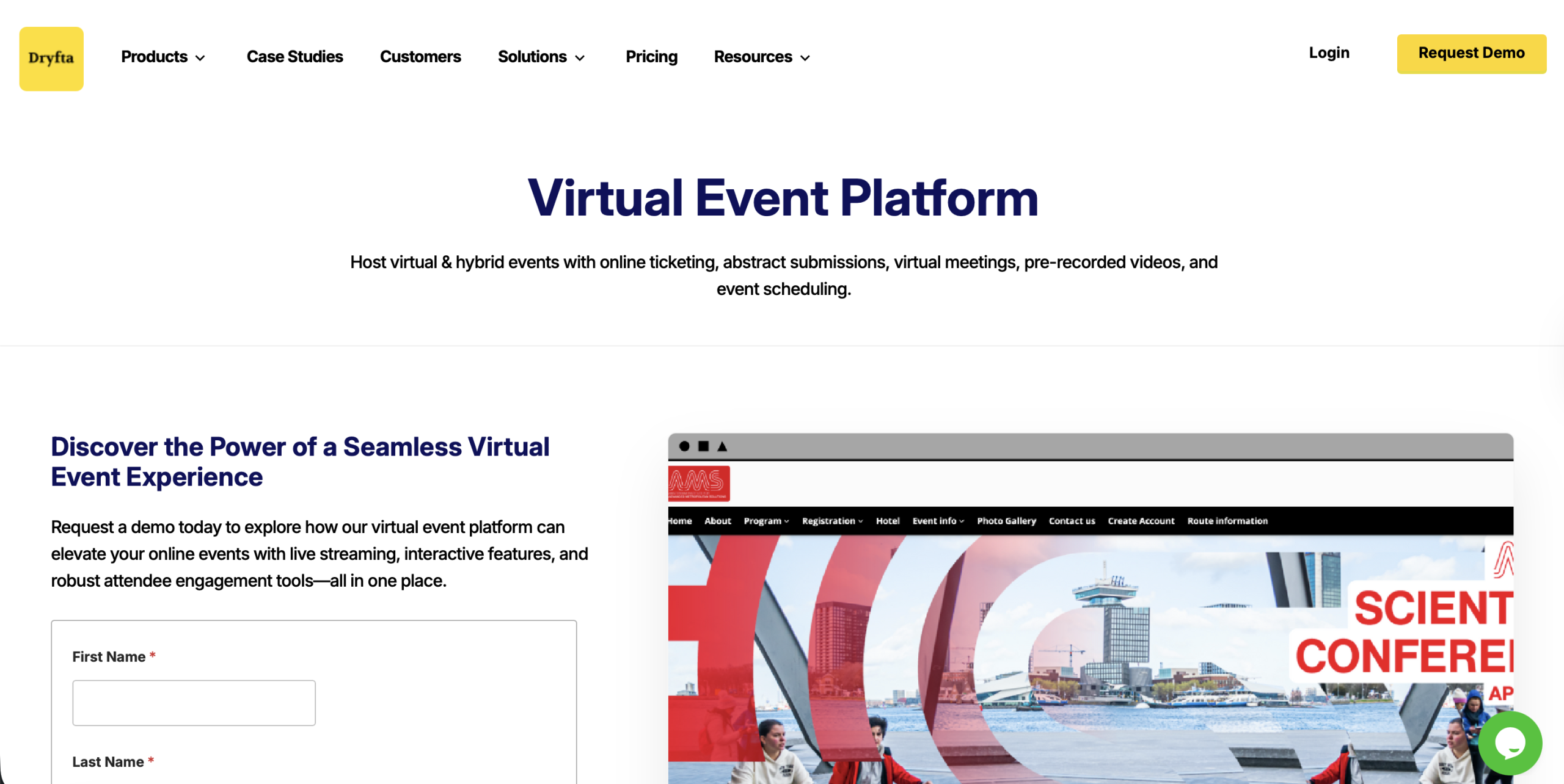
12 reasons why Dryfta is the best:
- End-to-end virtual event management platform: Streamline your event planning from initial sign-ups to final data reports without switching tools.
- Hybrid and virtual conference support: Connect in-person and remote audiences seamlessly.
- Registration and ticketing workflows: Collect payments and attendee details using custom forms built specifically for enterprise virtual events.
- Agenda and speaker management: Build complex schedules and coordinate speaker profiles with ease.
- Networking and attendee engagement tools: Encourage attendee interaction through built-in messaging and engagement features.
- Event website builder: Create branded landing pages to attract registrations without needing any coding skills.
- Sponsor and exhibitor management: Provide digital booths to maximize ROI and lead tracking for your event sponsors.
- Automated email and communication workflows: Send timely confirmation and schedule reminders to boost live participation.
- Real-time attendee analytics: Monitor user behavior and session popularity instantly as the event unfolds.
- CRM-friendly workflows: Sync contact data directly into your existing marketing CRM.
- Mobile-friendly attendee experiences: Ensure a seamless event for busy professionals with the mobile event app.
- Multi-track virtual conference management: Run multiple presentations simultaneously to keep diverse audiences engaged.
Bottom Lines
When all is said and done, digital gatherings have evolved into a core part of modern business growth strategies. In 2026, organizations use virtual events to expand their reach and drive scalable, long-term business growth. With the right approach, a typical online session can become a valuable lead-generation engine.
Dryfta streamlines this entire process by offering an all-in-one platform to run your B2B virtual and hybrid conferences flawlessly. Ready to scale your business growth? Book a free demo with our team today to get started!
Frequently Asked Questions About B2B Virtual Events
- What are B2B virtual events?
B2B virtual events are online business events where companies connect with clients, partners, and industry professionals through digital platforms. Attendees join remotely to watch presentations and network with peers from different locations using their computers or mobile devices.
- Why are virtual events important for B2B marketing?
Virtual events help marketing teams reach a global audience without incurring travel costs. They make it easy for busy executives to attend with just one click. Additionally, they give companies accurate data on what topics interest attendees, helping build trust and strengthen business relationships over time.
- Which virtual events generate the best ROI?
The highest return on investment comes from aligning your format with your business goals. For lead generation, large virtual conferences work best. If you want to close enterprise deals, smaller events like interactive industry roundtables or exclusive networking sessions yield the highest financial value for your sales pipeline.
- How do virtual events generate leads?
When attendees download resources or participate in live text chats, they share information about their business needs. Marketing teams track this to find interested prospects and hand them over to sales teams for personalized follow-up conversations.
- What KPIs should marketers track?
Track true attendance rates, average session watch times, and the total number of connections made during networking. Most importantly, measure marketing-qualified leads and total pipeline revenue generated to prove financial success.
- What is hybrid B2B event marketing?
Hybrid B2B marketing combines a physical corporate event with a digital online experience. It serves two audiences at once: in-person guests at the venue and remote participants logging in from home. It ensures everyone receives the same content value and networking opportunities.
