


Not long ago, an enterprise event team was preparing for a large international conference. Speakers confirmed their sessions, registrations kept increasing, and the schedule became more complex than expected. The problem started when the team realized the event platform they chose was designed for smaller marketing events, not large enterprise programs. Even simple tasks started taking longer than expected, while many features felt unnecessary for the type of event they were trying to manage.
Situations like this happen more often than people think. Platforms like Bizzabo work well for B2B events, but academic and professional enterprise conferences often need a different platform.
If you are planning an enterprise event in 2026, it may be a good idea for you to read further about the top Bizzabo alternatives and other crucial details.
What is Bizzabo?
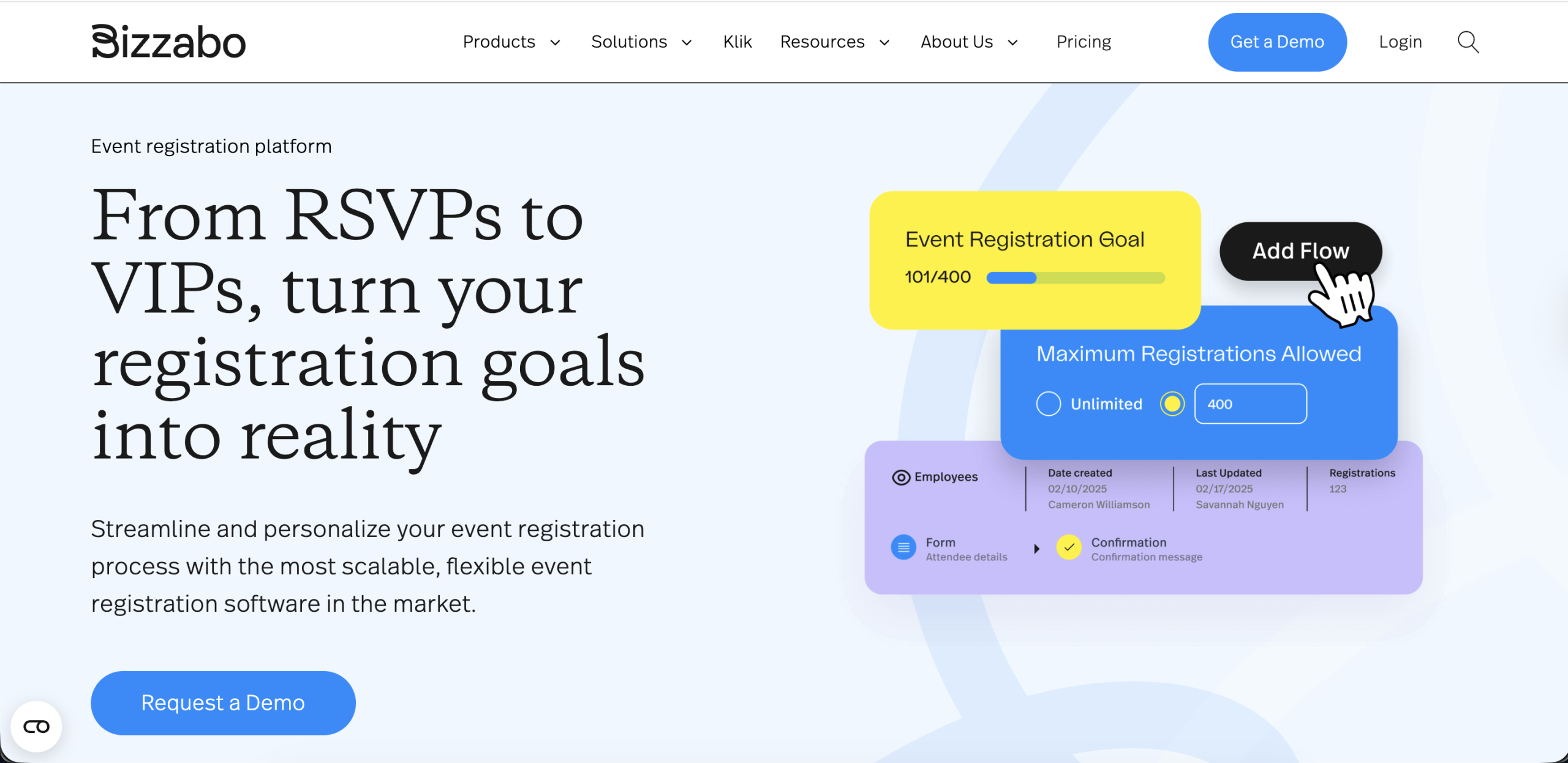
Bizzabo is an all-inclusive event management platform that helps modern enterprises create, plan and execute the full life cycle of conferences, whether they are in-person, virtual, or hybrid. Since its launch in 2011, Bizzabo has been the central hub where organizers can register attendees, coordinate speakers, and promote events through an intuitive user experience.
Bizzabo uses data and analytics to deliver live insights and reporting to planners and incorporates CRMs such as HubSpot and Salesforce to report on engagement and ROI. It also includes a branded mobile app for networking and automated email campaigns.
Why Are Enterprise Event Teams Exploring Bizzabo Alternatives in 2026?
In 2026, enterprise event teams place more weight on platforms that offer deeper customization, especially when they manage complex events. Bizzabo is still very prominent in the marketplace. However, the growing demand for flexibility and lower costs pushes many teams to seriously consider Bizzabo alternatives.
- Pricing strategy: Rising subscription renewals and platform fees push teams to look for pricing that feels more stable and easier to justify. Many alternatives now offer modular pricing that better fits changing event volumes.
- Advanced customization: Marketing teams often want more control than standard branding allows. Several competing platforms support deeper design control, including custom CSS and tailored registration.
- AI features: Newer platforms bring AI directly into the workflow. They automate tasks like session summaries and personalized agendas while offering live recommendations based on attendee behavior.
- Specialized onsite hardware and vendor support: Some teams need tools beyond the fixed ones. Hardware-agnostic platforms let organizers choose local vendors for security and onsite logistics.
- Enterprise complexity: Bizzabo consists of several robust features that can overwhelm the enterprise event teams who usually juggle among the multi-site conferences, global compliance, and custom integrations. This usually requires many endless tweaks across various departments. Teams’ productive hours get wasted in aligning sales, marketing, and other workflows. This leads to getting distracted from the important tasks, such as attendee experiences, and essential internal work that must be prioritized for high-stakes academic gatherings.
- Long implementation cycles: It usually consists of lengthy setup phases, which often stretch for around 6-12 months to complete the deployment. It also requires testing and stakeholder sign-offs that directly delay the launches. Essential timelines also get slipped, resulting in rushed workarounds or missed seasons. Enterprise events require quick implementations that boost the attendee experience and build momentum.
- Expensive add-ons: Although there are several features in Bizzabo. The pricing also gets expensive with every single add-on. The use of premium features like advanced reporting and mobile apps gets costlier. What starts as an affordable investment turns into a six-figure expenditure annually as teams layer analytics, virtual hubs, or CRM syncs, questioning ROI justifications. Event organizers usually prefer transparent pricing models that eliminate hidden costs and last-minute surprises.
- Difficult onboarding: The onboarding experience is tiring. It requires dedicated project managers and training sessions. This can make the smaller enterprises feel overloaded. New users struggle with dispersed resources and strict deadlines. The teams like it when there are self-serve academies, interactive demos, and easy-to-understand guides related to setting up and onboarding customers without any delays. Organizers always look for streamlined alternatives so that their event shines and the team members get proficient with event management software in no time.
- Complex UI for smaller teams: Event organizers look for simple navigation. They get easily confused by Bizzabo’s complex dashboard, especially while organizing large-scale academic conferences. If the size of the team is small, then the presence of critical elements like pointless toggles and deep menus will only lead to confusion. The UI makes the non-technical users get irritated. This directly results in making daily adjustments. It is very important to have an interface that promotes user-friendliness, is simple to adjust to team sizes, and consists of hybrid workplace setups. This makes conference management software get increased acceptance.
Limitations and Pain Points of Using Bizzabo
Users have expressed some common issues that limit their ability to use Bizzabo on a daily basis:
-
- Customization limitations: Users find the website and email automation tools to be somewhat limited and difficult to work with. Therefore, many advanced modifications still have to be done manually through writing CSS/HTML code.
- Steep learning curve and confusing interface: Because Bizzabo has so many different options, it can seem like too much to handle initially. For this reason, new users may require extensive training before feeling comfortable and proficient with all of the Bizzabo options.
- Repetitive manual data updates: Due to the lack of integration within the system, team members will have to regularly duplicate efforts when updating event information.
- Restricted onsite hardware compatibility: Onsite badge printing requires iPad-compatible hardware, which restricts the ability to use other hardware options.
- Inconsistent customer support across tiers: Enterprise users have access to high-quality support. Lower-tiered users have experienced delays in response times during critical issues.
- Gaps in reporting and analytics: Reporting options are usually too high-level and require further breakdowns than what is available from built-in reporting.
- High pricing for entry-level users: Most plans begin at approximately $17,999 per year with minimal user requirements. Small teams and one-time planners often struggle to justify the price.
These issues often lead teams to explore Bizzabo alternatives for large events.
Criteria for Evaluating Bizzabo Alternatives
The following criteria help you evaluate Bizzabo alternatives more effectively.
-
- The interface should feel simple for both planners and attendees. A complicated setup often increases onboarding time and creates unnecessary support issues during live events.
- Pick an event platform with a drag-and-drop website builder. You need to be able to replicate your brand’s style without having to call a developer to make small HTML/CSS changes.
- Native integration with CRM tools such as Salesforce and HubSpot is important. Accurate and clean data flow into your CRM helps reduce manual entry and makes your marketing lists more useful and accurate.
- A slow or unresponsive app will ruin the overall user experience. Look for platforms that have shown themselves to perform reliably, even under high-traffic sessions.
- Be sure to evaluate hardware requirements for check-in and badge printing. While some tools may be compatible with standard devices, many require specific equipment which adds additional cost.
- The platform should offer real-time analytics through its built-in dashboard. Using spreadsheets to analyze your data is time-consuming.
- Finally, always read the fine print regarding pricing. There may be hidden charges for registrations or additional fees for premium support.
What to Look for in a Bizzabo Alternative
Many users look for good Bizzabo alternatives, whose main focus is prioritizing platforms that focus on delivering core functionality and a seamless enterprise event management experience.
- Event registration and ticketing: During peak sign-ups, the need for reliable event registration and ticketing plays a crucial role. It is important that the event software manages different pricing models, group reservations, discounts, and coupon codes well without any issues. Choosing the best option enables the event organizers to personalize the forms with clear conditional logic, quickly record session preferences, and optimize the whole event management registration process.
- Hybrid and virtual event capabilities: There is a huge demand for innovative platforms that enable in-person, virtual, and hybrid events with smooth live streaming, multi-session scheduling, and interactive booths. These features help people to stay connected. It also helps to drag their interest. With synchronized agendas and chat features, online and in-person interactions become more effective.
- Mobile event apps: Not everyone can be at the conference venue. The event organizers must look for alternatives like native mobile event apps that deliver venue maps, speaker profiles, and customized agendas directly to guests’ pockets for simple and quick navigation. People get attracted if everything is at their fingertips, and mobile apps are perfect to meet this need. It is also a good idea to pick some of the popular features among users, such as one-tap networking and session reminders. This helps to monitor real-time engagement to instantly boost the onsite flow. Mobile event apps act as check-in tools that cut down on lineups and free up the crew to concentrate on hospitality rather than logistics.
- Networking and attendee engagement tools: Before the inception of the event, seek various options that provide clever matchmaking algorithms by linking guests according to their interests, occupations, preferences, and subjects. According to an EventMB study on insights on the future of audience engagement in early 2025, 72% of attendees feel more satisfied with an event when they get multiple ways to actively participate during presentations. This can be considered as one of the most important factors related to interactivity and audience engagement. This also influences many one-time conversations and results in long-term leads for upcoming conferences, and helps in automatically gathering post-meet feedback.
- CRM and marketing automation integrations: Giving top priority to strong and simple integrations with CRMs and marketing automation will help to get real-time attendee data syncing, supporting nurturing campaigns from registration through follow-up. These solutions not only improve opportunities but also upsell the resources by sending customized emails based on activities, such as session attendance or booth visits.
- Sponsor and exhibitor management: There are quite a few Bizzabo alternatives that offer dedicated sponsor and exhibitor management with features that include lead capture forms, automatic sponsor reporting, user-friendly dashboards, and drag-and-drop booth builders. There are also options like virtual product presentations to onsite traffic heatmaps, which ease the whole process and promise fulfillment and satisfaction.
- Analytics and reporting dashboards: Enterprise event organizers have a lot of things to take care of, and if they find everything in one place, then it becomes easy for them to carry out their tasks. The need for dashboards that show all the essential analytics and reports with customized widgets is helpful. These give quick insights related to the registration status, income projections, session popularity, and engagement heatmaps. These dashboards also provide data-driven adjustments that are necessary for tackling the pain points and enhancing productivity.
- On-site check-in and badge printing: Many directly attend the conference and look for onsite check-ins. Providing easy process check-in kiosks that can accommodate 100–10,000 guests is very useful. Participants feel more valued if they get something in return. Using software that provides customized digital badge printing will make the event a perfect platform for standard knowledge and excellence.
- AI-powered event management features: If there is an event management software that makes the best use of AI, then that is the one the organizers should pick. It is the perfect alternative for Bizzabo because of its features like providing intelligent recommendations, flagging high-value leads from chat logs, or recommending sessions depending on past data. AI-powered features also give clear predictive analytics for attendance forecasts and automatic sentiment analysis based on the feedback collected. This technology transforms basic event management software into a strategic business partner.
- Scalability for enterprise events: If a conference management platform consists of enterprise-ready attributes, then it can handle an infinite number of users, manage custom APIs, and provide multilingual support without experiencing any type of performance drops. It also should have features like sending 100,000 emails in a go, free automated notifications within just a click, and supporting teams internationally in different time zones.
- Pricing flexibility: The software should have a clear, usage-based pricing that fits with your enterprise event’s needs. Even if there are tight budget constraints, the costs should be flexible without any hidden charges. If there are free trials, discounts, and annual plans, then it is a must to try for.
- Customer support and onboarding: Look for 24/7 email and live chat support with committed success managers so that your staff may go live with practical training in a matter of weeks rather than months. In order to reduce downtime during registrations, make sure that the data mapping is done flawlessly. Responsive assistance always increases trust, giving rise to increased satisfaction levels.
Best Bizzabo Alternatives for Enterprise Events
An event management software should handle conferences irrespective of their size with its innovative solutions, deep integrations, and agility that actively meet the expectations of a global audience. Some of the prominent Bizzabo alternatives to look for in terms of enterprise events are
Platforms designed for large-scale conferences
The conference management platform should be designed in such a way that it easily handles large-scale conferences without crashing. The event organizers and their team should be able to run multi-day events with real-time scaling, from abstract reviews to live polls. Whova and Cvent are among the best choices when it comes to a deep feature set, strong analytics, advanced marketing, and registration tools. Dryfta shines especially in academic conferences by streamlining event management registration for 10,000+ attendees effortlessly.
Enterprise-grade integrations
Cvent CRM offers integrations with HubSpot, Marketo, and Salesforce by quickly syncing attendee data to power corporate CRM pipelines for both local and international teams. Dryfta event management CRM is mainly crafted for enterprises. It is easy to use and manage registrations seamlessly, even with complex workflows, speakers, and attendees’ information. EventsAir allows automating processes from registration to post-event leads without any headaches.
Advanced attendee analytics
For better and more intelligent planning, Whova offers heatmaps based on session popularity, no-show forecasts, and engagement scores. These highlight underlying patterns in attendance behavior. With Cvent’s dashboards, the organizers can delve into path maps and demographics to optimize future events using actual data from previous interactions and registrations. Dryfta transforms raw data into useful insights for business conferences with its AI-powered solutions on abstract quality and reviewer biases.
Multi-track agenda management
EventsAir consists of features like drag-and-drop scheduling across more than 50 tracks. It also provides options to create dynamic agendas, auto-conflicting sessions, and instantaneous updates to mobile apps. Dryfta also offers event scheduling features that help to plan events effortlessly on the website and on the app. Whova offers speaker portals and color-coded timelines that easily handle changes even in the middle of an event without confusing attendees.
Sponsor and exhibitor capabilities
EventsAir has tailored sponsorship packages with revenue options for tracks. It also provides unique leads for exhibitors. Dryfta increases renewals through demonstrated and action-driven ROI visibility while streamlining exhibitor onboarding with customizable packages and traffic metrics. Whova’s gamified interactions and virtual show floors get three times as many sponsor leads, making the business events income generators.
Scalability for global events
Cvent offers multi-language support, currency management, and regional data centers for low-latency hybrid delivery, which can accommodate more than 100,000 participants worldwide. EventsAir expands from regional meets to global series with its auto-adjusting bandwidth and compliance. For large-scale enterprise events, Dryfta is the perfect pick because it offers customizable schedules, track management, and many robust scheduling features.
Security and compliance support
InEvent offers role-based access, audit logs, and zero-trust models. Many IT teams trust this for their high-stakes events. Attendee data is protected by Cvent’s enterprise-grade firewalls and breach notifications. It guarantees higher satisfaction and strict international standards. Dryfta protects sensitive intellectual property by encrypting abstract submissions and complying with GDPR and CCPA regulations. It is committed to protecting data security with its multi-faceted approach.
Multi-team collaboration features
Whova has interactive features that offer marketing, operations, and sponsors the ability to edit agendas in real-time with the help of shared workspaces. There is also an option to check the version history so that there will be no confusion during busy times. Dryfta provides permission tiers where executives can clearly get a look at the overall picture while sub-teams can manage tracks individually. EventsAir consists of task assignments and approval workflows so that the remote teams are in sync about the details related to event management registration.
Best Bizzabo Alternatives for Academic Conferences
Academic conference organizers require highly specialized processes like handling abstracts and peer reviews, and end-to-end seamless conference management options. There are many Bizzabo alternatives, some of which include:
Abstract submission management
Dryfta offers a one-of-a-kind abstract management platform. It consists of several features like configurable form¸ multi-stage uploads, and automated plagiarism checks. It relieves the conference organizers from stress and gives them countless hours, mainly during busy times. Oxford Abstracts provides version tracking and author dashboards. It easily manages an infinite number of submissions, allowing researchers to make confident revisions while keeping complete control to easily meet the deadlines.
Peer review workflows
Oxford Abstracts offers intelligent assignment algorithms that perfectly match abstracts to expert reviewers based on expertise and conflicts. It also enables peer review procedures and significantly reduces the time required for manual matching. Dryfta consists of multi-round reviews and AI-enabled bias detection that eliminates partiality in assessments, giving rise to fair evaluations on which scholars can rely.
Speaker and session management
Ex Ordo is a custom-built solution for research conferences and scholarly events. It offers a perfect blend of speaker and session management features, which are easy to use and highly efficient. Dryfta has a dedicated speaker management system that includes speaker bios, live polls creation, roles, and time availability. This helps the academic conference organizers to assign chairs, moderators, and authors, as well as understand and manage attendees checked in to a session and those on the waiting list.
Poster presentation handling
Dryfta offers poster presentation handling smoothly with its interactive digital galleries, where authors can upload PDFs, videos, and QR-linked content for virtual browsing so that a worldwide audience can get involved easily. Oxford Abstracts transforms static displays into dynamic networking hotspots at the academic conference by creating e-poster walls with clear viewer analytics and planned walkthroughs.
Research symposium support
Dryfta offers all-in-one support to research symposiums, which makes in-person, virtual, and hybrid events a breeze to manage. With its live streaming, pre-recorded, and live presentations to multi-hub meetings, features can be used anytime and anywhere. Fourwaves gives the research symposium the boost of interdisciplinary matchmaking that facilitates cross-field collaborations, lightning talk schedulers, and themed submission tracks.
Multi-day academic agenda planning
For easy movement between venues, Whova creates multi-day academic agendas with color-coded timelines, session capacity restrictions, and real-time updates sent to participant applications. Oxford Abstracts synchronizes chair rotations and panel handoffs without last-minute hassles by producing paper programs apart from digital ones. Dryfta also gives options for managing multi-day academic conferences, featuring robust tools to create schedules, manage abstract submissions, and coordinate speakers. It facilitates complex, multi-track, and multi-day scheduling with a lot of ease.
University and association event management
Dryfta serves associations and universities effectively with branded portals, membership auto-syncs, and repeating series templates that save yearly meeting setup time. There is also an option to easily export rosters for campus badge systems and manage faculty committees, student chapters, alumni tracking, and more in a single system. Fourwaves provides easy integrations with various LMS platforms. It also consists of features like professors assigning attendance credits directly with the help of data present in the event management registration.
Reviewer collaboration workflows
Oxford Abstracts promotes reviewer cooperation workflows via threaded discussions, shared score views, and deadline nudges that keep panels in agreement on difficult choices.
Dryfta fastens the final accept/reject calls without needless email chains by enabling subgroups for track-specific discussions and AI-summarized comments.
Best Bizzabo Alternatives for Hybrid Events
These days, hybrid events are getting huge attraction. Event organizers are seeking platforms that handle both virtual and in-person events without causing attendees any inconvenience. Some of the most important things to focus on while looking for Bizzabo alternatives for Hybrid events are:
Virtual + in-person attendee management
Enterprise event organizers must choose software that keeps in-person and virtual audiences in sync, because using different tools for these formats usually creates confusion, duplicate data, and leads to missed updates.
Live streaming integrations
Live streaming integrations play an important role because hybrid events are highly based on reliable delivery. Choosing a platform that offers simple integrations with top streaming tools without any complicated setup is highly useful.
Real-time audience engagement
Grabbing the attention of attendees helps an event become more engaging and achieve success. Organizers must choose a hybrid event software that gives various interactive features like live polls, reactions, chats, audience prompts, and feedback collection.
Hybrid networking capabilities
Networking during the hybrid events helps people to connect. And, if there are options that support matchmaking, one-to-one meetings, group chats, and meeting scheduling, then build meaningful connections.
Virtual sponsor booths
An event management software that enhances visibility often increases the sponsor’s ROI. Virtual sponsor booths help the exhibitors to display videos, brochures, demos, and contact options in a branded environment. These lead to getting more value in continuing to invest in the future enterprise events.
Session recording and playback
A platform that offers session recordings and playback options helps the audience, irrespective of their location. This makes the hybrid events more flexible and allows them to continue delivering value even after the event.
Interactive Q&A and polling
According to a 2025 INNOVATE Events report, 58% of attendees at hybrid events stated polling and Q&A tools significantly boost their sense of inclusion. For global hybrid events that take place across different time zones and languages, these features help to bridge the gap and provide multilingual options and asynchronous input.
Cross-platform attendee experiences
Consistency plays a crucial role, especially among the hybrid audience. There should be a proper look and feel across desktop, mobile, and app-based experiences. This also helps in seamless hybrid experiences that make branding, navigation, and engagement remain aligned across various formats and channels.
Dryfta vs Bizzabo Comparison
| Feature | Dryfta | Bizzabo |
| All-in-one event management | ✔ | ✔ |
| Abstract submission management | ✔ | ✘ |
| Multi-track conference scheduling | ✔ | ✔ |
| Built-in event CRM | ✔ | Integration required |
| Unlimited events / annual usage model | ✔ | ✘ |
| Support for academic / research conferences | ✔ | Limited |
| Cost efficiency for multiple events | Higher | Lower |
| Sponsor/exhibitor management | ✔ | ✔ |
Why Dryfta Is a Strong Alternative to Bizzabo
Many enterprise event organizers choose Dryfta instead of Bizzabo because it offers comprehensive event administration without any hassles. The platform is user-friendly and supports end-to-end event registrations, abstract submissions, on-site check-ins, and many more. Some of the main factors why Dryfta is said to be a strong alternative to Bizzabo are:
- Built for academic and professional conferences: With integrated support for proceedings and citation exports, Bizzabo users jury-rig. This helps organizers to easily hold Institute of Electrical and Electronics Engineers (IEEE)-style symposia or medical conferences. Dryfta is primarily designed with a focus on academic and professional conferences. It seamlessly handles conference logistics so that the event organizers can get enough time to focus on other essential tasks.
- Integrated abstract management system: Using Dryfta boosts the abstract submissions. It provides an integrated abstract management system that easily eliminates the data silos and allows authors to edit, submit, and monitor their works without switching between programs or spreadsheets. The system also gives customized automated and invoice notifications, multimedia uploads that stream straight into reviews.
- Peer review and speaker workflows: Dryfta simplifies peer review with its automatic assignments, blinded scoring, and conflict identification that match experts to papers more quickly when compared to manual techniques. Through user-friendly portals, speakers can upload their profile, presentation files, manage their personalized schedule, download and print tickets and invoices. These features help the event’s team to focus on other quality-driven works.
- End-to-end event management platform: From inception to conclusion, Dryfta offers end-to-end support at each step for the event organizers so that it becomes an unforgettable one. It has a rich history that consists of tens of thousands of academic conferences, in-person and hybrid events.
- Cost-effective alternative for organizations: Dryfta event management software is a robust platform. It offers annual subscriptions that start as low as $1499/yr, scalable and affordable pricing options that fit events of all sizes and formats. It also offers free trials and training sessions so that the organizing team can use it easily.
- Flexible customization options: Dryfta consists of customization of forms, workflows, and branding through simple drag-and-drop builders, matching the event’s theme without any external developer help. This improves the attendee experience and generates insightful data to personalize other important aspects further down the line.
- Registration, agenda, and submissions in one platform: Dryfta is a one-stop platform. It offers dedicated features so that the attendees get registered, view agendas, and submit abstracts without the need to transfer between apps or click on unclear links that prevent conversions. The event organizers can create seamless event management registration flows by sending reminders, tracking no-shows, and syncing session sign-ups to capacities all from a single dashboard.
- Suitable for scientific and research events: Scientific and research events usually thrive on intellectual contributions. In these, accuracy and fairness are something that are non-negotiable. Dryfta was particularly built around the real-world challenges that are faced by scientific and research events. It offers event organizers a reliable system that safeguards academic integrity and also reduces the countless hours that are usually lost during the admin work.
- Dedicated support for conference organizers: Dryfta excels in providing 24/7 support in the form of email + Live Chat to the event organizers. It also offers dedicated support to the global events with multilingual capabilities. It eases the whole conference workflow and makes it totally effortless to organize. It is a perfect partner for event organizers because of its event-ready solutions.
The 10 Best Bizzabo Competitors for Enterprise Events in 2026
Here are 10 Bizzabo alternatives worth considering if you are looking for an alternative for managing large or complex events.
1. Dryfta
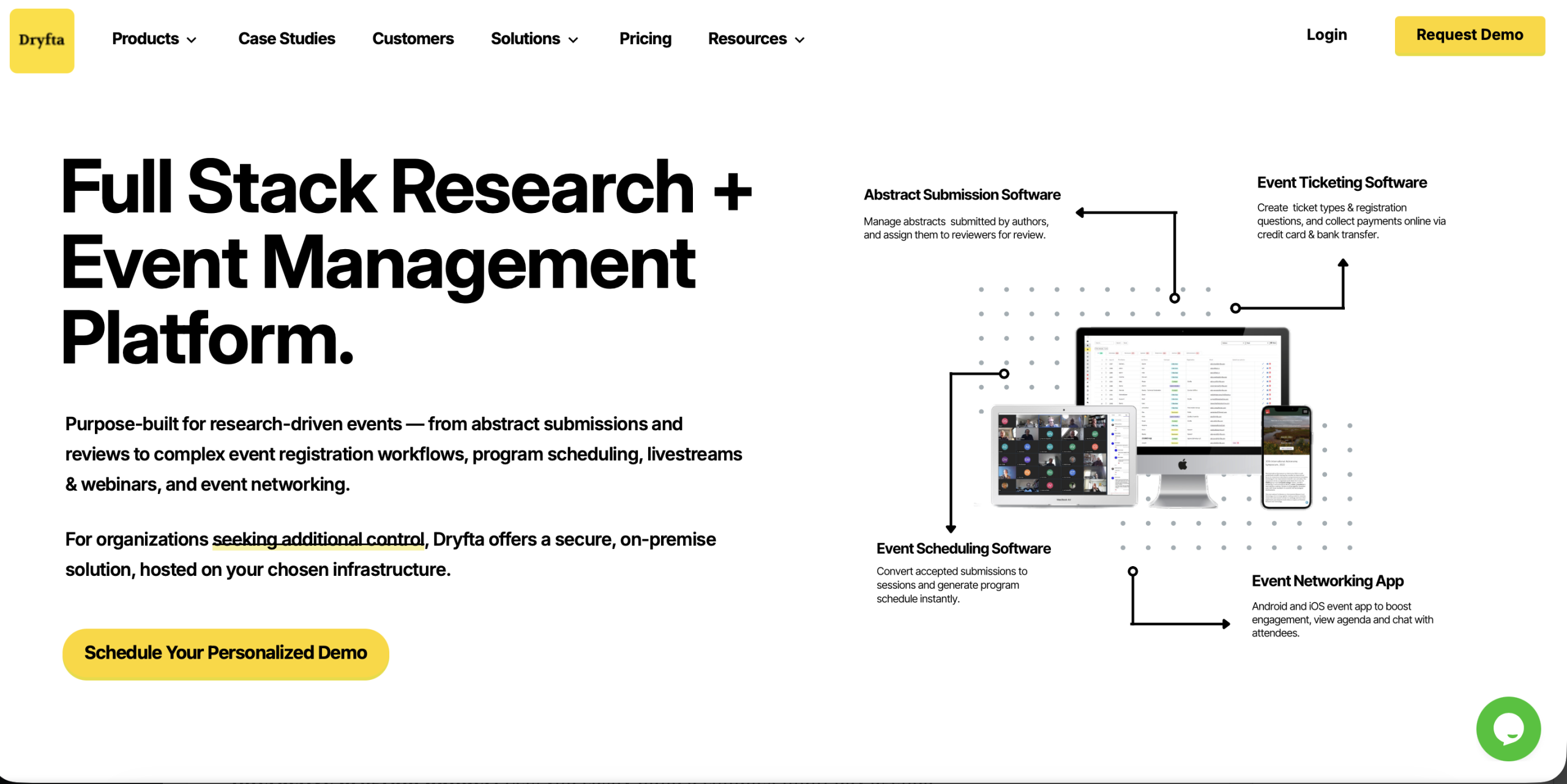
Dryfta is an all-in-one event management platform built for academic, professional, and scientific organizations that handle complex events. It supports detailed workflows such as abstract submissions, multi-track scheduling, and attendee management within a secure cloud system.
With a built-in CRM and support for hosting multiple events under one setup, organizations can manage their full event calendar without facing extra costs for every new event.
Key features:
-
- The abstract management software is responsible for all aspects of the submission process, including uploading submissions, assigning reviewers, and scheduling the final agenda.
- The multi-track agenda builder is an interactive drag-and-drop scheduling tool that will assist organizers in managing complex programs with multiple sessions, speakers or parallel tracks.
- All contact information (attendee, speaker, reviewer and author) will be stored in one place to simplify communication and event management.
- The mobile event app will let attendees view their schedule and network with other attendees via a single, unified system.
- Event data is secured through a cloud-based infrastructure that controls access.
- Tools for payment and reporting to help track registrations, payments, invoices, and general financial reports within the platform.
- Native bulk email broadcasting is built into the platform and can be used to announce and automate event notifications.
- Each sponsor/exhibitor will have their own separate dashboard to manage their profile and track leads.
Pros:
-
- More cost-effective for organizations that run multiple events throughout the year
- Flexible system that can support small meetings as well as large conferences
- Secure platform with controlled access and strong data protection settings
- Helpful onboarding and responsive support for organizers
- Simple interface that is easier to learn than many enterprise event platforms
Cons:
-
- Advanced customization may take setup time, but allows precise workflow control
- Built for academic conferences, the platform focuses on depth without compromising on simplicity
Pricing:
The Small plan starts at $1499 per year and includes core event management features for smaller teams and conferences. Medium and Large plans use custom pricing based on event size and feature requirements. And this is why many teams consider Dryfta as one of the top Bizzabo competitors for enterprise events.
2. Cvent
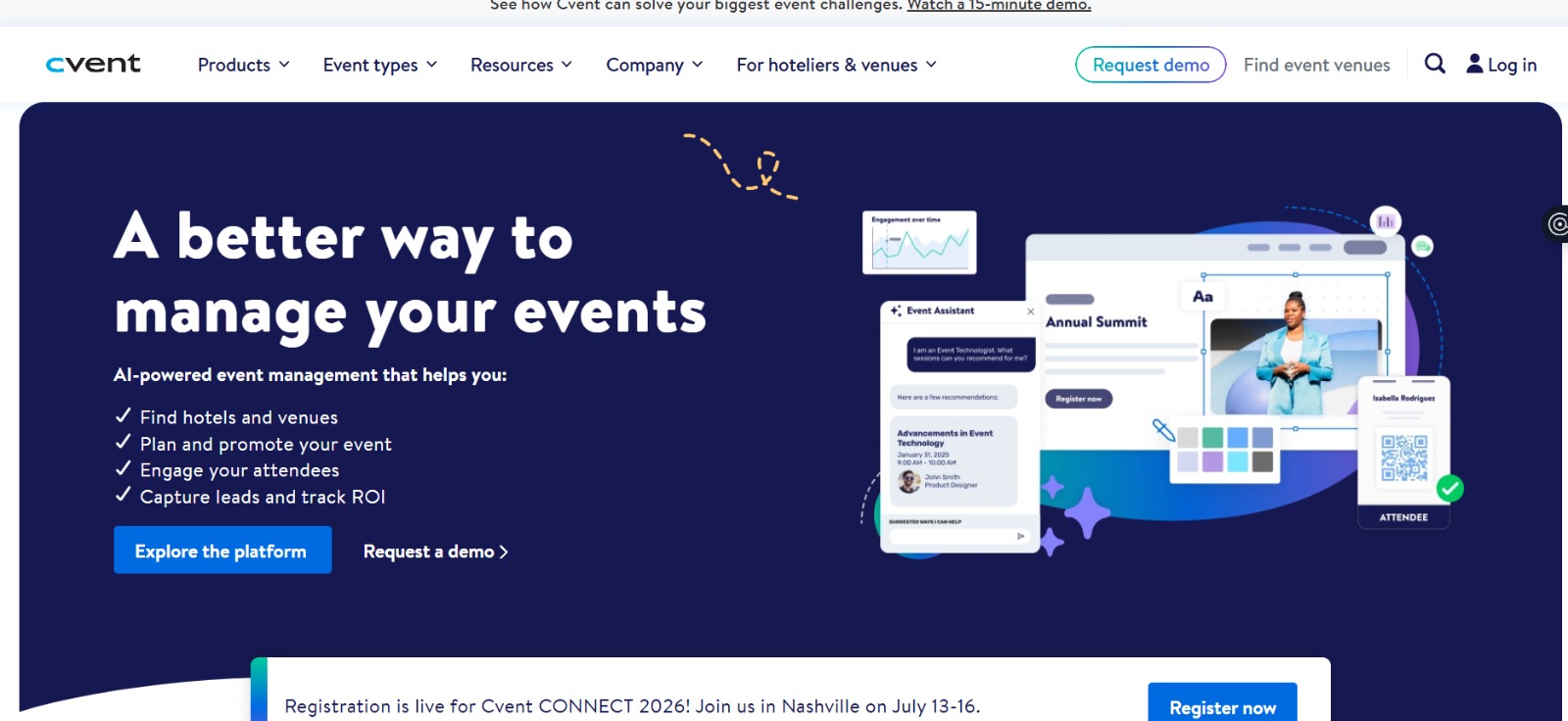
Cvent is an enterprise event management platform designed for complex events in need of robust venue sourcing, registration and robust onsite management tools.
Key features:
-
- Cvent Supplier Network for sourcing and managing RFPs for global venues
- Advanced registration with conditional logic and workflow controls
- Mobile event apps with agendas and networking
- Reporting and analytics across multiple event types
- On-site tools for badge printing and lead retrieval
Pros:
-
- Strong integration with platforms such as Salesforce and Marketo
- Multiple security and compliance options for enterprise teams
- Wide feature set for multi-event programs
Cons:
-
- Interface can feel complex for smaller teams
- Setup and training may take longer than newer platforms
- Costs can increase as more modules are added
Pricing:
Cvent provides pricing quotes based on event volume and required features.
3. Whova
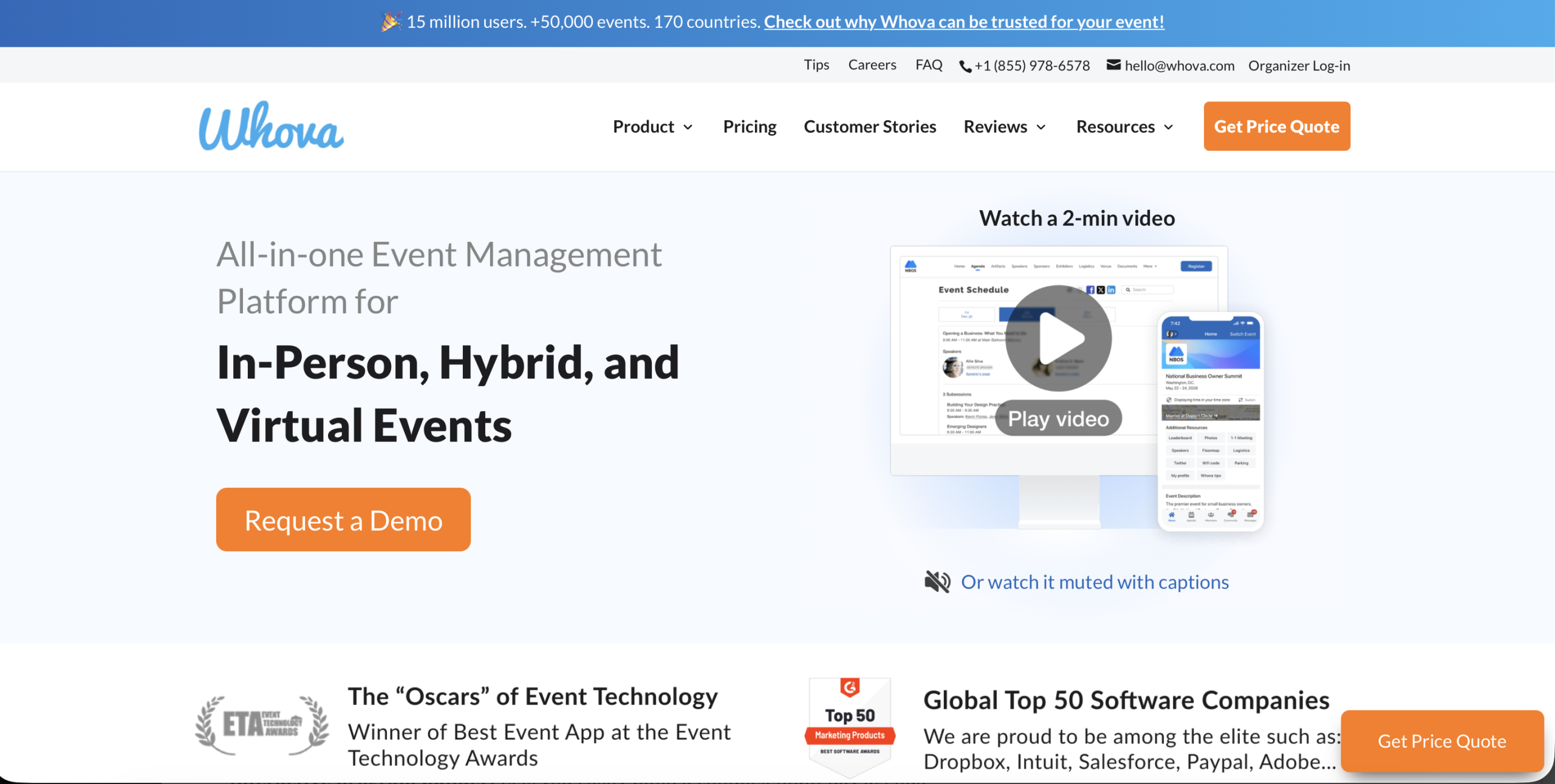
Many medium to large-sized events use Whova since it has an emphasis on attendee interaction.
Key features:
-
- Event community board for attendees to discuss and organize meet-ups
- AI matchmaking for networking suggestions
- Mobile-based registration connected to the event app
- Digital file sharing for slides and handouts
Pros:
-
- Attendee engagement via the event app is high
- Organizers can automate most of their networking tasks
- Supports smaller and mid-sized event teams
Cons:
-
- Fewer tools available for complex academic workflows
- Organizers have less ability to brand their event than they would using a completely white-labeled platform
- May need manual syncing with external systems
Pricing:
Custom pricing based upon the size of your event and the features you require. Public pricing is not listed.
4. vFairs

vFairs is best known for virtual trade shows and job fairs, with a strong focus on visual experiences and digital exhibition.
Key features:
-
- 3D virtual lobbies and exhibition halls
- Custom virtual booths with chat, video, and file sharing
- Lead retrieval tools for exhibitors
- Built-in registration and event management tools
Pros:
-
- Strong visual experience for virtual expos and fairs
- Detailed lead tracking for sponsors and exhibitors
- Dedicated support during event setup
Cons:
-
- Limited flexibility outside standard expo layouts
- Too complex for content-focused conferences
- Extra features can increase the total cost
Pricing:
Pricing is custom and depends on event size, number of booths and required features. Public pricing is not listed.
5. EventMobi
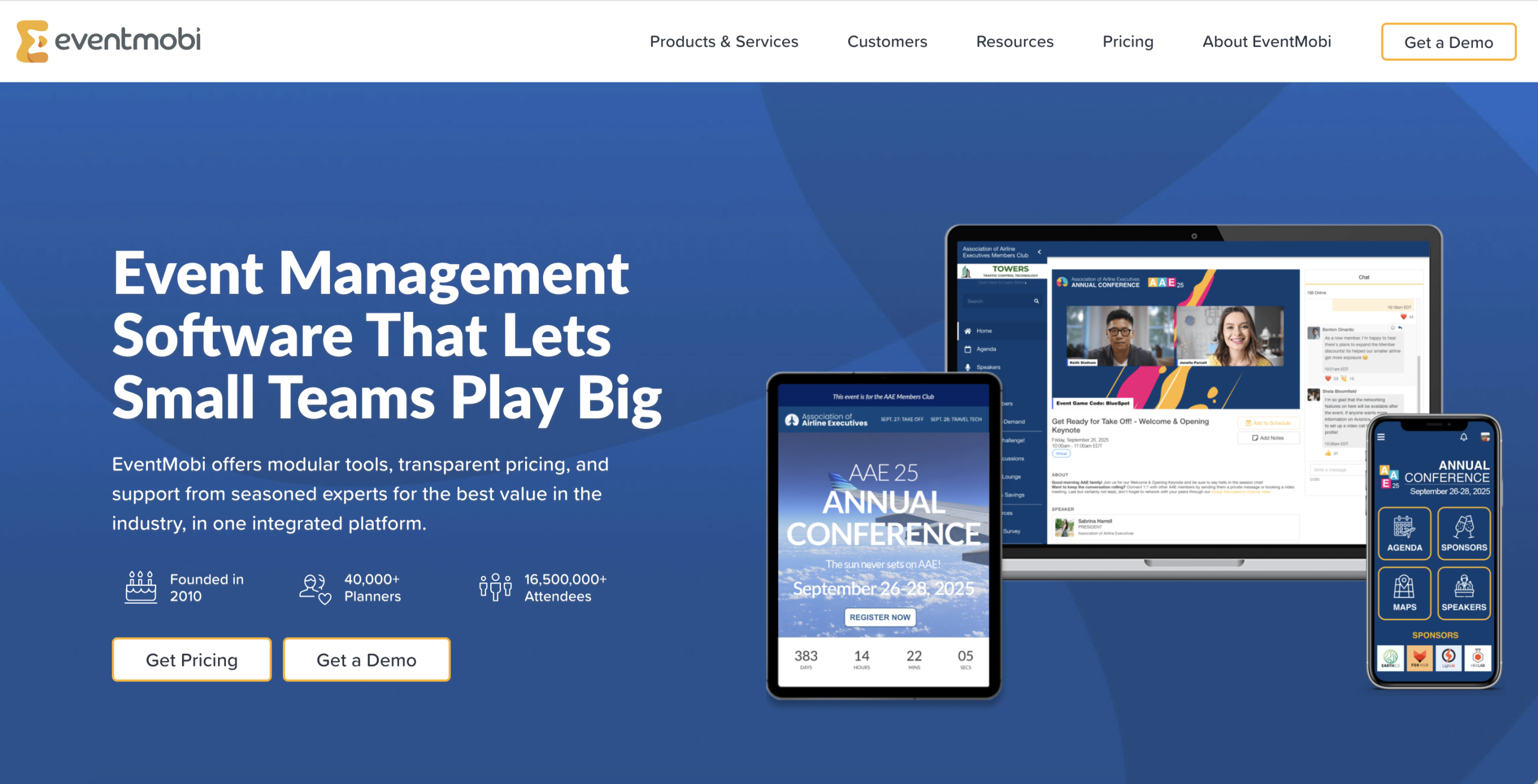
EventMobi is popular with mid-size conferences as it focuses on simplicity and a mobile-first experience.
Key features:
-
- Branded mobile event app that works on all devices
- Real-time push notifications and private messaging
- Basic registration and engagement tools
Pros:
-
- Easy to use for organizers with limited technical experience
- Strong onboarding and live customer support
- Good pricing options for recurring events
Cons:
-
- No built-in abstract or abstract management tools
- Costs increase as attendee numbers grow
Pricing:
Per-event packages start at $3,500, while multi-event annual subscriptions start around $7,500. Advanced modules like registration or custom branding incur additional costs.
6. RainFocus
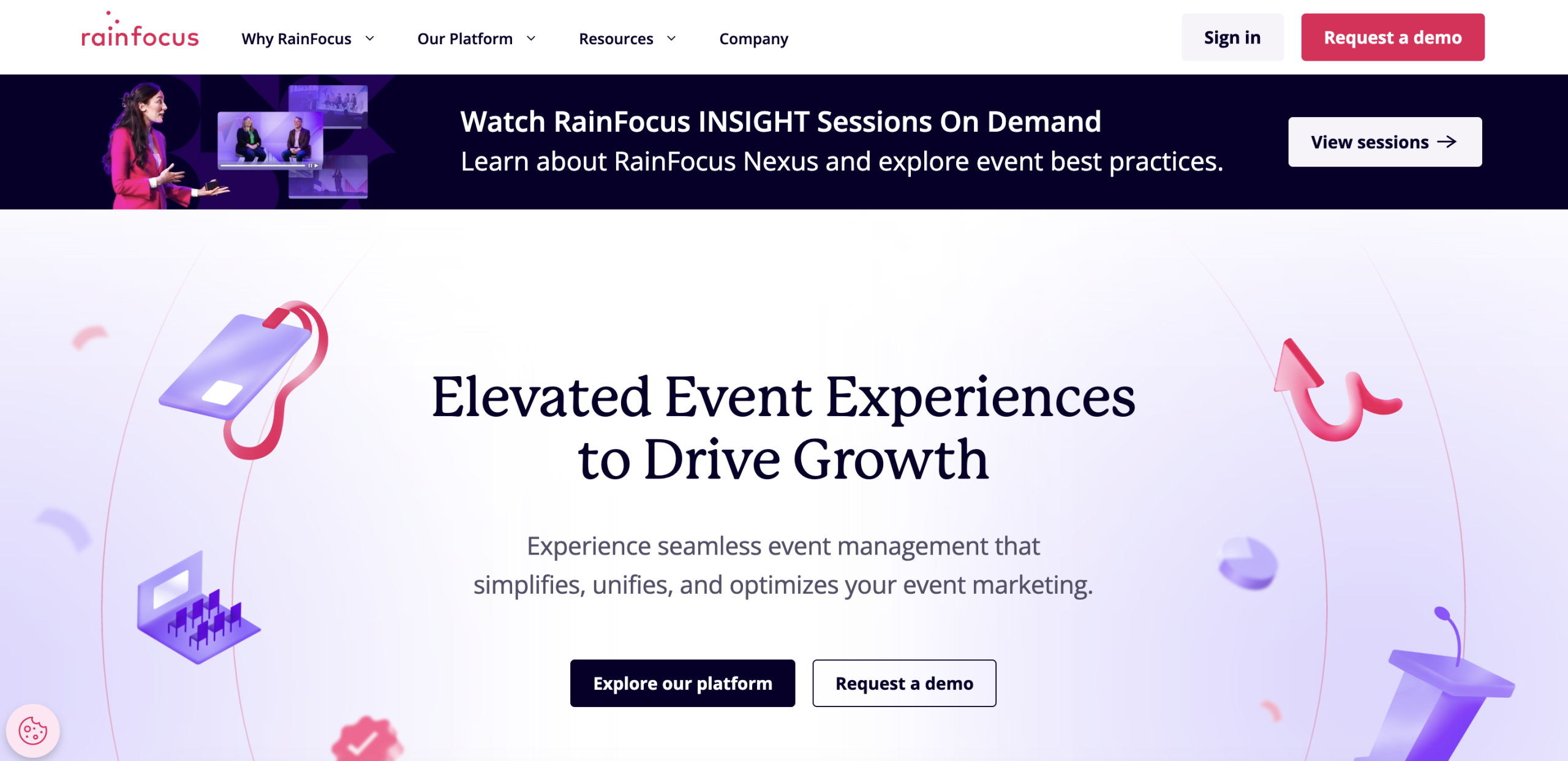
RainFocus is built for organizations that need detailed data tracking across multiple events. Marketing teams often use it when they want strong reporting, CRM integration, and clear ROI from large-scale conferences.
Key features:
-
- Unified attendee data across multiple events
- Direct sync with CRM and marketing automation tools
- Advanced dashboards for event performance tracking
Pros:
-
- Strong choice for data-driven marketing teams
- Works well for very large enterprise conferences
Cons:
-
- Complex setup that often needs specialist support
- Not designed for abstract-heavy academic events
- High cost compared to most event platforms
Pricing:
Pricing is quote-based.
7. Swoogo
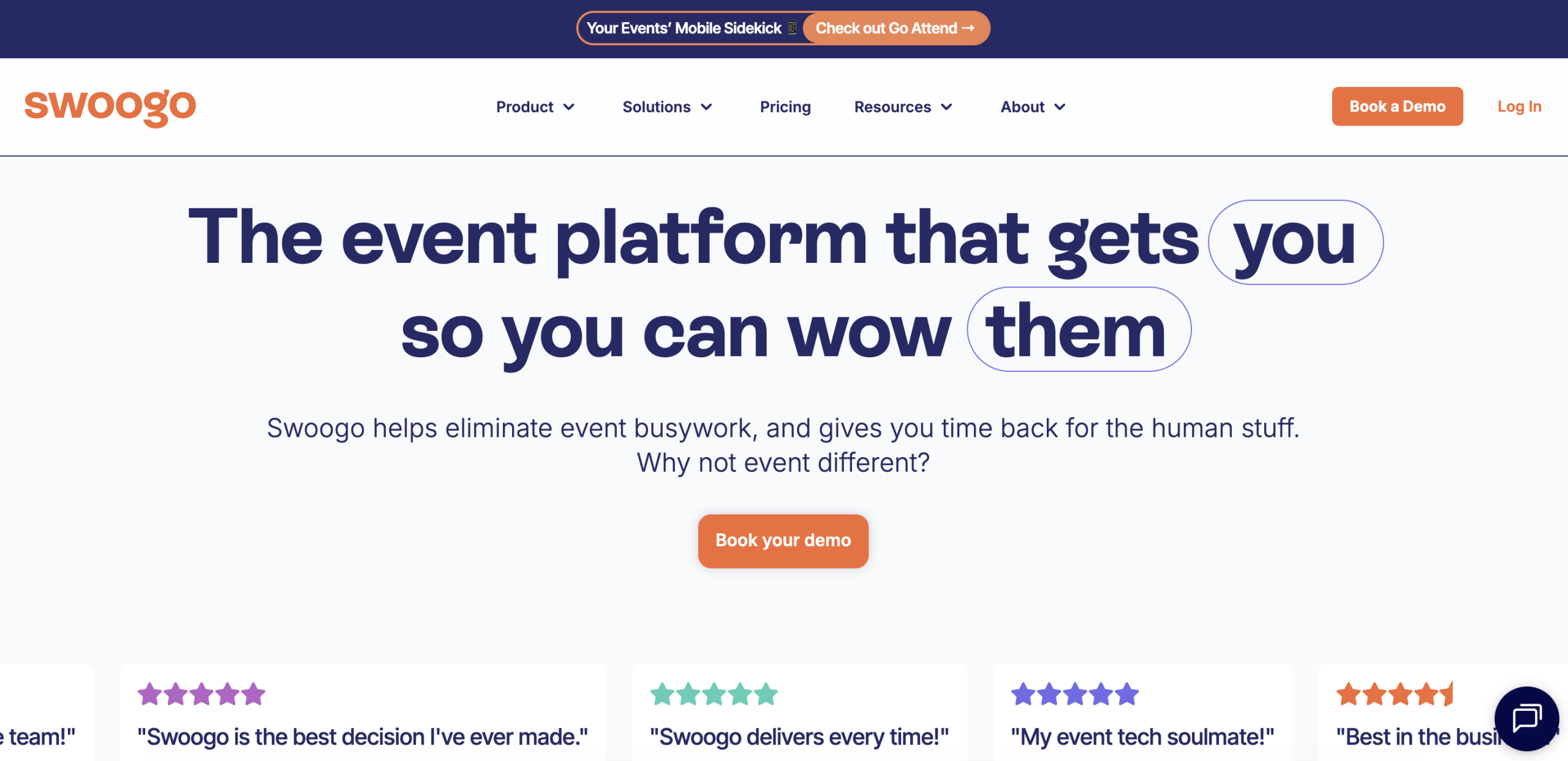
Many mid-size and enterprise events use Swoogo because it focuses on flexibility and detailed control over registration and event setup.
Key features:
-
- Custom registration builder with conditional logic
- Built-in email marketing and attendee communication
- Reporting tools for tracking registrations and engagement
Pros:
-
- Strong customization options for event setup
- Good choice for marketing-focused event teams
- Works well for recurring or multi-event programs
Cons:
-
- Setup can take longer for first-time users
- Some advanced features require technical knowledge
- Pricing can be expensive for smaller teams
Pricing:
Professional plan starts at about $11,800 per year and includes access to core event management features. Enterprise plan uses custom pricing and includes additional tools.
8. Stova
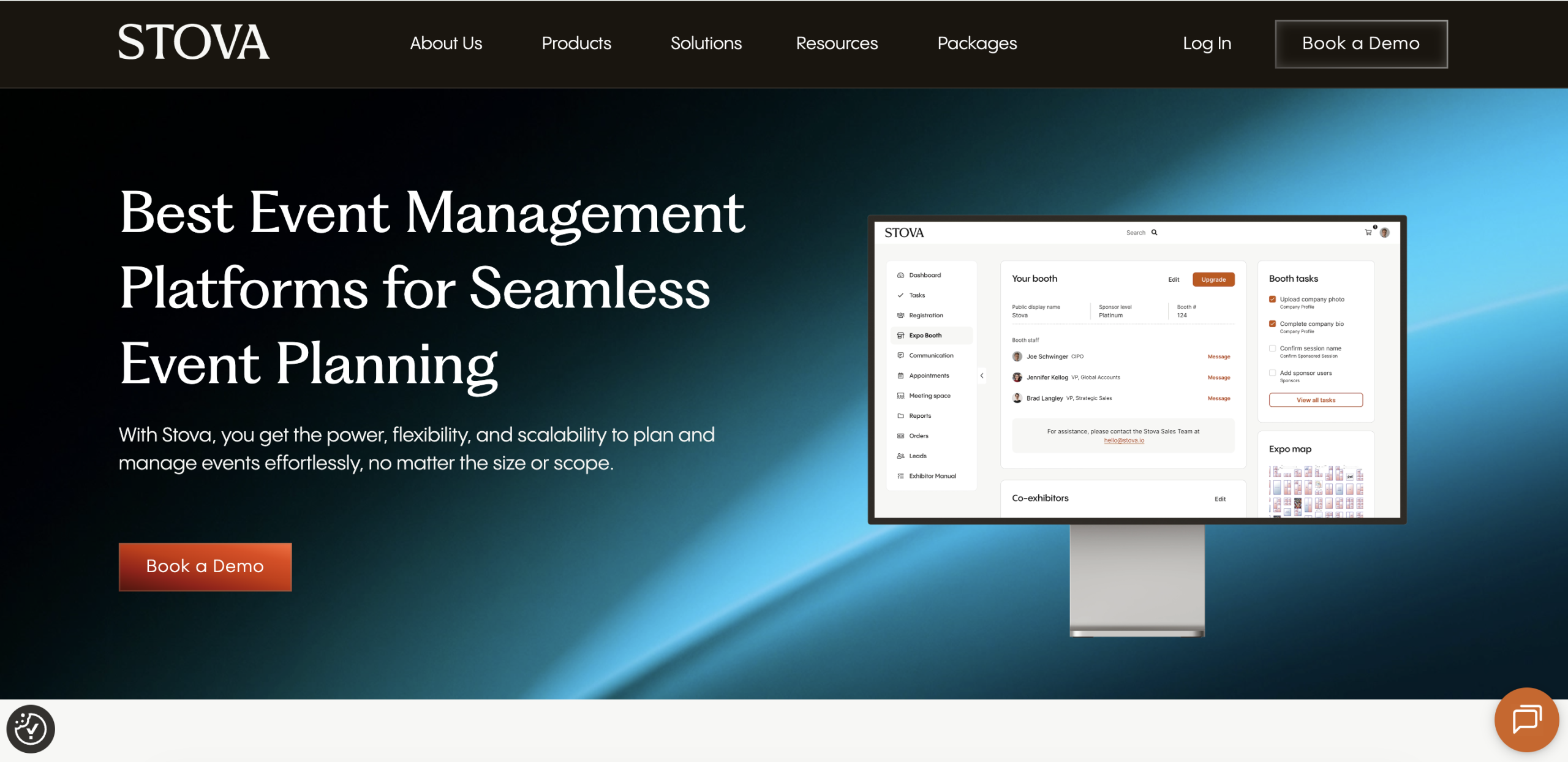
Stova is an enterprise event management platform used by high-growth companies, established enterprises, and trade show organizers that manage multi-event programs.
Key features:
-
- Flexible event registration with advanced workflow controls
- Event website builder with branding customization
- Reporting and analytics for tracking event performance
Pros:
-
- Strong customization for enterprise-level events
- Works well for large conferences and trade shows
- Supports multi-event management for large teams
Cons:
-
- Setup can take time for first-time users
- Some advanced features require training
Pricing:
Core plan starts at about $1,995 plus per-registration fees. Pro plan starts at $5,995 with additional features. Enterprise plan starts at about $12,995 for large-scale events. Final pricing depends on event size, registrations, and feature requirements
9. RingCentral Events
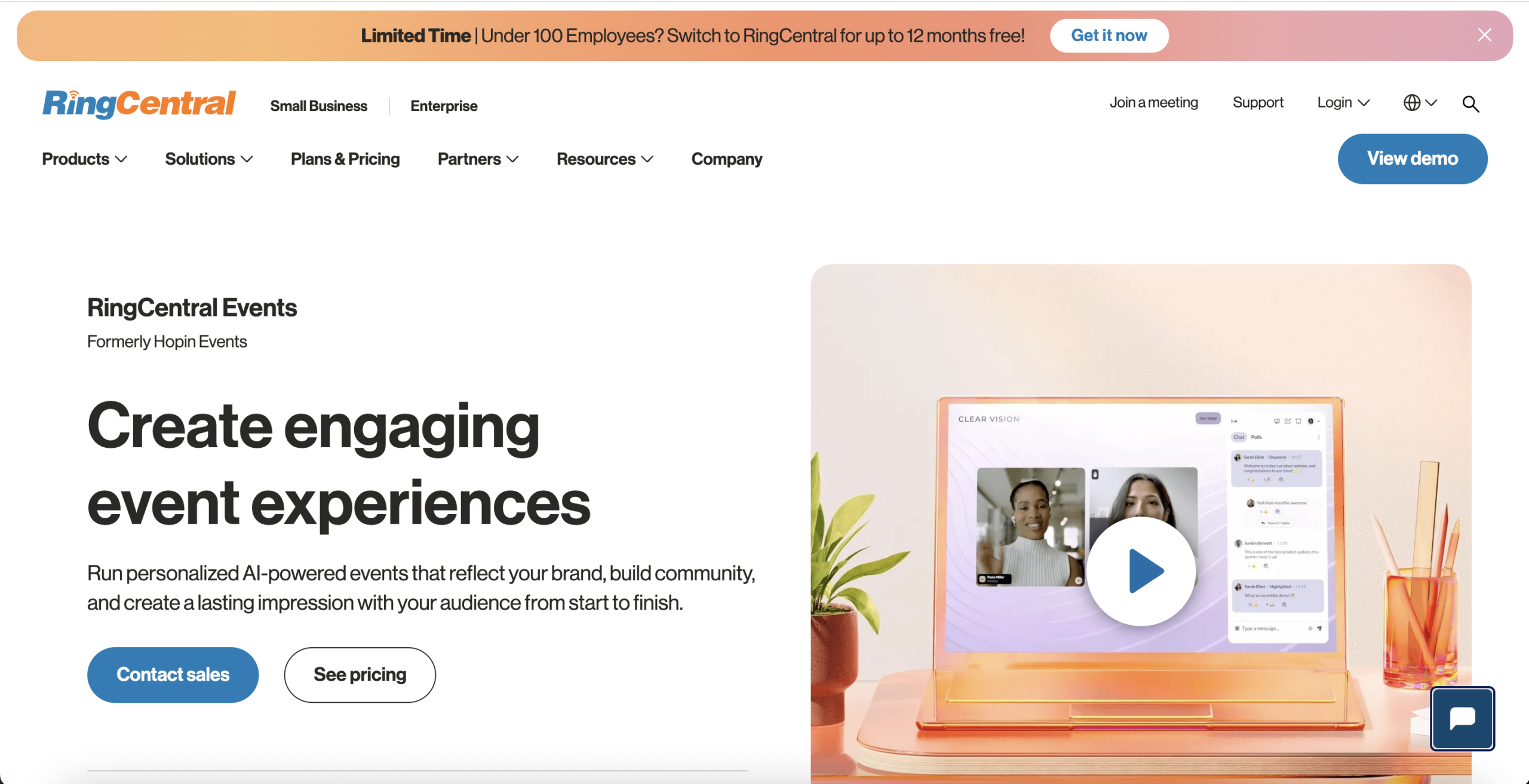
From corporate event teams to global enterprises to virtual conference organizers, RingCentral Events is built for organizations that host virtual, hybrid, and large-scale online events.
Key features:
-
- Virtual and hybrid event hosting tools
- Live streaming with stage, session, and expo areas
- Event registration and ticketing system
Pros:
-
- Strong support for virtual and hybrid events
- Works well for large online audiences
- Built-in streaming and engagement features
Cons:
-
- Less focused on complex academic workflows
- Customization can be limited for some event types
Pricing:
Core plan starts at $20 per user per month billed annually. The Advanced plan starts at $25 per user per month billed annually, and the Ultra plan starts at $35 per user per month billed annually. Enterprise bundle pricing is available on request depending on the number of users and required features.
10. PheedLoop
All-in-one event management platform that supports in-person, virtual, and hybrid events with tools for registration, mobile event apps, live streaming, badge printing, and attendee management.
Key features:
-
- Event registration and ticketing management
- Agenda and session scheduling tools
- On-site check-in and badge printing
Pros:
-
- Works well for in-person, virtual, and hybrid events
- Strong onsite tools for check-in and badges
- Flexible setup for different event formats
Cons:
-
- The interface may take time to learn
- Some advanced features need manual setup
- Customization options can require extra configuration
Pricing:
Request a quote on their official website.
Comparison Table
The following comparison highlights one of the top Bizzabo alternatives for enterprise events.
| Platform | Best Use Case | Integrations | Pricing | Standout Capabilities |
| Dryfta | Academic and scientific conferences with complex workflows | Payment gateways, email tools, CRM connections | Annual plans starting from $1499, higher tiers custom priced | Abstract management, multi-track scheduling, built-in CRM, sponsor portals, mobile app |
| Cvent | Large enterprise events and venue-heavy conferences | Salesforce, Marketo, marketing, and CRM tools | Quote-based pricing depending on modules | Venue sourcing network, advanced registration logic, onsite tools, enterprise reporting |
| Whova | Mid to large conferences focused on attendee engagement | Basic integrations with external tools and payment systems | Custom pricing per event, public pricing not listed | Community board, networking tools, mobile-first experience, engagement features |
| vFairs | Virtual expos, trade shows, and career fairs | Payment gateways and marketing tools | Custom quote based on booths and attendees | 3D virtual halls, virtual booths, exhibitor lead tracking, virtual environments |
| EventMobi | Mid-size conferences needing a simple mobile-first setup | API and basic integrations | Per-event pricing starting around $3500, annual plans available | Mobile event app, push notifications, attendee messaging, simple setup |
| RainFocus | Enterprise marketing events and large multi-event programs | Deep CRM and marketing automation integrations | Quote-based enterprise pricing | Unified attendee data, ROI dashboards, marketing sync, multi-event tracking |
| Swoogo | Corporate conferences and marketing-driven events | Salesforce, HubSpot, Marketo, and Stripe | Professional plan starts at about $11,800 per year. Enterprise plan uses custom pricing | Custom registration builder, strong branding control, email automation, and reporting tools |
| Stova | Large enterprise meetings and multi-event programs | Salesforce, Microsoft Dynamics, Eloqua, payment gateways, and API integrations | Core starts at $20 per user/month, Advanced $25, and Ultra $35, billed annually. Enterprise pricing on request | Event registration, onsite tools, venue management, reporting dashboards |
| RingCentral Events | Virtual and hybrid conferences with large audiences | StreamYard, Salesforce, and Slack | Core starts at about $1,995 plus per-registration fees. Pro from $5,995. Enterprise from about $12,995 | Virtual event hosting, live streaming, networking rooms, webinar tools |
| PheedLoop | Conferences and hybrid events | Stripe, PayPal, and Mailchimp. | Visit official website for pricing | Registration, mobile app, badge printing, session scheduling, hybrid event tools |
Why Dryfta Stands Out Among Bizzabo Alternatives?
-
- Dryfta features a specialized abstract management system that handles the entire lifecycle of scholarly submissions and double-blind peer reviews.
- The platform has built-in tools to support multi-track agenda creation, with a focus on more complex academic and scientific programs.
- It offers a mobile app for attendees to network and receive real-time updates about sessions without having to integrate with third-party systems.
- Dryfta includes a full-stack event CRM to centralize all data related to speakers and attendees.
- The pricing model starts at a much lower entry point than Bizzabo, making it more accessible for non-profits and research institutions.
- The platform includes a built-in tool that automatically generates and sends participation certificates to your attendees.
This is why Dryfta is often listed among the most reliable Bizzabo alternatives for enterprise conferences.
Which Bizzabo Competitor Should You Choose?
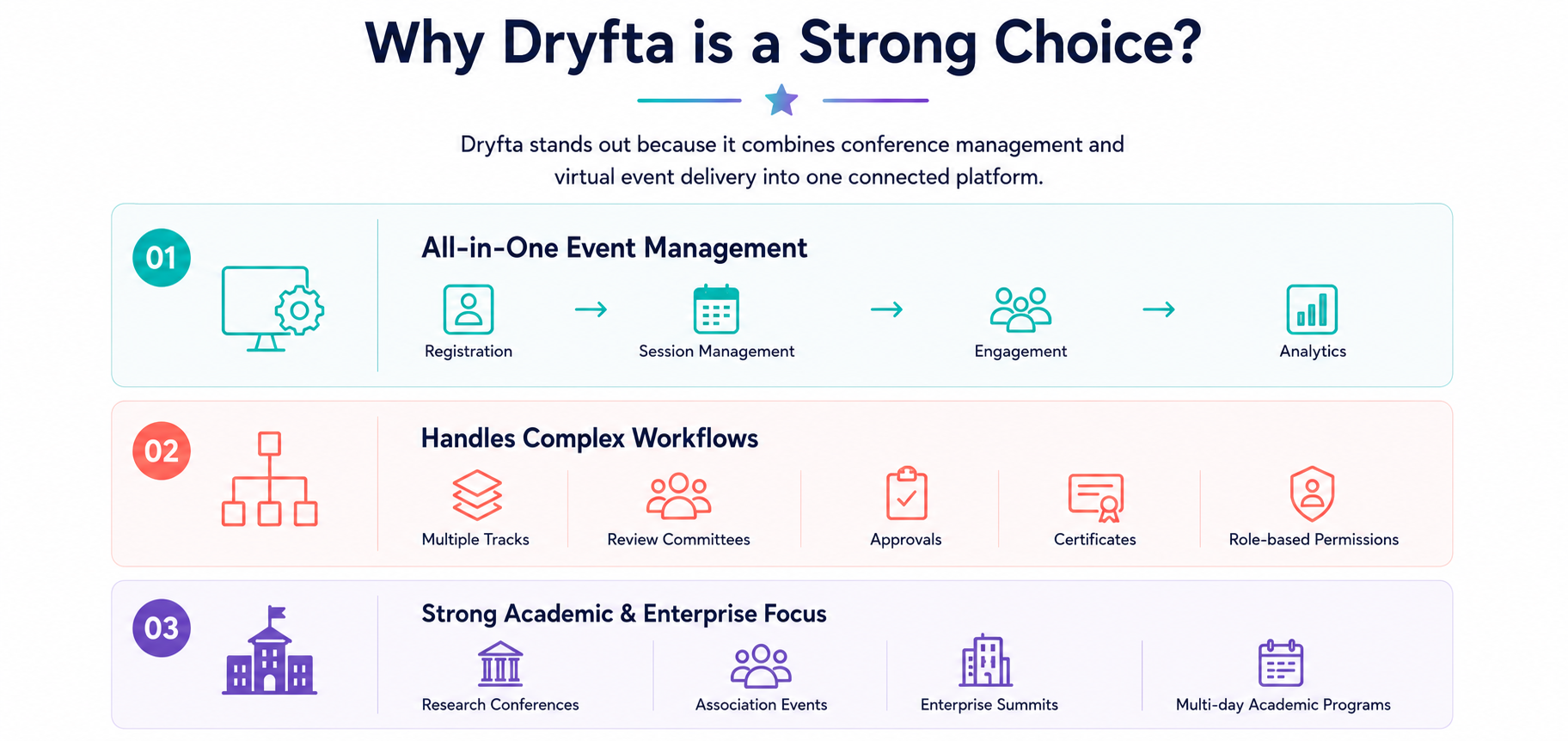
Dryfta is one of the strongest Bizzabo competitors for enterprise events that require more than basic registration and marketing tools. All of your event management, attendee data, scheduling and communications can be managed from one dashboard, which makes running complex multi-session conferences much simpler. The all-in-one setup of Dryfta helps organizations manage detail-intensive events in less time and for lower costs.
Bizzabo Pricing vs Alternatives
The pricing structure, hidden charges, and the event team’s ability to justify an enterprise spend are generally the main deciding factors when choosing between Bizzabo and its alternatives. As the event portfolio expands, it is very important to pay particular attention to how each alternative platform scales and how much of the cash is allocated to tools, add-ons, and operational overhead. To make a clear, ROI-driven decision, let’s dive deeper into the important pricing points for Bizzabo vs alternatives:
Enterprise pricing considerations
Bizzabo plans starting at about $499/user per month, billed annually (3 user minimum). It mainly targets large organizations. For associations or colleges with limited budgets, this pricing can be quite expensive. InEvent or Dryfta offers comparable enterprise features at more flexible price bands and with free trials, so the enterprise event organizer can still get robust tools at affordable costs.
Annual contract commitments
Bizzabo plans begin at $17,999 Per year with a minimum of three users. It usually demands annual contracts and a minimum user count. This might keep the organizers locked in, even if there are any changes during the mid-cycle or event portfolio shifts. This might many times lead to abandoning the platform early. Whereas, the alternatives of Bizzabo provide month-to-month and shorter-term billing without the need for negotiating the contracts annually. This opens more scope to change in budgets and gives more flexibility.
Cost of mobile apps and integrations
Bizzabo usually charges more for its premium add-ons, such as integration to third-party event apps and integration to third-party registration systems. Enterprise events teams usually find extra costs while using mobile apps for custom branding and on-site command. There are quite a few event management platforms that don’t charge extra for add-ons. Dryfta is one such affordable option that gives mobile apps and easy integrations within its already available pricing models.
Pricing scalability for growing events
Bizzabo offers good scalability based on the features, add-ons, number of users, sponsors, and more. This might get overwhelming for smaller and growing events. That per-user model can become chaotic when the event expands, especially if there are numerous organizers, departments, or outside partners to log in. Whereas other alternatives provide hybrid or usage-based models, which only change when more events, registrations, or sessions are added, rather than just more users.
Budget-friendly alternatives for smaller organizations
Bizzabo’s pricing is not so budget-friendly when compared to its alternatives like Whova and Dryfta. Bizzabo lacks a dedicated enterprise stack. Smaller organizations, academic or scientific conferences in universities, and regional research events usually run on very tight budgets; they might not find Bizzabo a good pick. A pricing plan should be of such a kind that meets all the needs of an event, irrespective of its size. Dryfta is one such platform that offers a Pay-as-you-Use plan and special discounts.
Hidden operational costs
Bizzabo requires more time for implementation, training, maintenance fees, and add-on services. This also leads to hidden operational costs. The amount of time spent in the process of onboarding, troubleshooting integrations, and overseeing data flows, all of which contribute to the platform’s actual cost. There are quite a few alternatives that provide free training sessions, easy and quick onboarding, exporting data, and many more features without any hidden operational costs.
ROI considerations for event teams
Bizzabo is a good choice for organizations that are looking for unified event operations, networking intelligence, and measurable ROI visibility. However, its pricing directly impacts the ROI, where the event organizing teams from small organizations like academic and charity organizations with less budget begin to doubt it. What started with a necessity becomes a liability.
There are simplified ROI-driven alternative event systems that save a lot of time, cost, work, and stress. Dryfta is one such platform that offers measurable and in-depth ROI without compromising on the quality. By using Dryfta’s all-in-one enterprise event handling platform, event organizers can focus on other essential tasks and redirect their savings to creating long-term brand value.
Flexible pricing models offered by competitors
Bizzabo offers monthly, yearly, single, and multi-event pricing models that provide features and essential add-ons. There are no free trials or any kind of discounts. There are many event hosting platforms that offer ‘no-platform-fee‘ models and clear pricing with no hidden commissions. Enterprise event organizers usually get to evaluate platforms based on long-term operational value with low entry-level pricing. Dryfta is the true all-in-one. It is an event management platform that offers a free demonstration and two free training sessions. It also offers discounts, and there are zero service fees.
How to Migrate from Bizzabo to Another Event Platform
Event platform migration is the process of transferring data, integrations, workflows, attendee experiences, and other important event-related information from one event management system to a modern event technology platform. Migration plays a crucial role in creating a strong and reliable data foundation and a more scalable event infrastructure. Some of the aspects to consider while migrating from Bizzabo to another event platform are:
Exporting attendee data
Event organizers must pay closer attention to exporting and restructuring historical attendee data. The team should accept all the data without manual re-entry or missing information. The duplicates must be removed without the loss of any information. There are many event management platforms that consist of simple and quick data migration solutions. Dryfta is one such platform that offers free event setup with data migration, which is already included in every plan. Exporting attendee data from Bizzabo to Dryfta can happen with many export options, including CSV.
Migrating registration workflows
Many Bizzabo alternative platforms also unify registration, engagement, and analytics data so the event handling teams can get performance metrics more clearly across their event portfolio. These platforms offer registration workflows that are easy to customize. Using a solutions-driven software always helps in migrating registration workflows without any hassles.
Agenda and session migration
To prevent the sessions from inadvertently disappearing or shifting to the incorrect day, compiling the present agenda, session hours, rooms, and tracking assignments is necessary before rebuilding them on the new platform. Choosing a platform that supports sessions, attendees, agenda, and speakers from spreadsheets or platform exports helps in losing data. This minimizes last-minute uncertainty and urgency for both in-person and online attendees while maintaining the accuracy of the agenda.
Speaker and sponsor data transfer
Event organizers must choose a platform that accurately replicates speaker and sponsor profiles, bios, logos, and contact information on the new platform or straight into the CRM, and extract them from Bizzabo. It is also useful to create a checklist to assess every profile after import, so that it is simple to identify any missing or mismatched information and make the necessary corrections.
CRM integration setup
It is important to set up CRM integration early in the migration process so the new platform can send attendee, session, and engagement data back to the CRM in real time. Dryfta offers efficient and solid CRM integrations that handle workflows seamlessly, maintain accurate segmentation of attendees, track interactions, and automate communications. It is a powerful tool that manages the attendees’ and speakers’ information all in one place.
Training and onboarding support
A successful migration usually consists of proper training and onboarding support. No matter how powerful a platform can be, user adoption requires proper training. The event organizers should look for a platform that offers hands-on training. It is also useful for accelerating the adoption and active implementation. This also decreases the friction while launching the event using the new platform. Dryfta offers a 24/7 support desk available via email, free training sessions, and day-of-event support. This kind of help gives the team the assurance they require to manage events successfully once the migration is done.
Testing before launch
Before going live on the new platform, take time for comprehensive end-to-end testing, from registration, check-in, agenda view, to sponsor, exhibitor booth visibility, and speaker availability. Choose a software that provides support, especially on the day of the event. This boosts confidence and minimizes the chances of falling into any problematic situations.
Post-migration optimization
After the migration, thoroughly evaluate the first few events to identify small gaps, such as unclear labels, missing fields, or underused features. that could improve your event management registration experience. Gather feedback from the team and from attendees to see where the new platform feels smoother and where it lacks in comparison to Bizzabo.
Best Bizzabo Alternatives by Use Case
Best Bizzabo Alternative for Academic Conferences: Dryfta
Dryfta is purpose-built for academic conferences where abstracts and peer review are at the center of the event. Beyond submissions, organizers can manage registration, speaker portals, proceedings, certificates, scheduling, and event websites on a single platform. Universities and research organizations that need a complete conference management solution will find Dryfta far more specialized than general event platforms.
Best Bizzabo Alternative for Large Enterprise Conferences: Cvent, Stova & RainFocus
Organizations running global conferences or enterprise event portfolios often consider Cvent, Stova, and RainFocus. Each platform is designed for large-scale operations, offering enterprise integrations, advanced attendee management, reporting, and tools that support multiple teams managing complex events.
Best Bizzabo Alternative for Hybrid & Virtual Conferences: vFairs & RingCentral Events
If your priority is hosting engaging hybrid or virtual experiences, vFairs and RingCentral Events are strong Bizzabo alternatives. Both platforms provide live streaming, virtual networking, exhibitor experiences, and interactive sessions that help connect online and in-person attendees.
Best Bizzabo Alternative for Marketing & Brand Events: Swoogo & EventMobi
Marketing teams look at Swoogo and EventMobi when branding and attendee engagement are top priorities. Swoogo offers flexible registration and marketing integrations, while EventMobi is known for its attendee networking and interactive event apps.
Best Bizzabo Alternative for Association & Community Conferences: Whova & PheedLoop
Professional associations and community conferences frequently choose between Whova and PheedLoop. Whova offers attendee networking and engagement, while PheedLoop blends registration, speaker management, scheduling, and exhibitor tools in a flexible platform suited to recurring conferences.
The Bottom Line
Choosing between the top Bizzabo competitors depends on your event size and budget. Many organizers reviewing Bizzabo alternatives focus on flexibility, pricing, and workflow support. For organizations managing academic or professional conferences, Dryfta provides a cost-effective platform that helps with registration, scheduling, attendee data, and communication. It simplifies complex planning while providing a seamless experience for speakers and attendees. ‘
Book a free demo today to see how Dryfta can streamline your next enterprise event.
Frequently Asked Questions (FAQs)
1. What are the best Bizzabo alternatives?
Dryfta is one of the best Bizzabo alternatives and the first choice for conferences that require both integrated abstract management and peer-review workflows. Cvent offers a large-scale option for global enterprises that manage logistics and source venues. Whova offers a mobile app with attendee networking and community engagement features.
2. Why do companies look for Bizzabo alternatives?
Many organizations are looking for Bizzabo alternatives because of the initial cost and the limitations in customizing the platform. Bizzabo also has a steep learning curve and lacks specific features, such as native abstract management that many organizations would want. On top of that, organizers feel that the manual data entry is repetitive and the reporting tools are clunky, making it difficult to analyze events at a deeper level.
3. Which Bizzabo alternative is best for large conferences?
Dryfta is a top choice for large conferences as it can handle both multitrack agendas, as well as complex speaker data from within a single, integrated platform. Also, the event CRM and automatic certification tools greatly simplify the admin workflow for high-attendee volumes.
4. What is the best Bizzabo alternative for hybrid events?
For hybrid events, Dryfta has advantages compared to Bizzabo as it synchronizes both in-person and online event participation. The mobile app provides in-person attendees with live updates on sessions as well as virtual attendees with the opportunity to view the same live stream and connect via networking tools.
5. Are there cheaper Bizzabo alternatives?
Dryfta is a cost-effective alternative to Bizzabo with annual plans starting significantly lower than Bizzabo’s premium enterprise rates. It provides a comprehensive suite of native tools without the hidden costs of third-party integrations.
6. Which Bizzabo alternative is best for virtual events?
Dryfta works best for virtual events because it integrates live streaming, networking, and interactive agendas into one dashboard. Attendees access everything through a single login, while organizers use built-in tools to manage virtual sessions and automated participation certificates without external software.
7. Which Bizzabo alternative is best for corporate events?
Dryfta is a solid option for corporate events because it provides a centralized platform to manage complex speaker bios and multi-track schedules. Its user-friendly interface allows your team to update session details instantly across the entire event site.