




In December 2025 alone, there were over 3.07 billion DOI resolutions. The importance of DOIs in the worldwide academic community has never been greater. Researchers, students, librarians and publishers rely on DOIs each and every day to locate valid and current scholarly information that they are looking for by avoiding broken links and out-of-date web sites.
That raises an important question. If conference articles contain useful research, why do so many authors and conference organizers continue to be unsure as to how DOI assignments really work?
Whether you plan to publish a single conference paper or a complete volume of proceedings, knowing how to get a DOI can make your research easier to discover and cite for years to come. This guide will provide an overview of what a DOI is, who provides a DOI, how to acquire a DOI and how conference organizers may create a DOI as part of their publication process.
What Is a DOI and Why Do Conference Papers Need One?
The Digital Object Identifier (DOI) is a unique identifier assigned to every research paper. A DOI does what a typical URL cannot do: it will never go outdated or direct users to incorrect webpages. As such, DOIs have become the norm in academic publishing for all conference papers. Every paper now has a permanent identification number which authors and others can rely on for many years.
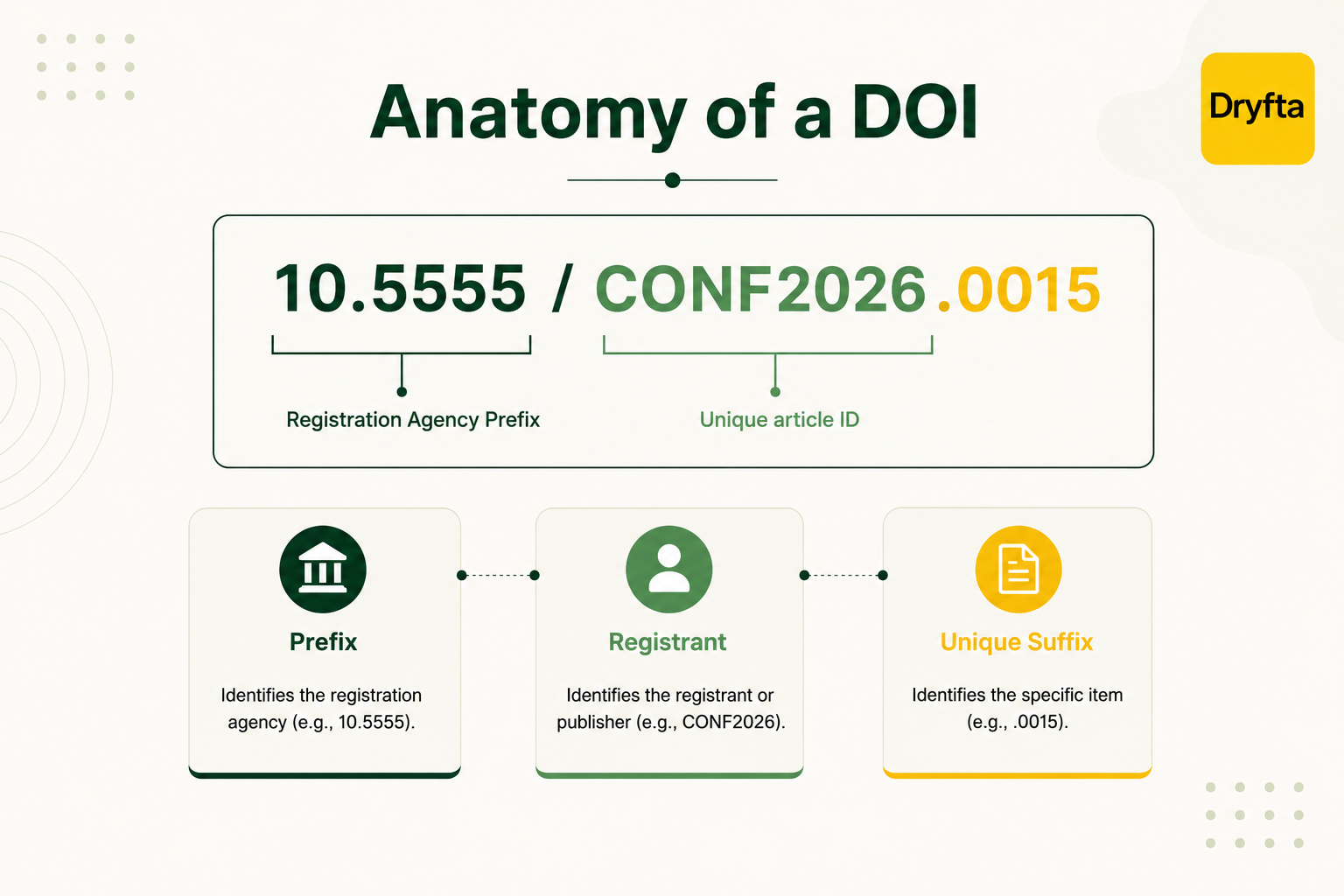
Every DOI starts with a prefix (usually 10.) followed by a publisher or registration agency code and then a unique suffix created for that specific paper. In other words: no two papers share the same DOI.
When organizers obtain a DOI for conference proceedings, each paper receives its own permanent, searchable record.
Why Conference Papers Specifically Need DOIs?
Conference papers are fast paced and notoriously hard to track. If you want your work to be taken seriously, you absolutely need a DOI for conference papers.
Here is why conference papers specifically need DOIs:
- When you get DOI for conference proceedings, search engines and academic databases can instantly index your work so that other researchers can effortlessly find and cite your research.
- Your academic profile needs to stay up to date. A DOI automatically links your new paper to your ORCID iD, ensuring you get valid credit for your hard work.
- Websites change and servers crash all the time. A DOI automatically sends people to the right place so even if a publisher changes their website, your paper stays easy to find.
- Let’s face it, money supports the research world. Most grant providers now strictly demand that any research they fund is openly trackable and permanently archived, which in turn requires a solid DOI for conference papers.
Understanding Who Assigns DOIs — Crossref, DataCite, and Zenodo
Ever wondered where those DOI links actually come from? There is a whole behind-the-scenes network working hard to make sure your research stays pinned to the internet for years.
That’s where a few well-known organizations come in. Each one has an important part to play, and knowing the difference makes it much easier to get DOI for conference proceedings the right way.
| Organization | Role | Best For |
|---|---|---|
| DOI Foundation | Governs DOI system | Standards |
| Crossref | Registers scholarly DOIs | Proceedings |
| DataCite | Registers research outputs | Datasets |
| Zenodo | Repository using DataCite | Individual researchers |
- The DOI Foundation (IDF): The International DOI Foundation is the organization that oversees the DOI system. It sets the global standards and rules that all DOI registration agencies follow. Think of it as the organization that makes sure the DOI system works properly, while others handle the actual registration.
- Crossref: Crossref is the most widely used DOI registration agency for academic publishing. Journals, conference organizers, publishers and academic societies use it to assign DOIs to research papers and conference proceedings. If your goal is to publish academic work professionally, Crossref is usually the first choice.
- DataCite: DataCite deals with research work beyond regular papers. Researchers use it to assign DOIs to datasets, software, reports, and other materials linked to their research. It is an excellent option for conferences that publish research data alongside their proceedings.
- Zenodo: Zenodo is a free research repository developed with support from CERN and the European Commission. Researchers can upload their work and automatically receive a DOI without becoming a publisher or Crossref member. It is especially useful for researchers who want to share papers or presentations openly.
Route 1 — Getting a DOI Via a Formal Proceedings Publisher
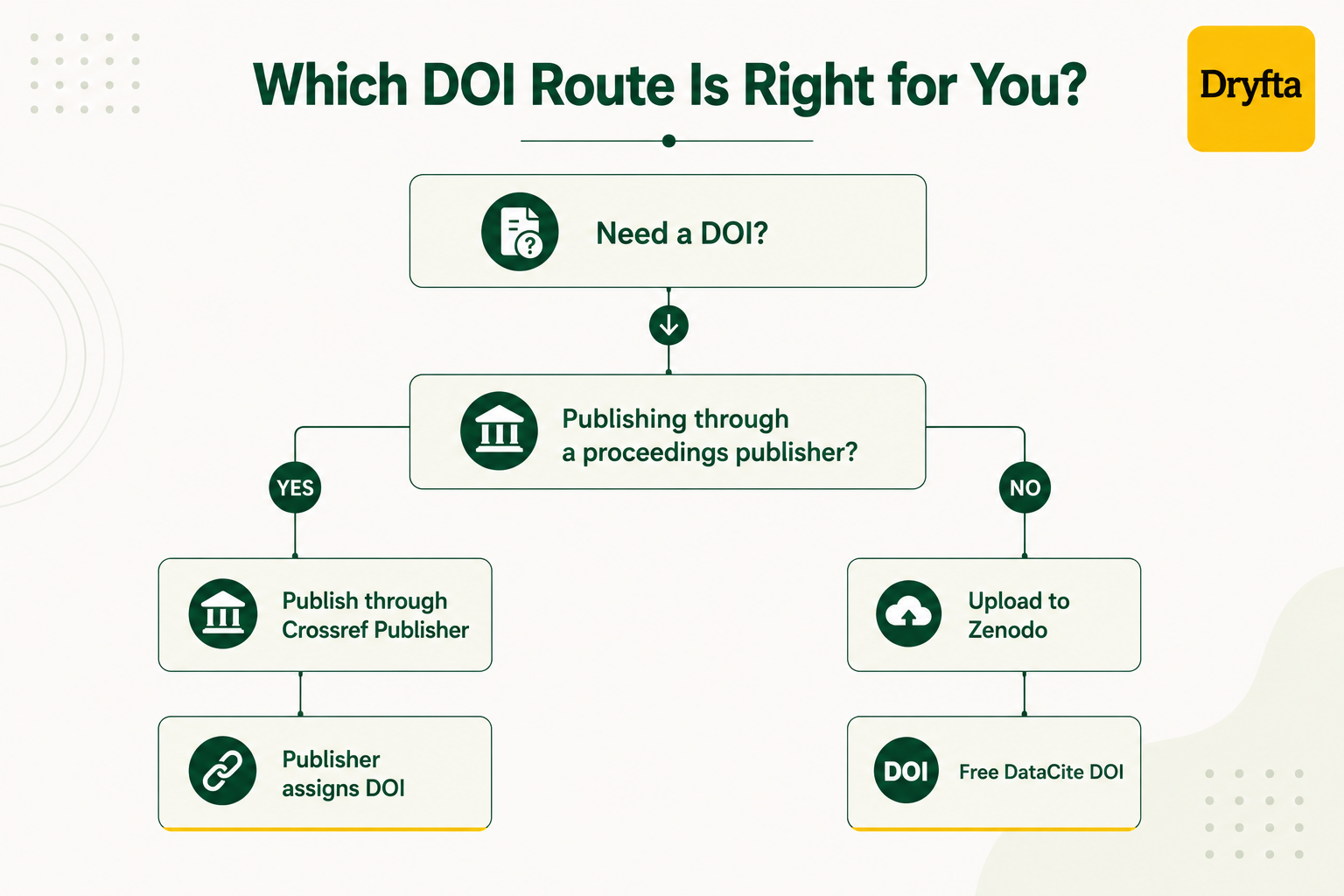
For most academic conferences, this is the easiest and most widely used way to assign a DOI for conference papers. Organizers partner with a proceedings publisher that already works with a DOI registration agency like Crossref rather than handling DOI registration themselves. This publisher handles the technical work and makes sure every paper gets a reliable DOI without you needing to learn to code.
If you’re wondering how to get a DOI for conference papers, this is usually the first route to consider.
Here’s how the process usually works:
- The conference selects a proceedings publisher that provides DOI registration with publishing.
- Required publication details are submitted by authors together with accepted Papers to the publisher for processing.
- Each paper is registered by the publisher and receives a DOI prior to being published in the proceedings.
- As soon as the paper has been assigned a DOI, authors will be able to cite it (and other associated work) immediately.
What does the conference organizer provide to the publisher?
To assign a DOI correctly, the publisher needs accurate metadata for every paper. A small mistake here can create problems later. So it is worth checking every detail carefully before submission.
- Author names and details: You must provide full names along with their universities and ORCID IDs to ensure the right people get the credit.
- Paper title: The exact wording down to the very last comma.
- Abstract: A short summary that explains the main discovery.
- Page numbers: The starting and ending pages of the paper in the final conference proceedings.
- Publication date: The official date the collection goes live for the public.
Mastering how to get a DOI for conference papers through a formal publisher takes some careful planning, but the credibility you gain is worth it. Also, getting these details right upfront makes the publication process much easier.
Route 2 — Getting a Free DOI for Conference Papers via Zenodo
Not every researcher publishes through a conference proceedings publisher, and that’s perfectly fine. If you’re publishing independently or your conference does not assign a DOI for conference papers, Zenodo offers a free and simple alternative. It is a zero-cost platform that helps you secure a permanent DOI at no cost. A classic no-budget, no-problem solution.
Step 1: Create a Zenodo Account
Head over to Zenodo’s website and sign up. You can sign up using your email or log in with an existing ORCID or GitHub account. Once you’re in, you’ll have access to your personal upload dashboard.
Step 2: Reserve Your DOI Before Uploading
Here’s a handy feature. Once you hit the “New Upload” button, look for the DOI section. Zenodo lets you reserve a DOI before publishing your paper, which is brilliant if you need to include the DOI in your manuscript or conference materials before the final upload.
Step 3: Upload the Paper File
Next, upload your conference paper as a PDF. Double-check that you’re uploading the final version because this is the file readers will be able to access after publication.
Step 4: Complete the Required Metadata
Now comes the important part. Fill in details such as the paper title, author names, affiliations, abstract, keywords, publication date, and other requested information. Complete and accurate metadata makes your conference paper DOIs much easier to discover through academic search engines.
Step 5: Publish
Once everything looks good, click Publish. Again: Do not forget to double-check. Zenodo will make your paper publicly available and activate its DOI immediately. Just like that, your research is now visible to researchers around the world!
DOI vs. ISBN for Conference Proceedings — What’s the Difference?
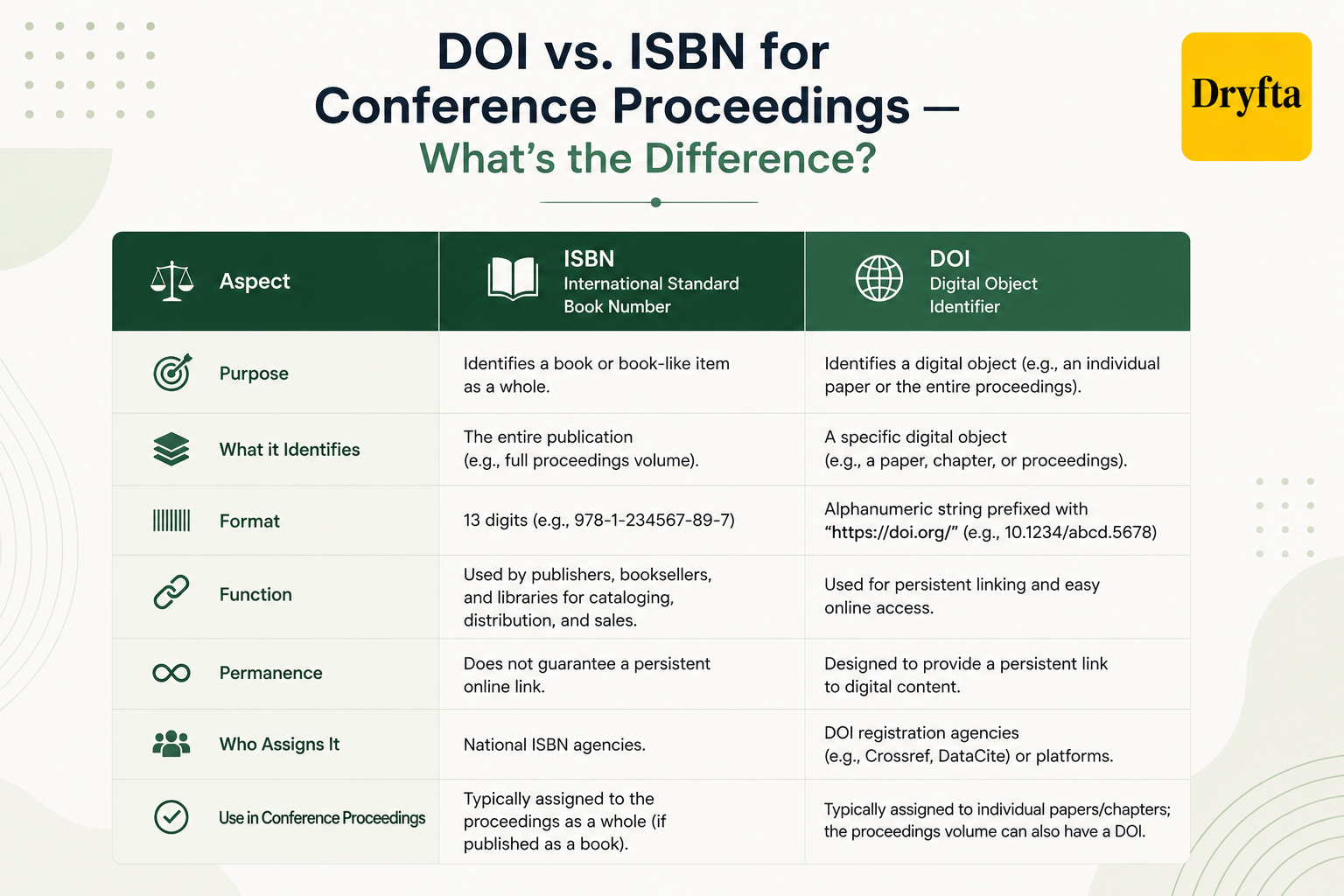
A lot of people think a DOI and an ISBN do the same job. But that’s not the case. One identifies individual research papers, while the other identifies an entire publication. Knowing the difference makes it much easier to understand how to get a DOI for conference papers.
ISBN (International Standard Book Number)
- Identifies the entire conference proceedings as one published book
- Used by libraries, bookstores, and book distributors
- One ISBN covers the complete proceedings volume
- Does not identify or link to individual papers
DOI (Digital Object Identifier)
- Identifies each conference paper separately
- Gives every paper a permanent online link
- Makes papers easier to find and cite
- Supports citation tracking and academic indexing
- Helps researchers receive proper credit for their work
Here’s the key takeaway: an ISBN and a DOI for conference papers are not competitors. They work together.
How Conference Organizers Should Plan DOI Assignment in the Abstract Management Workflow?
A successful conference starts with good planning, and metadata should not be left to the last minute.
Here is how to map it out effortlessly:
- Choose the right conference management platform: Pick a platform that captures complete paper metadata, including author details, affiliations, abstracts, and ORCID IDs.
- Launch your call for papers: Clearly tell authors what information they must submit. Setting expectations early reduces missing details and last-minute corrections.
- Select your proceedings publisher or repository: Decide where accepted papers will be published before the review process ends.
- Finalize accepted papers: Review every paper’s metadata carefully. Double-check titles, author names, affiliations, abstracts, and publication details before sending everything for DOI registration.
- Publish after the conference: Register the DOIs and share them with authors as soon as the proceedings go live.
Dryfta’s role in this workflow
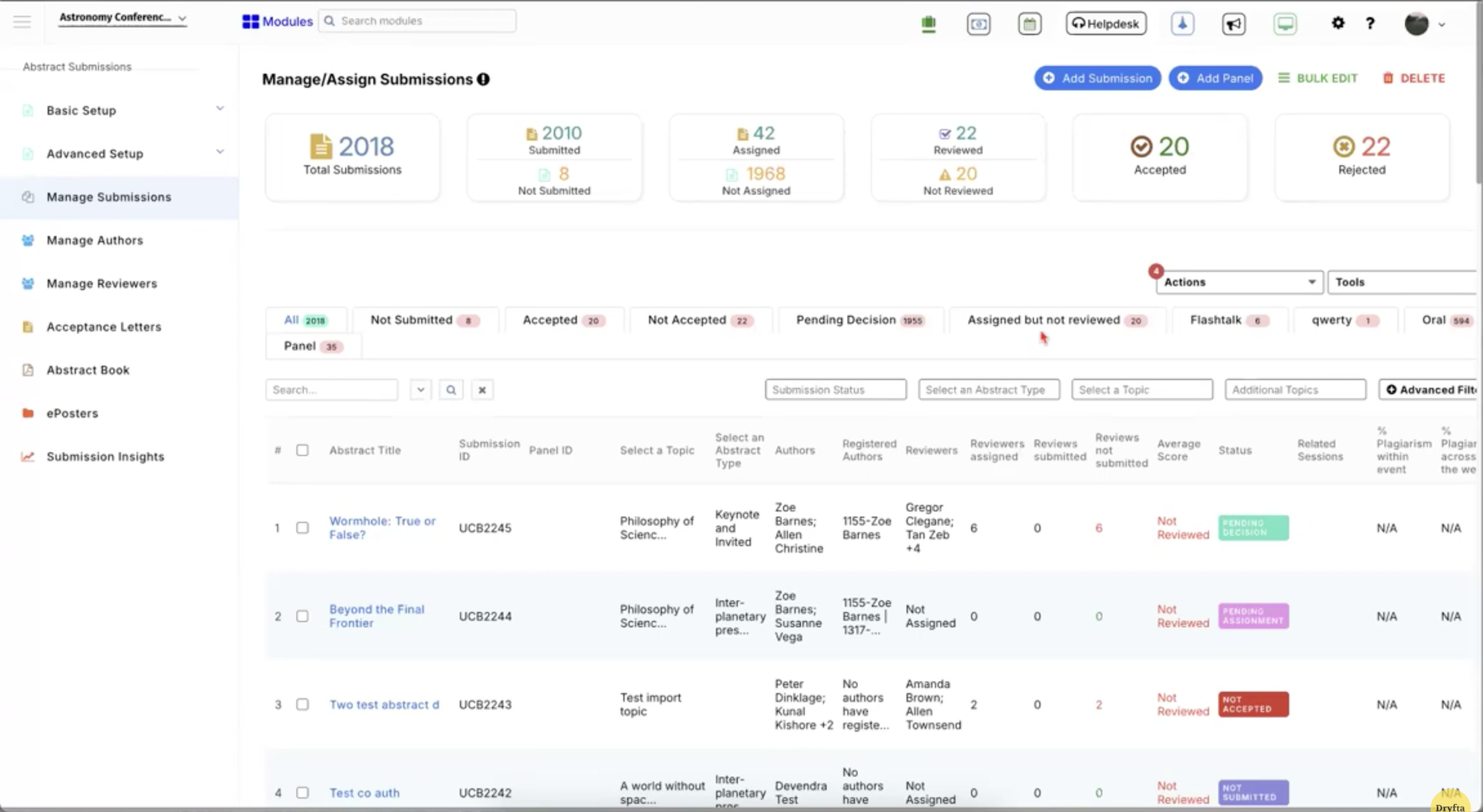
Managing this checklist by hand takes more time than you might expect. That is exactly what Dryfta is designed for.
Dryfta helps conference organizers manage submissions, peer review, author information, and proceedings preparation in one place. Every paper’s metadata stays organized throughout the event, making DOI registration through your preferred publisher or repository much easier.
Common Questions and Mistakes When Getting DOIs for Conference Papers
Getting a DOI for conference papers is usually straightforward, but a few common questions often confuse researchers and conference organizers. Let’s clear them up so you know exactly what to expect and avoid mistakes along the way.
1. Can I get a DOI for a paper that was already published without one?
Yes, but only if the publisher or conference organizer is willing and able to register the paper through a DOI registration agency. If the paper was published independently, uploading it to a repository like Zenodo is another option for obtaining a DOI.
2. Does a ResearchGate DOI count for my conference paper?
No. ResearchGate does not assign DOIs to uploaded papers. If a DOI appears on ResearchGate, it was assigned by the original publisher or repository before the paper was uploaded.
3. Is a Zenodo DOI as valid as a DOI from IEEE or Springer?
Yes. A Zenodo DOI is a genuine DOI registered through DataCite. The difference is not the validity of the DOI but where the paper is published. Publishers like IEEE and Springer assign DOIs to papers within their official proceedings, while Zenodo hosts papers in an open repository.
4. The ISBN for our proceedings volume is different from a DOI. Are we covered?
Not entirely. An ISBN identifies the proceedings as a whole, while a DOI for conference papers identifies each individual paper. Many conferences use both to improve discoverability and citation accuracy.
5. How long does it take to get a DOI?
That depends on the registration process. Most often, publishers will assign DOIs during the publication process, and Zenodo will activate a DOI almost as soon as you publish your upload. If you’re exploring how to get a DOI for conference papers, checking the registration timeline beforehand can help you avoid last minute delays.
The Bottom Line
It is important to plan ahead, whether you use a proceedings publisher or a free repository such as Zenodo. Better still, the ability to manage submissions, reviews, author information and publication metadata in one place minimizes errors as well. Dryfta’s end-to-end conference management platform helps you keep your workflow organized, making it easier to prepare papers for publication. Looking to make publishing your conference easy? Try a free Dryfta demo today and experience the ease of conference management.

Frequently Asked Questions
1. What is a DOI and why is it important for a conference paper?
A DOI is a permanent, online, digital identifier for a research paper. It works even if the paper is moved to another website, unlike regular URLs. A DOI for conference papers also makes the paper more discoverable and accessible in the long term.
2. How do I get a DOI for my conference paper for free?
You can self-archive your final accepted manuscript in open-access repositories such as Zenodo at no cost if your conference organizer did not provide you with one. It securely stores your research and provides a verified and permanent identifier for free.
3. What are the differences between Crossref DOI and Zenodo DOI?
Both are valid DOIs. The only difference is who registers them and where the paper is hosted. Journal articles and conference proceedings are often given Crossref DOIs. Zenodo assigns DOIs through DataCite for research shared in its open repository.
4. Can a conference proceedings volume have a DOI separate from the paper DOIs?
Yes, and it actually should. The conference proceedings volume may be assigned a separate DOI and each paper contained within the volume may also be assigned an individual DOI. This lets readers cite either the complete proceedings or a specific paper.
5. What information do I need to submit to register a DOI for conference papers?
Information needed to register conference papers for a DOI:
Paper title
Author names
Affiliations
Abstract
Publication date
Final publication URL
Some registration agencies also provide support to link papers with author profiles through ORCID IDs.
7. What is the difference between a DOI and an ISBN for conference proceedings?
A DOI identifies an individual research paper or publication. An ISBN identifies an entire book or proceedings volume. Both are employed in many conferences. If you’re planning how to get a DOI for conference papers, remember that having an ISBN does not replace the need for individual paper DOIs.
