
Where do you publish conference proceedings when the event ends?
This question comes up for every organizer because presenters expect a place to showcase their work. A clear and trusted platform helps the research reach more people. It also helps the event feel complete because the work does not stay hidden in local folders.
Publishing online gives you reach. People from other universities or labs can read the papers. Reviewers and students can learn from the findings. Authors also gain more visibility because online platforms make their work easy to access. A steady home for proceedings builds trust and helps your event grow over time.
Organizers must carefully choose the right platform. Some platforms, for instance, offer fast uploads. Others focus on long-term storage. Meanwhile, some offer indexing. Others provide clean layouts for reading. Together, each detail shapes how the final set of papers appears to readers.
This blog lists 12 strong platforms that support online publishing for conference proceedings.
Conference Proceedings Publishing- Two Categories Every Organiser Must Understand
Just as academicians and researchers begin to sleep a little easy following a conference presentation, the responsibilities of the aftermath begin to settle in. When the conference you are presenting at does not have a journal under its name or when they simply don’t publish their conference proceedings at all, what does one do?
Well, never give up on your research. Your work deserves recognition and a spot where it can be discovered by readers. There are plenty of pathways that researchers can take to self-publish their conference proceedings on the modern internet. Before you choose a pathway, you need to understand this important distinction between conference proceedings platforms and open-access repositories.
| Dedicated Conference Proceedings Platforms | Open-access Repositories |
| Conference proceedings platforms are dedicated, exclusive scholarly avenues that accept the best of research for publication in their online journal(s) or website. | As the name suggests, open-access repositories are databases wherein research by authors is available for free access by readers around the globe. |
| Generally, getting your work to be accepted by a conference proceedings platform is highly selective. Only the most high-quality pieces gain entry into prestigious publications. Entries are peer-reviewed and heavily scrutinized by copy editing as per the publisher’s standards. | Typically, authors voluntarily self-upload their work onto open-access repositories, a pathway that’s often also referred to as ‘green open access.’ It is often a kind of de facto agreement that researchers abide by within the larger research community particularly in fields such as Science. The rationale behind green open access is that access to scholarly work ought to be democratized for all. |
| Conference proceedings platforms are usually free for initial submission by authors. Once accepted, the research is expected to pay a registration fee for the conference. | Open access repositories are free to submit into as well as to retrieve and read. Researchers sometimes reposit a free copy of their work for broader access in addition to submitting to a paywall-based proceedings publication. |
One thing worth being clear about is that selecting a proceedings platform is a downstream decision, something that happens after a conference presentation has concluded. But the upstream process, the very set of functions that come before this that enable a successful conference proceedings publication, cannot be overlooked by organizers. Good event management begins at conception and takes you steadily through its organization and the later downstream aftermath. Event organizers need to receive submissions, compartmentalize and send them across for peer review, communicate decisions to authors and assemble everything else that has to be completed before thinking about how to publish conference proceedings online. When you run your event with the help of an all-in-one event management tool such as Dryfta, the upstream and the downstream can be unified into one singular, smooth chain of events. You will no longer have to figure out how to publish conference proceedings online or worry about conference proceedings platforms again. With Dryfta’s unified abstract management software (AMS), organizers take advantage of our native abstract book builder that lets you publish submissions within minutes and not days waiting for third-party journal approval.
What Researchers Expect From a Conference Proceedings Platform
Researchers want a platform that helps them reach readers without trouble. Accessibility comes first because people need to view the work fast and with as little trouble as possible. A portal that loads well and keeps files in a single space provides that support. Credibility also matters because published work must appear on a reputable platform. A strong platform shows clear standards and follows basic academic norms.
Indexing is another important feature. It helps people find research more quickly as it appears in well-known indexes. Lastly, long-term availability is an important expectation. Researchers want their papers to stay online for many years. A reliable platform maintains stable links so that readers can find the work long after the event ends.
How to Choose the Right Proceedings Platform for Your Conference
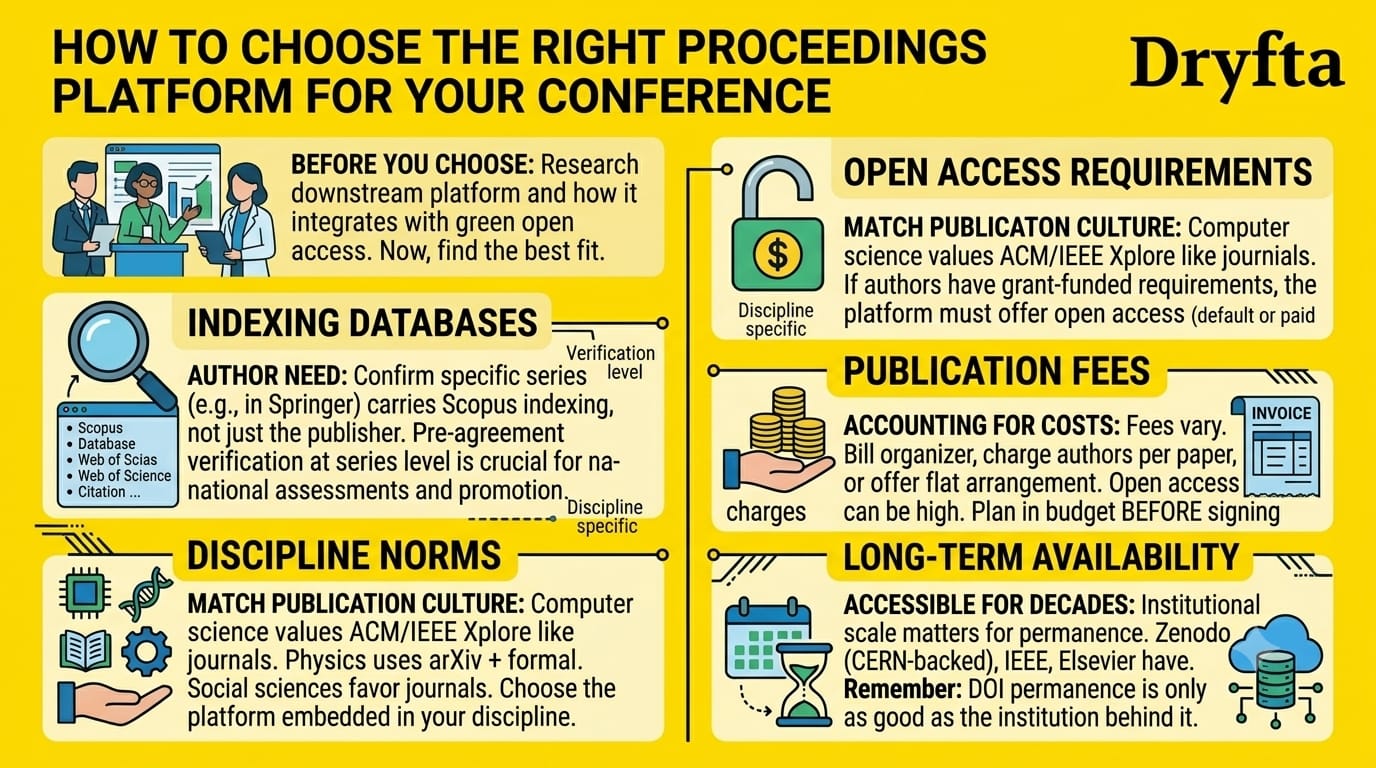
Now that we’ve delved into the characteristics of conference proceedings platforms, the upstream process behind it and how it differs from the green open access revolution, know how you can find the best platform for your conference proceedings.
- Indexing databases: Scopus and Web of Science are the databases that matter to most research institutions when they evaluate academic output. If your authors need Scopus indexing to satisfy promotion criteria or national research assessment requirements, you need to confirm that the specific series you intend to publish in carries that indexing and not just the publisher in general. A Springer volume is not automatically a Scopus-indexed volume. Verification at the series level, before any agreement is signed, is not optional.
- Discipline norms: Publication culture is not uniform. In computer science, a conference paper in IEEE Xplore or the ACM Digital Library carries citation weight that rivals a journal article. In physics, posting to arXiv alongside formal publication is standard and in the social sciences and humanities, journal publication still dominates how research is evaluated. The platform that already lives inside your authors’ reading and citation habits is the platform most likely to serve your conference proceedings well.
- Open access requirements: Funding councils across Europe and North America increasingly mandate that outputs from publicly funded research be freely available. If your authors include grant recipients under such requirements, the platform must offer open access either by default as Zenodo, arXiv and Elsevier Procedia do or through a paid option that authors can activate when their funding allows.
- Publication fees: Formal publishers charge and the structure of this pricing also differs. Some bill the conference organiser directly, some charge authors per paper and some offer a flat arrangement that covers the whole volume. Open access article processing charges can reach several thousand dollars per paper. These costs need to be accounted for in the conference budget before a publisher agreement is signed, not discovered after.
- Long-term availability: A proceedings platform should keep published papers accessible for decades. Publications like CERN-backed Zenodo make this commitment explicitly. IEEE and Elsevier also have institutional scale that implies permanence. The permanence of a DOI is only as reliable as the institution standing behind it.
12 Conference Proceedings Platforms for Research Papers
A proceedings platform affects how easy it is to publish and find papers. The options below cover well known repositories and publisher hosted libraries that support long term access.
1. Dryfta
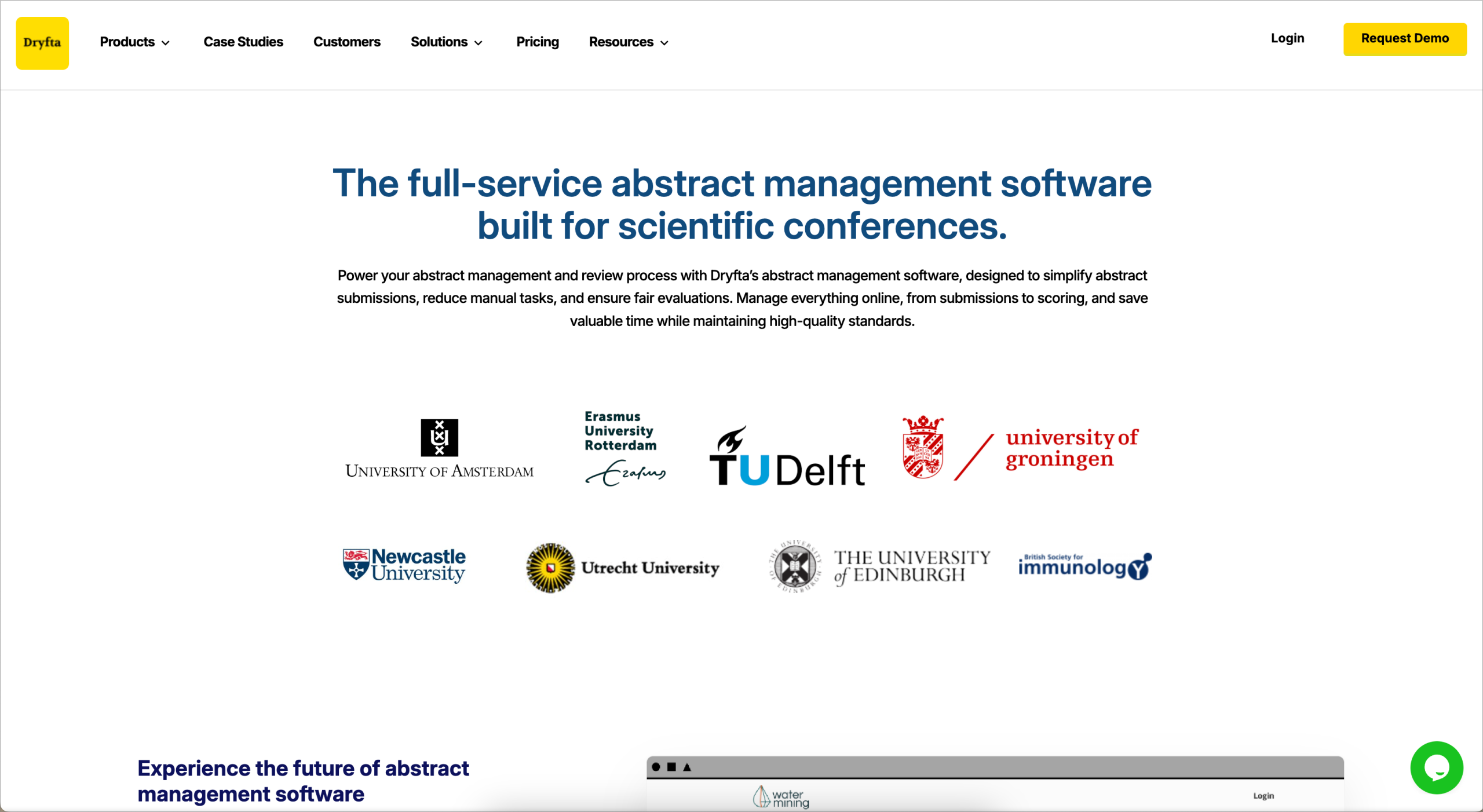
Best For: Conferences that want to publish an open-access abstract archive as part of a fully managed conference platform covering submission, peer review, scheduling and registration in one system.
Dryfta offers an online abstract archive where conferences can post their final papers for public viewing and other interested parties. Once posted, conferences do not need to take any additional action, as Dryfta will continue to organize the published papers for easy viewing.
Each proceedings volume has its own page, making it easy for readers to scan titles, download papers, and follow the full collection. The setup also provides long-term visibility, as the proceedings remain listed in the conference’s record.
Key Strengths
- The abstract archive is part of Dryfta’s full conference management platform, which means the upstream process of submission, review, decisions, scheduling and the published record exist within the same system with no data re-entry.
- Open access by default, with accepted abstracts publicly visible and accessible without cost to authors or readers.
- For conferences that publish full papers elsewhere, the Dryfta abstract archive serves as a complementary public record tied directly to the conference programme.
Limitations
- Dryfta’s archive does not carry Scopus or Web of Science indexing and it hosts abstracts rather than full papers.
- The platform is primarily a conference management tool, and its publication component should be understood in that context.
2. arXiv
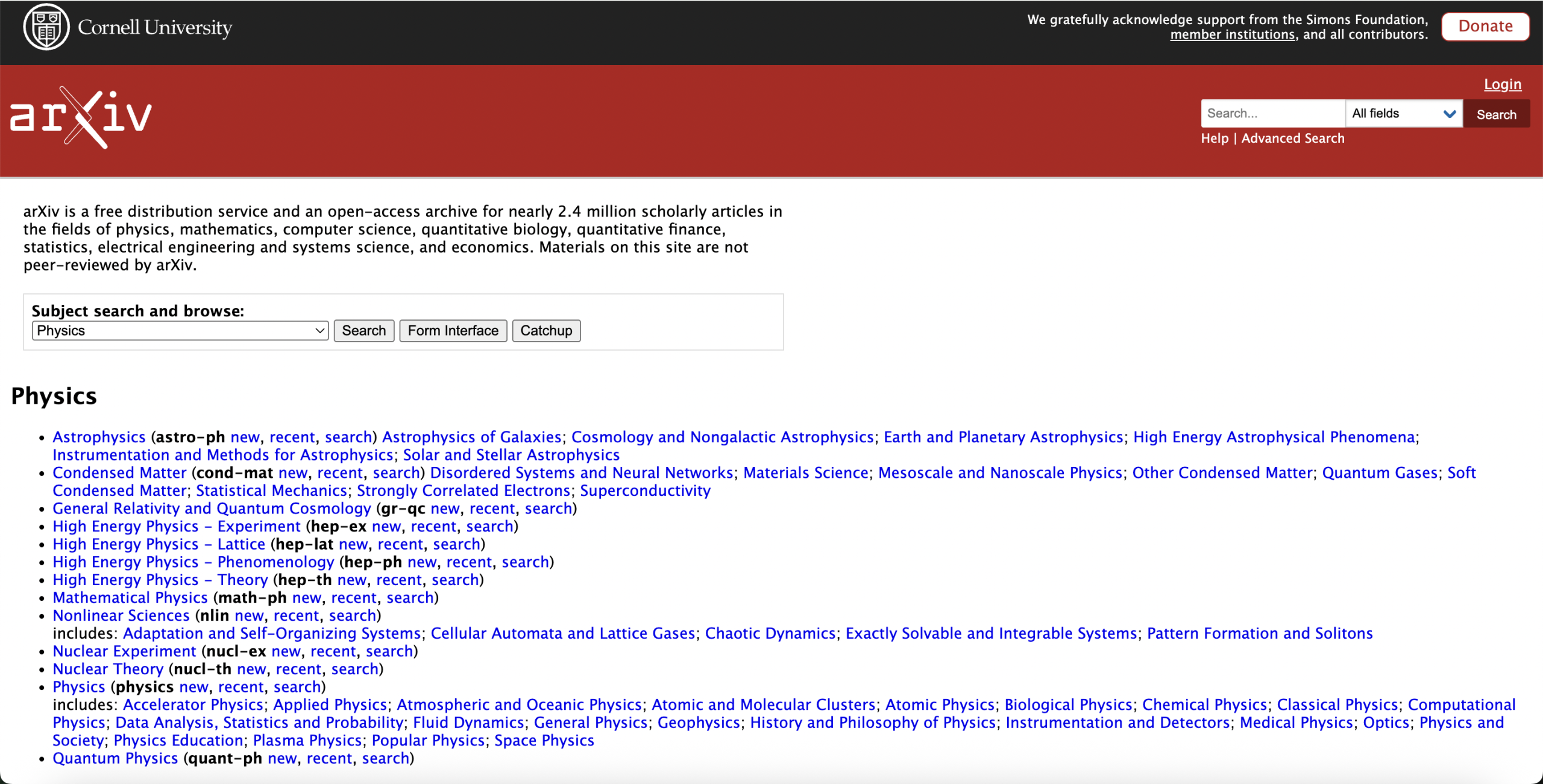
Best For: Physics, mathematics, statistics, computer science and quantitative biology conferences where preprint distribution is already part of how the field operates.
arXiv is an open-access platform that hosts research papers across many fields. The platform is widely used in physics, computer science, mathematics, and related areas. The platform works as a public archive where anyone can read papers for free.
arXiv is considered one of the best platforms to publish conference proceedings for several reasons. First, posting is fast and well-defined. Next, the longevity of the arXiv makes it highly trustworthy. Since authors’ contributions will remain free to readers, they do not have to worry about paywalls. Many fields use arXiv as a standard source for early research, ensuring visibility stays high.
The portal provides a stable reference link (an arXiv ID or DOI) for each article, so authors can easily cite each other’s work. The search tool is very user-friendly and allows users to limit searches to specific fields. arXiv maintains a permanent link to older articles.
Key Strengths
- Completely free for submitters and readers, at every stage.
- In physics, mathematics and much of computer science, arXiv is the first place researchers look for new work. This means that papers posted here reach active readers faster than any formal publication timeline allows.
- Cornell University Library backing and 30-plus years of continuous operation provide a stability and discoverability that most formal publishers can only match, not exceed.
Limitations
- Not indexed in Scopus or Web of Science, which limits its suitability for authors at institutions where those databases determine formal evaluation.
- arXiv applies discipline-based moderation and not peer review. It is, in essence, a distribution and preservation channel as opposed to a conference proceedings platform in the conventional sense.
3. IEEE Xplore
Best For: Engineering, computer science, electrical engineering and robotics conferences.
IEEE Xplore is a large online library of scientific and technical papers, managed by the IEEE, one of the largest organizations in engineering research. The site is widely trusted in academic fields because its content undergoes strict review. Many researchers use it to read new studies and follow the latest work in their field.
IEEE Xplore provides strong visibility as well. Each publication on IEEE Xplore appears in major search engines used in engineering and computer science; therefore, researchers find their published conference work more quickly.
In addition, IEEE Xplore works well for conferences in engineering, computer science, electronics, and related areas. The proceedings will be available for a long time and will be accessible to researchers worldwide.
Key Strengths
- Indexed in both Scopus and Web of Science, giving authors in IEEE-affiliated conferences the citation database coverage their institutions require.
- Brand recognition among engineering and technology hiring committees that no newer platform has come close to replicating.
- Open access is available per article through the IEEE Open hybrid scheme, letting individual authors comply with funder mandates without converting the full volume.
Limitations
- A formal IEEE Technical Co-Sponsorship application is required and approval is not guaranteed. Newer or independently organised conferences may find this barrier difficult to clear.
- Open access fees at approximately $2,800 per article are among the highest on this list and can strain conference budgets considerably.
4. Springer Nature

Best For: Computer science, information science, life sciences and interdisciplinary research conferences seeking formal indexing and global library distribution.
Springer Nature is an international academic publishing organization that provides worldwide access to scholarly articles, journals, books, and conference proceedings. Researchers widely use Springer Nature for its high degree of availability and long-term visibility.
The uploading process on Springer Nature is quite straightforward. Teams managing files do not have to worry about a complex process when uploading files. Each paper has a clear title page and easy-to-read sections. Readers can move from one paper to the next without trouble. Springer Nature is a suitable choice for conferences that include scientific disciplines, such as engineering and medicine, as well as social sciences.
Key Strengths
- Scopus indexed as standard, with many series also listed in Web of Science, making this one of the more comprehensively covered options for conferences across multiple disciplines.
- Standard proceedings publication carries no direct charge to the organiser, with open access available as a fee-based opt-in for authors whose funders require it.
- Strong global library subscriptions ensure papers reach researchers at institutions across Europe, Asia and North America without those institutions paying additionally.
Limitations
- Web of Science indexing varies by series. The specific volume, not the publisher name, is what needs to be verified before making commitments to authors.
- Mandatory formatting templates and production requirements place a non-trivial burden on authors and organising committees, particularly those working outside standard LaTeX environments.
5. Elsevier Procedia

Best For: Multi-disciplinary conferences covering engineering, materials science, social sciences and health sciences.
Elsevier Procedia is an online collection for conference proceedings. It helps conference teams to publish papers quickly and reach a large research community. The Procedia allows conference teams to publish a variety of papers across multiple fields, utilizing Elsevier’s tools to provide a seamless process from start to finish.
Furthermore, researchers use Procedia as it offers a strong reach. The proceedings are available on ScienceDirect, which gives access to 80% of global researchers. People can read the papers for free, which helps more authors gain visibility. Furthermore, Procedia also provides rapid publication. Procedia typically publishes papers within 8 weeks after the final versions are accepted.
Key Strengths
- Scopus indexed as standard across the series, which satisfies the indexing requirement for most research institutions and funding councils.
- Full open access funded through the conference-level agreement rather than per-author charges, removing a significant barrier for researchers at less-resourced institutions.
- Publication turnaround of approximately eight weeks from final file submission, meaningfully faster than most formal publishers.
Limitations
- Web of Science coverage is selective and inconsistent across Procedia series. Organisers should not assume WoS indexing is included.
- Conference-level fees are negotiated directly with Elsevier and are not publicly listed, which makes budget planning less straightforward than it should be
6. Taylor & Francis Online

Best For: Social sciences, humanities, education, business and interdisciplinary research conferences.
Taylor and Francis is a global publisher that works with journals, books, and online resources across many research fields. It supports peer-reviewed material and adheres to each journal’s editorial guidelines.
As long as users have access to the site, they may read the articles using a smartphone, tablet, or laptop. Most T&F journals undergo a peer-review process, and authors submit their articles through approved submission systems. A large number of T&F journals are also indexed in various databases. The company traces its history back to the nineteenth century, and the catalog has grown through partnerships with universities and research groups.
Key Strengths
- Indexed in both Scopus and Web of Science, with depth of coverage across social sciences and humanities that no other publisher on this list comes close to.
- Open access available at the article level, so individual authors with funder mandates can comply without the whole proceedings volume converting.
- Coverage across disciplines that larger, more technically focused publishers do not serve.
Limitations
- The conference proceedings programme is considerably smaller than the journal side of the business. Not all subject areas have an established series to submit to.
- Processing fees and timelines require direct negotiation, and response times vary by region and subject area.
7. IOP Publishing
Best For: Physics, materials science, environmental science and applied sciences conferences.
Researchers prefer IOP Publishing because the platform keeps every paper in a stable citation format. Each proceedings volume receives its own issue, along with its own set of papers, and a complete publication record.
Conference organizers have a positive impression of IOP Publishing’s guided workflow. The site provides clear steps for formatting, submission checks, and final upload. The system also ensures that all submitted manuscripts adhere to the same technical guidelines prior to being published, minimizing potential errors and saving time for the organizing committee of events.
Key Strengths
- Indexed in both Scopus and Web of Science, with particularly strong database presence across physics and materials science.
- Full open access is the default across IOP Conference Series, at no charge to individual authors which removes cost barriers for researchers at less-funded institutions.
- A streamlined online submission system built to handle high paper volumes, which matters for conferences accepting more than 50 papers.
Limitations
- Subject coverage is concentrated in physical sciences and engineering. Conferences in social sciences, humanities or law will find no suitable series.
- Service fees for conference organisers are not publicly listed and must be obtained through direct inquiry.
8. SciTePress

Best For: Computer science, information technology and engineering conferences, particularly newer events or those with limited access to IEEE or ACM affiliation.
SciTePress is a publisher focused on conference proceedings in computer science, engineering, and technology. The portal publishes all accepted papers from events in online volumes. All papers are presented in detail, and the volume includes author information, their affiliation, abstract, number of pages, date of publication, etc.
Additionally, submissions to the SciTePress go through a peer-review process. Papers submitted via this system that receive approval will be included in the final conference proceedings. Once SciTePress publishes the proceedings, the platform keeps the papers stored in its digital library, where readers with access can view them online in basic format.
Key Strengths
- Open access publishing is standard, with papers freely available immediately after publication.
- The integrated event management and publishing model reduces logistics complexity for smaller conferences managing both sides simultaneously.
- CrossRef DOIs are assigned to all papers, providing permanent citable references regardless of indexing status.
Limitations
- Scopus indexing is partial and Web of Science indexing is absent. For authors at institutions where citation database metrics drive promotion, this is a meaningful constraint.
- Per-paper publication fees apply and are charged to the conference or authors, so total costs for a conference with many accepted papers accumulate quickly.
9. EDP Sciences

Best For: Physics, astronomy, energy, environmental science and life sciences conferences, particularly those with European, Asian or African author bases.
EDP Sciences publishes conference proceedings through a set of dedicated series, including EPJ Web of Conferences, SHS Web of Conferences, and E3S Web of Conferences. Researchers prefer EDP Sciences for consistent and continuous exposure. As many of the proceedings are indexed in top-tier databases (Web of Science and Scopus), authors can reach a broader audience in their field of research.
EDP Sciences has several key advantages, including hosting stability, subject-based series, and strong database indexing. EDP Sciences works well for scientific, social science, and environmental events that want indexed proceedings with direct access to their online version.
Key Strengths
- Scopus indexed across all main conference series, consistently and without the series-by-series variation that complicates planning with other publishers.
- Full open access by default, with papers freely available globally at no charge to authors or readers.
- Lower formatting barriers and multi-language support make EDP a practical option for conferences with internationally diverse author pools.
Limitations
- Web of Science indexing is inconsistent. Only some EDP series appear in WoS, which limits the platform’s appeal for researchers at institutions where WoS metrics dominate evaluation.
- Name recognition is weaker in North American research communities than in European ones, and this affects how some authors perceive a conference that publishes with EDP.
10. AIJR Publisher
Best For: Small to medium-sized conferences in engineering, science and interdisciplinary fields that need a formal open-access home without requiring large-publisher affiliation.
AIJR publisher works best for small to mid-size academic conferences that need a simple and affordable way to publish proceedings online without a complex technical setup. The platform provides each paper with a separate PDF, a clear citation style, and a unique identifier via the AIJR Citation Style.
AIJR publishes all papers in a single proceedings volume with an ISBN (International Standard Book Number). Additionally, AIJR will assign a DOI (Digital Object Identifier) to the entire proceedings volume, thereby improving long-term visibility. However, AIJR does not claim to assign individual DOIs to each paper, so the information remains accurate and aligned with public details.
Key Strengths
- Open access by default, with all papers freely readable immediately on publication.
- CrossRef DOI registration included, giving papers a permanent, globally recognised identifier that supports citation tracking.
- No formal affiliation or sponsorship requirement, which makes the platform accessible to independently organised conferences that larger publishers will not take on.
Limitations
- Scopus indexing is partial and Web of Science indexing is absent. Authors at institutions where these databases drive evaluation will notice the difference.
- Lower brand recognition than established publishers, which affects how some prospective authors perceive a conference publishing with AIJR.
11. Zenodo

Best For: Budget-constrained conferences, open-science focused events and any conference that needs permanent, DOI-backed, freely accessible hosting at no cost.
Zenodo is a large-scale, open publishing platform built to store and share research outputs, including full conference proceedings. The service is run by CERN and the European Commission, which gives it strong credibility in academic circles. It supports many formats; therefore, conferences can use Zenodo to upload papers, PDFs, data files, and complete proceedings sets to a single location.
Organizers choose Zenodo as it is a low-cost and reliable tool to publish conference proceedings. The platform is considered best for conferences that want free publication, DOI support, and long-term access backed by a trusted research institution.
Key Strengths
- Completely free for organisers and authors alike with no publication fees, per-paper charges or institutional affiliation required.
- CERN’s institutional backing gives long-term preservation a weight that smaller repositories cannot match through policy statements.
- CC-BY licensing by default satisfies open-access funder mandates immediately and permanently, at zero additional cost.
Limitations
- Not indexed in Scopus or Web of Science. Zenodo records may surface in Google Scholar, but they do not feed the citation database metrics that many institutions use for formal evaluation.
- No editorial quality filter at the platform level. The credibility of a Zenodo proceedings collection rests entirely on the rigour of the conference’s own peer review process.
12. Galoá Proceedings
Best For: Conferences in Latin America and other regions seeking an accessible, open-access digital proceedings platform with DOI assignment and without formal indexed-publisher requirements.
Galoá Proceedings is helpful for researchers who need to maintain a permanent reference for their papers. In addition, the platform has made it easier for researchers to share their research with others. The links provided to each paper allow researchers to provide a direct reference to their peers.
The platform supports events by providing a centralized way to display all published papers. Organizers upload the final manuscripts, and Galoá prepares them for publication so the full proceedings stay neat and consistent. The platform also provides long-term access, helping conferences maintain a permanent digital record of their work.
Key Strengths
- Open access by default, with papers publicly accessible immediately on publication.
- DOI assignment is included, providing papers with a permanent citable identifier that supports reference tracking.
- A lower barrier to entry than formal indexed publishers makes Galoá accessible to conferences that cannot meet the affiliation or production requirements of IEEE, Springer or Elsevier.
Limitations
- Indexing status in Scopus and Web of Science is unclear or very limited, which constrains the platform’s usefulness for authors at institutions where those databases determine evaluation outcomes.
- Brand recognition is largely regional, and for conferences seeking to attract international submissions, the Galoá name carries less weight than the established global publishers on this list.
Quick Comparison- 12 Proceedings Platforms at a Glance
In this section, we’ll take a brief and comparative overview into the conference proceedings platforms we comprehensively discussed earlier.
| Platform | Type | Scopus Indexed | Web of Science | Open Access | Cost to Organizer |
| arXiv | Open repository | Not indexed | No | Free, open | Free |
| IEEE Xplore | Dedicated publisher | Yes | Yes | OA option (fee-based) | Contact IEEE |
| Springer Nature | Dedicated publisher | Yes | Some series | OA option | Free (standard); OA fees apply |
| Elsevier Procedia | Dedicated publisher | Yes | Selective | Open access (ScienceDirect) | Contact Elsevier |
| Taylor & Francis Online | Dedicated publisher | Yes | Yes | OA option | Contact T&F |
| IOP Publishing | Dedicated publisher | Yes | Yes | OA option | Contact IOP |
| SciTePress | Dedicated publisher | Partial | No | Online library access (basic format) | Publication fees apply |
| EDP Sciences | Dedicated publisher | Yes | Some series | Open access | Contact EDP |
| AIJR Publisher | Repository/publisher | Partial | No | Open access | Publication fees apply |
| Zenodo | Open repository | Not default | No | Free, CC-BY | Free |
| Galoá Proceedings | Repository/publisher | Unclear/limited | No | Open access | Contact Galoá |
| Dryfta | Open archive | No | No | Open access (abstract archive) | Contact Dryfta |
Which Platform Is Right for Your Conference?
In the section below, we’ve organized the best conference proceedings publications options around conference disciplines and the considerations associated with the fields.
For engineering and computer science conferences: IEEE Xplore and ACM Digital Library are the established choices. Both carry dual Scopus and Web of Science indexing and the discipline credibility that authors in these fields use to evaluate whether a conference is worth submitting to. Springer LNCS is a strong alternative for information science and AI. For conferences that do not yet meet the affiliation requirements of those publishers, SciTePress and AIJR Publisher offer a credible lower-barrier starting point.
For physics, materials science and applied sciences: IOP Publishing, AIP Publishing and EDP Sciences are purpose-built for these disciplines. All three carry Scopus indexing. IOP and EDP make full open access the default at no author cost. AIP carries the deepest institutional history in physics.
For social sciences, education and humanities: Taylor and Francis is the only publisher on this list with both meaningful disciplinary coverage and dual Scopus and Web of Science indexing across these fields. Elsevier Procedia covers some social science subject areas and publishes faster. For conferences without a large budget, Zenodo provides a permanent, freely accessible home even without formal indexing.
For conferences with funder-mandated open access: Zenodo, arXiv, Elsevier Procedia, IOP Conference Series and EDP Sciences all provide open access at no cost to authors. IEEE, Springer, ACM and AIP offer open access as a paid option for individual papers where authors have article processing charge funding through their grants.
For small or budget-constrained conferences: Zenodo and arXiv cost nothing and provide DOI registration alongside permanent hosting. AIJR Publisher offers a paid but more accessible open-access route with CrossRef DOIs for conferences that need a more formal publication appearance without the costs of the major publishers.
Before papers reach any of these platforms: the upstream process has to be complete. Submissions collected, peer review run and decisions communicated. You will most certainly need a software tool to help you with this, especially for large-scale events. Dryfta handles this upstream process. Everything on this list handles what happens after.
What are conference proceedings and how are they different from journal articles?
Conference proceedings are a published collection of papers presented at a specific academic event. Each paper has typically been through peer review, accepted by a programme committee, and revised before appearing in the final volume. The key differences from journal articles are timing, format and disciplinary weight. Proceedings are published as a collection tied to a single event, often within months of the conference itself. Journal articles go through a longer independent editorial process and appear in recurring issues. In computer science, conference papers can carry citation weight equal to journal articles. In medicine, law and much of social science, journal publication is still the more formally weighted output.
Are conference proceedings indexed in Scopus or Web of Science?
Some are. Some are not. The distinction depends on the publisher and the specific series, not on the conference or its quality. IEEE Xplore, ACM Digital Library, Springer LNCS, Elsevier Procedia, Taylor and Francis, IOP Publishing, EDP Sciences and AIP Publishing all carry Scopus indexing. Web of Science coverage is less consistent: IEEE, ACM, AIP and Taylor and Francis have strong WoS presence, while EDP and SciTePress have partial or no coverage. Zenodo and arXiv are not indexed in either database. The important thing is to verify indexing at the series level and not the publisher level before making any commitments to authors.
How do I publish conference proceedings for free?
Two platforms on this list carry no cost at all: Zenodo and arXiv. Both issue DOIs, provide permanent hosting and make papers freely accessible to any reader. Zenodo accepts papers from any discipline and allows organisers to create a dedicated conference collection. arXiv is discipline-specific and best suited to physics, mathematics and computer science. Among formal publishers, Elsevier Procedia, IOP Conference Series and EDP Sciences do not charge individual authors. Rather, their costs are covered through conference-level agreements, though the organiser still pays a fee on that side. The genuinely zero-cost route for both organiser and author is Zenodo.
What is a DOI and why does it matter for conference proceedings?
A DOI or Digital Object Identifier is a permanent standardised reference code assigned to a published document. When a paper has a DOI, it can be located through doi.org reliably, even if the original hosting URL changes. For conference proceedings, that permanence means authors can cite their work with a stable reference, citation tools can track how often it is cited, and readers can find the paper regardless of what happens to the original host. All formal publishers on this list assign DOIs, as do Zenodo and arXiv. For any author who needs their work to be traceable in the scholarly record, a DOI is the baseline requirement.
What is the best platform for publishing CS conference proceedings?
For computer science, the established answer is ACM Digital Library for ACM-affiliated conferences, IEEE Xplore for electrical engineering and computing systems, and Springer LNCS for information science and AI. All three carry both Scopus and Web of Science indexing and are recognised by CS hiring and promotion committees worldwide. For conferences that do not yet qualify for those publishers, SciTePress offers a credible open-access alternative with CrossRef DOIs. For preprint distribution alongside formal publication, arXiv is standard practice in theoretical CS and machine learning.
What is the difference between a preprint platform like arXiv or Zenodo and a formal proceedings publisher like IEEE or Springer?
The difference is editorial gatekeeping, indexing and the formal weight that research institutions attach to each. Publishers like IEEE, Springer and Elsevier apply production processes, list papers in indexed series, and feed the citation databases that universities use to measure research output. Zenodo and arXiv do not apply a publisher-level quality filter. They are distribution and preservation tools, not formal publication venues in the conventional sense. In fields where preprint culture is already embedded like physics, mathematics, theoretical CS, that distinction is narrowing. In clinical medicine, law and much of the social sciences, a formal publication still carries weight that a repository deposit does not.
Final Thoughts
Publishing conference proceedings online today is much simpler because so many platforms offer clear access, strong visibility, and long-term, stable storage. Therefore, each platform listed has its own particular advantages, which will allow event teams to decide how to meet their objectives. When your conference selects the right platform, the outcomes feel smoother for everyone involved.
Dryfta gives you one space to collect papers and track every step. The platform shows all tasks in a simple layout. Your team can share rules, collect submissions, and manage reviews without switching tools. Schedule a demo today to further understand what Dryfta can accomplish for your events.