


Money is decisive of all things event management. And event management software pricing models are among factors that you need to plan if you want the ball in your court. If you want to be a compelling event planner, it is time to take charge of your money. Don’t be a cheapskate but also don’t commit daylight robbery with exorbitant ticket prices. Your buyers are smarter than you think them to be. And almost all of them are eyeing the best ticket for the right event and at the right price.
But the event management software pricing models you choose should not have you feeling the pinch. Fortunately, the skies are looking bright for event professionals in 2026.
Skift meetings has found that more than half of all surveyed event professionals are expecting favorable work conditions in the year ahead (2026).
Why the Pricing Model Matters More Than the Headline Price
Two organizers can look at the exact same event software and walk away with completely different bills. And it is not that any of them did anything wrong. One may perhaps be running a per-attendee model that charges a dollar a head. The other could be exercising a percentage-of-ticket model that takes a cut of every sale. Each one of the event management software pricing models in the market today come with their own sets of upsides and downsides.
Something peculiar about event software pricing percentage of tickets is how numbers, at first glance, can be wildly misleading. The very first figure that pops up on ticket websites and budget calculations, often referred to as the headline price, can be misleading. And it seems to be making victims out of both event planners and ticket buyers. So what should one be looking at instead? If the headline price isn’t reliable, what is?
- Per-attendee and percentage-of-ticket models are not neutral. They are structured to charge more precisely when an organizer is doing something right, filling more seats, selling more tickets, building a bigger programme year over year.
- A subscription model and a commission model can advertise numbers that look similar on a landing page and diverge by thousands of dollars once real attendee counts are plugged in.
In this guide, we’re walking you through 6 event management software pricing models commonly employed by event professionals across the world today. To understand these pricing models, it is pertinent to also gauge how ticketing fees work.
The 6 Event Management Software Pricing Models, Explained
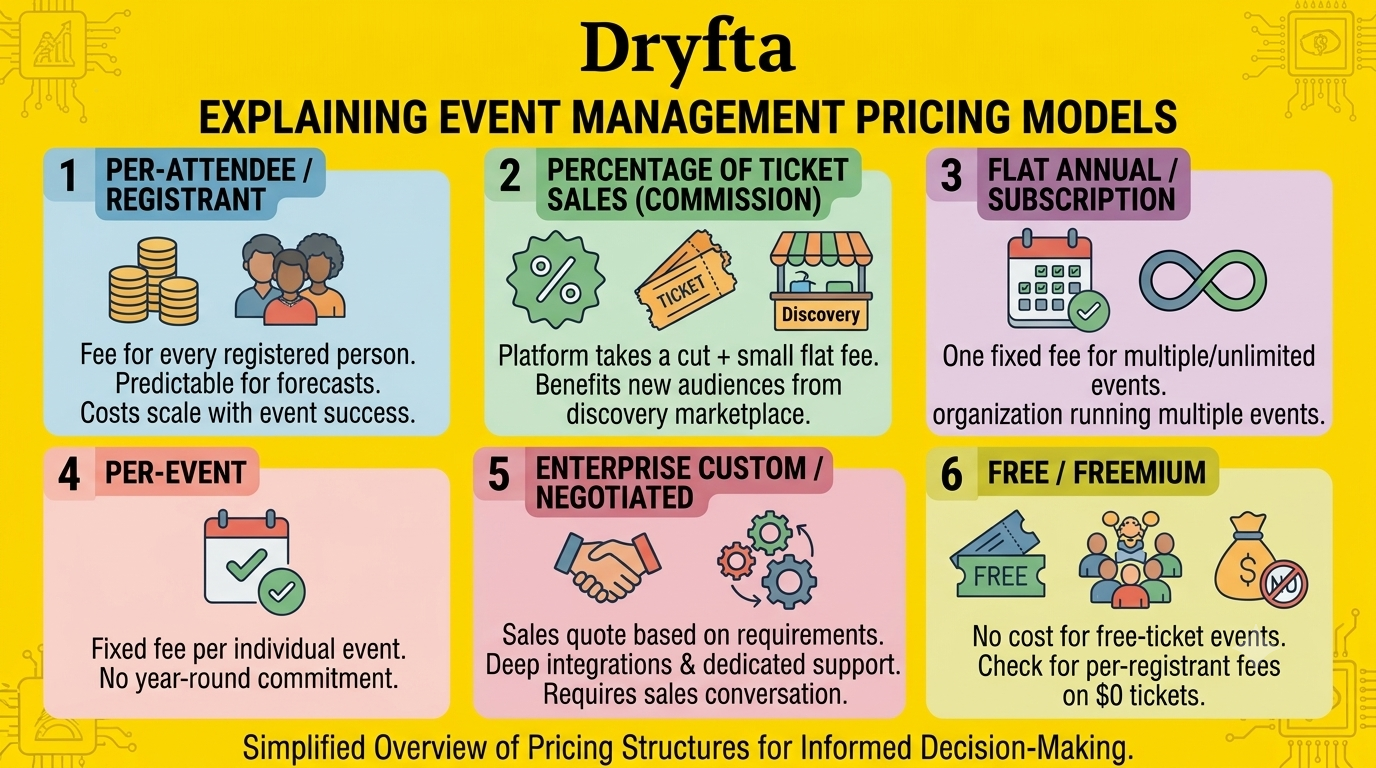
Every event platform on the market prices itself ends up using any one or some kind of a combination of the 6 pricing models that we’re about to discuss. So let’s dive right in and find what model(s) might work best for your big event, be it an academic conference, a concert or a virtual seminar. There’s something for everyone out here.
Per-Attendee / Per-Registrant Pricing
Here you pay a fee for every person who registers, either a flat amount per head or a small flat fee plus a slice of the ticket. Eventzilla charges a flat $1 per registration, while RegFox charges 99 cents plus 1%. This model works well for events with low, predictable attendee counts, where the total bill stays easy to forecast from one year to the next. The risk sits in the name itself. Cost scales directly with the event’s success, so the model that looked cheap at 100 registrants can look very different at 1,000.
Percentage of Ticket Sales, or Commission
This model takes a cut of each ticket’s price, usually a percentage plus a small flat fee, and often a separate payment processing charge layered on top. Eventbrite’s current US rate runs 3.7% plus $1.79 per ticket, with 2.9% payment processing added on top of that. It suits events with no existing audience that benefit from a platform’s built-in discovery marketplace, since the commission is effectively paying for exposure as much as for software. The quieter risk is how unevenly that percentage lands. A flat $1.79 component costs a smaller share of an expensive ticket and a much larger share of a cheap one, so the same rate can feel reasonable on a $200 conference pass and punishing on a $20 workshop ticket.
Flat Annual or Subscription Pricing
One fixed fee covers unlimited, or capped, events for the year, regardless of attendee volume. InEvent runs close to $9,990 a year and Accelevents close to $5,000. This is the model built for organizations running multiple events annually, where the fixed cost gets divided across enough programmes that the per-event math starts to look favourable. It is close to overkill for a single small one-off event, where a year-round subscription buys far more than the organizer actually needs.
Per-Event Pricing
A fixed fee charged per individual event rather than annually suits occasional organizers who do not want a year-round commitment sitting on their books. The tradeoff shows up the moment an organizer runs more than one or two events, since the per-event fee is often priced higher than what an equivalent subscription would have cost across the same number of events.
Enterprise Custom or Negotiated Pricing
Here there is no published rate at all. A sales team quotes a price based on registrant volume, feature modules, integrations, and support level, and Cvent is the most cited example, with procurement data putting typical contracts between roughly $19,550 a year at the mid-market median and $52,000 a year on average, often carrying built-in annual increases around 9%. This suits large, complex programmes that genuinely need deep integrations and dedicated support. The risk is baked into the process itself. Budgeting requires a sales conversation before an organizer can even compare options, and that conversation rarely produces a number smaller than expected.
Free or Freemium
No cost applies to free-ticket events, which makes this the natural home for community and nonprofit programming with no ticket revenue to draw from. The catch that trips up more than a few organizers is that some platforms still charge a per-registrant fee even on a $0 ticket, quietly turning a free event into a line item anyway.
The Layer Almost Every Comparison Misses: Payment Processing Fees
Payment processing fees typically run 1.5 to 3.5 percent plus 30 cents per transaction and they are charged by the payment gateway itself, Stripe, PayPal, or whatever processor sits built into the platform and not by the event software’s own pricing model itself. This is something that rarely makes it into a pricing comparison, which is exactly why we’re stated plainly here.
A platform advertising a $0 platform fee, or a low flat subscription with no per-attendee charge, can still cost an organizer roughly 2.9 percent plus 30 cents in processing on every paid registration. This cost pertains regardless of which of the 6 models above the platform itself uses. And it does not always show up on the marketing page next to the headline number. Any organizer comparing two platforms on price alone, without asking who processes the payment and at what rate, is only comparing incomplete numbers.
Real Cost Scenarios: What Each Model Actually Costs at Different Volumes
Numbers settle arguments that adjectives cannot. The table below applies real, current rates from four representative platforms across three attendee counts, assuming an average paid registration in the range typical of a professional or academic conference.
| Pricing Model | Example Rate | 100 Attendees | 500 Attendees | 2,000 Attendees |
| Percentage commission (Eventbrite-style) | 3.7% + $1.79 + 2.9% processing | ~$509 | ~$2,545 | ~$10,180 |
| Per-registrant flat (Eventzilla-style) | $1/registrant + processing | ~$275 | ~$1,375 | ~$5,500 |
| Flat annual subscription (Dryfta-style) | $1,499/yr + processing only | ~$1,674 | ~$2,374 | ~$4,999 |
| Enterprise custom (Cvent-style, mid-market median) | ~$19,550/yr + processing | ~$19,725 | ~$20,425 | ~$23,050 |
The pattern is hard to miss once it is laid out this way. The commission model starts cheap and ends expensive. The flat subscription starts more expensive and ends cheap. Somewhere between 500 and 2,000 attendees, the two lines cross, and an organizer who signed with the cheaper-looking option at 100 attendees is often the same organizer paying double or triple what a subscription model would have cost by the time the event has grown.
Why Some Platforms Won’t Tell You Their Price
Enterprise event platforms that cater to large-sized and sophisticated events vary based on factors such as customers, event size, feature depth, number of integrations, support level. So a single published rate here may end up misrepresenting the actual buyer. A number that fits a 300-person regional meeting says very little about what a 5,000-person annual congress with a dozen integrations will actually pay, so these platforms quote instead of publish.
But this does not mean the process has to be opaque on the buyer’s side. When evaluating a quote-only platform, it is worth asking 3 things directly:
- The typical price range for organizations of your size.
- What is included in that quote versus billed separately as an add-on and
- Whether a multi-year contract carries a built-in price increase, a known pattern in this segment of the market.
Any enterpise sales team that hesitates to answer any of these 3 questions may be worth reconsidering. It’s sign that’s telling you something about values like transparency about the quote before it even arrives.
How to Choose the Right Pricing Model for Your Situation
The right model depends less on which platform looks cheapest and more on what kind of organizer is asking the question.
- For small, one-time events: An organizer running one small, one-off event with an existing audience tends to do best on a per-registrant flat fee or a percentage-commission model, since there is no ongoing programme to amortise a subscription against. An organizer running one small event with no existing audience is usually better served by a percentage-commission platform with built-in discovery, of the kind Eventbrite offers, since part of what that commission buys is exposure to an audience the organizer does not yet have.
- For annual recurring events: Once an organizer is running two or more events a year, of any size, flat annual subscription pricing, the kind that Dryfta uses, tends to become cheaper than per-event or per-registrant model. This is because the fixed cost is now being divided across more programmes.
- For enterprise-grade events: Organizers running large, high-volume events of 1,000 or more attendees, even just once a year, usually find that flat subscription or negotiated enterprise pricing beats a percentage-commission model outright, for the same reason the crossover shows up in the table above.
- For non-profit organizations: Organizers running free, community, or nonprofit events with no ticket revenue should confirm, specifically and in writing, whether a free pricing tier still charges a per-registrant fee even on a $0 ticket.
Where Dryfta Fits in the Event Software Pricing Percentage of Tickets Landscape
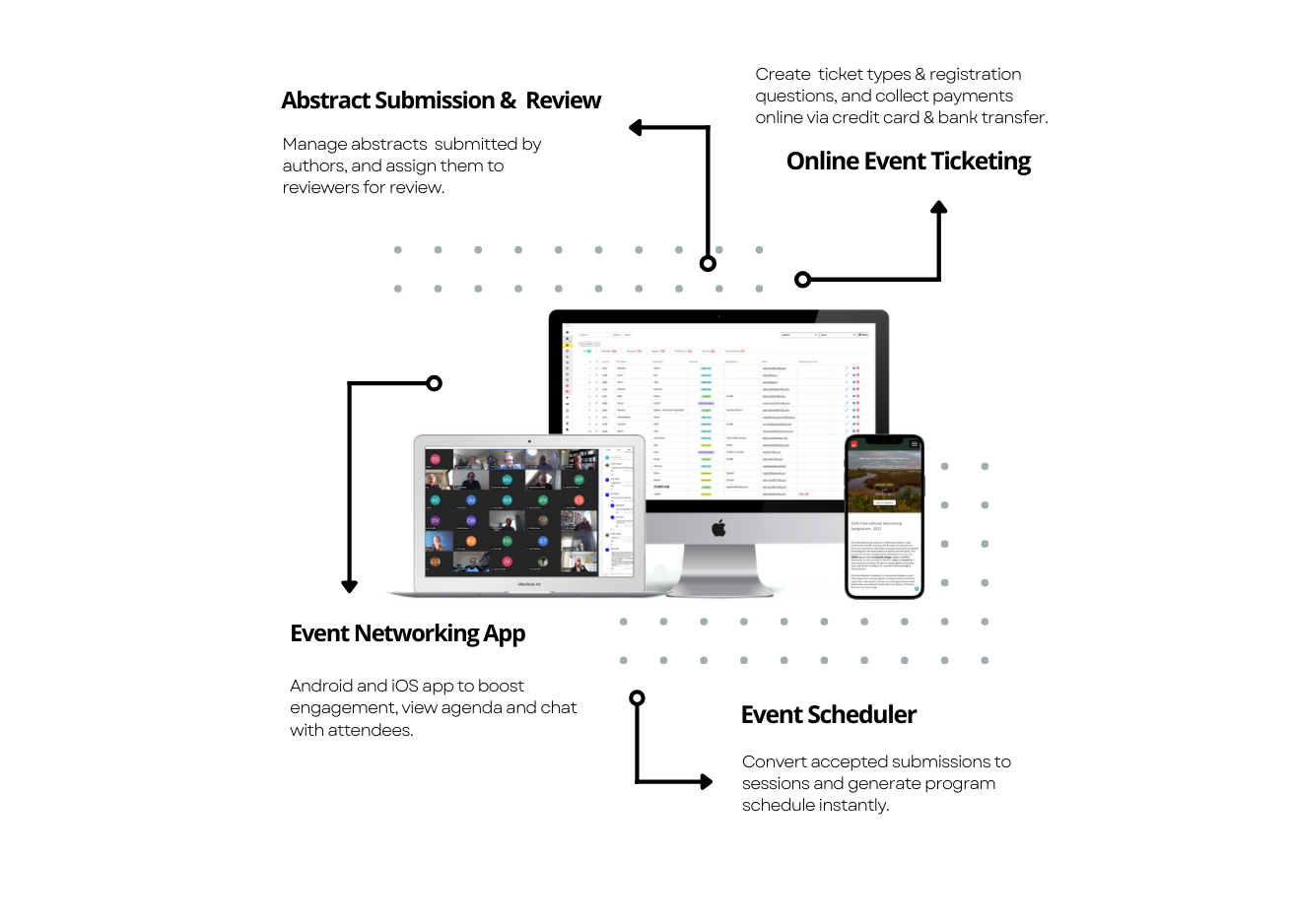
Dryfta uses a flat annual subscription model, starting at $1,499 a year for events with up to 100 attendees, rather than per-attendee or percentage-of-ticket pricing. Dryfta’s Registration & Ticketing is built around that structure deliberately.
- A commission or per-attendee model penalizes the kind of growth a recurring conference is trying to achieve. It charger more the moment attendance improves year over year.
- A flat subscription does the opposite. It stays fixed while the event grows, which is why the crossover point in the table above tends to favour subscription pricing well before an event reaches a few hundred attendees.
Dryfta’s ticketing model is built for organizations running conferences regularly as well as for one-off ticketed events. Standard payment processing fees still apply on top of Dryfta’s subscription, the same way they apply on top of every other model covered in this guide.
For a broader look at how Dryfta compares against Eventbrite, Eventzilla and the rest of the field on total cost rather than pricing model alone, read this article. To watch Dryfta in action, sign up for a free demo here today.
Frequently Asked Questions (FAQs)
What’s the difference between per-attendee and flat-fee event software pricing?
Per-attendee pricing charges a fee for every person who registers, so the total bill rises directly with attendance. Flat-fee, or subscription, pricing charges one fixed amount regardless of how many people register, up to whatever cap the plan allows. The practical difference shows up as an event grows. Per-attendee pricing gets more expensive exactly when an event is succeeding, while flat-fee pricing stays the same.
How much does Eventbrite actually charge per ticket?
Eventbrite’s current US structure is 3.7% plus $1.79 per ticket in service fees, with 2.9% payment processing added on top of the order total. On a mid-priced ticket that works out to somewhere around 8 to 14 percent of the ticket price in total fees, and there is no cap on the total, so the cost keeps scaling as ticket price and volume rise.
Do event platforms charge extra fees on top of the advertised price?
Almost always, yes. Payment processing, typically 1.5 to 3.5 percent plus 30 cents per transaction, is charged by the payment gateway rather than the event software itself, and it applies regardless of which pricing model the platform advertises. A platform can genuinely have a $0 platform fee and still cost real money per paid registration once processing is included.
Why don’t some event platforms publish their pricing?
Enterprise platforms serving large, complex programmes vary too much between customers, event size, feature depth, number of integrations, support level, for a single published number to mean much. A quote-based model lets the platform price each contract to what that specific organization actually needs, though it also means budgeting cannot begin until a sales conversation has happened.
Which pricing model is cheapest for an academic conference or professional association?
For an organization running a conference annually or more often, flat subscription pricing is almost always cheaper than commission or per-attendee models once attendance climbs past a few hundred people, since the fixed cost stops scaling with success. The exception is a very small, genuinely one-off event with no plan to repeat, where a per-registrant or commission model may still come out ahead simply because there is no future event to spread a subscription cost across.