


An event management platform that meets all the goals of your event, sets it up for success, right from the beginning. Narrowing down on the right low cost event management platform that ticks all the boxes can make or break your event’s performance. That being said, what the right event management platform should not do is break your bank.
Why Low Cost Event Management Software Matters 2026
According to Yahoo Finance, the event management software market is calculated to touch $34.7 billion by 2029.
Stripping this figure of the big numbers, what this means in practice is that the software industry will grow in breadth like never before. A larger market means more platforms vying for lasting relevance on the global scale. It is precisely in this sprint that software tools that no longer adapt to the changing industry standards, will be flushed out as though they were never here to begin with. Closely associated with this phenomenon of rearrangement, is the entry of newer players into the arena.
As layman event organizers, it can be the most perplexing point in time to choose the right event management software for your needs. Importantly, a growing market also means booming prices that can often be unsustainable to small and medium-sized events.
A survey by Conevene dating back to 2019 reveals that almost 47% of event planners cite cost management as their biggest frustration when it comes to organizing events.
And even still, events are not a failing marketing for businesses. It is reasonable to say that they will never be. For certainly, a good event can never go out of business. You see what we did there.
SplashThat notes that an overwhelming 90% of marketers remain in favor of hosting events, attributing them as important for their business growth.
The Pressure to Pull Off Events With Lower Budgets Than Ever Before
We probed the numbers and found two noteworthy inferences.
- Larger, Fortune 1000 firms are looking to increase their evenr budgets.
- Smaller firms, on the other hand, are steadily cutting down on the dollars pumped into events.
As a direct result of which, the pressure for event organizers of smaller organizations to deliver better performance metrics but with only economical budgets is greater than ever before. Event organizers see themselves frequently surfing what it means to be ‘cost-effective’ in hosting events. Sometimes, cost-effective can sound like a compromise on quality. In this guide, we’ll take you through the ultimate organizer’s guide to the most promising cost-effective event management platforms in the market.
The 10 Best Cost-Effective Event Management Platforms in 2026
Most event organizers will admit that not all platforms fit your budget. Some cost too much for what they offer. In 2025, your budget may be limited, but your market options are not. In this section let’s take a brief look at top event marketing platforms that still give you all the features you need.
1. Dryfta: Designed for Academic and Scientific Events
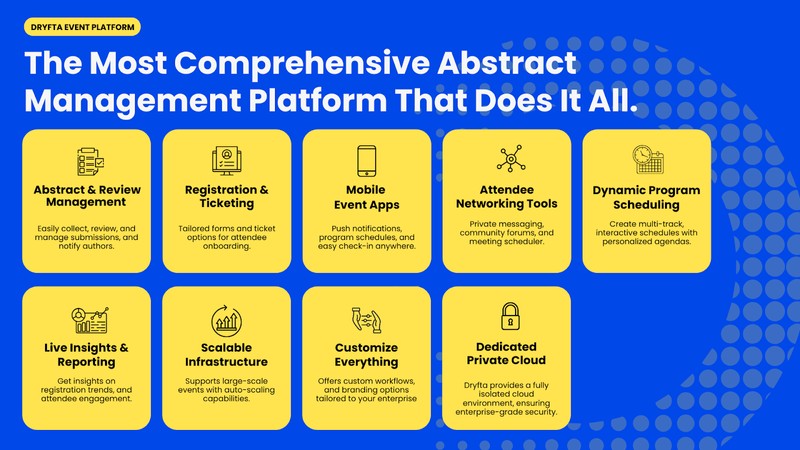
Dryfta is made mostly for universities and associations. It helps with managing abstract submissions and reviews. You don’t need extra software for that. Dryfta also works well for virtual and hybrid events. They have mobile apps so attendees can stay updated.
Dryfta’s abstract management and conference management system supports a multitude of academic functions, including abstract reviews, automatic session scheduling, and attendee messages. It keeps everything organized in one place, which saves time and cuts down on confusion.
Pricing: Dryfta’s prices start at $1,499 a year for events with 100 people or fewer. If you have a bigger event, you can get a custom quote.
2. Eventbrite: Easy to Use with Huge Reach
Eventbrite is one of the simplest platforms around. It is good for smaller to mid-sized events. You can create tickets quickly and sell them online. It also helps you promote events through social media and email.
The event platform also has an app to help with check-ins on the day of the event. They display your event in their extensive directory for greater public visibility.
Pricing: Eventbrite charges nothing if your event is free. For paid events, you pay 3.7% plus $1.79 per ticket sold. They also take around 2.9% from the transaction itself. The setup works if you want to avoid high upfront costs and only pay when you sell tickets.
3. Whova: Great for Attendee Engagement
Whova helps attendees connect and network during events. They offer a mobile app with schedules, live polls, Q&A, and messaging. The software can even suggest people to meet using AI.
Whova supports virtual booths and live streaming too, which is good for hybrid or online events. If your event focuses on getting people to talk and network, Whova is solid.
Pricing: You pay per person, approximately 3% plus $0.99 fee for each ticket. This can add up for big events, but the extra interaction might be valuable. However, Whova’s quote-only pricing is what determines the final figure.
4. Eventzilla: Clear Prices and Simple Features
Eventzilla is a no-fuss platform. They offer tools like custom registration forms, QR code check-in, and email reminders.
The interface of Eventzilla and its user setup is fairly simple to navigate. It does not demand much tech skill. This platform fits well if you want core event tools without paying for things you don’t use.
Pricing: Its basic plan charges $1.50 per registration. They also have monthly plans for bigger events with fewer extra fees. Additionally, Eventzilla has a comprehensive unlimited offering for a one-time payment of $4999/year.
5. Bizzabo: For Large Corporate Events
Bizzabo is built for big companies and big events. It lets you create event websites, send marketing emails, and get detailed reports on how the event went.
Bizzabo works best when you want all your event data linked to your company’s marketing system. If you plan many events or want top-quality support, Bizzabo helps.
Pricing: Pricing is not fixed. Usually, it starts around $17,999 a year or $499/ user on a monthly basis. The costing is high in comparison to other competitors in the market on average. However, Bizzabo justifies this figure with its offer of several add-on services.
6. Cvent Express: Enterprise Tools at Lower Cost
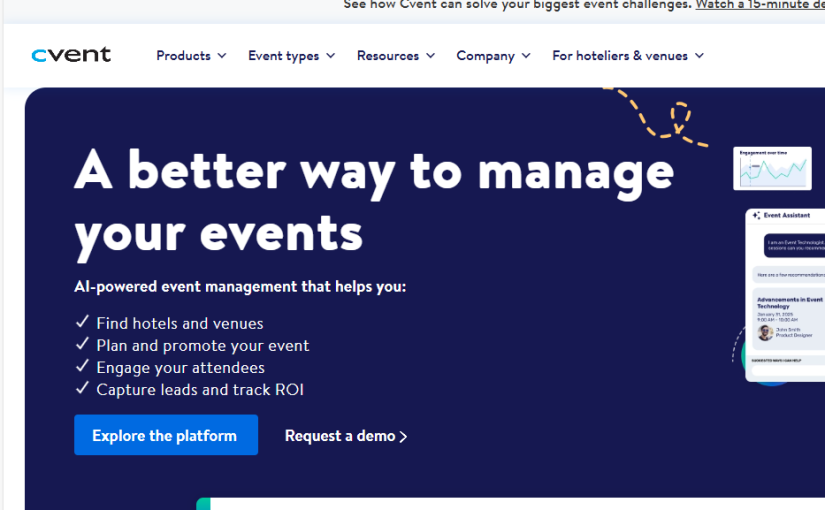
Cvent Express offers main event features but for less money than Cvent’s main platform. You can use it for registration, check-in, and basic reports.
The platform works well if you want trusted enterprise software but do not have the budget for all the miscellaneous costs in bigger plans. Smaller companies or those running many different events around the year may benefit from this approach.
Pricing: Cvent does not publicize its pricing upfront. The organization offers a quote only upon request from event organizers.
7. Hopin (RingCentral Events): Virtual Event Support
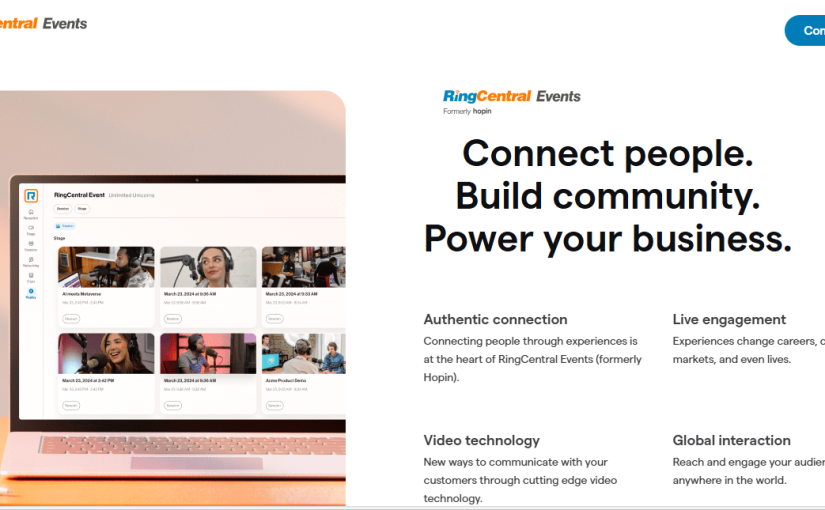
Hopin, now known as RingCentral, is designed mainly for online and hybrid events. You can create virtual stages, meeting areas, and exhibitor booths. The interface lets folks join sessions and talk to each other.
Pricing: They have a free plan with limits and paid plans starting at around $99 to $299 a month, which is charged annually. Larger plans let you have unlimited attendees. If you need a platform just for virtual events, Hopin does the job well.
8. Splash: Focus on Event Design and Marketing
Splash helps you build attractive event web pages and send email campaigns. It does not have many sophisticated event management features, but it makes your event look professional online.
This platform works well for events prioritizing marketing, as well as smaller events where the overall look and feel is a top priority.
Pricing: Splash offers plans in two denominations, pro and enterprise. The pricing for each of these plans is at the discretion of the company and is quoted upon request.
9. Accelevents: All-rounder for Hybrid and Virtual Events
Accelevents offers virtual, hybrid and in-person event management for all types of events. One of their standout features is an app that lets you send push alerts about sessions.
Other notable features include ticketing, networking tools, live streaming and sponsor/exhibitor management.
Pricing: The pricing starts at about $7,000 for large-scale business and enterprise events. Additionally, Accelevents also offers pay-as-you-go and monthly enterprise plans for smaller events.
10. Eventtia: Flexible for Different Needs

Eventtia offers a wide range of features. It works for conferences, corporate events, and associations. You can create custom websites and run virtual sessions.
Eventtia incorporates artificial intelligence to match its attendees to events on the basis of their interests. This system is a chance worth taking if your event is generic in genre or if you run many different types of events.
Pricing: Pricing is by quote and often starts near $1,500 per event. Larger packages come with more tools and app access, and the cost can climb up to $3500 billed annually.
What to Look for in a Cost-Effective Event Management Platform
Before you start placing dashboards and feature lists against each other and lose your mind because the choices are too many, stop. Pause. The first thing you will benefit from clarifying is knowing what it is that you are actually comparing. The cheapest platform on paper is not always the cheapest platform in practice. An inadequate software tool, in spite of a pricing point that looks like a steal, will only cost you more in ramifications. You’ll be spending to clear up the mistakes made by the software, to hire additional services in places where it underperforms. Therefore, it is important to also go over your key requirements when choosing a cost-effective platform. Here are some things you should be carefully looking at when choosing a separate cost-effective event management tool.
- Pricing model and transparency: Platforms price their services in a few different ways. These often include:
- Flat per-ticket fees
- Charges based on a set percentage of ticket value
- Per-attendee charges and
- Annual subscriptions
Beyond the pricing structure, that you should be a flat fee model or a more annual one, what matters on an equal footing is transparency. Platforms that publish their pricing and offer a free, flexible demonstration such as that of Dryfta will save you time and effort pumped into figuring both. If you find yourself looking at the words ‘quote only,’ this means extra effort on your part. More often than not, tools that offer prices on a strictly quote-only basis tend to gravitate towards higher price points.
- Total cost of ownership (TCO): The sticker price is just the beginning. Add Stripe’s standard 2.9% + $0.30 per transaction, tack on costs for branded mobile apps, badge printing, advanced analytics, and API access, and then factor in whether you’re paying per event or annually. The platform with the lowest advertised price often has the highest total cost once all the add-ons stack up. Run the full math, not just the headline number.
- Free events: Ask yourself if these are truly free. This one catches people off guard. Some platforms charge a per-registrant fee even for $0-ticket events. For nonprofits, universities, community organizers, and academic associations running frequent free sessions, this hidden charge compounds fast. Always verify whether free events actually cost nothing.
- Feature-to-price ratio: An all-in-one platform covering registration, abstract management, scheduling, a mobile app, networking, and analytics in a single system is almost always cheaper than stitching together a dozen separate tools. Even if the all-in-one’s annual price looks higher than any single tool on its own. The math of integration costs and time spent context-switching rarely works in favor of the patchwork approach.
- Scalability: Does the pricing grow with you in a way you can predict? Percentage-based models get punished at scale. Flat fees and subscription models, by contrast, become increasingly cost-efficient as event size grows. Know which direction your events tend to trend before committing to a pricing structure.
- Bring your own payment gateway: A lot of organizers often overlook this simple fact, that not every platform lets you connect your own Stripe or PayPal account. The ones that do can cut your processing costs substantially. Rounding a rough figure, one may cut costs by 14%. It’s a detail that is buried in the compressed terms and conditions contracts you sign without fully realizing.
- Integration costs: CRM connections (HubSpot, Salesforce), email marketing links (Mailchimp) and Zapier access are sometimes included in the base plan. Sometimes they’re premium add-ons, which means that you will have to pay extra. Make it a point to confirm this before signing and committing to a platform. Finding out that you have to pay a few hundred extra dollars after purchasing is hardly a pleasant experience.
- Customer support model: When signing up, always ascertain the degree and frequency of customer support you and your team will be receiving from the organization. Do not overlook learning curves. Many organizers realize well into the event that they have absolutely no idea how to operate a specific feature.
- G2 / Capterra ratings: Verified user reviews are the most honest proxy for product quality and support responsiveness you’ll find. Vendor-provided case studies as well as peer reviews can also offer some invaluable insights into pros and cons that show up as the software goes into action. There is certainly nothing as reliable as reviews from real customers who have used the software previously.
- Data ownership and security: GDPR compliance, data residency and who actually owns your attendee data after the event ends are often embedded in the fine print organizers don’t always read fully. However, in 2026, with evolving privacy compliance and data-based concerns, it is crucial to do so. If you are based in America or the EU, pay particular attention to these factors.
Quick Comparison- 10 Platforms at a Glance
In this section, we’ll have a brief overview of the 10 cost-effective platform evaluated in the previous section. The below table will offer event organizers a side-by-side comparison of what are the most economical platforms in the market at present. Dryfta tops this list.
Picking the Right Event Management Platform
All of the above event management platforms offer several pricing models for their potential clients. Some charge monthly or yearly fees, whereas others charge per attendee. Sometimes you pay a fee per ticket sold.
Look at the features you need. Check your budget. Also, think about how easy the platform is to use. Some platforms need tech skills or a team to operate.
-
- If your events are small and rare, platforms with low startup costs like Eventbrite or Eventzilla might work best.
- For academic or research events, Dryfta’s abstract management saves time.
- If you want to improve networking, Whova and Accelevents offer good apps.
- For virtual events, Hopin is built just for online and hybrid formats.
- Bizzabo and Cvent are better if you want powerful features and can pay more.
- Splash is great if you want eye-catching event pages and strong marketing tools.
Making Event Management Cost-Effective
All of the above-mentioned 10 platforms offer good value depending on what you want from your event management system. Choose one that fits your budget and event goals.
Cost is only one factor in a larger pool. Ease of use and features also matter considerably. Therefore, be on the lookout for a platform that best suits your event size, type and technical capabilities.
Don’t settle for less and do not choose too soon. Scrutinize, compare, contrast and then commit. Ask for a free demo of our sophisticated services and solutions.
Frequently Asked Questions (FAQs)
What is the most cost-effective event management platform for academic conferences?
Dryfta withstands as the most cost-effective platform for academic conferences in 2026. It starts at a reasonable pricing of $1,499 per year for up to 100 attendees and includes specialized features built specially for your end-to-end abstract management needs. With a cost-effective platform like Dryfta, you’ll be saving time and increasing your efficiency in hosting events.
What is the difference between per-ticket pricing and subscription pricing?
The per-ticket pricing calculates charges based on the fees per attendee or ticket sold. Subscription pricing, on the other hand, concern themselves with more fixed annual fees. The former is preffered for organziers running events that are a one-time affair. The lawyer is best suited for repeat organizers who look at the unlimited event format.
Which event management platform has the best G2 rating?
G2 currently ranks Cvent as the best event management platform. However, within the context of cost-effectiveness, Cvent is among the priciest enterprise-size platforms in the market. Prices start from $15,000 and can go up to a whooping $79,000. These figures make it a largely unsustainable choice of an event management software for SMEs.
Is there a free event management platform?
Yes, there are a handful of platforms offering free services with significant user caps. Zoho Backstage, Eventbrite, and Airmeet all offer free tiers for their users. Zoho Backstage is capped at 25 attendees, Eventbrite allows unlimited free registrations but charges per-ticket fees and Airmeet supports 100 virtual-only attendees for free.
What event management platforms offer transparent pricing without requiring a demo?
Dryfta displays its starting pricing ($1,499/year) publicly without demanding that interested users submit a quote. The demo, which goes live every week, is virtual and free to access for anyone from anywhere in the world. This was made with the needs of cost-effective event planners in mind, we understand and acknowledge that committing to a software is a large deal.
What should I look for beyond price when choosing an event management platform?
Beyond the monetary numbers, it helps to look at the platform’s past associations and events that their software has helped host. It is also recommended to check authentic user reviews to assess average customer satisfaction and alert you of any grievances that do show up. Additionally, also be aware of hidden charges quietly adding up to the final total. Opt for transparent platforms like Dryfta that make your purchase summary clear from start to finish, no compromises.