


The time period between putting out a call for papers to published proceedings can be a few months. But look closer and you’ll see weeks where event planners are burnt out and running on fumes, trying to have it all under control. Managing an academic conference workflow with an entirely manual workforce is like having a lot on your plate and not quite knowing how to empty it. Well, for everyone in academic event management, we have some incredible news. You don’t really have to do it all on your own. Automated software tools and technologies now exist that make end-to-end academic conference management possible.
So ditch the worries. In this blog, we’re demystifying everything about the conference paper publication process. If you read until the very end, we have bonus software perks you can use to simplify the academic conference workflow.
Why the Call For Papers to Published Proceedings Journey Is Longer and More Fragile Than It Looks
A conference paper’s journey from call for papers to proceedings publications runs through 9 different stages. Each of these stages, however, don’t exist in a vaccum. They are in continuity and are deeply connected to one another. For instance, writing a good call for papers (CFP) is important initial step that kickstarts the academic conference workflow. A CFP that is vague and missing important details is unlikely to attract quality submissions. Similarly, a submission system that breaks down when authors attempt to submit is futile.
Therefore, it is important to get the entire academic conference workflow right. A mistake you make in stage 1 can reveberate much later in stage 7. This piques the need for an academic conference workflow that is end-to-end.
That bring said, this kind of disconnected between stages is simply a hypothetical risk. It happens all the time with a manual workflow. Or when working with a dozen individual tools. A personal cost-saving startegy for many event planners despite the evident toll that it takes. Event planners pay hidden costs when working with several individual tools rather than sign up for an end-to-end event management platform like Dryfta.
Here is what’s current in academic conference workflows, from call for papers to published proceedings, in 2026:
- Actual 2026 conference call for papers documents from IJCAI-ECAI, WSDM, SIGCOMM, EACL, and ACM CCS build in explicit rules and named decision categories specifically because these handoff points are known failure modes.
- Page limits are stated to the page and things like reviewer counts are stated as minimums. With the help of automation, registration is also written into the publication condition.
The obvious difference between an arrangement like this, end-to-end and strategic as opposed to manually handling everything from call for papers to published proceedings is the precision. It is the clarity with which all data and metadata related to the academic conference workflow is segmented. Data flows like a pipeline rather than be segmented into information silos.
In the rest of this article, we’re:
- Mapping the full academic conference workflow as it actually runs at academic and scientific conferences in 2026, stage by stage.
- Using the language and structure that match current industry standards.
- Pinpointing exactly where these workflows are likely to break down and give in.
- And finally, what the magic of a single, connected and end-to-end academic conference workflow management system can do for your next event.
The Full Workflow: 9 Stages from Call for Papers to Indexed Proceedings
The 9 stages we’ve covered in this article are arranged in a chronological, linear fashion for operational clarity. One may use this as a checklist, to tick tasks off as they are finished. And to keep track of tasks that aren’t. Let’s get right into the 9 stages and we’ll have the call for papers process explained for you from start to finish.
Stage 1: Defining and Issuing the Call for Papers
What Happens: The programme committee defines submission tracks, paper types, page limits, formatting requirements, anonymization rules, ethics policy, and key dates, then publishes the CFP to the research community.
What Real CFPs Get Specific About: Page limits differ meaningfully by paper type and by track. EACL 2026 allows 8 pages for long papers and 4 for short papers, plus unlimited pages for references, while its industry track caps submissions at 6 pages excluding references and limitations. IJCAI-ECAI 2026’s special tracks cap papers at 9 pages total, split into 7 pages of body content and 2 pages of references. These are not rough guides. Submissions that violate paper size, margin, or font requirements are frequently rejected without review, before a single reviewer sees the content.
The Handoff Risk: A CFP that is vague about format, deadlines, or review type generates a submission pool with inconsistent quality and compliance, which pushes cleanup work onto the compliance screening and reviewer assignment stages that follow.
How to Reduce the Risk: Publish the CFP with the same precision as the examples above. State explicit page limits per submission type, explicit anonymization requirements, and explicit consequences for non-compliance upfront, not at review time.
Stage 2: Configuring the Submission System
What Happens: Before submissions open, the programme committee configures the technical infrastructure that will receive them: abstract submission forms matched to each track and paper type, required fields, file format validation, anonymization checks, and the reviewer pool and conflict-of-interest declarations that reviewing will depend on.
The Handoff Risk: Configuration completed reactively, days before the deadline or worse after submissions have already started arriving, forces the committee to retrofit rules onto papers that were submitted under a different, earlier understanding of the requirements.
How to Reduce the Risk: Complete submission system configuration at minimum 2 to 3 weeks before the CFP is issued, so the published requirements and the system that enforces them are already aligned on day one.
Stage 3: Submission and Compliance Screening
What Happens: Authors submit within the window, and the system or a coordinator performs an initial compliance check against page limits, formatting rules, required fields, and anonymization before a paper is passed along for review.
What Real CFPs Get Specific About: Multiple 2026 conferences build compliance screening directly into the CFP’s stated policy. IJCAI-ECAI 2026 explicitly defines what counts as a ‘formal publication‘ for the purposes of its dual-submission policy, treating any prior work with a DOI, ISBN, or ISSN as disqualifying. IJCAI also states plainly that full anonymization applies to both the letter and the spirit of the rule, including PDF metadata, and that violations are rejected without review.
The Handoff Risk: Compliance screening done manually, after reviewers have already been assigned, wastes reviewer time on submissions that should have been desk-rejected before assignment ever happened.
How to Reduce the Risk: Automate compliance screening for page count, required fields, and basic anonymization checks so non-compliant submissions are flagged before reviewer workload is committed to them.
Stage 4: Reviewer Assignment
What Happens: Submissions are matched to reviewers based on topic expertise, with conflict-of-interest checks applied before assignment is finalised.
What Real CFPs Get Specific About: WSDM 2026 assigns a minimum of 3 PC members plus a senior PC member per manuscript, a specific, stated review depth, and requires authors and reviewers to declare conflicts across a defined list of associations, including shared employment in the last 12 months and co-authorship within the last 24 months.
The Handoff Risk: Manual reviewer assignment at scale, across hundreds or thousands of submissions, is slow, prone to workload imbalance, and prone to missing conflicts of interest that a spreadsheet or an overworked chair simply cannot catch consistently.
How to Reduce the Risk: Use automated, expertise-based reviewer matching with enforced workload caps and systematic conflict-of-interest checks and scheduling, rather than relying on manual cross-referencing at volume.
Stage 5: Peer Review
What Happens: Reviewers evaluate assigned submissions against defined criteria, provide scores and written feedback, within a set deadline.
What Real CFPs Get Specific About: SIGCOMM ’26 has a formal one-shot revision category, offered to a small number of submissions that show promise but are not yet ready for acceptance. It comes with a summary of the paper’s merits and a specific list of required changes, and authors are given approximately one month to resubmit a revised manuscript addressing referee comments. A revised paper can only receive accept or reject on the second pass, which is what makes the process ‘one-shot.’
The Handoff Risk: Review outcomes communicated as a bare accept or reject, with no structure for revision requests, lose the value of borderline papers that could have been strengthened into acceptable ones.
How to Reduce the Risk: Build revision and resubmission into a formal decision category with a clear timeline and specific required changes. It also helps to work with platforms that have automation built into peer review workflows.
Stage 6: Decision and Notification
What Happens: Based on aggregated reviewer scores, the programme committee makes final accept, reject, or revision decisions and notifies all authors.
The Handoff Risk: Bulk notification of hundreds or thousands of authors, each requiring a personalised decision, reviewer feedback, and specific next steps, cannot realistically be done manually without delays or copy-paste errors that misroute feedback between papers.
How to Reduce the Risk: Use bulk decision tools with personalised, templated notifications that still include paper-specific reviewer feedback, so scale does not come at the cost of accuracy.
Stage 7: Registration as a Condition of Publication
What Happens: Accepted authors must register for the conference, and in most current CFPs, registration and in-person presentation are treated as a condition of the paper actually appearing in the published proceedings, not a separate administrative step.
What Real CFPs Get Specific About: WSDM 2026 states explicitly that at least one author of each accepted paper must register for the conference. IJCAI-ECAI 2026 goes further, stating that papers not presented in person will be excluded from the proceedings entirely, unless the authors formally notify the organisers of exceptional circumstances and receive prior approval.
The Handoff Risk: This is precisely the handoff risk covered in depth in our guide on separate abstract and registration tools: without visibility between the acceptance decision and the registration system, a programme committee has no reliable way to know which accepted authors have actually registered until very close to the conference, when there is little time left to chase down the gap.
How to Reduce the Risk: Use a system where acceptance status and registration status share the same attendee record, so ‘accepted but unregistered‘ is visible as a real-time status rather than something discovered during final proceedings preparation.
Stage 8: Camera-Ready Submission and Programme Assignment
What Happens: Accepted authors submit a final, camera-ready version of their paper, incorporating reviewer feedback, and the paper is assigned a session and time slot in the conference programme.
What Real CFPs Get Specific About: EACL 2026 grants long papers one additional page, from 8 to 9, and short papers one additional page, from 4 to 5, specifically so that reviewers’ comments can be taken into account in the camera-ready version. That extra page is a deliberate acknowledgment that the camera-ready stage is not just formatting cleanup, it is where a paper actually gets finished.
The Handoff Risk: Manual transfer of accepted paper metadata into the scheduling system, author names, co-authors, presentation type, abstract text, introduces delay and transcription errors at exactly the stage where the programme is meant to be locking in.
How to Reduce the Risk: Use abstract-to-schedule conversion so accepted paper metadata flows directly into the programme without manual re-entry.
Stage 9: Publication, DOI Assignment, and Indexing
What Happens: After the conference, or per some venues’ rules on the first day of the conference, the final proceedings are compiled and published, papers receive DOIs, and the collection is submitted for indexing.
What Real CFPs Get Specific About: SIGCOMM ’26 defines the ‘official publication date‘ with legal precision, as the earlier of the first day of the conference or the day the proceedings are made available in the ACM Digital Library or posted online, a date that can fall up to two weeks before the conference itself and can affect patent filing deadlines tied to the published work.
The Handoff Risk: Compiling accepted papers into publication-ready proceedings manually is slow and introduces errors when done from scratch rather than building on structured data carried through from earlier stages.
How to Reduce the Risk: Choose the proceedings publication route before the CFP is even issued, and ensure the metadata collected at submission, author names, affiliations, abstract text, keywords, is structured from the start for DOI registration and indexing rather than reconstructed after the fact.
Where This Workflow Most Commonly Breaks Down
5 things in the academic conference workflow account for the large majority of avoidable delays and errors. Each one is a handoff between stages rather than a failure within a single stage, which is why fixing them usually requires connecting systems rather than working harder within any one of them.
- CFP vagueness leads to inconsistent submissions: A CFP without precise page limits, anonymization rules, and format requirements produces a submission pool of mixed quality and compliance, pushing avoidable cleanup work onto every stage that follows.
- Reviewer assignment produces workload and conflict errors at scale: Manual assignment above a few hundred submissions reliably produces workload imbalance and missed conflicts of interest, since no chair can track hundreds of expertise matches and disclosure rules by hand.
- The acceptance decision does not connect to registration confirmation: This is the single most commonly cited operational gap, since acceptance and registration usually live in separate systems with no shared record to flag the difference between the two.
- Accepted abstracts do not flow into programme assignment: Manual data transfer from the review system into the scheduling tool is consistently the most time-consuming and error-prone step in building the final conference programme.
- The transition from conference end to proceedings production creates rework: Metadata that was not structured for DOI registration and indexing during the submission phase has to be manually reconstructed after the conference, slowing down publication.
How Dryfta Supports the Full Call-for-Papers-to-Proceedings Workflow
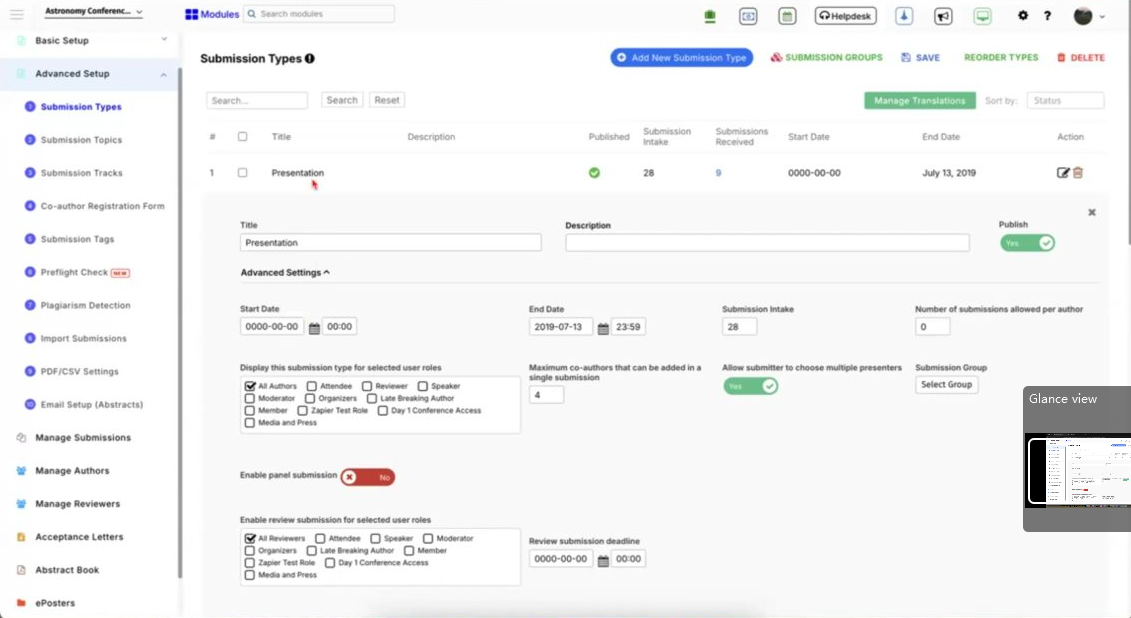
Dryfta was built around the idea that abstract management, peer review, registration, and proceedings publishing should share one attendee and submission record as opposed to inhabiting separate tools. The core purpose of Dryfta’s abstract management system design to to ensure very limited and almost nil manual reconciliation, except for when an event planner desires. Here’s how Dryfta makes the call for papers to published proceedings ordeal much more simpler than it should be, powered by automation and data technologies. Let’s make the big tech stuff, AI, big data and everything in between, work in the favor of your academic conference workflow.
- Stages 1 to 2, CFP and submission system configuration: Dryfta’s customisable submission forms let programme committees define page limits, required fields, anonymization settings, and track and topic categorisation before the CFP goes live, so the published rules and the system enforcing them match from day one.
- Stage 3, submission and compliance screening: Automated field validation and blind-review anonymization are applied at the point of submission, flagging non-compliant submissions before they ever reach a reviewer’s queue.
- Stage 4, reviewer assignment: AI-assisted reviewer matching assigns submissions based on topic expertise, with configurable workload caps and automated conflict-of-interest detection built into the assignment process rather than layered on afterward.
- Stage 5, peer review: Reviewers work from a self-service dashboard with configurable scoring criteria, supporting the same accept, minor revision, major revision, and reject decision structure used at conferences like SIGCOMM and DATE.
- Stage 6, decision and notification: Bulk accept, reject, and revision decisions trigger personalised, templated author notifications automatically, keeping paper-specific reviewer feedback intact at scale.
- Stage 7, registration as a condition of publication: Because abstract management and registration share the same attendee record in Dryfta, “accepted but not yet registered” is a real-time filter, not a manual cross-check performed under deadline pressure.
- Stage 8, camera-ready submission and programme assignment: Accepted abstract metadata, author names, co-authors, presentation type, and abstract text, converts directly into agenda-ready sessions through Dryfta’s abstract-to-schedule conversion.
- Stage 9, publication, DOI assignment, and indexing: Dryfta’s abstract book publishing feature compiles accepted papers into a proceedings-ready format using the same structured metadata collected at submission, rather than data reconstructed after the fact.
- Across every stage: a single attendee and submission record persists from first submission through final published proceedings, which is what closes the handoff gaps described above.
Frequently Asked Questions (FAQs)
What are the main stages from call for papers to published proceedings?
The call for papers to published proceedings workflow runs through 9 stages: defining and issuing the call for papers, configuring the submission system, submission and compliance screening, reviewer assignment, peer review, decision and notification, registration as a condition of publication, camera-ready submission and programme assignment, and finally publication with DOI assignment and indexing.
Is conference registration required for a paper to be published in the proceedings?
At most major academic conferences, yes. WSDM 2026 requires at least one author of each accepted paper to register for the conference, and IJCAI-ECAI 2026 states that papers not presented in person are excluded from the proceedings entirely, unless the authors notify organisers of exceptional circumstances and receive prior approval. Registration and in-person presentation have now become explicit publication conditions for a lot of contemporary conferences.
What is a one-shot revision in conference peer review?
A one-shot revision is a review outcome, distinct from a straightforward accept or reject, offered to a small number of submissions that show clear promise but need specific changes before acceptance. SIGCOMM ’26 defines it as a decision that includes a summary of the paper’s merits and a specific list of required changes, with authors given roughly a month to resubmit. On the second pass, the paper can only be accepted or rejected, which is what makes the revision one-shot rather than open-ended.
What is the official publication date of a conference paper and why does it matter?
The official publication date is the specific date on which a paper is considered formally published, which matters for patent filing deadlines and for establishing precedence over related work. SIGCOMM ’26 defines it as the earlier of the first day of the conference or the day the proceedings are made available in the ACM Digital Library or posted online, a date that can fall up to two weeks before the conference itself. Conferences that state this date with precision are giving authors a legally meaningful reference point, not just a publishing timeline.