




You have the venue locked in. The speakers are confirmed. The agenda looks great on paper. But here is the catch: none of that matters if the logistics behind the event fall apart. Buses arrive late, badge printing fails at the door, catering shows up to the wrong room and suddenly a meticulously planned event becomes a crisis management exercise.
Event logistics is the operational backbone that holds every other element of an event together. Get it right and attendees experience a seamless, professional event. Get it wrong and no amount of great content or impressive speakers can save the day.
This guide covers everything a modern event planner needs to know about event logistics, from foundational definitions to advanced management strategies, complete with a sample planning timeline you can use immediately.
What Is Event Logistics?
According to Grand View Research, from 2024 to 2030, the global event logistics market is expected to expand at a compound annual growth rate (CAGR) of 6.3%, from its estimated USD 68.63 billion in 2023. That is just how big the industry is. Now let’s get into what it actually entails.
What is event logistics? Event logistics includes all things that go on backstage and in preparation for an event or conference. In simple terms, event logistics can be referred to as the process of planning and coordinating that event managers and other professionals engage in. This can include functions like:
-
- Venue scouting and setup
- Transportation
- Catering
- Staffing
- Technology infrastructure, among other things.
The event concept lives in a brief and an agenda. Event logistics is everything that turns that concept into an experience that hundreds or thousands of real people can actually participate in. Event logistics, roughly, can be mapped across 3 stages:
1. Pre-event logistics: All planning, procurement and coordination that happens before the event day
2. On-site logistics: Operational management on the event day itself
3. Post-event logistics: Breakdown, return of equipment, vendor payments and other reporting
Event Planning Logistics- The Timeline
Here is the thing about event planning logistics that most guides skip over. It is to do with the quality of your logistics plan. This quality is determined almost entirely in the first few weeks of your planning process. And not in the final days before the event, no. This is a great and common misconception.
Working incredibly hard in the last few days leading up to the day of your event does not guarantee spotless logistics on event day. It has more to do with whatever you structured in the time until that point, which is truly reflective on event day.
Step 1: Get Clean On the Scope of Your Operations
Start your event logistics process with a clear operational brief that can answer questions like:
If you are able to smoothly go over these details, that’s a sign you’re planning in the right direction. However, if you encounter any roadblocks, pay attention to them. Any and all friction points that come up in the attendee journey is a logistics problem waiting to blow your venue over on event day.
Step 3: Build Your Vendor and Supplier List
For each supplier, document:
-
- Their confirmed scope of work
- Set up and arrival times
- Primary contact name and mobile number
- Backup contact in case the primary is unreachable
- Cancellation and contingency terms in the contract
But wait, there is more to vendor management than just signing contracts.
The planners who run the smoothest events are those who build genuine working relationships with their key suppliers over multiple events. A venue technician who knows you and trusts you will go significantly further above their contracted scope when something goes wrong on event day.
Event Logistics Management- The Core Disciplines
Effective event logistics management requires competency across six operational disciplines. Here is how each one works in practice.
Venue and Space Management
Venue logistics covers everything related to the physical space. This includes room layout configurations, signage placement, furniture setup, stage construction, lighting rigs and the flow of foot traffic between spaces.
Technology and Audio-Visual Logistics
Technology failures are among the most visible logistics problems at any event. A microphone that cuts out during a keynote, a presentation that will not display on the main screen or a live stream that drops mid-session all create immediate attendee frustration.
Effective event logistics management for technology requires:
-
- A full technical rehearsal at least 24 hours before the event
- Backup equipment for every critical technology element
- A dedicated technical support person on site throughout the event
- A clear escalation process when equipment issues arise
Catering and Food Service Logistics:
Catering logistics is deceptively complex. It involves coordinating delivery times, setup locations, dietary requirement management, service timing relative to the program schedule and post-service cleanup that does not disrupt ongoing sessions.
Transportation and Attendee Movement
For multi-venue events, events with shuttle services or conferences where attendees are traveling from out of town, transportation logistics requires dedicated attention. Map out all transportation routes, confirm vehicle availability and capacity and have a real-time communication plan for delays or changes on the day.
Health, Safety and Compliance
No event logistics plan is complete without a health and safety framework. This includes emergency evacuation procedures, first aid coverage, crowd management protocols and compliance with any venue or local authority requirements for events of your size.
Event Logistics Best Practices
Here are some event logistics best practices that professionals often tend to overlook but thank themselves later for.
Appoint a point of contact for each function: If you are an event manager or executive head of a planning team, do not resort to the grave mistake of taking it all upon yourself. What this leads to is confusion and overwhelm. Rather, it is advisable to institute one more point of contact for every logistics function.
This will come in handy when you want a last-minute update on a logistic and do not have any time to spare browsing through spreadsheets and receipts.
Prepare for the worst: In event logistics, one of the best practices is to prepare for the worst. Yes, you read that right. Although it may sound contradictory, when you have a backup plan for every pitfall that comes to mind, you are well-prepared to handle one on event day as well. This can look like having alternative vendors and even some extra budget allocated for miscellaneous costs that come up on event day.
Use an event management software: If you are in charge of hosting a large-scale event of 500 participants or more, resorting to manual methods is simply a path to disaster on event day. You and your team will find yourself overwhelmed for months during planning and walking on eggshells on D-Day. In order to make your event logistics much less overwhelming and a lot more organized, working with an event management software is ideal.
Since we discussed the best practices, you know what comes next.
That’s right. The mistakes!
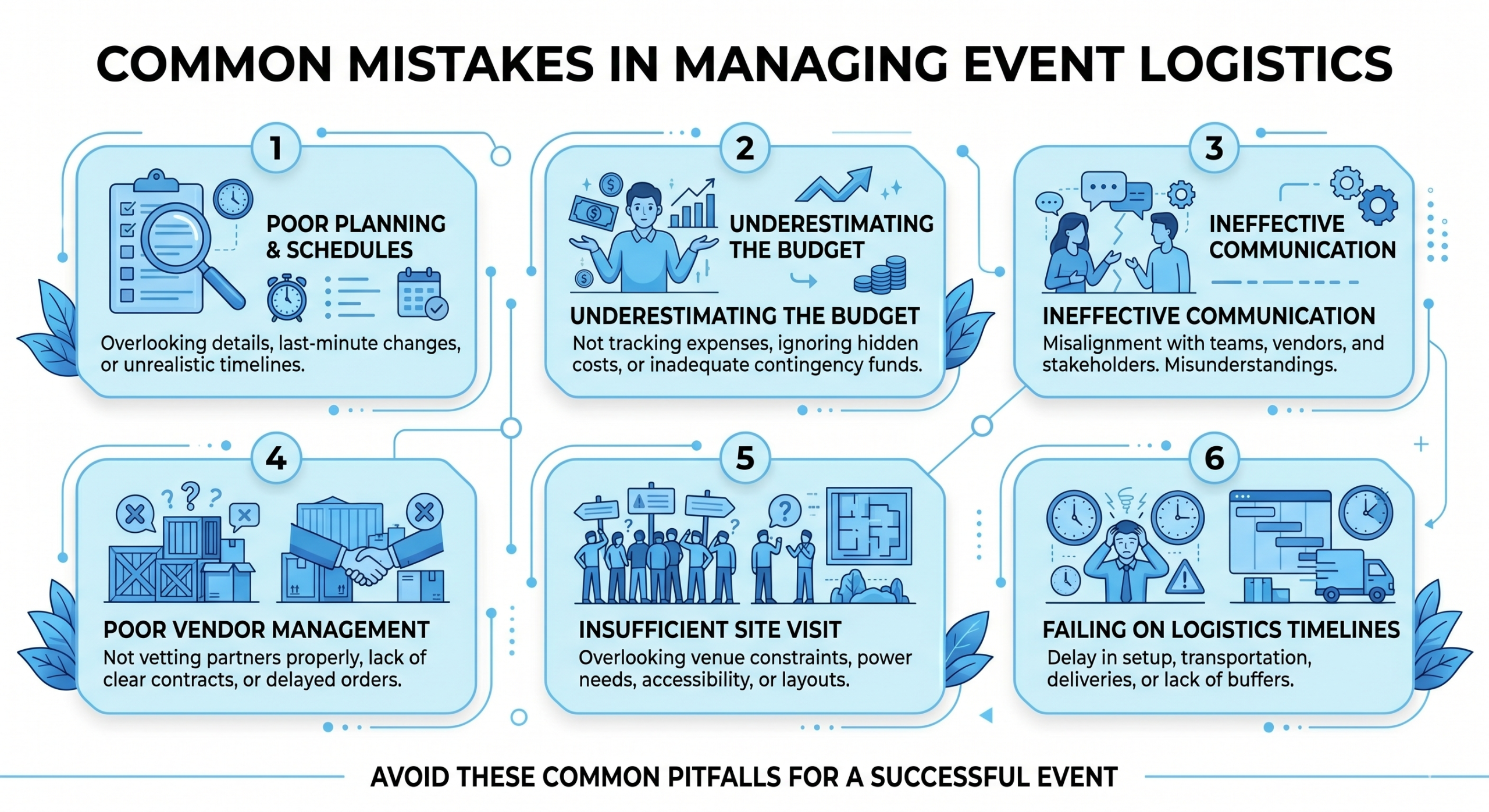
Common Mistakes in Managing Event Logistics
Here’s an infographic that highlights some of the common mistakes that event planners tend to make while managing the event logistics. Avoiding these mistakes ultimately ensures the success of your event.
Make Your Events Run Flawlessly This Year
Event logistics may perhaps be the part about event management that you least enjoy doing. Well, buckle up, because we’re about to help you change that.
With the right assistance, you’ll start to enjoy the very logistical tasks you have been dreading all this time. When logistics do not overwhelm you but rather offer more structure to your event’s purpose, event day is much more enjoyable for everyone involved. Poor logistics that are barely held together will cut through on event day. Even the most miniscule slip ups that turn your event day a slipshod affair.
But thanks to the massive growth that the event management industry has achieved, we now have capable software that handles much of event logistics in one place. All you have to do really is sign up to an all-in-one event management platform and sit back and be able to focus your energy on other aspects of the event logistics.
With Dryfta’s event management software, we are giving event planners a 360-degree operational platform that’s been tried and tested to meet the demands of events with the most rigorous event logistics. Dryfta can give your team the operational clarity and the control you need to execute event logistics minus the chaos. Visit our website today to explore the platform for yourself. Sign up for a free demo today.
Frequently Asked Questions (FAQs)
What is event logistics and why does it matter?
Event logistics refers to all planning and execution of operational elements in an event or conference. It is distinguished from other functions by its absolute necessity in running a successful event. Event logistics are a function that simply cannot be ignored or compromised. It is tied to almost every other part of the event itself and therefore matter immensely.
What does event planning logistics involve at a practical level?
Event planning logistics involves building a detailed operational plan that covers every supplier, every timeline, every risk and every contingency before D-Day. It includes things like your floor plan development, run-of-show documentation, supplier briefing, staff coordination as well as all-out management on the day of the event itself.
How is corporate event logistics different from other event types?
Corporate event logistics operate with some added pressures when it comes to things like brand consistency, VIP management, data security and multi-site execution. Corporate events are brand experiences as much as operational exercises. This means that every logistical element must meet both functional and experiential standards to stay true to the greater identity of the brand.
What are the most common event logistics management failures?
The most common failures in event logistics management are poor supplier communication, inadequate contingency planning, technology failures caused by insufficient testing and catering timing that disrupts the program schedule. Most of these failures are preventable with thorough pre-event planning and clear documentation shared with every party involved.
What tools help with event logistics management?
Purpose-built event management platforms are the most effective tools for event logistics management. They centralize registration, check-in, session management, supplier communication and post-event reporting in a single system. This reduces the risk of information inconsistency and gives the entire planning team a shared, real-time view of event status.
How far in advance should event logistics planning begin?
For events of 200 or more attendees, event logistics planning should begin at least 10 to 12 weeks before the event date. Larger events with complex multi-venue or multi-city requirements may need a planning window of six months or more. Starting logistics planning too late is one of the most consistent predictors of event day problems.