

AI-assisted abstract review uses software to support defined parts of a conference review process, such as submission checks, topic classification, reviewer assignment and advisory analysis. It should not replace expert assessment of scientific merit or a programme committee’s final decision.
That distinction matters when a university, scholarly society or research conference receives hundreds or thousands of submissions. The administrative burden is real, but so are the consequences of a poor reviewer match, an exposed identity, a missed conflict of interest or an unexplained rejection.
The useful question is not, “Can AI review abstracts?” It is, “Which tasks can it support, who checks the output and what evidence will the committee keep?”
Start with the decision AI is allowed to influence
Do not activate an AI feature and decide its role afterwards. Write the use case first.
For each proposed task, record:
- the problem the tool is meant to solve;
- the data it will receive;
- the output it will produce;
- the person responsible for checking that output;
- the action that may follow;
- the cases that must be escalated;
- how the committee will assess whether the tool helped.
This exercise separates ordinary workflow automation from AI-assisted judgement. Sending a deadline reminder because a review is late is a fixed rule. Suggesting which reviewer has the closest expertise is a recommendation. Producing an advisory evaluation of scientific content is a higher-risk use because it can influence how people interpret a submission.
The NIST AI Risk Management Framework recommends defining an AI system’s intended scope, limits, human oversight and measurement before relying on it. That is a sensible starting point for a conference too.
Use stronger controls as the risk rises
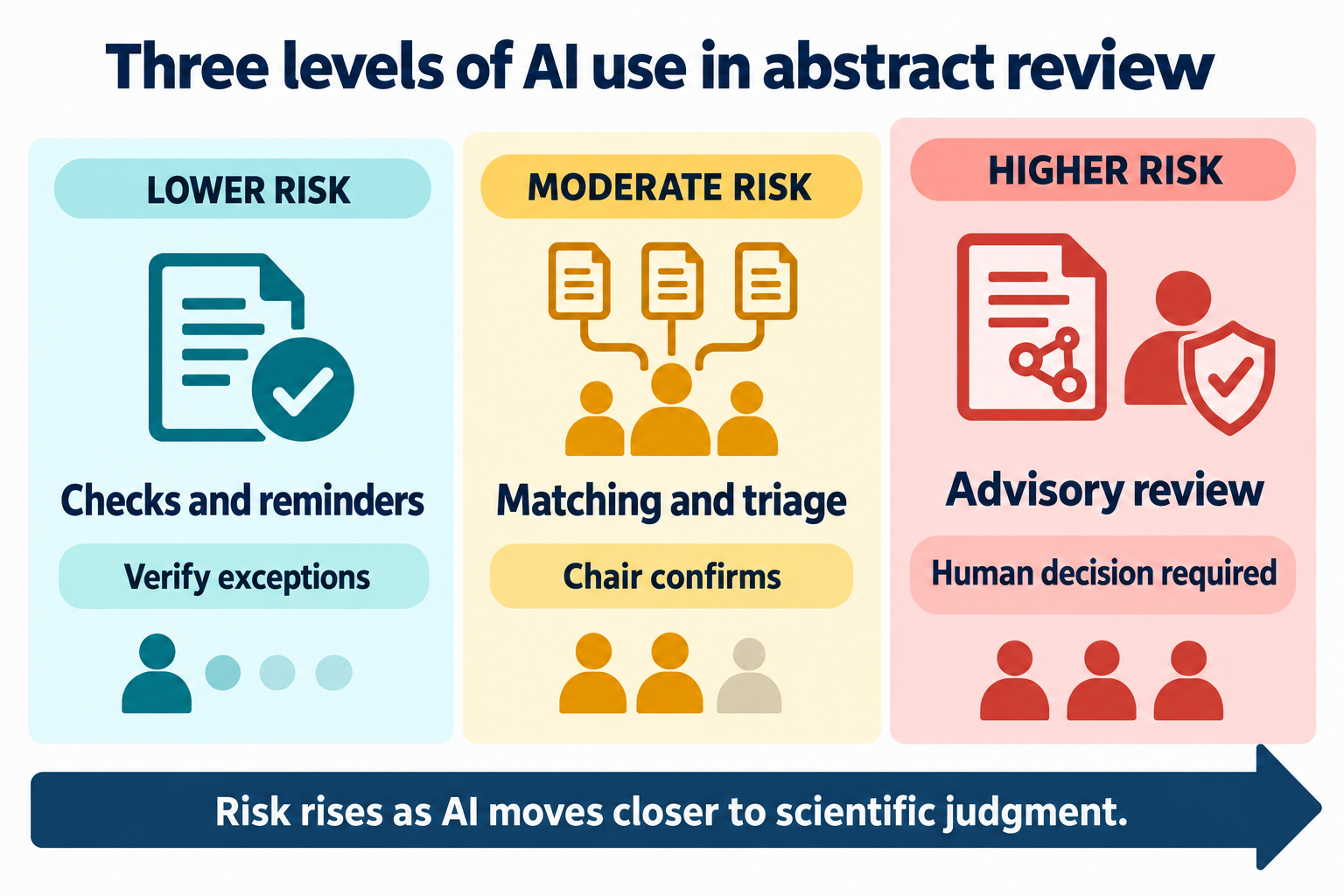
Not every use of AI deserves the same level of scrutiny. A three-level model helps a committee focus its attention where an error would matter most.
| Risk level | Suitable examples | Minimum human control |
|---|---|---|
| Lower | Check required fields, identify a missing file, suggest a topic label or draft a reminder | An administrator reviews exceptions and corrects false flags. |
| Moderate | Suggest reviewer matches, flag possible duplicates or summarise a submission for triage | A track chair checks the source abstract, expertise match and conflict information before acting. |
| Higher | Produce an advisory quality review, score against a rubric or recommend a decision | Keep the output separate from official human scores. Require qualified human review and a recorded committee decision. |
Some conferences may prohibit moderate or higher-risk uses entirely. That is a valid policy choice. The right boundary depends on the event’s confidentiality promises, discipline, sponsor requirements, data agreements and tolerance for error.
Where AI can support the review workflow
Submission checks
Software can check whether a submission contains required fields, stays within a word limit or includes an expected file. More advanced tools may flag language, formatting or possible text similarity for attention.
These checks should produce prompts, not misconduct findings. A similarity signal does not prove plagiarism. A grammar issue does not make the science weak. Authors should have an opportunity to correct administrative problems, and a qualified person should assess any research-integrity concern.
Topic classification and routing
AI can suggest topics or tracks based on an abstract’s content. This can help when authors choose an unsuitable category or a multidisciplinary submission sits between tracks.
The track chair should confirm the route before assigning reviewers. A model may recognise common terminology while missing the method, population or emerging subfield that actually determines the expertise required.
Reviewer matching
Matching can use declared expertise, topic preferences, languages, submission type and workload limits. It can narrow a large set of possible assignments, but it cannot establish that a reviewer is suitable.
Before approving a suggested match, check:
- relevant subject and method expertise;
- institutional, supervisory, personal and financial conflicts;
- current workload and availability;
- language requirements;
- the reviewer’s own confidence;
- whether specialist capacity should be reserved for harder submissions.
A matching score should never override a disclosed conflict or a reviewer’s request to recuse.
Advisory review
An AI-generated review can serve as a separate signal for triage or quality control if the conference permits it. It may help a chair notice missing reasoning, an out-of-scope submission or a large difference between assessments.
It cannot determine scientific validity on its own. Models can misunderstand novel methods, reproduce unsuitable patterns and express an incorrect conclusion confidently. Label the advisory output as AI-generated, keep it separate from formal human ratings and require a person with the right expertise to consult the original submission.
Review-round monitoring
Automation is particularly useful for operational oversight. A dashboard can show unassigned submissions, incomplete reviews, overloaded reviewers and approaching deadlines. These are observable workflow facts, so the committee can act without asking a model to infer scientific quality.
Fairness requires more than blind review
Blind review can reduce exposure to some identity signals, but it cannot guarantee an unbiased result. Names may remain in uploaded files. Methods and citations may reveal a research group. Reviewers may also interpret the same scoring scale differently.
AI does not remove those problems automatically. It may add new ones if its output varies by language, field, writing style or the amount of prior research represented in its training data.
A more defensible process combines several controls:
- Define conflicts of interest with examples and let reviewers recuse at any stage.
- Remove identity fields and inspect uploaded documents before blind review begins.
- Use a scoring rubric with clear anchors.
- Calibrate reviewers on sample abstracts before the live round.
- Collect reviewer-confidence information separately from the quality score.
- Flag large disagreements for another review or chair discussion.
- Keep an exception route for interdisciplinary and underrepresented topics.
- Record the reason for the final decision.
For the scoring process, use Dryfta’s abstract review scoring matrix template. For assignment safeguards, see the guide to handling conflicts of interest in abstract review.
Protect confidential and unpublished work
An abstract may contain unpublished results, personal data, commercially sensitive details or information covered by a funder’s rules. Before any AI system receives that content, the conference must know where the data goes, who can access it, how long it is retained and whether it can be used to train another model.
Do not assume that access to a general-purpose AI tool makes it approved for peer review. The NIH, for example, prohibits grant reviewers from uploading or sharing application content with online generative AI tools because of its confidentiality requirements. Conference rules will differ, but the example shows why organisers must check the policy that applies to their own submissions. See the NIH notice on generative AI in peer review.
Nature Portfolio’s AI policy uses a risk-based approach. It permits some assistive uses while keeping scholarly judgement human and requiring confidentiality, verification and disclosure.
Before using any AI review function, ask the provider:
- Is submission content retained, and for how long?
- Is customer content used for model training?
- Which model providers or subprocessors receive the data?
- Where is the content processed and stored?
- Can access be limited by role?
- Are prompts, outputs, overrides and deletions logged?
- Can AI functions be disabled for a specific event, track or submission type?
- What happens when the service is unavailable or produces an unsafe output?
The appropriate privacy, research-governance or procurement team should review the answers before the call for papers opens.
A seven-step plan for a large conference
1. Name the owner
Assign one programme chair or review-operations lead to own the AI policy. Technology teams and vendors can advise, but responsibility for the review process stays with the conference.
2. Set the boundaries
List permitted, restricted and prohibited uses. Decide whether authors and reviewers will be informed, whether consent is required and whether a non-AI route is available.
3. Prepare the review structure
Finalise topics, reviewer profiles, conflicts, workload limits, scoring criteria and escalation rules. AI cannot repair an unclear rubric or incomplete expertise data.
4. Test representative examples
Use a small, authorised set of abstracts that covers different tracks, languages, methods and quality levels. Record false matches, missed issues, abstentions and disagreements with human assessment.
5. Keep human checkpoints visible
Show administrators where an output came from and what they must verify. Do not blend an AI rating into the official human average or let an automated recommendation trigger a final decision.
6. Plan for exceptions
Create a route for conflicts, uncertain matches, unusual methods, interdisciplinary work and large score differences. A reserve reviewer pool prevents an exception from becoming a deadline crisis. Dryfta’s guide to building a reserve reviewer pool explains how to prepare one.
7. Audit after decisions
Compare AI suggestions with confirmed assignments and committee decisions. Review errors by track, language and submission type. Record which uses will continue, change or stop for the next event.
How Dryfta fits into the process
Dryfta brings abstract submission, reviewer assignment, scoring, decisions and programme building into one conference platform. Organisers can configure submission types and fields, use manual or automated assignments, set reviewer workloads, run multi-stage reviews, choose blind-review settings and move accepted submissions into the programme without rebuilding the record elsewhere. Explore Dryfta’s abstract management software.
Dryfta’s Virtual Reviewers can provide advisory assessments through the same review form used by human reviewers. Dryfta’s current feature documentation states that virtual and human ratings remain separate, virtual ratings do not alter the official human score and a Virtual Reviewer can abstain when a submission is outside its configured scope. The programme committee retains control of the formal evaluation and final decision. See how Dryfta Virtual Reviewers work for the feature details.
That separation is important. For a university or scientific conference, useful automation should add context and reduce administrative work without hiding who is accountable.
AI-assisted abstract review checklist
Use this checklist before the review period opens:
- We have named a human owner for every AI-supported task.
- Permitted, restricted and prohibited uses are written down.
- Our author, reviewer and privacy notices match the actual workflow.
- The tool and every subprocessor are approved to handle the submission data.
- We know whether data is retained or used for model training.
- Blind-review fields and uploaded files have been tested for identity leaks.
- Reviewer expertise, conflicts, availability and workload data are current.
- The scoring rubric has clear anchors and reviewers have been calibrated.
- AI-generated ratings and comments remain labelled and separate from human scores.
- A chair reviews uncertain matches, disagreements and integrity flags.
- Reviewers can recuse or abstain without penalty.
- Final accept, reject and presentation-format decisions require human approval.
- Prompts, outputs, overrides and decision reasons are retained as policy allows.
- The committee will audit results before using the same setup again.
Frequently Asked Questions (FAQs)
What is AI-assisted abstract review?
It is the use of AI to support defined tasks in a conference’s submission and peer-review workflow. Examples include checking submissions, suggesting topics or reviewer matches and producing a separate advisory assessment. Human experts remain responsible for scientific judgement and final decisions.
Can AI replace conference peer reviewers?
No. AI may help with routing, checks and advisory analysis, but it does not carry the subject expertise, accountability or contextual judgement of a qualified reviewer and programme committee.
Can AI eliminate bias from abstract review?
No. Anonymisation, rubrics, calibration and review monitoring can reduce some risks, but neither AI nor blind review can guarantee an unbiased outcome. The committee should test AI outputs and look for uneven results across relevant fields, languages and groups.
How can AI help assign reviewers to abstracts?
It can compare submission topics and methods with reviewer profiles, then suggest possible matches. A chair should still confirm expertise, conflicts of interest, availability, language and workload before approving an assignment.
Is it safe to upload confidential abstracts to an AI tool?
Only when the conference has approved the tool and confirmed its data-processing, retention, model-training, access and deletion terms. Some funders and publishers prohibit reviewers from sharing confidential material with public or unapproved AI systems.
Should AI scores be combined with human reviewer scores?
Not by default. Keeping them separate makes the source of each assessment clear and prevents an automated result from silently changing the formal score. The conference policy should define and approve any use of an AI score.
How does Dryfta handle Virtual Reviewer scores?
Dryfta’s current documentation says Virtual Reviewer ratings are shown separately from human reviewer ratings and do not alter the official human score. They serve as advisory input for organisers and programme committees.
Keep the committee in control
The value of AI-assisted abstract review is not automatic decision-making. It is a clearer way to handle repetitive checks, find possible matches and surface cases that deserve attention while qualified people remain accountable.
If your conference needs one environment for submissions, multi-stage review, decisions, registration and programme building, explore Dryfta’s abstract management software or request a personalised demonstration of the workflow.
Related reading: The risks of AI in event management