



When the call is for an abstract but you submit an entire paper. You may not be the brighter crayon in the box but this is a rather honest mistake to make. Abstract vs full paper: what is the distinction really? Is an abstract more of a trailer into your paper or is it the first page of your final paper?
You may have well found yourself pondering upon the difference between an abstract and full paper at some point in time, especially as amateurs. Both documents come from the same research. Both go through the same conference submission portal. But they serve entirely different purposes and produce entirely different outcomes, and treating one as a substitute for the other is where things tend to go wrong.
An abstract is a short summary of your research, typically 150 to 300 words, submitted first, at the call-for-papers stage, so that conference reviewers can assess fit and merit before the full study exists in publishable form. A full paper is the complete manuscript, usually 4 to 8 pages, containing your entire study: background, methodology, full results, discussion and references. The abstract gets your work into consideration. The full paper gets it into the record.
Which one you need depends entirely on what you are trying to achieve from the conference. That question is worth answering before the submission deadline arrives.
Side-by-Side Comparison
In the table below, let’s map the key differences in abstract vs full paper.
| Abstract | Full Paper | |
| Typical length | 150–300 words | 4–8 pages |
| Structure | Introduction, aim, method, results, conclusion, keywords | Introduction, literature review, method, findings/discussion, conclusion, acknowledgements, references |
| When submitted | First, at the initial call-for-papers deadline | Second, only after the abstract is accepted |
| Purpose | Lets reviewers judge fit and merit quickly | Provides the complete study for proceedings publication |
| Gets published in | Book of abstracts or conference programme only | Official conference proceedings like IEEE, Springer, IOP, AIP, etc. |
| Indexed (Scopus, Web of Science)? | Rarely. It has insufficient data, methodology or references for citation | Yes, typically. It is treated as a serial conference paper publication |
| Counts toward PhD/graduation? | Usually not, on its own | Usually yes, when indexed |
| Registration cost | Often lower, ‘presenter’ tier. | Often higher due to being at the ‘author’ tier |
What an Abstract Actually Needs to Include
A well-written abstract is not a compressed version of your full-length research paper, no. Rather, it is a manuscript that holds value in and of itself. An abstract is a self-contained piece of writing that is often compressed into 150 to 300 words. It gives reviewers in the organizing body to gauge whether your material carries value for the associated conference.
If reviewers deem the nature and course of your research as uniquely adding on to their publication, your abstract is likely to receive the green light. On the contrary, an abstract that is unclear about its ideas, appears repetitive and lacking the researcher’s novel perspective is likely to face rejection.
Here’s everything that goes into writing an abstract in the structural sense.
- Introduction/background: This is the opening context and explains to readers what problem or gap in knowledge the research addresses in about a few sentences. It tells reviewers why the study is worth doing.
- Aim or research question: In this section, a precise statement of what the study set out to find or test is entailed. When approaching this section, be sure to not be vague in your objectives or questions. A lack of clarity is the number one why even potentially good abstracts end up being rejected at first glance.
- Method: A brief account of how the research was conducted including the study design, data sources, or analytical approach. Reviewers need enough here to assess whether the methodology is sound and appropriate to the aim.
- Results: Actual findings are stated directly here. Abstracts that describe results as ‘to be discussed at the conference’ are at a risk of being rejected because they give reviewers nothing concrete to evaluate.
- Conclusion: What the findings mean and why they matter to the field. This is where your will either research earns itself a place on the program or be chucked into rejection oblivion
- Keywords Typically 4 to 6 terms that allow the abstract to be found and categorized. Keywords also influence which reviewers are assigned so choosing them with some care is worth the few minutes it takes.
What a Full Paper Actually Needs to Include
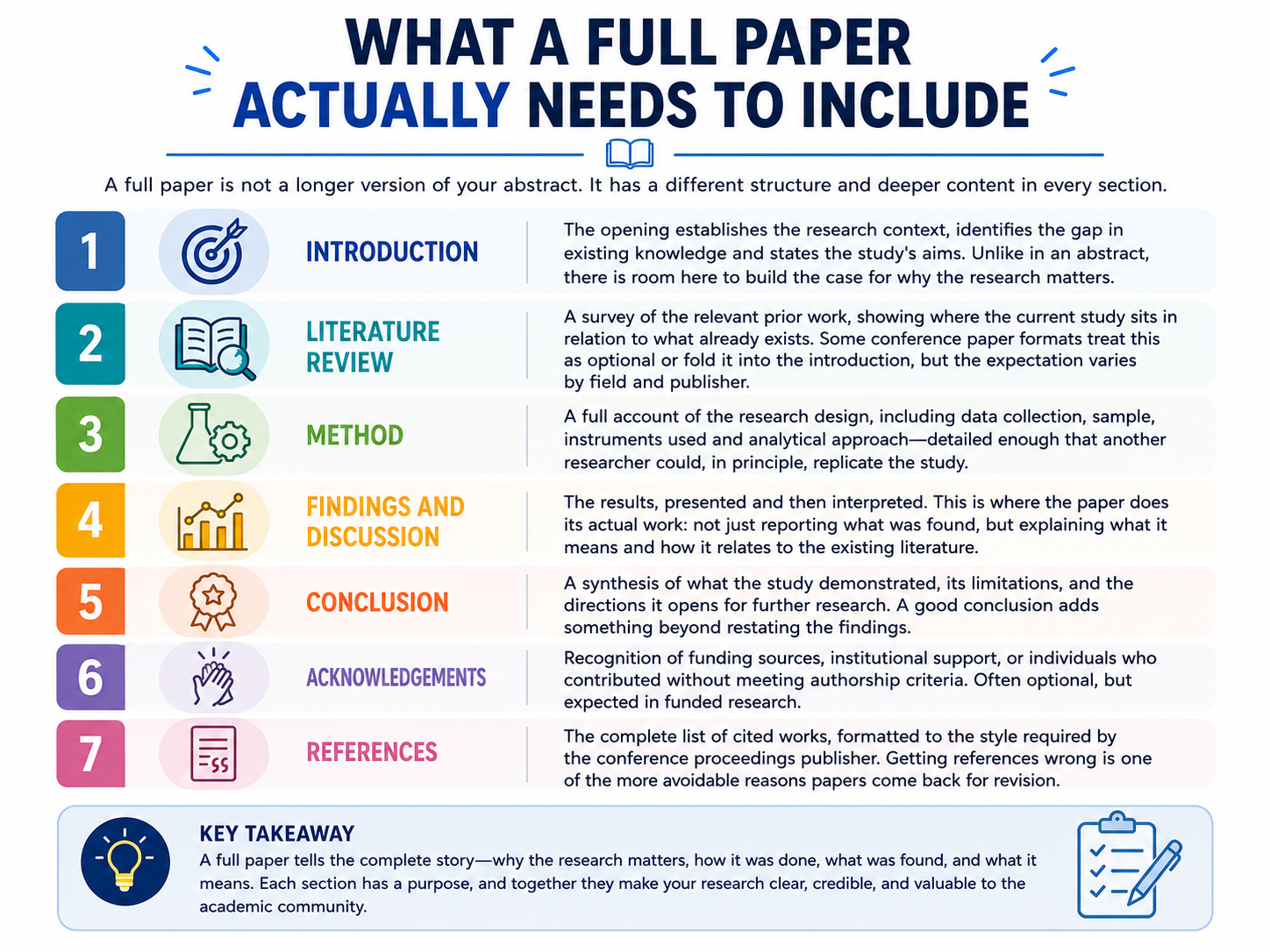
The opposite of what we mentioned earlier is also untrue. A full paper is not a longer version of your abstract. The structure changes, the contents of each section changes. Most importantly, this is the final manuscript that will go out into the world, meaning if published, will be open for readers. An abstract is often material that never goes past reviewers and the organizing team.
Now let’s look into what a full-length research paper comprises of while we’re in the abstract vs full paper debate.
- Introduction: The opening establishes the research context, identifies the gap in existing knowledge and states the study’s aims. Unlike in an abstract, there is room here to build the case for why the research matters.
- Literature review: A survey of the relevant prior work, showing where the current study sits in relation to what already exists. Some conference paper formats treat this as optional or fold it into the introduction, but the expectation varies by field and publisher.
- Method: A full account of the research design, including data collection, sample, instruments used and analytical approach detailed enough that another researcher could, in principle, replicate the study.
- Findings and discussion: The results, presented and then interpreted. This is where the paper does its actual work: not just reporting what was found, but explaining what it means and how it relates to the existing literature.
- Conclusion: A synthesis of what the study demonstrated, its limitations, and the directions it opens for further research. A good conclusion adds something beyond restating the findings.
- Acknowledgements: Recognition of funding sources, institutional support, or individuals who contributed without meeting authorship criteria. Often optional, but expected in funded research.
- References: The complete list of cited works, formatted to the style required by the conference proceedings publisher. Getting references wrong is one of the more avoidable reasons papers come back for revision.
The Indexing Question: Why This Distinction Actually Matters
This is the part of the abstract-versus-full-paper question that carries the most practical consequence, and it is also the part that is most consistently misunderstood. Scopus, Web of Science and the other major academic databases do not index standalone conference abstracts as a general rule.
The reason is straightforward: an abstract does not contain enough methodology, data or references to be cited scientifically as an independent piece of work. It points toward a study. It does not constitute one.
Full papers, once published in official conference proceedings by a recognized publisher like IEEE, Springer, IOP, AIP and similar are treated as serial publications and indexed accordingly. They receive a DOI. They enter the citation record. They count.
This distinction is a well-documented pitfall for PhD students specifically. A graduation requirement, an H-index goal, or a line on a tenure-track CV that calls for an indexed, citable publication will not be satisfied by an accepted abstract, regardless of how well the presentation was received on the day. The applause in the session does not follow the researcher into the database. Only the full paper does.
If an indexed, citable publication is what the submission is working toward, two things need to be confirmed before submitting: that the conference publishes proceedings through a recognized indexed publisher, and that accepted full papers receive a DOI as part of that process. Both pieces of information should be available in the conference’s call for papers or on its website. If they are not, that itself is worth noting.
How the Two-Stage Submission Process Actually Works
Most academic and research conferences in 2026 run the same basic process, though the specific timelines, the number of review rounds and the point at which the abstract-only and full-paper tracks diverge vary considerably from one conference to the next. Understanding the standard flow helps researchers plan their time accurately, because the gap between the abstract deadline and the full paper deadline is almost always shorter than it looks.
- Abstract submission (first deadline): This is the opening move wherein researchers prepare their wok in response to a Call For Papers (CFP). Researchers submit their abstract, typically 150 to 300 words, through the conference submission portal before the call-for-papers deadline closes. This is the stage at which the conference learns what research exists and assesses whether it fits the scope and quality threshold.
- Acceptance decision: Reviewers assess the submitted abstracts, typically using a scoring rubric against criteria the conference has set. Decisions, accepted, rejected, or conditionally accepted with revisions are communicated to authors. At this point, the submission process forks: authors whose abstracts have been accepted can choose whether to stop here and present only, or to proceed to a full paper submission if the conference offers that track.
- Full paper submission (second deadline): Authors who wish to have their work published in the conference proceedings submit the complete manuscript by the second deadline. This window is usually four to eight weeks after acceptance notifications are sent, though some conferences compress this considerably. The full paper is expected to expand meaningfully on the abstract and not to restate it at greater length.
- Peer review and revision: Full papers go through a second round of review, often more rigorous than the abstract review, since reviewers now have the complete methodology and findings in front of them. Revision requests are common and should be expected. Papers that do not revise to the satisfaction of reviewers may be withdrawn from the proceedings.
- Publication: Accepted and revised full papers are compiled into the conference proceedings and published by the proceedings publisher. Indexing, where it applies, follows publication sometimes immediately, sometimes after a delay of several months depending on the publisher and the indexing body.
The practical implication of this timeline is that researchers who intend to submit a full paper need to begin drafting it before the abstract decision arrives. Waiting for acceptance before starting the manuscript almost always means missing the full paper deadline.
Abstract vs Full Paper: Which One Should You Submit?
The answer to this depends less on the research itself and more on what the researcher needs to get out of the conference.
- If you need an indexed, citable publication: Submit a full paper. This applies to PhD researchers whose graduation requirements specify an indexed publication, academics building toward tenure, and anyone whose CV or grant application explicitly requires a citable conference paper. An accepted abstract alone will not satisfy any of those requirements, regardless of the conference’s prestige.
- If you want to present and plan to publish the full study in a journal later: Abstract-only is often the better choice. Submitting a full paper to conference proceedings can complicate a subsequent journal submission, because some journals treat prior publication in indexed proceedings as a prior publication conflict. Presenting from an abstract keeps the full study available for journal submission without that complication.
- If your research is still in progress: An abstract lets you share preliminary findings and collect feedback from the field before the full study is complete. This is one of the more underrated functions of conference presentations, and a full paper submission before the research is done tends to show in the methodology.
- If budget is a constraint: Abstract-only registration tiers often called ‘presenter’ tiers are typically meaningfully cheaper than full-paper ‘author’ tiers. The cost difference is due to the additional editorial and production work that conferences undertake for proceedings papers. For researchers self-funding their conference attendance, this can be a significant practical consideration.
- If you are unsure: Submit the abstract first. Once the abstract is accepted, the decision about whether to proceed to a full paper can be made with more information: the conference’s actual acceptance rate, the quality of the peer-review feedback, and a clearer picture of the proceedings publisher’s indexing status. Committing to a full paper before the abstract has been assessed adds work for an outcome that may not materialize.
Common Misconceptions about Abstract vs Full Paper
A few assumptions about abstracts and full papers persist in academic circles even among experienced researchers. Each of them has practical consequences when it shapes a submission decision.
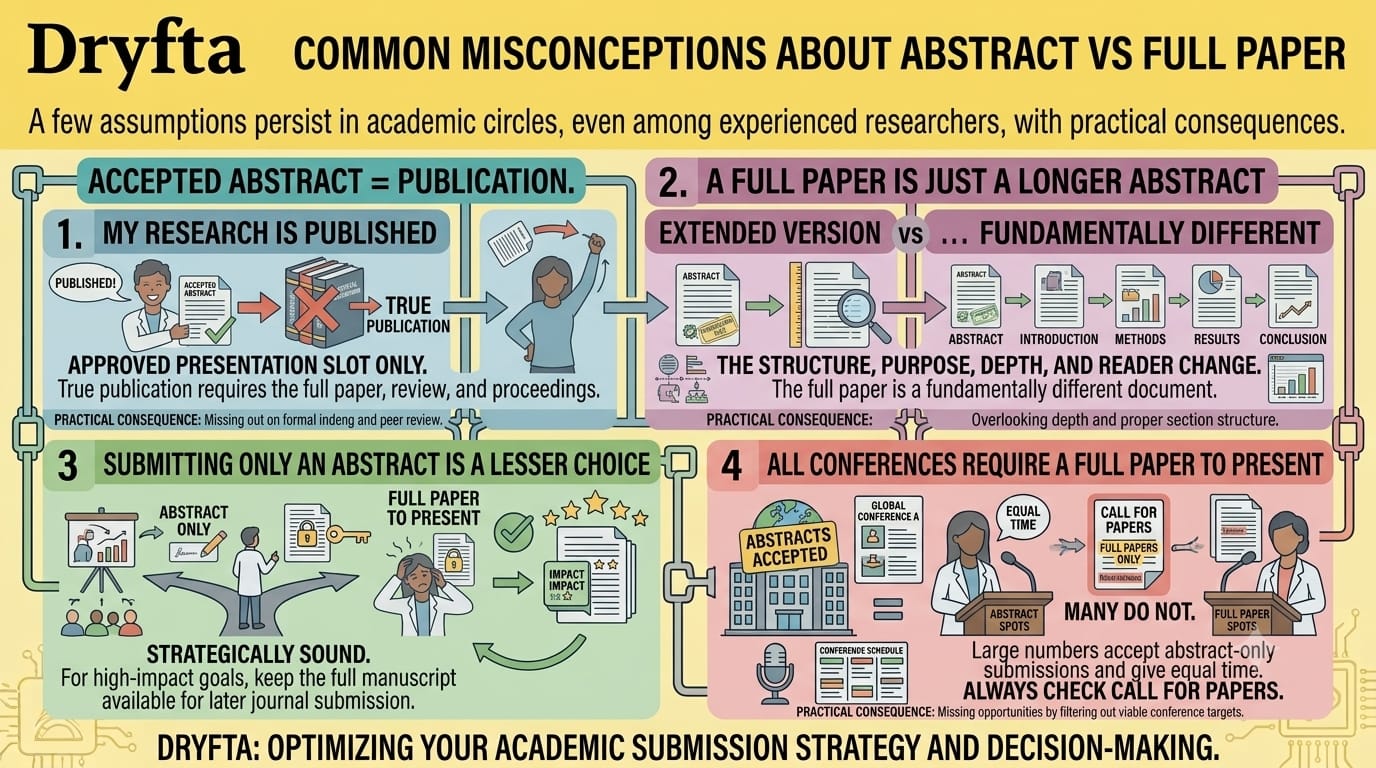
“An accepted abstract means my research is published.”
It does not. An accepted abstract means the conference has approved a presentation slot. Publication, in any meaningful sense, requires the full paper to be written, reviewed and included in official proceedings.
“A full paper is just a longer abstract.”
The structure changes, the reader changes, the purpose changes and the depth of each section changes. The full paper is a different document that happens to share the same research, not an extended version of the abstract.
“Submitting only an abstract is a lesser choice.”
For many research goals, it is the more strategically sound one. Researchers who plan to publish in a high-impact journal are often better served by presenting from an abstract and keeping the full manuscript available for that journal submission.
“All conferences require a full paper to present.”
Many do not. A large number of academic and professional conferences accept abstract-only submissions and give those researchers equal presentation time on the program. Whether a full paper is required is always specified in the call for papers.
Dryfta Supports Both Abstract-Only and Full-Paper Workflows
Whether a conference runs abstract-only presentations, full paper proceedings, or both as parallel tracks, the submission and review system needs to support that fork cleanly. A system that handles one well but requires workarounds for the other creates administrative overhead that compounds as submission volumes grow. Dryfta’s abstract management software comprises features that make both abstract-only and full-paper submission workflows possible.
- Configurable multi-stage submission workflows: Dryfta allows organizers to build the abstract submission and full paper submission stages as separate, sequenced steps within the same system. Each stage has its own deadline, its own notification logic and its own reviewer pool. Authors who are accepted at the abstract stage can be automatically invited to proceed to the full paper stage without the organizing team manually tracking who has and has not moved forward.
- Different criteria and templates per submission type: The structure of an abstract submission form and a full paper submission form are different, and Dryfta allows those forms to be built independently. Abstract submissions can be constrained to a word limit and a set of required fields. Full paper submissions can require file uploads, structured section headings, conflict-of-interest declarations and author contribution statements, without those requirements appearing in the abstract stage where they do not belong.
- Peer review configured separately at each stage: Abstract review and full paper review are different processes. Abstracts are typically reviewed quickly against fit and merit. Full papers go through a more rigorous process, often with multiple reviewers, structured scoring rubrics and revision rounds. Dryfta allows the review configuration to reflect that difference rather than applying the same settings to both stages.
- Accepted abstracts convert directly into the schedule; accepted full papers feed proceedings: Once an abstract is accepted, it can move directly into the session schedule within Dryfta, with speaker assignments, time slots and room allocations managed in the same system. Accepted full papers feed a separate proceedings workflow. Both tracks run in parallel without the organizing team having to maintain two separate systems or manually reconcile the data between them.
Frequently Asked Questions (FAQs)
Does an accepted conference abstract get indexed in Scopus?
Rarely. Scopus indexes conference papers full manuscripts published in official proceedings and not individual abstracts. An abstract may appear in a conference’s book of abstracts, but that publication is not treated as an indexed, citable work. If Scopus indexing is the goal, a full paper submission to a conference with recognized proceedings is the path.
Can I present at a conference without submitting a full paper?
At most academic and research conferences, yes. The majority of conferences accept abstract-only submissions and give those presenters equal time on the program. Whether a full paper is required to present is always stated in the call for papers. If it is not stated clearly, it is worth asking the organizing committee directly before the deadline.
Should I submit an abstract or a full paper if I plan to publish in a journal later?
Submit the abstract only. Publishing a full paper in indexed conference proceedings can create a prior publication conflict with journal editors, some of whom treat conference proceedings papers as prior publications. Presenting from an abstract keeps the complete manuscript available for journal submission without that complication.
What is the difference in structure between an abstract and a full paper?
An abstract compresses the entire study into 150 to 300 words, covering background, aim, method, results and conclusion. A full paper expands each of those sections into its own substantive component, adds a literature review and a complete references list, and is written to a standard that allows it to be cited as an independent piece of scholarship. The two documents share the same research but serve different readers and different purposes.
Why do some conferences charge different registration fees for abstract-only versus full-paper submissions?
The cost difference reflects the additional editorial and production work that full papers require from the conference. Full papers go through a more intensive peer-review process, require copyediting and formatting for the proceedings publisher, and involve coordination with the indexing body. Abstract-only submissions skip those stages. The registration tier ‘presenter’ for abstract-only, ‘author’ for full paper is how most conferences signal which path a submission is on and what the organizers have committed to delivering in return.