There is a point in every poorly planned online networking event that most of us may have encountered. The host cues to something like ‘go ahead and introduce yourself in the chat.’ Following this, dozens of names appear in the chat simultaneously and almost nobody is able to follow them. The next 15-30 minutes then whittles away in the kind of polite, structured silence that feels busier than it is.
By the time the event ends, the virtual networking event’s purpose has successfully been defeated. Most of your attendees have made exactly zero connections.
It is at this point that many participants, as well as organizers, begin attributing the problem to the format of virtual networking events itself.
The format was never the problem. But the way in which it is approached can certainly be. Virtual networking events, when designed with the same intentionality that good in-person events demand, are one of the most scalable and geographically inclusive ways to build professional relationships that exist today.
Virtual networking events have changed the way professionals build relationships across industries and geographies. In this blog, we’re covering everything about virtual networking events: what is a networking event, tips for networking events, and the ideas that make online connections actually work.
What is a Networking Event?
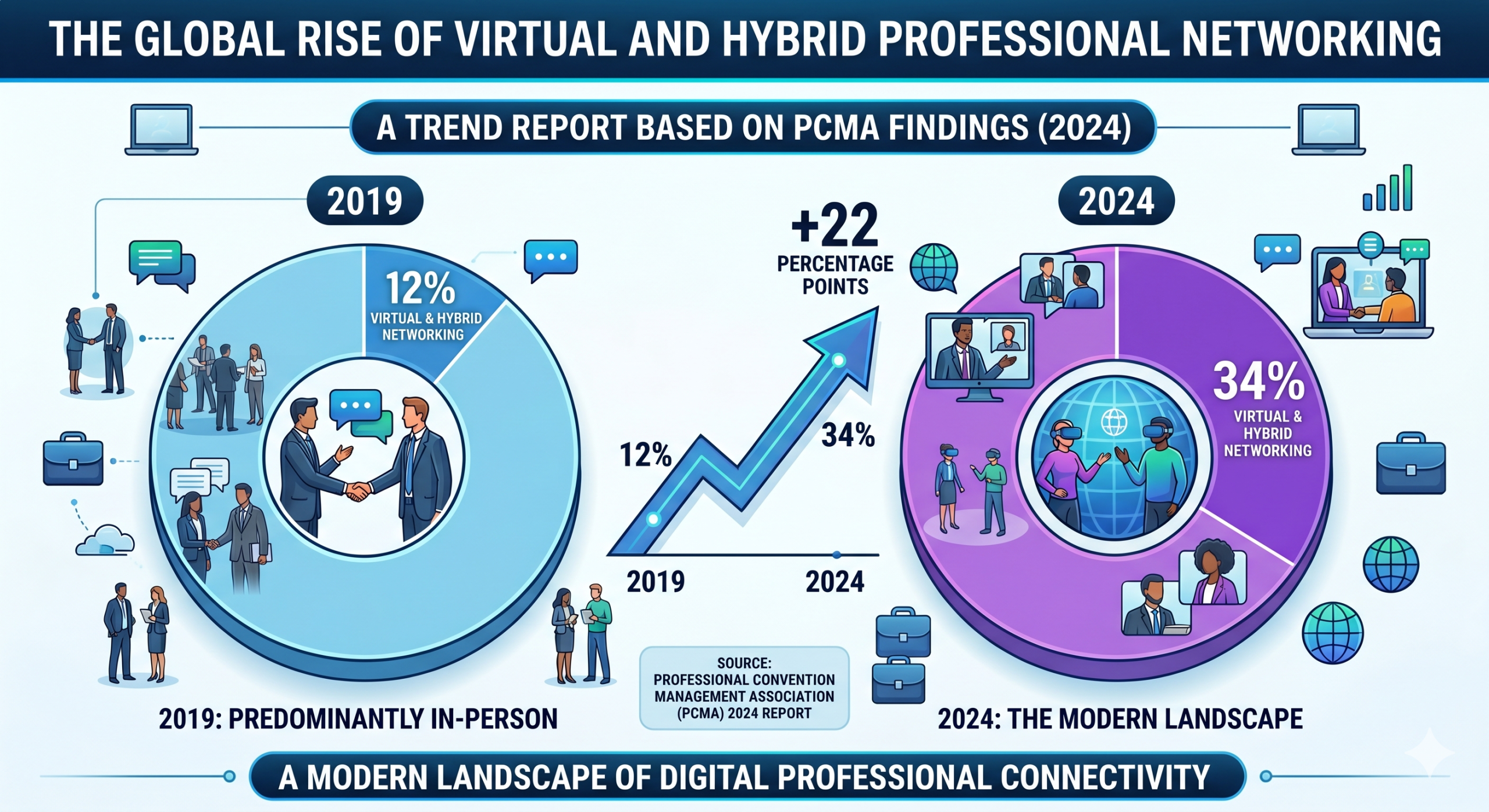
According to a 2024 report by the Professional Convention Management Association, virtual and hybrid networking events now account for 34% of all professional networking activity globally, up from just 12% in 2019. And according to another study, networking webinar attendance grew every quarter of 2024, averaging 229 live attendees per session. That is a 19% year-over-year increase.
These statistics are proof that virtual networking events are not just effective on record. Rather, they’re running on numbers that point at their popularity and reception amongst audiences. So that brings us to the question of: what is a networking event exactly?
A virtual networking event is any organized gathering, online or hybrid, where the primary purpose is to facilitate professional connections between attendees. Unlike a conference or a seminar, where content delivery is the main attraction, a business networking event is built around conversation. The content, if there is any, serves as context for connection rather than the reason people attended.
Why Virtual Networking Events?
The case for networking online moves beyond convenience and goes into factors like reach, cost efficiency and the structural advantages that digital formats offer over their in-person equivalents. These are advantages that are often dismissed by professionals who have had a bad experience with a poorly moderated Zoom call and concluded that online networking does not work. The connections that one makes at a well-run business virtual networking event can produce introductions, referrals and conversations that can contribute to an individual’s career graph.
Virtual Networking Events vs In-person Events
The table below compares in-person and virtual networking events across the factors that matter most to event planners and attendees:
Small Business Networking Events- Making the Most of Limited Resources
For small business owners, the need for investing in small business networking events, whether attending them or hosting them, is as strong as it is for large enterprises. And the virtual format often makes it more actionable.
For example, a boutique marketing agency does not have the budget to exhibit at a major industry conference. But it can host a monthly online networking event for sixty professionals in its niche for the cost of a platform subscription.
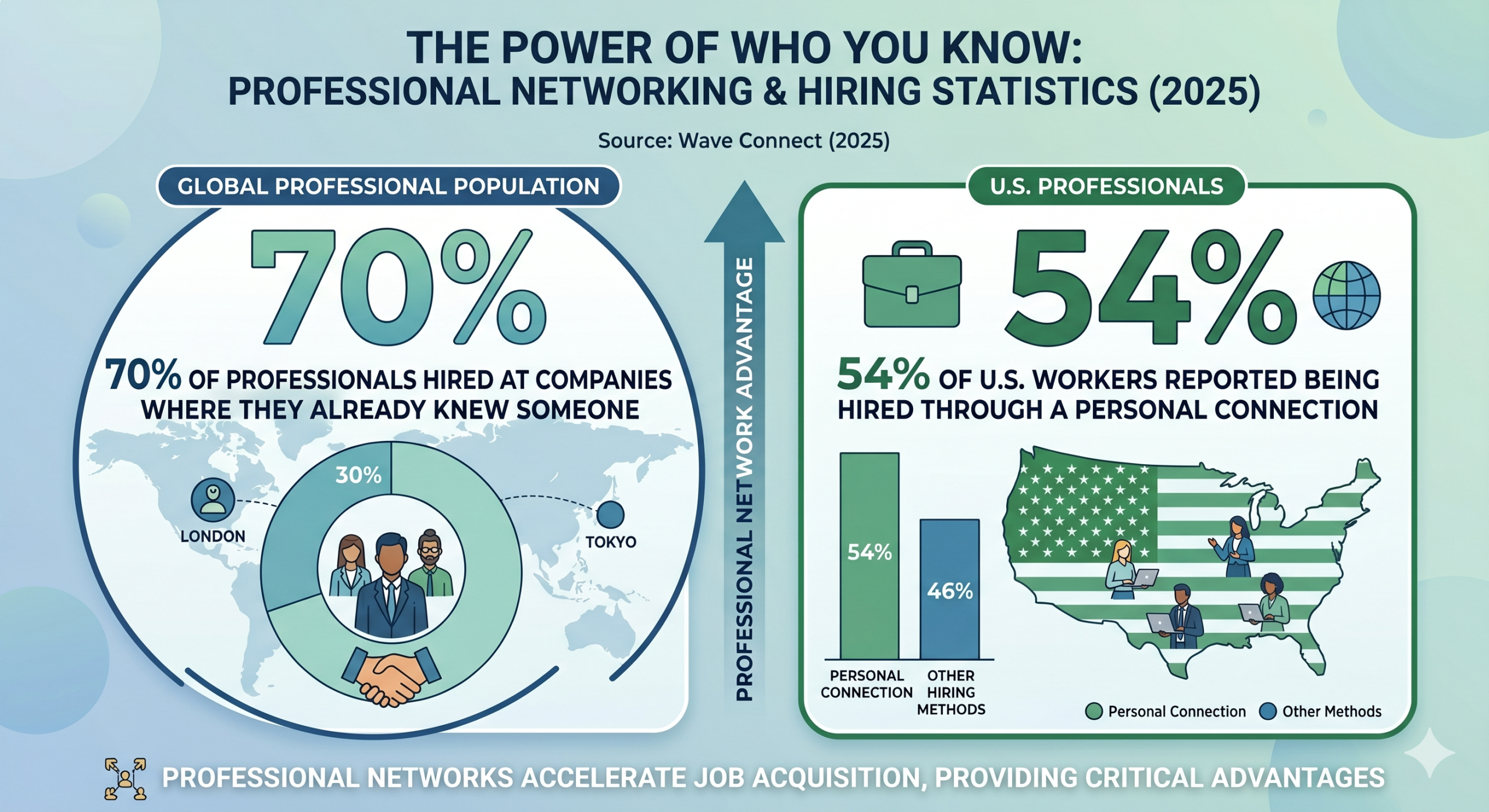
The primary challenge here for small businesses is not having access to networking events. It is follow-through. Wave Connect (2025) notes that 70% of professionals globally are hired at companies where they already knew someone. And 54% of U.S. workers report being hired through a personal connection. The relationships that produce those outcomes are built across multiple touchpoints over time and not from a single event and a business card exchange that goes nowhere.
Small business networking events that generate real pipeline share a few structural characteristics. They are specific rather than broad. A ‘small business mixer‘ attracts everyone and serves no one particularly well. A ‘roundtable for independent creative agencies’ attracts a smaller audience but one that has genuine reasons to know each other.
The most effective small business networking events are run by someone who attends the space regularly, knows the attendees personally and has a reputational stake in the quality of the experience. An anonymous corporate brand running a broad online networking event does not generate the same trust or the same room energy as a known voice in the community who has curated the guest list personally.
On Corporate Networking Events
The demands placed on a corporate networking event are different from those of a small business gathering. The audience is larger, the stakeholder expectations are higher, the budget is more defensible and the reputational risk of a poor execution is more visible.
What separates a corporate networking event that generates genuine pipeline is the content programme, the speaker lineup and the platform choice all matter. But the matchmaking does. The mechanism by which attendees who should know each other actually get introduced is the single highest-impact design decision any corporate networking event can make.
AI-assisted matchmaking tools have changed this calculation significantly. Formats like AI-matched breakout sessions and asynchronous video introductions can now produce better relationship outcomes in virtual networking events for corporates. For corporate event teams under pressure to justify the ROI of their event budgets, this is a meaningful data point.
The follow-up infrastructure also matters equally. A corporate networking event that draws its curtains without a systematic process for connecting attendees post-event, or sharing contact details produces a fraction of the relationship value that the same event with a well-designed post-event communication flow would generate.
Networking Event Ideas That Actually Work Online
The question of format is where most online networking events either succeed or fail at the design stage. A format that puts 100 professionals in a room and asks them to ‘network’ is not a format. It is simply an absence of format and it produces an absence of connection. The best networking event ideas for virtual settings are those that give attendees a reason to speak, a structure that removes the awkwardness of cold introductions and a time limit that keeps conversations from going stale.
-
- Speed networking sessions are the virtual equivalent of a well-run mixer. Attendees are paired in a series of short, timed one-to-one video conversations, typically 5-8 minutes each, before being automatically moved to the next pairing. The time constraint removes the social calculus of when to end a conversation and keeps energy levels higher across the event.
- Themed roundtables work particularly well for niche professional communities. A group of ten to fifteen people with a shared challenge or interest talking through a specific question for sixty to ninety minutes generates far richer connections than a general mixer of the same size. The specificity of the topic gives strangers an immediate, substantive reason to engage with each other and the small group size means that nobody can hide behind the chat box.
- Virtual coffee roulette is an informal, low-commitment format that works well as a recurring feature for professional communities rather than a one-off event. Participants are randomly paired for short, informal one-to-one conversations on a regular cadence weekly or fortnightly. The randomness of the pairing introduces people who would not have sought each other out, and the brevity of the format keeps the barrier to participation low.
- Ask-me-anything sessions with facilitated breakouts combine the draw of a known speaker or expert with the connection-building value of small group conversation. The AMA provides a shared reference point and a common language for attendees going into the breakout sessions, which makes initial conversation significantly easier.
Final Thoughts on Virtual Networking Events
A poorly facilitated online networking event is one of the most effective ways to convince a room full of professionals that virtual connections do not work. A well-designed one is one of the most scalable, cost-efficient and genuinely useful things an event team can put out into the world. The difference between the two is not the platform. It is the intentionality of the format, the quality of the facilitation and the discipline of the follow-up.
Whether your event’s goal is a recurring small business networking event for a niche professional community, a large-scale corporate networking event for an enterprise client base or a one-off online networking event built around a specific industry challenge, the fundamentals are the same: design with purpose, facilitate with attention, and follow up without delay.
If your team is spending more time managing logistics than creating genuine connection opportunities, Dryfta is built to change that. Dryfta is an all-in-one event management platform that handles registration, attendee profiles, matchmaking, session scheduling and post-event follow-up, all in one place. Sign up for a free demo today.
Frequently Asked Questions (FAQs)
What platform should I use for a virtual networking event?
Your choice of a platform for your next virtual networking event depends on your event size, interactivity needs and budget. For small online networking events, Zoom, Hopin or Airmeet offer solid breakout room and matchmaking functionality.
For larger corporate networking events, platforms like Cvent’s virtual experience platform, Bizzabo or Whova provide registration, branded event pages, attendee messaging and post-event analytics. Dryfta’s all-in-one event management software with special features for the virtual format work remarkable well for events both small and large in size.
What are the best networking event ideas for a virtual format?
The most effective networking event ideas for virtual formats include structured speed networking with pre-matched pairs, themed roundtables built around specific industry challenges, virtual coffee roulette for informal one-to-one conversations, and ask-me-anything sessions with a well-known speaker followed by facilitated breakouts.
How long should a virtual networking event be?
The ideal duration depends on format and audience size. According to Markletic (2024), 63% of people say the ideal time for a virtual round table discussion is between 60 and 90 minutes. For larger online networking events with multiple breakout sessions, two hours is generally considered the ceiling before screen fatigue sets in. Focused speed networking sessions can be as short as 30 to 45 minutes and still generate meaningful connections when the matchmaking is done well.