The pandemic brought with it the popularization of the ‘virtual’ format. Virtual offices. Virtual classes. Little did we know that this ‘accidental’ switch was here to stay. The virtual format remained and revolutionized the way in which the world approached meetings and events. Gradually, businesses and institutions began realizing that the virtual format was indeed sustainable. For employees and companies alike. For event organizers and attendees alike.
As a direct consequence, we now know that virtual events are no longer just a temporary substitute for in-person gatherings. Zoom reported from a global survey on marketing professionals that 93% of its respondents were considering switching to hosting virtual events.
But here is the catch: the bar for what attendees accept has risen sharply.
If you want to learn how to host a virtual event and stay ahead of the crowd, what you will need is not another generic blog post on the internet. Rather, your next event will benefit from structured approaches that consider every element of the experience, before, during and after the event date. In this exhaustive guide, we’re taking you through the A-Z on how to host a virtual event that your attendees will actually look forward to.
What a Virtual Event Actually Is
A virtual event is a planned, structured gathering that takes place entirely online. Participants join and interact using digital technology rather than being physically present in the same location.
But that definition, while accurate, is somewhat like describing a novel as a sequence of sentences. It is technically correct and almost entirely beside the point. What makes a virtual event distinct from a video call is the deliberateness of the experience. It has a beginning, a middle and an end. It has a purpose that every element of its design is arranged to serve and the host platform is chosen with care.
A virtual event’s agenda is built with an understanding of how attention moves and fades online. When all of these elements align, event professionals are able to pull off a virtual event that is valuable. Otherwise, what remains is another meeting that could have simply remained an email.
Types of Virtual Events
Here are some of the most common types of virtual events hosted globally:
1. Virtual Conferences: These are multi-session, multi-speaker events that replicate the physical conference format but online. Attendees move between simultaneous sessions, join keynotes broadcast to the full audience and access networking spaces between sessions.
2. Webinars: Webinars are single-session online presentations featuring one or two speakers on a specific topic. This is among the most accessible virtual event formats for lead generation, product education and thought leadership content.
3. Virtual Trade Shows and Expos: A replication of the classic exhibitor hall experience. Sponsors and exhibitors have dedicated virtual booths where attendees can visit, view product information and have live conversations with company representatives.
4. Virtual Workshops and Training Sessions: Participation-first formats where attendees work through exercises, collaborate in breakout groups and apply learning in real time rather than simply watching a presenter.
5. Virtual Networking Events: Structured formats using speed networking rounds, topic-based breakout rooms or facilitated group conversations to help attendees build professional connections online.
6. Hybrid Events: Hybrid events offer something for both live in-person audience and a simultaneous virtual audience. This needs dedicated planning for each group as opposed to treating virtual attendees as a secondary livestream of the physical event.
Why Host a Virtual Event?
Do you know what makes the virtual format particularly worthy of your consideration in 2026? This is regardless of whether or not you have the possibility of hosting an in-person alternative. Virtual events are preferred owing to the following factors and more:
-
- They offer a broader geographic reach and are not restricted by boundaries.
- Organizations can calculate expenses with a much lower cost per attendee, thereby saving on administrative costs proportionately.
- A virtual event advertised online has a massively larger potential audience base. When people from any part of the world can tune in, your target attendees shoot up to essentially the whole world.
- Virtual events are genuinely accessible for persons with disabilities, the elderly as well as student attendees.
How to Host a Virtual Event- The Fundamentals of Event Planning
It would be a mistake to treat virtual event planning as categorically separate from event planning more broadly. The foundational disciplines are identical. What changes is the medium of execution, not the underlying logic of what good planning requires.
Every event, regardless of format, begins with a question that is more difficult to answer honestly than it appears: what is this for? The answer to this question is the only reliable compass for every subsequent decision in the planning process.
For virtual events specifically, audience understanding extends beyond professional profile and subject matter interest. It also seconds for things like comfort with technology, the environments from which attendees are likely to join, whether a home office, a shared workspace or a mobile phone on a commute and the competing demands on their attention at the moment the event takes place. An event that’s planned without this understanding produces programming that may be intellectually strong and experientially misaligned.
The run of the show, the minute-by-minute agenda that governs event day also demands particular attention in the virtual context. Unlike a physical event where a skilled operations team can adapt in real time to a room that feels wrong or a schedule that is running slow, a virtual event run of shows is closer to a broadcast script. Deviations are visible to everyone and any silences are awkward in ways that physical space absorbs more gracefully. The run of the show should be built with a level of precision that may feel excessive in advance and will feel exactly right on the day.
In-Person vs Virtual Events- The Comparison
Being able to clearly distinguish between both in-person and virtual formats can help event planners make much better and more sustainable decisions.
| Factor | In-Person Events | Virtual Events |
| Geographic reach | Limited by travel distance | Global, no location barrier |
| Audience capacity | Constrained by venue size | Effectively unlimited |
| Cost per attendee | Higher due to venue and catering | Lower with no physical infrastructure |
| Networking quality | Spontaneous and organic | Requires deliberate design |
| Production complexity | Physical logistics-intensive | Technology intensive |
| Data and analytics | Limited, manual collection | Rich, automated and behavioral |
| Content longevity | Limited unless separately recorded | Easily recorded and repurposed |
| Environmental impact | High due to travel and venue | Significantly lower |
| Sponsor value | High visibility, tangible presence | Trackable, data-backed exposure |
Virtual Event Elements to Consider for Great Attendee Experience
A well-produced virtual event is made up of several distinct elements that work together to create a coherent attendee experience.
Registration and Pre-Event Communication: The attendee experience begins long before the live event. A clean registration flow, a confirmation email with clear joining instructions and a series of pre-event communications that build anticipation all set the tone. Poor pre-event communication is one of the leading causes of no-shows at virtual events.
Virtual Platform Environment: The platform is the virtual equivalent of a physical venue. It should be intuitive for attendees, visually consistent with the event brand and technically reliable under expected attendee load.
Live Sessions and Programming: Sessions should be timed appropriately for online attention spans, typically 20 to 45 minutes for individual presentations, with clear transitions between them. Back-to-back sessions without breaks cause attendee fatigue and significant drop-off rates.
Interaction and Participation Mechanisms: Every session should have at least one active participation mechanism, a live poll, a Q&A window, a chat prompt, or a breakout discussion that requires attendees to do something rather than just watch.
Networking Spaces: Dedicated networking spaces give attendees the opportunity to connect with each other outside of formal sessions. Structured formats such as speed networking rounds or topic-based rooms work significantly better than open, unstructured spaces.
Sponsor and Exhibitor Areas: Virtual sponsor areas give exhibitors a branded presence within the platform where attendees can visit, view content and initiate conversations. These areas should be integrated into the attendee journey rather than placed as an afterthought.
On-Demand Content Library: A post-event content library where recorded sessions are made available extends the event’s value for registered attendees and serves as a lead generation asset for people who could not attend live.
If you’ve made it this far into the blog, we are glad you find this insightful. Now, let’s move on to discuss the challenges of hosting virtual events.
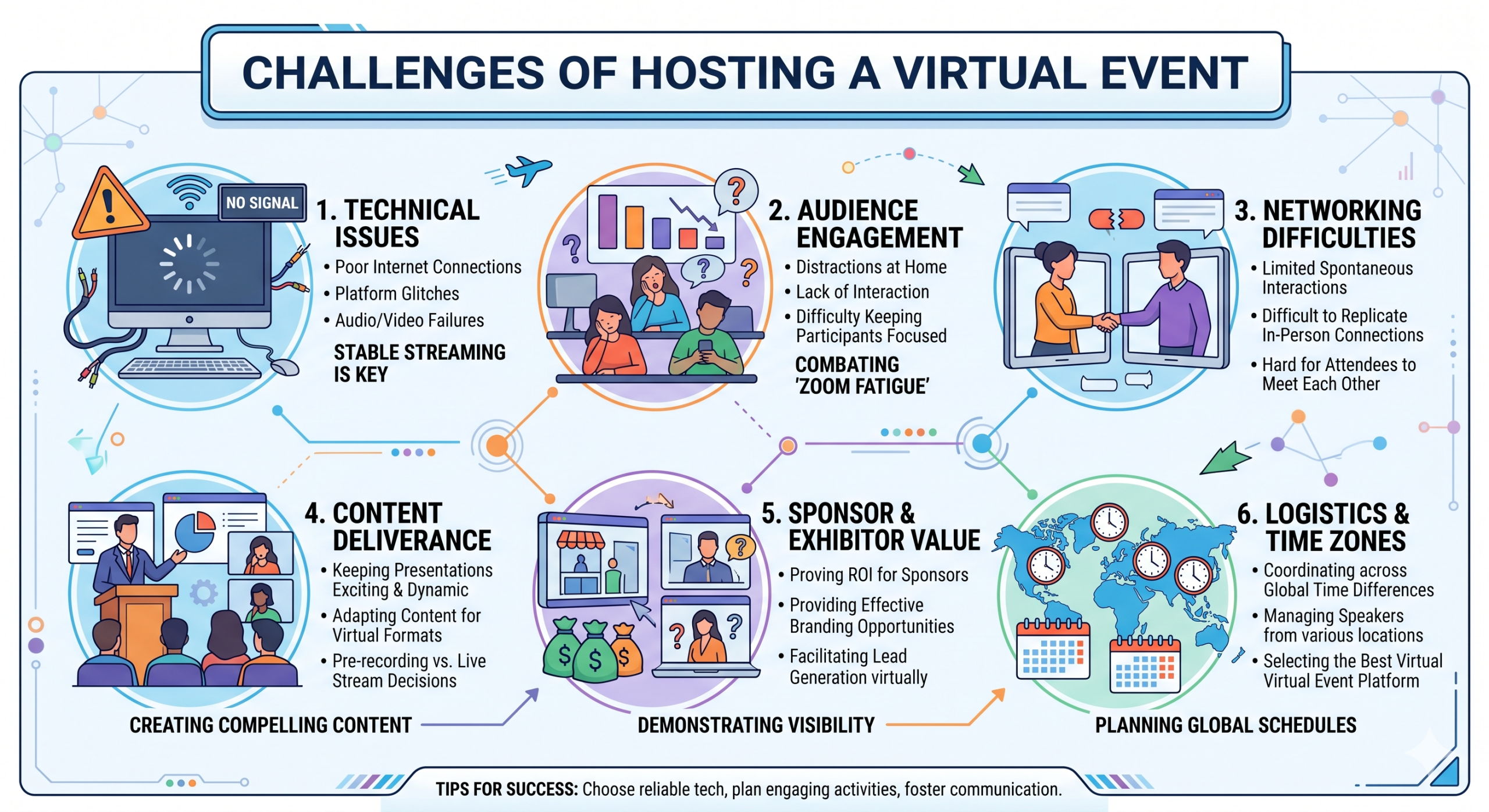
Challenges of Hosting Virtual Events
While there may be many advantages of hosting a virtual event, it’s also wise to weigh in on the challenges organizers face. The infographic below accurately captures some of the most common challenges of hosting virtual events.
Questions to Ask When Hosting a Virtual Event
Before committing to a virtual event format, work through these planning questions. The answers will shape every subsequent decision.
-
- What is the single most important outcome this event needs to deliver?
- Who is the primary audience and what are their technology comfort levels?
- What is a realistic attendance target based on our current audience size and promotional reach?
- Which platform best matches our audience’s familiarity and our team’s technical capability?
- How will we maintain attendee attention across the full duration of the program?
- What interaction formats will we use in each session to prevent passive consumption?
- How will attendees network with each other and what structure will facilitate that?
On Choosing the Right Virtual Event Software
There is a great deal written about virtual event software solutions and most of it consists of feature comparisons that, while useful, address the question at the wrong level of abstraction. The question of which platform to choose is not primarily a question about features. It is a question about fit: fit with the audience’s technical confidence, fit with the organization’s internal capacity, fit with the scale and format of the event being planned.
Additionally, check for the following:
-
- A check-in functionality that works reliably under the pressure of simultaneous access.
- Analytics that can produce post-event data in formats that can be used to learn something.
These features are the foundations when choosing an event platform. Everything built on top of them is valuable only to the degree that your event software holds.
How To Host Your Best Virtual Event Yet
If you’ve read this blog on how to host a virtual event until the very end, rest assured, the best is only yet to come for you and your event. Whether you are an event management company owner, a marketing professional or simply someone who has been hovering over the idea of switching to the virtual event format, the background, strategies and step-by-step breakdown in this article is certain to help upscale your next event.
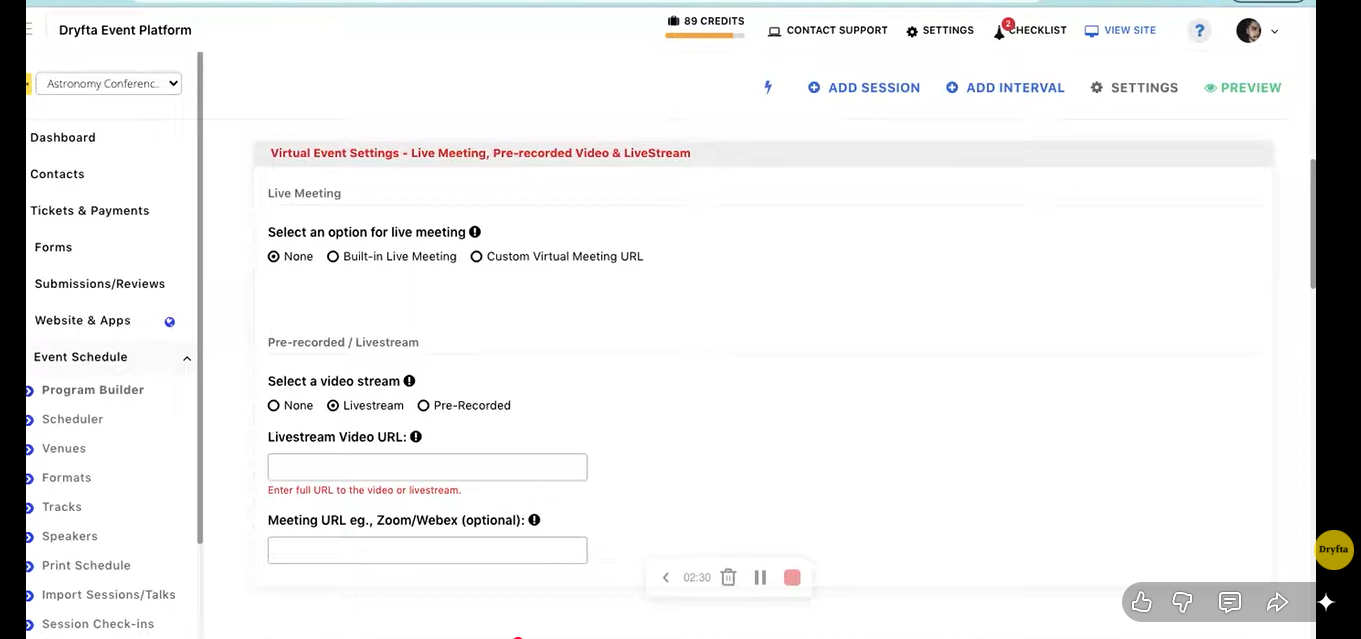
If you want to give your virtual event an even better boost, consider working with a state-of-the-art event management solution. Automation can help streamline several different aspects of your next event that your manual team may be likely to miss. If you want to try your hand at a software that offers built-in registration, abstract management, virtual session broadcasting, structured networking tools, sponsor management and post-event analytics for virtual events, sign up for a free demo with Dryfta today.
Our all-in-one event platform has successfully helped host virtual events for top organizations around the world. Dryfta gives your team the tools to deliver an experience attendees will value and remember. Visit our website today to explore the platform.
Frequently Asked Questions (FAQs)
How long does it take to plan a virtual event?
It takes significantly less time to plan and put together a virtual event than it does for a physical showcase. The reasons for this are obvious: there are fewer logistics to decipher when operating out of online platforms. Therefore, the planning timeline for your specific virtual event depends largely on the extent of your event. If it is a simple webinar for a small audience, you may be able to plan it in less than 2 weeks. A much more packed multi-session virtual conference with dozens of speakers and hundreds of attendees might demand a period of 4-12 weeks for preparation.
What is the biggest mistake people make when learning how to host a virtual event?
The biggest mistake that people make when learning how to host a virtual event also turns out to be the costliest one. And it is to do with treating a virtual event as a straightforward ‘transfer’ of an in-person event to an online format. It does not work like copy and paste. Rather, virtual events require a fundamentally different approach to content timing, interaction design and attendee experience. Sessions that work brilliantly in a physical conference room often fail to hold attention in an online environment. Designing specifically for the virtual format, with shorter sessions, more frequent interaction points and structured networking, produces dramatically better results.
How do you keep attendees engaged at a virtual event?
Keeping attendees engaged at a virtual event requires active design rather than hope. Shorter sessions of 20 to 40 minutes, interactive elements in every session, structured networking opportunities and a strong live host who maintains energy and momentum across the program are the most effective tactics. Gamification systems that reward active participation can also significantly increase the proportion of attendees who remain engaged across the full event duration.
What platform should I use to host a virtual event?
The best platform depends on your event format, audience size and technical requirements. For academic and research conferences that require abstract management, registration, virtual sessions and post-event reporting in a single system, Dryfta is purpose-built for that use case. For broader corporate virtual events, platforms like Hopin, Cvent and Whova offer strong feature sets. The most important criterion in any platform selection is reliability under your expected attendee load, followed by ease of use for your specific audience.