Have you ever found yourself searching for the right event management platform that fits your requirements? And if you’ve been looking at EventMobi, it’s definitely a popular choice for many event organizers. But is it worth considering? While the platform has some obvious advantages, many users have quickly moved on to searching for EventMobi alternatives.
Organizers today don’t shy away from carrying out event software comparison and doing their own research before opting for a platform. EventMobi works well for attendee engagement and has a responsive mobile app, but some events require more specialized and complex features.
Here’s a detailed guide that takes you through the best EventMobi alternatives that you can explore when planning your next event.
What is EventMobi?
EventMobi is a prominent event management software company that prides itself on offering an extensive feature set and a user-friendly interface for event planners. The event management solutions provided by EventMobi are utilized for hosting various types of events, such as large-scale enterprise events and corporate meetings. The platform also offers tools for attendee engagement and logistics management.
The platform features a powerful task management tool known as the Experience Manager for event teams to manage events and meetings seamlessly. Additionally, EventMobi also offers dedicated tools for the different stages of the event lifecycle, which include-
-
- Registration
- Check-in and badges
- Post-event engagement
Why Look for EventMobi Alternatives?
EventMobi is primarily focused on offering a great virtual and hybrid experience, and seems to be lacking in deeper on-site event capabilities. This is why many organizers look for EventMobi alternatives in the first place. Here are some more reasons why organizers often pick other EventMobi competitors.
Varied Preferences for User Interface: Different organizers may look for different things in the user interface of an event platform. While some may find EventMobi efficient, many users have reported that other event software in comparison have more intuitive interface.
Pricing and Budget: Some organizers may prefer lower-cost options, particularly for smaller events, which prompts them to look for EventMobi alternatives. Many event management software alternatives now come with affordable pricing structures for the convenience of event planners.
More Seamless Registration: Multi-day events often require more complex registration workflows for which EventMobi may not be an ideal choice. Event planners who prioritize registration as opposed to attendee engagement may find other EventMobi alternatives more suitable.
High pricing for growing events: EventMobi’s event app and virtual event platform starts at $3,500 for a single event and $7,900 per year according to their website. For organizations running multiple events per year with growing attendee volumes, this cost structure can become difficult to justify against more affordable alternatives.
Add-on costs for advanced features: Users have noted that limited customization is available, and that configurations requiring more advanced functionality often carry additional fees or programming skills. This tiered access to functionality is a recurring source of frustration for planning teams that require tailored workflows.
Need for more customization flexibility: Some users note that the app could benefit from more customization options. For events with distinctive branding requirements or non-standard session structures, the platform’s design constraints can be limiting.
Requirement for deeper CRM integrations: Some users note that integrations with platforms like Swoogo require workarounds, and that quirks in third-party tools do not always translate smoothly into EventMobi. Organizations that rely heavily on Salesforce or Marketo data flows report inconsistencies that require manual reconciliation.
Scalability concerns for enterprise events: EventMobi performs well for mid-market programs, but enterprise organizations managing portfolios of 50 or more annual events across in-person, livestream and on-demand formats often require a more operationally sophisticated infrastructure than EventMobi’s architecture readily provides.
Mobile app branding limitations: Users have noted the absence of bilingual app support, including the inability to toggle between languages such as English and French, which is a serious issue for international or bilingual organizations.
Complex workflows for multi-event management: Managing consecutive sessions in a preferred order has prompted some users to switch to third-party integrations for agenda sequencing. Multi-event organizations that require unified data management across an entire portfolio often find this fragmentation costly.
Need for stronger onsite event management tools: For events where badge printing, session scanning and real-time check-in are operationally critical, some organizers find that EventMobi’s onsite capabilities, though functional, do not match the depth offered by platforms built with in-person operations as a primary design concern.
Hybrid event scalability challenges: Hybrid and virtual event formats have become the norm for event organizers around the globe. Consequently, organizations now ought to run hybrid events at scale frequently identify this as an area where specialized platforms offer a more complete solution.
Need for academic conference workflows: EventMobi does not natively support abstract submission management, double-blind peer review and other workflows that academic and research conferences often need. Organizers from universities and research institutions who need these features must either supplement EventMobi with separate tools or switch to an all-in-one event management platform like Dryfta.
Demand for transparent pricing models: EventMobi’s publishes its pricing at the platform level. This transparency is appreciable. However, users often note that the price tag becomes considerably less transparent once add-ons, attendee volume tiers and custom features are factored in. Many organizers, as a result, are inclining toward a pricing structure that is honest from the very beginning.
Best EventMobi Alternatives for Enterprise Events
Enterprise event programs occupy a category of their own, and the organizations that run them know this well. What we’re talking about are a portfolio of 50 or more annual events spanning multiple continents. Each with its own registration configuration, sponsor commitments and reporting obligation, demands infrastructure that mid-market platforms are not designed to carry. As a matter of fact, they will crumble from the weight. The stakes for enterprise events are very large at this scale. And so are the consequences of choosing the wrong software.
Here are features to look for and evaluate when choosing an event management platform for your enterprise event:
- Multi-event management: The ability to manage an entire portfolio of events from a single administrative environment, with shared attendee records, consistent configuration defaults and unified reporting across all programs, is a non-negotiable requirement for enterprise teams. Platforms that treat each event as a fully separate instance multiply the administrative overhead with every event added to the calendar.
- Enterprise analytics and advanced reporting dashboards: Real-time dashboards covering registration velocity, session attendance, sponsor visibility and pipeline influence are the evidence base that justifies the event budget for the following year. Both Cvent and Dryfta offer native connections to Salesforce and HubSpot with reliable field mapping. Their reporting infrastructure is also designed to serve the kind of stakeholder audiences that enterprise teams present to regularly.
- Large attendee volumes: Enterprise conferences regularly accommodate thousands of attendees across multi-track programs with simultaneous sessions, breakout rooms and exhibition floors. The platform must handle this volume without performance degradation, and its onsite tools, including check-in kiosks, session scanners and badge printing stations, must operate reliably at peak arrival times.
- Enterprise security and compliance: GDPR compliance, SSO support, role-based access controls and enterprise-grade data handling are table stakes at this level. Any platform being evaluated for enterprise use should be assessed against these criteria before feature comparisons begin.
- Sponsor and exhibitor management: Branded sponsor profiles, sponsored session placements, exhibitor lead capture and post-event sponsor analytics are the features that allow enterprise teams to show sponsors the value of their investment and secure renewals across a multi-event calendar.
- Global event operations: For organizations managing events across multiple time zones, languages and regulatory environments, the platform must accommodate regional configurations without requiring a different product for each geography.
- CRM and marketing automation: Native integrations with Salesforce, HubSpot and marketing automation platforms with real-time data synchronization determine how much of the value an event produces actually makes its way into the sales and marketing workflows that act on it. CSV exports that require manual intervention after each event are an inadequate substitute at enterprise scale.
- Advanced reporting dashboards: The reporting layer must be exportable, connectable to business intelligence tools and sufficiently granular to satisfy both the event team and the finance and marketing leadership that reviews event performance.
Dryfta is the strongest performer in this area across all the alternatives evaluated here.
Best EventMobi Alternatives for Academic Conferences
Academic conferences ask more of their management software than most event types do. This kind of additional demand begins months before any session is scheduled. The very process of managing abstract submissions, assigning qualified reviewers, anonymizing author information, coordinating scoring and then communicating decisions back to authors is a different operational problem from organizing a corporate summit. It, therefore, demands a platform that was designed with just this sequence in mind. Truth be told, EventMobi was not built with academic events in mind and the gaps peek through.
Here are the features that leave no room for mistakes or compromise at your next academic event:
- Abstract management: Custom submission forms with conditional logic, file upload support, multi-track routing and author notification workflows are the minimum standard. Dryfta covers all of these within its core platform. Oxford Abstracts has spent two decades building exclusively for this use case with a free tier available for smaller events.
- Peer review workflows: Double-blind and single-blind review with automated reviewer assignment, conflict-of-interest management, reviewer dashboards, scoring rubrics and decision notifications covering the full peer review sequence are available in Dryfta and Ex Ordo. Both platforms also support rebuttal periods and meta-review workflows, which are requirements that general event management platforms do not address.
- Scientific conference management: For scientific and technical conferences where submission volumes are high and program committee coordination is complex, Dryfta and Ex Ordo are the most capable options. According to an article, Ex Ordo is used at research conferences in 60 countries, with 13 of the top 20 global universities on its client list.
- Speaker and session workflows: A scientific symposium may have 40 paper presentations across six parallel tracks, each with a session chair, a discussant and a strict time allocation. Dryfta’s session builder accommodates this level of structural complexity and keeps the attendee-facing schedule synchronized with the back-end program management database in real time, removing the need for separate spreadsheet-based scheduling.
- Proceedings management: Dryfta is designed with the event organizer and their proceedings in mind. The software is capable of both compiling and exporting conference proceedings for publication or institutional deposit. Morressier is another platform publication one step ahead for large research organization and offers direct integration with academic publishing workflows and archiving infrastructure.
- University event management: Universities and research institutions running departmental symposiums, graduate research days and faculty conferences need a platform that can accommodate small-scale events but without its enterprise price tag. Dryfta is an excellent option here, starting at a price of only $1,499 per year. This is much more economical compared to pricier EventMobi alternatives like Bizzabo and Cvent.
- Reviewer collaboration: Reviewer bidding systems, in which reviewers indicate their preferences for assigned papers before assignments are finalized, improve review quality and reduce dissatisfaction across the program committee. Dryfta supports this feature alongside discussion threads and meta-review capabilities that let you coordinate decision-making without having to resort to email.
- Research symposium support: For smaller, more focused research gatherings such as doctoral colloquia, workshop symposiums and working group meetings, the platform must be operationally straightforward without sacrificing the peer review and scheduling depth that research events require. Dryfta, Oxford Abstracts and Whova all serve this format well.
Best EventMobi Alternatives for Hybrid and Virtual Events
The hybrid and virtual event format first entered the market as an exceptional use case. However today, hybrid has become the norm for organizers globally. A riveting trend in event management that’s hard to look away from is the hybrid event format. Despite it having growing multifold in significance, very few organizations have mastered its execution fully. Hybrid and virtual events continue to remain one of the most technically demanding formats to full off. The challenge here is that virtual no longer means mere broadcasting a session to a remote audience. Rather, it is to with creating a coherent and equally effective event experience for two distinct groups of participants simultaneously,
The alternatives that serve hybrid and virtual events most effectively must tick the following boxes:
- Virtual streaming integration: Built-in or tightly integrated livestreaming infrastructure is a prerequisite rather than an optional extra. RingCentral Events, the platform that emerged from Hopin, brings the depth of RingCentral’s enterprise video infrastructure to multi-track hybrid conferences and supports over 40 App Store integrations.
- Hybrid audience participation: Keeping both in-person and virtual audiences actively involved in the same event needs purpose-built tools and not workarounds. What you need is not another excuse but good engagement. These are things like an interactive Q&A, live polling, gamification features and real-time social walls that can aggregate content across both audiences. They keep the virtual audience from becoming secondary during the event.
- Virtual networking: Unstructured virtual networking produces poor outcomes, and the platforms that have invested most seriously in solving this problem deliver meaningfully better results. Swapcard uses AI-driven matchmaking to generate personalized networking recommendations for each attendee, and its virtual and hybrid networking tools are particularly effective for B2B conferences where the quality of connections made is a primary measure of success.
- Session recordings: On-demand access to session recordings extends the value of the event beyond its live dates and accommodates attendees in different time zones who cannot participate in real time. RingCentral Events, vFairs and Dryfta all support session recording and on-demand content delivery within their hybrid and virtual event infrastructure.
- Interactive Q&A and polling: In-session audience interaction tools, including live Q&A, polling, word clouds and reaction features, are among the strongest differentiators between hybrid platforms. Live Q&A tools and Slido-style polling integrations are well regarded. Dryfta consistently offers a strong interactive Q&A and polling functionality for larger virtual audiences.
- Online sponsor booths: The ability for sponsors to maintain a meaningful presence for the virtual audience, with branded booth spaces, downloadable resources, live chat and post-event lead reports, determines whether sponsors renew their investment in a hybrid event program. vFairs’ customizable 3D exhibitor booths are among the most fully developed in this category. Addtionally, Swapcard’s digital exhibitor booth model is also well suited to B2B conferences and trade associations.
- Hybrid agenda management: A single scheduling system that can cater both sets of audiences without the organizer having to put on two separate programme agendas is a structural need for hybrid events. Dryfta, Bizzabo and Whova all offer unified agenda management with real-time updates. These synchronize across the event website, the mobile app and the virtual platform simultaneously.
- Remote attendee experiences: The quality of the experience for attendees who are not physically present determines whether a hybrid event actually functions as one event or simply as a conference with a livestream bolted on. Dryfta’s AI-driven micro-engagement tools for hybrid events are among the most developed approaches to this problem currently available in the market.
Best EventMobi Alternatives for Associations and Nonprofits
Associations and nonprofit organizations have event demands that are distinctly their own. Budget constraints are real as non-profits run on donations and sponsorships. Non-profit associations in this segment also tend to operate with small groups of permanent staff and more larger volunteer committees. This means that their workforce is hardly stable and it is, therefore, pertinent for the company’s event management software to keep records consistent.
The alternatives that serve associations and nonprofits most effectively address the following requirements:
- Membership event management: Registration pricing must accurately capture membership tier distinctions, so that members pay differently from non-members and different membership levels receive different access configurations. Whova and Dryfta both handle tiered membership pricing well, with Dryfta’s reputation in this area given its long history with large association clients.
- Educational session tracking: Many associations have a regulatory obligation to track and report continuing education credits for sessions attended, and the records must be exportable in formats that satisfy professional certification bodies. EventsAir’s continuing education workflows are among the most fully developed in this category, and
- Continuing education workflows: Beyond simple attendance tracking, continuing education management requires the ability to define credit values per session, handle partial attendance, accommodate multiple certification bodies with different reporting formats and generate certificates automatically upon completion. Dryfta supports this workflow at a level of detail that most other general event platforms typically do not.
- Affordable pricing models: Budget constraints are a genuine operational reality for most associations and nonprofits rather than a preference. Dryfta’s starting price of $1,499 per year, Accelevents’ accessible per-event pricing and Whova’s competitive ticketing fee model all represent meaningful alternatives to the enterprise pricing structures of Cvent and Bizzabo. Oxford Abstracts’ free tier is also available for smaller educational events.
- Volunteer-friendly tools: The interface must be intuitive enough for volunteer committee members encountering the platform for the first time to complete their core tasks without specialist support. Whova and Accelevents both receive consistent praise across G2 and Capterra reviews for ease of onboarding and low training overhead for non-technical users.
- Annual conference management: Consistency across annual editions matters enormously to associations whose membership has attended the same conference for many years. The platform should preserve historical data, returning attendee records and archived program structures from one year to the next, reducing the setup burden for each new edition. Dryfta, Whova and EventsAir all support multi-year event management with retained historical data.
- Community networking: For associations where the annual conference is the primary touchpoint between the organization and its membership, the quality of the networking experience carries strategic value that goes well beyond the event-day schedule. Dryfta’s community boards, in-app messaging and personalized agendas create a conference environment where members feel connected to one another and to the organization across the full event lifecycle.
- Fundraising integrations: Fundraising is a function that is fairly exclusive to and unique to the non-profit event sector. As a result, it is also a feature that mainstream event platforms are simply not equipped to handle. Dryfta is a platform that works spectacularly with its multi-track programming support within a single system. For organizations running gala dinners, charity events or hybrid fundraising programs alongside their conference calendar, this integration removes the need for a separate fundraising platform and keeps donor data within the same system as attendee records.
Best EventMobi Alternatives Compared
How Mobile Event Apps Compare Across EventMobi Alternatives
The mobile event app is, for many attendees, the primary interface through which they experience a conference. It is also one of the features where EventMobi has historically been strongest, so evaluating alternatives on this dimension specifically is important.
- Native vs web-based apps: EventMobi provides a fully branded native app. Whova, Bizzabo and Dryfta also deliver native app experiences. Some platforms, including certain configurations of Accelevents and RingCentral Events, offer progressive web app alternatives that eliminate the need for App Store downloads, which is a meaningful consideration for events with attendees in regions where app store access is restricted.
- Offline access: Whova’s app works offline for content viewing, session schedules and networking features, though full check-in operations, badge printing and real-time sync remain cloud-dependent. Dryfta’s mobile app supports offline content access with sync on reconnection.
- Attendee messaging and networking: Swapcard and Whova are consistently identified as leaders in in-app networking. Swapcard uses AI-driven networking to connect attendees with personalized recommendations for meaningful interactions, alongside a customizable branded mobile app. Dryfta provides in-app attendee directories and messaging suited to the structured networking needs of academic and professional conferences.
- Branding flexibility: Bizzabo offers the deepest white-label branding across the mobile app, registration pages and email templates. Whova’s branding customization falls short of what enterprise brand teams typically require if pixel-level white-labeling is a non-negotiable requirement. Dryfta and EventsAir both offer substantial branding control across the attendee-facing experience.
Top EventMobi Alternatives- Dryfta and Its Features
Dryfta includes several modern features that put it ahead of many of the EventMobi alternatives. Here are some of those features that set Dryfta apart from some of the best event management platforms.
-
- Self-service dashboard for all stakeholders: Each user in the platform is provided with a dedicated dashboard that aligns with their position. Speakers can add their presentations, authors can check the updates on their submissions, and reviewers get access to their assigned papers.
- Multi-stage submission processes: The feature allows organizers to initiate an abstract submission process across multiple stages. Each phase of the abstract submission and review may come with separate deadlines and announcements.
- Abstract book publishing: Dryfta comes with a built-in abstract book publishing tool for organizers to publish the most notable works for their conference proceedings. The tool helps create printable abstract books in no time.
- Community platform for post-event networking: Attendees can join the networking platform and create profiles with details such as research interests, past work, and affiliations. The platform lets participants join discussion groups and connect with other attendees conveniently.
Why Dryfta Is a Strong Alternative to EventMobi
EventMobi and Dryfta serve meaningfully different primary audiences, and that difference is worth being direct about. EventMobi is a strong choice for corporate, association and nonprofit events where the mobile app experience and attendee engagement are the primary differentiators. Dryfta is built for academic, scientific and research conferences where the submission and peer review lifecycle is as important as the event-day experience, and where the organizer needs a single platform to manage both without compromise.
Having said that, for organizers who find themselves using EventMobi for the event-day experience and separate tools for abstract management, registration workflows and post-event analytics, the case for consolidating onto Dryfta is straightforward. The platform covers the full conference lifecycle in a way that few alternatives do.
- Abstract submission: Custom forms with conditional logic and multi-track routing replace the need for separate submission systems.
- Peer review: Double-blind and single-blind peer review with automated reviewer assignment, reviewer dashboards and decision management replace the fragmented workflows that many academic organizers currently manage across email and spreadsheets.
- Registration and payment: Integrated payment processing with no service fees on ticket revenue, multiple ticket types and early-bird pricing.
- Conference website builder: A branded event website that updates automatically as the schedule develops.
- Hybrid and virtual support: HD livestreaming, virtual breakout rooms and on-demand content for conferences that extend beyond a single physical venue.
- Mobile event app: A mobile app with networking tools, schedule access, speaker profiles and real-time updates.
- On-site operations: Badge printing and session check-in with real-time attendance data available in the organizer dashboard.
The cost, starting at $1,499 per year, is a meaningful alternative relative to EventMobi’s annual pricing. This is particularly a great opportunity for organizations that are currently supplementing EventMobi with additional tools to close in on the gaps that keep showing up.
Comparison Table: Dryfta vs EventMobi
| Feature | Dryfta | EventMobi |
| Core Focus | Academic, research, and scientific events | Corporate and general events in tech, finance and healthcare |
| Abstract management | Supports the complete lifecycle (from submission to presentation at conferences) | Not supported |
| Multi-stage submissions | Yes, it comes with configurable workflows | Not supported |
| Reviewer assignment | Manual and automated matching | Not supported |
| Native mobile app | Yes | Yes |
| Virtual and Hybrid Support | Accurately integrated with event workflows | Supported, more focused on attendee engagement |
| Event website builder | Dedicated tool with diverse features | Mostly registration-focused |
| Engagement Tools | Live polls, Q&A, chat, gamification, and a community platform | Live polling, gamification, and a community platform |
Why Choose Dryfta Over EventMobi?
Both Dryfta and EventMobi present robust mobile event applications with extensive features to host in-person, virtual, and hybrid events with ease.
Some of EventMobi’s notable features include:
-
- Native integration capabilities with a built-in Integrations Hub that connects event data with external systems
- The mobile app takes care of registration, sponsor management, live streaming, AI-powered networking, and analytics
However, organizers can access most of these features only after paying an additional amount. For instance:
-
- Pricing per event starts at $3,000 or $8,900 annually for unlimited events
- Organizers need to pay additional charges starting at $1,000 for every standard integration
- Prices may go up as the number of attendees increases
On the other hand, Dryfta maintains a mobile-first approach to ensure the users’ convenience. The app prioritizes a structured workflow and usability without making the entire system unnecessarily complex. Here’s what Dryfta’s Mobile event is capable of:
-
- Maintaining attendee networking and engagement through a community platform
- Accessing personalized event schedules to avoid scheduling conflicts
- Dedicated speaker and sponsor profiles with complete control over their visibility
- Creating custom content with your event details in the event app
Top EventMobi Alternatives- Platforms to Watch out For
When we are making an event software comparison, it would be incomplete if we don’t weigh in on some of the best EventMobi alternatives.
Dryfta
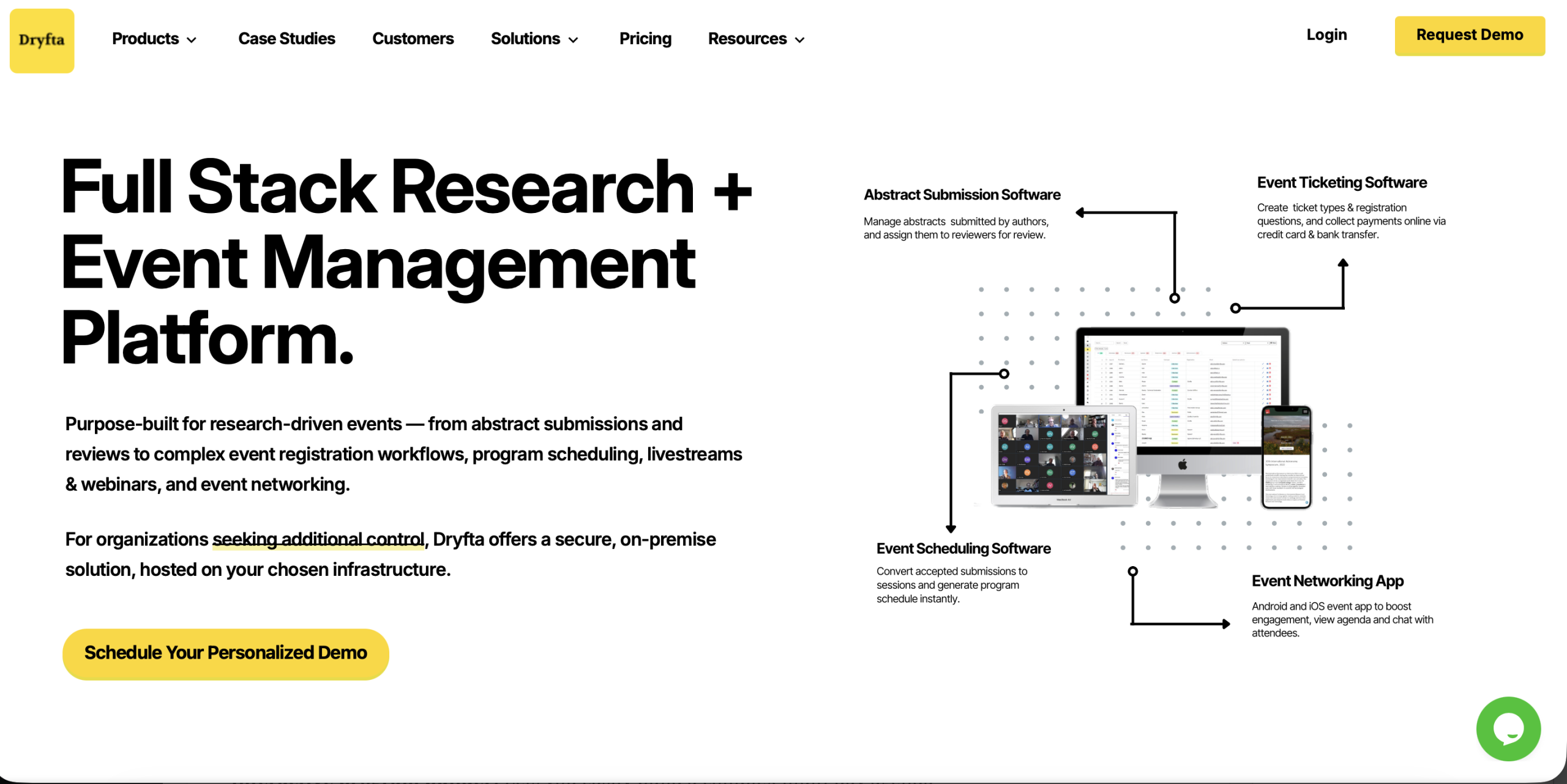
Dryfta emerges as one of the most worthy EventMobi alternatives in this list, among other brilliant options. It’s an all-in-one event platform specifically catering to academic conferences, research institutions, and non-profit organizations. It features an advanced abstract submission and peer review system that’s unmatched by event industry standards.
Core Functionalities:
-
- Abstract submission and review system: Dryfta’s abstract management system offers a completely automated abstract submission, reviewer assignment, and multi-layered peer review system.
- Registration and ticketing platform: The built-in registration and ticketing software comes with tiered pricing options and supports multiple payment gateways, so attendees can pay for the tickets from different locations internationally.
- Schedule builder: Lets users create multi-track agendas, which can be synced with the event website and mobile app to ensure attendees receive real-time updates.
- Intuitive mobile app: Dryfta’s mobile app creates personalized schedules, supports live polling, and allows the use of digital badges to maintain optimum attendee experience during events.
- Hybrid and virtual event assistance: The platform offers various tools to support live streaming sessions, record individual sessions, and maintain online networking forums for remote attendees.
- Event CRM: The CRM functionality allows the organizers to store the speaker and attendee information effectively. It also presents in-depth analytics of the event attendance and shows where improvements are necessary in the future.
Challenges Noted By Users: Users have highlighted that training the event teams to use the modern features takes a while. However, many users also note that with the thorough demonstrations that the platform provides, the problem is easily avoided.
Stova
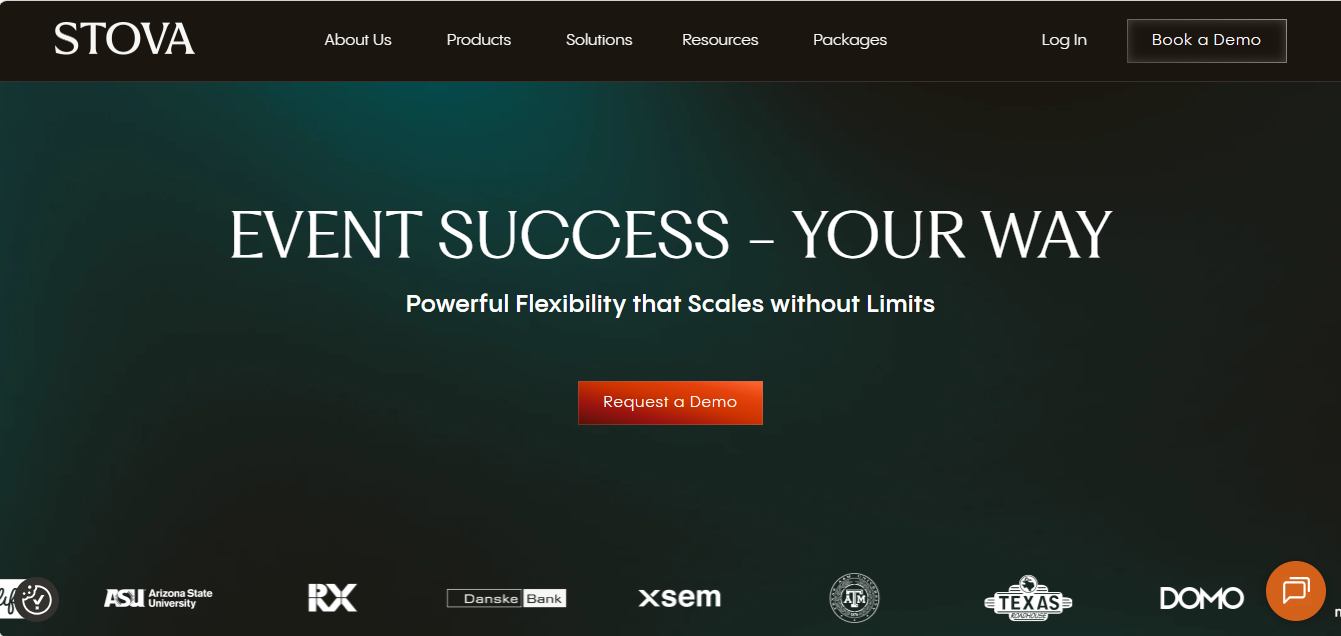
Stova was founded from the merger between MeetingPlay, Eventcore and Aventri. The platform is built to help nonprofits, corporate event teams, academic institutions and public sector organizations to host successful events. As one of the widely recognized EventMobi competitors, Stova offers a comprehensive system for event teams that involves virtual delivery, registration, networking, and much more.
Core Functionalities:
-
- Event Registration Management: The platform offers seamless online registration and attendee tracking features for managing event logistics.
- Attendee Engagement: It consists of features that support unfettered attendee interaction and community-building before, during and after the events.
- Enterprise-ready controls and Scale: Stova prioritizes multi-user permissions, configurable workflows and robust security infrastructure to assist larger events.
Challenges Noted by Users: Many users have complained about the limited flexibility for advanced customization. People have also highlighted that since the merger the user experience has become complicated with confusing navigation and settings.
vFairs
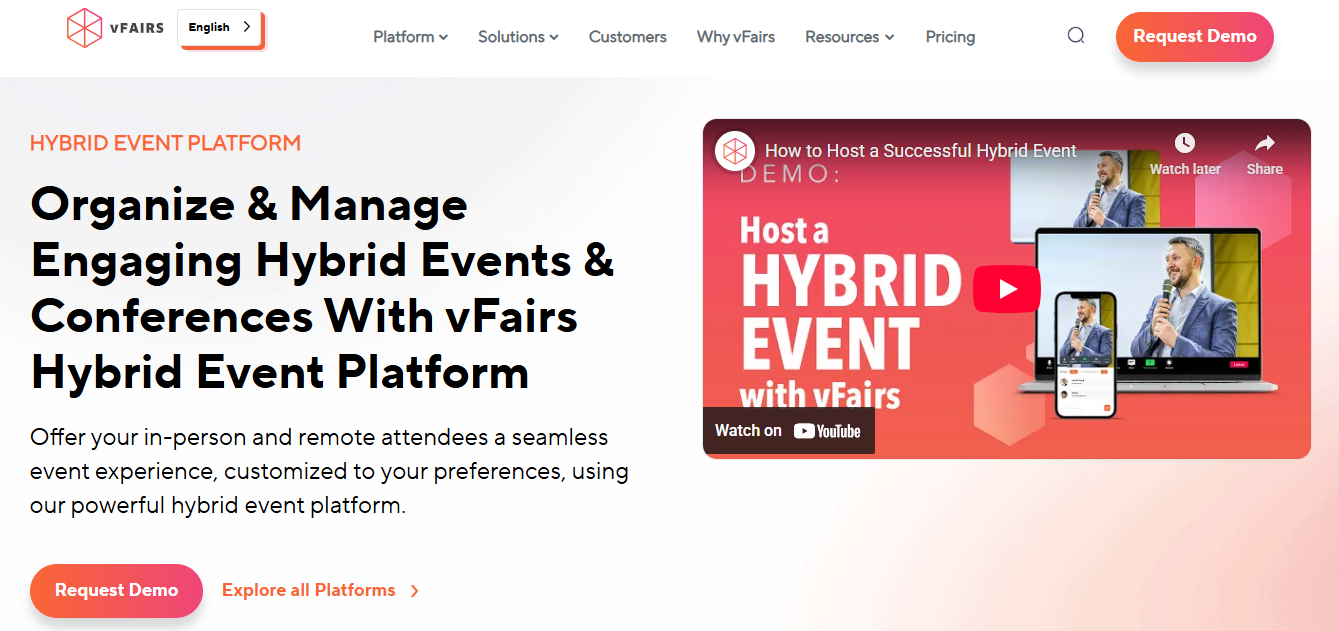
It’s a virtual-first event platform known for its 3D-style digital environments. It’s often considered one of the most popular EventMobi alternatives for hosting virtual expos, career fairs, or hybrid events. vFairs is often one of the go-to EventMobi alternatives for event planners when the focus is more on virtual interactions and visual experience than on-site features.
Core Functionalities:
-
- Support for virtual and hybrid events: The platform consists of tools to conduct engaging hybrid and virtual events.
- 3D intuitive event spaces: Attendees can enjoy a game-like environment with interactive virtual halls, auditoriums and booths which starkly differ from EventMobi’s app-centered interface.
- Event Marketing Tools: Promotional features such as dedicated landing pages and email campaigns help improve registrations and event visibility.
Challenges Noted by the Users: Many users have pointed out that the administrative processes are complex and time-consuming and even the routine tasks take longer to complete. People have also expressed concerns over connectivity issues during live sessions from the platform.
Micepad
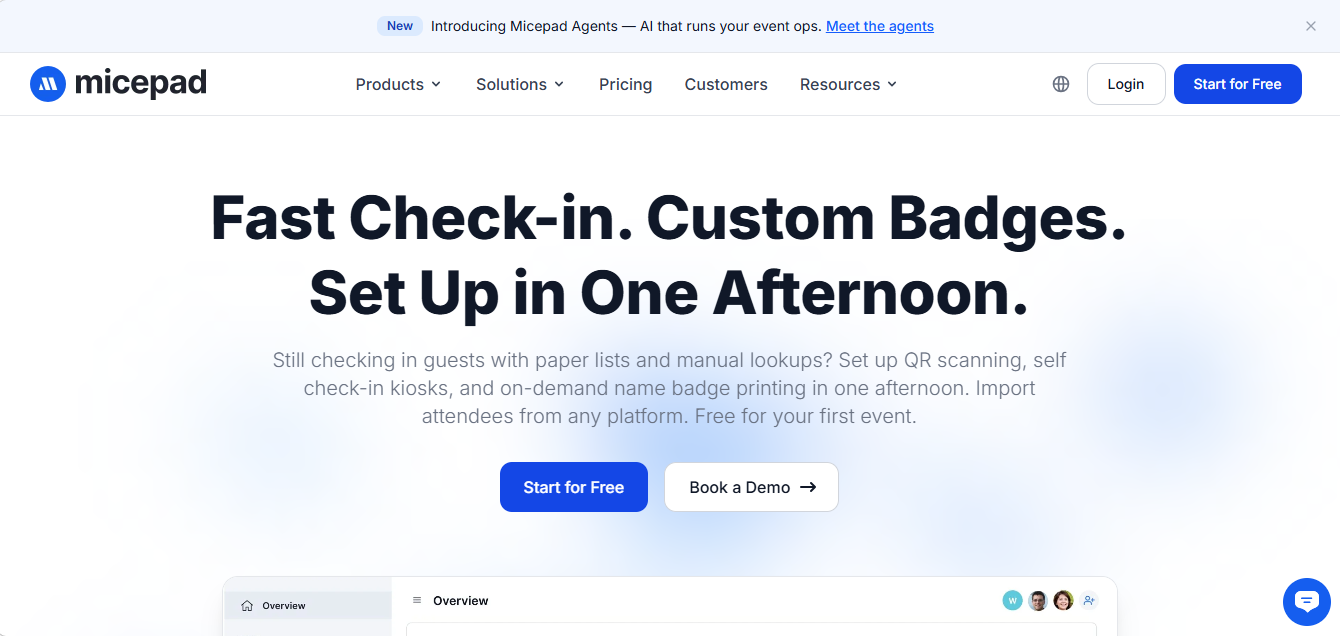
Micepad is another one of the decent event management software alternatives of EventMobi that specializes in hybrid and virtual events. It’s particularly ideal for event teams that focus on attendee engagement, branding, and registration. The platform supports many different types of event formats, which include large conferences, summits and smaller community-driven meetings.
Core Functionalities:
-
- Registration and ticketing: The tool offers multiple payment options, different ticket types and customized registration forms.
- Attendee engagement tools: The platform allows live polls, Q&A and gamification features to maintain optimum audience engagement.
- Responsive event app: Micepad’s mobile app offers access to interactive event schedules, speaker profiles, and document libraries.
- Hybrid and virtual event delivery: The tool presents a scalable event environment that is designed to support a large audience.
Challenges Noted by the Users: The onboarding process of the platform is quite steep. Several users have complained about latency issues between audio and video during live sessions.
Bizzabo
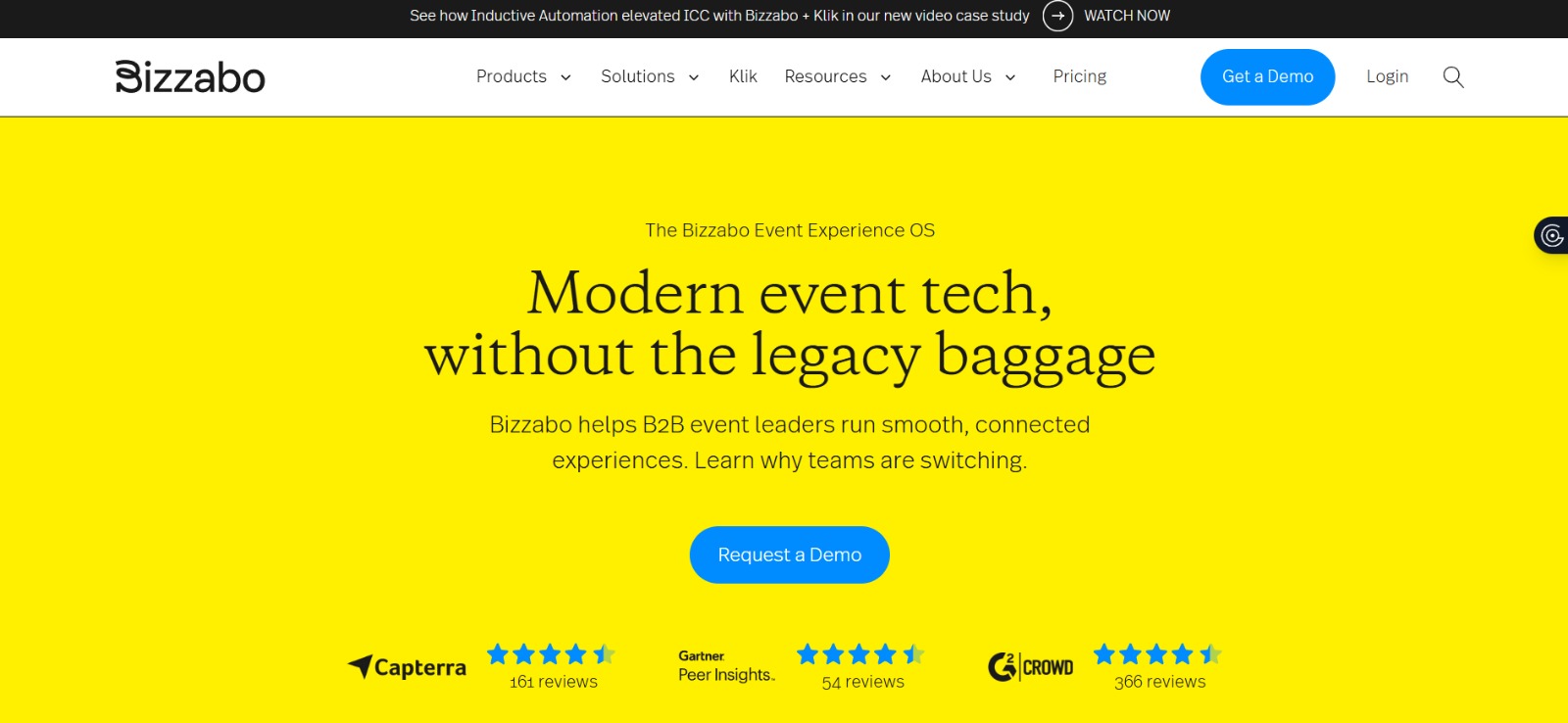
Bizzabo is a widely recognized enterprise event management platform created for B2B conferences and large-scale events. It’s one of the most preferred event management software alternatives for multiple sectors such as healthcare, technology and finance. Bizzabo puts more emphasis on analytics and sponsorship management, as compared to EventMobi.
Core Functionalities:
-
- Event registration: The system supports branded registration flows, session scheduling, and agenda creation to manage multiple events with one account.
- Enterprise-level security: Bizzabo offers centralized content libraries, single sign-on, custom apps, and dedicated IPs for enterprise event compliance needs.
- Dedicated Mobile App: The mobile app allows access to sessions, personalized agendas and real-time updates.
Challenges Noted by Users: The advanced features of Bizzabo often involve a complex setup process. Users also talk about limitations in customization and premium pricing, which makes it one of the most expensive event management software alternatives on this list.
How to Choose the Right EventMobi Alternatives?
It’s not unusual for event planners to struggle with choosing the right EventMobi alternative for their events. When there are so many options, it’s natural to feel decision fatigue. So, when you are doing your research and checking for event software comparison online, it’d be best if you remember the following factors:
Think about your budget: When searching for a suitable event management platform, always ensure the pricing is transparent and the fee structure is flat. Look for customization options: Check that the event pages, registration forms, and emails are customizable based on your brand’s requirements. Determine the user-friendliness: Go for an event platform that comes with a simple user interface and a clean dashboard. Check the integration options: The event platform you decide on should integrate with different tools, such as Google Analytics or Mailchimp. The Takeaway
The decision to choose an event management platform ultimately relies on the goals you have for your event. It also depends on the type of event you are hosting. For instance, academic conferences may need more structured tools, while large enterprise events may look for more in-depth reporting and integrations.
EventMobi alternatives like Dryfta works specifically well for academic conferences. Similarly, platforms like vFairs and Bizzabo may be ideal for large marketing- focused events. Weighing on every important aspects of each of these platforms allows you to make the right choice. Wondering what Dryfta can accomplish for you? Request a free demo and find out.
Best EventMobi Alternatives by Use Case
No single platform is the best fit for every event. Some are built for academic conferences, while others shine at enterprise events or hybrid experiences. Here’s where each EventMobi alternative stands out.
Best EventMobi Alternative for Academic Conferences
Dryfta
- Built specifically for conferences that rely on abstract submissions and structured peer review.
- Makes it easy to manage the entire scientific program without switching between multiple tools.
- A great fit for organizers who need flexibility without the complexity of enterprise software.
Best EventMobi Alternative for Enterprise Events
Stova
- Designed for organizations managing large-scale events with multiple teams involved.
- Supports complex event operations from planning through onsite execution.
- Works best for enterprises that need advanced integrations.
Best EventMobi Alternative for Hybrid Events
vFairs
- Helps organizers offer a streamlined experience for both in-person and virtual attendees.
- Creates branded event spaces that feel engaging.
- Well-suited for events where sponsors and exhibitors play a major role.
Best EventMobi Alternative for Executive Meetings
Micepad
- Built around audience participation rather than just presentations.
- Keeps attendees engaged with interactive meeting experiences throughout the event.
- A strong option for board meetings and corporate gatherings.
Best EventMobi Alternative for Marketing-Led Events
Bizzabo
- Ideal for organizations that view events as part of their marketing strategy.
- Helps teams understand attendee behavior with detailed reporting and analytics.
- Fits companies that want to connect event performance with business outcomes.
How to Switch from EventMobi to Another Event Platform
The decision to migrate from EventMobi to a new platform is, on its surface, a technical one. In practice, it is as much an organizational one, involving communication with authors, reviewers, sponsors and attendees, team retraining and careful timing relative to the event calendar. Having said that, it is considerably more manageable than it typically appears, particularly when approached in a structured sequence.
Export attendee data: Begin by exporting all attendee records from EventMobi in CSV format, including contact details, registration history, session selections and payment records. Verify the completeness and accuracy of this export before beginning any import into the new system.
Registration migration: Import attendee data into the new platform’s registration module. Confirm that custom field mappings are preserved and that any discount codes, group registrations or multi-ticket purchases are reflected accurately.
Agenda and speaker migration: Rebuild the conference schedule in the new platform’s scheduler. This is an opportunity to review and restructure the agenda rather than simply replicate it, since modern schedule builders offer considerably more flexibility than legacy systems.
Sponsor and exhibitor transfer: Recreate sponsor profiles, exhibitor booth configurations and lead capture setups in the new platform. Inform sponsors of the transition and provide updated instructions for accessing their profiles and data.
CRM migration: Reconfigure CRM integration settings in the new platform, including field mapping, deduplication rules and consent tracking. Test the data flow from registration to CRM before the event goes live.
Mobile app transition: Communicate the app transition to registered attendees well in advance of the event. Provide clear download instructions and, where possible, run both apps briefly in parallel to avoid disruption for attendees who have already installed the previous one.
Team onboarding: Invest time in a proper onboarding process for the planning team, making use of whatever training resources the new platform provides. The overhead is real but considerably smaller than the cost of managing a poorly executed transition at scale.
Timeline planning: Begin the migration at least eight to twelve weeks before the next event opens for registration. This provides enough time to resolve issues before they affect participants. For large events with complex sponsor configurations or multiple registration tiers, twelve weeks is a more reliable minimum.
Minimizing attendee disruption: Communicate the platform change proactively and positively. Attendees who have previously registered should receive clear guidance on what, if anything, they need to do differently. Frame the change as an improvement to their experience, because in most cases it genuinely is one.
Frequently Asked Questions (FAQs)
Which EventMobi alternative is the most affordable?
Of all the EventMobi alternatives that have been discussed here, Dryfta stands out remarkably because of its efficient yet cost-effective features and functionalities. Unlike many popular EventMobi alternatives, the platform maintains complete transparency when it comes to pricing and demands no additional charges to access its extensive features. The pricing plan comes in three categories: Small, Medium, and Large.
What features should I look for in an EventMobi alternative?
The features you should look for in EventMobi competitors depend a lot on the specific requirements you may have. For example, if you’re hosting an academic conference, then choosing event management software alternatives such as Dryfta or Ex Ordo may be a good idea. Even for enterprise events, Dryfta has been known to simplify event planning for organizers for close to a decade.
Are there EventMobi alternatives for large-scale events?
Some of the best event management platforms for large-scale events are Cvent(for enterprise), Bizzabo(hybrid) and Dryfta(all-in-one solutions). All of these EventMobi alternatives consist of features that streamline the planning and execution of large-scale events and are well-known for superior customization and scalability. For large-scale events, organizers may also prefer platforms that offer deeper analytics and sophisticated on-site technologies.
Which EventMobi alternative is best for academic or association events?
Dryfta is definitely one of the best event management platforms for hosting complex, research-driven events. The platform has already made its presence felt in some of the most coveted academic and research events of our time and has enriched those events with its advanced features. Some such features include abstract management, a triple-blind review system, and multiple submissions workflows.
Is there an EventMobi alternative with better customization?
Multiple EventMobi alternatives that present flexible and superior customization options. For example, Dryfta enables complete customizations for its registration and abstract submission forms. Similarly, there are other platforms, such as Eventsair, that offer branding customizations, and vFairs, which offers personalized virtual environments.
Do EventMobi alternatives offer mobile event apps?
Most of the prominent event management software alternatives have dedicated mobile apps. For example, Dryfta offers a native event app that supports private messaging, community platform, surveys and gamification. Bizzabo provides a comprehensive event experience app. Similarly, the mobile app of vFairs is focused on virtual and hybrid networking and on-site check-in and QR-code scanning capabilities.