
Your registration dashboard shows 520 delegates. The hotel’s latest pickup report shows only 91 rooms booked on the peak night, against 140 in the contract. The review date is days away.
The two figures may both be accurate. They simply measure different things. Registration tells you who plans to attend. The hotel report shows reservations credited to the room block. It does not automatically include attendees who booked elsewhere, shared a room, chose different dates or reserved without the group code.
Managing hotel room block attrition starts with that distinction. Compare contracted and credited room nights, investigate each material gap and make a documented decision before the relevant deadline. If you are still choosing a destination or property, start with Dryfta’s guide to choosing a conference destination and its advice on what to review before booking a venue. This article begins after your team signs the room-block agreement.
Start with room nights, not registration totals
A room block is a set of commitments across specific nights. One attendee staying for three nights creates three room nights. That is why a respectable total can hide a weak peak night.
Consider this illustrative three-night block:
| Night | Contracted room nights | Current pickup | Current gap |
|---|---|---|---|
| Arrival night | 80 | 62 | 18 |
| Peak night | 140 | 91 | 49 |
| Final night | 90 | 74 | 16 |
This example does not calculate a penalty because it does not state the agreement’s terms. The 49-room gap on the peak night deserves attention, but the signed agreement determines whether that gap creates exposure.
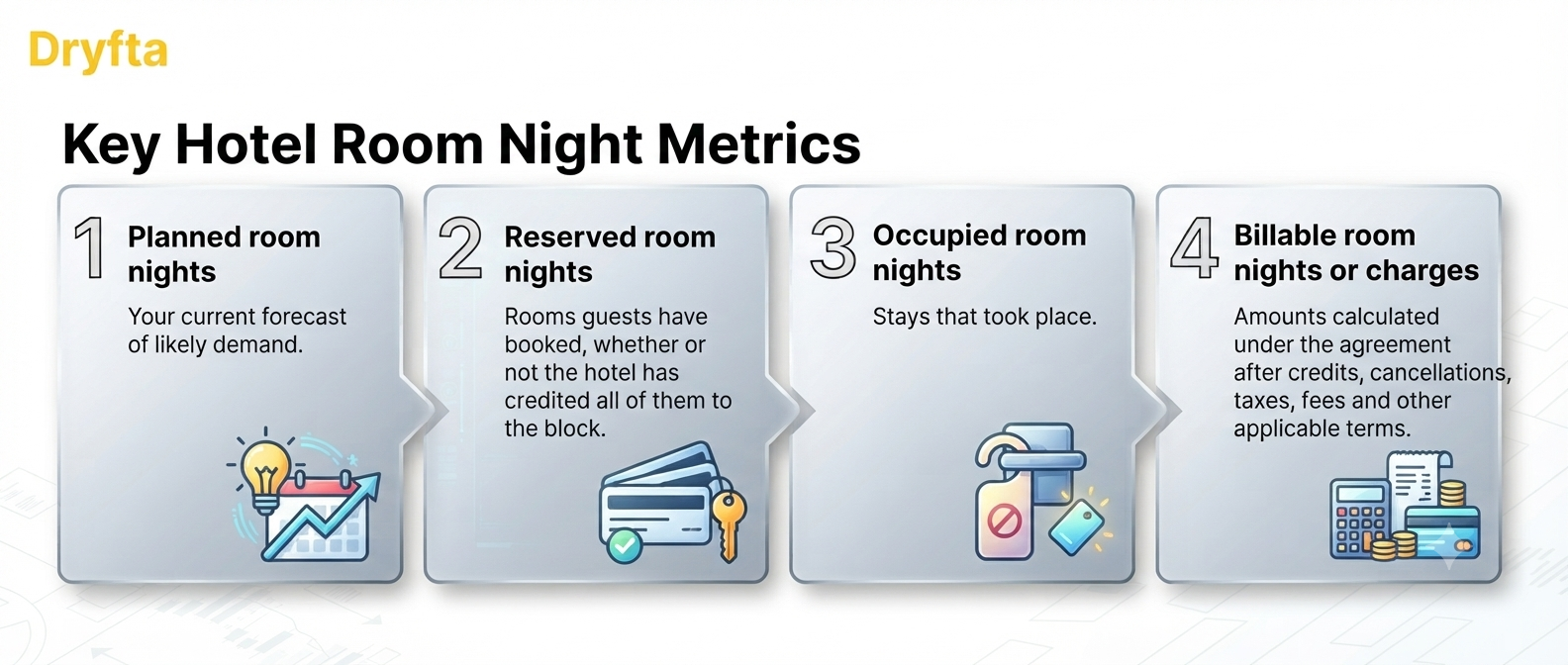
Keep four figures separate:
- Planned room nights: Your current forecast of likely demand.
- Reserved room nights: Rooms guests have booked, whether or not the hotel has credited all of them to the block.
- Occupied room nights: Stays that took place.
- Billable room nights or charges: Amounts calculated under the agreement after credits, cancellations, taxes, fees, and other applicable terms.
Ask the hotel for pickup by night, not just a cumulative total. A single total can look healthy while the peak night remains exposed. If the report shows only one figure, request the nightly split in writing.
Turn the signed agreement into a working calendar
The agreement contains the dates and rules that shape every decision. Review it with the appropriate procurement or legal adviser, then extract the facts your operating team needs:
- Contracted rooms for each night.
- The method used to measure pickup, such as nightly or cumulative performance.
- Review dates and any reductions permitted at each stage.
- The cutoff or release date.
- Rules for approved off-block credit.
- Treatment of cancellations, no-shows and early departures.
- Taxes and fees used in any calculation.
- The pickup-report format and hotel contact.
- The person authorized to approve a release or amendment.
Do not paste clauses into a spreadsheet and call it advice. Turn each term into a date, an owner and a piece of evidence. Anything that cannot become one of those three deserves a question for your adviser. A review date is a good example. It may be the last moment a reduction is allowed, or it may only be a checkpoint, and the difference decides whether a hard conversation is optional or urgent. Read it, ask and write the answer next to the date in your own calendar.
Build a forecast from evidence that measures different things
Registration totals can feel decisive, but they measure attendance, not hotel choice. Four inputs help build a room-night forecast, and each has a blind spot.
| Input | What it can reveal | What it cannot prove |
|---|---|---|
| Current registrations | Attendance volume and timing | Hotel choice or length of stay |
| Registration questions | Stated travel plans, if collected appropriately | A completed reservation |
| Historical stay pattern | Likely nights and booking pace | Current-year behaviour |
| Hotel pickup report | Reservations credited to the block | Every attendee staying at the hotel |
Forecast by attendee segment and by night. Speakers and staff may arrive earlier than general delegates. Exhibitors may leave after the final public session. Local attendees may need no hotel room, while colleagues or family members may share one.
Suppose 520 people have registered for an association conference. The number sounds reassuring, but it does not answer the hotel question. The organizer still needs to estimate how many attendees will travel, which nights each group will stay, how many will share and how many may book outside the block. A forecast that records those assumptions is more useful than one confident total with no explanation.
Use aggregated counts whenever possible. A forecast rarely needs passport details or a full guest profile. Collect only the travel information the team genuinely needs, explain why you need it and protect it under the relevant privacy and contract controls.
Read pickup as a trend
Conference room block pickup is a moving picture. Compare each hotel pickup report with the prior report, the same point in a comparable year where you have one, the registrations added since the last report, any deadline that may change booking pace and any group or VIP rooming lists not yet loaded.
A slow week does not automatically justify a release, and a late surge does not erase exposure. The decision depends on the evidence, time remaining and contract terms. For example, imagine peak-night pickup rising from 86 to 91 rooms over a week. Whether that is encouraging or concerning depends on the timeline, any recent campaign, outstanding rooming lists and the contract’s decision dates. If the latest report is two weeks old, you are reading history, not a current trend.
Assign each decision before the deadline arrives
A table beats a checklist here, because every row names an owner.
| Decision point | Evidence reviewed | Decision owner | Possible action | Record kept |
|---|---|---|---|---|
| Contract review date | Pickup, forecast and pace | Named owner | Hold, reduce or request amendment | Written decision and assumptions |
| Before cutoff | Pickup by night and unresolved bookings | Named owner | Release only where permitted | Written hotel confirmation |
| Final pre-event review date (set by event schedule) | Near-final pickup and rooming changes | Named owner | Resolve exceptions | Pickup report and exception log |
| After event | Final stay report and credits | Finance and operations | Reconcile or dispute discrepancies | Approved closeout record |
The agreement defines the dates and rights, and written sign-off should follow your organization’s authority rules. Name a decision owner and backup before the cutoff so a release or amendment does not wait on one person.
Investigate the gap before treating it as a shortfall
With 520 delegates registered, 140 rooms contracted for the peak night and 91 currently credited to the block, the 49-room difference needs investigation. It is not yet a confirmed shortfall. Run an off-block room audit first. Several explanations are possible. Attendees may have booked without the group code, a third-party channel may have hidden attribution, names may differ between registration and hotel records, colleagues may share a room, local attendees may need no room, stay dates may fall outside the standard pattern or a rooming list may not have been loaded.
Matching names and dates is a process job. Use a secure transfer, send only the fields needed and follow the privacy and contract controls that apply. Never post a guest list publicly or send it loosely by email, however urgent the deadline feels. Start by matching on last name and arrival date, then look at the leftovers by hand. Some discrepancies may narrow once eligible bookings are credited to the block. Confirm each stay with the hotel and check whether the agreement allows it; take unresolved gaps to the hotel with supporting records.
- Correct the record: Resolve missing credit, name mismatches, and unposted rooming lists.
- Update the forecast: Use the newest pickup, registration pace, and segment assumptions.
- Use available options before they expire: Follow any permitted reduction, release, or mitigation route in the agreement.
- Escalate the exposure: Give the authorized owner the current evidence, deadline, and potential financial effect.
The organizer can ask the hotel about mitigation but should never assume a waiver. Put the request, supporting evidence, hotel response, amended terms, and internal approval in writing. A clear request sent before the deadline gives both parties something concrete to evaluate.
Reconcile the Final Report Before Closing the Event File
The work continues after the conference. Conference housing reconciliation should compare:
- Contracted room nights.
- Approved reductions or amendments.
- Final occupied and credited nights.
- Eligible off-block credit.
- No-show and early-departure charges.
- Complimentary rooms and agreed concessions.
- Applicable taxes and fees.
- The final calculation under the agreement.
Assign every unresolved discrepancy to an owner and set a response date. Keep the final hotel report, approved calculation, supporting correspondence and lessons for the next event in the closeout file.
Then compare the final result with the forecast. Did one attendee segment stay fewer nights than expected? Did a registration deadline change booking pace? Did a rooming list arrive late? Those answers give the next organizing team a stronger starting point.
Where Dryfta data can help
Registration records can show booking pace, attendee categories and the travel answers you deliberately collect. Those inputs can support a forecast and a room audit, provided you ask for travel plans deliberately, explain why you are asking and collect no more than you need. If you want to see how that data is gathered, read here about event registration and ticketing.
The hotel remains the source for pickup, occupied-night and billing records unless a specific current integration is verified. Dryfta does not automatically calculate contractual attrition or reconcile a hotel invoice.
To see how registration data can feed your own forecast, request a demo from Dryfta here.
Frequently Asked Questions (FAQs)
What is hotel room block attrition?
It is the shortfall between the room nights you contracted and the room nights the hotel credits to your block, measured as the agreement defines it. Terms such as cumulative or per-night measurement can change the result, so always check the signed terms for how it is calculated.
Is the cutoff date the same as the attrition deadline?
Not necessarily. Cutoff, review and attrition dates can differ, and each may carry different rights. Read the agreement, list every date separately and confirm each one with an authorized adviser before you plan around it.
Can rooms booked outside the group code count toward pickup?
Sometimes, if the agreement allows credit for approved off-block stays. It depends on the signed terms and the hotel’s acceptance, so never promise it to an attendee or a colleague. Ask the hotel how such stays are verified.
How often should a conference request pickup reports?
Request pickup reports often enough to review the trend before each decision date. Agree on the reporting schedule with the hotel and check any requirements in the contract.
Make the Next Decision Visible
Start with a current nightly pickup report. Check uncredited bookings against the agreement, update the forecast and give the authorized decision-maker a documented recommendation before the relevant deadline.
No forecast will be perfect. After the event, compare your assumptions with actual stays and pickup, then record what should change for the next forecast.