



Have you ever walked into a store thinking you’ll spend a little, only to leave wondering where all your money went? Conference software shopping can feel exactly the same.
At first, every platform seems like a good deal. Then you book a demo, discover a few must-have features aren’t included, or find out the price depends on how many submissions you receive. Before you know it, comparing platforms isn’t nearly as straightforward as you expected.
So, how much does abstract management software actually cost in 2026? More importantly, what are you really paying for?
That’s exactly what this guide answers. We’ve compared the most popular platforms, explained the different pricing models, highlighted the hidden costs you should watch for, and broken everything down in simple English. By the end, you’ll have a much clearer picture of abstract management software pricing and know which platform gives you the best value for your conference.
What Abstract Management Software Actually Costs in 2026 — The Real Range
Most vendor websites don’t tell you how much their abstract management software costs. Instead, they ask you to “Book a Demo” before sharing a price because they want to know your budget before sharing a quote. This guide gets past all that and shows you the real price range in the market this year, so you have a realistic idea of how much does abstract management software cost before you start contacting vendors.
Most platforms fall into one of these three categories:
- Free or freemium platforms
These tools cost nothing upfront but usually limit the number of submissions you can make or take a percentage of your ticket sales. They work well for small conferences, workshops, first-time organizers, and nonprofit events. Basic plans let you collect a small number of papers for free. But advanced features like blind peer review and custom scoring are only available on paid plans. - Transparent published pricing
This is the sweet spot for mid-sized annual academic conferences. Paid tiers typically range from $800 to $1,500 per event or use flat annual rates, with platforms like Dryfta starting at $1,499 per year. These packages include robust multi-track scheduling and communication tools, meaning you know exactly how much does abstract management software cost upfront without hidden transactional fees. - Enterprise quote-based pricing
Large conference platforms usually offer custom pricing rather than fixed plans. The final cost depends on factors such as event size, required modules, integrations, and support. While this approach offers flexibility, it also means you’ll need to speak with the sales team to understand your actual abstract management software pricing. Platforms like Cvent or Cadmium scale their abstract management software cost based on submission volume and required integrations, with custom setups easily ranging from $2,000 to well over $8,000 per event.
The Three Abstract Management Pricing Models — And What Each Means for Your Budget
You’d think finding abstract management software pricing would be easy. What you actually get is this. One platform lists a price. Another asks you to book a demo. A third tells you to “contact sales.” Before long, you’re comparing apples to oranges and still wondering what you’ll actually pay.
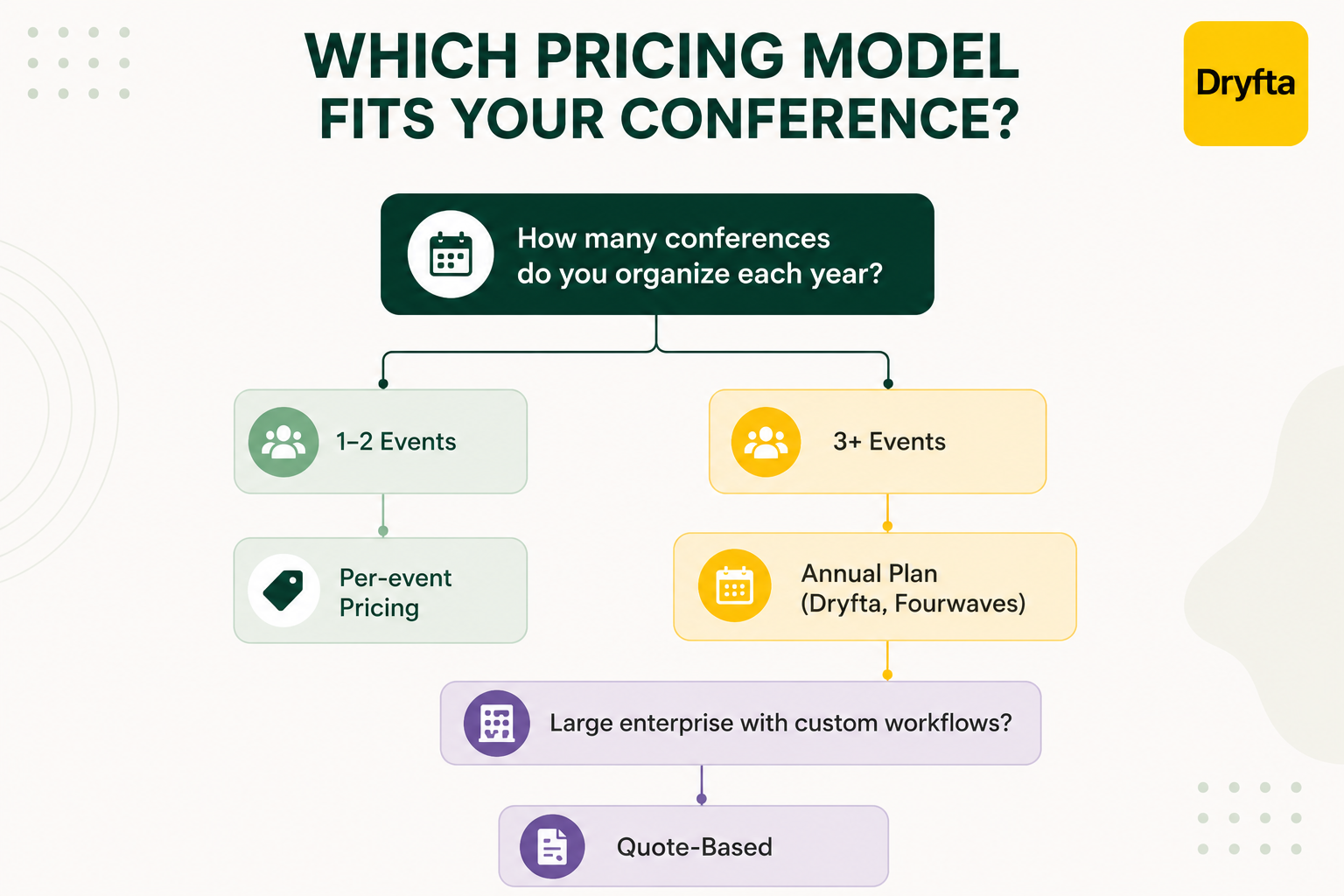
Thankfully, most vendors use one of three pricing models. Learn how they work, and estimating your abstract management software cost becomes a breeze.
Model 1: Per-Event Flat Fee
Hosting only a couple of conferences each year? This model is often the easiest to budget for. You pay a fixed fee for each event and that’s usually it. No long-term commitment, which makes it a great fit for universities and organizers who run conferences occasionally.
Model 2: Annual Subscription
Running multiple conferences every year? An annual subscription makes more sense and can be the more cost-effective option for you. Instead of paying for each event, you pay once and use the platform as much as your plan allows. It may cost more upfront, but you’ll often spend less on abstract management software cost in the long run.
Model 3: Quote-Based or Custom Enterprise Pricing
Don’t expect to see a price tag here. Most enterprise vendors keep their abstract management software pricing off their website and prepare a custom quote instead. They’ll consider your event size, submission volume, features, integrations, and support needs before giving you a price. It takes an extra step but it also means you get a plan that fits your event.
Here’s what we’d suggest you do: Don’t jump straight into comparing platforms. First, figure out which pricing model fits your conference. It narrows your options and makes abstract management software pricing much easier to compare.
Abstract Management Software Pricing Comparison Table (2026)
| Platform | Starting Price | Pricing Model | Free Tier | Best For |
|---|---|---|---|---|
| Dryfta | $1,499/year | Annual subscription + Quote-based | ❌ No(2 free training sessions included) | Universities and organizations managing multiple academic conferences |
| Oxford Abstracts | Free / $890 per event | Per-event | ✅ Yes | Research-focused conferences and scholarly events |
| Fourwaves | Free / $899/year | Annual subscription | ✅ Yes | Academic conferences that want transparent pricing |
| Whova | Custom quote | Quote-based | ✅ Limited (free ticketing for free events) | Conferences needing all-in-one event management |
| EasyChair | Free / $4 per submission | Pay-as-you-go, Fixed price, Deposit | ✅ Yes | Paper submissions and peer review |
| Microsoft CMT | Free | Free | ✅ Yes | Eligible academic conferences focused on peer review |
| Ex Ordo | Custom quote | Quote-based | ❌ No | Scholarly and scientific conferences |
| OpenWater | Custom quote | Quote-based | ❌ No | Associations, nonprofits, and enterprise organizations |
| ConfTool | Custom quote | Quote-based | ❌ No | Academic conferences of all sizes |
| Cvent | Custom quote | Quote-based | ❌ No | Large enterprise conferences with complex event management |
Platform-by-Platform Pricing Breakdown
Alright, let’s talk numbers. Some vendors are upfront about it and some are not. On top of that, there are the platforms that charge extra for features that feel like they should come standard. To save you the back and forth, here’s a simple breakdown of each platform’s abstract management software pricing, what’s included, what costs extra, and where surprise costs can pop up.
1. Dryfta
Dryfta is an all-in-one conference management platform built specifically for academic events. Rather than switching between different tools for abstract submissions, peer review, registration, speaker management, and scheduling, you can manage the entire event from a single platform. That’s why it’s a popular choice for universities and scholarly societies.
What’s included:
- Abstract submission and peer review
- Registration and ticketing
- Speaker and attendee management
- Session scheduling
- Event website
- Mobile event app
- Email communication
- Reporting and analytics
Pricing model:
- Small: $1,499/year
- Medium: $14,999/year
- Large: Quote-based
What costs extra:
- Additional training sessions beyond the two free onboarding sessions ($80/hour).
- Advanced features like the networking app and participation certificates are available on higher-tier plans.
Notable strengths:
- Transparent pricing with no per-attendee fees.
- Blends abstract management, registration, scheduling, and CRM in one platform.
- Well suited for organizations that run multiple conferences each year.
Considerations:
- The Small plan has submission and attendee limits.
- The annual subscription may not be the best fit for organizers running small-scale events.
The best way to know if it’s right for your conference is to try it. Schedule a free demo and let our team walk you through the platform.
2. Oxford Abstracts

Oxford Abstracts puts abstracts and peer review front and center. Once those are covered, you also get tools for conference programs, event websites, virtual and in-person events, and attendee engagement. That’s why it’s a popular option for research-focused conferences.
What’s included:
- Unlimited abstract submissions
- Reviewer assignment and reporting
- Conference program builder
- Live and virtual event support (higher plans)
- Conference website builder and attendee networking (Professional plan)
Pricing model:
- Free
- Abstract Management: $890/event
- Standard Conference: $2,290/event
- Professional Conference: $3,450/event
What costs extra:
- Multi-stage submissions: $850/event
- Symposium management: $850/event
- Certificates: $150/event
- Conference website builder: $200/event
Notable strengths:
- Transparent per-event pricing.
- Strong abstract submission and peer review features.
- Free plan available for small meetings and events.
Considerations:
- Several useful academic features are priced as add-ons.
- Costs can increase as more conference modules are added.
3. Fourwaves
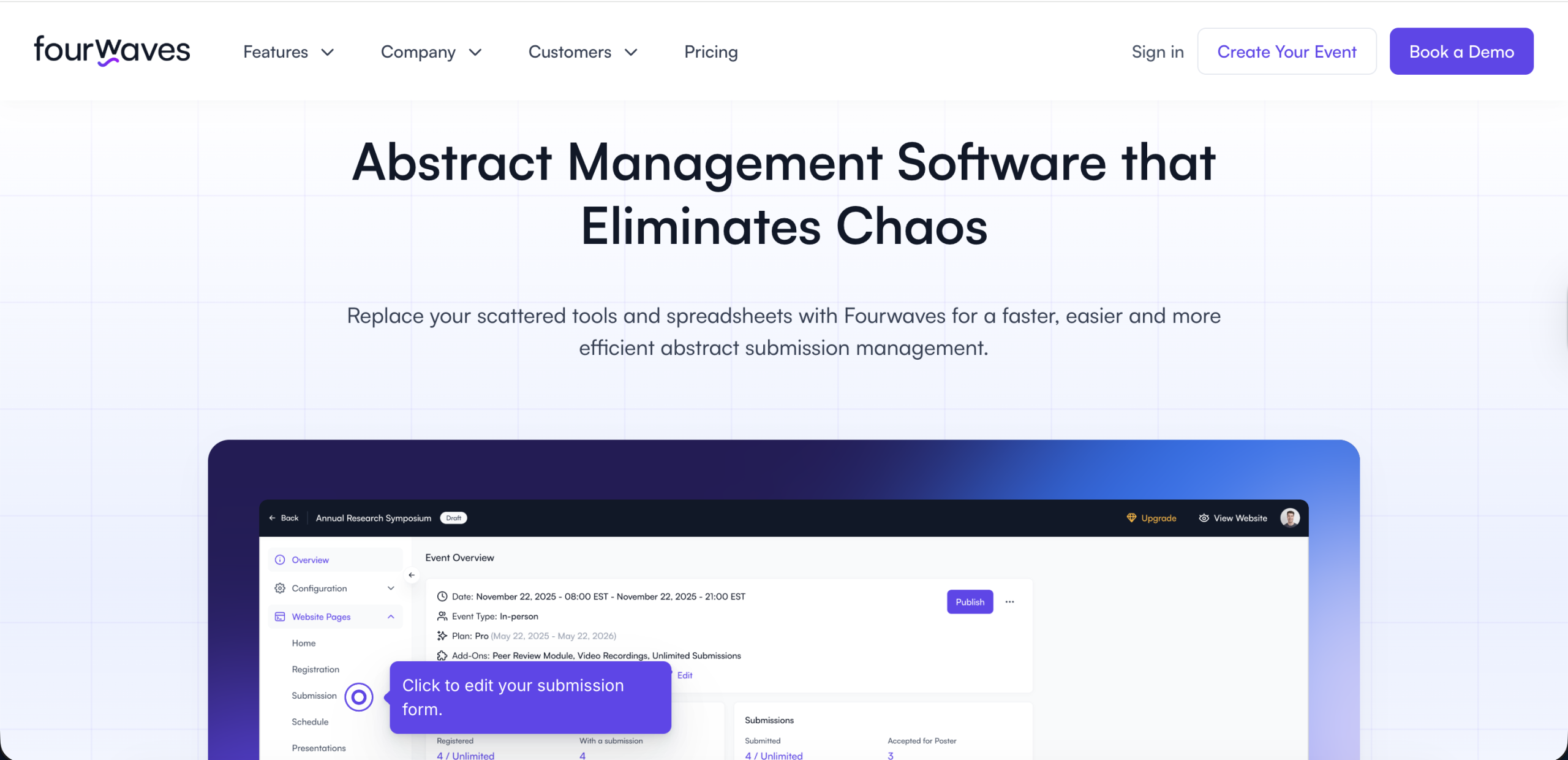
Fourwaves takes a pretty straightforward approach to conference management. Instead of sending you from one tool to another, it lets you handle abstracts, reviewers, registration, and your event website from the same platform. The abstract management software pricing is transparent with published annual plans, so you know what you’re signing up for.
What’s included:
- Unlimited events and registrations
- Event website builder
- Abstract submissions and registration
- Certificates (Advanced plan)
- Peer review module (Pro plan)
Pricing model:
- Free
- Essential: $899/year
- Advanced: $1,799/year
- Pro: $4,799/year
What costs extra:
- Peer review module: $799/active event
- Unlimited submissions add-on: $499/active event
- Virtual platform: $999/active event
- Video recordings: $499/active event
Notable strengths:
- Good feature set for academic and research events.
- Three-year pricing option offers discounted rates.
- Transparent annual pricing with a free plan.
Considerations:
- Several academic features require separate add-ons.
- A 3% service fee applies on most plans, while the Pro plan reduces it to 2.5%.
4. Whova
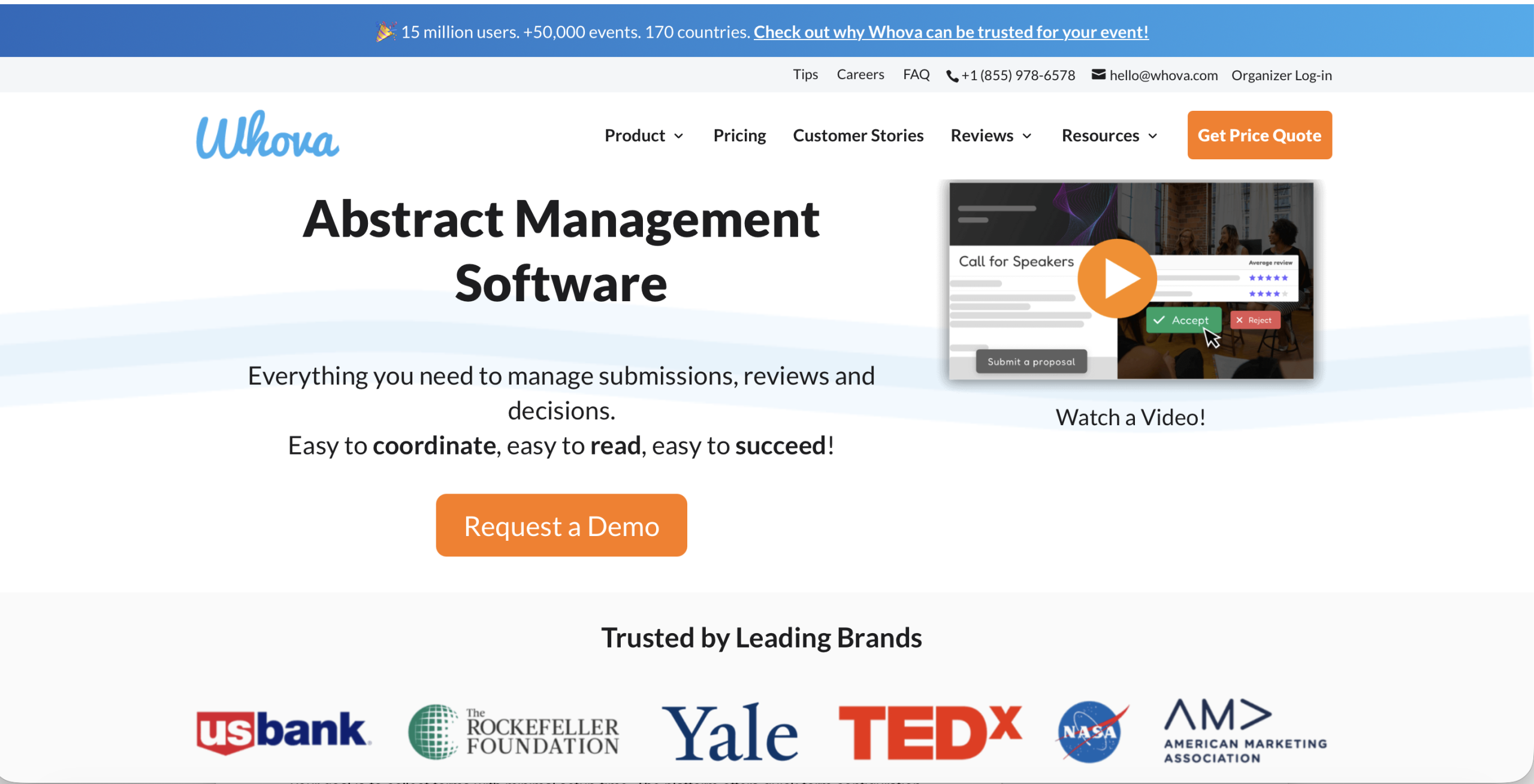
Whova is an all-in-one event management platform that includes abstract collection, speaker management, registration, networking, and a mobile event app. Its abstract management software pricing is not publicly listed, so organizers must request a custom quote.
What’s included:
- Abstract and speaker submission management
- Configurable peer review workflow
- Reviewer assignment and scoring
- Event registration and ticketing
- Mobile event app and networking
Pricing model:
- Quote-based custom pricing
- Free ticketing for free events
- Paid ticketing fees apply for paid events
What costs extra:
- Registration and payment processing fees for paid events.
- Some advanced modules and higher submission limits depend on the selected package or custom quote.
Notable strengths:
- Strong all-in-one platform that combines abstract management, registration, agenda management, and attendee engagement.
- Eliminates the need to export accepted abstracts into a separate scheduling system.
Considerations:
- No publicly available software pricing, making budget comparisons more difficult.
- Submission limits increase with higher-tier packages.
5. EasyChair
EasyChair is a long-standing conference management platform used primarily for paper submissions and peer review. Its abstract management software pricing is more flexible than that of many platforms, as organizers can choose between fixed pricing and usage-based billing based on the expected number of submissions.
What’s included:
- Abstract and paper submissions
- Peer review workflow
- Reviewer assignment
- Multiple payment plans
- Support for several currencies
Pricing model:
- Free License (up to 20 submissions)
- Professional License: Pay-as-you-go from $4 per submission (up to 60 submissions)
- Executive License: Fixed price or pay-as-you-go
- VIP License: Fixed price, pay-as-you-go, or deposit plan
What costs extra:
- Submission fees increase based on license type and submission volume.
- VIP licenses include a one-time setup fee starting at $1,370.
Notable strengths:
- Flexible pricing with fixed-price and pay-as-you-go options.
- Free license available for small conferences.
- Discounts of up to 40% are available for larger submission volumes.
Considerations:
- Pricing is based primarily on the number of submissions rather than a complete conference platform.
- Understanding the different license tiers can take some time for first-time organizers.
6. Microsoft CMT (Conference Management Toolkit)
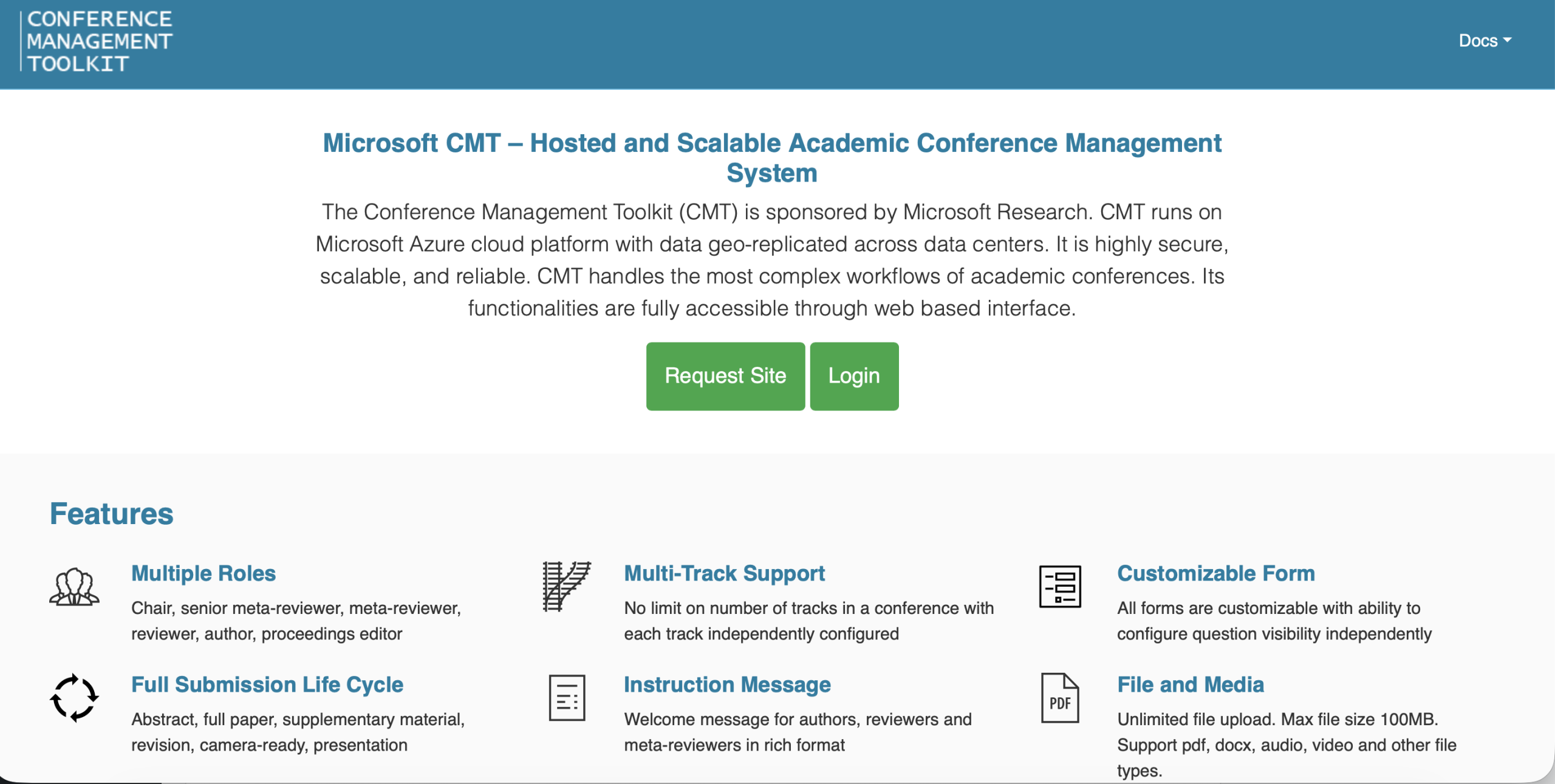
Microsoft CMT is a cloud-based conference management system developed by Microsoft Research for academic peer review. Its abstract management software pricing is simple because the platform is completely free for eligible academic conferences. However, it focuses on the submission and review process rather than providing a complete end-to-end conference management solution.
What’s included:
- Free abstract and paper submission management
- Peer review workflow
- Multi-track conference support
- Custom submission and review forms
- Full paper lifecycle from submission to camera-ready version
Pricing model:
- Free for eligible academic conferences
- No licensing or subscription fees
What costs extra: None. Microsoft Research does not charge for using CMT or accept payments for the platform.
Notable strengths:
- Completely free for academic conferences.
- Trusted by thousands of conferences worldwide.
- Highly scalable with strong peer review features.
Considerations:
- Designed only for academic peer review rather than full event management.
- Does not handle registration, payments, attendee management, or event logistics.
7. Ex Ordo

Ex Ordo is designed specifically for scholarly, scientific, medical, and technical conferences. Its abstract management software pricing is quote-based, so organizers need to contact the sales team for a custom proposal based on their event size and requirements.
What’s included:
- Abstract and paper submission management
- Configurable peer review workflow
- Reviewer assignment and scoring
- Conference program management
- Registration and virtual event support
Pricing model: Quote-based custom pricing
What costs extra:
- Ex Ordo lets organizers add book of abstracts and proceedings preparation to their package.
- Pricing for optional services is available through the sales team.
Notable strengths:
- Built specifically for academic and research conferences.
- Strong peer review and abstract management features.
- Supports in-person, virtual, and hybrid conferences.
Considerations:
- Pricing is not published, making it difficult to compare costs before requesting a quote.
- Some services, such as book production, are offered as paid add-ons.
8. OpenWater
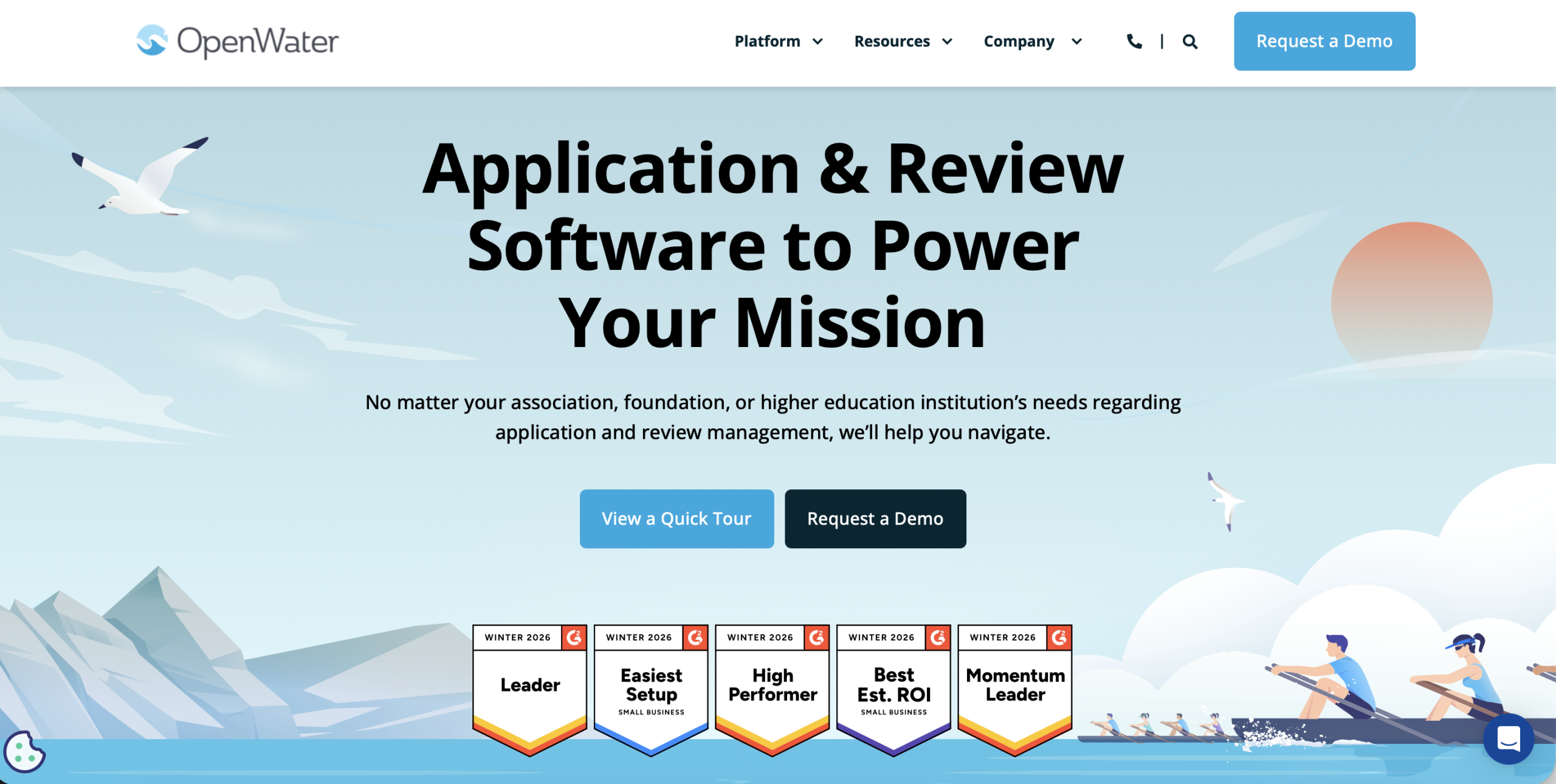
OpenWater is an enterprise conference management platform built primarily for associations, nonprofits, universities, and professional organizations. It is best suited for conferences that need highly configurable workflows and are willing to trade simplicity for flexibility. Its abstract management software pricing is quote-based.
What’s included:
- Multi-round abstract submission and peer review
- Reviewer assignment, scoring, and conflict management
- Session builder and conference agenda creation
- Speaker management
- Conference website builder
Pricing model: Quote-based enterprise pricing
What costs extra: Pricing for optional modules is not published.
Notable strengths:
- Strong integration capabilities with AMS, CRM, payment gateways, and association systems.
- Suitable for organizations managing large conferences alongside awards, grants, fellowships, or scholarship programs on the same platform.
Considerations:
- No transparent pricing.
- Larger organizations benefit the most from OpenWater, while smaller conferences may not need all of its capabilities.
9. ConfTool
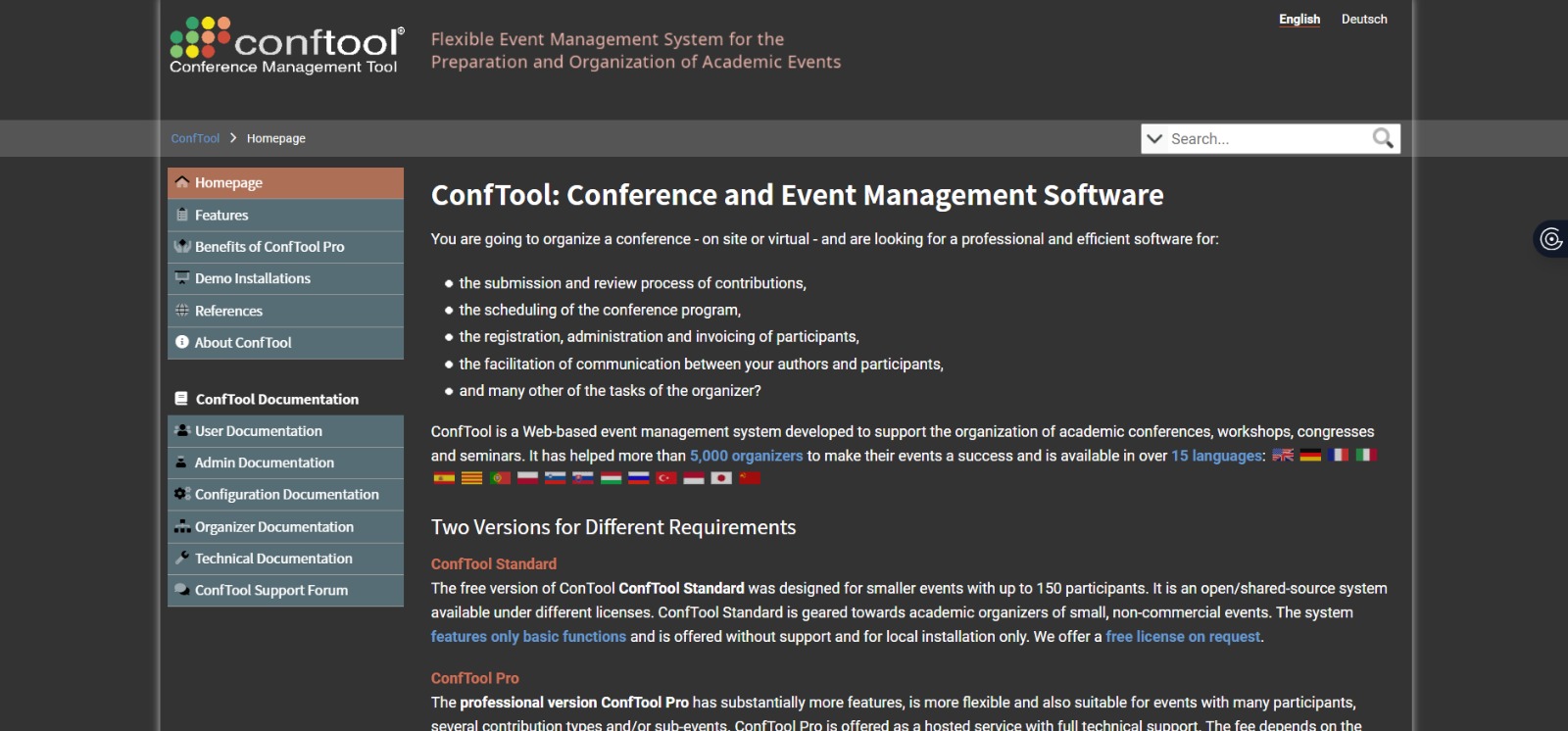
ConfTool is a long-established conference management platform designed primarily for academic and research events. It is popular among universities and scholarly societies that need a reliable system without enterprise-level complexity.
What’s included:
- Abstract and paper submission
- Peer review management
- Conference registration
- Session scheduling
- Participant and speaker management
Pricing model: Quote-based custom pricing
What costs extra:
- Pricing depends on the number of participants and selected modules.
- Optional services and customizations may increase the overall cost.
Notable strengths:
- Built specifically for academic conferences.
- Supports conferences ranging from small workshops to large international events.
Considerations:
- No public pricing, making abstract management software pricing harder to compare.
- The interface feels more functional than modern.
10. Cvent
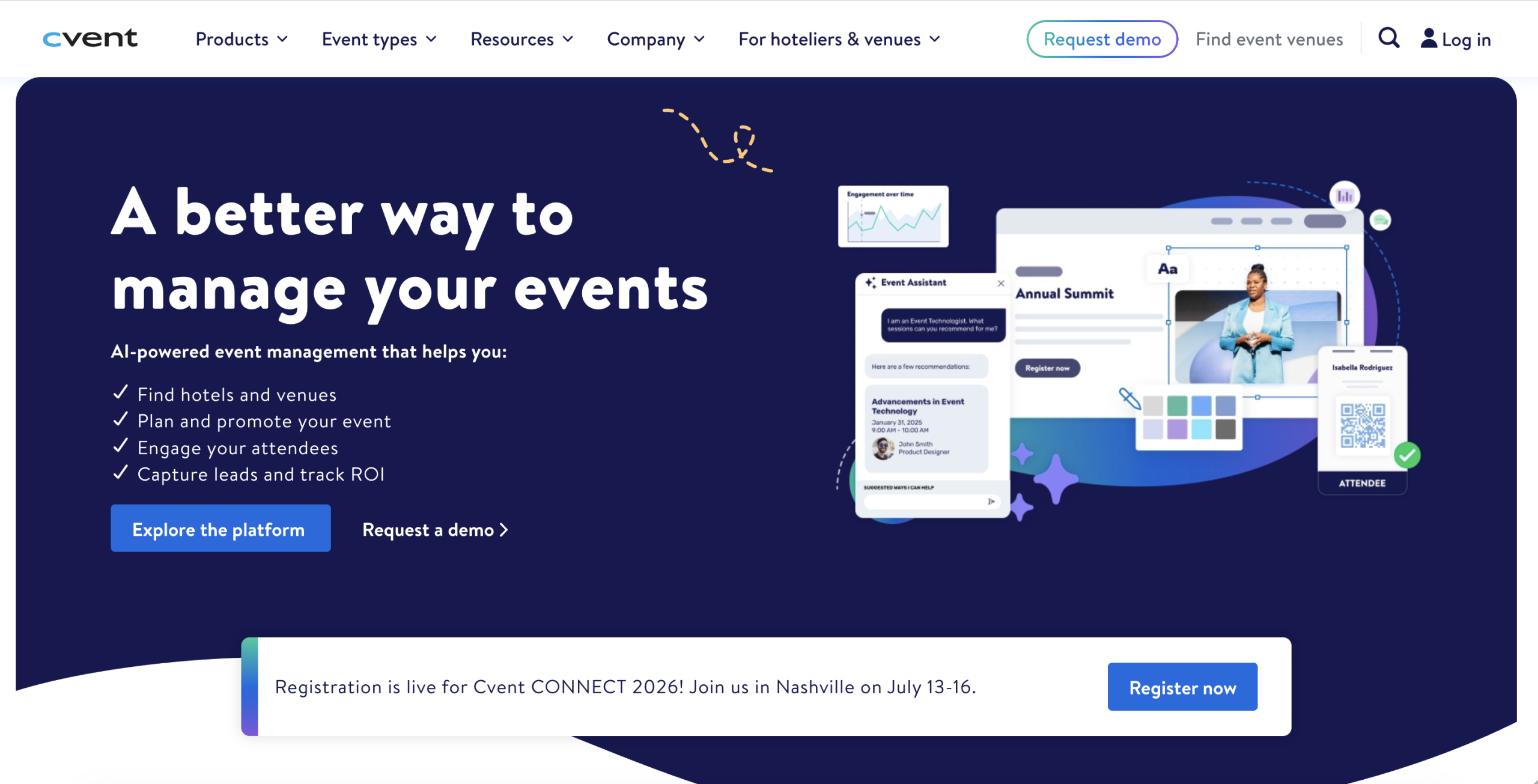
Cvent is an enterprise event management platform used by corporations, associations, universities, and government organizations worldwide. It is best suited for organizations managing large conferences with complex logistics and multiple stakeholders.
What’s included:
- Abstract and paper submissions
- Peer review workflow
- Speaker management
- Session and agenda management
- Event registration
Pricing model: Quote-based custom pricing
What costs extra:
- Pricing varies based on event size and required features.
- Premium services, integrations, and advanced modules may increase the overall cost.
Notable strengths:
- Comprehensive platform for managing complex events.
- Extensive integration ecosystem with CRM and marketing tools.
- Scales well for enterprise organizations hosting multiple events.
Considerations:
- No public pricing.
- Initial implementation and onboarding can take longer than simpler conference management platforms.
Hidden Costs to Watch For — Beyond the Sticker Price
Ever looked at a software price and thought, “I can work with that”? Wait until the demo.
Add a few features and the final quote makes you do a double-take. That’s why, when comparing abstract management software pricing, your question should be: what am I getting for that price?
Here are the hidden costs that come with standard abstract management software pricing:
- Abstract management sold as an add-on, not included in the base platform: Some platforms treat abstract submission and peer review as paid add-ons. By the time you’ve added the features you actually need, the price can look very different. Always compare what’s included before comparing abstract management software cost.
- Per-registrant or per-ticket fees that scale with attendance: Some vendors charge per attendee or ticket sold. It starts out affordable. However, costs can add up as your conference grows. Reach 1,000 attendees and the total may surprise you.
- Proceedings publishing and book of abstracts as separate add-ons: On some platforms, generating proceedings, exporting accepted papers and creating a digital book of abstracts all cost extra. They’re small charges on their own but together they can stretch your event budget dramatically.
- Mobile app access as a separate purchase: Don’t let the conference app catch you by surprise. Many platforms treat it as a premium feature even if it’s highlighted on their websites. If your attendees rely on mobile schedules and notifications, check whether your plan includes it.
- The cost of evaluation time itself for quote-only platforms: Nobody tells you how much time this part takes. You usually book a demo, then answer a few questions and wait for the quote only to do it all over again with the next platform. That’s why transparent abstract management software pricing is worth so much.
The Bottom Line
Finding the right abstract management software is a bit like finding the right research partner. On paper, a lot of platforms look similar. But once the submissions start rolling in and reviewers begin scoring papers, the differences become pretty obvious.
Price matters, but so does your sanity. At the end of the day, the best platform is the one that takes work off your plate, not adds more to it.
If you’re after a platform that’s built with academic conferences in mind from day one, Dryfta is definitely worth exploring. Book a free demo and see how it fits your workflow before making your decision.
Frequently Asked Questions
1. How much does abstract management software cost in 2026?
It depends on the platform and pricing model. Free plans are available for small events, while paid plans usually start at around $800 to $1,500 per event or $1,500 per year. Enterprise platforms with custom pricing can cost $2,000 to $8,000 or more, depending on your event size and the features you need.
2. Is there free abstract management software?
Yes. Platforms like Microsoft CMT offer free abstract management for eligible academic conferences. Oxford Abstracts and Fourwaves also provide free plans with certain limits such as the number of submissions or available features.
3. Which abstract management platforms publish transparent pricing?
Not many do. Many vendors ask you to contact their sales team for a custom quote instead of showing prices online. Platforms like Dryfta, Oxford Abstracts, Fourwaves, and EasyChair publish their pricing, making it much easier to compare costs before booking a demo.
4. What hidden costs should I watch for in abstract management software pricing?
Always check what’s included in the base price. Some platforms charge extra for features like multi-stage submissions, certificates, conference websites, mobile apps, proceedings, or additional reviewers. Others also charge per attendee, per submission, or per ticket sold, which can increase your total cost.
5. Should I choose per-event pricing or an annual subscription for abstract management software?
If you organize one or two conferences a year, per-event pricing is usually the better choice. If you manage multiple conferences every year, an annual subscription offers better value because you pay once instead of paying separately for every event.
6. How does Dryfta’s pricing compare to other abstract management software?
Dryfta offers transparent annual pricing, so you know the cost before contacting the sales team. Unlike many enterprise platforms with quote-only pricing, it clearly lists its plans on its website. It also includes a wide range of conference management tools in one platform, helping many organizers avoid paying extra for multiple separate systems.
