


Do you like being all over the place? At work? At home? Or at school? Perhaps you are much of the time. But do you truly enjoy it? We reckon you don’t. And it’s likely that you’re taking (or thinking of) actionable steps to change your ways. So why then are you and your team still succumbing to the hidden costs of separate abstract and registration tools?
In a survey undertaken by Forrester in 2024, about 83% of respondents admitted to using anywhere up to 5 tools at a time for their event management tasks.
The more noteworthy part of this grim statistic is that, it seems, event planners are becoming increasingly self-aware. A study by the same firm, administered to a largely similar respondent pool across North America, EMEA and the APAC, discovered a notable increase in this number.
Forrester’s most recent Q1 2026 survey indicated that, out of 417 respondents globally, two-thirds had integrated their event management tools into a single, unified platform.
Modern event planners are getting smarter and smarter. It doesn’t help to be a skimp anymore in 2026 event management. For certainly, investing into what’s statistically and empirically likely to upgrade your event management, can never be a wrong choice. Once you’ve taken the plunge into abstract management and registration integration, your organization may suffer from the following challenges, with immediate effect:
- A truckload of free time because team members no longer have to collate and update progress across a dozen tools.
- Employees and managers who appear usually zestful since their energy hasn’t been eaten by the demons that crawl out of overcrowded excel sheets.
Well, doesn’t that sound like a problem you and your company would like to have? If you’re interested in knowing how to sign up for them, keep at it. Continue reading and we’ll tell you all the secrets, one by one, step-by-step. We don’t gatekeep, you’re welcome.
The Two-Tool Trap Most Conference Organisers Don’t Notice Until It’s Too Late
I have a tool to put all the abstracts I collect in order. I also have one to collate all the registrations that have come in for my conference. What could go wrong? Well, pretty much everything.
If you realized just how often authors forget to register for the conference, you’d be giving this ‘two-tool’ arrangement better thought. We get why using multiple individual tools for your event.
- Individual tools can appear, at least in the outset, as markedly cheaper than a full-scale platform.
- Settling into a new platform, learning its waters and adopting it wholly can be more time-consuming than signing up for singular tools.
We get it. Individual tools are cheaper, quicker, easier. Involves much lesser thought.
But does immediate mean effective?
Does cheaper mean efficient?
Think again. Because with multiple individual tools you’re still paying for something. You’re paying for the hidden costs of separate abstract and registration tools. It is just that you don’t realize it yet.
Where the Hidden Costs Of Separate Abstract and Registration Tools Actually Appear: A Stage-by-Stage Breakdown
On the fringe, the hidden costs of separate abstract and registration tools remain hidden. But as you go deeper, you start to pay up these indirect costs. It shows up at several different points. For instance, when you embark on an abstract to registration data reconciliation, the gaps start to show up. It then widens without end. And you’re left with two choices:
- Stick to the status quo and walk on eggshells at work all the time or
- Switch to abstract management and registration integration and never have to worry about operational bottlenecks again.
1. The Accepted Abstract to Registration Cross-Check
The Problem: Once an abstract is accepted in the abstract management system, someone has to confirm the presenting author has also registered and paid for the conference. When you have a separate abstract and registration platform, you have no point of connection between the two. Especially for the labour of someone who makes both correspond by hand.
The Real Cost: For a conference with 400 accepted abstracts, this cross-check alone can consume 10-15 hours of staff time spread across the weeks leading up to final deadlines. Event coordinator pay currently averages between $24 and $31 an hour in the US, which puts the labour cost of this single reconciliation task at $250 to $450 or more per event, and that figure grows with abstract volume.
What Integration Eliminates: A single full-stack event CRM platform ties abstract status and registration status to one attendee record so acceptance and payment status sit side by side automatically, with no scrambling needed.
2. Manual Abstract-to-Programme Data Transfer
The Problem: Accepted abstracts need to become the actual conference programme, complete with session titles, time slots, room assignments and speaker bios. In a two-tool setup, that data inhabits the abstract system and has to be copied, formatted and then re-entered into a scheduling tool or a website builder by hand.
The Real Cost: Copying titles, author names and affiliations for a few hundred abstracts by hand invites the same error rates found in any manual data entry process.
What Integration Eliminates: When an abstract is accepted inside a connected platform, it can move directly into a session slot on the programme grid, carrying its title, authors and abstract text along with it so nothing has to be retyped and nothing risks being lost in the loop.
3. Duplicate and Inconsistent Attendee Communications
The Problem: Presenters and attendees exist as two separate contact lists when you refuse abstract management and registration integration. Programme updates seem to originate from one tool and finish in another, making attendee and communications along the way tough to follow.
The Real Cost: Support inboxes fill with questions in the final weeks before an event, adding hours of reply time exactly when staff have the least room to spare for it. Larger conferences with several hundred presenters can see this pattern repeat dozens of times across a single registration cycle, each exchange chipping away at attendee confidence in the event’s organisation.
What Integration Eliminates: One communication history per attendee means a single team sends one consistent message, timed against both abstract status and registration status together, so nobody gets conflicting instructions.
4. The Registration Tool’s Abstract Management Is an Afterthought (or Vice Versa)
Registration platforms built for ticketing rarely offer automated peer review, reviewer assignment or multi-stage submission workflows. Similarly, abstract platforms that were built solely for the academic sphere barely consider aspects like ticketing, group registration or on-site badge printing. So what you end up doing is perpetually try to make these two fundamentally disconnected tools to make peace with each other. Abstract to registration data reconciliation becomes a living nightmare.
The Real Cost: Your staff may have to spend time explaining workarounds to presenters instead of running the event itself, and the ‘good enough’ two-tool workflow will show you that it never was in the first place. The team will be dealing with miniscule yet steadily compounding customer grievances, adding to your woes.
5. Reporting That Requires Manual Reconciliation Across Two Data Sources
The Problem: Answering a question such as how many accepted presenters have not yet registered or what share of registrants submitted an abstract means exporting data from both systems and merging it by hand, usually in something as flimsy as an excel spreadsheet.
The Real Cost: Building and checking that merged report takes you hours every time a board member, sponsor or venue asks a cross-system question. And the worst part is that the answer can change. Your answer is only as current as the last export. Chances are plenty the sheet has been updated without you realizing it.
What Integration Eliminates: A platform holding both abstract and registration data in one database such as Dryfta is your saviour. It lets you answer these burning, time-bound cross-system questions in real-time, meaning they update and save automatically without human intervention.
The Real Total Cost Comparison: Separate Tools vs One Platform
Add up the cross-checking, the re-entry, the duplicate messaging and the reconciled reports, and the price tag on separate tools stops looking like the cheaper option. The comparison only makes sense once both the visible subscription cost and the invisible labour cost sit on the same page.
What the two or more tools setup typically costs
- Abstract tool: free to around $800 per event, covering options like EasyChair, Microsoft CMT or an entry-tier dedicated tool
- Registration tool: a separate cost, typically $500 to $2,000 or more per event depending on provider and ticket volume
Here are some of the hidden costs of separate abstract and registration tools:
- Coordinator labour: Cross-checking registrations against accepted abstracts, re-entering programme data and merging reports by hand can add ten to twenty hours of staff time per event. At the national average pay range for event coordinators of roughly $24 to $31 an hour, that labour alone runs $250 to $600 or more, on top of whatever the two subscriptions already cost.
- Error correction: Manual re-entry error rates of one to four percent translate into real fixes: reprinted programmes, corrected badges and apology emails to presenters whose names or affiliations were entered wrong. Each fix costs staff time and, more than once a season, costs goodwill with a presenter who now doubts the event was organised carefully.
- The ‘good enough’ registration compromise: When the registration tool is chosen mainly for its abstract features, or the reverse, attendees are forced to absorb the gap. What they”ll be facing are clunky group registrations, no real-time abstract status and a payment step that just doesn’t sit well within the larger system.
What abstract management and registration integration typically costs you:
- A single annual subscription, for example Dryfta starting at $1,499 a year, covers everything around abstract management and registration natively within a single system.
- No hidden reconciliation labour because all data pertaining to acceptance, rejection and attendee registration inhabit the same record. This kind of setup is accessible for everyone across the team and prevents information silos.
- Error-correction labour is a thing of the past. Automated event management tools are built for, and deliver perfection. You can move data from abstract to schedule without it having to be retyped, retracted or replicated anywhere.
The Specific Moments Where Fragmentation Becomes a Visible Problem
The hidden costs of separate abstract and registration tools don’t stay hidden for too long. Sometimes, they decide to show up at the worst time possible. Almost like they know it. “Everything going smooth? Well yeah, sounds good, I’m about to fall through right now.”
- The night before programme publication: This is perhaps the best time for your revered two-tool setup to show signs of failure, giving the team some massive jitters. It may be too late to fix anything then. So make sure you’re making all the smarter choices right now.
- The keynote speaker who already registered but in the wrong system: There’s always that one guest that swears they did everything right. Well they did but at what cost? Since we’re operating on the edge, with a two-tool system and a dozen others for emotional support, simple challenges like these threaten the entire workflow. Which seems to be hanging by a thread already.
- The sponsor report that takes a week to compile: Sponsors want the numbers rolling in immediately. But manual data analysis, reconciliation and three rounds of cross-verification take more than a few hours. That is when you’re hooked onto a disconnected workflow riddled with individual tools.
- The refund/cancellation that doesn’t update the programme: And…the usual culprits: a refund that doesn’t go through. Is it the bank? Is it the payment gateway? Or is it the attendee? Like Kanye West famously proclaimed, we guess we’ll never know. The whodunnit remains unresolved.
- The audit that can’t reconcile revenue to submissions: Something about the numbers that just don’t add up. The very process of abstract to registration data reconciliation has taken you days and now the numbers don’t correspond. Time to pull out your notes and investigate where you went wrong. And the team is packed for at least the next week playing the losing game of figuring out where the numbers really went.
What to Look for When Evaluating Whether to Consolidate
Worst case scenarios about the two-tool system have been ruminated. Enough to get you atleast thinking if not rushing to get yourself an integrated event management system like Dryfta. Now let’s get into the things that make platform integration worth considering.
- You run more than one conference per year: Running a single conference with fragmented event tools is impressive enough. Don’t try any more party tricks. One can’t be doing this all year round.
- Your submission volume exceeds 200–300 abstracts: When submissions run into the 100s, abstract management and registration integration becomes an obligation and no longer a choice for event planners who want to offer the best experience for their clients.
- You’ve had at least one visible failure: A single mix-up or two that didn’t escalate last time is not guaranteed to do so this time. Take the hint and switch today. Sign up for a free demo with an integrated system like Dryfta and witness the difference for yourself.
- Your registration tool’s abstract features (or vice versa) feel like an afterthought: You can’t expect singular tools to have it all. But you know what? You can expect everything from unified interfaces. And unlike fragmented tools (or people), they don’t disappoint!
- Your team spends measurable time each cycle on manual reconciliation: The most talented people in your team will have succumbed to a fate of reconciling data, a task that automation can now accomplish in minutes. Subjecting your manual workforce to repetitive, overwhelming tasks like these can minimize their sense of agency and take away their satisfaction at work. For the benefit of everyone on board, switch today!
What an Integrated Platform Actually Looks Like in Practice
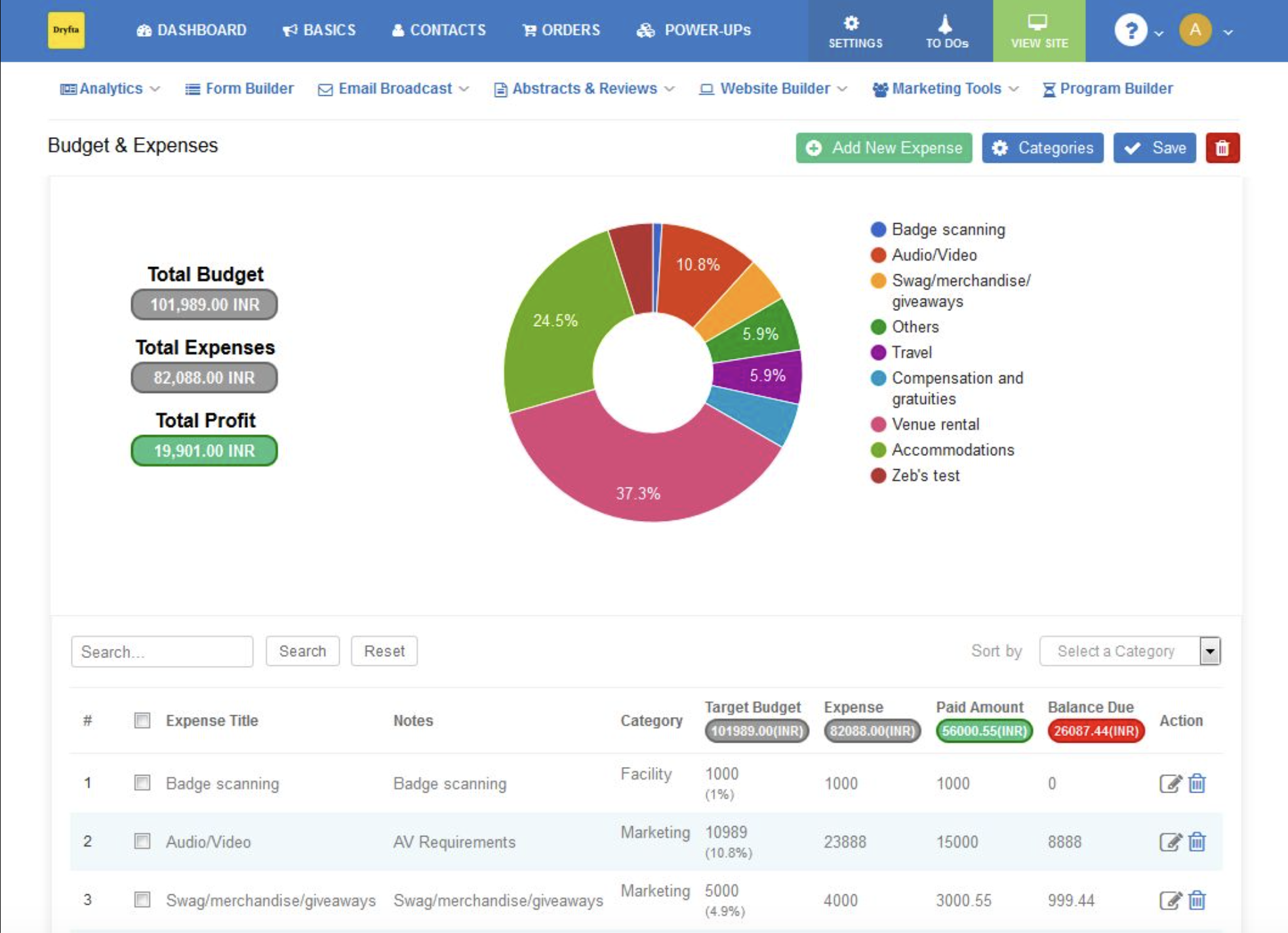
Move past the cost comparison and the day-to-day difference becomes just as clear. Here is what changes once you adopt abstract management and registration integration:
- One attendee record, from first submission to final attendance: A presenter’s name, affiliation, abstract status and payment status sit in a single profile instead of two disconnected accounts. Staff pull up one record to answer any question about that person, instead of checking two systems and hoping the details match.
- Abstract acceptance automatically triggers registration workflows: The moment a decision is recorded, the presenter can receive a registration invitation carrying their acceptance details already filled in. There is no separate export, no manual email list and no lag between decision and action.
- Accepted abstracts convert directly into programme sessions: A title, an author list and an abstract text move straight from submission to the session grid without anyone retyping them. Schedule changes made in one place update everywhere the programme appears, on the website and in the printed guide.
- Unified reporting answers cross-system questions instantly: A question about how many accepted presenters still need to register can get resolved quickly, without needing a major spreadsheet overhaul. Organizers, sponsors and venue partners have the privilege of accessing current numbers at any point in time, cutting down panic and confusion last-minute.
- A single communication history per attendee: Every email, whether that be about an abstract’s verdict or something confirming a registration, inhabits a single microcosm. This extends into larger, uniform macrocosms where all data is neat and organized.
Frequently Asked Questions (FAQs)
What are the hidden costs of using separate abstract management and registration tools?
The hidden costs of separate abstract and registration tools show up as time, effort and capital spent correcting manual errors, reconciling data that could’ve been gotten right the first time around and the general morale of a workforce. hidden costs of separate abstract and registration tools. Over a full event cycle these seemingly tiny frictions grow into something big enough to take your entire event on the way down.
How do I calculate whether switching to an integrated platform is worth it?
Firstly, ask yourself if you’d like to continue sparing the obvious challenges caused by fragmented tools. Following this, calculate the true specifics. Start by tallying the hours your team spends manually syncing data between tools each month and multiply that by staff cost. Add the price of both subscriptions plus any integration or support fees. Compare this total against a single integrated platform’s cost. Dryfta, for instance, starts at $1,499 per year.
Can I use an abstract management platform’s built-in registration feature instead of a separate tool?
Yes. Platforms like Dryfta that are built with both functions natively let organizers to move attendees from submission straight through to registration without re-entering data. This works particularly well for academic and medical conferences where abstract review and registration are closely associated with one another.
What is abstract-to-schedule conversion and how does it reduce hidden costs?
Abstract-to-schedule conversion automatically turns accepted submissions into a structured program, assigning sessions and then segments it into time slots and venues. This eliminates the hours that’s otherwise spent on manually transferring accepted abstracts into a separate scheduling tool. Since all the data you’ll need sits neatly within a system, errors from re-entry can be avoided entirely. As organizers, you gain a schedule that remains accurate and unfazed even as last-minute changes come by.
Does an integrated platform cost more than separate tools?
It can look like it but not really. There’s a price to pay for better organization and convenience. And many organizations believe it’s a small price to pay for long-term, continued value and satisfaction for all stakeholders. Singular abstract and registration tools can appear cheaper but as is the repeated perspective of this article, ends up making you pay some hidden costs.