


Cloud-based event management platforms like ConfTool are helping numerous event organizers from around the world run their events. Professionals planning academic conferences, in particular, have ratified ConfTool’s stature as a trusted tool in the scholarly community. It handles core event management functions like abstract submissions, peer review workflows and basic registration for academic and scientific events skillfully. At least it has for a long time.
However, in 2026, loyalty to no one event management platform is guaranteed. Unless the creators are committed to a long and continuing process of upscaling and innovation. The event management space is changing quickly and at a pace like never before. Contemporary technology waves like Artificial Intelligence and data technologies are sweeping up the field.
ConfTool may have been the ideal choice for 15,000+ users. However today, the hunt for the best event management platform is altering this figure.
Organizers are not simply looking at alternatives but they’re exploring major overhauls of their event management functions. The modern event organizer wants something that comes off as one-of-a-kind at first glance. For a long time, ConfTool has remained the default choice for universities and research associations that needed something dependable. But dependable and ideal are not always the same thing. The rising demand for innovative engagement and management tools for virtual and hybrid conferences is a major factor propelling this shift. ConfTool standard involves a fair amount of manual effort and this is something that event organizers in 2026 know can be completely eliminated. 100% automated and all-in-one event and conference management is now made possible by platforms like Dryfta. If you’re also an event organizer in 2026 looking to radically level up your organizational game beyond recognition, keep reading.
If you’d prefer spending yet another year constrained by the same tools and same failures or are not ready to upgrade, this is an article to elude. Or perhaps, keep reading and we’ll change your mind.
What Is ConfTool?

ConfTool is a web-based conference management system that heavily caters to the needs of academic and scientific event organizers. The platform is best-known for its abstract submission capabilities and peer review functionality. However, it is also constrained by an interface that begets evolution per the current industry standards, that are being raised each day.
What is ConfTool’s major user base?
ConfTool is most commonly used by universities, research institutions and professional associations to manage abstract submissions, peer review processes and attendee registration.
What are ConfTool’s primary features?
- It supports multi-track scheduling, proceedings management and basic communication between organizers, authors and reviewers.
- ConfTool has been a reliable workhorse for workshops and symposiums since the early 2000s. Many organizers trust it precisely because it is familiar and does not surprise them.
- The appeal of ConfTool users has, in a way, been its specialization and specificity. Rather than trying to cater to every type of event there is, ConfTool has instead chosen to focuse almost exclusively on academic conferences.
- That being said, the specificity of ConfTool can also be inferred as a kind of rigidity. By being unwilling to evolve into a more well-rounded platform like Dryfta, ConfTool is gradually working itself toward broader irrelevance.
Familiarity also has its limits. Organizers who’ve crossed that mark, are now discovering ConfTool alternatives.
Why Conference Organizers Look for ConfTool Alternatives
Let’s dive right into the chief factors contributing to many organizers looking for a ConfTool alternative in 2026.
- The user interface has been a recurring frustration for organizers and authors alike. Some users describe the experience as dated and less intuitive than other modern event platforms like Dryfta.
- Attendee engagement features, such as live polling, networking tools, interactive agendas, are largely absent. This has turned into a problem as organizers try to build more immersive conference experiences.
- Hybrid and virtual conference support is limited and teams that need to host remote sessions alongside in-person programming often find themselves reaching for separate tools to compensate.
- Customization is another sticking point. The platform offers relatively little flexibility when it comes to organizers who wish to adapt their submission forms per conditions, logic and other modern tech considerations. Review workflows and registration pages are also evolving dramatically on the technical front, a trend that ConfTool has remained largely unbothered by.
- Stronger CRM integrations are increasingly expected and many organizations need their conference platform to connect with their membership databases, email systems and marketing tools.
- Mobile experiences for attendees and resulting convenience like personalized schedules, push notifications, session check-ins are simply unavailable in ConfTool.
- Sponsor and exhibitor management is scarce and bare minimum makes it difficult for aspiring organizers who prioritize their stakeholders and commercial partnerships.
- Scalability becomes a concern for larger international conferences, where the volume of submissions, reviewers and attendees can push the platform beyond its comfortable operating range.
- AI-powered features for reviewer matching, scheduling optimization and communication automation are not part of the ConfTool offering, leaving organizers to handle these tasks manually.
- Reporting and analytics are basic compared to what modern platforms provide. Organizers who need detailed data on submission trends, reviewer performance and registration patterns often feel underserved.
What to Look For in a ConfTool Alternative
You may say, “Fine, I’ve made up my mind. I will switch to a ConfTool alternative.”
But which one do you switch to? Especially when the market is filled to the brim today. Newer tools seem to appear on almost a weekly basis.
Do I go for established platforms or do I offer employment to the new ones?
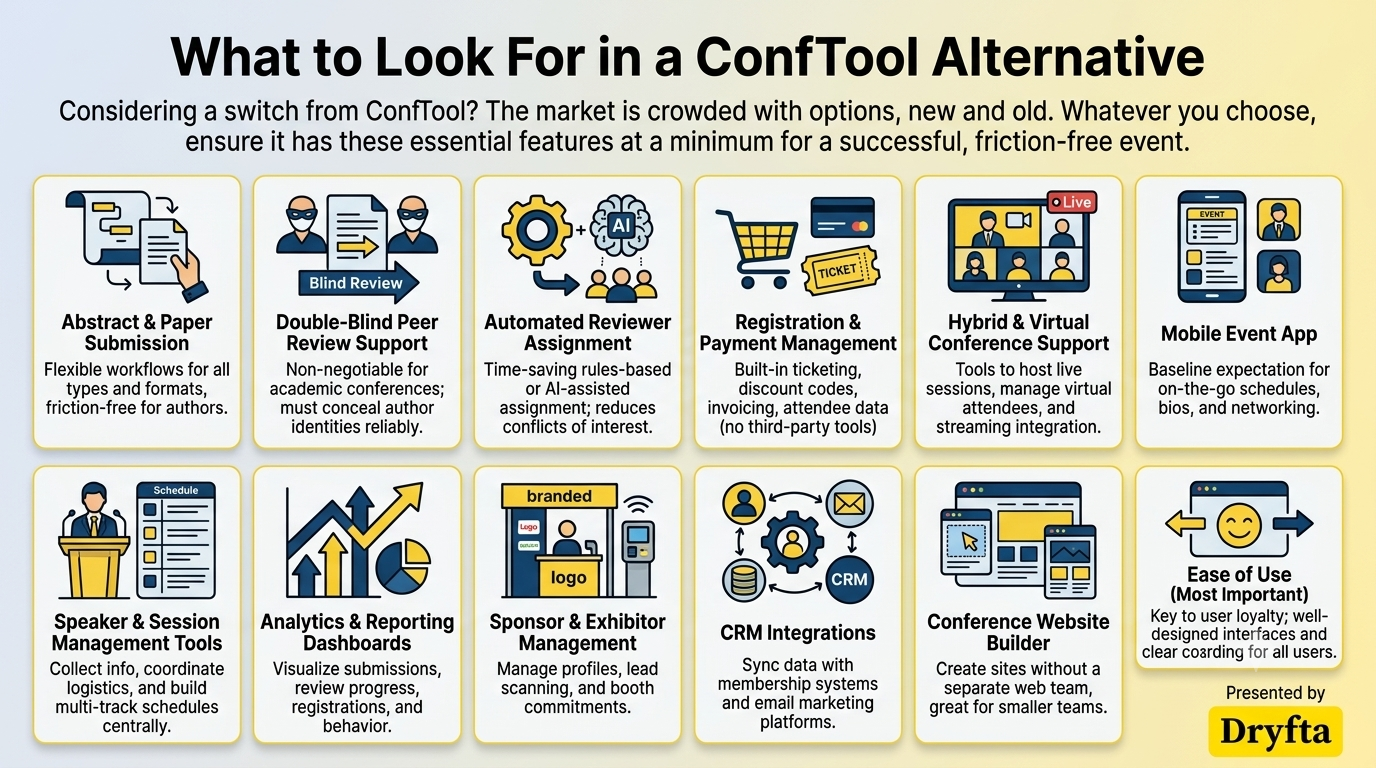
Well, whatsoever you choose, make sure the ConfTool alternative harbors the below mentioned features at the least. At the most, the sky is the limit.
- Abstract and paper submission: Workflows in your ConfTool alternatives of choice ought to be flexible enough to accommodate different submission types, formats and file requirements without creating friction for authors.
- Double-blind peer review support: This is non-negotiable for academic conferences, so the platform must be able to conceal author identities from reviewers reliably and consistently.
- Automated reviewer assignment: Rules-based or AI-assisted, whatsoever the underlying mechanism may be, this is a sacrosanct features that saves organizers time and effort. It also brings down your risks of arriving at a few conflicts of interest at the final moment.
- Registration and payment management: Must be built in natively and should cover your ticketing functions. Things like discount codes, invoicing and attendee data collection without needing a third-party booking tool are also noteworthy features to watch out for.
- Hybrid and virtual conference support: Reliable customer support increasingly expected, so look for platforms that can host your live sessions, manage virtual attendees and integrate using streaming tools.
- Mobile event app: An application that works on vertical screens gives attendees quick and last-minute access to things like schedules, speaker bios and networking features. This is an expectation that is now the baseline for most professional conferences.
- Speaker and session management tools: Organizers must be able to collect speaker information, coordinate presentation logistics and build multi-track schedules within one place in the ConfTool alternatives that they choose.
- Analytics and reporting dashboards: These should surface submission volumes, review progress, registration trends and attendee behavior in formats that are easy to interpret and act on.
- Sponsor and exhibitor management: Helps organizers deliver on commercial commitments, so the platform should support sponsor profiles, lead scanning and booth management.
- CRM integrations: Customer relationship management matters for associations and universities that need their conference data to flow into membership systems, email marketing platforms or broader organizational databases.
- Conference website builder: Feature that cuts down dependence on separate web development resources, especially for smaller teams managing multiple events each year.
- Ease of use: for organizers, reviewers and authors this is what truly determines if the platform is worth sticking to. Ease of use is what justifies continued user loyalty. Therefore, make it a point to prioritize systems with well-designed interfaces and clear onboarding.point to prioritize systems with well-designed interfaces and clear onboarding.
Quick Comparison of the Best ConfTool Alternatives
Best ConfTool Alternatives for Academic Conferences
Scientific conference management requires platforms built around the research workflow as the primary function, and the best conftool alternatives for academic events understand this from the ground up rather than treating it as a secondary consideration.
- Research symposium workflows involve multiple submission rounds, multi-stage review processes and revision cycles that general-purpose event tools like ConfTool were never built to accommodate. Look for a more hands-on ConfTool alternative. Dryfta says hello.
- University conference support needs configurations that respect the specific conventions of academic publishing as opposed to forcing them to adapt their processes to suit the software.
- Proceedings management should be automated so that the organizing committee is not spending the final weeks before the event reformatting accepted papers by hand.
- Reviewer collaboration workflows depend on clean discussion tools and shared scoring systems so that program committees can reach decisions efficiently and transparently without coordinating across email.
- Multi-track scheduling has a propensity to consume your team’s time in exorbitant amounts. However, there are smart ways to save time and reduce manual workload when organizing multi-track conferences. One way is to choose a software that will handle parallel sessions for you, perform session chair assignments and allocate rooms in a way that minimizes conflicts for attendees moving between program streams.
- Research networking capabilities matter because one of the primary reasons researchers attend conferences is to connect with others in adjacent areas, and structured networking tools within the platform support those connections.
- Author communication management at every point, beginning from initial acknowledgement and all the way to acceptance notifications, communication must be handled through automated workflows rather than manual outreach.
Best ConfTool Alternatives for Peer Review Management
Peer review management offered by ConfTool is rudimentary. When more advanced tools like Dryfta exist in the market, why restrict yourself to basic tools?
Here are some of the most exciting functionalities offered by the best ConfTool alternatives in the market.
- Double-blind and single-blind review support must be built into the assignment workflow as a configurable setting, because reviewer anonymity is a requirement that cannot be maintained manually at scale.
- Reviewer bidding systems allow reviewers to express preferences for papers that align with their expertise, and that input meaningfully improves the quality of assignments and reviewer satisfaction with the process.
- Conflict-of-interest management must surface automatically rather than relying on chairs to identify problems through manual cross-referencing of reviewer and author affiliations.
- Automated reviewer assignment based on expertise matching and reviewer capacity reduces the assignment process from days of coordination to hours, and platforms that have invested in this automation deliver measurable time savings for program chairs managing large submission volumes.
- Review scoring workflows should be configurable to match each conference’s specific criteria, and reviewers should be able to complete assessments through a clean and intuitive dashboard that does not require lengthy onboarding.
- Reviewer dashboards showing assignment status, review deadlines and paper details in one view reduce the volume of questions reviewers send to the organizing committee during the review period.
- AI-assisted reviewer matching is an area where leading platforms are now building meaningful capability, using publication history and stated expertise to identify the strongest pairings between reviewers and submissions.
- Bulk acceptance and rejection workflows allow program chairs to act on large volumes of decisions efficiently once the review period closes, and discussion and rebuttal workflows support conferences that include author responses in their review format.
- Review analytics dashboards give program chairs real-time visibility into completion rates and score distributions so they can intervene before deadlines pass.
Best ConfTool Alternatives for Hybrid and Virtual Conferences
According to PCMA Convene research from 2023, 73 percent of event organizers have intended to maintain and invest into their hybrid formats in the long.
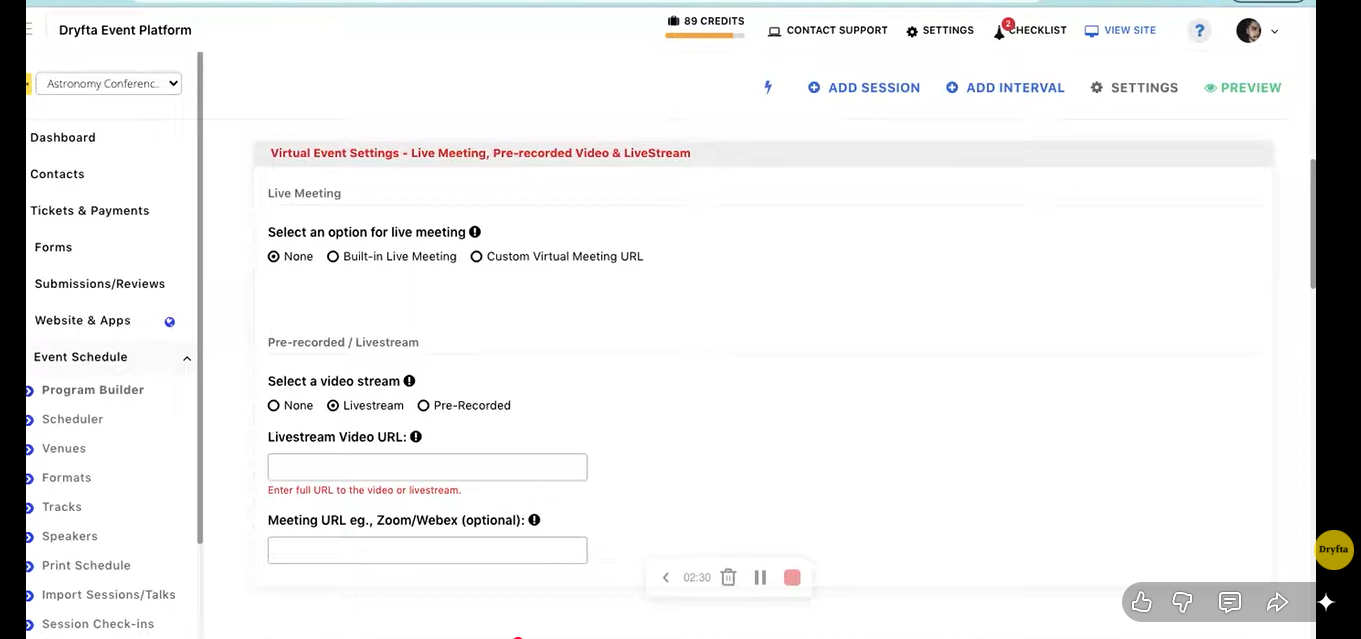
Virtual session hosting is now a baseline requirement. So organizers need a system where your attendees can do it all: access live sessions, ask questions and participate in the program. All without any third-party applications.
- Live streaming integrations should be built into the platform rather than requiring manual configuration at each event, and the system should deliver reliable access to both in-person and remote audiences simultaneously.
- Virtual poster presentations have become a standard format and the platform should support asynchronous poster viewing, author availability windows and comment threads. Online participants can then engage with poster content in a structured way.
- Interactive attendee participation tools including live polling, moderated Q&A and session feedback collection should be integrated into the conference experience rather than added through separate applications.
- Hybrid networking tools that connect in-person and remote attendees are among the hardest features to execute well. Platforms like Dryfta who do this effectively invest significantly in matching algorithms, structured meeting scheduling and virtual lounge formats.
- Session recording and playback capabilities, an inextricable part of the modern conference experience, will extend the value of your conference. With these features, there will be no such thing as an expiry date for your big day.
- Browser-based conference experiences that do not demand any downloads from attendees is a great way to get first-time attendees and international viewers on-board. With little friction and lesser steps to follow, attendees are more likely to take action and register.
- Mobile-first attendee experiences are another feature to explore to the maximum. The overwhelming majority of participants who access event information do so on their phones. Therefore, it is a given to provide a full-featured rather than a degraded experience to them.
Whova, EventMobi, Cvent and Dryfta are all worthy contenders in this category. But Dryfta outperforms the rest as the most practical ConfTool alternative in 2026.
Best ConfTool Alternatives for Enterprise Conferences
- Enterprise CRM integrations are a definitive feature at this scale. ConfTool alternatives ought to be able to connect reliably with Salesforce, HubSpot and other major systems with limited technical support.
- Multi-event management is a non-negotiable factor to consider if you are an organization that’s running a few big conferences yearly. The ConfTool platform you subscribe to should let your teams oversee separate events from within a single dashboard ajd keep your branding and reporting consistent.
- Large-scale attendee management places your ConfTool alternative of choice under great pressure to prove itself worthy. Handling hundreds if not thousands of registrations, session sign-ups may seem like a monumental task. But for automated platforms like Dryfta, this is child’s play. All you have to do is sign up and watch the magic unfold itself.
- Sponsor and exhibitor workflows need to be dedicated features covering package management, exhibitor profiles, lead capture and post-event reporting that sponsors can use to measure their return on investment.
- Advanced analytics and reporting give event teams the data they need to make decisions during the event and present outcomes to stakeholders after it.
- Enterprise-grade security including features like single sign-on, role-based access controls and data residency options is required for organizations operating under strict compliance frameworks.
- Marketing automation workflows that integrate conference registration to broader campaign management let enterprise teams to maximize the value of their events.
- Global event management capabilities including multi-currency registration, multi-language support and time zone handling are important for organizations running international conferences.
ConfTool vs Modern Conference Management Platforms
- Traditional conference systems like ConfTool were built to resolve the problems of an earlier era of academic conferencing. An all-in-one platform built in the past decade starts from a fundamentally different set of assumptions about what conference management involves.
- Modern platforms like Dryfta invest in interface design as a product value. On the other hand, ConfTool’s interface continues to stick to the priorities of the period during which it was built. While there is no denying that ConfTool has come a long way since its founding in the 2000s, the greater truth is that it is yet to match up to the advancements of 2026.
- Registration and attendee management in ConfTool is functional but limited, lacking the flexibility that contemporary ticketing tools offer for tier management, early-bird pricing and group booking structures.
- Hybrid event readiness is the most significant factor in the comparison, because ConfTool requires external tools for virtual session delivery and online networking. This kind of dependency creates coordination overhead and data synchronization problems that modern platforms avoid.
- Mobile app experiences also differ considerably. Dedicated mobile apps in platforms like Dryfta give attendees a full-featured conference experience on their phones, and ConfTool offers no comparable native mobile capability.
- Workflow automation in modern platforms covers reviewer assignment, author communications, registration confirmations, schedule updates and certificate generation in ways that ConfTool handles only partially and often with manual steps between stages.
- Analytics and reporting in modern platforms give organizing committees real-time visibility into every stage of the event cycle, which is a meaningful operational advantage over ConfTool’s more limited reporting.
- Sponsor management is absent in ConfTool and present in varying degrees across modern alternatives, and that gap matters considerably for conferences that rely on sponsor revenue.
- Scalability comparisons favour modern cloud-based platforms that handle large submission volumes and high attendee numbers without performance issues.
- CRM integration flexibility in modern platforms allows organizations to connect conference data with the broader systems they use to manage members, donors and partners.
Why Dryfta Is a Strong Alternative to ConfTool
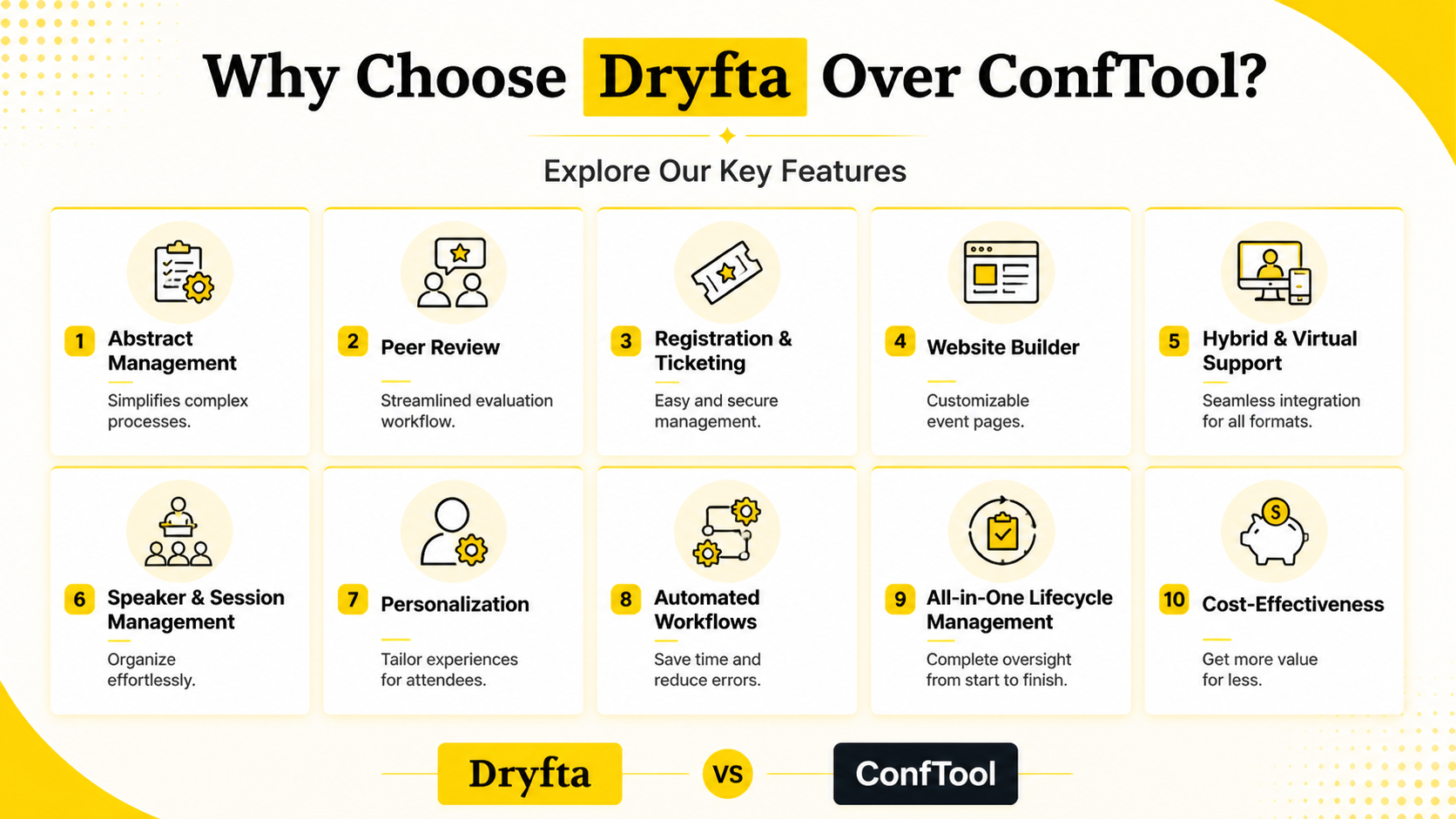
Dryfta is an all-in-one academic conference management platform designed to cover the full event lifecycle, and its feature set makes it one of the more complete conftool alternatives available for scientific and professional conferences.
- Abstract management: Advanced abstract submission workflows support configurable submission types, file format requirements and metadata fields that can be customized to each conference without the hassle of extensive technical customization.
- Peer review: An integrated peer review system covers double-blind and single-blind review configurations, automated reviewer assignment with conflict-of-interest detection and real-time review analytics that give program chairs continuous visibility.
- Registration and Ticketing: The registration and ticketing system handles efficient ticketing using smart strategies for a full house like early-bird pricing, group registrations and payment processing within the same platform where submissions and reviews are managed.
- Website builder: The conference website builder connects directly to the submission system, registration database and program schedule so that published information stays current without manual updates.
- Hybrid and virtual conference support: Hybrid and virtual conference support is built into the core platform rather than delivered through an integration, and online attendees access the same session infrastructure as in-person participants.
- Speaker and session management: Speaker and session management links the accepted paper workflow to the program schedule. In doing so, it reduces the manual re-entry work that organizers typically manage after the review process closes.
- Personalization: Better workflow customization allows each conference to configure its submission, review and communication processes to match its specific conventions rather than conforming to a fixed structure.
- Automated workflow: Automated communication workflows handle author notifications, reviewer reminders, registration confirmations and schedule updates without requiring manual outreach at each stage.
- 360 degree event management software: Dryfta is suitable for scientific and professional conferences across a range of sizes. Its platform covers the full event lifecycle for conferences running academic, research-focused and professional programs. Click here to see some of our esteemed clients.
- All-in-one event management software: End-to-end conference lifecycle management within a single platform reduces the data synchronization problems that arise when multiple disconnected tools share attendee and session information.
- Economical ConfTool alternative: Dryfta is a cost-effective alternative for growing conferences that need more than a specialist review tool but cannot justify the cost of enterprise platforms.
How Dryfta Helps Conference Organizers Simplify Workflows
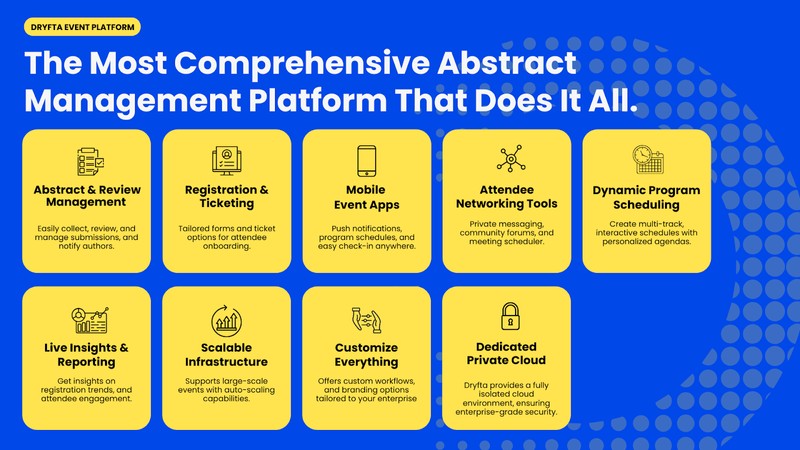
- Automated abstract management: Abstract submission and reviewer workflows are automated so that the organizing committee spends less time on coordination and more time on the quality of the scientific program.
- Intelligent reviewing functions: Simplified reviewer assignment and scoring reduces the program chair’s coordination workload and provides a clean decision dashboard where acceptance and rejection decisions can be made in bulk once the review period closes.
- Unifies registration and management: Registration, scheduling and agenda management are connected within the same system, so attendee data, session assignments and program updates flow between functions without manual re-entry.
- Hybrid event compatible: Hybrid and virtual conference experiences are supported within the same system that manages smart scheduling and registration. This means that organizers do not need to maintain separate accounts or transfer data between platforms.
- State-of-the-art websites: Customizable conference websites connect directly to the event database and automated reminders and notifications go to authors, reviewers and attendees at configured intervals without requiring the organizing team to send them manually.
- Tracking in real-time: Real-time submission and review tracking gives program chairs and conference chairs an accurate picture of where the event stands at every stage of the cycle.
- Smooth proceedings management: Simplified proceedings and certificate generation reduces the manual work at the end of the event cycle when the committee is typically at its most stretched.
- Stakeholder management: Sponsor and exhibitor management tools within the platform allow commercial relationships to be managed alongside the academic program rather than through a separate system.
- Automation that reduces manual toil: The reduced manual operational workload across the full event lifecycle means more time for the organizing committee to focus on the scientific content of the conference.
- Collaborative and coordinated workflows: Collaboration between organizers, reviewers and authors is supported through structured communication tools within the platform. Dryfta scales for international conferences and symposiums without requiring reconfiguration as the event grows.
Best ConfTool Alternatives for Small Conferences
Affordable conference management solutions for small events need to cover the core academic workflow without charging for capabilities that a workshop or small symposium will never use.
- Easy setup and onboarding matter particularly for committees that cannot dedicate time to platform configuration before the submission window opens and where the organizer is often also the program chair and communications manager.
- Lightweight peer review systems that cover the essential functions of assignment, scoring and decision-making without the complexity of enterprise-grade tools are the right fit for workshops and smaller events.
- Budget-friendly platforms that require minimal technical expertise allow academic departments and early-career researchers to run professional conferences without specialized support.
- Minimal technical expertise requirements are important for small conference teams where no dedicated technical support is available within the organizing committee.
- Open-source alternatives offer maximum flexibility for conferences with technical teams willing to invest time in setup and customization, and they avoid recurring subscription costs.
- Simple registration workflows that handle basic ticketing and attendee management without requiring complex configuration are sufficient and preferable for most small events.
OpenConf’s one-time licensing fee suits workshops running on minimal budgets. EasyChair also offers a free tier that can cover your core review workflow. Oxford Abstracts and Ex Ordo offer per-submission pricing that scales with the event’s actual size.
Dryfta offers pricing that’s accessible to small conference organizers relative to the breadth of what the platform covers, including conference websites, registration and abstract management in one system rather than 3 or 4 separate subscriptions.
How to Migrate From ConfTool to Another Conference Platform
- Exporting submission and attendee data from ConfTool is the first step, and organizers should verify that exported files are complete and correctly formatted before beginning the import process in the new platform.
- Migrating reviewer assignments requires careful documentation of which reviewer was assigned to which submission, and that information should be preserved separately even if the new platform does not import it directly.
- Importing author information should be tested with a small sample before running the full import, because field mismatches between the old and new system’s data structures can create errors that are time-consuming to correct after the fact.
- Transferring conference schedules requires the new platform to support the same session types and track structures, and any structural differences should be resolved before the schedule is published to attendees.
- Registration migration workflows vary between platforms, and organizers should confirm with the new platform’s support team how existing registrations will be handled so that attendees who have already paid do not need to re-register.
- Setting up new review processes is an opportunity to improve on the configurations used in ConfTool rather than simply replicating them, since modern platforms often have automation options that ConfTool does not support.
- Organizer onboarding and training should be completed before the submission window opens so that the team is confident with the new platform before authors and reviewers depend on it.
- Communicating changes to authors and reviewers in advance of the submission deadline reduces the volume of support questions that arrive when the system goes live, and a clear email explaining the new platform covers most common questions.
- Testing workflows before launch by running a complete test submission cycle internally catches configuration errors before they affect real participants.
- Minimizing disruption during migration by planning the changeover between conference cycles rather than during an active event gives the team time to resolve any issues before they become time-critical.
Features Conference Organizers Need in 2026
It is 2026 and there is little room for conference management softwares that stay rigid and unreceptive to customer feedback and larger industry trends. This should be a core dealbreaker in your search for the ultimate ConfTool alternative. Artificial Intelligence, the buzzword of this decade is changing the industry out of recognition. Here all the features your conference management tool needs to keep up with the AI wave of 2026.
- Your tool needs to be equipped with smart conference scheduling. Evaluate for features like automated conflict detection, speaker availability matching and multi-track balancing. There is little room for former spreadsheet-based scheduling.
- Virtual poster sessions are now a standard aspect of most virtual undertakings. If you concentrate on this format, make sure your tool has specific provisions for the same.
- Attendee participation and in real-time. With tools like live polling, moderated Q&A and session feedback collection, your attendees who tune in online should be just as engaged as your offline guests.
- Mobile-first conference experiences are a bare minimum of requirement in 2026. Attendees are no longer pulling out bigger screens to make purchases. Most decisions are made on mobile. Optimize for this.
- ORCID and DOI integrations connect conference submissions and proceedings to the broader research identity infrastructure and are increasingly required by funding bodies and institutional repositories.
- Automated analytics dashboards are replacing manual reporting that required data exports and spreadsheet work, and the best platforms in 2026 make those dashboards configurable rather than fixed.
- Hybrid conference support should be built natively into the platform rather than delivered through third-party integrations. This will cut down on the backbreaking hassle that comes with running events simultaneously for in-person and online audiences.
- Cloud-based conference management with real-time access for distributed organizer teams is essential as committees increasingly operate across institutions and time zones.
- Research networking tools that help participants identify and connect with others in their field extend the value of the conference beyond the formal program.
- Open-access proceedings support is growing in importance as funding bodies are demanding that research outputs be available for publicly access
- Integrated attendee management that unifies every core aspect of the full attendee experience: registration, scheduling, communications and on-site check-in within a single operational umbrella is the standard that ConfTool alternatives should compete to meet in 2026.
Frequently Asked Questions (FAQs)
What is the best alternative to ConfTool?
The best ConfTool alternative in 2026 amongst ConfTool competitors is undoubtedly Dryfta’s all-in-one event management platform. Dryfta closes in on all the gaps left by ConfTool and improvises them. If you want a platform that makes fair peer review possible, smooth events feasible as well supports hybrid events, then Dryfta is your go-to.
Which ConfTool alternative is best for academic conferences?
ConfTool competitors like Ex Ordo, Oxford Abstracts and Fourwaves are the most commonly recommended platforms for academic conferences. These platforms make for good ConfTool alternatives, allowing you to go a few steps ahead. But if you want to take the leap and completely overhaul your event management tasks, choose Dryfta. Choose today. Click here to experience a free demo.
Is there a cheaper alternative to ConfTool?
Yes. Microsoft CMT is one ConfTool alternative platform that is completely free for public use. However, it has its constraints and free is not always enough. For a more cheaper alternatives, Dryfta starts at an economical $1,499 per year. This is a steal deal compared to more pricier alternatives like Cvent who don’t disclose their pricing upfront.
Which platform is best for peer review management?
Dryfta has a spectacular peer review system, modeled with a variety of techniques including double-blind, single-bling and triple-blind review. Each of these techniques are associated with their own pros and cons. However, at its very core, Dryfta’s peer review management is among the most fairly and squarely performed. The AI-automated peer review system makes review assignment and later evaluation fuss-free, unbiased and intelligent. Learn how to use Dryfta’s peer review tool in detail here.
Which conference management software is best for hybrid events?
Dryfta, having helped global organizers pull off scores of virtual events, leads on this point table. The attendee experience offered by Dryfta is unmatched. Platforms like Cvent and Whova also follow in this list, with these platforms often being disadvantaged by their higher price point. ryfta is the smart choice to make if you want affordability, experience in the format and steady customer support.
Can I migrate from ConfTool easily?
Yes, once you have made up your mind and decide to take the plunge, migration is the last step. It’s often also the easiest one if you choose a platform like Dryfta that is responsive and easily adaptable to mass data migration. All you have to do is make amends to export your data from ConfTool and communicate the change to stakeholders early. Go over what import tools and onboarding support you need and request that from your existing platform or the new one as per your needs.