


The role of the corporate event planner has changed fundamentally over the last few years. Many of these changes have been driven by the advent of contemporary technology, such as artificial intelligence and data technologies. From the perspective of the attendees as well, performance expectations are greater than they have ever been.
This is in part because of a rise in competition in the event management industry. Clients are scrutinizing budgets more closely than ever and the responsibility to demonstrate tangible and consistent ROI from every event has never been greater.
At the same time, the tools available to corporate event planners have advanced to a point where a well-equipped individual or small team can execute events that would have required a much larger operation just a decade ago. If you are brand new to the corporate event planning profession or are mid-career or senior professional in the field, the tips we’re going over in this blog are sure to help you. All tips and strategies in this blog are drawn from what is working for the best of corporate event planners operating in the market right now.
What Is an Event Planner?
Before getting into tips for corporate event planners, it helps to understand what this role entails. For the unversed, at the most basic level, a corporate event planner is a professional who is responsible for conceptualizing, organizing and executing events on behalf of a business or organization. These events can include anything from conferences, product launches, to even team-building activities.
Often, the terms corporate event planner and event coordinator are used interchangeably. While some of their functions do intersect, the key difference lies in the business context within which they operate.
Types Of Corporate Events
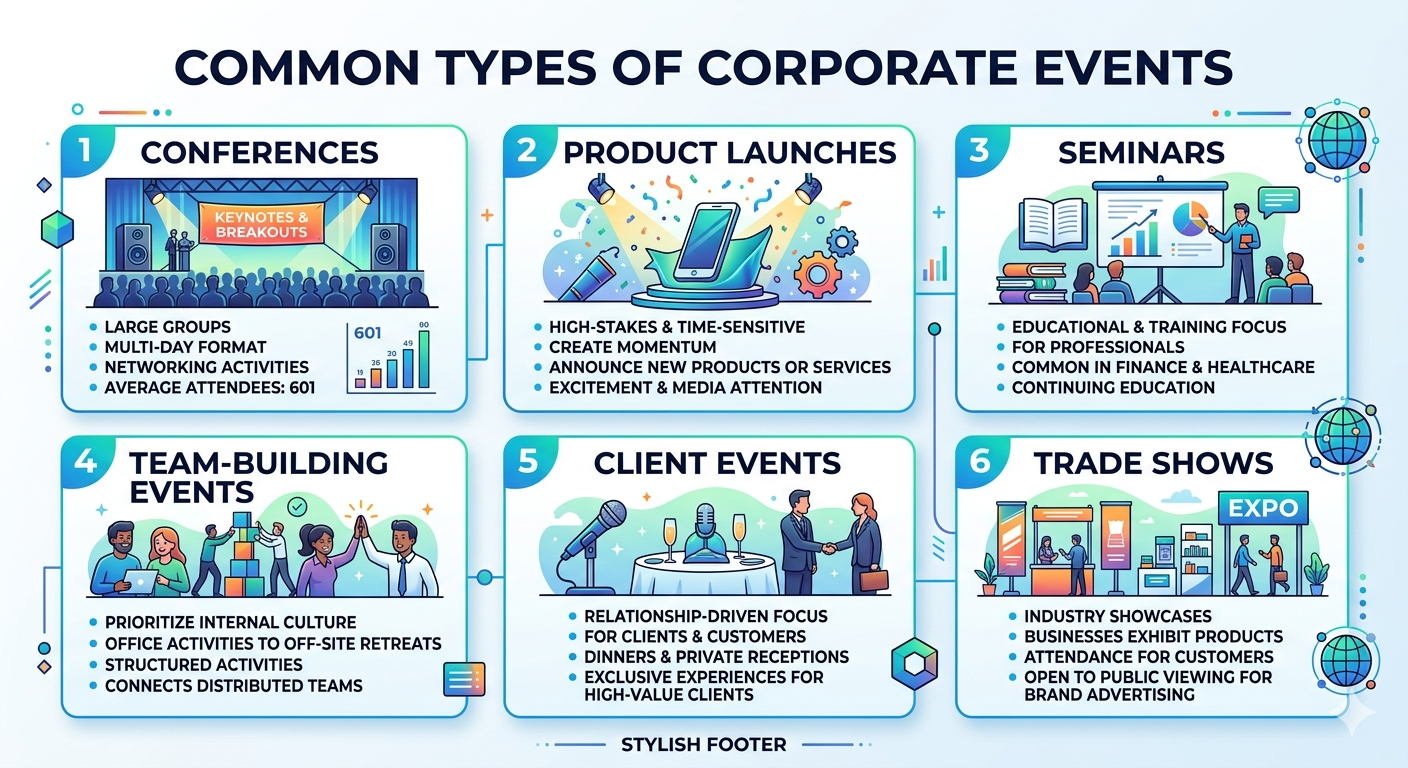
The term ‘corporate event’ is broad. To squeeze the several different formats of the event under the single umbrella of ‘corporate’ can be misleading. Knowing the type of corporate event you are hosting inside and out comes in handy during event management. Let’s take a look at some of the most common types of corporate events.
- Conferences: The most widely used format in corporate events. Corporate conferences often host large groups of attendees and include activities like keynotes, breakout sessions, and networking across one or more days. average of 601 attendees.
- Product launches: High-stakes and time-sensitive corporate events with the primary intent to create momentum around a new product or service.
- Seminars: These are corporate events inclined more toward education and training for professionals. Seminars are a very common format in fields like finance and healthcare where continuing education is encouraged.
- Team-building events: Team-building corporate events prioritize internal culture. It ranges from in-office team bonding activities to even off-site retreats. Structured activities are increasingly used to help distributed teams connect with one another.
- Client events: A type of corporate event that is relationship-driven, centering on a corporation’s clients and customers. Dinners, private receptions, and exclusive experiences designed to further connections with high-value clients.
- Trade shows: Trade shows are industry showcases that involve businesses exhibiting their products or services to customers. Trade shows open to public viewing are an avenue for corporations to advertise their brand.
What Does an Event Planner Do Day to Day?
Some routine tasks of a modern corporate event planner include:
-
- Setting budgets for events and figuring out the logistics and feasibility of a proposed event.
- Scouting for vendors and researching suitable locations and venues.
- Tasks that involve a large amount of negotiation and comparison, including things like catering companies, audio-visual suppliers and accommodation providers
- As the event date approaches, the work shifts more toward attendee communication and contingency planning.
- On the event day itself, the planner moves into an operational mode and looks at every aspect of the program in real-time.
Step-by-Step Corporate Event Planning Process
Step 1: Define Your Goals Clearly
Every decision you make as a corporate event planner depends on this one: your goals. As evident as it may seem, there are plenty of corporate event planners who jump straight into planning without clarifying their goals first. The result is a handful of jumbled goals, with no one objective receiving strategic planning and execution. It is often better to focus on a single decisive goal for your event as opposed to a dozen goals that you are not too sure of.
Step 2: Approach Budget Planning Smartly
Build the budget before you give your word to any other commitment. It can turn out disastrous to commit to anything before getting your finances in order. When you don’t approach budget planning cleverly, you’ll find that you have too little for something that appears to be an important expense at the end. Corporate event planners who are bootstrapped often regret pouring their money early on into functions that don’t matter, such as aesthetics and return gifts. Plan with your realities in front of you.
Step 3: Select Your Venue Strategically
Your venue either makes or breaks your event. While every other choice you make in planning is important in its own right, venues hold a certain significance. Your venue is what drives a substantial portion of your total cost. Make sure to choose the right place, and only after extensive research. Once finalized, book early.
Step 4: Prioritize Vendor Coordination
Catering, audiovisual, production, transport, and accommodation all need coordinating. According to Business NH Magazine, audiovisual costs have risen 25 to 50% since the pandemic. This is mainly driven by the now popular business format of sealing exclusive vendor contracts at hotels and convention centers. It is, therefore, of paramount importance to form vendor relationships early in 2026. Negotiate with your vendors on exclusivity clauses.
Step 5: Pay Attention To Event Marketing
Registration, promotion, and attendee communications demand their own timeline as well as their own plan. Pre-event marketing that you kick off too late will only result in markedly low attendance. Launching an email campaign and some other targeted outreach can help your digital event marketing efforts. When you market to a targeted audience, you consistently outperform broad social media promotion for corporate events.
Step 6: Go All Into Execution
Execution. This is where your plan turns into reality. Sometimes it’s better to live in your head and look at your dreams through rose-tinted glasses. But the real job of a corporate event planner begins at execution on event day. The job on event day is not just to manage your agenda but also to handle crises. It is normal for gaps to show up between what you planned and what actually transpires. Staff briefings, contingency plans, and real-time communication tools are the infrastructure that will play savior on execution day.
Step 7: Follow-Up After the Event
Most of the value a corporate event generates is realized after it ends. Make it a point to steer your follow-up efforts into survey collection, content distribution, and CRM updates. Remember that the most effective follow-up happens in the days immediately following your event. The teams that are clever enough to invest in sturdy post-event analytics will certainly outperform planners who rely only on manual reporting.
Corporate Event Budget Planning
Some of the most significant costs to plan for as a modern corporate event planner include following:
- Catering prices
- Audiovisual equipment rents
- Venue costs
- Staff salaries
- Marketing and allied activities.
According to GoGather’s benchmarking data, food and beverage accounts for approximately 34% of total conference spend, with audiovisual at 17%. These two categories alone will take up more than half of your event’s budget.
How Much Does It Take to Host a Corporate Event in 2026?
As per a 2026 cost breakdown analysis, here is how much it takes to pull off a corporate event by scale.
- For small meetings: Your total costs can sit under $15,000.
- For mid-sized conferences: Your survey expenses are likely to range between $30,000 and $90,000.
- For large annual events: These regularly exceed $250,000 and stretch into exorbitant amounts for large conglomerates.
Tips When Allocating Costs To Your Budget
- Prioritize attendee experience: Prioritize the categories attendees feel most directly. This includes things like food and beverage, venue, and technical equipment. Poor catering and poor audiovisual damage attendee experience more than almost anything else.
- Negotiate on others: Protect your line items and negotiate on things like room rental, décor, and printed materials.
- Plan a contingency budget: Attrition penalties on room blocks, service charges on catering contracts, and on-site labor adjustments are among the most common sources of budget overruns. Therefore, make sure to build a contingency of at least 10 to 15% into every budget.
Smart Strategies To Save Your Costs
- Hack time to save money: Schedule events during off-peak periods. This is a smart way to grab better venue rates.
- Build smart vendor relationships: Negotiating multi-year contracts with preferred vendors can help reduce per-event costs.
How to Choose the Right Corporate Event Format
Choosing Between In-Person vs. Virtual vs. Hybrid Events
All three formats of corporate events have their set of audiences. However, the majority verdict is that in-person conferences are the most effective. This is closely followed by a growing preference for virtual events. All thanks to the pandemic that made us go digital first. Therefore, it appears that the best choice in 2026 for corporate event planners is to host hybrid events. Hybrid formats now account for approximately 15% of the North American market, according to Upmetrics.
Making Audience Considerations
Know your attendees before committing to a format. A globally distributed team may respond better to a hybrid or virtual format. A regional client base with high relationship value warrants the investment in case of an in-person corporate event.
Figuring Budget and Scale
According to DesignRush, virtual events typically cost $500 to $1,000 per virtual attendee. In-person conferences run $3,000 to $4,500 per person for full-service delivery. Your choice about the format is also in a way a budget decision. It is important that you account for both sides of the equation before locking a venue.
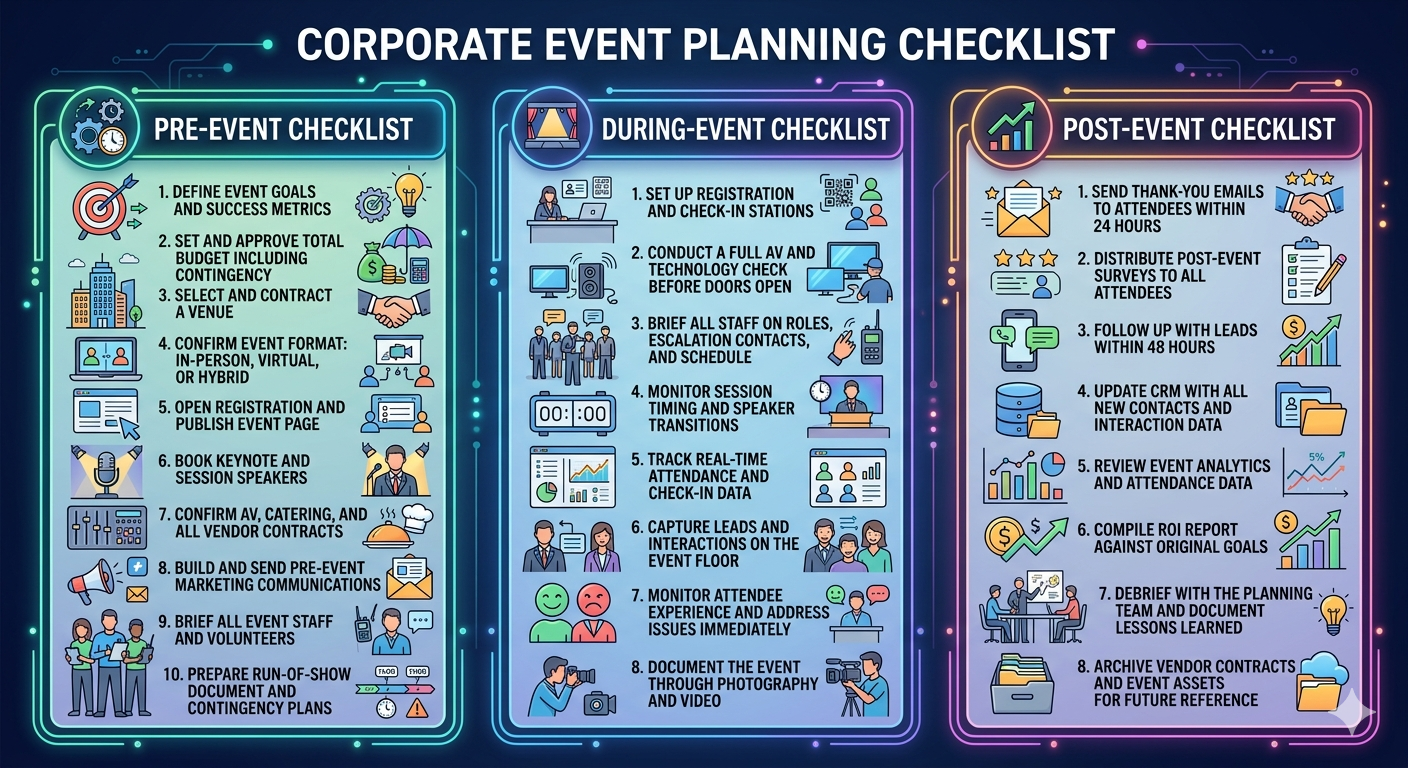
Corporate Event Planning Checklist
Pre-Event Checklist
- Define event goals and success metrics
- Set and approve total budget including contingency
- Select and contract a venue
- Confirm event format: in-person, virtual, or hybrid
- Open registration and publish event page
- Book keynote and session speakers
- Confirm AV, catering, and all vendor contracts
- Build and send pre-event marketing communications
- Brief all event staff and volunteers
- Prepare run-of-show document and contingency plans
During-Event Checklist
- Set up registration and check-in stations
- Conduct a full AV and technology check before doors open
- Brief all staff on roles, escalation contacts, and schedule
- Monitor session timing and speaker transitions
- Track real-time attendance and check-in data
- Capture leads and interactions on the event floor
- Monitor attendee experience and address issues immediately
- Document the event through photography and video
Post-Event Checklist
- Send thank-you emails to attendees within 24 hours
- Distribute post-event surveys to all attendees
- Follow up with leads within 48 hours
- Update CRM with all new contacts and interaction data
- Review event analytics and attendance data
- Compile ROI report against original goals
- Debrief with the planning team and document lessons learned
- Archive vendor contracts and event assets for future reference
Corporate Event Marketing Strategy
A big chunk of corporate events underdeliver despite having a good lineup of event activities. Do you know why? One of the largest reasons for underperformance in 2026 is a lack of good event marketing.
It seems that all corporate event planners are marketing their event today. But are they doing it the right way, the smart way? That is the greater question. Organizers spend months planning their event. They spend a few more weeks rigorously marketing them. But when you get it all wrong, none of it truly matters. Here are some important event marketing strategies to consider adopting as a smart corporate event holder in 2026.
- Promotion before your event: Start earlier than it feels necessary. The single most common timing mistake in corporate event marketing is starting too late. A dedicated event page, registration setup, and initial email outreach should be live six to eight weeks before the event date. Not 4 weeks. Not 3. But 6 to 8 weeks.
- Email campaigns: A single launch email just does not cut it. What your event needs is an elaborate email campaign targeted at the right audience. Email has been shown to outperform other channels when it comes to converting prospective leads into completed registrants.
- Social media: When it comes to social media marketing, the relevance of which needs little introduction in 2026, professional platforms like LinkedIn are most effective for corporate event promotion. Speaker profiles, session topics, and behind-the-scenes content in the weeks before the event, anchored by a consistent hashtag, will help you build anticipation in the audience most likely to show interest.
- On-site engagement: On the day of the event, pay attention to attendee engagement. Stick to your previously made plan, but also work proactively and spontaneously should the need for it arise. Engage physical and digital touchpoints during the event, including live polls, Q&A tools, social walls, and gamified networking. This will keep your attendees actively involved rather than passively present. Dozing off at a corporate event is strictly prohibited.
- Post-event follow-up: Your event is not over when the last session ends. You still have work to do, perhaps the most impactful of them all. Follow-up and work around content from the event. Take advantage of things like recordings, summaries, and key takeaways, extending its reach to people who could not attend. Personal follow-up from speakers or hosts to attendees who engaged most actively builds on the momentum the event created.
Attendee Experience and Engagement Strategies
Agenda planning: A dense agenda with no breathing room produces fatigue, not engagement. This is a planning mistake that feels counterintuitive because filling every slot looks like rigor. It is not. It is a structural guarantee that attendees will check out before the afternoon sessions begin.
Networking formats: Interactive sessions outperform lecture-style presentations in both engagement and satisfaction scores. Panels that invite real audience participation, live workshops, and working sessions are not novelty features. They are what attendees increasingly expect.
Interactive sessions: Hosted roundtables, speed networking, curated meeting programs, and AI-powered matchmaking all produce more intentional connections than leaving networking to chance.
Personalization: Personalized agendas, content recommendations based on registration data, and targeted networking suggestions improve the experience without significantly increasing cost when the right technology is in place.
Common Corporate Event Planning Mistakes to Avoid
Poor budgeting
Underestimating costs is the most common failure mode. Nearly 50% of event professionals identify rising costs as their single biggest challenge, according to Momencio. Build in contingency from the start.
Weak planning
Events that begin execution without a fully locked run-of-show and clearly assigned responsibilities produce chaos on event day. Plan to a level of detail that feels excessive. It rarely is.
Lack of engagement
Filling an agenda with presentations and leaving networking to chance produces passive attendees. Design interaction into the event, not as a feature but as a structural principle.
No follow-up
Leads collected at a corporate event decay quickly. Follow-up that happens a week after the event is follow-up that largely does not work. This is not an opinion. According to studies, ROI confidence is directly linked to how quickly post-event data connects to CRM and revenue systems.
Ignoring ROI
A study established that about 40% of organizers are still reporting difficulty in proving their event ROI in 2026. Events that are not measured cannot be improved, justified, or scaled. The conversion rate, meaning how many leads generated at the event moved forward in the sales process, is the number that most directly ties event investment to business outcome. It is also the number most organizers do not track consistently.
How to Measure Corporate Event ROI
- Leads generated: The total number of new contacts collected, qualified by engagement level and potential value. Quantity without qualification is not a measure of success.
- Engagement rate: Session attendance, Q&A participation, networking interactions, and app activity all measure how actively attendees participated. Passive presence is not the same as engagement.
- Cost per attendee: Total event spend divided by total attendees. According to Momencio, corporate event spending is reaching $169 per attendee per day in 2026. Understanding your own cost per attendee against that benchmark helps contextualize spend.
- Conversion rate: Of the leads generated at the event, how many moved forward in the sales process? This is the number that most directly links event investment to business outcome.
- Feedback analysis: Post-event content, recordings, summaries, and key takeaways extend the event’s reach to people who could not attend. Personal follow-up from speakers or hosts to the most engaged attendees builds on whatever momentum the event created. None of this is complicated. Most of it simply does not happen.
Corporate Event Planning Tools and Software
A corporate event planner managing registration, communications, on-site check-in, networking, and post-event analytics across separate tools is working harder than necessary and producing more errors than a single platform would.
Dryfta brings the full event management stack into one system, built for corporate events that require more than basic ticketing.
- Event registration: Custom registration forms with multiple ticket types, early-bird pricing, approval workflows, and automated confirmations. Payment is processed directly to your account.
- Ticketing: Flexible pricing structures including group rates, discount codes, and member pricing, all manageable from a single dashboard.
- Attendee management: A built-in CRM that tracks every attendee from registration to check-in, recording session attendance, engagement activity, and interaction history in one place.
- Networking tools: In-app directories, attendee messaging, and AI-powered matchmaking that give attendees the tools to connect with purpose before, during, and after the event.
- Analytics: Real-time dashboards showing registration trends, check-in rates, session attendance, and lead capture data. Every metric is exportable for post-event reporting.
Event Planner Software- The Tools That Make the Difference
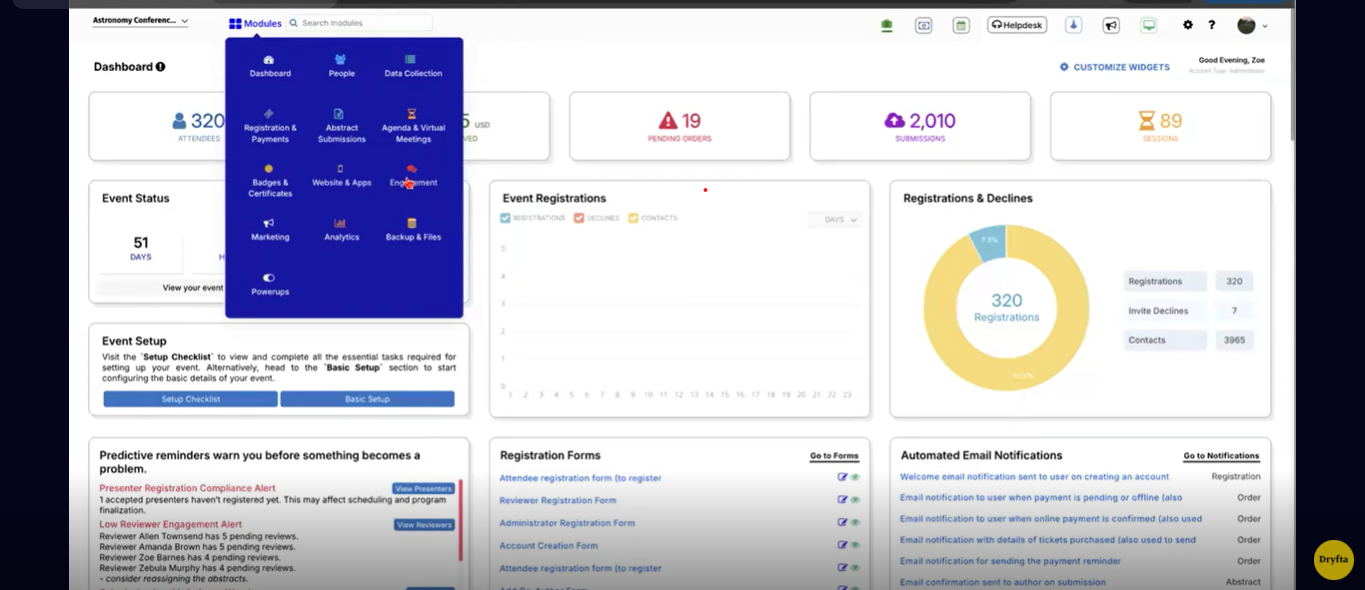
In 2026, it is safe to say that most modern corporate event planners understand the importance of working with event planning software. The administrative functions associated with corporate events are greater than ever. A capable event planner software helps centralize all of these moving parts of the corporate event into a single platform where professionals can operate from. It is only human for errors to occur when corporate event planning is overseen by a manual workforce.
Modern softwares do not exist to downplay the manual work and thought that goes into event planning. Rather, it only helps offload the administrative load significantly. The centralization that comes with using all-in-one event management software reduces the risk of information inconsistency to zero. As a direct result of this, the entire planning team can enjoy a collective and shared viewing of the event status at any point in time.
When on the lookout for the best event planner software for your organization, consider the following keenly:
-
- If you are hosting a large-scale event, it is non-negotiable to scan your chosen software’s scaling capacity. Unless you prefer to coordinate your event functions across dozens of platforms, a centralized tool will simplify your administrative tasks significantly.
- Perform an audit of the communication tools offered by the software. Check if the tool will allow you to exercise the kind of attendee communication you had planned in your mind.
- Additionally, also examine the check-in functionality. A mobile check-in app that works reliably under heavy load is something that is essential today to run event day operations without errors.
- Fourth, also review the reporting suite. Post-event data on attendance, session popularity and revenue should be exportable in formats your team can actually use.
Event Planner Website For Business Development
For corporate event planners who operate as independent professionals or run their own agencies, an event planner website is the single most important business development asset they have. In 2026, potential clients conduct significant research online before reaching out to any supplier. If your event planner website does not clearly communicate your expertise, your specialization and the quality of your past work, you are losing business to competitors before the first conversation ever happens.
A strong event planner website should do several things well. It should clearly state what types of events you specialize in and the scale of events you handle. It must feature case studies or portfolio entries from past events that demonstrate outcomes, not just aesthetics. It should include testimonials from clients who can speak to the quality of your planning and execution. And it should make it easy for a prospective client to take the next step, whether that is scheduling a consultation call or submitting an event brief.
Search engine optimization matters for an event planner website too. Ensure your site includes the specific terms that potential clients search for when looking for planning professionals in your category and geography. A well-optimized event planner website generates inbound inquiries from clients who are already motivated to hire, which is far more efficient than outbound prospects.
Corporate Event Trends (2026 and Beyond)
- Hybrid events: According to Upmetrics, hybrid events account for approximately 15% of the North American market, and 65% of planners expect hybrid events to remain the norm. The format is no longer experimental. It is operational.
- AI-powered personalization: Ninety-five percent of event teams expect AI usage to increase in 2026. Applications range from personalized content recommendations to AI-driven networking matchmaking and predictive registration analytics.
- Data-driven planning: The shift from gut-feeling event planning to analytics-driven decisions is increasing. Teams that connect event data to CRM, marketing automation, and revenue systems are showing stronger ROI and are able to secure larger budgets for subsequent events.
- Sustainability: Attendee and organizational expectations around environmental responsibility are influencing venue selection, catering choices, travel policies, and printed materials. Events that ignore this are increasingly out of step with both attendee values and corporate ESG commitments.
Best Practices for Modern Corporate Event Planners
Make data-driven decisions
Measure everything you can before, during, and after the event. Registration conversion rates, session attendance patterns, networking activity, and post-event survey scores all inform better planning for the next event.
Choose Automation
Manual data entry, confirmation emails, reminder sequences, and post-event follow-up all have automated equivalents. The time saved is significant. The error rate drops to near zero. Use it.
Work On Personalization
Personalized agendas, tailored communications, and curated networking recommendations are no longer a premium feature. Attendee expectations around personalization are continuing to rise year over year. Meeting those expectations requires the right data and the right tools.
Take Technology Adoption Seriously
According to Upmetrics, 97.4% of event professionals rate in-person events as either very important or moderately important to their strategy in 2026. Investing in the technology to run those events well, from registration to post-event analytics, is not optional for planners who want to compete at that level.
On Corporate Event Planning in a Hybrid World
Hybrid corporate events, those that include an in-person audience as well as a simultaneous virtual audience, have moved from novelty to becoming the bare minimum for many organizations. Managing a hybrid event well needs a corporate event planner to think about these 2 parallel attendee experiences without compromising on either. One of the most common mistakes that corporate event planners make in hybrid corporate event planning is treating the virtual audience as secondary.
Virtual attendees who feel like they are watching a livestream of someone else’s event rather than participating in their own experience will disengage quickly and are unlikely to attend future events in any format. It is therefore important to design the virtual experience with the same intentionality as the in-person one.
Use a dedicated virtual event tool that can manage the online audience, monitor questions and ensure that virtual attendees feel seen and included throughout the program. Invest in camera angles and audio quality that give the virtual feed a professional broadcast feel rather than the look of a webcam pointed at a stage.
Plan Smarter Corporate Events in 2026
Modern corporate event planners today are backed by the best of technology there has ever been in the field. State-of-the-art event platforms, such as that of Dryfta, are built with the modern corporate event planner in mind. In building Dryfta’s event software over the years, we’ve had the privilege to work with some incredible clients and committed event professionals.
As a result of years of learning, experimenting and success, we continue to serve the event needs of our corporate clients in 2026. If you are planning an executive retreat for 50 people or a large-scale corporate conference for 5,000 people, whatever your event may be, Dryfta is built to scale to meet the objectives of your event. Visit our website to explore the platform and sign up for a free demonstration today.
Frequently Asked Questions (FAQs)
What is an event planner in a corporate context?
A corporate event planner is a professional who plans and executes events on behalf of businesses and organizations. What is an event planner’s primary responsibility in this setting? It is to ensure that every event serves a defined business objective, whether that is strengthening client relationships, aligning employees or generating commercial opportunities. The role involves budget management, vendor coordination, attendee experience design and post-event reporting.
What event planner software is best for corporate events?
The best event planner software for corporate events depends on the scale and complexity of the events you run. Look for platforms that handle registration, attendee communication, session scheduling, check-in and post-event reporting in a single system. Dryfta is built specifically for the demands of complex corporate events and gives planners a centralized platform that covers every phase of the planning and execution process.
How important is an event planner website for winning corporate clients?
An event planner website is critically important for independent planners and agencies. Most corporate clients research potential suppliers online before making contact. A professional event planner website that showcases your specialization, features detailed case studies and includes strong client testimonials positions you credibly before the first conversation and significantly increases the likelihood of winning new business.
How has corporate event planning changed in recent years?
Corporate event planning has changed in several significant ways. Hybrid formats combining in-person and virtual audiences are now standard for many organizations. Attendee experience expectations are higher across every element of an event. Data and post-event measurement are now expected by most business stakeholders. And event planner software has advanced to the point where a small, well-equipped team can execute events that previously required much larger planning operations.
