



It is a big deal to plan a scientific event, symposium, conference, or academic meeting. You should have proper event management software to ease your trouble of managing registrations, collecting and reviewing abstracts, handling event workflows, constructing schedules and keeping track of attendee engagement.
The right platform will help you in the above mentioned areas and keep you organized throughout the process. Without this, there are chances you will have to deal with last-minute problems in your event management that can even cause the event to come to a standstill.
In this blog, we will compare top scientific event management software platforms and how they work. Their strengths and limitations will guide you towards choosing the correct platform for your event. This will also provide you with proper insight into how each one will enable you to make your event a success in the market.
What Makes Scientific Event Management Software Different From General Event Tools
Most event management platforms are built around a straightforward sequence: open registration, sell tickets, manage attendees, run the day. That sequence works for product launches, music festivals and corporate summits. It does not account for what a scientific conference actually requires.
A platform qualifies as scientific event management software when it is built around three specific capabilities that general tools do not provide.
- The first is native abstract submission and peer review. This means a system that supports structured submission workflows, topic categorisation, reviewer assignment, blind review configuration, scoring rubrics and decision communication, all within the same platform, rather than a simple form that collects files and deposits them into a folder.
- The second is abstract-to-schedule conversion. Accepted papers should flow directly into the event programme without requiring the organiser to manually re-enter data or reconcile two separate systems. The submission record and the schedule slot should be the same object at different stages of the same workflow.
- The third is author and reviewer self-service dashboards. In a conference receiving several hundred submissions, the volume of status enquiries (where is my review, has my revision been received, when will I hear a decision) is substantial. Platforms built for scientific events give authors and reviewers their own portals to check this themselves. This reduces the coordinator email volume that would otherwise consume weeks of staff time.
What to Look for in Scientific Event Management Software
The criteria below are the ones that separate platforms built for scientific events from platforms that have added a submission form to a general tool and called it sufficient.
- Blind review configuration: Single-blind, double-blind and triple-blind review processes are not interchangeable. The platform should support whichever configuration your conference requires, and ideally all three, with the anonymisation enforced at the system level rather than managed manually by the coordinator.
- Abstract-to-schedule conversion. Accepted submissions should move into the programme builder without requiring data to be re-entered or exported and re-imported. This is one of the most time-consuming manual steps in conference coordination, and a good platform eliminates it.
- Author and reviewer self-service dashboards: Both groups should be able to check submission status, access assigned papers, submit scores and upload revisions without contacting the organiser. The alternative is an inbox that does not empty.
- Automated notifications: Submission received, reviewer assigned, decision communicated, revision requested: each stage should trigger the right notification to the right person automatically, with templates the organiser can customise.
- Submission form flexibility: Scientific conferences collect different things: structured abstracts, full papers, symposia proposals, grant applications, poster submissions. The platform should support custom fields, file upload types and multi-stage submission workflows rather than a fixed form structure.
- AI-assisted reviewer matching and scoring: Assigning reviewers by expertise is one of the most labour-intensive steps in programme committee work. Platforms with AI matching reduce this to a confirmation step rather than a research task. AI-assisted scoring adds a further quality signal alongside human review.
- Integration with broader event management: Registration, ticketing, the event website, the mobile app and the schedule should ideally live in the same platform. Managing these through separate systems creates data inconsistencies and adds coordination overhead that compounds through the planning cycle.
- Hybrid and virtual session support: The scientific conference has not returned fully to in-person. Platforms that handle virtual streaming, session check-ins and online Q&A within the same system reduce the complexity of running parallel physical and remote audiences.
- Pricing model: Some platforms charge per event, others annually, others by submission volume. The structure that is cheapest for one conference is expensive for another. Understanding what you are paying for, and what happens if submission numbers exceed an estimate, is worth clarifying before signing.
The 7 Best Scientific Event Management Software Platforms in 2026
Here is an honest account of what each scientific event management platform does well, where it falls short and which type of conference it is actually built for.
1. Dryfta
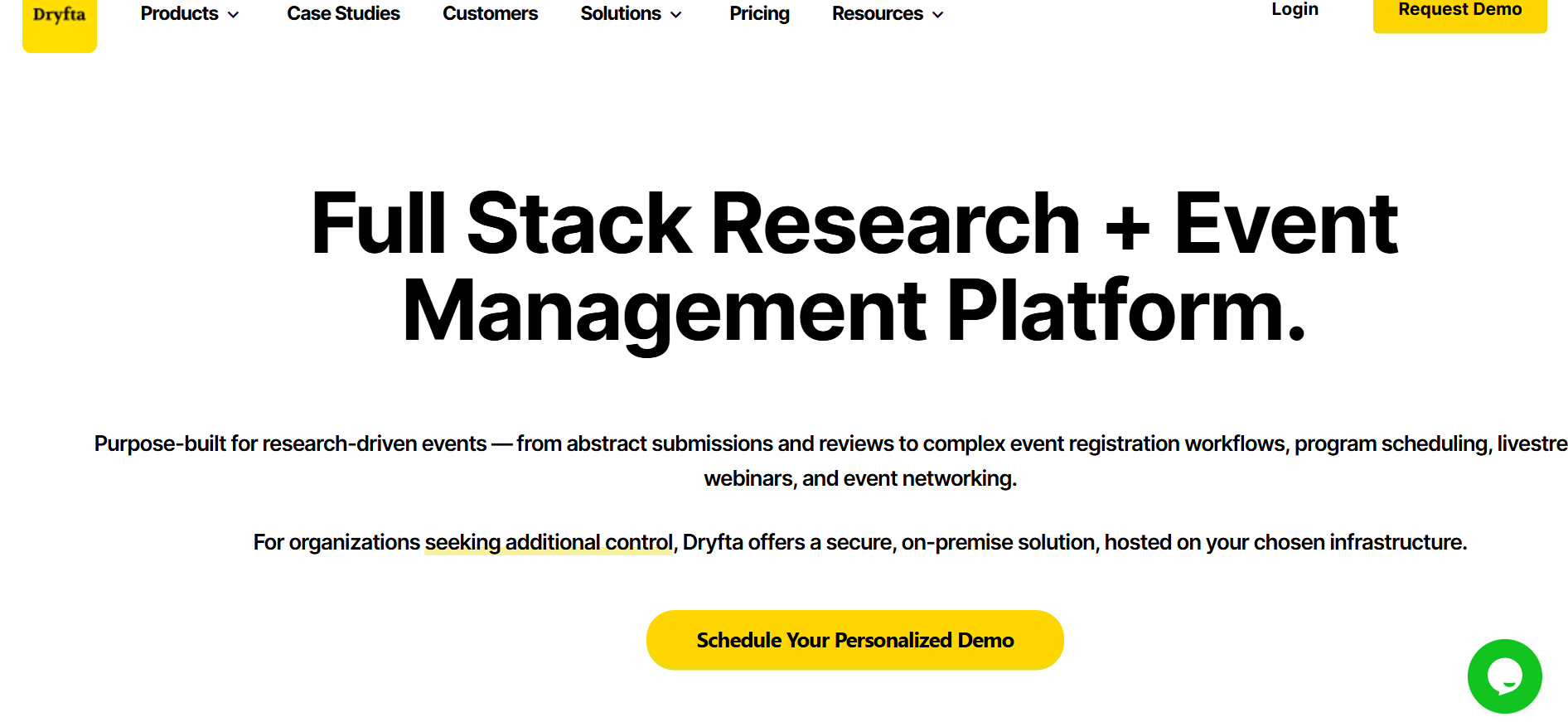
Dryfta is a complete event management tool which is designed for research and educational events. Unlike conventional event management software, this platform takes care of abstract submission, peer review, registration, scheduling, hybrid events, networking, and more in a single ecosystem. This makes it a highly sought-after platform for scientific conferences and hybrid events.
The key features of the platform include a robust CRM that tracks the details of the attendees, drag and drop scheduling, automatic notifications and marketing capabilities to suit your needs. The tool is also capable of abstract book publishing, session check-ins, real time reporting for teams, all under one ecosystem.
Features of Dryfta
-
- Registration and Ticketing: Dryfta provides a registration and ticketing system that supports all formats of events. Organziers can create multiple ticket types, make pricing rules, and configure custom registration forms based on different attendees. The platform makes sure the payment modes are secure and properly sends invoices.
- Abstract Management and Peer Review: The abstract submission and peer review process helps organizers can make custom submission forms, mention the areas of the topic, and set submission deadlines easily. The peer review system supports single-blind and double-blind review processes. It also provides authors and reviewers dashboard and sends automatic notifications on the status of the submissions.
- Scheduling: Dryfta has a powerful event scheduling system that helps the organizers to design structured event agendas with multiple tracks, sessions and presentations. The scheduling system updates everyone across the event, and organizers can manage last-minute changes efficiently.
- Event Networking App: The mobile application is available for both Android and iOS. This allows you to keep track of your agendas, messaging, and other networking features on the go. The application allows attendees to create their profiles, browse participant lists, and connect with others who have similar interests.
Scientific Event Use Case and Real Examples
International Association of Applied Linguistics (AILA 2021)
The scientific program had more than 2400 registered participants, 260+ thematic symposia, more than 270 virtual sessions and above 1740 abstract submissions. The participants were able to interact during the event via audio, video and text messaging, and all the sessions were accessible even in the following year.
Features of Dryfta That AILA Used:
-
- Abstract submission and peer review
- Online and offline registration
- Email campaigns
- Building an event website with custom content and event information
- Virtual meetings
- Building an interactive event schedule
- Collecting and processing pre-recorded videos
- Managing an online community for attendees, speakers and moderators
- Live chat, private messaging and video call
- Mobile event application for both iOS and Android
- Creating and designing certificates
With the help of Dryfta, AILA asked the authors to submit their abstracts and upload the pre-recorded presentations. During the live event, the participants watched the pre-recorded presentations by the speakers and then joined the live Q&A session to discuss the papers. There were two types of sessions in the AILA Congress: Live Meetings (for symposia) and Livestreams (for keynotes). They also used the Matchmaking tool to find attendees who have similar interests.
2. Ex Ordo

Ex Ordo is an online conference management system for academic gatherings such as scientific conferences, technical meetings, and research symposia. The key strengths of the platform include abstract management systems and peer review systems, which are combined with registration and online event solutions.
The platform allows organizers to plan events and assign reviewers from a single point. It has an easy-to-use system suitable for both the organizer and attendee, and is used by associations, universities, and scientific communities worldwide. It also supports in-person, virtual, and hybrid event formats, with an online conference platform that retains content even after the live event ends.
Features of Ex Ordo
-
- Abstract Management and Review System: The platform has a structured abstract submission format and a proper system that allocates reviewers, manages comments and sends automated notifications on the status of submissions. The review tools and conflict avoidance mediums make sure the review process runs efficiently.
- Virtual Event Space: The system has a virtual event space to manage the audience online. It hosts highlights and star speakers in live sessions. Alongside the platform also gives space for video presentations, and papers to browse, which lets the attendees engage in discussions, ask questions and interact professionally.
- Comprehensive Registration and Payment Collection: Ex-Ordo helps you customize your registration forms. Its registration and payment collection system makes sure the payments remain secure, and the delegates have the freedom to pay by bank transfer as well.
Scientific Event Use Case and Real Examples
Society of Engineering Science Annual Meeting (SES2019)
In 2018, the new organizing team for the SES Annual Meeting had to design and manage a complex review system to handle the number of submissions for their upcoming conference the next year. They had to register delegates, collect payments, and it was necessary to monitor the entire process. They wanted to create a program that handled it all, both online and offline, through a mobile application. The conference had 1000+ submissions, 152 reviewers, 54 topics, 900+ delegates, and 20 parallel sessions.
Features of Ex-Ordo That SES Used:
-
- Abstract submission and review management
- Registration and payment collection
- Programme handling
- Mobile application
Ex-Ordo has all of that functionality at an affordable price, and the system could manage the delegates, registration and the handling of reviews. The recorded data from the system gave them an early indication of the workload. This way, they were able to assign reviewers to areas of their expertise easily. With the help of the platform, they managed the conference successfully.
3. HEPCon
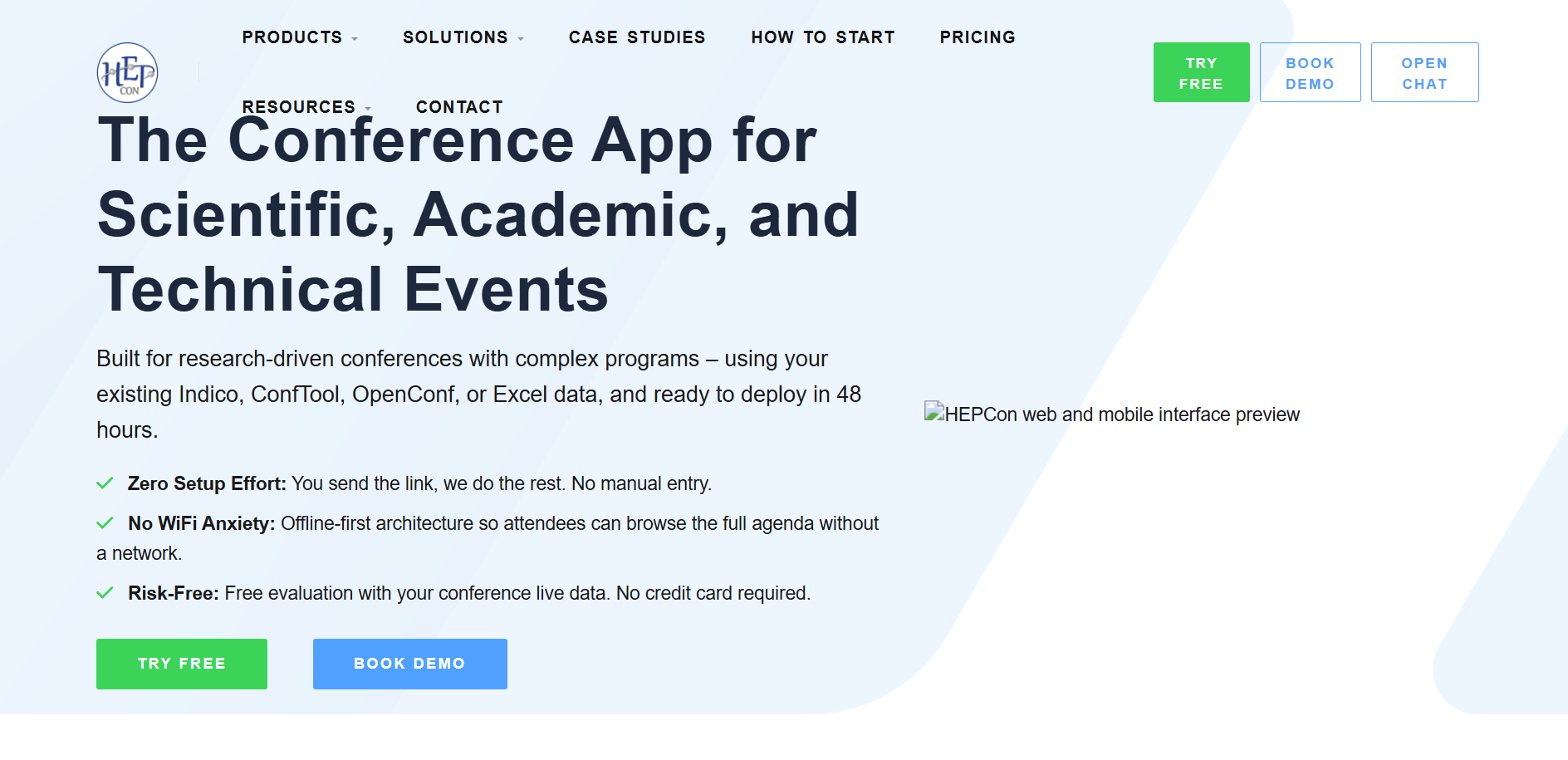
HEPCon is developed as a specialized online conference solution, which aims particularly at scientific, technical, and academic meetings, especially those with complex multi-track schedules, large sets of abstracts, and large attendee lists.
The platform addresses the particular needs of scientific events, starting from supporting scientific agendas, parallel sessions, authors, and speakers, to offline support. The system interoperates directly with Indico, ConfTool, OpenConf, and CSV databases, which ensures that organizers can easily and automatically import scientific programmes and session structures. The mobile and web solutions are tailored for scientific conferences.
Features of HEPCon
-
- Advanced Scientific Program and Event Management: The platform supports detailed sessions and structured scientific content, which allows the organizers to present large volumes of research material in a clean and coherent format. Attendees can easily explore sessions by using their desired filter options.
- Mobile and Website Experience Available: One of the strengths of the platform is that it has both mobile and web facilities. The mobile application can also be used in offline mode. Attendees can access the full event agenda, abstracts, speaker details and personal schedules even without an internet connection. This feature helps large scientific events run effortlessly, even when the connection is disrupted for any unavoidable reason.
- Seamless Integration with Scientific Conference Systems: The platform allows the organizers to keep track of the schedules, abstracts, and session updates while it works with the scientific conference systems alongside. This streamlined workflow allows consistency and accuracy, which maintains the quality of the event.
Scientific Event Use Case and Real Examples
EPS-HEP 2025 (European Physical Society Conference on High Energy Physics)
The European Physical Society Conference on High Energy Physics is an international conference in particle physics. The 2025 conference took place with 798 registered participants. The event had 124 sessions, 684 oral contributions, and 10 posters, which were distributed across multiple parallel tracks. Without a mobile agenda, the participants would have been forced to rely on static PDFs or the Indico website, both of which were troublesome during the conference days. HEPCon helped them with its mobile application and web agenda platform, as it is specifically designed for conferences with complex scientific programmes.
Features of HEPCon That EPS-HEP Used:
-
- Mobile application
- Website agenda
- Push notifications
- Analytics dashboard
HEPCon made the event agenda available in offline mode for the participants. This helped them to search for speakers, browse abstracts, and build personal schedules even where there was limited connectivity.
Quick Comparison: 7 Scientific Event Management Platforms at a Glance
In the table below, let’s take a brief and yet comparative overview into the 7 best scientific event management software in the market presently. We’ve segmented the platforms on the basis of the criteria that truly matter for users in practicality. Our categorization is not superficial or glossing over the same ideas over and over again. Each characteristic in this table is a cue toward finding the best scientific event management platform for your event.
| Platform | Best For | Blind Review | AI Features | Integrated Event Mgmt | Starting Price |
| Dryfta | Academic/research conferences; full event suite | ✅ Single, double, triple | ✅ AI scoring + plagiarism | ✅ Full suite | From $1,499/yr |
| Ex Ordo | Scholarly conferences needing specialist peer review | ✅ Yes | ⚠️ Partial | ✅ Full suite | Quote-based |
| Whova | Full-scale academic conferences with networking | ✅ Yes | ⚠️ Partial | ✅ Full suite | Quote-based |
| Fourwaves | Smaller academic/scientific events; easy setup | ✅ Yes | ❌ No | ✅ Registration + programme | From ~$500/event |
| Oxford Abstracts | Transparent per-event pricing; flexible formats | ✅ Yes | ⚠️ Partial | ⚠️ Registration add-on | $890–$3,450/event |
| EasyChair | CS/budget-constrained conferences | ✅ Yes | ❌ No | ❌ No | Free / Pro |
| HEPCon | High-energy physics conferences (Indico-based) | ✅ Yes | ✅ Indico ecosystem | ⚠️ Physics-specific | Community / contact |
Which Platform Is Right for Your Scientific Conference?
The question sounds straightforward. It is not. The right platform depends on the size of the conference, the scientific discipline, how much the peer review process matters relative to everything else and what the budget can realistically support. The scenarios below cover the cases most organizers actually face.
- For large-scale academic and research conferences: Dryfta is the most complete option. It covers abstract submission, peer review, registration, scheduling, networking and hybrid sessions in a single system. The configuration requires time, and the annual pricing reflects the depth of the platform, but for a conference that would otherwise manage these functions across three or four separate tools, the consolidation is worth it.
- For scholarly conferences where peer review quality is the primary decision factor: Ex Ordo has the deepest specialization in the submission and review workflow. Its peer review configuration and reviewer management features are built around the specific requirements of scholarly program committees, and its expansion into broader event management means it can now serve the full conference cycle.
- For full-scale academic events prioritising community networking and the highest G2-rated user experience: Whova is the clearest choice. Its attendee engagement features, including community boards, meeting scheduling, session Q&A and in-app messaging, are as strong as anything in the market, and its consistent G2 ratings reflect a platform that performs reliably on the day of the event.
- For smaller scientific events: Fourwaves was designed for this. It sets up quickly, its submission and review workflow is accessible to programme committee members without technical backgrounds, and its per-event pricing starting around $500 is financially realistic for symposia and regional conferences that cannot justify an annual enterprise subscription.
- For events needing transparent per-event pricing: Oxford Abstracts publishes its pricing tiers clearly, which is unusual in this market and genuinely useful for conference organizers who need to plan budgets before entering a sales conversation. The platform covers abstract submission and peer review well, with registration available as an add-on.
- For computer science or budget-constrained academic conferences: EasyChair’s free tier provides a functional submission and peer review system with no cost and no negotiation required. In computer science, its familiarity among authors and reviewers removes the adoption friction that a newer platform would face.
- For high-energy physics conferences using the CERN Indico framework: HEPCon is the appropriate choice, and for conferences already embedded in the Indico ecosystem, it is effectively the natural one. It is not designed for general use and does not need to be. For the community it serves, it provides purpose-built infrastructure that a general-purpose platform cannot replicate.
Frequently Asked Questions (FAQs)
What is scientific event management software?
Scientific event management software is a platform designed for the specific organizational requirements of academic and research conferences. This includes abstract submission, peer review, reviewer assignment, blind review workflows, author notifications and the conversion of accepted papers into a conference program. Most platforms in this category also cover registration, scheduling and attendee management, though the depth of the scientific process tools varies considerably between them.
How is scientific event management software different from general event software?
General event software handles the logistics of running an event: registration, ticketing, attendee communication and on-site management. Scientific event management software handles all of this and the months of peer review process that precede the event. The critical difference is native abstract submission and review functionality: submission forms, blind review configuration, reviewer dashboards, scoring rubrics, decision communication and abstract-to-schedule conversion. General event tools do not provide this or provide a version of it that does not meet the requirements of a program committee running a serious peer review process.
Which conference management software is best for academic conferences?
The answer depends on the scale and requirements of the conference. Dryfta is the most complete option for large academic and research conferences that need abstract management, peer review, registration, scheduling and networking in a single platform. Ex Ordo is the strongest specialist option when peer review quality is the primary concern. Fourwaves is the most practical choice for smaller scientific events that need a clean setup at a lower price point. EasyChair is the default for computer science conferences with limited budgets. The right answer is the platform that fits the specific configuration of your event: discipline, scale, budget and what your program committee actually needs to do.
Is there free scientific conference management software?
Yes. EasyChair provides a fully functional abstract submission and peer review system at no cost. It does not include event registration, scheduling or attendee networking, so conferences that need those features will require additional tools or an upgrade to EasyChair Pro. Zenodo, while not a conference management platform, provides free DOI-backed hosting for proceedings once the conference has ended. For organisations within the CERN ecosystem, HEPCon and Indico are available as open-source, community-maintained options.
How much does scientific event management software cost?
Pricing varies significantly across the category. Dryfta starts at $1,499 per year for the full platform. Fourwaves charges per event starting around $500, scaling with submission volume. Oxford Abstracts publishes per-event tiers between $890 and $3,450. EasyChair is free at the standard tier with paid Pro options available. Ex Ordo and Whova are quote-based and require direct contact for pricing. HEPCon is community-maintained and available at no cost to qualifying physics organizations. The right pricing model depends on how frequently your conference runs and how submission volume scales from year to year.
Final Thoughts
Proper execution of scientific events needs careful planning. From abstract submission to the actual session, it is important to use an appropriate event management tool. Each of these platforms offers a unique set of benefits. From a full-fledged event management software to a platform designed specifically for scientific events. Every one of them has different levels of functionality and offers particular solutions to your problems.
In the end, choosing the right platform for your event will depend on the complexities and needs of your event. When you are able to match your needs with the strengths of the platform, you will inevitably be able to alleviate the stress of the whole event planning process. Book a free demo with Dryfta today to find out how it will suit your next conference and help you maintain your workflow and event quality.