
When you plan an event, you want a smooth registration experience for every attendee. But selling tickets can be a challenge, especially for nonprofits and academic conferences managing multiple ticket types, discounts, and payment rules. Choosing the right online ticketing platform can reduce administrative work while helping your organization keep more of its ticket revenue.
However, there are several online ticketing platforms out there with low fees to help put on fantastic events and ensure a smooth, hassle-free experience for everyone involved.
Whether you’re hosting a musical concert or corporate conference, one of the best ticket sales platform today will help run your event without any hitches. With so many options to choose from, it can be challenging to find the best event ticketing platforms with lowest fees for your event. In order to avoid any unnecessary fees, this article provides a list of the 10 best event ticketing software with low fees, as well as what factors are taken into consideration for these rankings.
Why Ticketing Fees Matter More Than Most Organizers Realize
Ticketing fees, and the platform you choose to handle the workflow, both have implications and ramifications larger than most organizers realize. Perhaps ticketing is only one component of the larger event management process. However, it is pertinent for event organizers to acknowledge that no single facet of the event management process is worth approaching haphazardly. All of them need, and demand, your unequivocal attention.
Having said that, it is this inclination to treat fees as secondary that is costing organizers dearly. A 3% platform charge on a $50 ticket appears negligible in isolation. Yet, when you multiply it across 500 attendees and compound it with premium feature add-ons that are sometimes not advertised upfront, the total sum adds up quickly.
This problem of ‘premium fees’ or ‘tax fees‘ being discreetly squeezed into the final bill has persisted for decades. It is a practice that several undermines the transparency and fiscal ethics of an organization. To address and to effective counteract this growing problem, the Federal Trade Commission (FTA) came with what is called the ‘Junk Fees Rule.’ In effect since May 12 last year, the rule now mandates that all obligatory charges be disclosed upfront to users within any price advertised for live-event tickets.
Non-compliance to the Junk Fees Rule carries civil penalties of up to $51,744 per violation.
Understanding Ticketing Platform Fees- What You Are Actually Paying
In the below section, we’ll run you through the most common types of ticketing fees that customers pay for.
- Platform or Service Fee: This is the charge levied by the ticketing company itself. It’s a service fee that accounts for the organization’s work hosting the event, from start to finish. Platform and service pay often take the form of a flat fee per ticket and sometimes a percentage of total ticket revenue. Of all the different fee types, this is the one over which an organizer exercises the greatest control, given that it is determined entirely by the choice of platform.
- Payment Processing Fee: This charge is applied by the payment processor, for example, platforms such as Stripe, PayPal, Square or a regional equivalent. The purpose of this fee is to facilitate the movement of funds from buyer to organizer. It typically runs at approximately 2.9% plus $0.30 per transaction and applies regardless of which ticketing platform is in use.
- Hidden or Premium Feature Fees: A good number of platforms are guilty of advertise a low headline fee and then discretely pply separate charges for more features. These add-ons can, in addition, double or triple an organizer’s effective cost without ever appearing in the platform’s primary pricing summary. Also called ‘bait fees,’ these payments are likely to hurt customer loyalty and your firm’s financial transparency.
- Free Event Fees: This category is frequently overlooked but is an important fee variant to be considered. Some platforms apply no charge whatsoever for events at which no ticket revenue is generated. Others impose their standard fee structure regardless of whether a single dollar changes hands. For community organizers or nonprofits that run free events with any regularity, free events fees can be beneficial.
The true measure of any platform’s cost is its Total Cost of Ownership, the aggregate of platform fees, processing charges, add-on costs and any revenue withheld. You must evaluate this against the specific characteristics of a your event, in terms of its size and ticket prices. The scenarios that will be coming up in the next section are intended to make this concept more clear and understandable in concrete terms.
Real-World Cost Scenarios- What You’d Actually Pay
When it comes to ticketing, users find themselves paying fees that can look different from platform to platform. The core reason for these pricing structures is to do with varying rules and regulations. Some of this is regional and others are determined by factors, like service and processing charges, that are almost universal. It is also possible that the same platform may be selling tickets of varying prices across events. In the below section, we’ll take a brief look into three hypothetical scenarios and what total ticket prices add up to for each. If you are an event organizer, you will also find a bonus rule of thumb at the end of this section.
Scenario A- Small Community Event: 100 Tickets at $15
Gross revenue: $1,500
- At 3.5% + $1.00 per ticket: platform fee = $52.50 + $100.00 = $152.50 (10.2% of revenue)
- At $0.99 flat per ticket: platform fee = $99.00 (6.6% of revenue)
- At $29/month subscription + $0 per ticket: platform fee = $29.00 (1.9% of revenue, assuming one event per month)
For low-ticket-price events, flat fees and subscriptions save disproportionately more than percentage-based models. Every percentage point taken from a $15 ticket is a meaningful slice of very thin revenue.
Scenario B- Mid-Size Conference: 300 Tickets at $75
Gross revenue: $22,500
- At 3% + $1.00 per ticket: platform fee = $675 + $300 = $975 (4.3% of revenue)
- At $0.99 flat per ticket: platform fee = $297 (1.3% of revenue)
- At $99/month subscription + $0 per ticket: platform fee = $99 (0.44% of revenue)
Subscription models become dramatically cheaper above around 40-50 paid tickets per month. At this event size, the difference between a percentage-based platform and a subscription platform is nearly $900 on a single event.
Scenario C- Large-Scale Event: 1,000 Tickets at $100
Gross revenue: $100,000
- At 3% + $1.00 per ticket: platform fee = $3,000 + $1,000 = $4,000 (4.0% of revenue)
- At $0.99 flat per ticket: platform fee = $990 (0.99% of revenue)
- At $169/month subscription + $0 per ticket: platform fee = $169 (0.17% of revenue)
At scale, percentage-based fees become extremely expensive. Flat fees and subscriptions are the financially rational choice, and the gap between them and percentage models widens with every ticket sold.
Rule of Thumb For Event Organizers
If you sell more than 40 paid tickets per month consistently, a subscription-based platform with $0 per-ticket fees will almost always be the cheapest option overall. For one-off events under 100 tickets, a flat per-ticket model at $0.75–$0.99 is usually best.
Should You Pass Ticketing Fees to Attendees or Absorb Them?
On Absorb All Fees and Building It Into the Ticket Price
When taking a call on your final ticket price, there are 3 different ways to approach the decision. Whatsoever you may choose from the section delineated below, make sure to be transparent and consistent in communicating that to your users. Each of the three pricing models carry their own set of pros and cons. The smarter choice today may perhaps be to choose a hybrid, split model, which you will reading about in point 3. However, ultimately, the decision remains yours to make.
If you opt for this model of ticketing fees, what you will be doing in effect is setting your ticket prices high enough to also be able to cover your platform and processing costs. In this case, therefore, your attendees will see a single, clean number at checkout. As well as a breakdown of how much goes into the main ticket fee and the plus charges. Building processing charges into your total flat fee makes sure that there are no surprises for buyers at the checkout screen.
This is encouraged now that the FTC’s Junk Fees Rule is in effect, requiring total prices to be disclosed upfront anyway. The only downside here is that your headline ticket price looks higher than competitors who externalize their fees. Doing this can affect how your event appears in search results and comparison shopping.
Pass All Fees to Attendees (Buyer-Pays Model)
Most platforms let you add a booking fee or service fee to each ticket, which attendees will then pay on top of the face value. In this type of buyer-pays model, your net revenue will remain closer to the ticket price you set. All of your additional costs here will be effectively covered by the people generating them.
The obvious tradeoff here is that attendees will see a higher total than they expect. This can be off-putting and creates friction during purchase. Your users may raise questions pertaining to your firm’s transparency in ticketing and more general grievances on how clearly your fees are labeled.
Split Model
Some organizers absorb part of the cost and pass on part, rounding to a psychologically clean number. This is worth considering when your ticket prices are already high and an additional fee feels disproportionate to attendees but you’re still dreaming of partial cost recovery.
Practical Guidance For Event Organizers
- For free or low-cost community events, absorbing fees is generally the right call. The amounts are small and the goodwill is worth more.
- For conferences and professional events with $75+ tickets, the buyer-pays model is well-established and widely accepted.
- For fundraisers, absorbing fees signals generosity and removes friction from donations.
Whatever it is that you choose, make sure to communicate it clearly and wisely. Ensure.that your branding is consistent across your ticketing page and any other promotional material. Make the total cost visible at every stage of checkout.
What is an online ticketing platform?
An online ticketing platform, simply put, is a digital apparatus that lets organizers create, manage, and sell tickets for their events via the internet. The convenience of these online ticketing platforms is that they cater to almost all kinds of events, be it academic conferences, non-profit fundraisers, sports tournaments, cultural festivals or even a high school farewell. Yes, a good platform handles it all.
Online ticket sales platforms let your attendees say no to flimsy paper tickets that get lost or crumpled easily. If you’ve ever lost or misplaced your concert tickets, you would know just how incredible these online ticketing tools are at preserving them. These are websites and applications that connect event creators directly with their audiences. They take away the friction that once made event management an exhausting, resource-heavy endeavour.
How Do Online Ticketing Platforms Work?
The process of how the online ticketing platforms work is fairly simple. This is how it goes:
-
- The process begins with the organizer. They register on the platform, create an event listing complete with date, venue, description and ticket pricing and publish it for the world to see.
- The platform then follows it up with a dedicated event landing page, shareable across social media, email and messaging applications.
- Attendees are then able to easily visit the page, select their tickets and complete payment via integrated gateways supporting cards, net banking or digital wallets.
- Once payment is confirmed, the system automatically issues digital tickets, QR-coded, tamper-proof, and delivered instantly to the buyer’s inbox or mobile device.
- On the day of the event, organizers use scanning tools provided by the platform to validate entries swiftly at the gate. No manual cross-referencing. No room for fraudulent duplicates.
What are the Benefits of Using an Online Ticketing Platform?
An online ticketing system, in 2026, is not just a nice addition to have as an event manager. Rather, it is now an extension of your event or conference itself. Such is the importance of an online ticketing system, wherein almost 90% of entry passes to your event are sold. Some of the most notable benefits of switching to an online ticketing platform include:
-
- As an organizer, you begin saving plenty of time. And by plenty, I do not mean a few hours. I mean entire weeks that one would otherwise spend in sorting, printing, and tracking tickets for attendees.
- As a user, you no longer have to worry about misplacing your ticket anywhere. Nor do you have to worry about printing your pass in the first place. All your needs and requirements to gain entry to the event are available on your mobile event app, at the click of a button.
What Features Should I Look for in an Online Ticketing Platform?
The best online ticketing platforms are the ones that offer a combination of features that simplify the process of ticketing and registration. So, the obvious question now is, what are the features that most event planners look for in a ticketing platform?
When looking for the best online event ticketing platforms in the USA, go for platforms that give you the option of viewing customizable reports in retrospect. This feature allows you to focus on the metrics that matter most for the success of your event. A well-equipped online ticketing system should also be able to create custom email templates that match your brand. Additionally, it should also allow you to schedule targeted communications to specific attendee segments as well as track email open rates and click-through rates.
On the more technical front, issues in connectivity do not wait for convenient times to crop up. They show anytime, anywhere, virtual or in-person. Therefore, your ticketing platform needs to be proactive and responsive in customer support. Make sure you have grievance redressal available on mail, phone or live chat. Alternatively, you may make amends to arrange for a third-party technician who may be familiar with the platform’s operation.
Top 10 Online Ticketing Platforms
To help event planners make an informed decision about choosing the right ticketing platform, we have curated a list of some of the best online ticketing platforms in the USA.
1. Dryfta
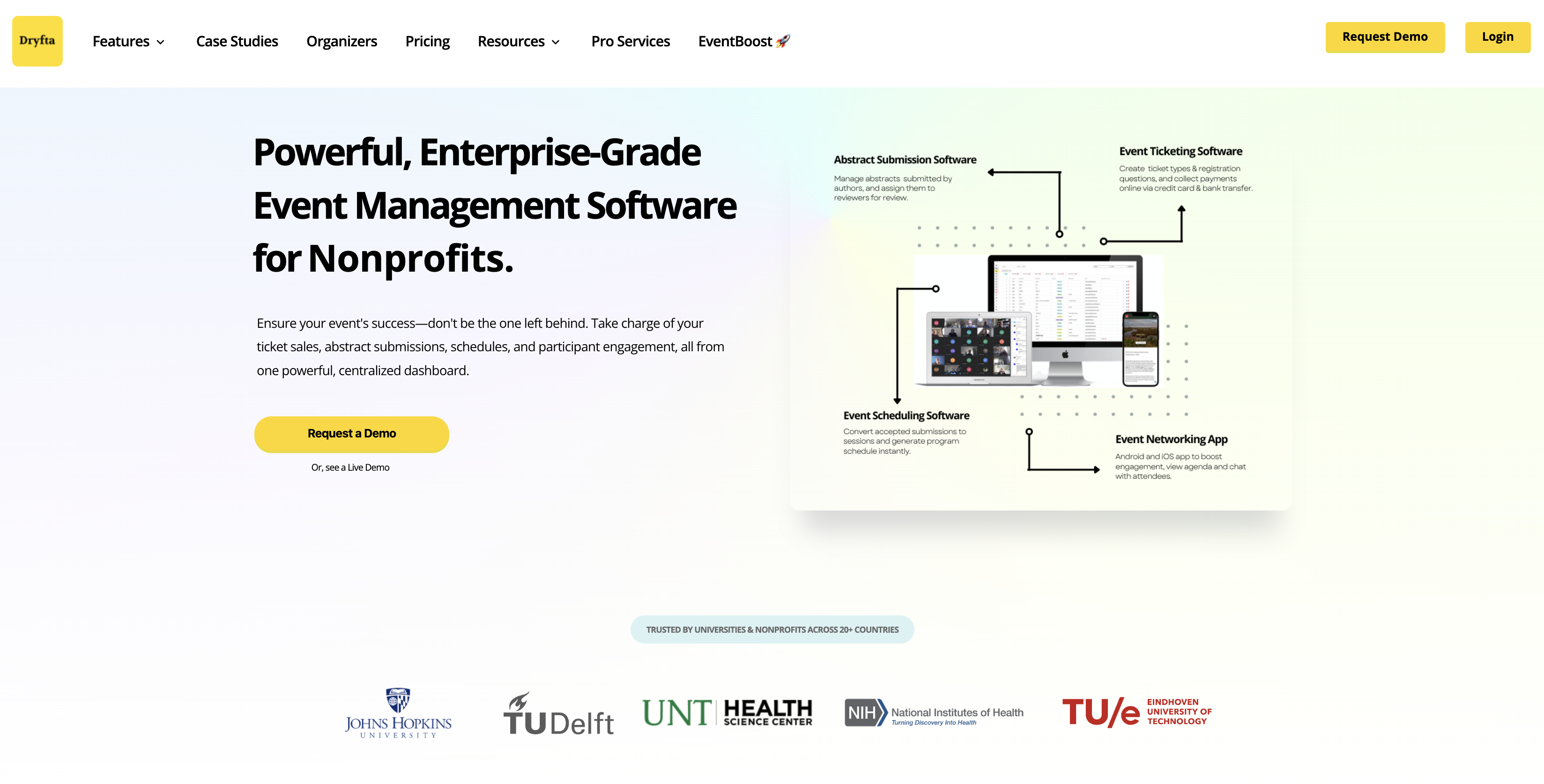
Dryfta is an all-in-one event management platform designed to simplify every aspect of your event, from registration to attendee engagement.
🎯Key Features
☑ Intuitive and customizable registration and ticketing tools
☑ Effortlessly manage abstracts, reviews, and program schedules for academic and professional events
☑ Powerful networking features, including private messaging and community forums, to boost attendee interaction
☑ Real-time analytics to monitor attendee engagement and event performance
☑ Secure platform with integrated payment processing and data protection
💰Pricing
If you connect your own merchant account with a payment gateway supported by Dryfta, the cost is as low as $1.8 per successful transaction—ideal for nonprofits and organizations of all sizes, with no additional fees. Do not have your own merchant account? Use Dryfta payment gateway, which incurs a 4.9% fee per successful transaction (2% service fee + 2.9% card processing fee).
☁ Website
dryfta.com
2. Eventix
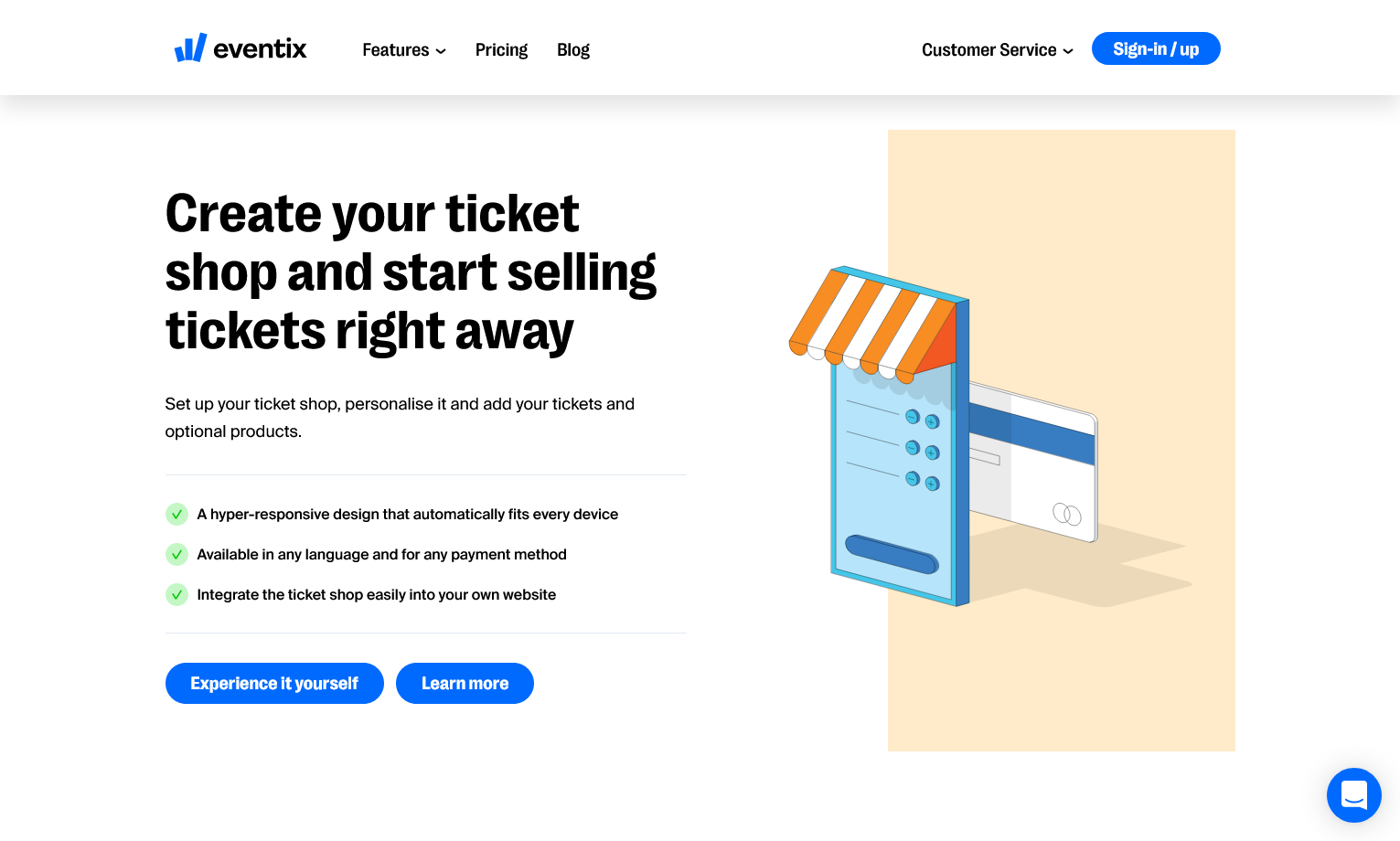
Eventix is an event management and ticketing platform that provides the smoothest experience in organizing and selling tickets for any event.
🎯Key Features
☑ The technology is easy enough for anyone to use.
☑ Create and share your event listings. And easily invite guests to events.
☑ Create individual or general reservations for your events.
☑ The software provides more data than just entry and includes biometric data such as heat maps, animations, and stats, so exhibitors can see what people are most interested in.
☑ It makes sure the information associated with each ticket remains secure and confidential.
💰Pricing
Eventix sells tickets online has excellent pricing plans that start at a low price of $1.21 per sold ticket.
☁ Website
eventix.io
Why Eventix might not be the right option for you:
Eventix has fairly simple technology to navigate. Therefore, this might prove limiting to event organizers who want deeply data-enriched statistics and analytics.
3. Tix
Tix is a feature-rich ticketing platform that has been successful in its business from what began as a simple idea: creating an easy-to-use, customizable platform for event ticketing.
🎯Key Features
☑ It offers different ticket types for its clients.
☑ It also offers discounts for multiple tickets purchases and pre-sale tickets.
☑ It offers its clients the option to skip service fees.
☑ It provides opportunities for attendees to get more involved in their events.
☑ It provides a free platform service with advanced features.
💰Pricing
It charges each ticket $0.25 in box office fees, and online tickets range from $1 to $1.50.
☁ Website
tix.com
Why Tix might not be the right option for you:
-
- Customizable options for tickets are limited in nature.
- Customer reviews also note that there are fewer automations for event reminders and season subscriptions.
4. TicketSpice
TicketSpice provides cloud-based event management and ticketing services. In addition to ticketing features, fee controllers, price setting options, event analytics, inventory tracking, making offline payments, and branding controls are available.

🎯Key Features
☑ By dragging and dropping fields, you can create customizable ticketing pages.
☑ As well as mobile ticketing offers app-based scanning of tickets and barcodes.
☑ Generating dashboards and reports that can be exported into Excel makes it possible to generate real-time data summaries.
☑ Ticket users can also sell tickets for multi-location or multi-day events.
☑ Social networking platforms and customer relationship management (CRM) platforms like Salesforce can be integrated.
💰Pricing
At their ticketing platforms with the lowest fees level, they charge only a small fee of $0.99 per paid ticket plus the payment processor’s credit card fees of 2.9% + $0.30 per transaction.
☁ Website
ticketspice.com
Why TicketSpice might not be the right option for you:
TicketSpice’s mobile app is reportedly difficult to manage with regard to on-site operations.
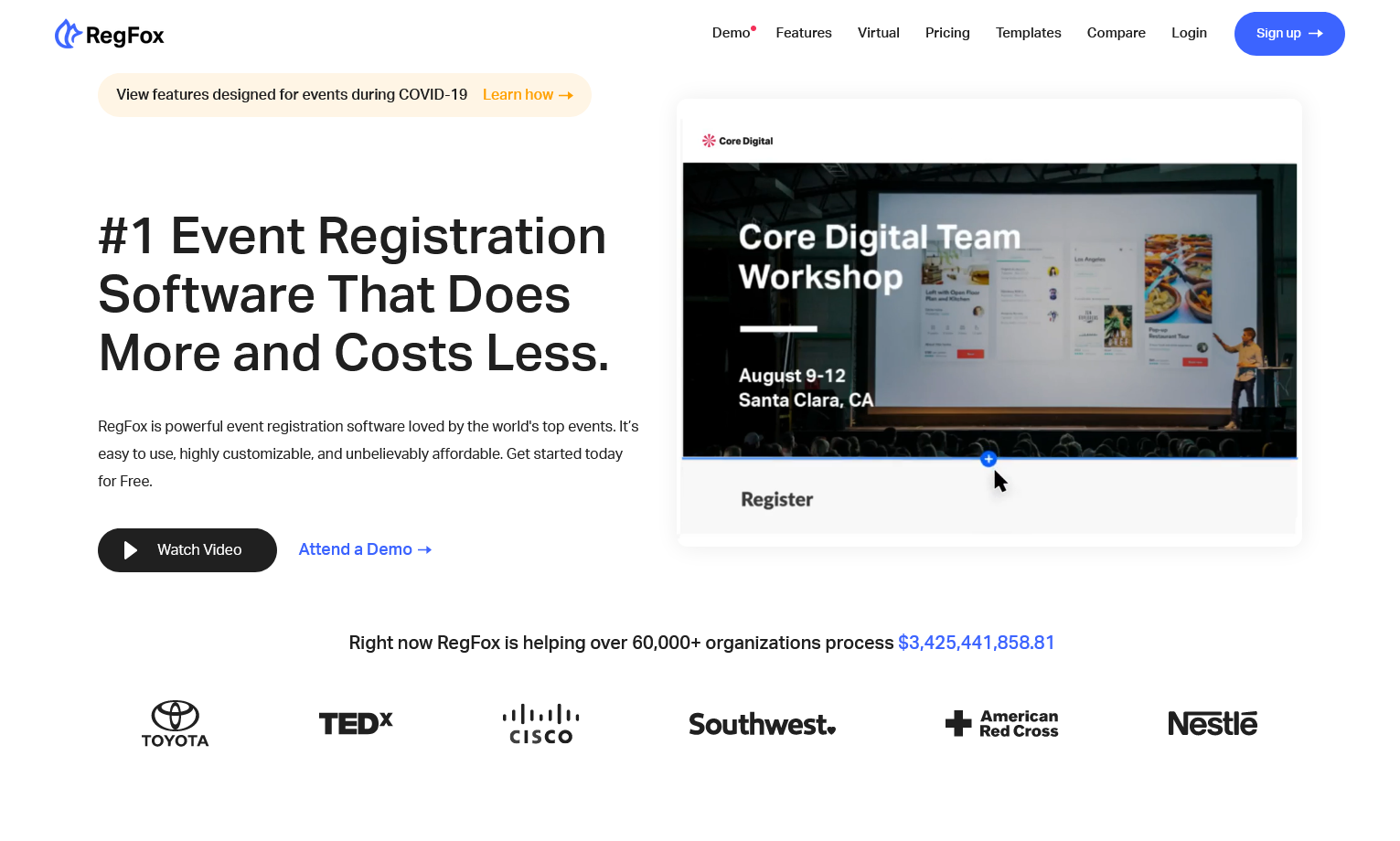
5. RegFox
RegFox is one of the cloud-based ticketing platforms with lowest fees specifically designed for managing registrations for racing events.
🎯Key Features
☑ They offer the ability for event organizers to create customizable registration pages and send invites to individual participants or teams.
☑ Furthermore, admin rights are provided for managing the registration page, which includes conditional visibility, allowing users to restrict the visibility of graphics.
☑ Additionally, the user can configure date-based pricing and supply pricing, including a set of pricing rules.
☑ Users can specify rules for formatting and displaying certain fields in the registration.
☑ You can create events easily and sell tickets with its powerful event page builder.
💰Pricing
There is a charge of $0.99 per registrant for free events if you subscribe to the Classic plan, and $0.89 per paid registrant plus $19.
☁ Website
regfox.com
Why RegFox might not be the right option for you:
-
- Availability of very limited post-event tools, like surveys.
- Payments are also restricted to certain third-party gateways (Stripe-only) and extra fees are levied for other processors.
6. Ticket Tailor
Ticket Tailor allows you to sell tickets online and create event campaigns.

🎯Key Features
☑ Ticket Tailor lets you create a new online event campaign or pick an existing one.
☑ Ticket Tailor eliminates the need for any ticketing fees, which means that it makes it very affordable.
☑ It also offers integrations with third-party systems such as Google Analytics and MailChimp.
☑ It is easier for organizers, promoters, and attendees to find an event.
☑ They provide a simple ticket registry.
💰Pricing
The price per ticket ranges from $0.26 to $0.52.
☁ Website
tickettailor.com
Why Ticket Tailor might not be the right option for you:
-
- Ticket Tailor leans its operations very heavily on buyer-paid processing. This has been a source of complaints from attendees who sign up for low-priced events.
- It has limited built-in marketing tools compared to its all-in-one rivals like Dryfta.
7. Eventzilla
Eventzilla aims to help event planners move from their current archaic process of building static events to more digital and interactive ones.

🎯Key Features
☑ It has an integrated registration system.
☑ Includes security features, like credit card verification.
☑ Payment integration: Stripe Checkout, PayPal, and others are supported.
☑ Social media integration is possible to promote your event.
☑ Insights dashboard that provides information about guests and registrations.
💰Pricing
There is no charge for free events. There is no monthly fee, no contract; that’s why it is on the list of ticketing platforms with lowest fees. Plans for prepaid for basic users are $1.50/registration.
☁ Website
eventzilla.net
Why EventZilla might not be the right option for you:
Prepaid plans are costly on the platform. They also lock in funds early, which proves risky for events with uncertain attendance rates.
8. Showpass
Showpass is one more choice among the ticketing platforms with lowest fees that provide ticketing access to global distribution and discovery channels.

🎯Key Features
☑ It offers a one-stop-shop for venues, promoters, and venues to sell tickets with built-in merchandising.
☑ The system automatically assigns each visitor to one of several roles.
☑ Event organizers can print their badges on a variety of materials.
☑ Showpass offers a unique solution for event organizers to manage their event ticketing operations.
☑ Showpass provides tools that make their job easier, such as touchpoints or beer check-ins, venue entry, and more.
💰Pricing
They charge only 1.0% + $0.59* per ticket sold in their lowest pricing tier when listing events for free.
☁ Website
showpass.com/
Why Showpass might not be the right option for you:
Showpass has limited USA-specific venue tools and has regional constraints.
9. TicketSource
TicketSource is entirely free and available to all.

🎯Key Features
☑ The primary use is for concerts and sporting events, but it can be used for any event.
☑ Nonprofit organizations widely use it to offer low-priced tickets while still making profits.
☑ It is free.
☑ You can print your tickets anytime on any device connected to the internet.
☑ Companies can manage their entire event from any location.
💰Pricing
Event organizers can use their fully functional online box office for free. Customers can book online for paid events for a small fee.
☁ Website
ticketsource.us
Why TicketSource might not be the right option for you:
Mobile navigation is a recurring cause of concern for frustrated users. Its seating charts are often clunky and tough to navigate for beginners.
10. ThunderTix
ThunderTix helps organizations and businesses boost their revenue by streamlining the ticketing process.

🎯Key Features
☑ It finds new ways to integrate external marketing resources.
☑ It does not charge per ticket or have contracts.
☑ You can create custom events sell tickets through your website.
☑ It enables you to sell your tickets through Facebook, Twitter, Instagram, and other social media platforms.
☑ Their main feature is that they offer a free 10-day trial.
💰Pricing
They offer plans for as low as $79/month for general admission events and $99/month for reserved seats.
☁ Website
thundertix.com
Why ThunderTix might not be the right option for you:
The trial version limits full testing for potential buyers when it comes to custom integrations.
11. Accelevents
Accelevents provides as it combines ticketing platforms with lowest fees with online marketing, online event management, and marketing automation.

🎯Key Features
☑ An intuitive and straightforward user interface is provided.
☑ They also offer affordable pricing.
☑ They offer a variety of interactive features like live streaming and mobile apps.
☑ A fundraising team can create their custom-made ticketing website set up a digital event.
☑ It allows event hosts to customize their page to sell tickets and registrations.
💰Pricing
Their price is $500 per event.
☁ Website
accelevents.com
Why Accelevents might not be the right option for you:
It has fixed and fairly high flat fees that can be unsuitable for one-off events as well as for small-scale organizers.
Best Ticketing Platform for Events: Side-by-Side Comparison
| Platforms | Key features | Pricing |
| Dryfta | Intuitive and customizable registration and ticketing tools | $1.8 per successful transaction. |
| Eventix | Eventix offers biometric data such as heat maps, animations and stats so exhibitors can see what people are most interested in. | $1.21 per sold ticket. |
| Tix | Tix offers its clients the option to skip service fees. It provides opportunities for attendees to get more involved in their events. | It charges each ticket $0.25 in box office fees, and online tickets range from $1 to $1.50. |
| TicketSpice | Social networking platforms and customer relationship management (CRM) platforms like Salesforce can be integrated with TicketSpice. | $0.99 per paid ticket plus the payment processor’s credit card fees of 2.9% + $0.30 per transaction. |
| RegFox | Admin rights are provided for managing the registration page, which includes conditional visibility in RegFox. | $0.99 per registrant plus $19. $0.99 + 1.25% per registrant (capped at $4.99). Free events are at $0.99. |
| Ticket Tailor | It is easier for organizers, promoters, and attendees to find an event on Ticket Tailor. They provide a simple ticket registry. | The price per ticket ranges from $0.26 to $0.52. |
| Eventzilla | Eventzilla has an integrated registration system and includes security features like credit card verification. | Plans for prepaid for basic users are $1.50/registration. |
| Showpass | Showpass offers a one-stop shop for venues, promoters, and organizers to sell tickets with built-in merchandising | $1.69 + 2.5% per ticket (processing) per ticket sold in their lowest pricing tier when listing events for free. |
| TicketSource | The primary use of TicketSource is for concerts and sporting events, but it can be used for any event. | Event organizers can use their fully functional online box office for free. Customers can book online for paid events for a small fee. |
| ThunderTix | ThunderTix’s main feature is that they offer a free 10-day trial. | $79/month for general admission events and $99/month for reserved seats. |
| Accelevents | An intuitive and straightforward user interface is provided. Accelevents also offers affordable pricing | Their price is $500 per event. |
What to Look For in an Online Ticketing Platform?
When opting for the best ticketing platform for events in 2026, organizers need to ensure the platforms consist of the following features:
User Experience: Both organizers and attendees appreciate a ticketing platform with well-designed dashboards, clear menu structure, and one that prioritizes mobile-responsiveness.
Automated Communication Through Email: Ticketing platforms that allow personalized email templates are always the best pick.
Flexibility of Different Ticket Types: The popular online ticketing systems allow organizers to create different ticket types with different pricing structures, which provides flexibity the whole ticketing and registration process.
Insights on Event’s Performance: The efficient event ticketing systems come with the ability to export data in different formats for the stakeholders to check and have clarity on the event’s overall performance.
Frequently Asked Questions (FAQs)
1. What is the best online ticketing system?
The best online ticketing platforms in the USA include Dryfta, Ticket Tailor and EventZilla among others. Dryfta leads the race and remains a widely recognized name for its fast setup, flexible pricing and an already established audience marketplace. The right fit for you, however, depends on things like your event size, budget and customization.
2. What is the best site for online tickets?
Among the best online ticketing platforms for events, Dryfta, Eventzilla and Ticket Tailor consistently rank at the top. Online ticket sales platforms like Dryfta and Eventbrite also have reviews for their analytics and marketing tools.
3. Is there something better than Eventbrite?
Yes, several alternatives to Eventbrite offer more flexibility depending on your needs. Among the best online ticketing platforms free of excessive fees, Dryfta charges a flat rate per ticket that undercuts Eventbrite’s percentage-based model.
4. Are online ticketing platforms suitable for small events?
The best ticketing platform for small events are made to accommodate workshops, community gatherings, yoga sessions and even local meetups. Most online ticket sales platforms need no upfront costs for free events and only charge per ticket sold for paid ones. These platforms give small organizers access to professional-grade tools that are otherwise fairly inaccessible.
5. How much do online ticketing platforms cost?
Pricing across the best online ticketing platforms in the USA varies widely. Most operate on a pay-per-ticket model and charge a percentage of the ticket price plus a flat fee. Some platforms are free for non-profit and smaller events. Other best online ticketing platforms free of unnecessary monthly subscriptions include Dryfta and Eventbrite.
6. Can I customize ticket types using online ticketing platforms?
Yes, you can. Customization today is a fairly standard feature that comes in almost all the best online ticketing platforms for small or big events. Prominent online ticket sales platforms like Dryfta also support discount codes, promo pricing and custom registration forms.
7. Do online ticketing platforms support mobile ticket scanning?
Essentially, all leading online ticketing platforms support mobile ticket scanning through QR codes. This is typically achieved via a free companion scanning app offered by the ticket provider.
8. Are payments secure on online ticketing platforms?
Yes, payments on reputable online ticket sales platforms are highly secure. Most platforms integrate with trusted payment processors like Stripe and PayPal. Should you be doubtful, it helps to check with your ticket provider once and enquire if they use SSL encryption and PCI-DSS compliance standards.
9. Can attendees get refunds through online ticketing platforms?
Yes, most of the best online ticketing platforms for events include built-in refund management tools. Organizers can set their own refund policies, whether full refunds, partial refunds, or no refunds and the platform handles the processing automatically while you sleep. Zero manual intervention.
10. What types of events can use online ticketing platforms?
Online ticketing platforms today are versatile and are built to support a wide range of event formats. The best online ticketing platforms for events cover concerts, festivals, corporate conferences, academic seminars, workshops, fundraisers, yoga classes, food markets, comedy shows, virtual webinars and hybrid events among others.
Conclusion
Ticketing is a two-sided business, with the company providing tickets, and the customer buying them. It’s an industry that has been doing well for a long time and has recently become more popular due to the rise of online ticketing platforms. However, many people are concerned about such companies’ fees. Each platform has its pros and cons, so make sure you compare them before buying tickets.
Related Searches
- New Waitlist Features for Improved Ticket Management
- Introducing Ticket Swapping: Simplifying Event Management
- Transforming Event Ticketing with Tax Manager
- How to Sell Tickets for Your Annual Event
- How to Price Event Tickets for Maximum ROI ?
- Sell Event Tickets with Square Payments
- Sell Tickets on Dryfta Without a Merchant Account