


A medical congress is not, in any meaningful sense, a standard conference. It asks organizers to coordinate hundreds of scientific abstracts through formal peer review, to run dozens of sessions in parallel, to satisfy regulatory requirements for continuing education credits, to uphold strict standards of data security, and to manage sponsorship arrangements that often carry significant financial stakes.
When these responsibilities are pushed through spreadsheets and scattered email threads, the strain becomes visible rather quickly, since missed deadlines, version control failures, incomplete attendee records, and a diminished delegate experience tend to follow close behind.
The cost of choosing poorly is not abstract either, because a congress that runs into these problems can damage an institution’s reputation, discourage future attendance, invite compliance violations, and quietly erode the revenue that registration and sponsorship were meant to provide. A congress that runs well, by contrast, tends to draw stronger speakers, more committed sponsors, and attendees who return year after year.
International medical conferences have increased by over 40%. Experts attribute statistics as this to a growing need for updation and innovation in a field that is as vast as medicine and healthcare.
Quite simply put, there never has been and there will never be a dearth of medical congresses or conferences. But what appears to be in dearth are capable software management tools and/or platforms to help run these events. Scientific conference softwares have always existed in the market. However, something much more precise, something like medical congresses are rarely borne in mind when software makers build their tools. Contemporary conference management softwares like Dryfta are changing exactly this misattribution. At Dryfta, we refuse to tag medical conferences as just one among the large pool of scientific events aka rooms where the serious guys meet and discuss jargon that flies right over most heads.
In this blog, we’re on a mission to round up the best conference platforms for medical congresses in the event management industry. While only one, or perhaps two platforms have direct experience in hosting a medical congress, we’ve compiled this list on the basis of their best features, analyzing their suitability in real-time medical gatherings. We are comparing the best conference platforms for medical congresses and help organizers choose the right solution for their specific needs. Rest assured, be sure to exit this article having found the best conference platform(s) for your next medical congress!
What Makes Medical Congresses Different From Regular Conferences?
A typical conference tends to revolve around networking opportunities, a handful of keynote speakers, and an exhibition hall, but a medical congress operates according to an entirely different logic. Before any platform can be fairly evaluated, it helps to understand exactly where that logic diverges.
Scientific Abstract Management
The foundation of any medical congress is peer-reviewed research, and this means that sessions are never simply chosen by an organizing committee on instinct. Instead, they pass through a structured submission and review process that closely mirrors academic publishing. Researchers must submit abstracts that follow specific formatting conventions, often constrained by word limits and required sections covering background, methods, results, and conclusions. Those abstracts are then evaluated by multiple subject matter experts, frequently under anonymous conditions, using scoring rubrics paired with written feedback. Since outcomes rarely fall into a simple binary, decisions tend to land in one of several categories, including acceptance, rejection, or conditional acceptance, and each path carries its own follow-up workflow. Duplicate detection systems are also necessary, given that the same abstract is sometimes submitted to competing conferences at the same time. Once abstracts clear review, they still need to be organized into tracks, symposiums, oral presentations, poster sessions, and virtual formats, which is a task far beyond what general event platforms were ever designed to handle, since those tools manage session selection rather than the layered demands of peer review.
Complex Speaker Management
Scale introduces its own complications, and a large medical congress can easily feature anywhere from 200 to 1,000 speakers spread across dozens of simultaneous tracks. Handling that volume requires considerably more than a basic speaker directory. Platforms built for this work tend to maintain comprehensive speaker profiles that include credentials, conflict-of-interest disclosures, and a record of prior speaking engagements. They also provide upload portals where speakers can submit slides, audio, and multimedia while retaining version control over each file. Because congresses increasingly draw international participants, these systems must coordinate schedules across multiple time zones and offer tools for managing last-minute changes without unraveling the broader program. Automated communication rounds out the picture, since reminders, technical requirements, and moderator assignments are far easier to track through software than through memory alone.
CME and Continuing Education Requirements
Many medical professionals attend congresses not purely out of intellectual curiosity but because continuing education credits are required to maintain their licenses, and this makes CME tracking anything but optional for most medical events. The work involved is substantial: credits must be calculated per activity based on session type and duration, attendance must be verified through badge scans, QR code check-ins, or time-stamped digital logins, and certificates must be generated with the correct credit amounts, accreditation body codes, and compliance information attached. Audit trails also need to be maintained for bodies such as ACCME, EACCME, and CECBC, and attendees generally expect long-term access to their earned credit transcripts long after the event has ended. Without dedicated software to manage this, the burden falls squarely on staff, and the compliance risk grows accordingly.
Compliance and Data Security
Healthcare data carries a sensitivity that few other industries match, and medical congresses must satisfy a layered set of regulatory standards as a result, including HIPAA for attendees based in the United States, GDPR for European participants, and a range of local healthcare privacy laws elsewhere. Any platform entrusted with this kind of data needs audited security practices, clearly documented data deletion policies, and in many cases a signed Business Associate Agreement before an organization should even consider moving forward.
These four pillars, taken together, explain why a platform built for trade shows or corporate retreats tends to buckle under the specific demands of a scientific congress. The comparison below makes the gap between generalpurpose tools and purpose-built ones easier to see at a glance.
Platform Comparison at a Glance
| Platform | Abstract
Mgmt |
CME
Support |
Mobile
App |
Hybrid
Events |
| Dryfta | ★★★★★ | ★★★★★ | ★★★★★ | ★★★★★ |
| Cvent | ★★★ | ★★★ | ★★★★ | ★★★★ |
| Whova | ★★ | ★★ | ★★★★★ | ★★★★ |
| EventMobi | ★★ | ★★ | ★★★★★ | ★★★★ |
| Oxford Abstracts | ★★★★★ | ★★★ | ★★★ | ★★★ |
| Ex Ordo | ★★★★ | ★★ | ★★★ | ★★★ |
Platform Profiles
In this section, we’re placing the magnifier a lot closer and assessing the details of the platforms tabulated previously. These 6 platforms are vying against one another in the race to be among the best conference platforms for medical congresses in 2026. Before we see who takes the trophy home, let’s lay their winning tracks down.
Dryfta
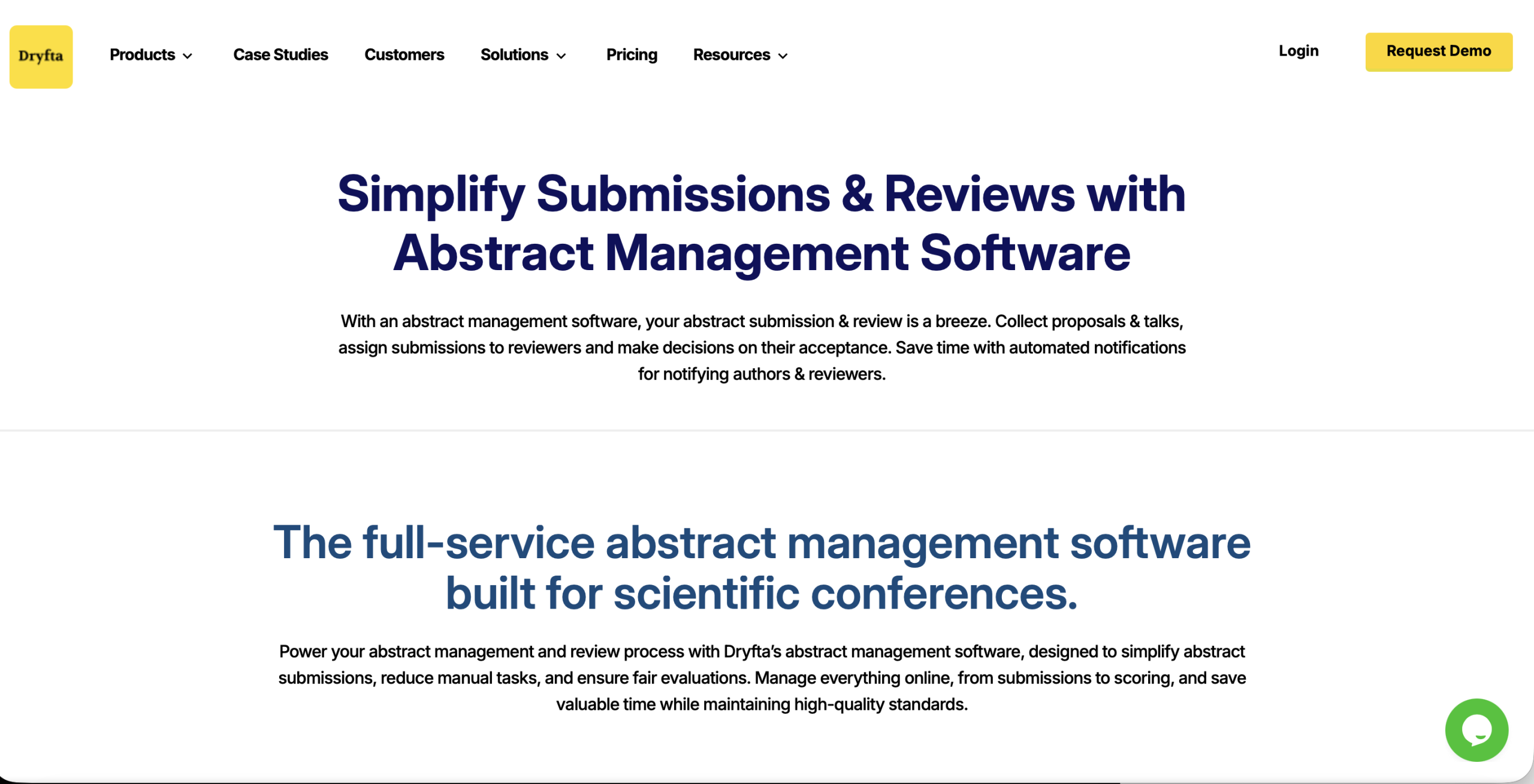
Best for: Academic conferences, medical congresses, scientific associations, research societies.
Dryfta stands apart from the rest of this list because it was conceived from the outset for medical and scientific events rather than adapted toward them later, and that origin shows clearly throughout its feature set.
Strengths:
- Dryfta was built by people who had themselves organized research congresses and understood firsthand where the pain points tend to surface.
- Dryfta’s abstract management system supports multiple submission types, configurable review workflows with custom scoring rubrics, blind peer review.
- Dryfta extends further still into flexible registration, with support for early-bird pricing, group discounts, and discount codes to increase your ticket sales.
Cvent
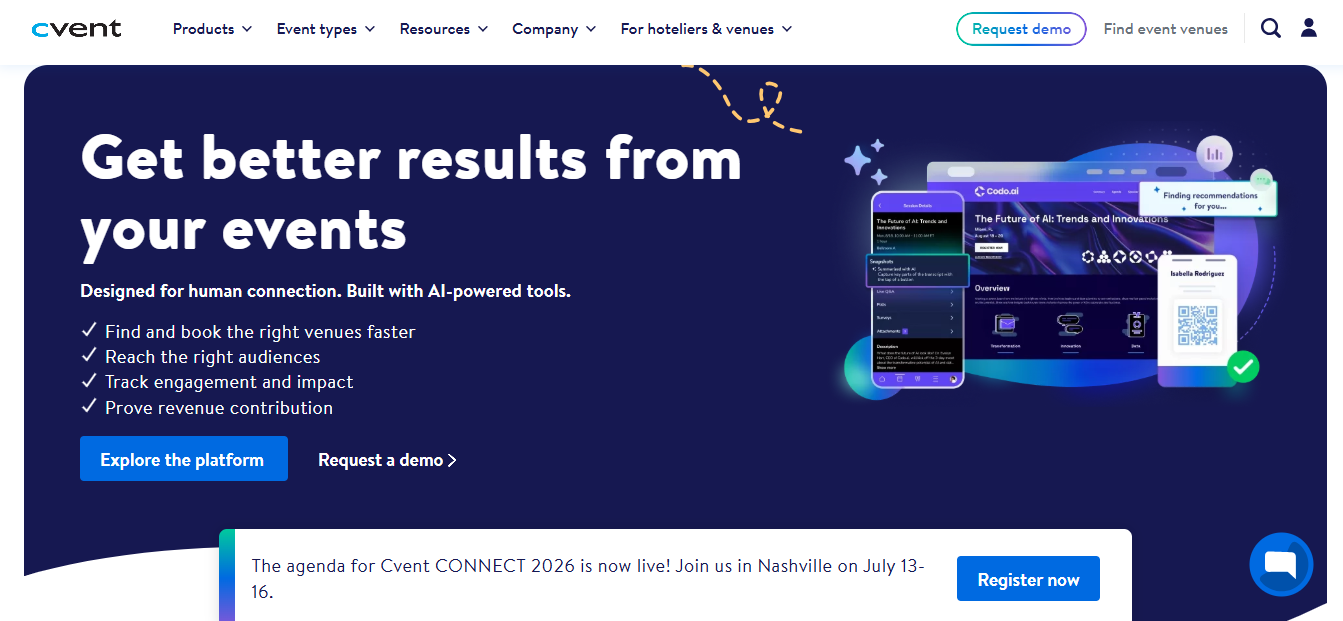
Best for: Large-scale events, enterprise organizations, those already operating in the Cvent ecosystem.
Cvent has built its reputation as an established enterprise platform over the year. The platform is used widely by Fortune 500 companies and major institutions. For medical congresses specifically, it brings scalability to the table,
Strengths
- Cvent’s registration tools allow for highly customizable business logic and flexible pricing structures.
- The platform’s integrations extend across CRM systems, accounting software, email marketing platforms and even hotel management tools.
Weaknesses:
- Abstract management is fairly basic out of the box and hence demands heavy customization before it can meet the standards of medical congresses.
- Implementation timelines for Cvent tend to run much longer than comparable platforms such as Dryfta.
Whova
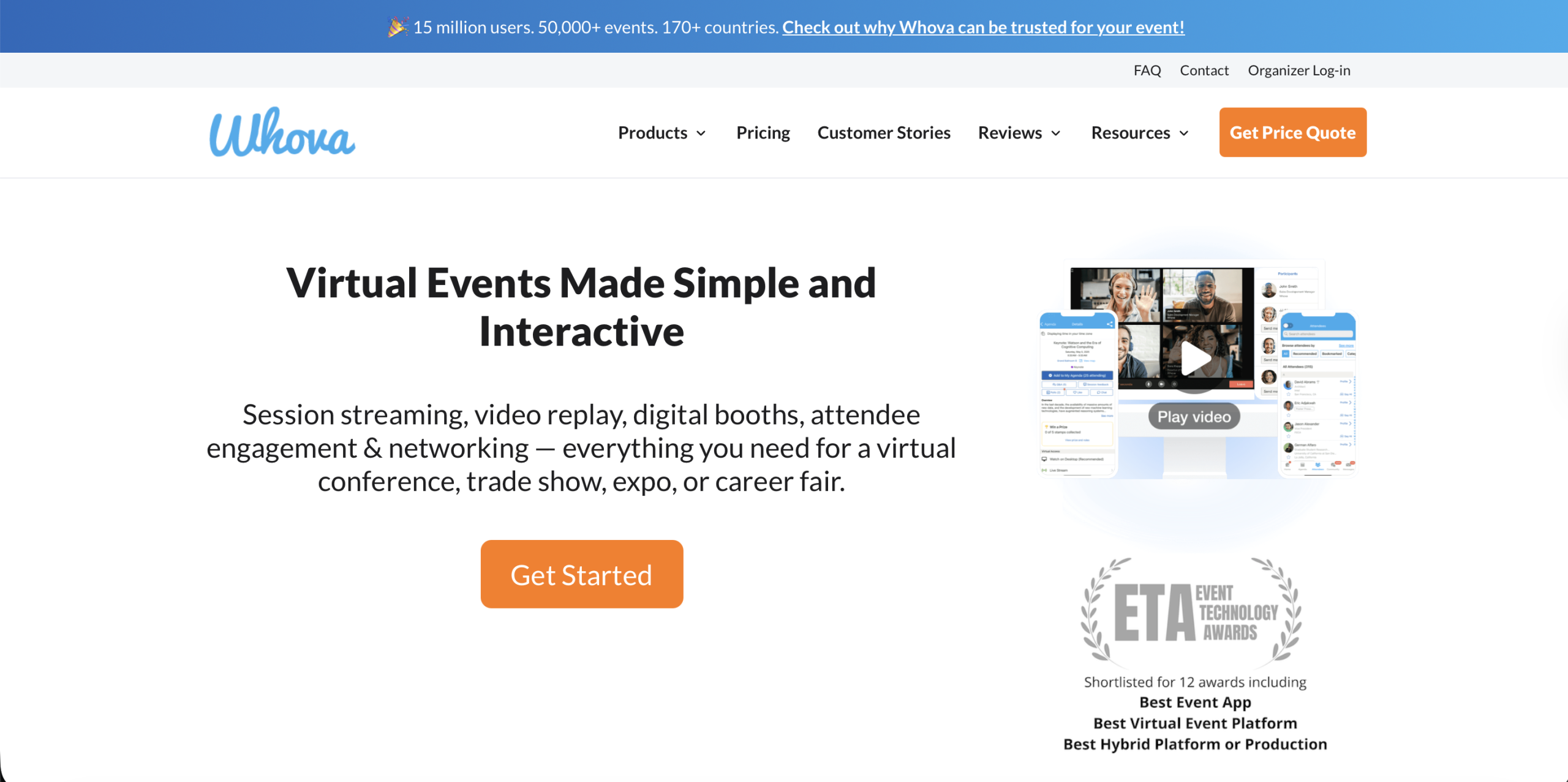
Best for: Events prioritizing attendee engagement, networking, and mobile-first experiences.
Whova has earned its reputation primarily through its mobile app and the attendee engagement tools built around it.
Strengths:
- Whova’s mobile app itself is intuitive, offering real-time schedule updates, offline access, and a design that feels engaging.
- Its networking ffeatures include attendee matching based on shared interests and profession, one-on-one meeting scheduling, and social feeds.
Weaknesses:
- Whova’s abstract submission is treated more as basic form collection as opposed to a full-fledged workflow.
- Whova’s speaker pportals and proceedings management are also limited in depth at best. This can be a major setback when looking at conference platforms for medical conferences.
EventMobi
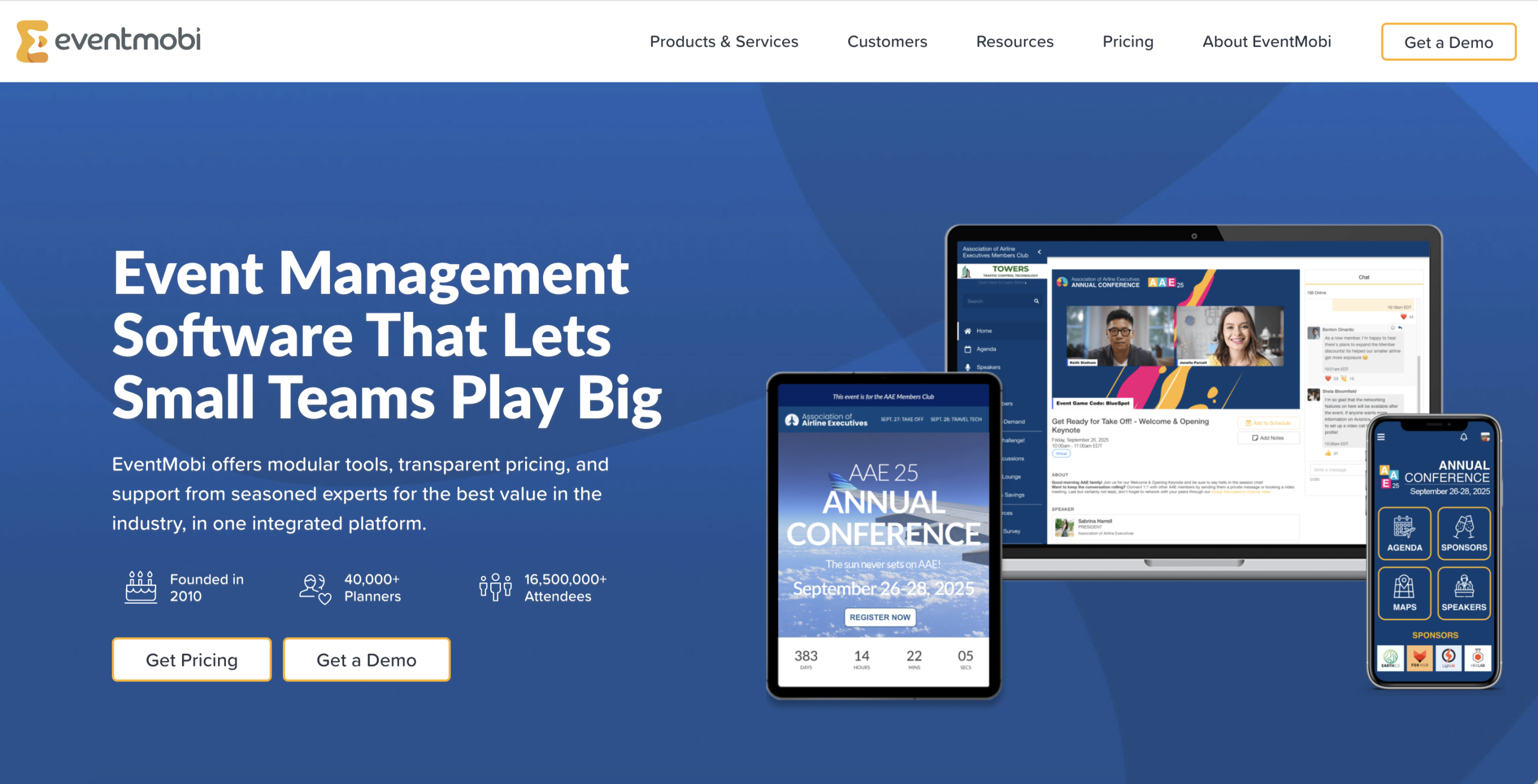
Best for: Tech-forward events, mobile-priority audiences, organizations wanting a premium app experience alongside another primary platform.
EventMobi is a platform that has gradually carved a niche for itself in the larger event management space. The software’s identity revolves more around event applications than full event management
Strengths:
- EventMobi has an in-house mobile app that is equipped with push notifications, live updates, exhibitor information and more interactive features like gamification, badges, and leaderboards.
- Booth management and lead capture tools that come with EventMobi also work effectively within this scope as well.
Weaknesses:
- Since EventMobi functions primarily as an app layer rather than a complete platform, it does not include registration, abstract management or the deeper logistical tools that a medical congress requires.
Oxford Abstracts

Best for: Academic conferences, research symposiums, events where abstract workflows are the primary concern.
Oxford Abstracts is an abstract-first event platform and software tool that caters to academic and research conferences around the world.
Strengths:
- Oxford Abstracts’ abstract management software comprises comprehensive submission management, starting from flexible review workflows to everything up until final decision-making.
- Oxford Abstracts works well as conference platforms for medical congresses given that it supports both single and double-blind peer review, accommodates multiple review rounds and handles conditional acceptance without difficulty.
Weaknesses:
- The tradeoffs, however, are just as clear as the strengths as registration features stay basic and CME tracking also remain limited.
- Attendee engagement and mobile tools are also fairly minimal. As a platform, Oxford Abstracts tends to suit research symposiums and medical congresses where peer review is the core tenet, with little importance spared to things like a mobile app.
Ex Ordo

Best for: Research conferences, scientific societies, submission-focused events.
Ex Ordo centers its design around submission management and author communication. The experience that ex Ordo offers to its authors is good enough to noticeably reduce friction throughout the process.
Strengths:
- Ex Ordo has communication tools capable of guiding authors from ssubmission all through to acceptance.
- Ex Ordo’s is also comparatively affordable when placed against enterprise-grade conference platforms for medical congresses like Cvent.
Weaknesses:
- As with Oxford Abstracts, Ex Ordo’s feature set is fairly narrow and for the most part, is unable to look beyond basic abstract management.
- CME tracking does not exist and the mobile experience remains limited.
Best Platforms by Medical Event Type
The best conference platforms for medical congresses also very by the type of your event. This is further subject to variation based on factors like the size of your audience or even the amount of personalization your event will need.
- If you’re down for a mediocre show, almost any abstract management software in the market will help.
- But if you are dreaming of a medical conference like none other, if you’re someone who is consistently raising the bars for yourself and your team, this section is a must-read.
Large International Medical Congresses (2,000+ Attendees)
Events at this scale tend to involve multiple simultaneous sessions spread across venues, hundreds of international speakers, thousands of attendees with varied registration needs and sponsorship arrangements substantial enough to shape the event’s entire budget.
- Dryfta stands as the primary choice here, given its proven performance at congresses drawing 5,000 or more attendees.
- Cvent also remains a reasonable alternative here. However, its price point makes it unaffordable for small-sized medical congresses and unsustainable for bigger ones in the longer run.
Specialty Medical Associations (300- 800 Attendees)
Specialty societies working in fields such as cardiology, oncology, and gastroenterology tend to run annual congresses built around well-established structures, typically combining abstract submissions, specialtyfocused tracks, and tight-knit member communities.
- Dryfta again stands out as the primary recommendation, since it was built with association events specifically in mind and includes member pricing alongside member directory features.
- Oxford Abstracts can also be workable alternative too if paired with a separate and simpler registration tool.
Research Symposiums (100 to 500 Attendees)
Symposiums of this kind tend to prioritize paper presentations and peer discussion well above commercial activity. They typically run shorter, more specialized programs on tighter budgets than larger congresses allow.
- Oxford Abstracts, Ex Ordo and Dryfta can all be good choices as primary choices here, since each was built around research submission workflows from the ground up.
- Dryfta remains a worthwhile alternative for organizers who also need a stronger event website, registration system, and sponsorship support alongside their abstract management.
CME-Focused Conferences (Any Size)
Any event offering continuing education credits needs reliable CME tracking, a requirement that applies just as much to clinical update symposiums and healthcare provider training sessions as it does to most medical association conferences generally.
- Dryfta leads the recommendations in this category because of its native CME tracking, credit allocation, and certificate generation, while any other platform paired with a third-party CME addon such as MedCom or AXIS offers a workable alternative.
Whatever system is chosen still needs to cover automated attendance verification, per-session credit calculation, accreditation body compliance, certificate distribution and long-term transcript access for attendees who return for their records months or years later.
Hybrid Medical Congresses (Any Size)
Hybrid formats combining in-person and virtual attendance have become close to standard at this point, and most medical congresses now need to manage in-room delegates, virtual attendees, remote speakers, and ondemand replay within a single coordinated system.
- Dryfta remains the primary recommendation given its integrated streaming, virtual networking, and on-demand content.
- Cvent paired with a streaming integration such as Zoom serves as a capable alternative.
How to Choose the Right Platform for Your Medical Congress
How many attendees do you expect?
Abstracts, Ex Ordo, or a basic Dryfta setup suit as smaller-scale medical conference softwares. Those between 300 and 1,000 generally do well with Dryfta or Cvent, while events scaling from 1,000 to 5,000 attendees usually call for a fuller feature deployment on either platform. Beyond 5,000 attendees, Dryfta tends to suit research-focused congresses best, while Cvent remains the stronger enterprise option.
Do you require abstract submissions and peer review?
If sophisticated review workflows are necessary, Dryfta, Oxford Abstracts, or Ex Ordo are the platforms worth considering. If only basic submission forms are needed, Cvent or Whova can manage that adequately, and if abstracts are not part of the picture at all, attention should shift entirely toward registration and attendee engagement features instead.
Do you need CME tracking and credit allocation?
If so, Dryfta offers native support, while any other platform can be paired with a third-party CME system to achieve similar results. If CME tracking is not required, this consideration falls away entirely.
Will your event be hybrid?
If it will, Dryfta offers the strongest integrated support, while Cvent paired with a separate streaming tool serves as a capable alternative. If not, this factor simply does not weigh on the decision.
How many staff members will manage the event?
Teams of one or two tend to do best with Dryfta or Oxford Abstracts, both of which were designed with lean operations in mind. Teams of three to five generally find success with Cvent, Dryfta, or Whova, distributing tasks by function, while teams of five or more tend to find that most platforms work reasonably well at that level of resourcing.
Taken together, these answers tend to collapse into a few clear patterns. Abstract management paired with CME requirements and an attendee count between 500 and
5,000, especially in a hybrid format, points toward Dryfta.
Enterprise scale combined with an existing Cvent deployment, more than 5,000 attendees, and only basic abstract needs points toward Cvent instead. A research focus paired with a tight budget, 100 to 300 attendees, and a strong peer-review requirement points toward Oxford Abstracts or Ex Ordo, while a small event built around engagement and networking points toward Whova, and an organization already settled on another platform that simply wants a premium mobile layer should look toward EventMobi as a complementary addition.
Even with the right platform identified on paper, organizers tend to run into a handful of avoidable mistakes during implementation, and it is worth naming them directly.
Common Mistakes Medical Congress Organizers Make When Selecting Software
- Choosing based on price alone: The cheapest platform on the market rarely turns out to be the cheapest option once implementation begins, since a platform lacking proper abstract management forces staff to track peer reviews by hand, copy feedback into individual emails, and manage rejections one at a time. At scale, this adds up to hundreds of extra staff hours, and a platform costing 20,000 dollars a year that saves 500 hours of staff time will ultimately cost less than a 5,000 dollar platform that generates 800 hours of additional work.
- Ignoring abstract management requirements: Organizers consistently underestimate how complex abstract management really is, often choosing a general platform only to discover mid-submission season that it cannot support blind peer review, reviewer assignment, or conditional acceptance. The fix is always the same regardless of when the problem surfaces, since the full abstract workflow should be tested before any contract is signed, which means submitting test abstracts, assigning reviewers, and running through the complete review process from start to finish.
- Overlooking reviewer workflows: An abstract system is only as strong as the experience it offers reviewers, and review quality tends to suffer whenever reviewers cannot access abstracts on mobile devices, cannot interpret scoring rubrics clearly, or miss deadlines because reminder emails fail to function properly. The reviewer experience deserves testing with actual reviewers rather than internal staff alone, since the two groups rarely encounter the same friction points.
- Neglecting sponsor management: A platform may handle registration and abstracts well while still creating real problems for sponsors, since sponsors who cannot access their own logo placements, who do not learn their booth numbers until weeks before the event, or who cannot capture leads during the congress itself tend to report poor returns and grow reluctant to return the following year. Sponsorship needs should be defined upfront, with verification that the chosen platform can actually support them.
- Not testing the attendee experience: Backend tools built for organizers often look considerably stronger than the front-end experience delegates actually encounter, which is why people uninvolved in setup should walk through the complete attendee journey before launch, registering, downloading the app, locating sessions, accessing presentations, and submitting questions just as a real attendee would. Whatever friction they encounter along the way is friction the actual attendees will hit as well.
These missteps tend to repeat across organizations precisely because the underlying technology keeps shifting. It helps to look ahead at where that technology seems to be heading next.
Future Trends in Medical Congress Technology
- AI-powered abstract screening: Machine learning tools are beginning to pre-screen abstracts for quality markers such as completeness, plagiarism, and relevance to scope before human reviewers ever see them, and for conferences managing more than 5,000 submissions, this could reduce review time by 20 to 30 percent while freeing reviewers to focus on scientific content rather than formatting errors. Advanced implementations are arriving across 2026 and 2027, with wider adoption expected by 2028.
- Personalized session recommendations: Algorithms are steadily improving at recommending sessions based on attendee profiles, past participation, and the choices made by similar delegates, which amounts to a curated conference schedule rather than a static printed program. Basic versions of this already exist, and the underlying technology continues to mature as 2026 progresses.
- Advanced analytics and predictive insights: Platforms are moving well beyond simple attendance counts toward engagement scoring, network analysis, sponsor ROI predictions, and churn models designed to identify attendees unlikely to return. These tools are intended to support sharper decisions around session scheduling, speaker selection, and pricing strategy, and the expectation is that they become standard offerings by 2027.
- Smart networking and AI matchmaking: AI matching is moving past shared job titles toward connecting attendees based on complementary research interests and professional goals, and for research-focused congresses. Early implementations are already visible across 2026. Event Dryfta’s intuitive event management platform and abstract tool has incorporated several AI-powered upgrades including attendee matchmaking and networking.
- Automated CME tracking: The shift toward automated attendance tracking through badge printing and scanning, QR codes, and digital login timestamps continues to accelerate. The practical result is that attendees receive certificates immediately after completing sessions rather than having to wait for weeks together. This is also steadily becoming standard practice across conferences and medical congresses around the globe.
Frequently Asked Questions (FAQs)
What is the best platform for medical congresses?
No single answer applies universally, since the right choice depends entirely on an event’s specific requirements. That said, Dryfta consistently performs best for organizations needing abstract management, CME tracking, speaker management, and sponsorship tools brought together within one integrated platform. Cvent remains the right answer for organizations already operating within an enterprise ecosystem and willing to customize for scientific workflows, while Oxford Abstracts and Ex Ordo offer strong options for research-focused events where peer review sits at the center of the concern.
What software manages medical conference abstracts?
Dryfta, Oxford Abstracts, and Ex Ordo were built specifically for this purpose. General event platforms such as Cvent and Eventbrite can capture abstract submissions but lack the sophisticated peer-review workflows that medical congresses tend to require, and for research-only events without complex registration needs, Overleaf and SciencesConf are also worth considering.
Can conference platforms track CME credits?
Some can, and others simply cannot. Dryfta includes native CME credit allocation, attendance verification, and certificate generation, while Cvent, Whova, and similar platforms lack this natively but can integrate with thirdparty CME systems such as AXIS, MedCom, or Acclaim. Specific CME capabilities should always be verified directly before any platform is selected.
What is the best platform for hybrid medical events?
Dryfta provides the most integrated hybrid support through streaming, virtual networking spaces, on-demand content, and unified registration working together. Cvent supports hybrid events capably as well, though it requires a separate streaming integration, and Whova handles attendee engagement effectively within hybrid formats specifically. The virtual experience is worth testing directly with each platform before any final decision is made.
How much does medical conference software cost?
Basic platforms such as Eventbrite and Splash tend to run between 500 and 5,000 dollars per year, though with limited features attached. Specialized platforms like Oxford Abstracts and Ex Ordo typically range from 5,000 to 15,000 dollars annually depending on attendee volume, while midmarket options such as Dryfta start at 1,499 dollars per year for a typical congress, covering abstracts, registration, speaker management, and CME together. Enterprise platforms like Cvent run anywhere from 30,000 to more than 150,000 dollars per year depending on scale and customization, and since most platforms apply tiered pricing based on attendee count, a 1,000-person congress will generally cost less than a 5,000-person event running on the same system.
Can medical conference platforms support peer review?
They can, though capability varies considerably across the market. Dryfta, Oxford Abstracts, and Ex Ordo all offer sophisticated built-in peer-review systems supporting blind review, multiple rounds, reviewer assignment, and custom scoring rubrics, while general platforms such as Cvent and Whova lack this functionality altogether. If peer review is a genuine requirement, the wiser path is to select a platform where it is native from the start rather than attempting to bolt it on afterward.
The Bottom Line
Medical congresses operate under conditions that standard events do not encounter. Conference platforms for medical congresses, therefore, demand more sophisticated features and tools.
The platform that you choose will shape the very experience that your speakers, attendees, reviewers, and sponsors all carry away from the event. The verdict on the best conference platforms for medical congresses has been explored rigorously in this article. Now it is up to you and your team to either choose relevance or fade into oblivion.
To become part of organizations running their events using Dryfta’s medical association event software and abstract management software, sign up for a free demo here.