




Eventbrite’s new pricing approach has compelled most organizers to seek alternatives. At the same time, the events industry itself keeps growing at a serious pace. According to industry reports, the global events market is projected to reach approximately $1.46 trillion in 2026, driven by anticipated demand for corporate events, conferences, and massive experiences.
There are a lot more event software alternatives entering the event space, so organizers nowadays can select from a wider range based on business requirements, budget, and complexity of their events. Although Eventbrite remains strong in terms of coverage and user-friendliness, its pricing and restrictions may not apply to all events.
This guide provides a breakdown of 8 best Eventbrite alternatives to help you find something that actually fits your needs.
Best Eventbrite Alternatives at a Glance
| Platform | Pricing | Free-event option | Ticketing | Registration | Conference tools | Main advantage |
|---|---|---|---|---|---|---|
| Dryfta | Starts at $1,499/year | No | Tickets and payments | Custom forms and registration options | Abstracts, peer review, speakers, scheduling | Built for academic conferences |
| Eventcube | Starts at $99/month | Yes | Online ticketing | Custom registration | Event and conference tools | Strong branding and white-label options |
| Ticketbud | 2% + $0.99 per ticket | Yes | Tickets and payments | Custom registration forms | Basic event management | Simple setup and built-in marketing |
| Eventbee | Starts at $1 per ticket | Yes | Flat-fee ticketing | Custom forms and ticket types | Conference registration tools | Predictable ticketing costs |
| Ticket Tailor | From £0.22 per ticket | Yes | Flexible ticketing | Custom checkout forms | Basic event management | Low ticketing fees and white-label checkout |
| Remo | Starts at $299/month | 14-day trial | Paid and free events | Registration forms | Virtual conferences and networking | Interactive virtual networking |
| RSVPify | Starts at $24/month | Yes, limited | Tickets and payments | Guest management and custom forms | Multi-session event support | Strong RSVP management |
| ClearEvent | Starts at $895/year | No | Ticketing and payments | Custom registration | Speakers, sessions, sponsors | Handles complex event logistics |
Quick verdict: There is no single best Eventbrite alternative for every organizer. Dryfta is the stronger fit for complex academic and professional conferences, while the other platforms make more sense for specific needs such as low-cost ticketing, branded event stores, virtual networking, RSVP management, or broader event logistics.
Why Look for an Alternative to Eventbrite?
Eventbrite alternatives will likely save you money and give you greater control over your event data. It is a fair game to uncover tickets for the general public, yet there are far too many organizers who begin to see the cracks when the charges add up and the ability to create something personalized starts to seem limited, particularly for professional or recurring events. Once you visit other platforms, you discover a few options that better align with how you actually run events and budgets.
Here are a few reasons why you must look for Eventbrite alternatives:
Your ticketing costs grow with sales
Eventbrite charges a percentage plus a flat fee for every ticket you sell. As your ticket prices or attendance grow, those fees add up fast. Before long, you’re paying thousands of dollars in ticketing fees that could have stayed with your organization.
Want to keep more of what you earn? Explore our guide to low fee ticketing options.
You need more control over branding
Your registration page shouldn’t feel like a detour from your website. Most organizations want attendees to move from the event page to registration without noticing a change in branding, emails, checkout, or the overall experience.
- Keep registration aligned with your organization’s brand.
- Give attendees a consistent experience throughout registration.
- Look for control over domains, emails, checkout, and branded touchpoints.
Switching to a third-party-looking page can break that experience.
Your event is more complicated than ticket sales
Academic conferences and multi-track programs can involve plenty of data like:
- Abstract submission and review workflows
- Speaker and session management
- Multiple tracks and schedules
- Sponsor and exhibitor management
- Registration and ticketing
If you’re managing all of that separately, an event platform may be a better fit than a tool that’s mainly built for ticket sales.
You need different attendee-management workflows
Not everyone who registers for your event needs the same registration workflow.
Depending on your event, you might need:
- Approval-based registration for selected attendees
- Member pricing or member-only tickets
- Invitations for specific groups
- Group registration for teams or organizations
- Conditional forms that show different questions based on an attendee’s answers
Those registration details are easy to miss when you’re managing things manually.
You need different marketing or community tools
Eventbrite does have a major advantage here: its marketplace can help organizers reach people who are already searching for events. That built-in discovery can be genuinely useful, especially for public events without a large audience of their own.
The trade-off is that some organizers may care more about controlling the brand experience or connecting event data with their existing marketing an
How We Evaluated the Eventbrite Alternatives?
Every platform in this Eventbrite alternatives list was reviewed using the same criteria. That makes it easier to compare them side by side.
- Registration Flexibility: We checked custom fields, conditional forms, different ticket types, group registration, and approval options.
- Branding: We considered white-label options, custom domains, email branding, and checkout customization.
- Event Management Depth: Beyond ticketing, we considered scheduling, speakers, abstracts, exhibitors, and attendee management.
- Onsite tools: We evaluated QR code scanning and badge printing options.
- Marketing and Discovery: We considered email tools, marketplace discovery, integrations, and campaign tracking.
- Data and Reporting: We tested custom exports and real-time data tracking.
- Ticketing Cost: We compared total platform fees, payment fees, and options to pass costs to buyers.
- Support and Best Fit: Finally, we looked at onboarding, documentation, support options, and the types of events each platform suits best.
Eventbrite Pricing in 2026
Eventbrite charges an all-inclusive rate per ticket in 2026. You can publish events for free, but pay once you start selling tickets. Free events come with zero cost, while paid tickets include both a service fee and a processing charge.
-
-
- Zero cost for free tickets: When the ticket price is set to $0, Eventbrite does not charge any type of service fee or processing fee.
- Service fee of 3.7% + $1.79 per ticket: This fee is charged on all paid tickets and accounts for the bulk of the Eventbrite pricing.
- Processing fee of 2.9% per order: Each processed transaction by Eventbrite has a standard processing charge that is calculated as a percentage of the entire order.
- Typical total fee example: When you buy a single ticket for $50, the total fee would be approximately $5.09, making up about 10.18% of the original ticket price.
- Optional Pro plans from $15 to $100 per month: These plans provide email marketing tools for those who regularly host multiple events.
- Unlimited free event publishing update: Eventbrite no longer limits free event creation after discontinuing the Flex plan.
-
For example, with 500 registrations at $50 per ticket, one ticket per order, Eventbrite’s listed fees would come to about $5.09 per ticket, or $2,545 in total fees on $25,000 in ticket sales.
Features to Look for in an Eventbrite Alternative
When it comes to picking the right platform from the many Eventbrite alternatives, there’s more to it than just the basic features. Organizers need tools that can actually support long-term event growth and more complex event needs. These are some of the important features to look for.
1. Event Registration & Ticketing
How easy it is for people to sign up is the base of any event. Attendees want to buy tickets quickly, without having to create an account. Many Eventbrite alternatives nowadays focus on reducing drop-offs by keeping the registration simple.
- Look for platforms that support multiple ticket tiers such as early bird, VIP, and group discounts
- Choose tools that include flexible promo codes and hidden ticket options for VIP guests
- Prioritize conditional logic features that adjust registration questions based on ticket type
- Automated waitlist management can help you handle sold-out events more efficiently
- Multi-currency payment support becomes important when attracting international attendees
2. White-Label Event Pages
Let’s face it: branding is more important than ever. A white-label event page will make sure your organization stays on top of your attendees’ minds. The best Eventbrite alternatives let you adjust CSS, fonts, and brand colors across all interactions.
- Remove all external platform branding from your registration pages
- Host the event page on your own custom domain or subdomain
- Design a seamless visual transition from your website to checkout
- Design custom email templates that match your brand’s theme
3. Attendee Networking Features
Believe it or not, networking is often the number one reason people attend professional gatherings in the first place. Modern software now includes AI-driven matchmaking and private messaging to spark conversations.
- Offer an attendee directory where guests can opt in to connect
- Support group video conferencing for virtual and hybrid attendees
- Add discussion boards or birds of a feather group topics
- Integrate digital business card swapping to replace paper versions
4. Hybrid & Virtual Event Support
The world of tech is changing rapidly, and your software setup will also have to adjust. You need a platform that handles live streams, on-demand video, and physical check-ins simultaneously.
- Stream high-definition video right from the player
- Provide simulive sessions to lessen the pressure of live broadcasting
- Enable interactive elements like live polls and live Q&A sessions
5. Mobile Event Apps
Today’s audience expects to have everything they need right in their pocket. A dedicated mobile event app is the ultimate companion for navigating a busy schedule. And honestly, it also serves as a direct communication channel with your audience.
- Send push notifications for last-minute schedule changes or reminders
- Include interactive maps to help guests navigate large venues
- Allow attendees to build their own personalized agenda
- Provide a digital wallet for easy access to entry QR codes
6. Event Analytics & Reporting
Live event data is a must. Without it, you’ll never know which of your marketing efforts generated sales.
- Look for “at-a-glance” dashboards that track registration
- Monitor the number of tickets sold by each source to determine which ads are effective
- Track session attendance to determine which of your speakers are most popular
- Create automated financial reports for your accounting team
- Evaluate your audience and improve future marketing efforts
7. CRM & Marketing Integrations
The beauty of an integrated event technology solution is its ability to connect with your other business software, such as CRM systems, email marketing channels, payment processing tools, and even communication platforms like Slack. The best thing about it: the sooner your sales team can get those leads, the sooner you’ll see a higher conversion rate.
- Sync attendees directly to HubSpot, Salesforce, or Mailchimp
- Use Zapier to connect with thousands of other business applications
- Automate post-event follow-up emails based on attendee behavior
8. Badge Printing & Check-In
Long lines are the worst thing for guests when they arrive. A check-in app that scans QR codes in just a few milliseconds is a smart choice. Some Eventbrite alternatives even offer badge printing on demand so that no pre-printed badge goes to waste.
- Scan tickets in seconds with any smartphone or tablet
- Create professional, customized badges in less than 10 seconds
- Handle walk-in registrations while at the event’s entrance
- Track in-room counts in real time for safety and capacity restrictions
9. Payment Processing & Faster Payouts
Waiting weeks for your ticket revenue is a major hurdle for event planning. While some platforms hold your money until the event is over, better options offer immediate payouts. You should have the freedom to choose your preferred payment processor, like Stripe or PayPal.
- Receive your funds daily or weekly rather than after the event ends
- Support major credit cards, Apple Pay, and Google Pay for speed
- Set up flexible refund policies that you can trigger with one click
- Keep your financial data secure with PCI-compliant processing tools
10. Sponsor & Exhibitor Management
Events are heavily dependent on sponsors. You need to keep them happy. Give them a dedicated portal to upload their logos, brochures, and videos. Many Eventbrite alternatives support badge scanning and lead capture to help sponsors connect directly with attendees during the event.
- Provide multiple sponsorship levels that offer different levels of visibility
- Set up a virtual booth for online exhibitors to connect
- Provide sponsors with lead retrieval tools through a mobile app
- Provide comprehensive sponsor ROI reports when the event ends
Best Eventbrite Alternatives Worth Considering
The section below shows a detailed comparison to help you evaluate these Eventbrite competitors.
1. Dryfta
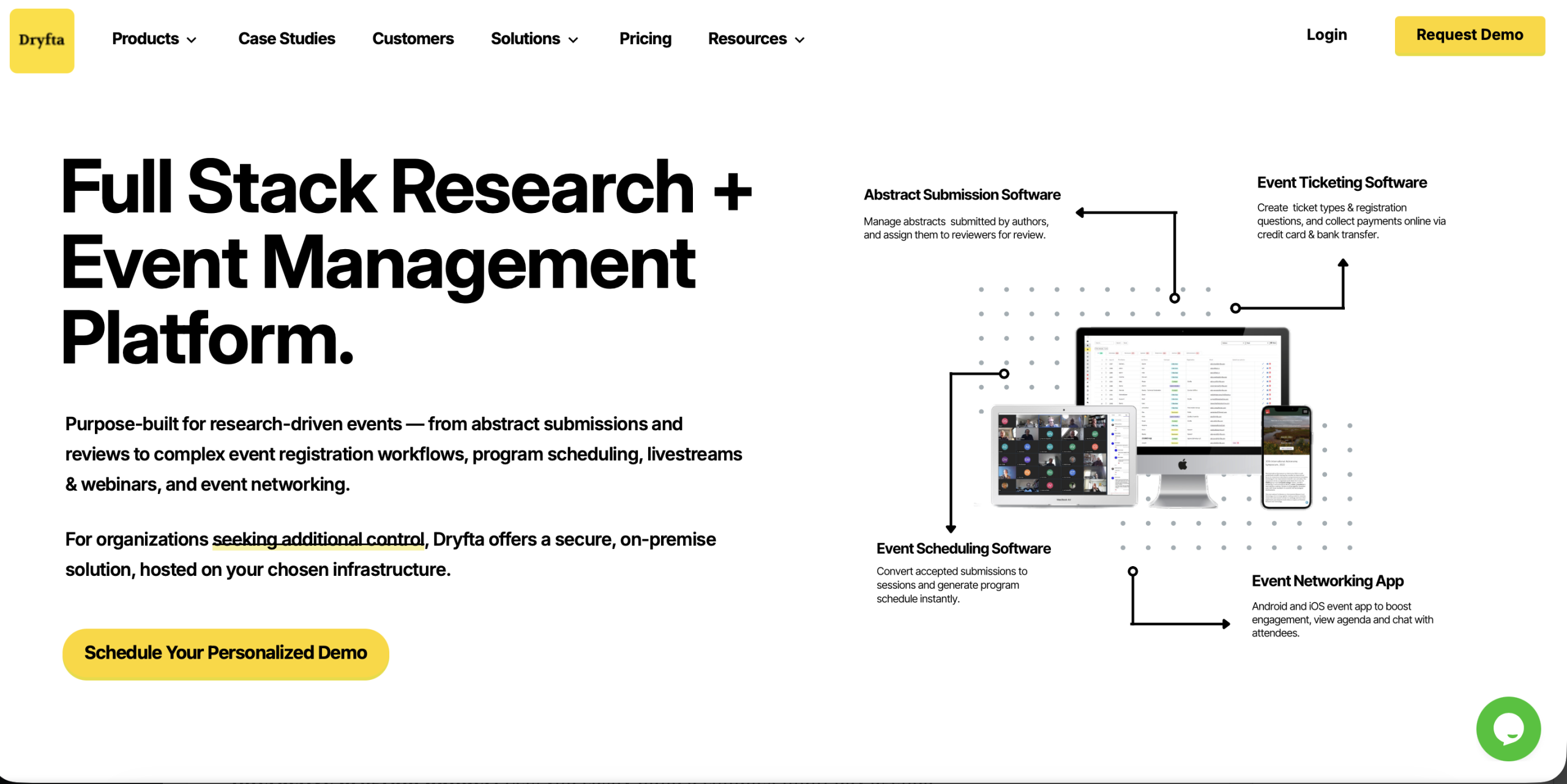
Quick Verdict: Dryfta is a strong Eventbrite alternative for academic and professional conferences. It makes more sense when your event needs more than just ticket sales.
Best For
- Academic conferences
- Research events
- Scientific meetings
- Multi-track professional conferences
- Complex conferences with abstract submissions
Key Capabilities
- Abstract submission with multi-stage peer review
- Drag-and-drop session scheduling
- Custom registration forms and workflows
- Built-in CRM for attendee management
- Networking with attendee directories and messaging
Where Dryfta Is Stronger Than Eventbrite? Dryfta takes conference management one step further. It is a better fit when you need abstract submission or peer review along with ticketing.
Where Eventbrite May Still Be Stronger? Eventbrite can be a better choice for public events. Its event marketplace also gives organizers an extra way to reach people looking for events.
Pricing Model: As of 2026, Dryfta starts at $1,499 per year for small events. Medium and large events use custom pricing based on event size and requirements. There is no fixed free plan.
Pros
- Strong abstract submission and peer review tools
- Built for complex conference programs
- Custom forms and registration options
- Built-in CRM for attendee management
- Networking tools are included
Limitations: Dryfta does not have a fixed free plan. The initial setup can also take some time because there are many customization options.
Ideal Use Case: A university planning a multi-track research conference with abstract submissions and peer review would be a strong fit for Dryfta.
Verdict: Shortlist Dryfta if your event has complex conference needs and you want those tools in one platform. If you mainly need ticket sales and event discovery, Eventbrite may be a better fit.
2. Eventcube
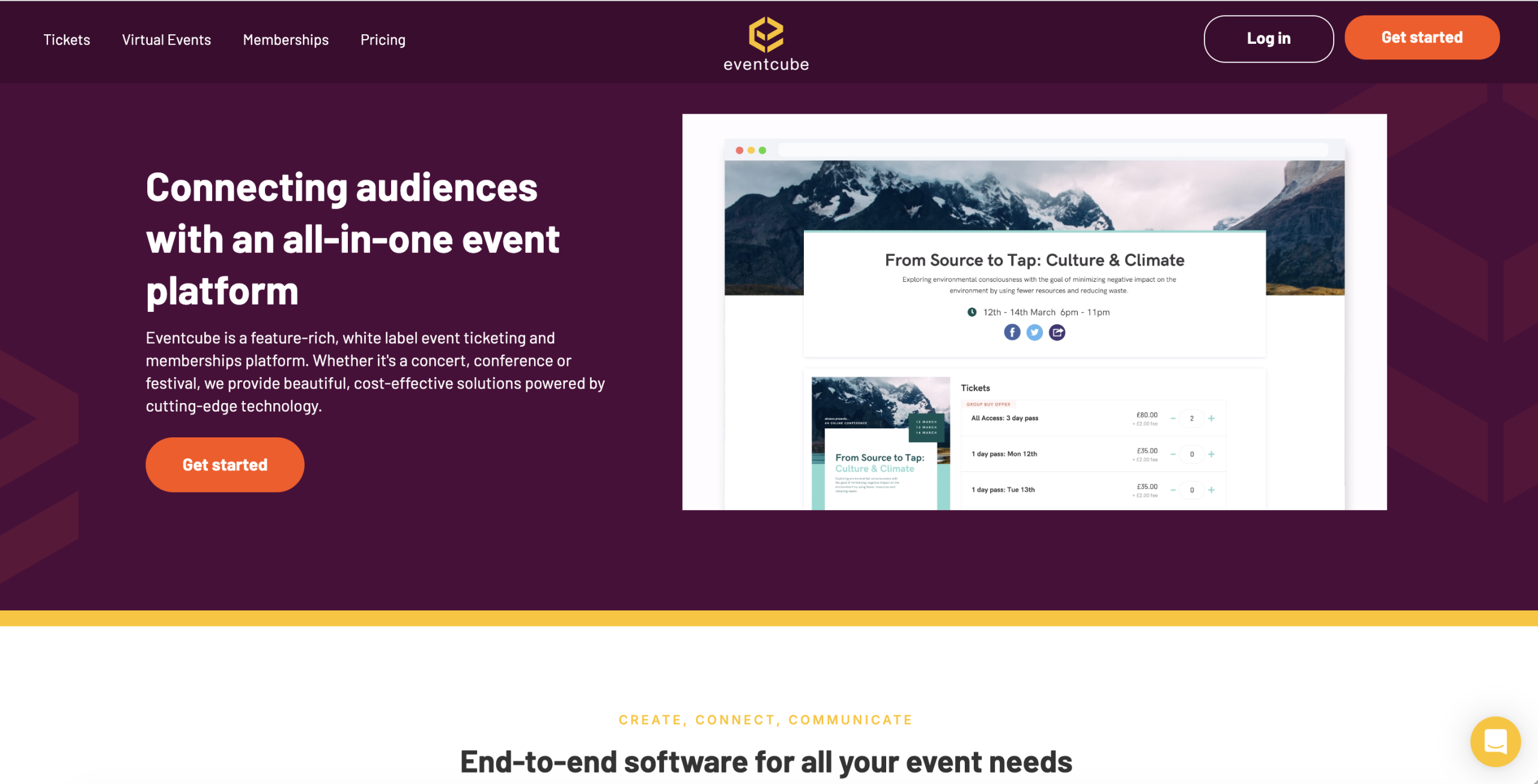
Quick Verdict: Eventcube is a strong Eventbrite alternative for organizers who want more control over their event branding and ticketing experience. It is especially useful when keeping the event experience closely tied to your own brand matters.
Best For
- Branded events
- Recurring events
- Community events
- Events that need white-label ticketing
- Organizers who want more control over the ticketing experience
Key Capabilities
- White-label event pages and ticketing
- Custom branding across the event experience
- Custom domains
- Ticket sales and registration
- Built-in event management tools
Where Eventcube Is Stronger Than Eventbrite? Eventcube gives organizers more control over how their event looks and feels. Its white-label options can make the ticketing experience feel more like the organizer’s own website rather than a third-party platform.
Where Eventbrite May Still Be Stronger? Eventbrite may be better if you want a simpler ticketing setup.
Pricing Model: Eventcube’s Pro plan starts at $99 per month, with Enterprise pricing available on request. It also offers a free plan. Pricing can vary depending on the plan and features selected.
Pros
- Strong white-label branding options
- Custom domains are supported
- Good control over the event experience
- Works for recurring events
- Offers a free plan
Limitations: Eventcube’s advanced customization can require more setup. Organizers looking mainly for event discovery may also prefer Eventbrite’s larger marketplace.
Ideal Use Case: An organizer running a branded event series who wants the ticketing experience to feel like part of their own website would be a strong fit for Eventcube.
Verdict: Shortlist Eventcube if branding and control over the ticketing experience are high on your list. If event discovery and marketplace reach matter more, Eventbrite may still be the better fit.
3. Ticketbud
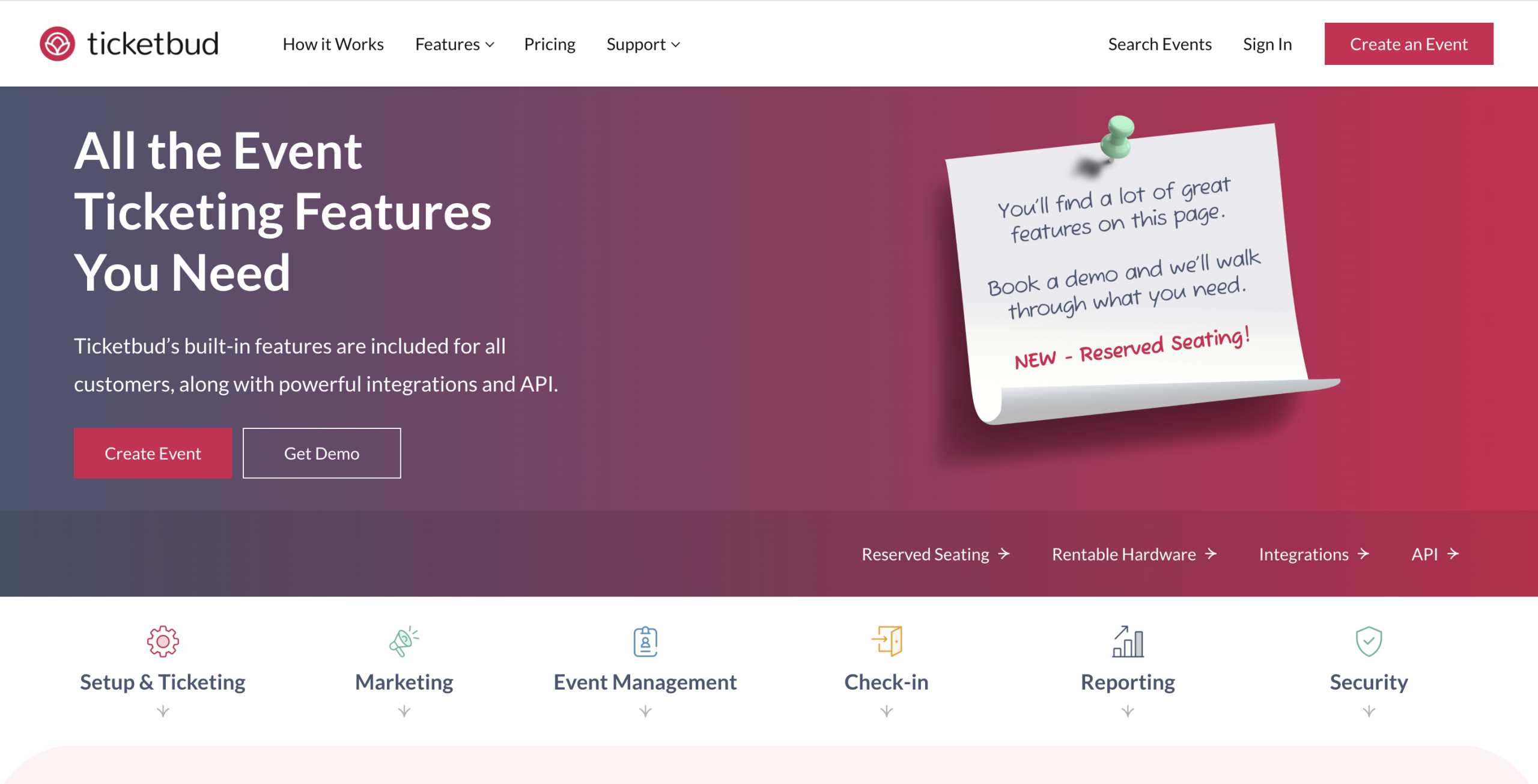
Quick Verdict: Ticketbud is a simple Eventbrite alternative for small and mid-size events. It focuses on easy setup and practical ticketing tools.
Best For
- Small community events
- Workshops and classes
- Fundraising events
- Local events
- Mid-size events
Key Capabilities
- Ticket sales and registration
- Discount codes and referral tracking
- Email communication tools
- Real-time sales reporting
- Flexible payout options
Where Ticketbud Is Stronger Than Eventbrite? Ticketbud keeps event setup much simpler than Eventbrite. Its built-in sales tools also give organizers more control over payouts and promotions.
Where Eventbrite May Still Be Stronger? Eventbrite may be a better fit for organizers who need a larger range of event management features.
Pricing Model: Ticketbud charges 2% + $0.99 per ticket for paid events. Discounted rates are available for nonprofits. Custom pricing is also available.
Pros
- Simple setup with a low learning curve
- Built-in tools for promoting ticket sales
- Flexible payout options
- Real-time event reporting
Limitations: Ticketbud can become more expensive as ticket volume grows.
Ideal Use Case: A small event organizer running a paid workshop with limited setup needs would be a good fit for Ticketbud.
Verdict: Shortlist Ticketbud if you want simple event setup and ticketing. It is a good option for small to mid-size events where ease of use is a must.
4. Eventbee
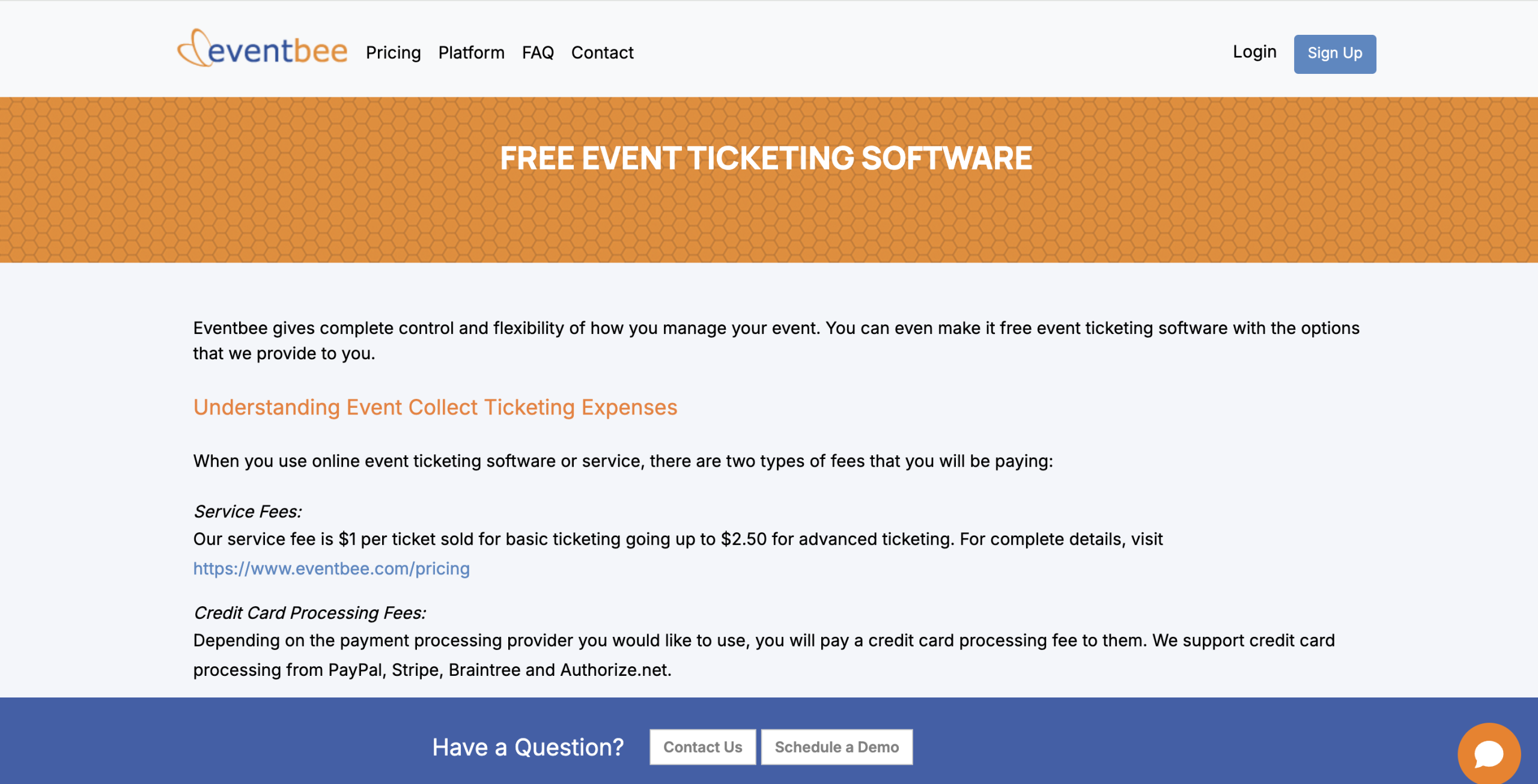
Quick Verdict: Eventbee is an Eventbrite alternative for large events with simple ticketing requirements. The flat pricing can also make costs easier to plan.
Best For
- Large events
- High-volume ticket sales
- Events with simple logistics
- Events that need fast check-in
Key Capabilities
- Ticket sales and registration
- QR code check-in
- Custom event pages
- Branded confirmation emails
- Multiple payment gateways
Where Eventbee Is Stronger Than Eventbrite? Eventbee offers predictable flat pricing. It also gives organizers more control over event branding.
Where Eventbrite May Still Be Stronger? Eventbrite may be a better fit when you need more advanced event features beyond core ticketing.
Pricing Model: Eventbee charges a flat fee starting at $1 per ticket. There is no monthly fee model.
Pros
- Predictable pricing for high-volume events
- Fast QR code check-in
- Strong branding controls
- Immediate access to funds
Limitations: Eventbee focuses mainly on core ticketing. Advanced needs may require additional tools.
Ideal Use Case: A large event with simple ticketing and high attendee volume would be a good fit for Eventbee.
Verdict: Shortlist Eventbee if you want simple ticketing with predictable costs. It works well when your event does not need many advanced management features.
5. Ticket Tailor

Quick Verdict: Ticket Tailor is a strong Eventbrite alternative for organizers looking for low-cost ticketing without a monthly subscription.
Best For
- Low-cost ticketing
- Budget-conscious organizers
- Events that need flexible branding
Key Capabilities
- Low per-ticket pricing
- Customizable event pages and white-label checkout
- Email updates and attendee management
- Reporting and analytics
- Free check-in app with real-time tracking
Where Ticket Tailor Is Stronger Than Eventbrite? Ticket Tailor keeps ticketing costs low while giving organizers more control over branding and checkout. Its free check-in app also makes event entry easier to manage.
Where Eventbrite May Still Be Stronger? Eventbrite may be a better fit for organizers who want built-in event discovery rather than relying mainly on their own promotion.
Pricing Model: Ticket Tailor starts at £0.22 per ticket upfront or £0.60 per ticket on a pay-as-you-sell model. Free events can use the platform at no charge.
Pros
- Very low per-ticket fees
- Fully customizable event pages and white-label checkout
- Built-in email, reporting, and attendee management tools
- Free check-in app with real-time tracking
Limitations: Ticket Tailor does not have a built-in event marketplace for organic discovery.
Ideal Use Case: A budget-conscious organizer running a ticketed event can rely on Ticket Tailor.
Verdict: Choose Ticket Tailor if keeping ticketing costs low is a priority. Eventbrite may make more sense if event discovery is important.
6. Remo

Quick Verdict: Remo is a strong Eventbrite alternative for virtual events that put networking and attendee interaction first.
Best For
- Virtual conferences
- Networking events
- Career fairs
- Webinars and workshops
Key Capabilities
- Immersive 3D floor plans
- Table-based networking and private chat
- Live polls, quizzes, Q&A, and reactions
- Custom registration and paid ticketing
- Event analytics and attendee management
Where Remo Is Stronger Than Eventbrite? Remo focuses heavily on attendee interaction. Its virtual tables, video, chat, and movement features make online networking feel more natural and engaging.
Where Eventbrite May Still Be Stronger? Eventbrite may be a better fit for organizers who need a more traditional event platform with broader event management options.
Pricing Model: Remo uses subscription-based pricing. Plans start at $299 per month, with one-time event pricing from $699 and custom pricing for enterprise needs.
Pros
- Interactive virtual tables that simulate real-life networking
- Built-in video, chat, and movement features
- Strong focus on attendee engagement
- Supports roundtables and breakout discussions
Limitations: Remo offers limited customization compared to many in-person or hybrid event platforms.
Ideal Use Case: A company hosting a virtual conference or career fair where networking and attendee interaction are central to the event.
Verdict: Choose Remo when virtual networking is the main priority. Eventbrite may be a better fit for more a traditional event management approach.
7. RSVPify

Quick Verdict: RSVPify is a strong Eventbrite alternative for events that put RSVP management and personalized registration first.
Best For
- RSVP-driven events
- Private and social events
- Conferences with detailed guest information
- Events that need seating and guest grouping
Key Capabilities
- Custom registration forms
- Guest list management
- Seating and grouping
- RSVP tracking
- Attendee data collection
Where RSVPify Is Stronger Than Eventbrite? RSVPify is stronger when you need detailed guest information, custom registration forms, seating arrangements, and RSVP tracking.
Where Eventbrite May Still Be Stronger? Eventbrite may be a better fit for organizers who mainly need ticketing and want access to a dedicated event marketplace.
Pricing Model: Pay-as-you-go or subscription. Plans start at $24 per month, with higher tiers at $89 and $299 per month. Custom pricing is available for enterprise plans.
Pros
- Advanced custom forms
- Strong guest management
- Flexible registration options
- Seating and grouping tools
Limitations: Ticketing features are more complex compared with dedicated ticketing platforms.
Ideal Use Case: Events where detailed RSVPs, guest lists, seating, and attendee information are more important than high-volume ticket sales.
Verdict: RSVPify is a better fit than Eventbrite when your event revolves around guest management and personalized registration, not just selling tickets.
8. ClearEvent

Quick Verdict: ClearEvent is an Eventbrite alternative for complex events that need detailed planning and budgeting.
Best For
- Complex event logistics
- Multi-layered events
- Events with sponsors and volunteers
- Teams managing detailed event plans
Key Capabilities
- Budget tracking
- Sponsor and volunteer management
- Centralized event dashboard
- Timeline and logistics management
Where RSVPify Is Stronger Than Eventbrite? ClearEvent is a better fit when you need to keep a close eye on budgets, sponsors, volunteers, logistics, and team coordination.
Where Eventbrite May Still Be Stronger? Eventbrite works well for organizers who wants to tap into a built-in audience.
Pricing Model: Flat annual pricing starting at $895 per year for one event. Plans cost $1,795 for up to 5 events and $2,995 for up to 10 events.
Pros
- Detailed budget tracking
- Built-in sponsor management
- Volunteer management tools
- Centralized logistics dashboard
Limitations: Not designed for enterprise-level requirements
Ideal Use Case: Complex events where planning and budgeting are more important than ticketing alone.
Verdict: ClearEvent is a good fit for organizers who need detailed event planning and logistics, rather than a platform focused mainly on ticket sales.
Why Conference Organizers Choose Dryfta Over Eventbrite?
Many conference organizers are making the switch because they require a platform that is designed specifically for complex academic and professional events. Eventbrite is great for basic ticketing and small events, but doesn’t have the integrations required for multi-day summits. Dryfta offers an all-in-one ecosystem that can’t be matched by most modern platforms.
Not to mention, having all tools under one platform saves hundreds of hours of manual data entry.
With Dryfta, you can:
- Create customized tickets for registrations, sponsorships, memberships, donations, and workshop passes with flexible payment collection options for both online and offline transactions.
- Create a basic/complex abstract submission workflow and peer review process using automated reviewer assignment, searchable abstract archives, and a self-service author dashboard.
- Host virtual events with live meetings, HD livestreaming, pre-recorded sessions, group chats, private messaging and interactive audience engagement tools.
- Automatically generate conference schedules using accepted talks while giving speakers control to manage their own session details and uploads.
- Promote events across multiple event listing websites while tracking campaign performance through clicks, pageviews, and attendance insights.
- Manage attendee data, invoices, purchase orders, communications, and event activities through an integrated event CRM and organizer dashboard.
Dryfta vs Eventbrite
|
Feature |
Dryfta |
Eventbrite |
|
Platform type |
All-in-one event management platform for conferences, academic, and professional events |
Ticketing and event listing platform for public and social events |
|
Pricing model |
Flat annual pricing |
Per-ticket fees + payment processing fees |
|
Abstract management |
Built-in abstract submission and review system |
Not available |
|
Event registration |
Advanced registration with custom workflows |
Basic ticketing and registration |
|
Best for |
Conferences, academic events, multi-track programs |
Workshops, meetups, public events |
|
Customization |
High customization for complex events |
Limited customization |
|
Multi-event management |
Supported in one account |
Usually managed per event |
|
Onsite tools |
Check-in, badge, schedule, speaker tools |
Basic check-in tools |
|
Cost predictability |
Stable pricing |
Cost increases with ticket sales |
Best Eventbrite Alternatives by Use Case
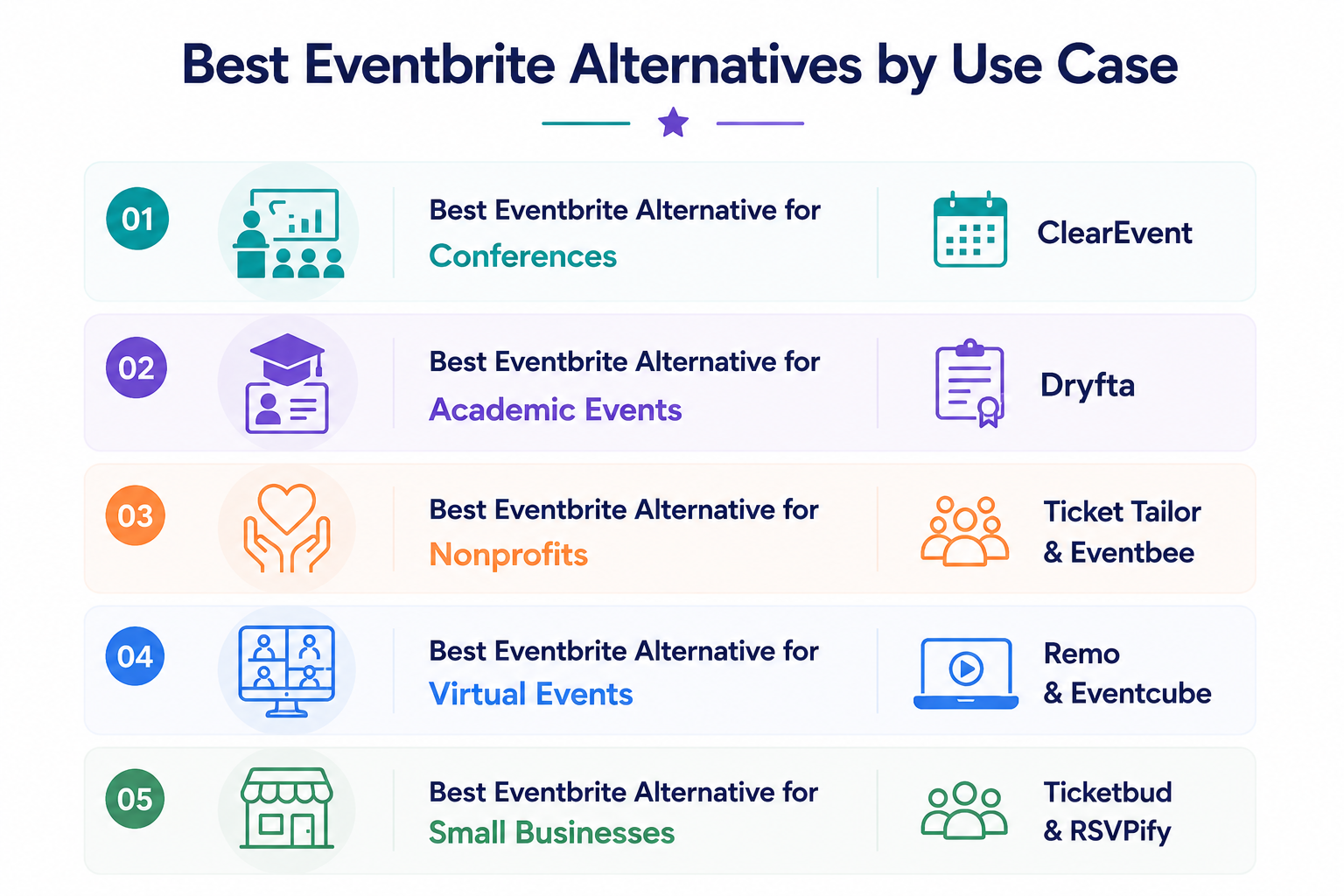
Best Eventbrite Alternative for Conferences: ClearEvent
ClearEvent is a good choice for conferences. It provides an easy-to-use platform for handling complicated logistics and participant communication in an organized dashboard.
Best Eventbrite Alternative for Academic Events: Dryfta
Dryfta is the top-tier solution for academic events and one of the best Eventbrite alternatives. In essence, Dryfta is a tool that can simplify the very complex process of submitting an abstract and the peer-review process. It is very easy for organizers to manage researchers and academic sessions on this platform.
Best Eventbrite Alternative for Nonprofits: Ticket Tailor & Eventbee
Organizations that are focused on the bottom line often choose between Ticket Tailor and Eventbee. Ticket Tailor’s low, flat-fee model allows nonprofits to retain a larger portion of their donations. Eventbee’s flat-fee-per-ticket pricing is ideal for charity galas.
Best Eventbrite Alternative for Virtual Events: Remo & Eventcube
Remo and Eventcube offer an immersive digital experience beyond just a video call. Remo is known for its interactive floor plans and networking tables that simulate real-life interactions. Eventcube includes a virtual store and streaming platform for high-end digital broadcasts with customization options.
Best Eventbrite Alternative for Small Businesses: Ticketbud & RSVPify
For small events, Ticketbud and RSVPify are great Eventbrite alternatives. Ticketbud provides daily payouts to improve business cash flow, and RSVPify is great for managing guest lists for exclusive corporate launches.
Eventbrite Alternatives With Better Branding & Customization
If you’re fed up with your event page looking like any other generic page on the web, it’s time to consider Eventbrite alternatives that put your brand first.
Eventbrite alternatives provide simple designs, while Dryfta goes the extra mile with branding. These platforms enable you to build premium, engaging websites that feel like an extension of your business.
- Dryfta offers a white-labeled environment where your branding remains prominent throughout all the attendee touchpoints.
- Splash provides a designer-friendly interface, featuring advanced styling tools for high-impact marketing pages.
- With TicketSpice, you can have a lot of control over the checkout experience, including custom CSS and fonts.
- Whova’s mobile event app will let you make sure your brand pops right off the screen.
Integrations Supported by Eventbrite Alternatives
Having your platform seamlessly integrate with your other event tools makes managing them much easier. That kind of automation can make a huge difference for the event teams that are stressed between registrations, tickets, marketing, and attendee communication all at once.
Here are a few integrations supported by modern Eventbrite alternatives:
- Stripe and PayPal provide secure, instant payment processing for global ticket sales.
- Zoom and Microsoft Teams integrate directly to sync attendee lists with virtual meeting links.
- HubSpot and Salesforce capture every new lead automatically for your sales pipeline.
- Mailchimp allows you to trigger personalized marketing journeys based on registration data.
- Slack sends real-time alerts to your team the moment a new ticket is sold.
- Zapier acts as the ultimate bridge to connect with thousands of other niche business tools.
Drawbacks of Eventbrite
Although Eventbrite has remained a popular ticketing platform, many organizers have faced constraints that have affected their revenue and the professional appearance of their events. The problems become more evident once you have to deal with high-value or recurring events where consistency and control do come into play.
-
- High service fees: A fee of 3.7% + $1.79 per ticket can add up quickly. In cases where you charge high priced tickets, you are essentially losing a significant amount of money from each sale.
- Payment processing costs: In addition to service fees, you also pay an additional 2.9% for credit/debit card payments. Together, these two fees make transactions seem much more costly than they were before.
- Branding restrictions: Although Eventbrite has provided its users with a variety of customization options within its system, these remain somewhat limited. Consequently, your registration page(s) may appear relatively generic. It is more difficult to build a coherent brand experience that makes it look like your own event.
- Data siloing: You do not have full access to attendee information. The platform pushes advertising for other events to your registered attendees, limiting your ability to communicate exclusively and focus on your specific event.
- Lack of specialized tools: In academic or corporate conferences, the system lacks features such as abstract management, multi-track scheduling, and built-in networking.
- Customer services: Customer support can be unpredictable, particularly at peak times when you require the fastest possible responses.
Final Verdict: Which Eventbrite Alternative Should You Choose?
There is no one-size-fits-all answer here. You need to align the software with your event’s complexity and your budget. Here is the bottom line on which tool to pick for your next event.
Choose:
- Dryfta: For professional conferences and academic events that require robust abstract management, peer review, and agenda building.
- Eventcube: For a white-label virtual store and high-end digital broadcasting features.
- Ticketbud: If you need a user-friendly interface with the benefit of daily payouts.
- Eventbee: For a flat-fee pricing model that works well for large-scale ticket sales.
- Ticket Tailor: For low-fee ticketing with easy website integration.
- Remo: For immersive networking and virtual floor plans that make digital guests feel like they are in the room.
- RSVPify: For elegant guest list management and highly customized invitations for corporate or private events.
- ClearEvent: For comprehensive event logistics and attendee communication.
The Bottom Line
Choosing the right event platform becomes important when costs increase and features feel limited. Organizers who manage complex events often need more flexibility, predictable pricing, and tools that support detailed workflows. Dryfta helps by offering an all-in-one event management platform with flat pricing, advanced customization, and built-in abstract management. This makes it easier to plan, manage, and scale events without unexpected costs or extra integrations.
Book a free demo with Dryfta today to see how we can simplify your event planning.
FAQs
1. Which Eventbrite alternative has the lowest fees?
Zeffy is a completely free solution for nonprofits, with no platform or transaction charges because it operates on optional donor tips. In the overall application, Ticket Tailor maintains a low price at flat charges of approximately 0.28% per ticket. Other cost-effective Eventbrite competitors are TixFox and TicketSpice at approximately 0.39% and 0.99% per ticket.
2. Are there free Eventbrite alternatives?
Yes, there are various Eventbrite alternatives that offer free events with no platform or ticketing charges. The best Eventbrite alternatives in 2026 are Ticket Tailor, which allows up to 5,000 free tickets annually, and TicketLeap, which eliminates all the service fees on free tickets. More credible free-to-use event platforms include TixFox, TicketSource, and Humanitix, which are best for community events and fundraising.
3. What features should I look for in an Eventbrite alternative?
When selecting an alternative, it is recommended to focus on low service costs and expedited distribution through processors like Stripe. These benefits, like branding choices, emails, and mobile check-in, come in handy. Available seating and waitlists/discount codes may come in handy in case of bigger or professional events. Also, reporting functions and GDPR are implemented in a way that keeps attendee data safe, and you can easily track ticket sales.
4. Which Eventbrite alternatives are best for conferences?
At major conferences, Dryfta is indeed leading the pack, with strong abstract management, networking, and multi-track schedules. Other competitors include Whova, which has a clean mobile app, and Swoogo, which can organize complex registration. The three platforms are complementary and can be custom-branded for academic events and corporate conferences, offering an arrangement that goes way beyond basic ticketing.
5. Are there Eventbrite alternatives for virtual events?
In fact, several Eventbrite alternatives specialize in hosting virtual events with embedded streaming capabilities and user communication tools. Dryfta would be an appropriate option and offers a dedicated virtual event system, including live streaming, online poster boards, and online networking lounges to communicate with other remote attendees. Organizers can also manage registration, speakers, and video conferencing from the same dashboard, which enables hosting a large virtual meeting without using multiple tools.
6. Can I migrate my event from Eventbrite to another platform?
Yes, it is possible to migrate your event by exporting your attendee data from Eventbrite as a CSV file and pasting it into another system. Most Eventbrite competitors, such as Dryfta, include an inbuilt import tool that makes it easy to map custom fields, ticket types, and contact details, among others. Your guest list and previous communication are also maintained, so you won’t have to enter them manually when you decide to move to a less expensive alternative for your next conference.
7. What is the best Eventbrite alternative for small events?
For smaller recurring events, Dryfta is an Eventbrite alternative that uses a single system to buy or sell tickets and track attendees. It eliminates tool switching, which is a regular occurrence since the registration, emails, and check-ins are now stored in a single location. The flexibility of Dryfta will enable small organizations to maintain professionalism by personalizing the brand and automating the process with reminders.
8. Is Eventbrite the best platform for event management?
Although Eventbrite is popular, its system, with its high cost in terms of percentage and strict structure, is usually limiting. Dryfta is the better option for those who want to have real control. It provides an advanced, single ecosystem, flat, foreseeable pricing, effortless custom field mapping, and built-in abstract management, which Eventbrite does not offer for complex, professional eventing.