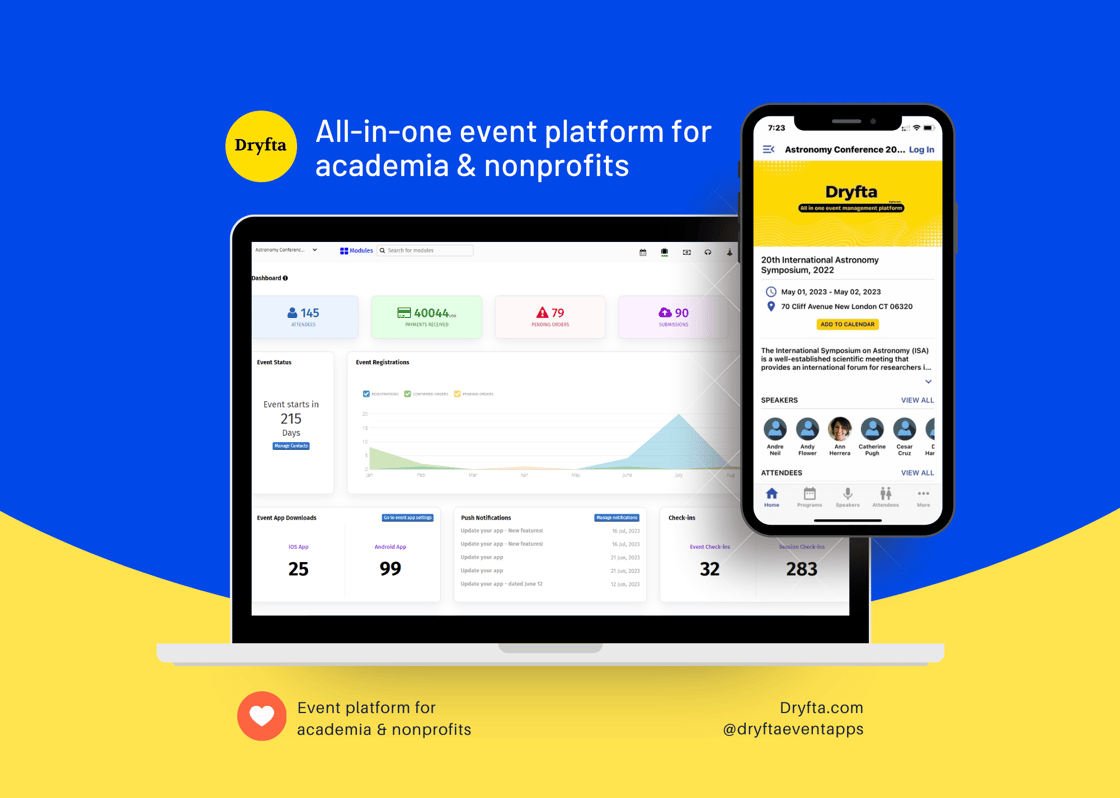
This month’s Dryfta updates focus on making virtual delivery simpler, attendee navigation faster, and admin controls tighter across matchmaking, submissions, and ticketing.

This month’s Dryfta updates focus on making virtual delivery simpler, attendee navigation faster, and admin controls tighter across matchmaking, submissions, and ticketing.

When I ask you to think of innovation in higher education, chances are, you are visualising large university classrooms and laboratories, and fairly so. These are the places where most present-day researchers and experienced professionals began their journey. This is where ideas sprout and innovation begins.
Academic events have now moved beyond the concept of printed agendas and static timetables. Organizers deal with complex event lifecycles with diverse session types, parallel tracks and virtual participants. At the heart of the successful events lies a feature that is transforming how event planners work and how attendees experience events. This is the interactive event schedule feature.
Abstract management is one of those tasks that appears simpler than it is in practice. The closer one gets to the field, the tougher the process seems. This may be true of perhaps a lot of fields. But abstract management is particularly prone to this kind of underestimation.
Once a call for papers brings in hundreds of submissions, the best abstract management software has to do more than collect files. It must keep reviewer assignments fair, flag incomplete reviews and conflicts of interest, send decisions on time, and turn accepted work into a usable program.

Imagine you walked into an event hoping to hear insightful details from the speakers, but sat through endless presentations with no interactions. You wouldn’t want your attendees to feel the same about the events you put together. And the most effective way to organize a high-quality event is to invite good speakers.
When experts gather for presentations, discussions, and networking, they typically choose between a symposium and a conference. Although they seem to be the same event on the surface, they have different formats based on their purposes and participants.
Conference organizers across the globe share a common headache. The process of managing academic abstracts manually has transformed into an overwhelming burden that drains resources and threatens event quality. Every year, thousands of research conferences struggle with the same problem that refuses to go away.
In academic and professional writings and submissions, an abstract plays a very important role. It provides the essence of a research or scientific paper, report, thesis, or presentation. Its main purpose is to give a complete summary or overview of the project to the reader. It gives a glimpse of the objectives, methods, key findings, and conclusions of the study carried out by the scholars.
Events that are conducted exclusively online were a far-fetched possibility for most event management organizations prior to the COVID-19 pandemic. Particularly for event professionals in regions where the larger industry still remains growing and emerging, taking the plunge meant risk. However, a global lockdown left the event management sector, like most other industries, with no other choice for the months to come.
Use this guide to check whether your shortlisted event ticketing software can carry one booking from ticket selection through payment, changes, refunds and event-day admission. It is written for registration managers, finance staff and check-in leads who need a shared test script before opening ticket sales.
On-site badge printing connects an attendee’s registration record, a badge template and a printer at the check-in desk. A staff member or kiosk finds the correct record, confirms the details and sends the assigned badge to print. When one part of that chain fails, the queue can grow quickly.