




A public health researcher walks into a meeting with local policymakers. Months of research are summed up in a few slides. The evidence and data are strong. But after the meeting, the research is forgotten and never becomes part of a policy or a real-world program.
Now picture the same research being presented in a better way. It’s backed by policy evidence, reaches the right people, is easy to understand, and is tracked after publication. Before long, it starts showing up in public discussions.
That’s the difference between publishing research and creating impact. The right advocacy tools help researchers present their findings more effectively and understand how their work is making a difference beyond academic journals.
In this guide, you’ll discover the best tools that help turn your research into real-world impact.
What Translating Research Into Real-World Impact Actually Looks Like?
Want proof that research can do more than sit on a shelf?
The Youth Endowment Fund’s toolkit in the UK is a great example of knowledge translation tools and advocacy tools for research impact actually doing the job. The toolkit turned research on youth violence into practical guidance for policymakers. Instead of expecting decision-makers to read lengthy reports, the toolkit presented clear evidence about which interventions were proven to work.
The impact was almost immediate.
Within its first years, the UK Home Office required Violence Reduction Units to spend at least 20% of their intervention budget on programs rated as “high impact” by the Youth Endowment Fund Toolkit. The requirement later increased to 30%, helping local authorities make more evidence-based funding and youth violence prevention decisions.
It didn’t stop there.
The toolkit was also used in direct talks with the Prime Minister’s Office, where it helped push officials away from a bootcamp-style proposal and toward a focused-deterrence approach instead.
That’s a real-world impact.
Research is only useful if people can understand it and apply it in real life. That’s where advocacy tools for research impact and effective knowledge translation tools help. They turn research into action.
The Three Dimensions of Research Impact Tracking
So, you’ve published your paper. Now what? Gone are the days when success was measured only by how many researchers cited your work. Today, what really matters is how your research is making a difference in the real world.
That’s why advocacy tools for research impact and knowledge translation tools look beyond the usual academic metrics.
Let’s break them down:
- Policy citation tracking
This is where your data changes the law. Dedicated tracking platforms watch government white papers and global health guidelines to see if lawmakers are leaning on your findings. It is the ultimate proof that your study is shaping official decision-making. - Broader attention and altmetrics
Next comes broader attention, often tracked through altmetrics. These capture mentions in news media, social media, blogs, online reference managers, and discussion spaces, giving you a wider picture of who is noticing the work and from where. - Community engagement and practice-level uptake
And then there’s community engagement and practice-level uptake. This is about whether the research is being used by the people it is meant to help, like practitioners or service teams and whether it changes what they do in the real world.
Simply put: Advocacy tools for research impact and knowledge translation tools make it easier to see whether research is making a real impact beyond publications.
What to Look for in a Research Impact Tool?
Not all advocacy tools for research impact offer the same features. Some only tell you how many people have seen your research, while others show whether it’s influencing decisions. Before choosing a platform, make sure it helps you measure the kind of impact that matters.
Here are a few things worth checking:
- Does it track policy citations specifically, or just general attention? A good platform needs to show if your findings are directly shaping real-world laws and government reports. If you care about real-world change, choosing research impact tools with policy influence features is non-negotiable.
- Free tools vs. institutional subscription: Free advocacy tools for research impact are awesome for individual scholars on a tight budget. However, paid university-wide plans offer much better analytics and reporting that free tools cannot match.
- Searchable by ORCID, DOI, or name: Make sure you can search by ORCID or DOI for better accuracy. Searching by name alone can miss authors or mix them up.
- Does it help you promote research, or only measure existing attention? Some platforms simply count your views, while top-tier options give you active outreach features. The best options double as advocacy tools for research impact, helping you actively push your findings out to journalists and community leaders.
- Institutional or department-level rollups: If you’re part of a university or research organization, look for tools that can combine results across departments. That makes it much easier to measure collective impact and prepare reports for funders or leadership.
Breaking Down the Top Research Impact Tools in 2026
No single research impact tool is perfect for every researcher. Each platform has its own features and limitations. It’s worth comparing them before deciding which one fits your needs.
1. Overton
Overview:
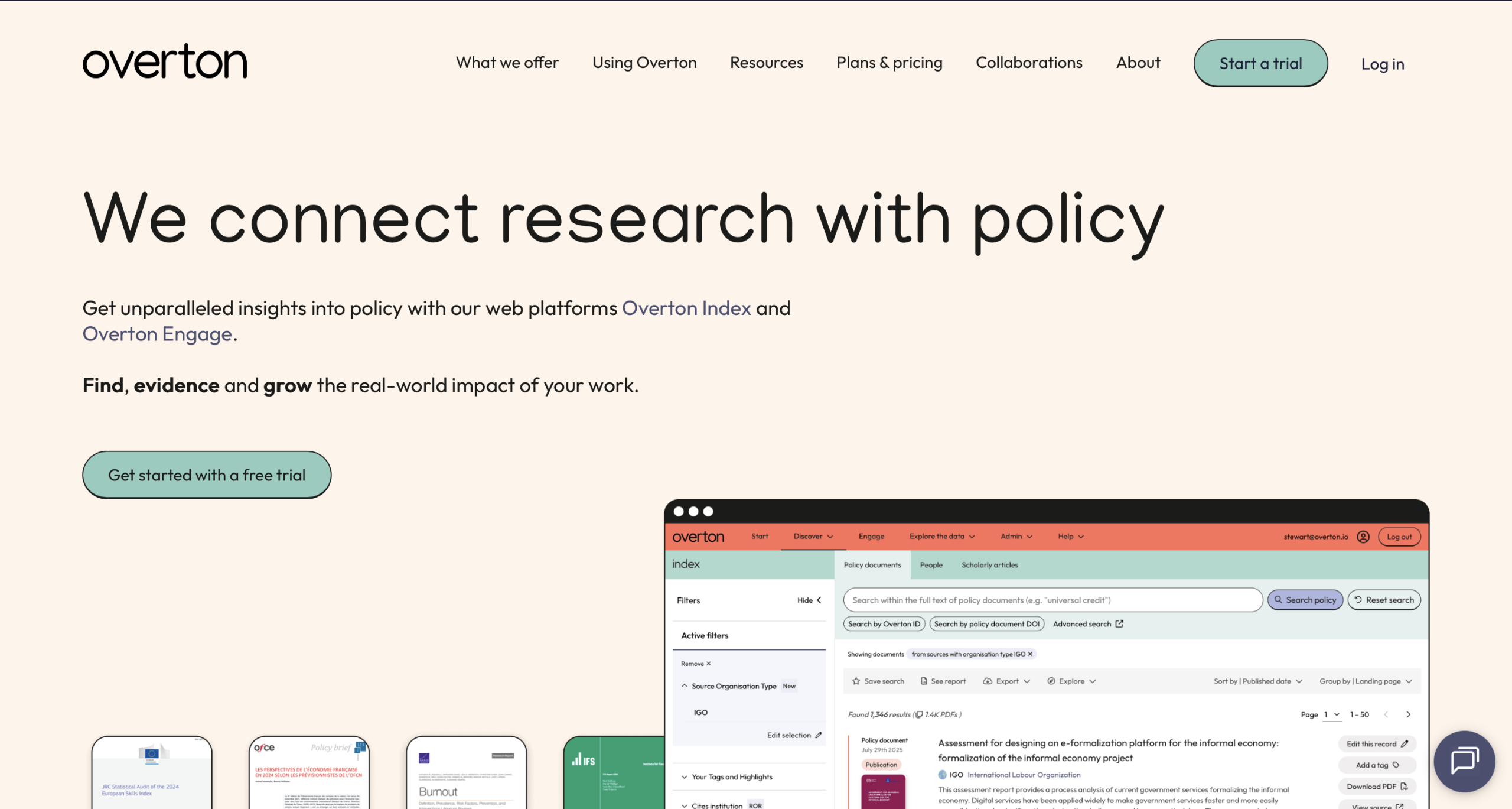
Overton is a research impact tool that focuses on policy citations. It helps you see whether your research has been mentioned in government policies, guidelines, think tank reports, and other public documents. If policy influence is your main goal, Overton is one of the strongest tools available.
Best for: Researchers and institutions that want to measure policy impact.
Pros:
- Built specifically for tracking policy citations.
- Covers millions of policy documents from governments and organizations around the world.
- Makes it easier to demonstrate real-world impact to funders and research institutions.
Cons:
- No free plan for most individual researchers.
- Focuses mainly on policy impact rather than broader online attention.
2. Altmetric
Overview:
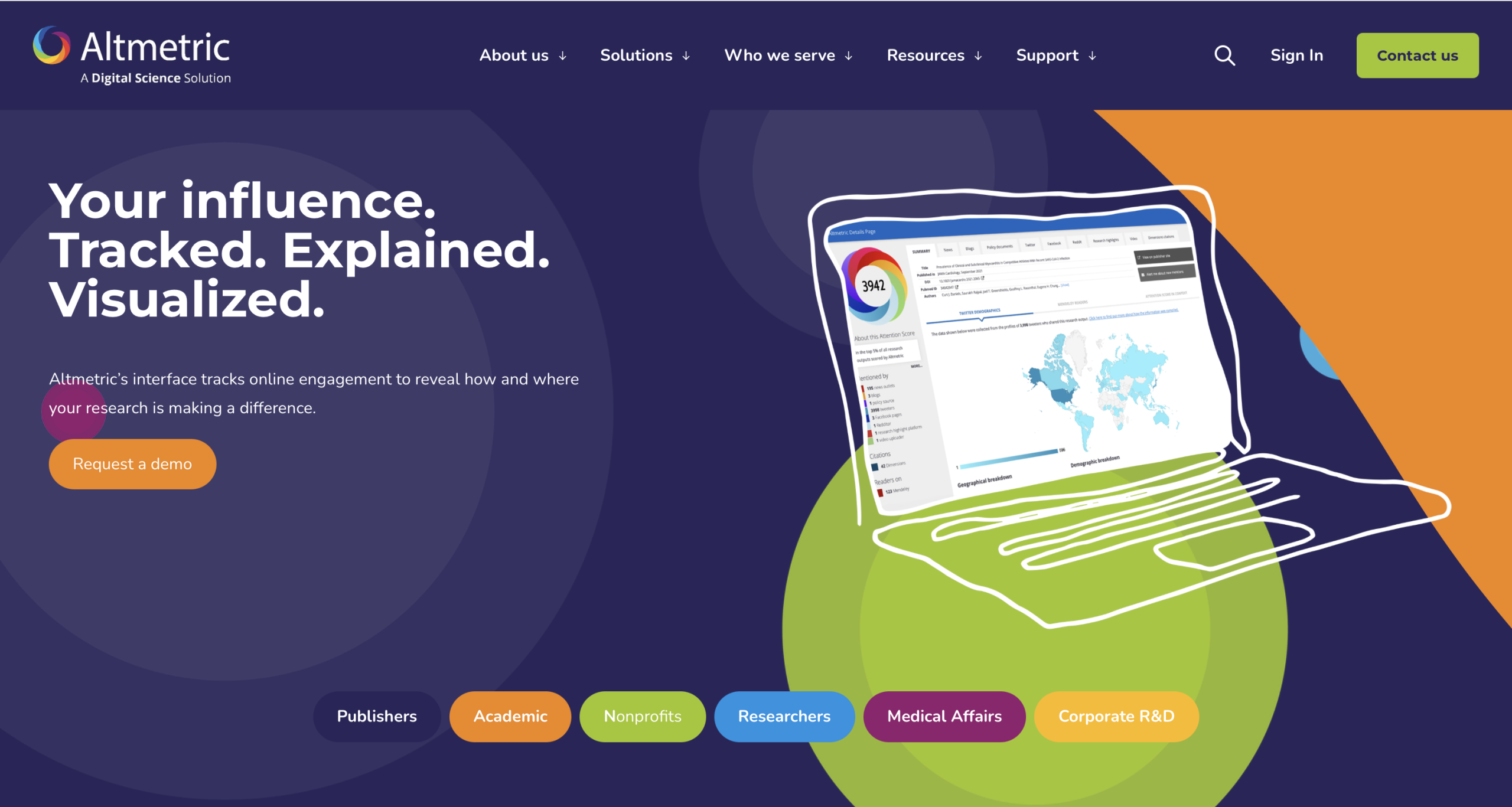
Altmetric helps you understand how people are talking about your research online. It tracks mentions in news articles, blogs, social media, policy documents, and reference managers. It’s a great way to see how quickly your work is reaching different audiences.
Best for: Researchers who want to measure online attention beyond citations.
Pros:
- Tracks many different sources in one place.
- Shows attention soon after your research is published.
- Includes policy citations along with news and social media mentions.
Cons:
- High attention doesn’t always mean high research quality.
- Many advanced features require institutional access.
3. PlumX Metrics
Overview:
PlumX Metrics gives a broader view of research impact. It tracks citations, downloads, policy mentions, social media activity, and other research metrics. Many universities already use it through Elsevier products like Scopus and ScienceDirect.
Best for: Institutions already using Elsevier research platforms.
Pros:
- Combines different types of research metrics in one dashboard.
- Includes policy citations as one of its impact categories.
- Works well for universities managing large numbers of publications.
Cons:
- No free version for most users.
- Can feel overwhelming if you only need a few simple metrics.
4. Kudos
Overview:
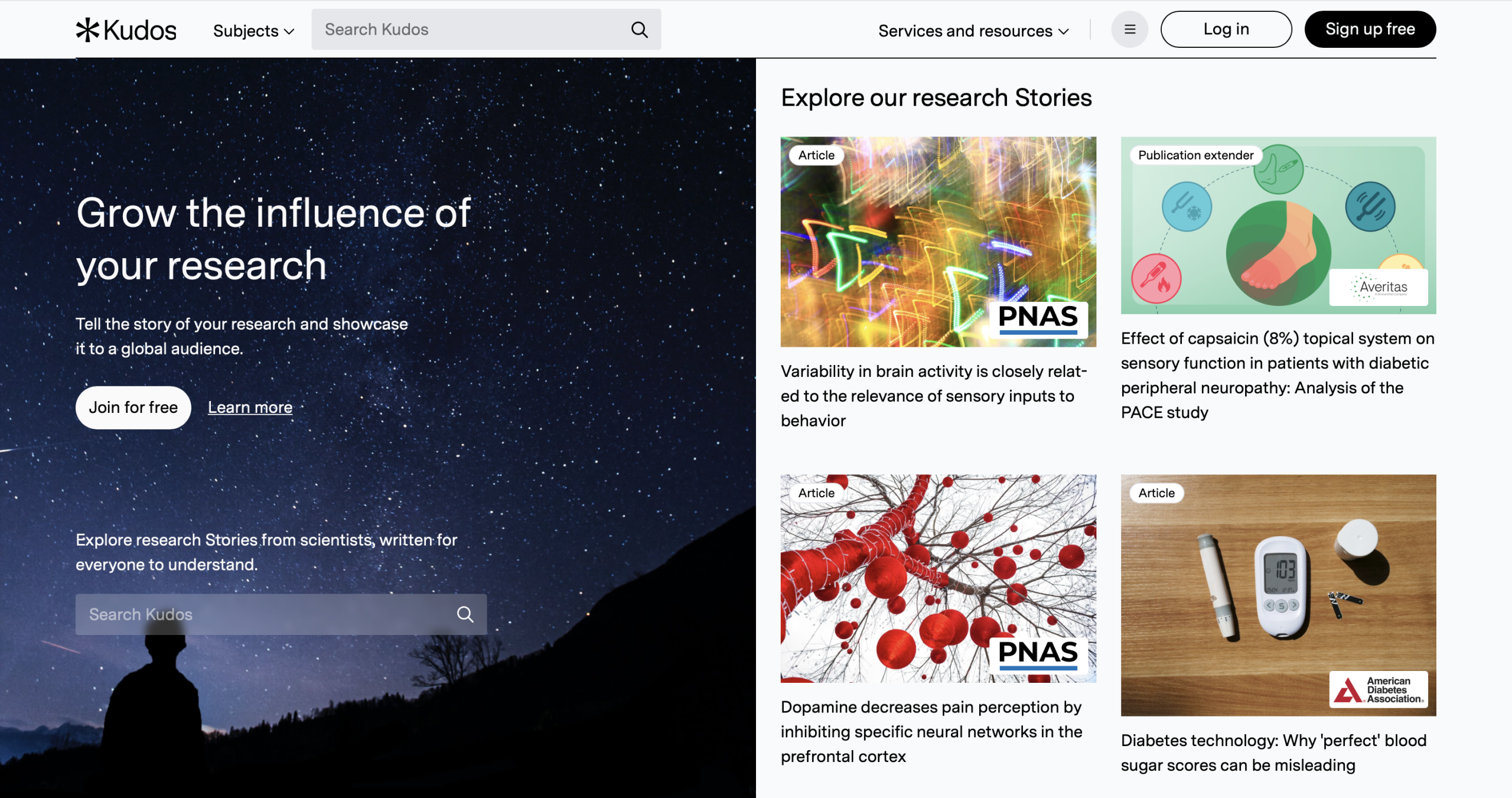
Kudos is different from most research impact tools. Instead of only measuring attention, it helps researchers explain and share their work with a wider audience. The goal is to make research easier to understand and discover.
Best for: Researchers who want to actively promote their publications.
Pros:
- Helps increase the visibility of your research.
- Makes it easy to share plain-language summaries and links.
- Offers a free plan for individual researchers.
Cons:
- Doesn’t focus on tracking policy citations.
- Works best when researchers regularly update and promote their work.
5. Dimensions
Overview:
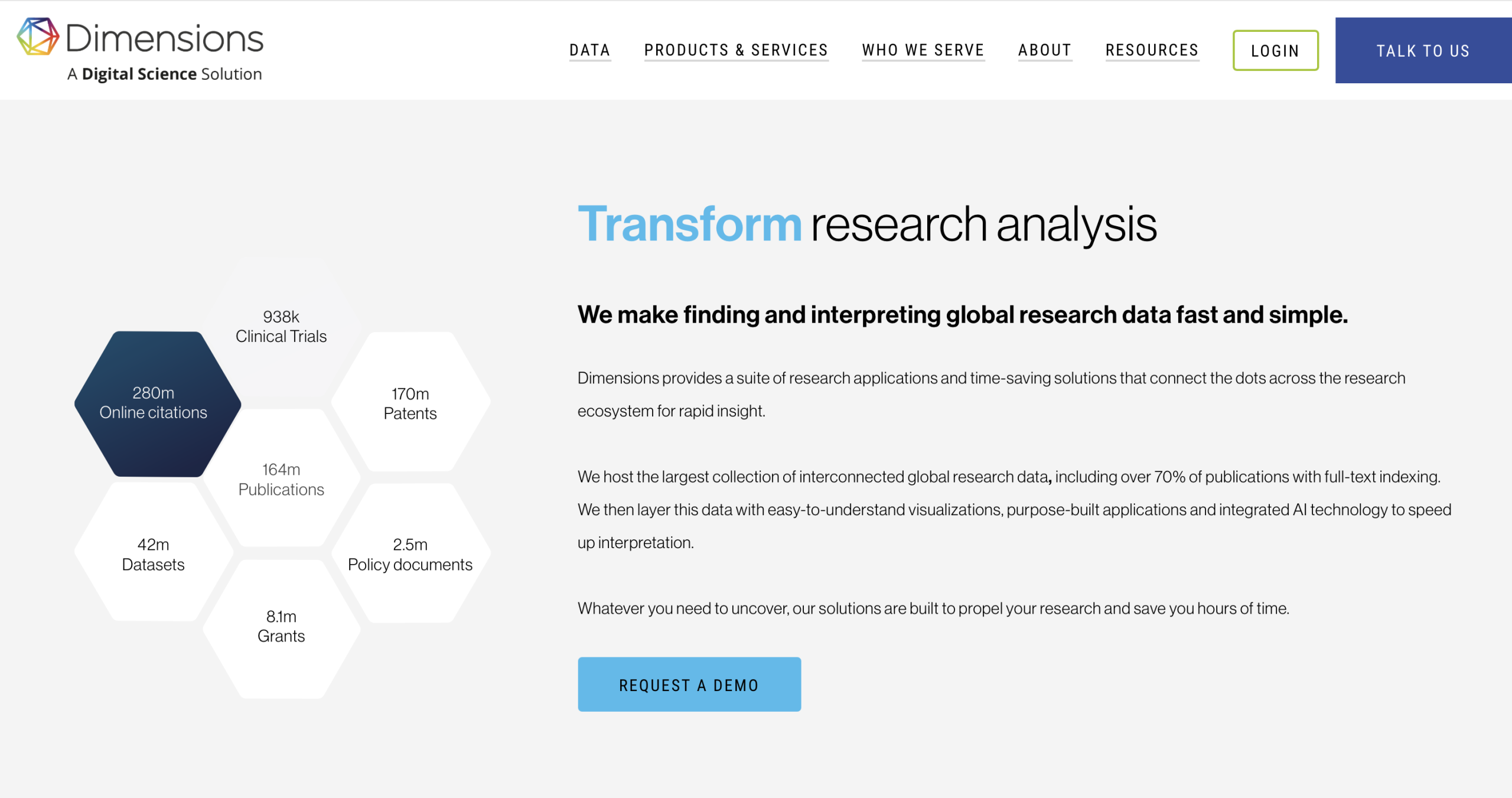
Dimensions is a research discovery platform with built-in impact tracking. It connects publications with grants, patents, clinical trials, and some policy documents. This helps researchers see how their work fits into the bigger research landscape.
Best for: Researchers who want to explore research outputs and funding connections.
Pros:
- Links publications with grants, patents, and clinical trials.
- Includes a limited free version for individual users.
- Helps researchers follow the journey from funding to impact.
Cons:
- Policy tracking is not as detailed as Overton.
- Some advanced analytics are only available with a paid subscription.
6. ImpactStory
Overview:
ImpactStory is an open-source tool that highlights research shared outside traditional journals. It focuses on outputs like datasets, software, preprints, and other open science contributions. It’s a good choice if you want to showcase more than published papers.
Best for: Researchers who support open science and share different types of research outputs.
Pros:
- Completely free and open source.
- Highlights datasets, software, and other non-traditional research outputs.
- Encourages researchers to make their work more open and accessible.
Cons:
- Doesn’t track policy citations.
- Offers fewer impact metrics than larger commercial platforms.
Quick Comparison — Research Impact and Knowledge Translation Tools
| Tool | Tracks Policy Citations? | Free Tier | Best For |
|---|---|---|---|
| Overton | ✅ Yes — its core specialty | ❌ No (institutional/subscription access) | Dedicated policy citation tracking and measuring policy impact |
| Altmetric | ✅ Yes | ⚠️ Limited (free Altmetric badges/details for some papers; full features require institutional access) | Tracking online attention, news, social media, and policy mentions in one place |
| PlumX Metrics | ✅ Yes (as a Policy Citations category) | ❌ No (available through institutional subscriptions such as Scopus/ScienceDirect) | Institutions already using Elsevier products and PlumX Metrics |
| Kudos | ❌ No (focuses on research promotion rather than policy tracking) | ✅ Yes | Researchers who want to share, explain, and increase the visibility of their work |
| Dimensions | ✅ Yes (includes policy documents alongside grants, patents, clinical trials, and publications) | ✅ Yes (Dimensions Free with limited features) | Exploring connections between funding, publications, citations, patents, and policy impact |
| ImpactStory | ❌ No | ⚠️ Not actively offered as a standalone researcher platform | Historically used for alternative research impact; most researchers now use tools like Altmetric, Dimensions, or OpenAlex instead |
How Does Dryfta Fit Into the Research-to-Impact Pipeline?
Dryfta does not track government policies or count your Twitter mentions. Advocacy tools like Overton or Altmetric already handle that side of things beautifully. Instead, Dryfta focuses entirely on the crucial first step: getting your research out into the open world through live academic events.
Here is exactly how Dryfta helps:
- Presenting at a conference is usually the very first step toward making a real-world impact. Dryfta manages registration, abstract submissions, peer reviews, and speaker schedules so that your research reaches an active audience. It is one of the most reliable advocacy tools for research impact by helping you lay a solid foundation for early exposure.
- Without a unique digital identifier, tracking where your paper ends up across the web is nearly impossible. Dryfta helps organizers attach proper DOIs to conference papers so citation systems can trace them down the road.
- Many conferences now include sessions designed for policymakers, industry professionals, patients, or the wider community. Dryfta helps organizers manage these programs alongside traditional academic sessions, giving research more opportunities to reach people outside academia.
- If your presentation slides go lost after the event ends, nobody can cite your work or build on it. Dryfta compiles and publishes clear, discoverable digital abstract books that stay accessible to the global scientific community.
Before research can influence policy or practice, it needs the right platform to be shared. Book a free demo and discover how Dryfta helps bring your research to the people who matter most.
Frequently Asked Questions
- What is knowledge translation?
Knowledge translation is the process of turning research into information that people can easily understand and use. It helps researchers share their work with policymakers, healthcare professionals, educators, businesses, and the public so it can lead to real-world change.
- What tool tracks whether my research has been cited in policy documents?
Overton is one of the best advocacy tools for tracking policy citations. It shows whether your research has been mentioned in government policies, guidelines, think tank reports, and other public documents. Altmetric and PlumX also include policy citations, but Overton offers the most detailed coverage.
- What’s the difference between Altmetric, PlumX, and Kudos?
Each tool has a different purpose. Altmetric tracks online attention like news stories, blogs, and social media. PlumX measures different types of research impact, including citations, downloads, and policy mentions. Kudos focuses on helping researchers explain and promote their work so it reaches more people.
- How do I measure community engagement impact that doesn’t show up in citation tools?
Community impact isn’t always reflected in citations. You can look at things like workshop attendance, public talks, community partnerships, training sessions, media coverage, feedback from participants, or changes in professional practice. Together, these provide a clearer picture of how your research is making a difference.
- Why do conference papers need a DOI for research impact tracking to work?
A DOI gives each conference paper a permanent and unique identifier. This makes it much easier for research impact platforms to track your work with future citations. Without a DOI, research can be much harder to discover and measure over time.
