
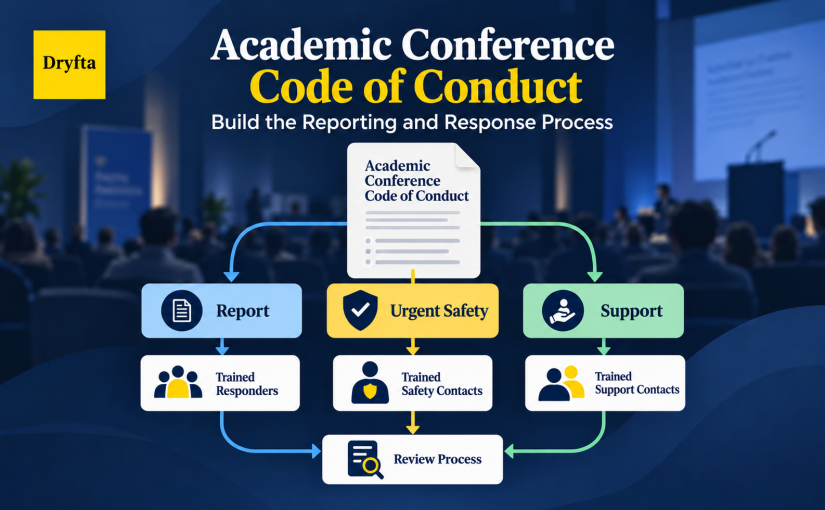
An attendee tells a volunteer that another participant’s behavior made them feel unsafe. The conference website says that harassment is prohibited. The volunteer, however, does not know who receives the report, what they may promise or whether the situation needs an urgent response. The policy exists, but the process stops at “contact us.”
A working academic conference code of conduct closes that gap. It sets expectations for participants and connects those expectations to reporting routes, trained roles, safety decisions, fair review and clear communication. This guide explains how to build that operating process before a concern reaches the team.
Important: This article offers planning guidance, not legal, HR, safeguarding or investigative advice. Ask the host institution’s legal, HR, safeguarding and privacy specialists to approve the final policy and procedure.
Separate the public code from the operating procedure
A statement of values cannot tell every member of the team what to do next. A complete system has three connected layers. Each layer serves a different audience and should point to the same approved reporting route.
| Layer | Who uses it | What it must accomplish |
|---|---|---|
| Public code | Participants, speakers, sponsors, exhibitors, staff and guests | Set behavior expectations, define scope, identify reporting routes and explain the broad range of possible responses. |
| Response procedure | Trained and authorized team members | Guide intake, urgent safety decisions, conflicts, information handling, review, communication and closeout. |
| Role aids | Volunteers, session chairs and designated contacts | Provide a short, safe handoff route without asking untrained people to interview participants or decide what occurred. |
The internal procedure does not need to appear online in full. The public page still needs to tell people how to raise a concern, who will receive it, what they can expect next and where emergency help sits outside the conference process.
The IEEE Event Conduct and Safety Statement provides a useful visibility lesson. IEEE recommends sharing the statement through registration terms, event websites, programs, welcome materials and opening remarks. A well-written code cannot guide participants if they do not know where to find it.
Define who and what the policy covers
Scope answers three practical questions: which people, which spaces and which behavior fall within the conference’s authority. Avoid copying another organization’s list without checking how it fits your event, institution and jurisdiction.
The code may cover attendees, speakers, authors, reviewers, exhibitors, sponsors, staff, volunteers, vendors and invited guests. It may also cover the venue, official social functions, virtual sessions, event-managed chats and communications sent through conference channels. The CSCW 2026 code of conduct, for example, applies its expectations to participation both in person and online.
Some situations require a decision rather than an automatic answer. Conduct during independent travel or at an unofficial gathering may sit outside the organizer’s authority. Conduct before or after the event may still require review when it has a defined connection to participation. Retaliation against someone who reports a concern or supports a review should appear explicitly in the policy.
| Situation | Likely treatment | Why | Who confirms the boundary |
|---|---|---|---|
| Official conference reception | Usually covered | The organizer manages or sponsors the activity. | Conference response lead |
| Virtual session chat | Usually covered | It forms part of the event-managed participation space. | Conference response lead and platform owner |
| Independent gathering after the program | Requires review | The organizer’s authority may depend on the event’s connection to the gathering. | Institutional policy owner |
| Immediate threat at the venue | Use the urgent safety route first | Emergency and venue procedures take priority over the later conduct review. | Approved safety contact |
Use this table as a set of questions, not as a universal ruling. The host institution should define the actual boundary before publication.
Give participants more than one reporting route
A single inbox may become unavailable, inaccessible or inappropriate when the concern involves the person monitoring it. Provide more than one route and tell participants when each route applies.
- A named email address or institution-approved secure form;
- An in-person contact or clearly identified response desk;
- A monitored phone or urgent route during event hours;
- An alternative contact when a response-team member has a conflict;
- Language or communication assistance where feasible;
- Separate instructions for immediate danger, urgent medical help or venue security;
- An honest explanation of how anonymous and third-party reports will be handled.
Make the route usable for disabled participants, but keep accommodation requests separate from conduct reports. Dryfta’s guide to communicating accommodation routes separately explains the different purpose and information needs of that workflow.
To raise a concern, contact [role or team] through [approved channels]. For immediate danger or urgent medical help, contact [local emergency route]. We will explain who receives the report, what information may need to be shared and what the next step can be. We cannot promise absolute confidentiality or a particular outcome.
Do not publish this wording unchanged. Legal, HR, safeguarding and privacy reviewers should adapt and approve it for the event, institution and location.
Assign trained roles and conflict-free backups
Define roles by responsibility rather than assuming that a familiar job title carries the right training or authority. A small conference may combine responsibilities, but it still needs clear limits and an independent backup when a team member has a conflict.
| Role | Responsibility | Must not do |
|---|---|---|
| Intake contact | Listen, record agreed information and explain available routes. | Promise an outcome or conduct a review alone. |
| Immediate-response lead | Coordinate urgent safety and operational steps within approved authority. | Treat an interim measure as a final decision. |
| Review lead or panel | Apply the approved review process and document decisions. | Participate when a personal, academic, financial or supervisory conflict exists. |
| Information custodian | Restrict access, apply retention rules and record authorized disclosures. | Store sensitive reports in personal accounts or open shared folders. |
| Communications lead | Coordinate approved updates for affected people and operational teams. | Reveal identities, case details or unverified information. |
The IEEE VIS 2026 reporting process separates reporters, confidants, a response team and local authorities. Its ombuds receive concerns and explain next steps, but they do not decide cases or take corrective action. That distinction helps a reporter seek support without turning every conversation into an improvised investigation.
Select team members for training, authority, availability, independence and diversity of perspective. Name backups before the event. The conflict process should cover personal relationships, supervisory links, academic dependence, financial interests and institutional loyalty.
Explain confidentiality and information sharing honestly
People often use confidentiality, anonymity and privacy as if they mean the same thing. They do not.
- Confidential handling restricts information to defined people and purposes.
- Anonymous reporting means the recipient may not know the reporter’s identity.
- Privacy concerns how the organization handles personal information under its policies and applicable law.
- Necessary disclosure covers circumstances in which safety, safeguarding, insurance, institutional or legal duties may require information sharing.
Listen to the reporter’s preferences and explain the options clearly. Also explain who decides whether information must be shared and, where permitted, how the reporter will be informed. An anonymous report may still reveal patterns or improve event planning, although limited identity or evidence can restrict action against an individual.
Avoid phrases such as “complete confidentiality,” “no one else will know” or “we guarantee anonymity.” Use precise language about access, purpose, limits and the next communication point.
Respond to immediate needs without deciding the case
The first contact should stabilise the situation and activate the approved route. It should not attempt to reach a final conclusion.
- Check immediate safety and urgent support needs.
- Explain the available reporting, support and emergency routes.
- Record only the information needed for the next decision.
- Check for conflicts and contact an approved backup when needed.
- Consider time-limited interim measures within the organizer’s authority.
- Preserve relevant information in the approved secure location.
- Set the next contact point and explain when an update can be expected.
Possible interim measures include voluntary separation, schedule changes, additional staff presence or temporary access restrictions. The team should assess authority, proportionality, accessibility and possible unintended effects before using them. An interim measure is not a finding.
Connect this conduct-specific route to the wider plan for medical, technical, venue and security incidents. The onsite event operations guide covers that broader command structure without replacing the conduct procedure.
Design a fair and documented review
Decide how review works before the team receives a report. The approved process should answer these questions:
- Which reports fall within the conference’s scope?
- Who has authority to make decisions?
- How will the reporter and the reported person receive information?
- What information will the team consider, and how will it assess relevance?
- How can each person respond where appropriate?
- Which approved threshold or standard guides the decision?
- How will the team document conflicts and recusals?
- What timeline applies, and what happens if it changes?
- Is there a review route, and what grounds does it cover?
Use terminology from the institution’s approved policy. Avoid importing legal terms such as “burden of proof,” “due process” or “investigation” unless the policy defines them and the organization has the authority and expertise to use them.
Match outcomes to authority and policy
A conference response depends on its authority, the information available, the seriousness of the conduct, safety considerations and institutional rules. The policy should describe the possible range without making any response automatic.
Options may include a reminder of expectations, behavioral conditions, removal from a particular activity, revocation of current event access, limits on future participation or referral to an employer, institution, publisher, venue or public authority where appropriate. The process may also conclude that no further action is available under the conference policy while still explaining support and other routes.
A conference decision is not the same as a criminal, employment or academic-disciplinary finding. State that boundary clearly and avoid implying broader authority than the organizer holds.
Communicate without turning the process into a public spectacle
Silence can leave people feeling that nothing happened, but unrestricted disclosure can expose private information and undermine a fair process. Plan what each audience genuinely needs to know.
- Tell the reporter when to expect the next update.
- Explain what information the reported person will receive and when.
- Brief operational staff only on actions they need to carry out.
- Use a reviewed communication plan for any public statement.
- Consider aggregate, de-identified transparency reporting only when privacy and specialist review allow it.
“We cannot share every detail” should not become “we did nothing.” Within approved limits, the team can explain that it received the concern, followed the stated steps and closed or transferred the matter.
Train and test the route before the event
Run a short scenario exercise with designated contacts, volunteers and chairs. Test decisions, access and handoffs rather than asking people to role-play traumatic detail.
- Can staff find the current public policy?
- Do they know the approved handoff route?
- Are urgent safety contacts current?
- Can a conflicted team member activate a backup?
- Are all reporting channels accessible and monitored?
- Does the team have an approved location for sensitive records?
- Does response coverage match event hours and time zones?
- Does the stated scope include virtual sessions and official social functions where intended?
Session chairs should know when to pause a discussion, seek immediate help and pass a concern to the designated contact. They should not interview participants or decide whether a violation occurred. Use the conference session chair checklist for the room-management role, then add the approved conduct handoff as a separate briefing.
Review the system after the event
Review aggregate, de-identified process signals with the approved policy owners. Ask whether reporting channels stayed monitored, any handoff took too long, conflicts arose, confidentiality limits were understood and interim measures worked as intended.
Record which policy wording, staffing arrangement or training step needs improvement. Apply the institution’s retention and deletion rules to sensitive records. Never use case details as event marketing or as a casual training story. Any transparency report needs careful privacy, legal and safeguarding review.
Where Dryfta fits
Dryfta can help organizers keep conference records, participant communication, schedules and event operations connected. Teams can use the event website and segmented communication tools to distribute the approved public policy, contact routes and operational updates across the conference lifecycle.
Sensitive conduct reports should still use the institution’s approved secure process and access controls. Dryfta does not investigate misconduct, guarantee confidentiality, provide emergency response or replace HR, legal, safeguarding or law-enforcement procedures.
If your team is reviewing the wider conference workflow, you can discuss connected conference workflows with Dryfta.
Make the code usable before anyone needs it
A code of conduct becomes useful when participants can find it and the team can operate it. Before registration opens, confirm the policy’s scope, reporting channels, urgent safety route, trained decision-makers, conflict backups, information controls and review authority. Publish the participant-facing information in the places people will actually look, then test the handoff with staff, volunteers and session chairs.
Keep the final process proportionate to the event, but do not leave critical decisions to improvisation. A smaller conference still needs a monitored contact, a backup, a secure information route and a clear connection to the host institution. Review the process after the event, correct what failed and record the version that will govern the next conference.
Frequently asked questions
What should an academic conference code of conduct include?
Include the policy’s purpose, the people and spaces it covers, expected behavior, prohibited conduct, non-retaliation, reporting routes and emergency contacts. Explain who receives reports, the limits of confidentiality and anonymity, the roles involved in response and review, the possible range of outcomes and any review route. State how participants can access the current policy before and during the event. The public code should set clear expectations without exposing sensitive internal instructions, and the host institution should approve it before publication.
Can a conference accept anonymous reports?
A conference may accept anonymous reports if its approved process explains how the team will use them. Anonymous information can reveal a pattern, identify an operational risk or guide prevention. However, limited identity, detail or supporting information may restrict the action available against an individual. Do not dismiss an anonymous report automatically, but do not promise a particular result. Tell participants whether the organization may need identifying information before a report can enter a formal review or transfer to another authority.
Who should handle a conference conduct report?
Use trained and authorized people with defined responsibilities, secure information practices and named backups. The team may include an intake contact, an immediate-response lead, a review lead or panel, an information custodian and a communications lead. Build a recusal process for personal, academic, supervisory, financial or institutional conflicts. Volunteers and session chairs need a clear handoff route, but they should not interview participants, assess evidence, promise an outcome or investigate a concern on their own.
Should the code list every possible sanction?
No single list can predict every situation. The public code should describe the range of possible responses clearly enough to set expectations while preserving room for proportionate, reviewed decisions under the approved policy. It can mention behavioral conditions, removal from an activity, loss of current access, future participation restrictions or referral to another authority. Avoid automatic sanctions and avoid implying powers the organizer does not hold. The internal procedure should identify who can authorize each response and how that decision is documented.
How often should the reporting and response process be reviewed?
Review it before every event and after any meaningful use, staffing change, policy change or identified failure. Confirm that contacts, emergency routes, response coverage, conflict backups, storage locations and communication templates remain current. After the event, examine de-identified process signals such as missed handoffs, access barriers or unclear wording. Legal, HR, safeguarding and privacy specialists should approve material revisions. Keep a dated version record so the team knows which policy applied when a report arrived.