


Knowledge and discovery are, at their most fundamental level, social pursuits. Researchers can, and have, produced incredible research from within the reaches of their solitude, in their rooms and offices. However, even this research has relied upon other ways albeit in indirect ways. This researcher, like most other peers, is likely to have attended multiple scholarly events prior to embarking on his own research endeavor. Having networked with countless researchers, listened to them share their inputs on the large stages, this research finds a resolve to pursue of their own.
Such is the power and necessity of event networking at academic conferences. Academic research rarely exists in a vacuum. It is one of those fields that needs, and demands, lifelong learning.
Academic collaborations that originate at conferences have a well-established role in producing multi-institutional research, joint grant applications, and co-authored publications. For doctoral researchers and early-career academics in particular, a single meaningful introduction at a conference can set the direction of the years that follow. Beyond just the individual level as well, there is an interdisciplinary field-level argument that chimes us all to take conferences and networking more seriously. For practitioners in interdisciplinary fields to collaborate, they ought to meet and exchange ideas and propositions first. Academic conferences and the space they leave for networking are among the most productive spaces to bring out interdisciplinary interaction. This is something that is almost nil in other more homogenous spaces where the potential for other disciplinary peers being in attendance is less.
Introduction to Event Networking in Academic Conferences
Consumer News and Business Channel (CNBC) notes that close to 80% of professional roles in academia are filled via personal contacts, aka networking.
While some organizers continue to neglect networking at academic events, putting it secondary on their list of petiotitries, that’s a fact that is mind-blowing. Bad or zero networking means you are missing out on all of these potentially career-defining opportunities.
Typical event networking challenges at academic conferences
Event Networking at large-scale academic conferences can be a tough egg to crack perfectly. There are challenges that are prone to pop up when networking for academic events. Some of the most common structural limitations include:
- Bigger gatherings of several 100 or even 1000s researchers are often multi-track affairs, cutting across dozens of simultaneous sessions. This arrangement leaves little space for guided connection-making and can turn the process into more of a hit-or-miss thing.
- Attendees who are senior and well-networked often tend to have pre-existing ties. This is something that freshers lack. Those who are early in their careers or attending for the first time frequently leave having spoken to fewer people in comparison or none at all.
- Another structural problem is not to do with the willingness of researchers to connect, as is often cited as being the case. Rather, it is the absence of reliable human infrastructure that puts off good networking.
How technology can address these challenges
Technology has, in recent years, proven to be a potential answer to closing these structural apertures once and for all. The most meaningful shift in academic conference design over the coming decade will not come from programming or content innovation alone but from the deliberate use of purpose-built networking platforms that replace chance with structure.
Dryfta is among the platforms most specifically designed for this purpose, and in this article, we’ll take a closer look into how modern-day academic conference organizers can take advantage of futuristic tools like Dryfta.
Key Features of Dryfta’s Event Networking Platform for Academic Conferences
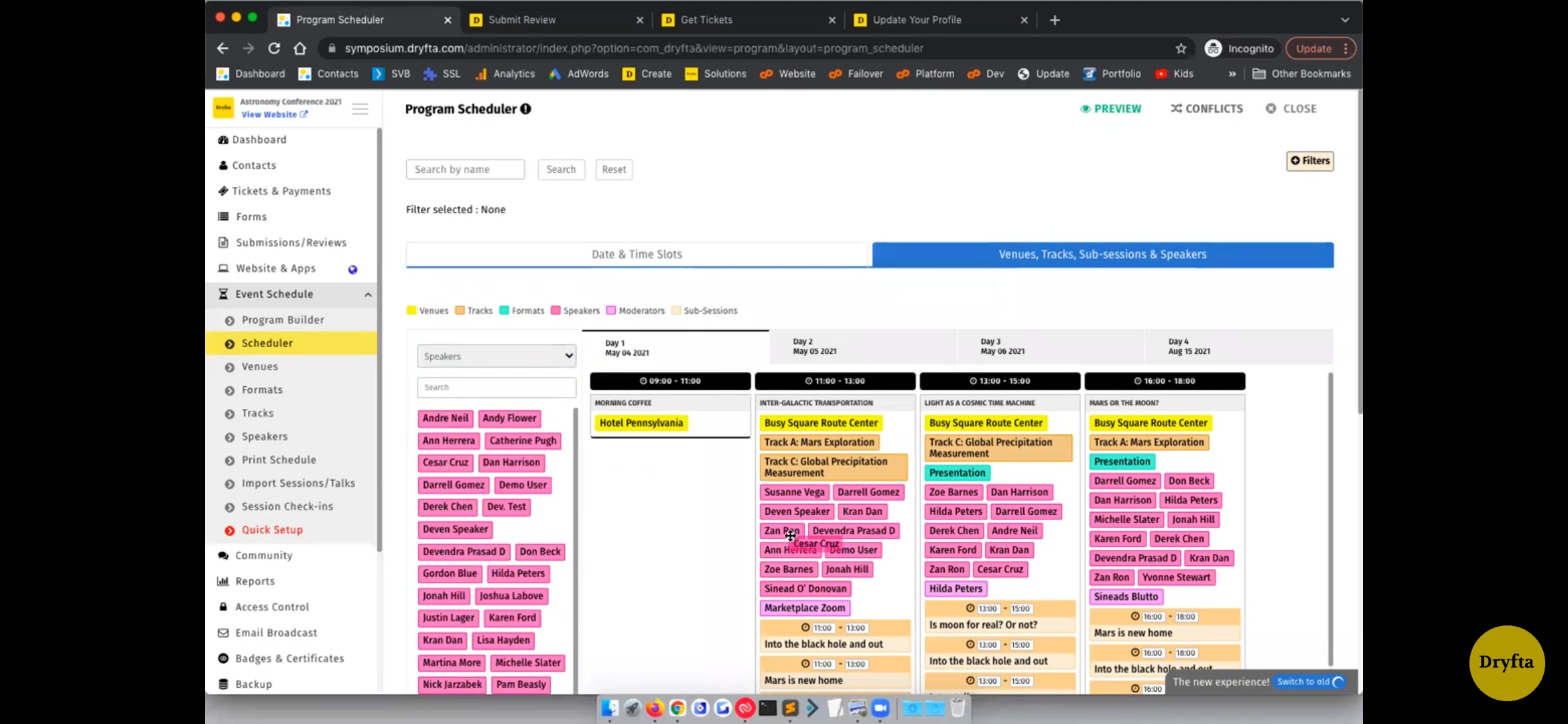
The organizing principle behind Dryfta’s approach to conference networking is the belief that meaningful connections should not depend on luck. The platform’s academic event management tools are built around the premise that if you give attendees the right information about each other and lower the barrier to acting on it, the connections will follow. Here is how that philosophy runs in actual functionality:
- Attendee Profiles and Matchmaking Algorithms: Every attendee on Dryfta, first and foremost, creates a structured profile for themselves. This includes the obligatory information as well as more detailed inputs on things like areas of expertise, describing current projects and specializations. This structured input then feeds an AI-powered matchmaking engine that prescribes connection suggestions based on these career and personality traits. Dryfta’s matchmaking is designed to surface complementarity, making it particularly well suited to interdisciplinary conferences where the most valuable connections are also the least obvious ones.
- One-on-One Meeting Scheduling and Virtual Meeting Rooms: Identifying a potentially valuable connection and acting on that identification are two very different things. Dryfta closes that gap with a meeting scheduler that allows attendees to browse suggested connections, review profiles in detail, send meeting requests and confirm time slots that are automatically added to both parties’ calendars.
- Group Discussions and Topic-Based Networking Lounges: Not every valuable academic conversation is a one-on-one exchange. Dryfta’s online networking lounges also allow for facilitated group discussions organized around specific research themes, methodological approaches or professional development topics. These spaces, which can be virtual or physical depending on the event format and can kick off structured conversation across institutional and disciplinary lines that the standard conference format rarely facilitates.
- Integration with Conference Agenda and Mobile App: Attendees manage their networking schedule, receive connection notifications and join virtual meeting rooms without switching between tools or navigating multiple platforms. Dryfta’s native mobile event app consolidates all of this into a single interface on iOS and Android apps stores.
Best Practices to Optimize Event Networking for Academic Conferences Using Dryfta
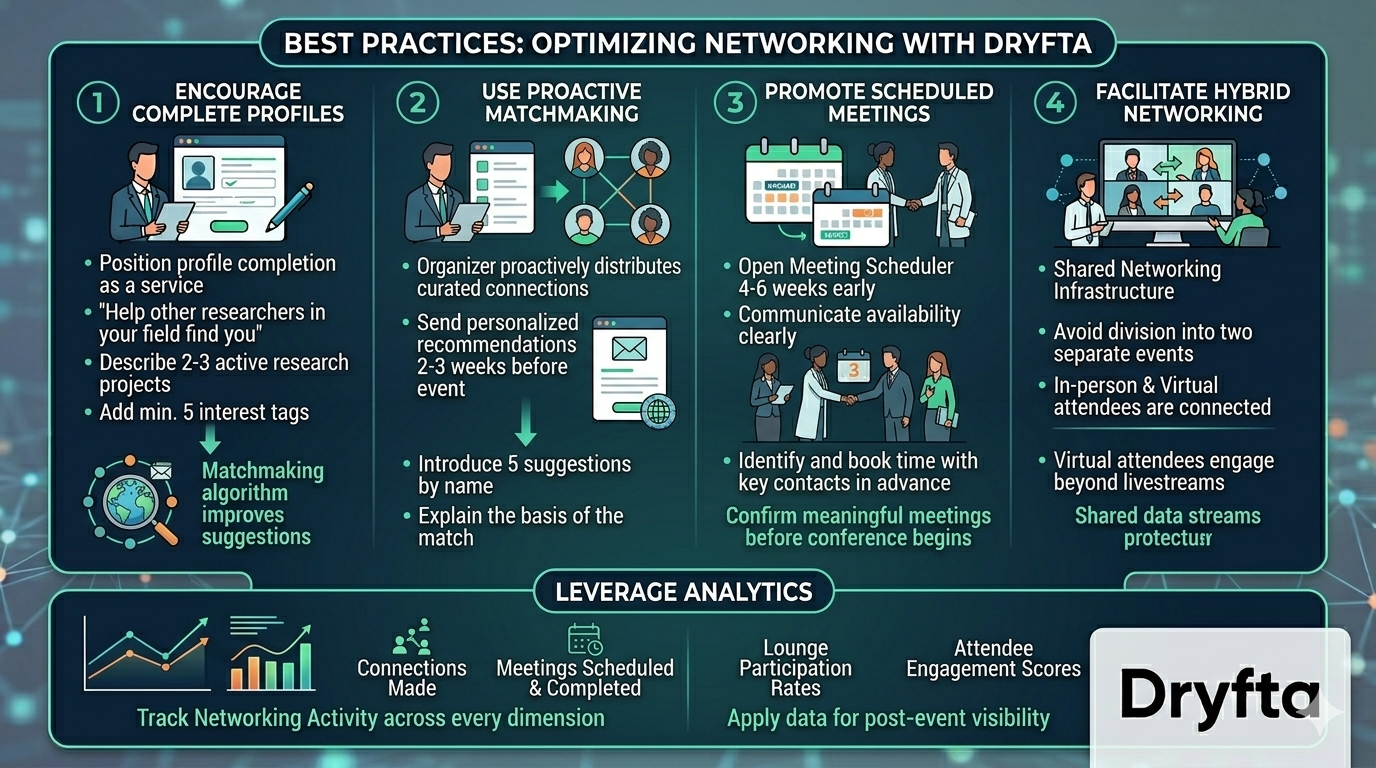
The platform gives you the infrastructure to make academic networking possible. Whether or not your chosen infrastructure produces the results you hoped for relies on how you set up the experience around it. Upon examining how the most effective academic conferences have approached this, we have identified several practices that consistently separate events that optimize networking from those that merely enable it.
Encourage Early Profile Completion and Interest Tagging
The quality of every matchmaking suggestion Dryfta generates is a direct function of the completeness of attendee profiles. An incomplete profile limits what the algorithm can do and, by extension, limits the networking value that attendee will both receive and offer to others.
A prompt that positions profile completion as a service to the attendee themselves (‘help other researchers in your field find you before the conference begins’) consistently outperforms one that reads like administrative notes through and through. It also helps to ask attendees to describe 2 or 3 active research projects and to add at minimum 5 interest tags, which gives the matchmaking engine sufficient signal to give out relevant suggestions.
Use Matchmaking to Suggest Relevant Connections
Passive availability of connection suggestions is not sufficient. The most effective use of Dryfta’s matchmaking capability involves organizers proactively distributing curated connection recommendations in the two to three weeks before the event. A personalized message that introduces five suggested connections by name and explains the basis of the match gives attendees a concrete action to take and creates networking momentum before the conference has formally opened.
Promote Scheduled Meetings Before and During the Event
The period between registration confirmation and the opening of the conference is networking time that the majority of organizing committees effectively leave unused. Opening Dryfta’s meeting scheduler 4 to 6 weeks before the event and communicating its availability clearly to registered attendees allow people to identify and book time with key contacts in advance. By the time the conference begins, a meaningful portion of the most valuable meetings may already be confirmed.
Facilitate Virtual and In-Person Hybrid Networking
The hybrid conference format, now an inextricable aspect of the event experience, also brings with it a certain kind of structural risk that organizers must actively design against. Without deliberate intervention, in-person and virtual attendees will split into two separate conferences. And often, the virtual attendees are the ones who turn into individuals witnessing a livestream, as physical attendees participate. Dryfta’s shared networking infrastructure is designed to make this division unnecessary.
Leverage Analytics to Understand Event Networking Engagement in Academic Conferences
Dryfta’s event analytics software provides organizers with real-time and post-event visibility into networking activity across every dimension of the conference. Through the conference management platform, committees can track the number of connections made, meetings scheduled and completed, lounge participation rates and individual attendee engagement scores. This data has two distinct and equally valuable applications.
Case Study- Successful Academic Conference Event Networking with Dryfta
Let’s take a look into this hypothetical scenario. We have a mid-sized conference in the Sciences that gathers its participants on an annual basis. The event sees anywhere between 900 and 1000 multinational attendees from 30 countries around the globe. But there is something concerning about the past two years of this annual event that continues to bother organizers as they gear up for this year’s big day.
For 2 consecutive editions, post-event surveys returned one consistent finding. It inferred that attendees rated the networking dimension of the conference as its weakest element. And this is despite rating the content quality and organization highly.
Now let’s work the magic. The organizers of this conference go on to make a smart choice: They try Dryfta. Well, you can do too, today. And completely free of cost. Sign up for a demo here. Circling back into the hypothetical scenario, the organizing committee engaged Dryfta ahead of their 3rd edition with specific and measurable goals. These were their most important goals for the years:
- They sought to increase average connections per attendee from under 5 to double digits.
- To introduce structured one-on-one meeting opportunities for the first time in the conference’s history.
- To create a networking experience that is equitable for the 280 virtual attendees who had been excluded from the informal connection-making that in-person attendance offered.
How Dryfta’s Event Networking Tools for Academic Conferences Were Implemented
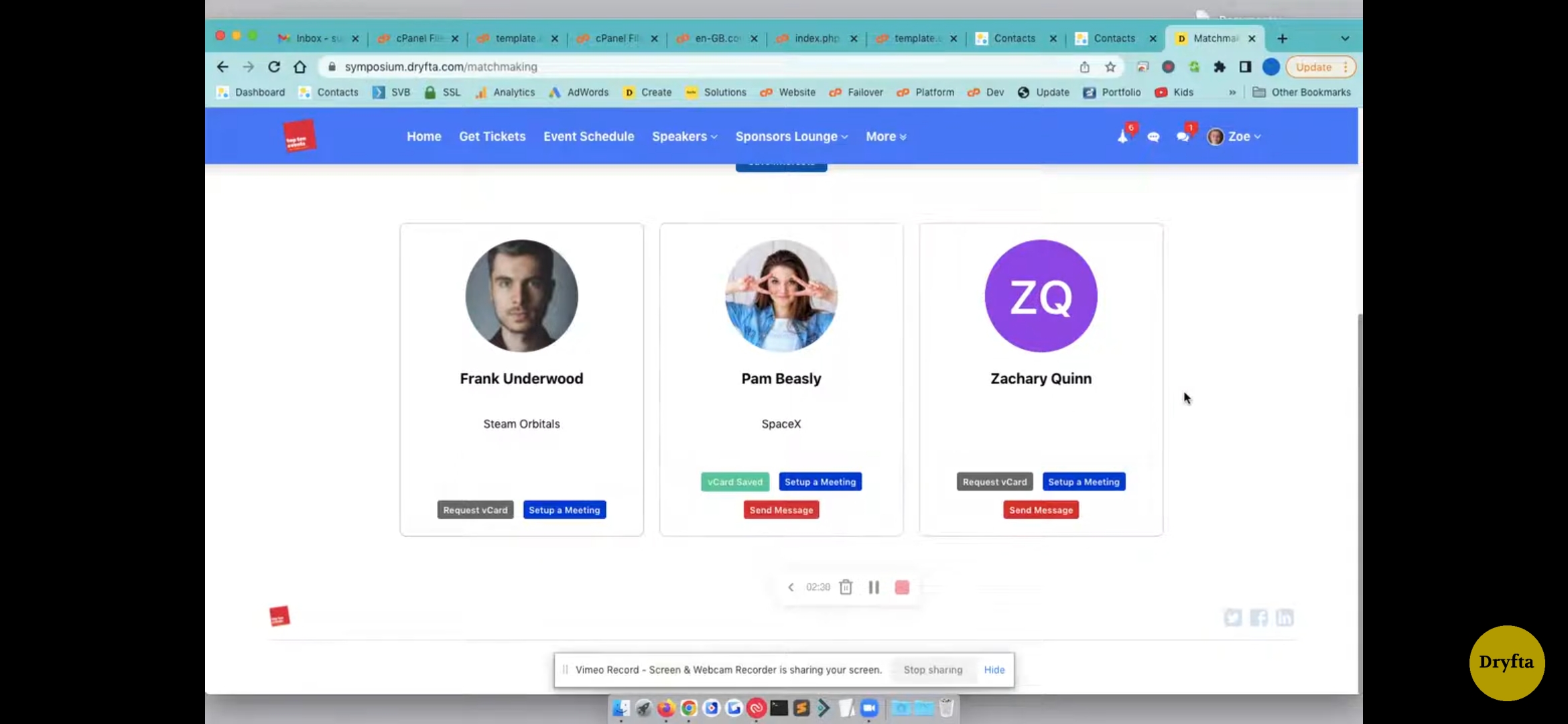
- Profile activation: The organizing committee opened Dryfta’s attendee portal about 6 weeks before the event and used a three-part email sequence to guide attendees through profile completion. By the opening day, a good number of registered attendees had already completed their profiles, ready to be pruned for attendee matchmaking.
- Pre-event matchmaking: Exactly a month before the conference, Dryfta’s matchmaking engine gets down to work with personalized connection recommendations for each attendee. The organizing committee distributed these as ‘researchers you should meet‘ messages. Within 48 hours, close to 100 pre-event connection requests will have been sent.
- Meeting scheduler launch: 4 dedicated 90-minute networking blocks were reserved across the two-day agenda and made visible within the Dryfta mobile app. A brief tutorial was included in the registration confirmation email for attendees’ reference.
- Topic-based lounges: About 5 networking lounges were created around sub-themes of the main conference and each lounge hosted between 15 and 40 participants across the event.
- Hybrid integration: Virtual attendees were also assigned to the same matchmaking pool as in-person attendees. Dryfta’s virtual meeting rooms facilitated scheduled meetings, including cross-format meetings between in-person and remote participants.
Post-event Results
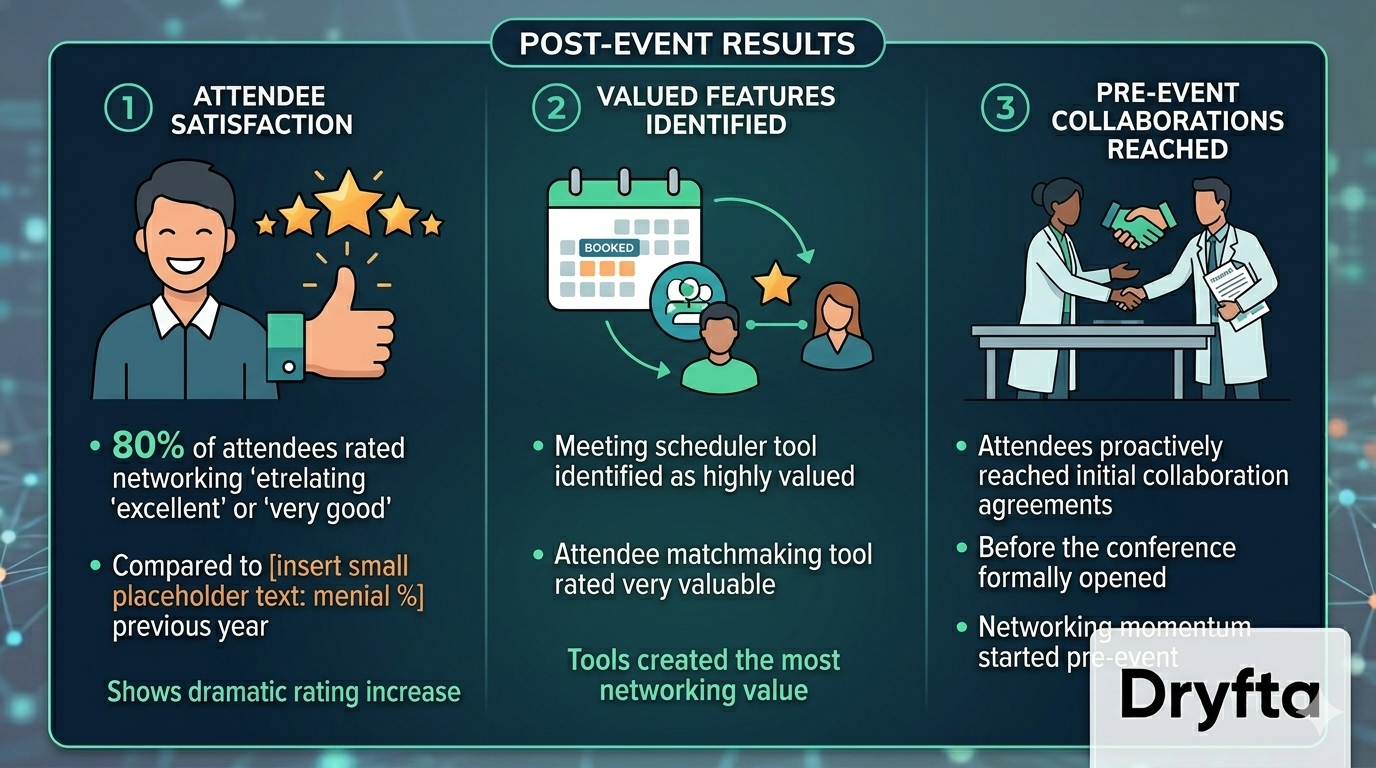
Post-event survey results noted the following:
- 80% of attendees rated the networking experience as excellent or very good, compared with the menial percent the year before.
Qualitative feedback also identified the meeting scheduler and attendee matchmaking tools as the most valued features. - Several attendees noted that they had proactively reached initial collaboration agreements before the conference had formally opened.
Conclusion and Next Steps for Organizers
There is a case to be made that academic conferences have, for too long, treated networking as a fortunate byproduct of gathering researchers in the same place. The evidence from both platform capability and real-world implementation is consistent on one point, that conferences which design the networking experience deliberately produce better outcomes for attendees and stronger long-term research communities than those that rely on proximity and chance alone.
Dryfta provides the complete infrastructure to make these hypothetical results realistically possible for your next event. From AI-assisted matchmaking and structured meeting scheduling to hybrid-accessible networking lounges and granular post-event analytics, the platform addresses the networking challenge across every stage of the conference lifecycle, from the weeks before registration closes to the post-event period when follow-through on new connections determines whether those connections endure. Explore Dryfta’s conference management software for your next academic event. Request a personalized demo and see how the platform can be configured around your conference goals.
Frequently Asked Questions (FAQs)
How can Dryfta help improve event networking at academic conferences?
Dryfta helps improve networking at academic conferences with a range of pre-event networking and attendee matchmaking tools. Powered by automation and scheduled into repetitive perfection by event organizers, Dryfta’s tools yield the best kind of networking metrics around. Organizers, for their part, gain access to an analytics dashboard that makes networking engagement visible and measurable in ways that the traditional conference format never permitted.
Is Dryfta suitable for both virtual and in-person academic conferences?
Yes, certainly. As a matter of fact, Dryfta has built exclusive features to cater to the virtual format and not treat it as a secondary audience. Our networking infrastructure looks at both in-person and virtual attendees as members of the same community and refuses to allow viewership to split into two parallel audiences. Virtual meeting rooms are accessible to both attendance modes, and a native mobile app gives in-person attendees the ability to join virtual meetings from their phones between sessions.
Can attendees schedule one-on-one meetings through Dryfta?
Yes, Dryfta’s meeting scheduler is among the platform’s most used features when it comes to academic conferences. Using this tool, attendees can comfortably browse suggestions and connection requests. They may also choose to scout through the larger attendee directory. The scheduler integrates with the conference agenda so that meetings can be booked during designated networking blocks without conflicting with sessions the attendee has already committed to attending.
How does Dryfta ensure relevant networking matches for attendees?
Dryfta’s matchmaking algorithm draws on the structured data that attendees provide during profile completion. This includes factors like research areas, current projects, methodological expertise, career stage and stated collaboration interests. The system is designed to surface complementary profiles.
What analytics does Dryfta provide to measure networking success?
Dryfta’s analytics dashboard tracks a set of networking metrics including total connection requests sent and accepted and one-on-one meetings scheduled and completed. Organizers can access real-time dashboards during the event to identify engagement gaps and make adjustments as well as post-event summaries that give you a complete account of networking activity across the entire conference.