


Let’s cut to the chase: what is a symposium? To answer this question, you’ll first need to understand what a symposium is not. A symposium is not a place wherein attendees gather arbitrarily and gratuitously. While one may argue that, ‘Well, no gatherings are uncalled for! Everything holds a purpose.’ However, symposiums hold a particular kind of weight and importance that other closely associated conference formats don’t. A conference is often massive, sometimes with people packed to the brim. The takeaway is, therefore, limited in individual scope. It is more passive than active. Some participants run the show, while most others watch the show run.
A symposium, on the contrary, is a more close-knit gathering focused on a specific topic of interest. Most if not all participants here contribute to the conversation in meaningful ways. Sometimes, symposia participants are held accountable for their progress in case of an annual review.
A symposium is a formal academic or professional event organized around one specific topic, where experts present research, share ideas and engage in structured discussion that the wider conference circuit rarely has time for. Herein, the speakers present, a receptive audience asks questions and panels debate to arrive at important conclusions or a course of action. The proceedings at a symposium are documented to be released for public viewing later. Symposiums are most common in academic, medical, scientific and corporate environments. But the the format has found a home anywhere that a topic is important enough to warrant concentrated, expert-led attention.
What Does Symposium Mean?
The term ‘symposium‘ shoulders more history than its counterpart event formats. We’ll tell you some of it. According to Merriam-Webster, the term comes from the Greek term ‘sympinein‘, a combination of ‘syn‘ meaning ‘together’ and ‘pinein‘ meaning ‘to drink.’ Collectively, the term means ‘to drink together.’ The word traces its root to ancient Greece, where a sympinein was held after a banquet. Here, men would drink wine, discuss philosophy, debate ideas and recite poetry. The drinking eventually became secondary but the discussion did not. By the end of the 18th century, as Merriam-Webster notes, the word had taken on its modern sense, referring to meetings focused on absorbing ideas rather than beverages.
Key Characteristics of a Symposium
Presides Over A Focused Topic Discussion
A symposium does not attempt to cover an entire field and instead takes just one or two specific subjects and examines them from multiple expert angles. As an example, the Global Atmosphere Watch (GAW) Symposium in Geneva, organized by the World Meteorological Organization (WMO) facilitated a symposium discussion in Climate Research. The gathering saw the three major research programmes of the WMO participate in debating progress and future action plans.
Brings Together Expert Speakers and Presenters In A Room
Presenters at a symposium are typically invited specialists, not open-call applicants. The papers submitted are gathered under a specific submission theme and the presenting panel tends to come from various institutions. This allows for broad but detailed discussion within a defined area of expertise.
Sets Off Interactive Discussions That Hold Purpose
A symposium is not just another lecture series. Unlike passive lectures, symposiums build discussion into the agenda. Q&A sessions, panel debates, audience participation and structured peer dialogue are not secondary. The symposium is the design. Attendees are expected to walk in with some background in the subject and then contribute meaningfully to the conversation.
Takes Place In An Academic or Professional Environment
Most symposiums are organized by universities, research institutions, professional associations, healthcare organizations or corporate bodies with a research function. The atmosphere is scholarly and serious. Attendees come to learn and contribute and rarely to feel entertained.
Overseen By A Smaller and More Focused Audience
Scale is one of the clearest differences between a symposium and a conference. Most modern symposiums host anywhere between 50 and 200 attendees.
Types of Symposiums
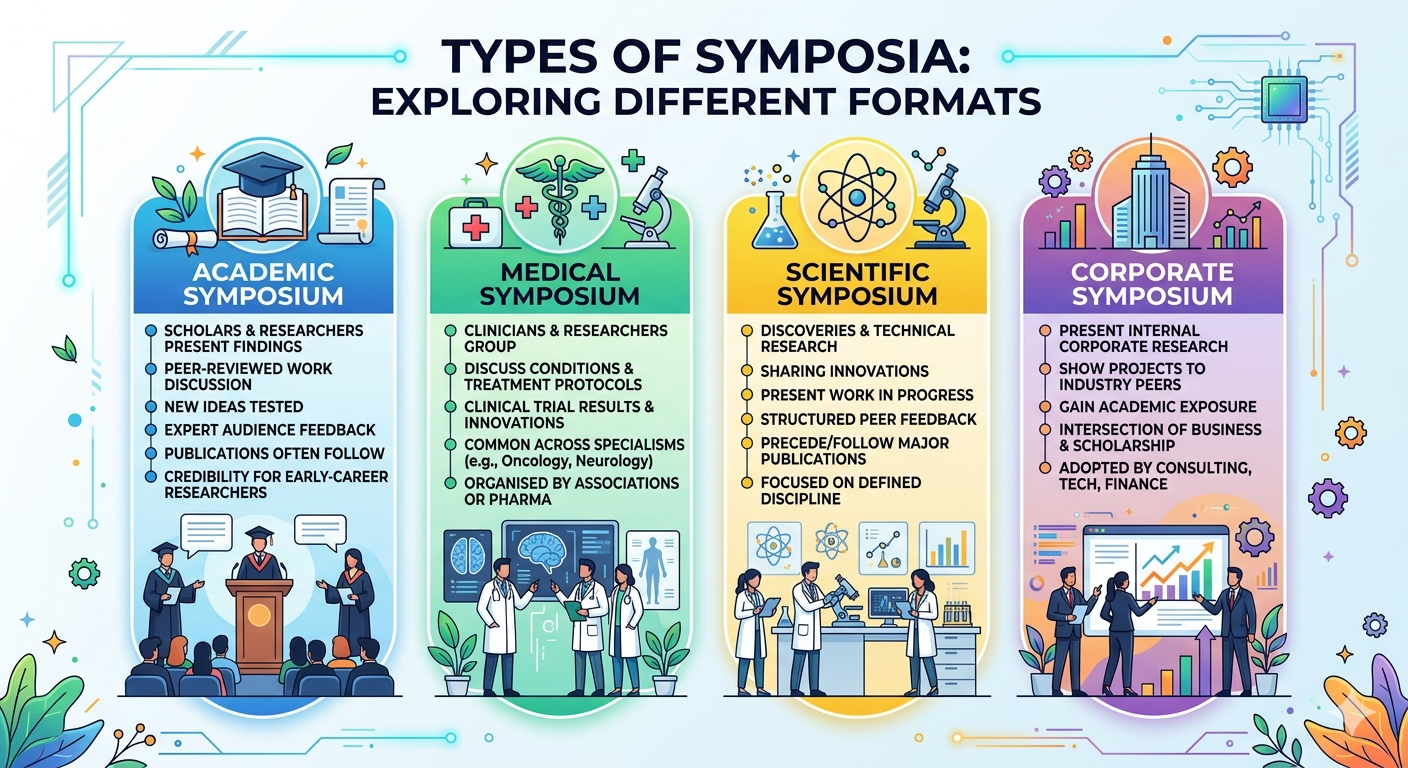
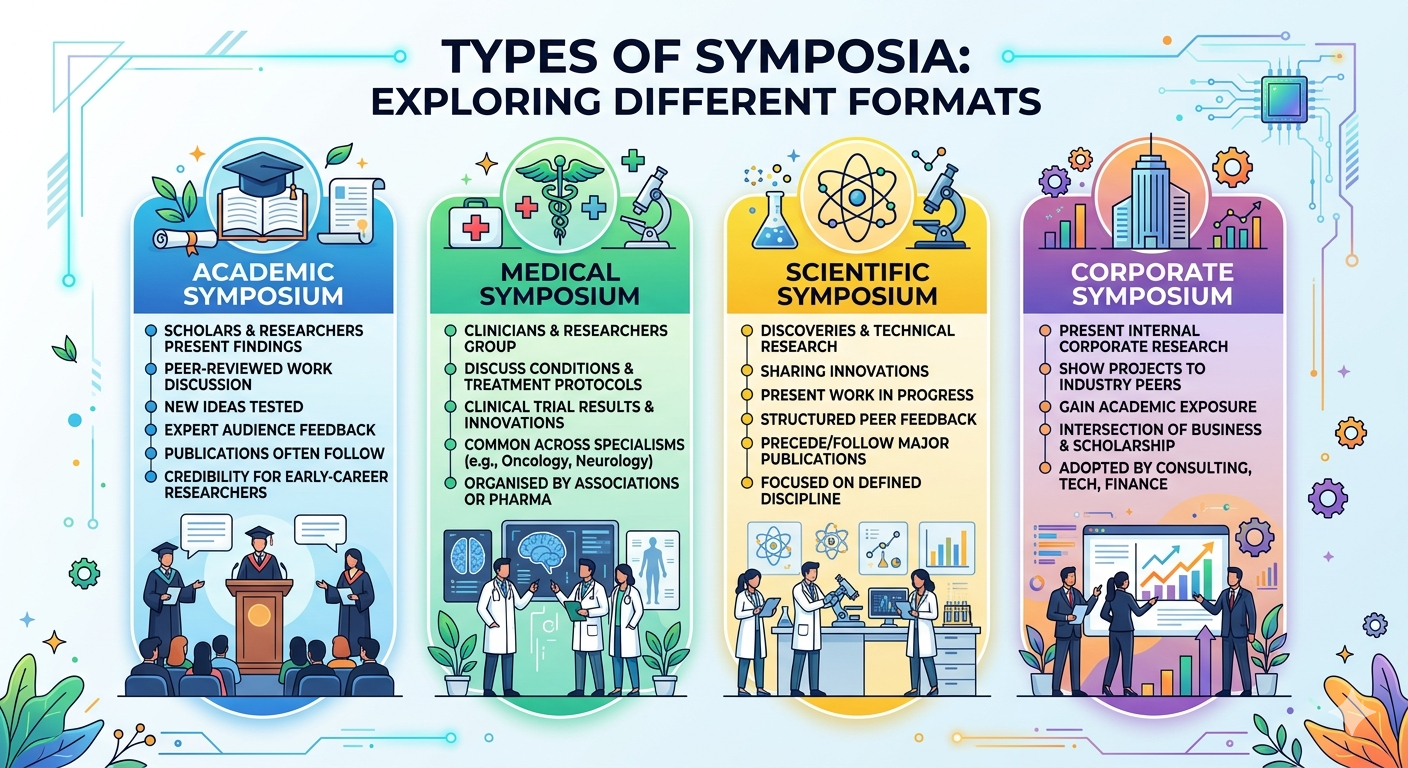
- Academic Symposium: The academic symposium is the format closest to the original meaning of the word. Researchers and scholars present findings, peer-reviewed work is discussed and new ideas are tested in front of an expert audience.
- Medical Symposium: Gathering that bring together clinicians, researchers and public health professionals to discuss specific conditions, treatment protocols, clinical trial results or new innovations. These events are common across specialisms from oncology to neurology and are frequently organized by professional medical associations or pharmaceutical institutions.
- Scientific Symposium: As the name indicates, scientific symposiums focus on discoveries, technical research and the sharing of innovations within a defined discipline. They often precede or follow major publications and give researchers the opportunity to present work in progress and receive structured feedback from peers before formal publication.
- Corporate Symposium: Organizations outside academia also use the symposium format. Corporate symposiums are used to present internal research, show projects to industry peers or gain academic exposure for work that sits at the intersection of business and scholarship. Consulting firms, technology companies and financial institutions have all adopted the format for exactly this purpose.
Symposium vs Conference
The two terms are often used interchangeably far more often than they should be. Here are some important differences between the two formats:
Why Are Symposiums Important?
The need for symposiums can seem straightforward. But here are some key factors to emphasize its important in the world today:
- Symposiums encourages knowledge sharing: A symposium creates a structured space for experts to share what they know with others who can use it. The depth of discussion that comes out in a focused room of specialists rarely happens elsewhere.
- Symposiums promotes innovation: When experts at the frontlines of a topic gather in one place, new ideas surface. Many research collaborations and published findings trace their origins to a symposium conversation.
- Symposiums supports academic collaboration: Symposiums bring together researchers from different institutions and backgrounds around a common question. This kind of a cross-institutional panel structure is one of the more defining features of the format.
- Symposiums helps professionals network: The smaller scale of a symposium makes networking more personal and more productive. Withno more than 50 to 200 people in the room, meaningful connections are possible in a way they often are not at larger events.
- Symposiums offer learning opportunities: Attendees at a symposium are not passive observers. The interactive format, built around Q&A and debate, means every person in the room has the opportunity to further their understanding of the subject in real-time.
- Symposiums highlight the latest research and trends: Symposiums are often where new findings reach a live audience for the first time. This is even before formal publication and is ahead of wider conference dissemination.
How to Organize a Successful Symposium
Step 1: Choose a Clear Theme
The value of a symposium comes directly from its focus. A theme that is too broad produces a format that behaves like a conference without the scale. Make sure to justify the theme that you choose to yourself and then to your audience. Narrow down the theme as much as is feasible.
Step 2: Invite Expert Speakers
Remember that a symposium is not yet another conference. It is a format in itself. It is the whole show. Therefore, it is necessary to rope in speakers who are the most experienced, knowledgable or relevant in their respective fields. Symposium speakers are typically invited rather than recruited via an open call. Identify the leading voices in your chosen topic and reach out early.
Step 3: Create an Agenda
A good symposium agenda balances presentation time with discussion time. Most symposiums overwhelmingly plan a single series of presentations across one day, with structured time saved for panel discussions and networking. Make sure to not fill every minute with content. The spaces left in between are where the best kind of conversations are bound to happen.
Step 4: Manage Registrations
Even a small symposium demands a transparent and easy-to-navigate registration process. Consider using an event management software that offers access to customized forms, capacity controls and automated confirmations. This will substantially cut down on your administrative overhead.
Step 5: Promote the Event
This is the most important and yet overlooked step. Even the most groundbreaking of symposia need a certain amount of advertising to reach the right audience. If your event is open to the public, make sure to let them know that. Target your outreach precisely because you do not want to invite attendees who are not serious about the theme. A symposium audience is specialist by nature, so broad promotion is rarely helpful.
Step 6: Use Event Technology
Abstract management, registration, scheduling, badge printing and post-event analytics are all easier to manage when on a single platform. For hybrid and virtual symposiums, integrated livestreaming and virtual networking tools are not optional additions anymore. This is now non-negotiable infrastructure that makes the symposium format work even at a distance.
How Dryfta Helps You Manage Symposium Events

Managing a symposium involves more operational functions than its size suggests. Abstract review, speaker coordination, session scheduling, attendee check-in and post-event reporting all need to work together. Dryfta’s software to manage symposiums brings each of these into a single platform. As an organizer, you will no longer have to stitch together a dozen tools for each function. Here are our software’s key features:
- Online registration: Custom forms with multiple attendee types, early-bird pricing and automated confirmations, with payment processed directly to your account.
- Abstract management: Full submission and peer review workflow, including blind review, reviewer assignment and decision communications, without any third-party tools.
- Speaker management: Centralized speaker profiles, session assignments and communication tools that keep presenters informed at every stage.
- Agenda scheduling: A built-in schedule builder that links sessions to speakers and rooms, with real-time updates reflected in the attendee-facing agenda.
- Networking tools: In-app attendee directories and messaging that let participants connect before, during and after the event.
- Virtual and hybrid symposium support: HD livestreaming, virtual breakout rooms and on-demand content for symposiums that extend beyond a single physical venue.
- Badge printing: On-site badge generation with QR codes for fast, accurate check-in without manual lists.
- Attendee check-in: QR-based check-in at the door and at individual sessions, with real-time attendance data available in the organizer dashboard.
- Email communication: Automated emails are triggered by registration, abstract decisions and schedule changes, keeping every stakeholder informed without manual follow-up.
The Benefits of Using Event Management Software for Symposiums
Running a symposium without dedicated software means you are managing abstract submissions on email threads and coordinating speakers through flimsy spreadsheets. You’re also perhaps gearing up for dreadred check-in that runs into lengthy printed lists.
It is important to know that manually managing these functions means plenty of gaps. Each of those gaps, prone to manual errors, could show up on your event day. And in front of attendees. When they do show, they come across not as errors but as inadequacy.
For an event format as sophisticated and meticulous as symposia, there is little room for mistakes. Choosing the right kind of event management platform, therefore, becomes principal. If you are an organizer planning your next symposium soon, your day deserves to run smoothly and without interruptions. State-of-the-art software technology such as that of Dryfta now make perfection possible. Sign up for a free demo today.
Frequently Asked Questions (FAQs)
What happens during a symposium?
Speakers present research or findings on a shared theme. Audience members ask questions. Panels discuss and debate. Networking happens in the margins. Many symposiums also produce published proceedings, making that the the event’s impact goes beyond the room itself.
What is the difference between a symposium and a seminar?
A seminar is usually a smaller and more interactive session inclined towards teaching and training. It often hosts a single facilitator who guides the discussion. A symposium, on the other hand, involves multiple expert presenters and is organized around research presentation and peer discussion rather than instruction.
Who attends symposium events?
Researchers, academics, clinicians, industry specialists and graduate students are the most common attendees. These attendees are expected to have some background in the subject to participate meaningfully. Most symposiums are not made to be attended by a general audience.
How does Dryfta help manage symposium events?
Dryfta handles the full operational stack. This includes online registration with custom forms, abstract submission and peer review, speaker management, schedule building, virtual and hybrid event support, on-site check-in with badge printing and post-event analytics. Everything runs from a single platform, removing the need to stitch together separate tools for each function.