





According to Upmetrics, the US events market alone is expected to nearly double from $407 billion to $916 billion by 2033.
At first glance, webinars and seminars can feel pretty similar. You share ideas, answer questions, and try to keep people engaged. But that’s where the similarity ends. Each format attracts a different audience and serves a different purpose.
With the industry growing this fast, choosing between a webinar vs seminar becomes a strategic decision. In this blog, we’ll break down how each format works, where each one fits best, and how you can use both together to get the right balance of reach and depth.
What is a Webinar?
Put simply, a webinar is an event that takes place entirely online. It is basically like a classroom experience or a video conference, happening live as participants view from their computers or smartphones.
Participants simply click a link to log into a virtual meeting space, where they view presentations (or other content) by the speakers or demos. Many webinars also have interactive features. For example, you may be able to type your question into a chat box, vote in a poll or download resources distributed during the presentation.
Here’s the best part: webinars are recorded, so you can repurpose them for future use and keep getting value beyond the live event, which is a common point of discussion in the webinar vs seminar debates.
What is a Seminar?
Let’s look at the other side of the webinar vs seminar discussion. What is a seminar?
A seminar is an event in a physical location at which people physically attend and participate in learning or sharing about a subject of interest.
You go to a room, sit down, listen to the presenter, and interact with them as well as all of the other participants. Seminars are typically held in a classroom, a large meeting room or an auditorium.
The most significant difference between the webinar and seminar formats is the in-person experience. You can see the audience’s reactions and responses immediately. There will be real-time dialogue and interactions among individuals who may have common interests without a screen in between.
Use Cases of Webinars
Here are some of the ways webinars deliver tangible value for organizations:
- Generating leads: Do you want people who understand what you provide? Run a webinar. Also, when you launch a new feature and take participants through a live demonstration. After the webinar, check who attended or viewed the recording later. Now, your sales team has an interested lead group to follow up with.
- Product demos and launches: Are you trying to clearly demonstrate how your product works? A webinar does a great job at this. You could host a “What’s New” session to highlight new features. Show live demonstrations of those features and answer questions as users ask via chat.
- Training and enablement: Do you need to get all stakeholders aligned quickly? A webinar is a quick way to train customers or onboard employees without having to attend the same session 10 times.
- Expert panels: Do you want multiple experts speaking from multiple locations on one platform? A webinar is a great way to bring them together into a single view and make hosting panel discussions much easier.
All this makes webinars a winner in a webinar vs seminar debate, especially when you want to reach more people and be more flexible.
Use Cases of Seminars
A seminar is the right choice if you want to spend time with a select group and go deeper into the topic.
- Executive roundtables and VIP sessions: Are you looking for an opportunity for your top executives or VIP guests to have meaningful conversations with one another? A Seminar is the perfect environment.
- Hands-on workshops: Want people to actively participate and not just listen? Seminars make that possible. People sit together in a room, talk to each other, and do tasks, which makes it more practical.
When a Webinar Fits Better?
Have you ever thought, “This is a great topic, but it doesn’t need to be in a room?” It’s probably time for a webinar.
Webinars work well when:
- You want to reach a wider audience
- Your audience is located in different places
- You’re presenting content that is more presentation or demonstration-based
- You want digital data and analytics
Webinars Have Some Obvious Benefits
- More affordable overall: There is no need to pay for venues, food service, or traveling.
- Faster to set up: When using a reliable platform, you can go live in weeks rather than months.
- Reach a broader audience: You can also reach an audience across multiple geographic locations simultaneously.
- Re-useable content: You can record the webinar and then use those recordings as on-demand videos, clips, or training materials.
- Better tracking and metrics: You can measure who registered for the event, who attended, how engaged they were during the presentation, and where users clicked links in your slides.
Trade-Offs Associated With Using a Webinar
- People can drop off quickly: People often attend a webinar from where they work or live; therefore, it is easy to lose their attention or have them log out prematurely.
- It will be harder to build relationships: Screens take away much of the naturally occurring social interaction and bonding that occur when two humans interact face-to-face.
- Coordinating time zones: Scheduling a time that works for everyone involved is difficult.
When a Seminar Fits Better?
Now imagine this. You are hosting an event for a small group of key clients or prospects, and you want to have conversations. This is where a seminar is ideal.
Seminars work well when:
- You want to build stronger relationships
- Your topic needs discussion and hands-on input
- You have senior or high-value audiences
- You want a local, personal touch
Seminars Provide Notable Benefits
- More personal interactions: Attendees connect in person, recall discussions more easily, and trust each other more after the seminar.
- Greater relations: People interact more, ask questions, share experiences, and practice ideas as you receive instant feedback.
- More comfortable for confidential topics: In-person, behind closed doors, is more secure.
Seminars Have Their Limitations
- More expensive per participant: Venue, food, travel, audio-visual, and staffing costs add up for each person.
- Smaller reach: Only those who can travel and take time out on that day can attend.
- More time and risk: More time is needed to plan with vendors, and external factors can affect the event.
Webinar vs Seminar: A Comparison
| Factor | Webinar | Seminar |
| Access | Join from anywhere with an internet connection | Requires physical presence at a venue |
| Engagement Style | Chat, Q&A, polls, moderated interaction | Face-to-face discussion, group activities, networking |
| Audience Scale | Can handle large audiences with ease | Typically smaller, more focused groups |
| Setup Requirements | Platform, speakers, and the internet | Venue, travel, materials, and on-site coordination |
| Duration | Usually short and structured, often under 90 minutes | Can run longer, from a few hours to full-day sessions |
| Content Delivery | Presentation-led with limited interruptions | More flexible, allows deeper discussion and interaction |
| Reusability | Sessions can be recorded and shared later | Recording and reuse are more limited |
| Ideal Use | Broad reach, awareness, and scalable learning | Relationship building and in-depth learning |
| Flexibility | Easier to schedule and attend across time zones | Fixed schedule with less flexibility for attendees |
Webinar vs Seminar: How to Decide
So, how do you actually decide between webinar vs seminar? Ask yourself these questions before you decide.
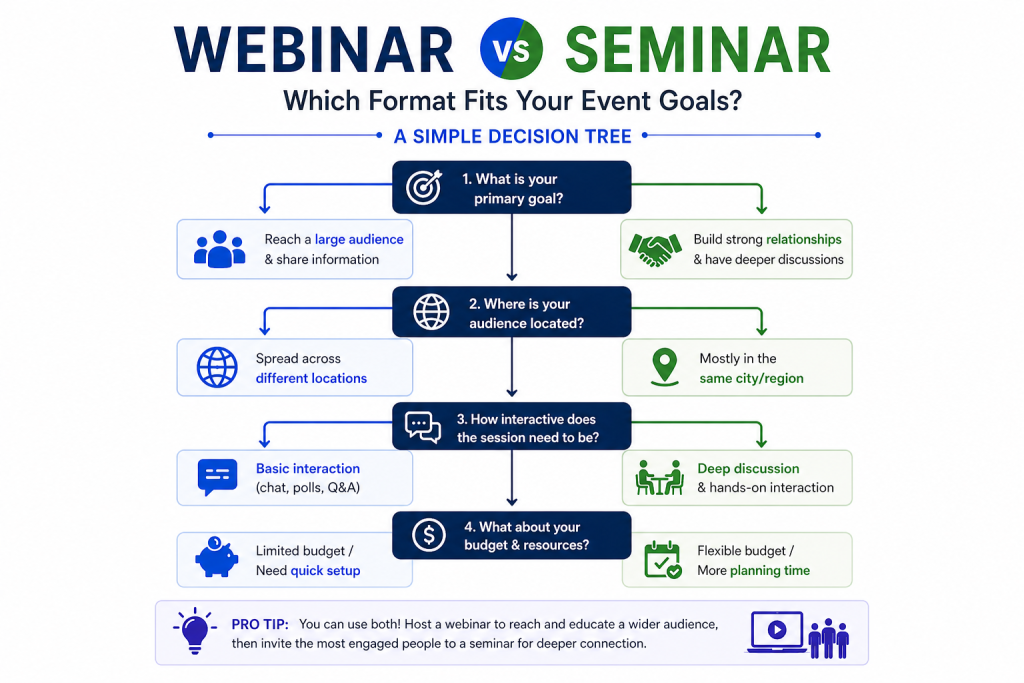
1. What is your top objective?
To educate and engage as many people as possible, use a webinar. To build meaningful connections and establish trust with an intimate group, choose a seminar.
2. Where is your target audience?
If they are spread over multiple locations, a webinar may be ideal as participants can attend from anywhere. However, if they are mostly located within driving distance of each other, a seminar could be the way to go.
3. How complicated is your subject matter?
A webinar may be best suited for simple subjects (slide presentation/ Q&A). Seminars offer much more flexibility for topics that require group work, brainstorming, and hands-on activities. Your goals should also help guide this decision.
4. What is your budget/timeline?
If you are on a tight budget or short on time, webinars could be a good fit. Otherwise, seminars offer an enhanced experience.
5. Do you require high levels of interaction?
If you want basic interaction, such as chat or polls, a webinar will work. If you need more interaction with discussions, roundtables, or networking, a seminar is better.
6. Does your team have the capacity for planning and logistics?
If your team has the resources (planning/logistics/facilitation) to execute a seminar, then you’ll get the strongest results. If your team is limited by resources, consider a webinar as they’re less resource-intensive.
7. Are there specific types of data you require?
Do you need digital metrics such as attendee numbers or clicks? If yes, then a webinar will be the way to go. Are you looking for real-time conversation, feedback, or reactions? If yes, a seminar will provide you with a richer experience.
The Bottom Line
Now that you have two formats of running sessions as part of your toolset and a good sense of which to use when, the next time your teammate suggests “Let’s run a session on this,” you won’t be guessing. You can go through the checklist of questions and determine which format would work best. If you’re planning a webinar, a seminar, or a combination, you can evaluate how your attendees respond and grow from there.
Dryfta is here to help you easily manage both webinars and seminars without managing separate tools. Schedule a free demo and learn how we can work together for all of your events.
FAQs
- What is the difference between a webinar vs seminar?
The difference between a webinar vs seminar is interaction. A webinar is an online event that can reach large audiences. A seminar is in-person and involves more discussion and interaction. Webinars are broadcast-oriented, while seminars are more about discussion, networking, and interaction.
- When should you choose a seminar vs webinar?
Deciding between a seminar vs webinar depends on your objective. Choose a seminar for personal engagement, trust, and practice. Go with a webinar for audience size, flexibility, and cost. A webinar is a good way to demonstrate a product to a global audience. A CEO leadership training fits a seminar.
- Online seminar vs webinar: what’s the difference?
An online seminar vs webinar sounds like a technical distinction, but in practice, they overlap. They’re both online, but webinars tend to be more formal, with a presentation format. Online seminars typically include more discussion or group work. It’s not about the technology, but the format.
- Which is the best platform to host a webinar?
It depends on the event type and your end goals. With that said, Dryfta is ideal for professionals. It’s all-in-one for registration, ticketing, attendees, and integrations. It’s more than a webinar platform; it supports the entire event lifecycle.
