


If you are an event organizer who has spent any time recently reading about what is changing in event planning, you will have noticed that artificial intelligence (AI) keeps coming up. It is a term that keeps popping up in conversations about marketing, about content, about attendee experience and everything else. What it does not get talked about as directly as it should is registration.
And yet, for most event planners, registration is precisely where the operational load is heaviest and where the most avoidable problems tend to cluster. AI event registration is not a distant luxury that is reserved for large conference teams with dedicated tech budgets, no. It is now becoming increasingly accessible, increasingly specific and increasingly worth understanding if you run events of any meaningful scale.
The only issue is that most event planners are afraid to take the plunge and explore the possibilities that AI holds for the event management industry. In this blog, we’re breaking it all down for you: what AI for event registration means, what it actually involves, why it matters and where it can make the most difference for you and your team.
What the AI Event Registration Process Actually Involves
Before getting into strategy, it is worth being clear on what the AI event registration process means in practice. And no, it is not simply putting a chatbot on your registration page. Rather, it refers to the use of machine learning and automation at various points in your event’s registration workflow.
-
- At the most basic level, what this can mean for your organization is that you can utilize AI to automate registration confirmations. You can also potentially send intelligent follow-up sequences based on attendee behavior.
- At a more technologically advanced level, you will be looking at systems that can predict drop-off points in the registration flow and even recommend sessions based on an attendee’s profile based on what has historically produced the best results for your audience.
The common thread is that the AI event registration process removes the dependency on a human reviewing each step manually. But what it does not do yet is completely remove human judgment from the picture. It takes away the repetitive, rule-based work that does not need human judgment and, in turn, frees your team to focus on the decisions that do.
Starting With the AI Event Registration Form
The goal of AI in registration is not to replace the people running your event. It is to stop those people from spending half their time on tasks that a well-configured system can handle on its own.
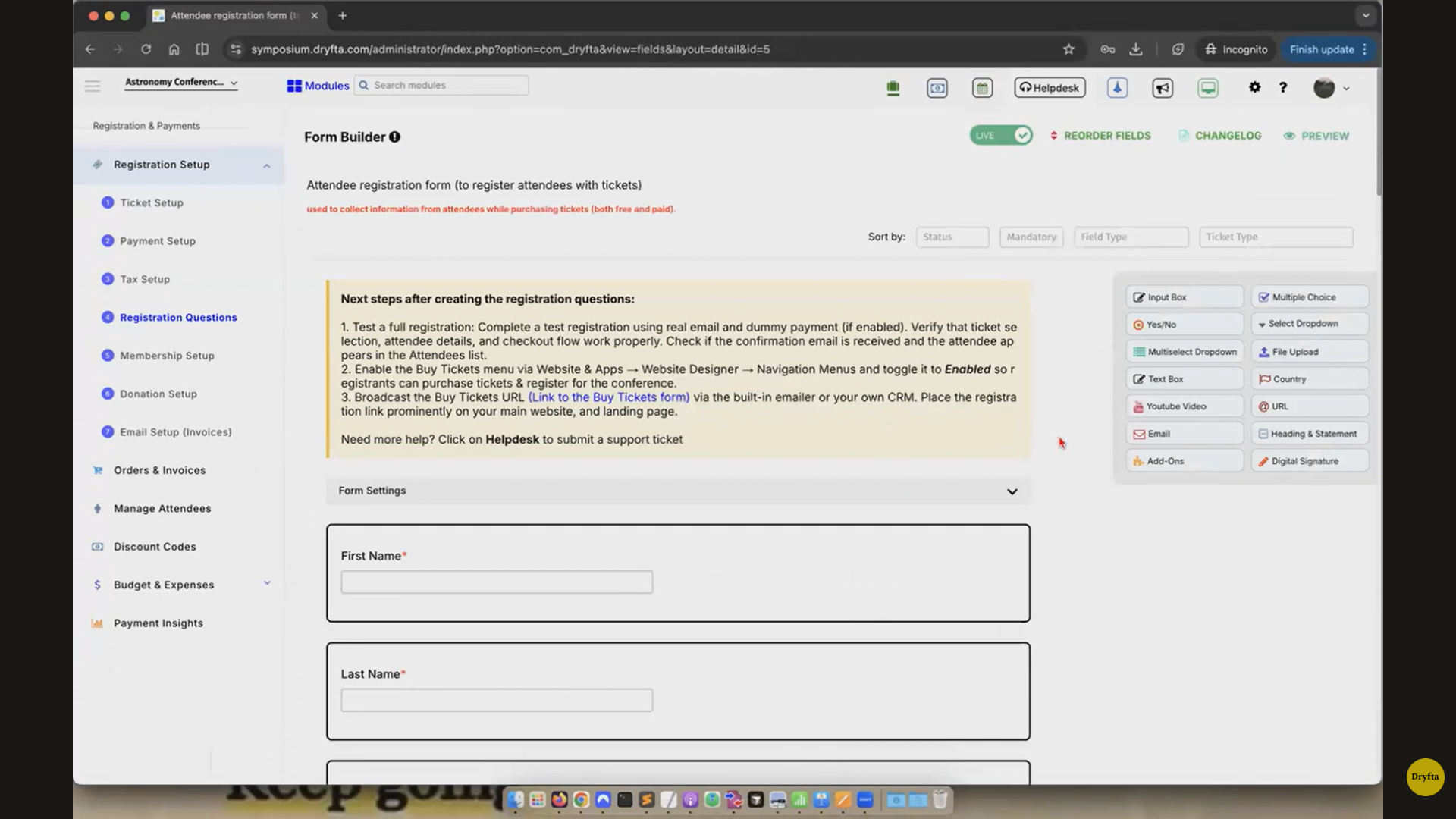
Starting with the AI event registration form, this is where most attendees first interact with your event operationally, and it is also where a significant number of drop-offs happen. An AI event registration form addresses this by adapting to the person filling it out.
An AI event registration form can use conditional logic informed by prior data to show or hide fields based on what an attendee has already told you. It can pre-populate fields for returning attendees. It can flag in real time if a submitted email address is formatted incorrectly or if a chosen session has reached capacity and offer an alternative immediately, rather than letting the attendee discover the problem after submitting.
These are not features that require a large technology investment. Several AI event registration platforms now include them as standard. Many teams find that the most immediate win from any AI event registration tool is simply the ability to automate registration confirmations and follow-up sequences, which alone removes a significant chunk of repetitive manual work.
What an AI Event Registration System Does Differently
An AI event registration system is distinguished from a standard registration tool primarily by what happens after someone submits their details. A standard tool records the submission and sends a confirmation.
An AI event registration system continues working with that data. It can scan the registrant based on their profile and history to identify if they are likely to engage deeply with the event. It can also trigger a different communication sequence for each segment.
It might analyze the pace of registrations coming in and alert your team if the rate suggests you are on track to fall short of your capacity target with enough time to act. For larger events, AI conference registration tools take this further. At the scale of a multi-track conference with hundreds or thousands of attendees, the AI event registration process becomes considerably more sophisticated.
AI conference registration systems are built to handle this sophistication at scale in a way that manual processes simply cannot. The return on investment in a dedicated AI conference registration platform becomes much clearer once you have tried to manage those variables by hand.
Where AI Event Registration Makes the Most Difference
The honest answer is that AI event registration delivers the most value in the places where event planners are currently spending the most time on work that should not require their attention. That tends to mean 3 areas.
Communication: Sending registration confirmations, reminders, waitlist updates and pre-event information manually is time-consuming and inconsistent. An AI-driven system can handle all of this automatically and the result is a more consistent experience for attendees and considerably less operational load for your team.
Data quality: Poor data quality is one of the most persistent and underacknowledged problems in event planning. AI tools that validate and clean data at the point of entry prevent many of these issues before they occur rather than requiring someone to fix them later.
Capacity management: Knowing in real time how your registration numbers are tracking against your targets is valuable information that most organizations only review periodically. An AI event registration system can surface this continuously.
Common Misconceptions About AI Event Registration
There are a few assumptions about AI event registration that are worth addressing directly because they tend to stop organizations from looking at it seriously.
-
- AI event registration is not relevant only for large events. The operational benefits of an AI event registration system are just as real for a 200-person professional development day as they are for a 5000-person conference.
- AI event registration is not defined by technical expertise to set up and manage. Most modern platforms are designed to be configured without developer support. If you can figure out how you currently manage registration manually, you can generally configure an AI-assisted version of the same process.
- Automating parts of registration does not make the experience feel less personal for your attendees. In fact, the opposite tends to be true. A form that adapts to what an attendee tells you feels more considerate than a generic one. Personalization and automation should exist together. When done well, they can support each other.
Where to Begin
If you are considering AI event registration for the first time, the most useful starting point is an honest audit of where your current registration process breaks down.
Where do people drop off before completing their registration?
Where does your team spend the most time on manual follow-up?
Where do data errors tend to appear and when do you typically catch them?
The answers to those questions point directly to where AI can make the most immediate difference. You do not need to overhaul your entire registration setup at once. Most organizations start with one or two specific improvements, see how they perform, and build from there.
See What Dryfta Can Do
Dryfta’s automated registration system is built for event teams that want a smarter way to manage their registration functions and broader event operations from within a single platform. Dryfta is giving you the tools you need to automate the routine work that fatigues manual teams, keep your databases cleaner, and stay on top of your numbers without losing your mind. Visit Dryfta today, sign up for a free demo and see how we can scale your events.