
At the first committee meeting after a conference, the dashboard is full: registrations, attendance, session ratings, budget lines. Then the chair asks, “What are we asking the board to decide?” No one has a clear answer. The numbers are there, but the report has not connected them to the conference’s goals or next steps.
A conference post-event report template helps turn those records into a decision-ready account. It should show what the conference set out to do, what the evidence says happened, where results differed from plan, and what decision or action follows. It is not another dashboard. Put detailed charts and source notes in an appendix; keep the recommendation, owner and due date easy to find.
For example, if workshop attendance fell short of its target, a useful report does more than state the gap. It defines how attendance was counted, checks the schedule and feedback for context, then presents a practical option, such as changing the time or outreach, for the board to consider. This is an illustrative scenario, not a report of actual conference results.
A post-event report should help the board decide what happens next
A decision-ready report has three layers: the decision itself, the explanation behind it, and the evidence a reader can use to verify it. Keeping them separate makes the recommendation easy to find while preserving the detail a board may want to check.
| Layer | Reader question | Content |
| Decision-making | What must we decide? | Recommendation, options, owner, due date |
| Explanation | Why? | Result, variance, context, and consequence |
| Evidence | Can we verify it? | Definitions, charts, source records, and detailed notes |
Decide the report’s audience, decisions, and evidence window first
Before anyone drafts a page, settle what the report is for. A short scoping note, agreed with the person who will present the report, prevents most rewrites. Record the following:
- Primary readers and their authority: Who will read it, and what can they approve? A board can change budgets and policy; a program committee may only advise.
- Decisions expected from them: List the approvals, changes, and deferrals you hope to leave the room with. If you cannot name one, the report may be a briefing, and that is fine, but call it that.
- Event objectives and approved success measures: Use the goals agreed before the event, not goals chosen after the results arrived.
- Reporting period and comparison period: State both with dates, for example, the current edition against the previous edition or against the approved plan.
- Financial close status and known estimates: Say whether the books are closed and which figures are still provisional.
- Data owners, definitions, and gaps: Name who owns each source, how each measure is defined, and what is missing.
- Confidential sections and distribution list: Decide which material is restricted and who receives which version.
This scoping step also tells you what the report is not. A sponsor report, an attendee recap, an annual report, and an internal operational debrief, for instance, are all separate reporting functions each with their specific yet different target audiences. A sponsor report tells you about the reach and value delivered throughout the event. An attendee recap, on the contrary, is more light-hearted.
Put the executive summary on one useful page
The executive summary is the part most board members will read closely, so it carries the weight of the whole report. Aim for one page. It should contain, in this order:
- Conference purpose and context. One or two sentences on why the event exists and anything unusual about this edition, such as a new venue or a change in format.
- Three to five material outcomes. Only results that bear on the objectives or on a decision. Resist the urge to list every number.
- Important variance from plan or prior period. Name what moved, in which direction and by how much, with the definition used.
- The explanation, supported by evidence. A sentence or two on the likely cause, with a pointer to the evidence layer.
- Decisions requested. Phrase each as something the board can approve, defer or decline.
- Recommended owners and dates. Each decision has an accountable person and a deadline.
The example below shows how one result travels from objective to decision. The logic is illustrative: it uses no real results and invents no figures, which is the standard your own report should meet as well, with real numbers and sources in place of the placeholders.
| Element | Example logic |
| Objective | Increase participation from early-career researchers |
| Result | Share increased, based on the stated registration definition |
| Context | Discount uptake rose while one outreach channel underperformed |
| Recommendation | Retain the discount and revise the channel mix |
| Decision | Approve the outreach budget allocation by a named date |
Notice what the chain does. The result is tied to an objective set in advance. The context explains it without excusing it. The recommendation follows from the context, and the decision is something a board can actually vote on, with a date attached.
Write the summary last, but read it first. If a director reads only this page, they should be able to say what happened, what you think should change and what you need from them.
Report outcomes against the goals approved before the event
Organize this section by objective, not by software screen. A board does not think in terms of the registration module or the survey tool. It thinks in terms of what the conference was supposed to achieve. For each objective, show the target, the actual result, the comparison, the explanation, any limitation on confidence and the next action.
A table keeps this disciplined:
| Objective | Measure and definition | Target | Result | Variance | Explanation | Next action |
| Name the approved objective | State the measure and exactly how it is counted | Approved target | Actual, marked provisional if not final | Difference from target or comparison period | Likely cause, with confidence or limitation | Owner and date, or “none needed” |
Copy one row per objective, and keep the row text short enough to read without scrolling sideways. If an explanation needs a paragraph, put a reference in the cell and the paragraph in the explanation layer.
Three habits make this section trustworthy.
- Disclose definition changes: If the way you count a measure has changed since the target was set, say so and show the result on both bases where you can. A quiet change of definition is the fastest way to lose a board’s confidence.
- Keep measures distinct: Registrations, checked-in attendance, unique participants and session activity are different things. A person can register and not attend, attend and join no sessions, or join many sessions in one visit. Do not present them as interchangeable, and do not let a favourable figure stand in for the one the objective actually names.
- Show missed objectives in plain sight: A target that was missed belongs in this table with the same prominence as one that was met. The board’s decisions depend on knowing where the event fell short, and a shortfall explained honestly is more useful than a success that has been over-polished.
For choosing which measures to track in the first place, and how to interpret them, see our guide on how to use event analytics. This report starts after those choices have been made.
Give finances enough context to support a decision
A financial summary in a board report is not a ledger. Its job is to show the financial position clearly enough that the board can decide something: a price change, a venue commitment, a supplier renegotiation or the size of a contingency.
Cover these items, in roughly this order:
- Budget and result: The approved budget, and the actual or forecast close, with the date of the figures.
- Material revenue and cost variances: Explain only the lines that moved enough to matter, using a threshold the committee has agreed, and say what caused each.
- Restricted funds: Identify money that can be spent only for a stated purpose, so the board does not treat it as free surplus.
- Unpaid and outstanding items: List invoices, refunds, sponsor payments or commitments not yet settled.
- Assumptions: State what the forecast depends on, such as exchange rates, pending payments or an expected final supplier bill.
Then make the connection the board needs. A variance on its own is information; a variance linked to a decision is a recommendation. If late registration revenue fell short of plan because the final pricing tier opened too soon, the finance section should lead to a pricing decision. If catering costs exceeded the contract because minimum guarantees were set from optimistic numbers, it should lead to a decision about supplier terms or how guarantees are set.
Keep the scope modest. This section does not teach accounting, advise on tax treatment or describe audit procedure. Those belong to the organisation’s finance function and its auditors.
Ask the finance owner to validate every figure before the report is circulated, and label anything provisional as such, with the reason and the expected date of the final number. A board that is told “this is an estimate, and the final figure is due on a named date” can act sensibly. A board that discovers later that an estimate was presented as final will question everything else in the report.
Summarize participation, programme and experience without repeating the dashboard
This is the section where reports most often turn into a data dump. The dashboard already exists, and the board does not need it reproduced in prose. Organize the section around three questions, and include only the evidence that changes an interpretation or a recommendation.
Participation: who registered, attended or did not complete the journey? Look at the shape of the audience against the objectives. Did the event reach the groups it set out to reach? Where did people drop out between registering and attending, or between attending and engaging? Report a pattern only if it supports a decision, such as a persistent drop-off at one registration step or a segment that registered in strong numbers but rarely attended.
Programme: which content patterns affected objectives or future choices? Here the question is not which session was most popular but what the programme taught you. Did a track draw an audience the objectives called for? Did a format, a time slot or a speaker mix affect participation or feedback in a way that should shape next year’s call for abstracts or schedule?
Experience: what did structured feedback and service records reveal? Use survey results and service records, such as helpdesk requests or onsite queries, to explain the result rather than decorate it. Report response rates and who responded, because feedback from a small or self-selected group needs a caution beside it. Separate recurring themes from one-off comments.
A few rules can help you keep this section short and honest.
- Give a finding only when it changes what the board might decide.
- State the definition and base for each figure, such as whether a percentage is of registrants, attendees or survey respondents.
- Mark interpretations as interpretations, and keep them apart from the observed facts.
Detailed metric selection and analysis belong elsewhere. For how to choose and read event measures, see event data beyond attendance. For common errors when examining results, see post-event analysis mistakes. If your conversation turns to keeping attendees engaged after the event, our guide to post-event engagement covers that follow-up.
Record accessibility, risk and operational exceptions
Every conference has things that did not go to plan. The board does not need a blow-by-blow account, but it does need to know about exceptions that carry cost, obligation or risk for the organisation. Summarize them at an appropriate level, covering:
- Accessibility and accommodation outcomes. Whether requested accommodations were delivered, where they were not, and what the gap suggests for next year.
- Safety and conduct issues. The number and general category of reports, and whether the response followed the agreed procedure.
- Technology failures. Outages or defects that affected attendees, speakers or revenue, and whether the cause is resolved.
- Supplier exceptions. Missed deliverables, disputed charges or service failures that affect contract decisions.
- Unresolved obligations. Refunds, credits, sponsor commitments or contractual items still open.
Two disciplines matter here.
- Protect people: Report at the level of detail the board needs to govern and no further. Do not name attendees, staff or complainants, and do not publish case details that could identify anyone. Where a matter is sensitive, put it in a restricted section with a smaller distribution list, as decided in your scoping note.
- Distinguish an incident from a pattern: One session room with a failed microphone is an isolated incident. Accommodation requests that were repeatedly acknowledged late is a process gap, and a process gap is what leads to a recommendation. Say which one you are describing, and give the basis for the judgement, for example how many times it occurred and across how many sessions or days.
Do not make legal conclusions in this section. If an incident may carry legal or insurance consequences, state the facts at a high level, note that the matter has been referred to the appropriate owner, and leave the assessment to them.
This section is also a good place to be candid about what the team could not see. If incident logging was incomplete or feedback from certain groups was thin, say so. Unknowns that are named can be fixed; unknowns that are hidden are repeated.
Turn lessons into recommendations that can be approved
A lessons-learned list tells the board what the team noticed. A recommendation tells it what to do about it. The bridge between them is a chain in which every link is visible:
- Evidence: what the data or records show.
- Interpretation: what you believe it means, and how confident you are.
- Recommendation: the specific change proposed.
- Decision needed: what the board is asked to approve, defer or decline.
- Owner: the person accountable for carrying it out.
- Due date: when the decision is needed and when the action completes.
Require every recommendation to state six things: the problem, the proposed change, the expected benefit, the cost or dependency, the accountable owner and the decision deadline. If any of the six is missing, the recommendation is not yet ready for the board.
Here is how the chain reads when it is complete, using placeholders rather than real results:
Evidence: the share of registrants who did not attend a workshop track was high, and survey comments cited the afternoon schedule.
Interpretation: the schedule probably conflicted with travel times, though the survey base was small.
Recommendation: move the workshop track to the morning and test the change. Decision needed: approve the schedule change and a small budget for the revised room set-up.
Owner: programme chair.
Due date: before the call for abstracts opens.
Compare that with a generic lesson such as “communicate earlier.” It is true, probably, and it changes nothing, because no one can approve it. Unless the report says what communication, to whom and by when, it is a sentiment and not a recommendation. A useful rewrite names the message, the audience and the deadline: for instance, the final programme to confirmed speakers by a named date, owned by the programme chair.
Limit the list. Five or six strong recommendations are more likely to be acted on than twenty. If you have more, group the rest into an operational debrief for the staff team and keep the board report to the changes that need board authority, budget or policy.
Close the loop with a decision and action register
A report is not finished when it is delivered. It is finished when the decisions it asked for have been recorded and the actions that follow have an owner. A simple register at the end of the report, kept alive afterwards, does this work.
| ID | Decision or action | Status | Owner | Due date | Evidence or dependency | Follow-up forum |
| D1 | Decision the board is asked to make | Requested, approved, deferred or declined | Accountable person | Date | Section or source that supports it | Meeting where progress will be reviewed |
| A1 | Action that follows an approved decision | Not started, in progress or done | Accountable person | Date | Budget, approval or other dependency | Meeting where progress will be reviewed |
Use one row per decision or action, and give each a short ID so that the minutes, the report and later meetings can refer to the same item. Keep the status vocabulary small and consistent. Record the outcome of the meeting directly in the register: what was approved, what was changed, and what was deferred and why.
Deferred items matter as much as approved ones. A deferral with no date is a decision to forget. Write down what information would allow the board to decide, who will provide it and when the item returns to the agenda.
The register is also what you hand on. When the organising team changes, the report, the register and the reasoning behind each decision are what the next committee inherits, and they should not live in one person’s inbox. For how to preserve this knowledge from one edition to the next, see our article on what gets lost between annual conferences and how to keep committee handover intact. This article covers the report; that one covers the continuity that follows from it.
As a final check, ask whether someone who did not attend the meeting could open the register and tell what was decided, who is doing what and when it is due. If so, the loop is closed.
Copy-ready conference post-event report skeleton
Use this outline as a starting point. Keep the main report focused on the decisions your board needs to make, and place detailed evidence in the appendices.
- Title, event dates, reporting period and version
- Executive summary (one page)
- Decisions requested (what, by whom, by when)
- Objectives and outcomes (target, result, variance, explanation)
- Financial summary and variance (status: final or provisional)
- Participation and programme findings
- Attendee, speaker, sponsor and stakeholder evidence
- Accessibility, risk and operational exceptions
- Recommendations (evidence, interpretation, action, owner, date)
- Decision and action register
- Data definitions, limitations and appendices
How Dryfta can support the evidence behind your report
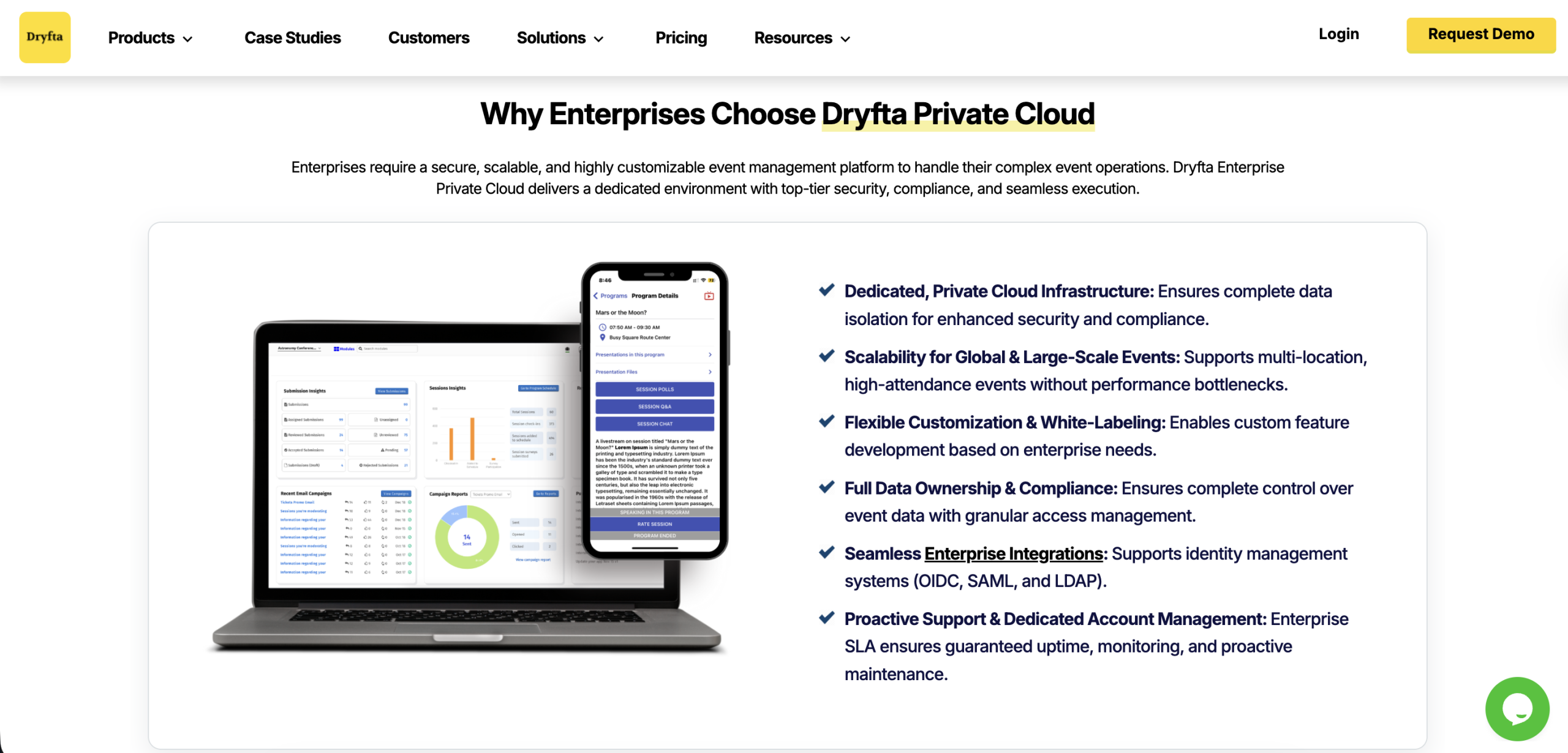
Much of the effort in a report like this goes into reconciling records: registration lists from one place, abstract and programme data from another, communications history from a third, and engagement figures from a fourth. When those records are connected inside one event platform, the evidence layer takes less manual matching, and definitions are easier to keep consistent from the registration list through to the programme and the follow-up.
That is the extent of what a platform can do for this report. The organizer still chooses the objectives, validates the definitions, interprets the results and writes the recommendations. Decisions about what the board should approve are governance decisions, and they stay with the people accountable for them. Dryfta does not generate board recommendations automatically, and this article’s template is a working guide rather than a built-in Dryfta feature.
If you are gathering the evidence layer for your next report, the practical question to ask is which of your records are already connected and which still need to be reconciled by hand. Start by listing the sources behind each objective in your scoping note. The gaps in that list are where time, and errors, tend to accumulate.
If you’re evaluating event platforms, request a demo to see whether Dryfta’s event records and reporting tools fit your team’s workflow.
Frequently Asked Questions (FAQs)
When should a conference post-event report be completed?
Set the timing by the next board or committee meeting and by when the key figures can be verified. Start gathering evidence as the event closes. If the financial close is still pending, label estimates clearly, name who will confirm them, and give a date for the final update. That lets the group discuss decisions without mistaking provisional numbers for final results.
How long should a board-level conference post-event report be?
There is no fixed page count. Keep the main report concise enough for board members to find the outcomes, material variances, recommendations and decisions without wading through raw data. A one-page executive summary is a useful target; put detailed charts, definitions and source records in the appendices.
What belongs in the appendix of a conference post-event report template?
The evidence layer: metric definitions, detailed charts, financial schedules, survey detail, source records and notes on data limitations. The appendix lets a sceptical reader verify a claim. It should not hold the decisions, the material variances or the recommendations, and it should not be where a missed objective or a data gap is quietly placed.
How should incomplete financial figures be shown in a conference post-event report template?
Show them, and label them. Mark each provisional figure as an estimate or a forecast, state what it depends on, and give the date when the final number is expected. Keep final and provisional figures visibly separate. Ask the finance owner to confirm the values before circulation, so the board does not act on an unvalidated number.
Who owns the final conference post-event report?
One named person should own it, usually the conference director or the executive responsible for the event, who decides what goes in and signs it off. Others own their inputs: finance owns the figures, programme leads own programme findings, and so on. The report should name each data owner, so questions have a clear route.