




Reviewing hundreds of abstracts is already a lot to handle. Now add conflict of interest disclosures, late-breaking submissions, embargo policies, reviewer assignments, accreditation rules, and publication deadlines to the mix.
It doesn’t take much for things to feel all over the place.
Medical and scientific conferences have compliance requirements that go far beyond those of a typical academic event. You can’t just deal with them as they come.
That’s where a structured abstract management workflow comes in. It helps organizers stay compliant while keeping reviewers on track and giving authors a smoother submission experience from start to finish.
In this guide, we’ll walk through the complete abstract management workflow for medical conferences, one stage at a time.
Before we get into that…
Why Medical and Scientific Conferences Need a Different Abstract Workflow
Search for guides on conference abstract management and you’ll notice a pattern. Most articles stop at the basics: open the call for papers, collect submissions, run peer review, and send accept or reject emails. That may work for many academic events. But medical and scientific conferences usually have a much more detailed abstract management workflow.
This is not just a theoretical argument either.
A look at the 2026 abstract calls from organizations such as the American Thoracic Society, the Congress of Neurological Surgeons, the American Heart Association, and the World Conference on Lung Cancer reveals extra layers that go well beyond standard peer review.
Conference organizers often ask authors to:
- Submit structured abstracts
- Disclose any conflicts of interest
- Provide ethics information
- Choose their preferred presentation format
- Follow the conference’s submission rules
On top of that, many conferences have multiple review stages and publication requirements.
All of those extra steps change how organizers manage submissions.
A scientific conference abstract workflow has to support compliance, fairness, reviewer consistency, and accurate record keeping from beginning to end. If one step is missed, organizers may face unnecessary delays and extra work.
That’s why investing time in a solid abstract management workflow pays off.
So, how do successful conference teams manage it all? Let’s walk through the medical/scientific abstract workflow, one stage at a time.
The Medical & Scientific Abstract Workflow — Stage by Stage
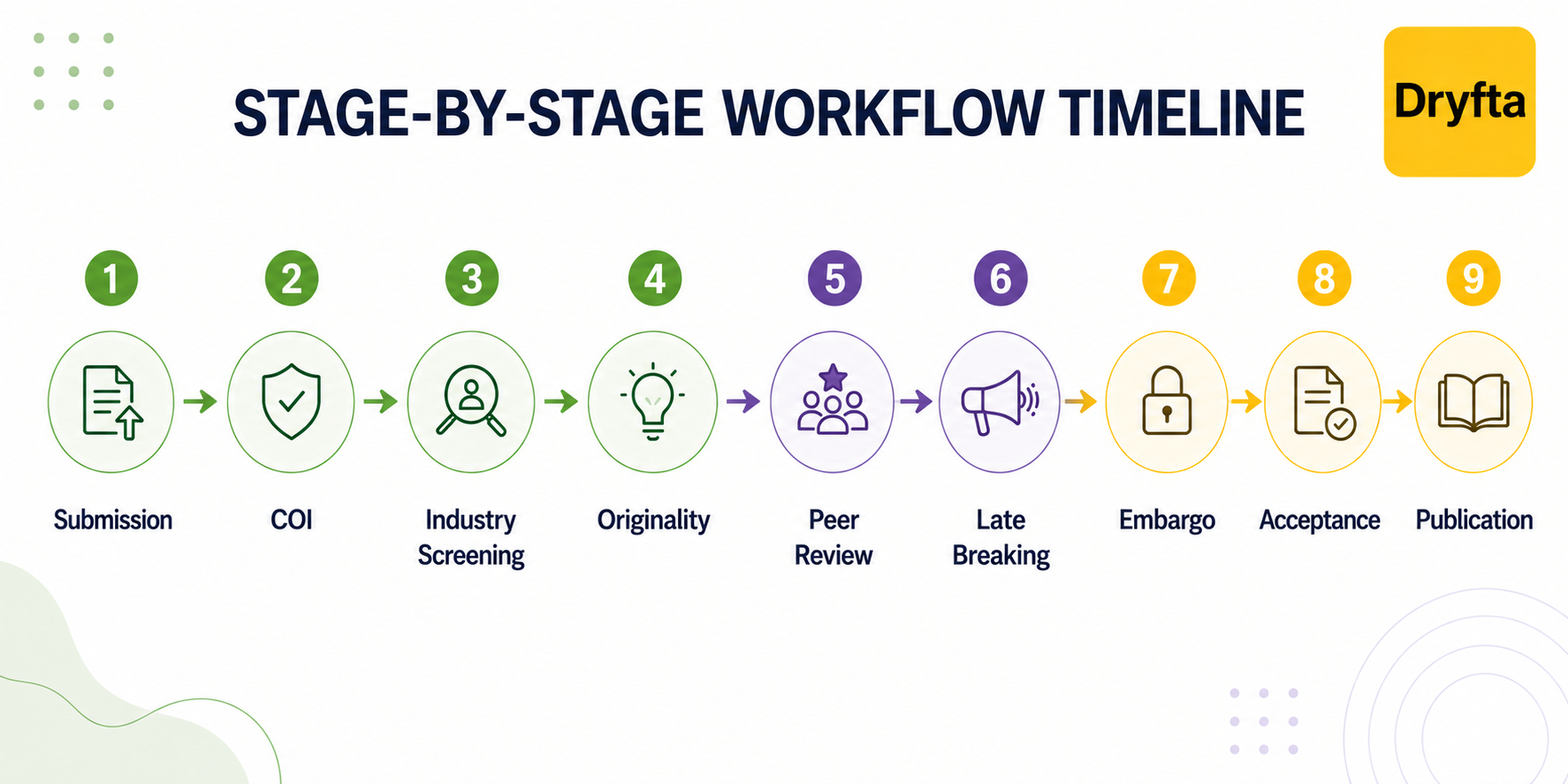
By now you know that medical and scientific meetings do not play by the same rules as a general academic conference. The abstract management workflow here has to deal with strict review right from the start. In other words, the medical and scientific conference abstract workflow needs to be built for precision before anyone even hits submit.
Stage 1 — Defining Submission Categories and Formatting Rules
What happens?
The conference committee creates the submission categories, such as scientific abstracts, case reports, late-breaking research, posters, or oral presentations. Each category can have its own submission requirements, helping authors choose the right option.
Medical/Scientific-Specific Requirements
The 2026 guidelines prove that medical groups care immensely about tiny details.
- Title constraints: Titles are strictly capped at 150 characters.
- Abstract text restrictions: The body must fit into 300 words or roughly 2,500 total characters.
- Text casing style: Headings require strict title-case-only presentation.
- Data protection rules: Authors cannot disclose any premature trial results directly within the title text.
Workflow implication
Checking every submission for formatting errors takes a lot of time. Word limits, character limits, required fields, and formatting rules should be built directly into the submission form so authors can fix issues before submitting.
Stage 2 — Conflict-of-Interest Disclosure (Often a Two-Stage Process)
What happens?
Authors must disclose any professional relationships that could influence how their research is reviewed or interpreted. Depending on the conference, disclosures may be required for the presenting author, co-authors, or the entire research team.
Medical/Scientific-Specific Requirements
Medical conferences go beyond a simple yes-or-no declaration. For example, the 2026 American Thoracic Society (ATS) asks authors to disclose any co-author conflicts of interest that could affect the research. It also asks authors to disclose any relationships with the tobacco, vaping, or cannabis industries, making the process more detailed than a standard COI form.
Workflow implication
A modern abstract management workflow should support step-by-step and conditional disclosure forms instead of using one fixed questionnaire. Different questions can appear based on an author’s previous answers.
Stage 3 — Industry-Relationship Screening (Beyond Standard COI)
What happens?
At this stage, organizers check whether any industry relationships could affect a submission’s eligibility. Unlike a standard conflict-of-interest disclosure, the goal here is to identify submissions that fall into categories the conference does not allow.
Medical/Scientific-Specific Requirements
Some medical conferences apply strict eligibility rules for certain funding sources. For example, the 2026 American Thoracic Society (ATS) does not accept abstracts funded by the tobacco industry or by cannabis organizations promoting non-evidence-based uses, regardless of whether those relationships have been disclosed.
Workflow implication
A well-designed abstract management workflow should also screen submissions against the conference’s disqualifying industry categories and accreditation policies. This is especially important for abstract management medical conferences.
Stage 4 — Originality and Prior-Presentation Screening
What happens?
Organizers check whether the submitted research meets the conference’s originality requirements. Part of the review includes confirming that the work hasn’t already been presented or published in ways that would make it ineligible.
Medical/Scientific-Specific Requirements
Originality guidelines are far from uniform across major healthcare societies.
- CNS 2026 standards: Research that has already been presented as peer-reviewed original science elsewhere is generally not eligible. The only exception is research presented at local trainee research symposia.
- ASTRO 2026 thresholds: The rules depend on the size of the meeting. Research presented at co-sponsored niche symposia is allowed. However, authors must notify ASTRO if the abstract is later accepted by another major national meeting with more than 3,000 attendees.
Workflow implication
Your abstract management workflow should allow organizers to customize them. It should support exceptions like student presentations and apply different eligibility rules based on conference size or prior presentation history.
Stage 5 — Peer Review and Scoring
What happens?
Each abstract is assigned to reviewers who evaluate it using a predefined scoring. Scores and reviewer comments help the conference committee decide which submissions should be accepted.
Medical/Scientific-Specific Requirements
Reviewers are also asked to consider whether the research has practical clinical value, whether it is useful for patient care or healthcare professionals, and whether the study supports the conclusions being presented.
Workflow implication
Your abstract management workflow should use a structured scoring matrix with separate scoring categories for originality, methodology, clarity, and clinical relevance. Adding clinical relevance as its own scoring criterion helps reviewers evaluate submissions more consistently. It’s also important for the specialized review process used in abstract management medical conferences.
Stage 6 — The Late-Breaking Abstract Pathway (A Separate Track)
What happens?
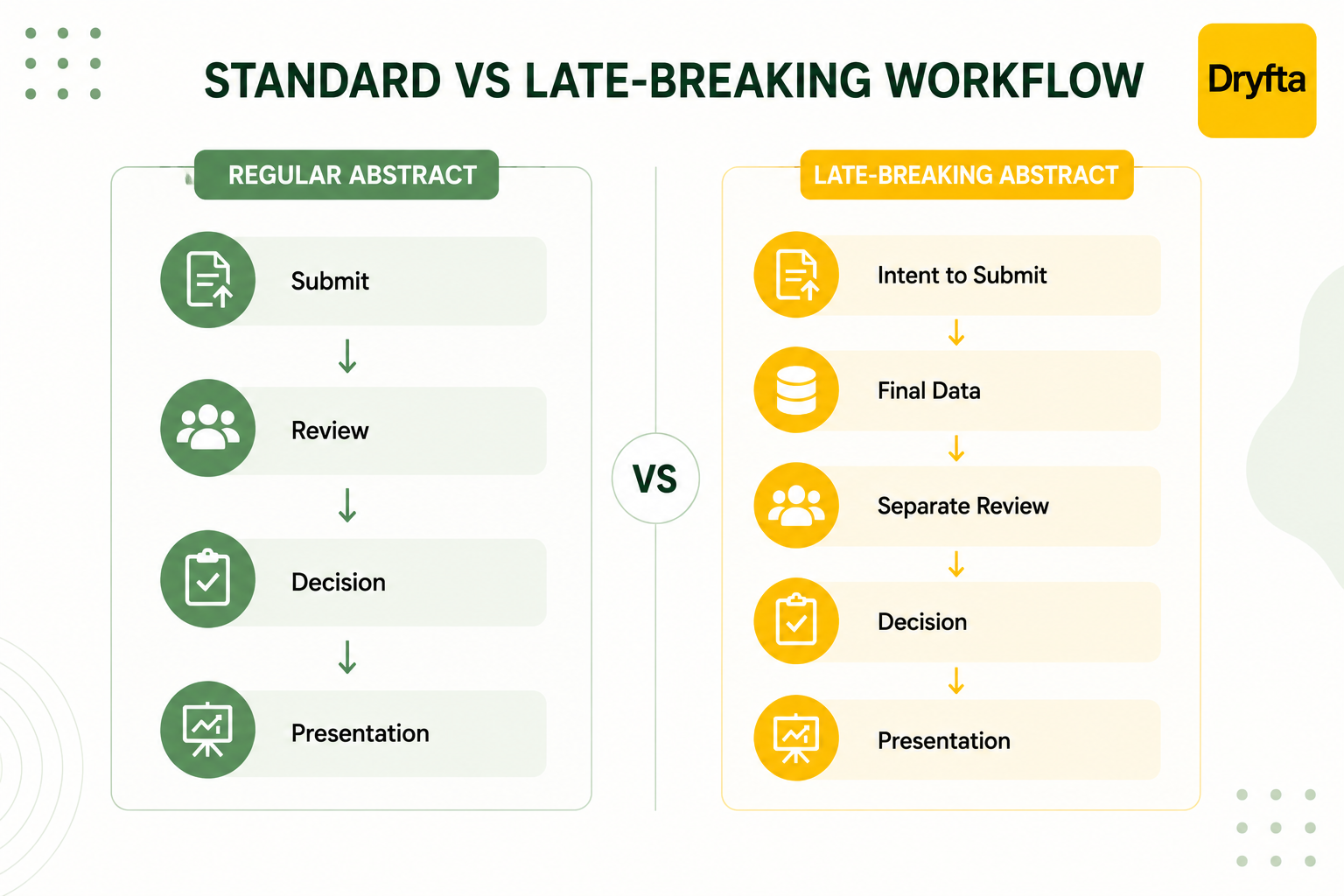
Some conferences have a separate submission process for late-breaking research. Authors with important new findings can submit their work after the regular abstract deadline so that the conference has a chance to include the latest research.
Medical/Scientific-Specific Requirements
Leading oncology and clinical events run multi-step protocols to handle late-breaking data without compromising review quality.
- Intent-to-submit requirement: Conferences like WCLC 2026 ask authors to confirm their intent to submit well before the final trial data becomes available.
- Secondary data deadline: Authors submit their complete datasets and final statistical analyses closer to the conference through a second submission deadline.
Workflow implication
Late-breaking abstracts work best when they’re managed through their own submission timeline. Organizers should be able to configure different submission windows, deadlines, review stages, decision categories, and automatic routing, ensuring late-breaking research follows its own workflow without disrupting the standard review.
Stage 7 — Embargo Management (Where Enforcement Has Real Consequences)
What happens?
Accepted late-breaking or high-impact abstracts are placed under embargo until their scheduled presentation date and time. Until then, the research cannot be shared publicly.
Medical/Scientific-Specific Requirements
Medical conferences enforce embargo policies very strictly. For example, the American Heart Association (AHA) Scientific Sessions 2026 states that if embargoed research is presented at unofficial satellite meetings or shared at press conferences, the abstract may be withdrawn from the conference and barred from presentation.
Workflow implication
Embargo status should be managed as a dedicated part of the abstract management workflow. An organized list of embargoed submissions makes it much easier to monitor compliance and avoid accidental policy violations before the conference begins.
Stage 8 — Decision, Notification, and Award Consideration
What happens?
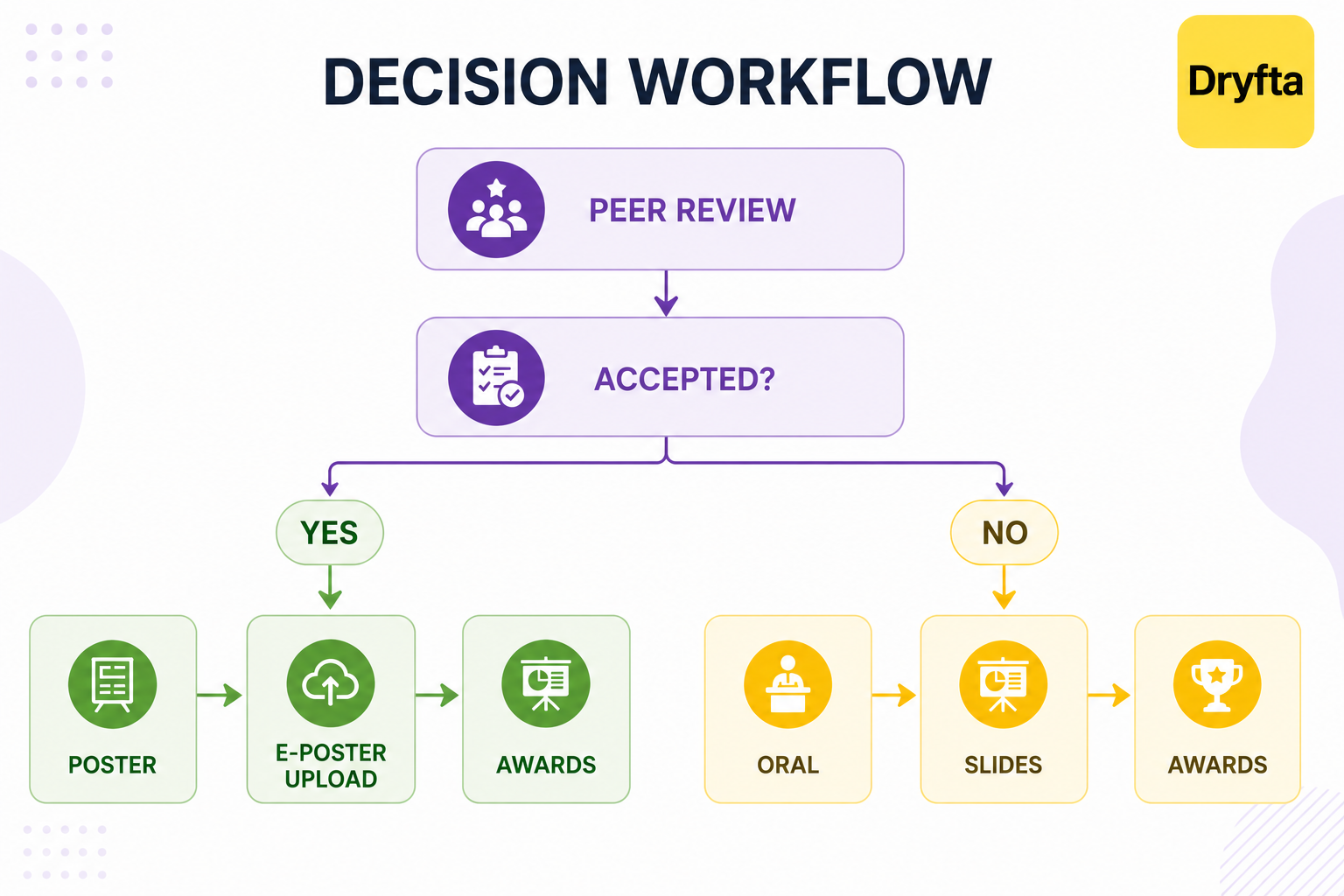
Once reviews are complete, authors are notified whether their abstracts have been accepted or rejected. Accepted submissions are also assigned a presentation format, such as an oral presentation or a poster.
Medical/Scientific-Specific Requirements
The American Heart Association (AHA) Scientific Sessions 2026 requires every accepted poster presentation to also be submitted as an online E-poster, making it a mandatory part of the presentation process rather than an optional add-on.
Workflow implication
Acceptance emails should explain what each presentation format requires next. For example, authors assigned to a poster session should automatically receive instructions and deadlines for uploading their E-poster. Award eligibility can also be tracked alongside the accept/reject decision so that organizers can manage both within the abstract management workflow.
Stage 9 — Publication and Cross-Organization Coordination
What happens?
After acceptance, abstracts are prepared for publication in the conference proceedings. Some conferences also coordinate publication with an external journal so the research becomes publicly available at the right time.
Medical/Scientific-Specific Requirements
Many medical conferences partner with journals to publish important research alongside the conference. For example, WCLC/IASLC 2026 publishes accepted abstracts in the Journal of Thoracic Oncology (JTO). Most abstracts are released before the conference while embargoed abstracts are published on the day they are presented. The conference also encourages simultaneous publication of associated manuscripts in peer-reviewed journals.
Workflow implication
Publishing accepted abstracts isn’t always the final step in the abstract management workflow. Conferences that partner with journals need a system that keeps publication timelines in sync, so abstracts are published at the right time in both the conference proceedings and the journal.
A Compliance Checklist for Medical and Scientific Conference Organizers
Running a top-tier healthcare meeting requires a bulletproof abstract management workflow at every turn. To help you stay on top of things, we built a comprehensive, actionable checklist.
Use this checklist to make sure your platform can handle the demands of high-stakes scientific conference abstract workflow.
[ ] Make sure your submission form validates formatting requirements automatically before an abstract is submitted.
[ ] Collect a basic conflict of interest disclosure during submission and request detailed disclosures only for abstracts selected for CME-accredited sessions.
[ ] Check submissions for restricted industry relationships during the submission process rather than after acceptance.
[ ] Set originality rules that allow approved exceptions, such as student presentations, and different eligibility criteria based on conference size.
[ ] Create a separate abstract management workflow for late-breaking research with its own deadlines and review process.
[ ] Track the embargo status of every abstract so your team knows when research can be shared publicly.
[ ] Add post-acceptance requirements to decision emails and track each follow-up deadline through your abstract management workflow.
[ ] Keep award nominations and review scores together in a single workflow instead of tracking them in separate files.
[ ] Sync your conference review process with partner journals so abstracts are published at the right time.
How Dryfta Supports the Medical and Scientific Abstract Workflow
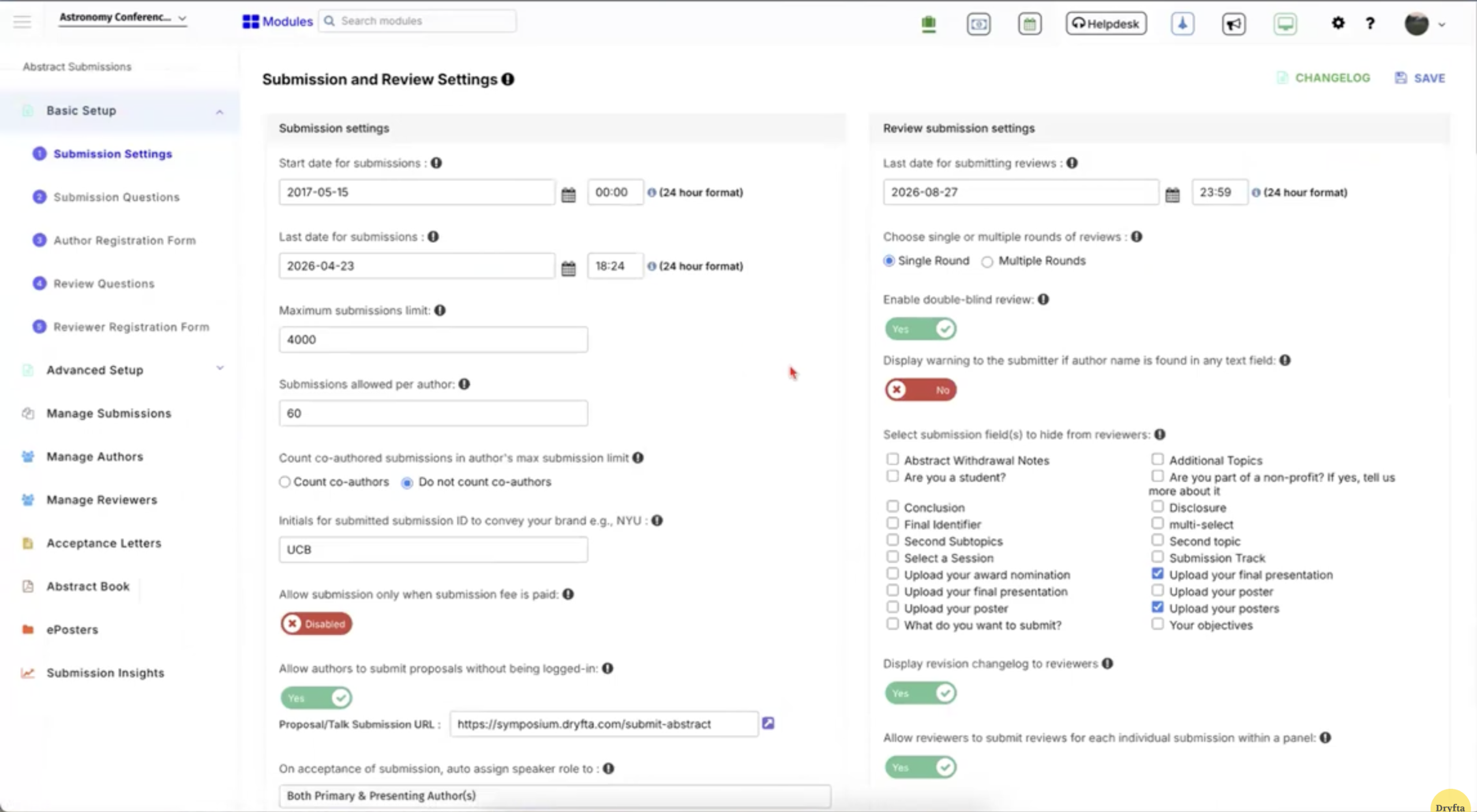
If you’re looking for a platform that can handle the complex requirements of medical and scientific conferences, you’re in the right place. Dryfta is built to support the complete abstract management workflow, helping conference teams stay compliant throughout the entire scientific conference abstract workflow.
Here’s how Dryfta helps at every stage:
- Custom submission forms with built-in formatting rules: Create submission forms with title limits, word-count limits, required fields, and category-specific submission types such as regular abstracts, case reports, and late-breaking abstracts. Once configured, these rules are automatically applied during submission.
- Configurable, staged disclosure workflows: Collect conflict of interest disclosures during the initial submission and add more detailed disclosure forms later when authors are selected for specific sessions or CME-accredited tracks. The abstract management workflow stays organized without asking every author to complete unnecessary forms upfront.
- Blind review configured for your conference: Choose single-blind, double-blind, or triple-blind review based on your conference or individual tracks. The system also checks for conflicts of interest using institutional affiliations before reviewers are assigned.
- Automated reviewer assignment with workload management: Match reviewers based on expertise while setting workload limits for each reviewer. Conflict alerts appear before assignments are finalized.
- One platform for the entire workflow: Dryfta keeps submissions, reviews, decisions, revisions, and author notifications in one place. Everyone works from the same version of each abstract, making the abstract management workflow easier to manage from submission through final decisions.
Ready to see Dryfta in action? Book a free demo today and see how our platform can streamline every stage of your abstract management workflow.
Frequently Asked Questions
1. How is abstract management different for medical conferences compared to general academic conferences?
Medical conferences usually have more rules to follow. Besides collecting abstracts, organizers also manage conflict of interest disclosures, industry relationship checks, embargo policies, and clinical review standards. Because of this, the abstract management workflow is often more detailed than it is for general academic conferences.
2. What is a late-breaking abstract, and how is its process different?
A late-breaking abstract is used for important research that becomes available after the regular submission deadline. Instead of following the normal submission schedule, it usually has its own deadlines and acceptance decisions. Many conferences include it as a separate part of their abstract management workflow.
3. What happens if an embargo on a late-breaking abstract is violated?
If embargoed research is shared before the official presentation time, the conference may take action. Depending on the conference policy, the abstract could be withdrawn, removed from the conference, or not allowed to be presented. Organizers and authors should always follow the embargo rules carefully.
4. How does conflict-of-interest disclosure typically work for medical conference abstracts?
Authors are usually asked to disclose financial relationships or other potential conflicts when they submit an abstract. If the abstract is accepted for certain sessions, they may be asked to provide more detailed disclosures before the conference.
5. Can I resubmit research that was already presented at another conference?
It depends on the conference’s policy. Some conferences allow previously presented research in certain situations, while others accept only original work. Always read the submission guidelines before you submit.
