




Are you currently planning an academic symposium or scientific conference and struggling to keep up with the flood of papers? You are definitely not alone.
Strict milestones are crucial in conference planning to keep peer-review timelines and program scheduling running smoothly. Despite scrutinized planning, late abstract submissions happen frequently because researchers often face unpredictable institutional approval delays or wait until the final minute for breakthrough data.
In this blog, we will look at why late abstract submissions happen, the challenges they cause, and the best strategies you can use to manage them effectively.
Why Late Abstract Submissions Happen?
To be frank, no matter how many reminders you send, a last-minute rush is almost guaranteed. However, this does not mean the researcher is simply procrastinating. In fact, as we will discuss below, many breakthroughs occur in academic circles due to time-sensitive work. But once you understand the ‘why’ behind the delayed submissions, you will have a better way to handle late abstract submissions without losing your mind or disrupting your schedule.
So, what is causing the holdup? It usually boils down to a few common reasons:
- In many cases, researchers delay their submission because they are still waiting for final results (or data) to verify their conclusions. This is true for all types of abstract submissions, especially late-breaking abstracts.
- Internal approval delays from universities and research institutions stall the process, even when the paper is fully written.
- Technical submission issues like server crashes and frozen portals happen frequently when thousands of users try to upload files at the final hour.
- Confusion about submission guidelines forces authors to submit formatted documents that are automatically rejected by online systems, requiring them to start again.
- Last-minute author changes require updating institutional metadata and re-verifying contributor order at the eleventh hour.
- Researchers hesitate to submit when funding or travel confirmation is delayed, as they don’t know if they will have the funds to attend.
- Poor communication of deadlines by conference marketing teams leaves many potential presenters completely unaware of the original cutoff.
Did you know? IAS 2025 received more than 5,250 abstract submissions reviewed by over 840 reviewers, highlighting the growing operational burden conference organizers now face during peer review and scheduling.
Challenges Conference Organizers Face with Late Submissions
Handling late abstract submissions appears easy at first, but as soon as an organizer realizes that one delayed submission can affect several different workflows throughout their entire conference timeline, things quickly become overwhelming. To add to the pressure, many late-breaking abstracts are submitted just as review teams are already at full capacity.
Here’s where the domino effect begins.
- One of the biggest problems with handling late abstract submissions is the delay in reviewer assignment that happens once original review schedules are already locked.
- Late-breaking abstracts, even a few, can delay peer review and place an extra burden on already busy reviewers.
- Organizers often face additional workload through manual edits and approval coordination.
- Publication timelines for proceedings may also slow down while editors process newly accepted abstracts and papers.
- Review quality can suffer when reviewers rush through late-breaking abstracts without enough evaluation time.
- Above all, accepting these papers is unfair to on-time submitters who respected the original timeline.
Strategies for Managing Late Abstract Submissions
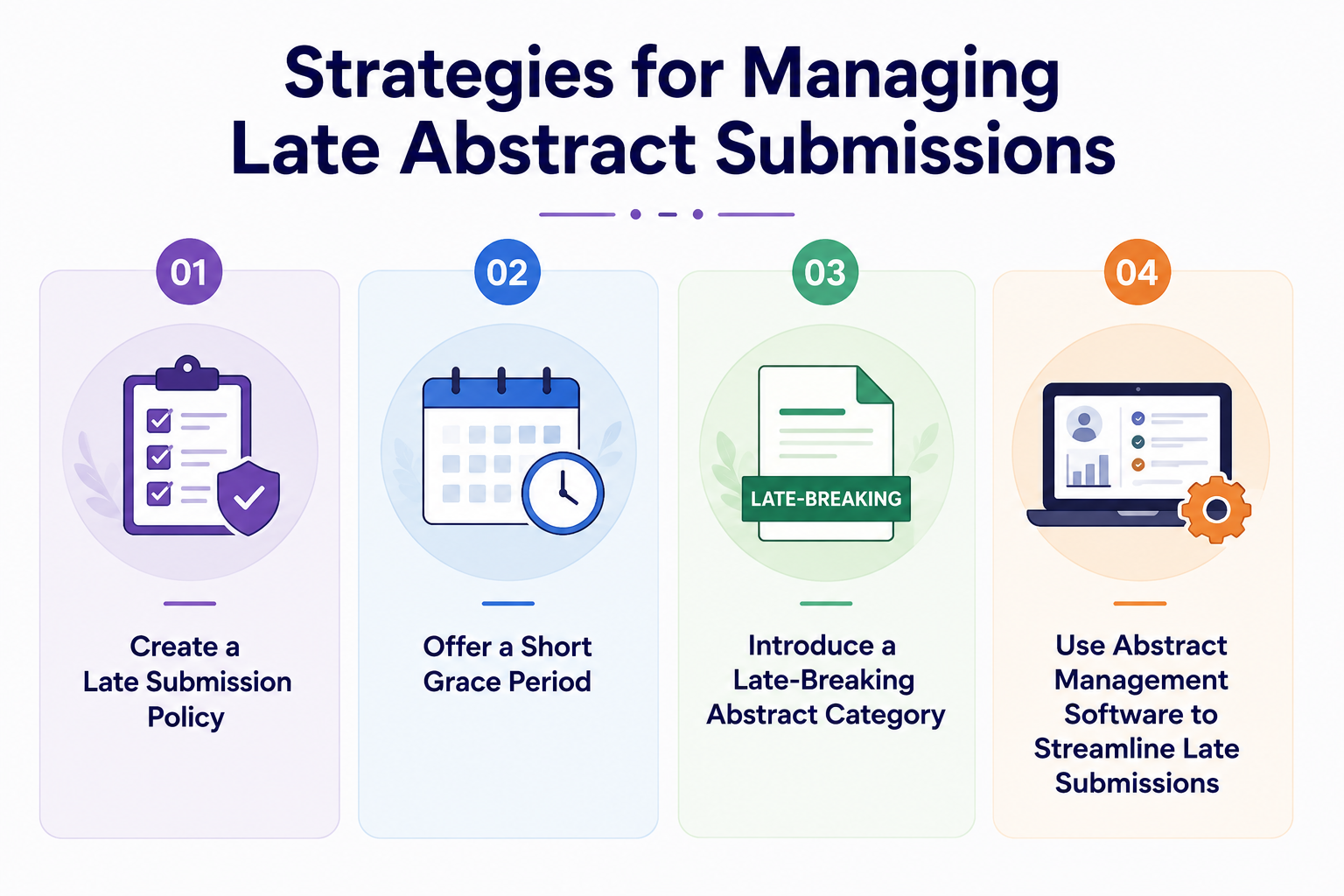
Quite frankly, presenters will always miss deadlines. While announcing conference abstract submission deadlines is helpful, you also need a practical solution for handling late abstract submissions without slowing the review process. Here are some tips that will help.
Create a Clear Late Submission Policy
- Remind attendees of late submission policies in the Call for Papers.
Example: “Late administrative processing fee of $50 will be charged for all submissions received after the official October 1st deadline.”
- Clearly establish grace periods to give your team operational breathing room.
Example: “We extend the submission deadline by an additional 24 hours for those who may have a last-minute internet problem.”
- Include acceptable excuses for late work to separate procrastination from emergencies.
Example: “Late entries are welcome in case of unplanned events such as awaiting final approval from the university, sudden illness, or visa processing delays.”
- State whether late abstracts will be evaluated by the original panel or an alternative panel.
Example: “Late abstracts will be reviewed but assigned to a backup review team and will not delay the main schedule.”
- Mention whether late abstracts are eligible for oral presentations or limited to poster presentations.
Example: “Any accepted abstract submitted after the initial deadline will automatically be assigned to a poster session format with no exceptions.”
- Establish separate deadlines for submitting late-breaking abstracts to provide a clear conduit for rapid-response data.
Example: “If you are waiting on final lab results, you may submit your work via our designated ‘late breaking’ portal that is open until November 15th.”
- Last but not least, keep the process simple so authors can easily understand your submission policies and deadlines. Send email reminders to different author groups when needed, and place important updates and notifications where they are easy to spot on your website.
Offer a Short Grace Period Strategically
Sometimes, the best way to handle a stressful situation is to build in a little breathing room. Offering a short, strategic grace period can help you manage late abstract submissions with ease.
Here is how you can use a short extension to your advantage:
- Use automated deadline reminders to help authors submit their work well before the portal closes.
- Allow a 24–72 hour extension when necessary to accommodate unexpected website crashes or time zone errors.
- Use grace periods only for minor delays, rather than altering the main schedule for everyone.
- Avoid repeatedly extending deadlines, as it makes your timeline look disorganized and unprofessional.
- Communicate the final extension clearly so authors understand there will not be another surprise extension later.
- Maintain fairness across all submitters through single/double/triple blind reviews.
- Keep reviewer timelines intact so your grading panel has plenty of time to read every paper.
Believe it or not, following these simple rules will go a long way toward protecting the professional integrity of your event.
Introduce a Late-Breaking Abstract Category
One way to include emerging research within your timeline, while still controlling what gets presented at your event, is through a late-breaking category.
- Accept important new research findings that were genuinely unavailable before the initial deadline passed.
- Add separate submission windows that open weeks after the standard portal closes to capture rapid-response data.
- Clearly distinguish from regular submissions so authors know this is not just a second chance for missed deadlines.
- Highlight innovation and urgency requirements to filter out ordinary papers that are simply procrastinated.
- Create separate review criteria focused strictly on high impact, novelty, and immediate scientific value.
- Use stricter acceptance standards to keep the overall volume of entries manageable for your team.
- Limit presentation formats to poster sessions so you do not have to shuffle your oral presentation schedule.
- Avoid disrupting main conference scheduling by locking in your main session speakers early.
Use Abstract Management Software to Streamline Late Submissions
By now, most event teams know that handling paper submissions manually with spreadsheets and emails alone doesn’t help. It ultimately slows down your team. Upgrading to a dedicated abstract management software changes the game completely by taking care of the heavy lifting for you.
How does software simplify your workflow?
- Automated submission tracking monitors exactly when files arrive so you can spot late abstract submissions instantly.
- Deadline automation and reminders send out alerts to authors before the submission window closes.
- Real-time communication with authors lets you answer questions instantly without leaving the main software system.
- Bulk email notifications let you update the status of hundreds of late submitters with a single click.
- Reviewer reassignment workflows let you pass late papers to backup judges when regular reviewers get too busy.
- Easy reviewer collaboration lets your grading panel share notes and scores seamlessly within the portal.
- Conflict-of-interest checks automatically flag any potential biases before a late paper goes out for review.
- Submission status dashboards give your committee a clear bird’s-eye view of your entire event timeline.
Note: Flexible late abstract submissions can easily backfire if organizers do not set clear limits. Too many last-minute submissions might take attention away from truly valuable late-breaking abstracts.
How Dryfta Helps Manage Late Abstract Submissions?
Are late abstract submissions starting to delay reviews and create extra work for your conference team? We got you.
Dryfta helps you manage the entire abstract submission and review process from one centralized platform.
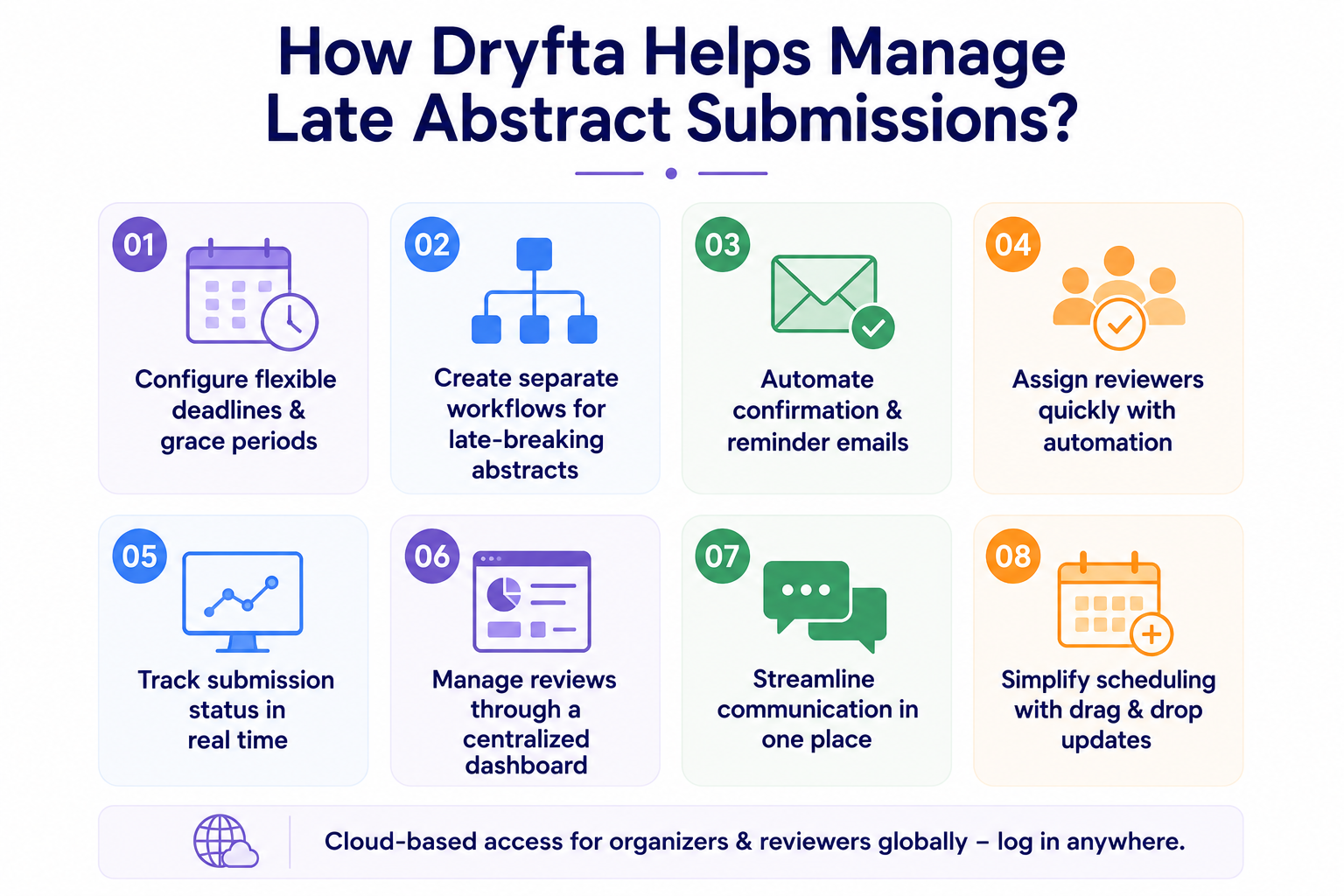
With Dryfta, you can:
- Configure flexible submission deadlines and grace periods to easily accommodate authors who need just a few extra hours.
- Create separate workflows for late-breaking abstracts so cutting-edge research receives dedicated evaluation.
- Automate submission confirmation and reminder emails to keep authors fully informed.
- Assign reviewers quickly using automated reviewer management tools to save time during an unexpected surge of papers.
- Track submission status in real time so you always know exactly how many entries are pending.
- Manage abstract reviews through a centralized dashboard that keeps your entire committee on the same page.
- Streamline communication with authors, reviewers, and committee members through a single integrated system.
- Enable fast-track review workflows for urgent submissions that arrive right before the final event schedule locks.
- Prevent reviewer overload with balanced reviewer assignment features that evenly distribute the workload across your team.
- Support hybrid and virtual conference abstract management to seamlessly handle digital presentations and live posters.
- Simplify conference scheduling after late abstract approvals by dragging and dropping new presentations directly into slots.
- Generate reports and analytics for submission tracking to help you spot submission patterns and plan future events.
- Allow organizers to customize submission policies and forms to match the exact requirements of your specific field.
- Provide cloud-based access for organizers and reviewers globally so your international team can log in anywhere.
Mistakes to Avoid When Handling Late Abstracts
Handling late abstract submissions becomes much harder when organizers rush to make decisions under pressure. Also, trying to please everyone usually backfires and hurts the quality of your entire event.
Here’s where things usually go sideways.
- Accepting all late submissions without review: Allowing every late submission into the program weakens quality control and creates unnecessary pressure on reviewers and organizers.
- Repeatedly extending deadlines: Constantly pushing conference abstract submission deadlines teaches authors that deadlines are flexible and optional.
- Poor communication with submitters: Authors end up lost and anxious when they do not receive clear updates about their entry status.
- Changing policies midway: Adjusting rules after submissions close creates fairness concerns and damages trust between organizers and participants.
- Overloading reviewers: Forcing your grading panel to read extra papers at the last minute leads to rushed evaluations and extreme fatigue.
- Ignoring scheduling constraints: You will quickly run out of physical room space and time slots if you approve too many late abstract submissions.
- Delaying acceptance notifications: Waiting too long to notify authors can lead to visa delays.
- Creating unfair advantages for late submitters: Giving extra flexibility to late authors can frustrate participants who respected the original deadlines from the beginning.
The bottom line? Stick to your guns. A well-managed deadline is the hallmark of a world-class conference.
Wrapping up
The key to a successful event is achieving the perfect harmony of flexibility and fairness. When you use transparent policies alongside structured workflows, you protect your schedule while still collecting the absolute best research papers. Incorporating modern technology is the smartest way to save time because automated systems do all the heavy lifting for you.
For the best results, stick firmly to your conference abstract submission deadlines, but keep a hidden grace period ready for unexpected emergencies. Using a smart, proactive approach makes handling late abstract submissions absolutely effortless for your team.
To better handle your abstract submissions, Dryfta provides all the automated tools and real-time dashboards you need to stay organized from start to finish.
Ready to see how Dryfta can transform your next event? Book a free demo TODAY!

FAQs
- Should conferences accept late abstract submissions?
Yes, but only under strict conditions. Accepting late abstract submissions might let organizers receive high-quality data that was unavailable earlier. However, you must limit these exceptions. Doing so protects your timeline and maintains total fairness for authors who respected your original conference abstract submission deadlines.
- How long should a conference grace period be?
A strategic grace period should last between 24 and 72 hours. This brief window will let you take care of unexpected problems like internet outages or timezone confusion. Keeping this buffer unadvertised prevents widespread procrastination.
- What are late-breaking abstracts?
Late-breaking abstracts are submissions reserved for high-impact, brand-new research findings completed after the main deadline. These tracks open late specifically to feature critical breakthroughs or clinical trial results. Late-breaking abstracts ensure your event features cutting-edge science without disrupting standard review schedules.
- Can late abstracts be accepted for oral presentations?
Generally, no. Late presentations are usually restricted to poster sessions because oral slots are locked in early. However, exceptional late-breaking abstracts containing groundbreaking data might earn a speaking slot if an on-time presenter cancels at the last minute. Otherwise, stick to posters to protect your timeline.
- How do conference organizers review late submissions?
The main committee is usually avoided by the organizers and a secondary review panel is used instead. This is a separate team that works quickly and fairly with the same grading rubrics. The option will let you review late abstract submissions effectively without postponing your event.
- How can abstract management software help?
Abstract management software automates deadline enforcement, tracking, and reviewer assignments within one centralized dashboard. It instantly flags late abstract submissions and sends automated status updates to authors. Platforms like Dryfta make handling late abstract submissions effortless by removing manual tasks from your daily routine.
