
Most event organizers recognize a dreaded email that only ever seems to arrive at the last minute. Someone is requesting a minor change in authorship. Well, the change is minor however only for them. As for the team, this still means having to refer back to their authorship change policy. Your team may see it fit to make an exception this one time around. But what does this mean for your event and/or organization’s larger structural policies? If your team resorts to making a few last-minute calls almost every time you host an event, is your authorship change policy even reliable? Or is it malleable at the slightest in convenience? These are important questions that academic event organizers and scientific conference planners ought to ask themselves. The sooner you find your answers, the more concrete your authorship change policy will turn out to be.
The foremost problem with a vague or not so clear authorship change policy is that forthcoming leadership may simply be unable to establish any clear boundaries. And when teams make last-minute decisions, they’re often telling themselves that they would never do so again. Or that they would prevent a similar situation from arising again. But in unfortunate reality, the final-minute requests do keep coming in and frantic decisions keep being made. As event organizers, we cannot do much about the former. Submitters will keep reaching out to you for various reasons, each more sinister and puzzling by the day. What your team can do, however, is have a clear authorship change policy that will act as your starting point when chaos does ensue. Clarity is key here. Therefore, when formulating your authorship change policy, explore the deepest trenches of your human imagination. Ask yourself, “What can go wrong?” and jot everything down, from the most feasible to the most unlikely scenario. It turns out that in event management, nothing really is unfeasible!
Classify the Request Before Deciding Where It Falls in Your Authorship Change Policy
Starting out at the most fundamental level, classify the requests that come in. Many organizers realize that the query they’ve been tracking was just doing a whole lot of nothing. A wild goose chase concludes with something like, ‘Hey, I was just checking in’ or ‘Have I made it to the final list’ etc.
When we’re attending to the authorship change policy attached with your event, it is crucial to run along those lines strictly. Generic queries are best left in the care of your communications team. Revert any feedback or grievances to the hospitality and management team. Only take on requests for change in authorship. On that note, let’s take a closer look at the most common queries that come in the context of authorship.
| Request | Primary question | Usually not the same as |
|---|---|---|
| Add an author | Did the person meet the applicable authorship criteria and deadline rule? | Adding a presenter or administrator |
| Remove an author | Is there documented agreement and a valid reason? | Withdrawing the whole abstract |
| Reorder authors | Does the event permit order changes at this stage? | Correcting a spelling error |
| Change corresponding author | Is responsibility or contact ownership changing? | Changing the submitter login |
| Change presenting author | Who will deliver the work under event rules? | Changing the author list |
| Correct a person’s name | Is the same individual’s identity record being corrected? | Adding or replacing an author |
Most of these queries look the same in your inbox. And that is if your sender is kind enough to give you all the details in one go. Usually, this is not the case and event teams have to pick up the pieces and quite literally ‘piece them together’ to arrive at a coherent conclusion. Withdrawing the entire submission is a whole different ball game altogether. We’ve covered this in more detail in a separate article on abstract withdrawal after acceptance.
So what does one do about segregating authorship change policy requests at the very beginning?
Apply the Rule That Governed the Relevant Stage
To make things a lot easier for your team, categorize requests based on what stage of the authorship change policy they are at.
- Abstract registration or initial submission
- The full-paper or final-submission deadline
- Review period
- Acceptance/ rejection decision
- Proceedings transfer
- Published proceedings.
The above mentioned stages are some of the most common ones cutting across conference themes and formats. Different events freeze the author list at different points. Some allow free edits until review opens. Others lock additions and removals at the submission deadline but allow reordering for a short window. A few permit exceptional changes at any stage with chair approval. Each approach can be defended. What matters is that the authorship change policy that you wrote down before submissions opened in the first place.
Ask for the Facts Needed to Review the Request
A request without facts cannot be reviewed fairly. Build an intake form that collects what the decision team needs and nothing more. It should be short enough that people finish it and specific enough that reviewers can act on it.
- Start with identification: Ask for the submission identifier and the current author list. Then ask for the requested change stated precisely, such as “add Dr. A as fourth author”, because vague wording invites back-and-forth. Ask for the reason and for when it became known. A change discovered yesterday reads differently from one known for months.
- Go over your authorship change policy: Ask what contribution or responsibility the person holds that is relevant to the event’s authorship rule. Where the policy requires it, ask for the written position of every current and proposed author.
- Explore consequences: Does the change affect conflicts, affiliations, disclosures or eligibility? What does it mean for the presenting author and for registration? Where does the paper stand with the proceedings or the publisher? Which deadline or production step has already passed?
- Finish with a confidential contact: Some requests involve sensitive team dynamics, and the requester may not want colleagues copied.
Do not invite any unnecessary personal detail. Reviewers need to know what the person did for the work and not their personal circumstances. Use a secure channel for the intake and limit access to the decision team alone.
Require Agreement Without Turning the Administrator Into an Investigator
Written agreement is the simplest way to show that a request is not a unilateral change. When every current and proposed author confirms in writing, the administrator has something concrete to file. The administrator’s role has limits, though. Conference staff manage records so they are not equipped to judge who contributed what to a study.
Here are some of the most frequent scenarios that arise and how to deal with each of them in accordance with your authorship change policy:
- Missing confirmation: One author has not replied, perhaps because of travel or a lapsed email address. The routine change pauses. Staff try other agreed contact routes for a stated period.
- Explicit disagreement: An author objects to the addition, the removal or the order. The routine change stops and the case moves to the event’s research-integrity process. Staff do not weigh the competing claims.
- Alleged coercion or misrepresentation: For example, a claim that someone was removed without knowing. This needs the same escalation plus extra care with confidentiality.
- Clerical corrections: This entails things like a misspelled name as confirmed by the person concerned. That can stay routine and would not cause much conflict to your authorship change policy.
Decide Who Has Authority at Each Point
Policies fail most often on the question of authority. A rule that says changes need approval but never says whose approval leaves staff guessing. Name a decision owner for each stage and a backup for when that person is conflicted or away. The table gives example owners, and it is a starting draft and not a standard.
| Stage | Likely decision owner to define in policy |
|---|---|
| Before review | Submission or program chair |
| During review | Program chair with conflict controls |
| After acceptance | Program and publication chairs |
| After publisher transfer | Publisher or proceedings editor under its process |
| After publication | Formal correction or publisher-integrity route |
The pattern follows control. Early on, the submission or program chair holds the record and can decide quickly. During review the program chair acts, but with conflict controls, since a chair who is also an author on the submission should not decide on it. After acceptance the decision is shared, because the change now touches both the schedule and the proceedings. After transfer the publisher decides under its own process. After publication, a formal correction or integrity route applies.
Publish the actual authority in your author guidelines. Authors should see who decides, how to reach that person and what the backup path is. Two items belong in the policy text itself. One is a recusal rule for any decision-maker with a link to the submission. The other is a statement of what happens if the owner is unavailable near a deadline. Without them, a single absence can freeze the queue.
Test the Request Against Research-Integrity Questions
Once the facts and agreements are in, the authorized reviewer applies a short set of integrity questions. These are not accusations. They are the checks any careful editor would run on a late change.
- The first question is whether the person meets the authorship rule that applies to the event. Many events adopt a recognized definition, and the reviewer measures the request against it.
- The second is whether every required author agrees, as covered above.
- Third comes conflicts and anonymity. A new author may have a relationship with a reviewer or may reveal an identity that a blind process was meant to hide.
- Fourth, do contribution, affiliation, funding or competing-interest records change as well? An added author usually brings an affiliation and sometimes a funder.
- Timing is next. Does the date suggest a workaround, such as adding a student to make a paper eligible for a prize category? Timing alone proves nothing. It is simply a reason to look more closely.
- After that, ask whether the publisher or society must review the case. Ask too whether the change affects certificates, awards or registration obligations.
Language matters a great deal here. Do not tell the requester that the request looks suspicious. Write that it “requires further review” or “cannot be processed as a routine administrative change“.
Keep Authorship and Presenting Responsibility Separate in Your Authorship Change Policy
Authorship and presentation answer different questions. Authorship describes who contributed to the work and takes responsibility for it. Presenting describes who delivers it at the event. Mixing the two causes most of the confusion in late requests.
Several outcomes are possible:
- The author list stays the same and an eligible co-author becomes the presenter. That is a presenting-author change only. The author record does not move, though the programme, registration and presenter label might.
- The presenting author changes and the author record changes too, under an approved process. Both reviews apply, and the decision record should show both.
- When no approved presenter is available. The event’s no-show or withdrawal rules then take over, and the guide to presenter no-shows and substitutes covers that path.
Record the Decision and Communicate It Consistently in Line with Your Authorship Change Policy
A decision that lives in someone’s memory will be questioned later. Keep a short record for every request. It should note the request received and the stage reached, the evidence reviewed and the rule applied. It should show how conflicts or recusals were handled and who owned the decision. Add the outcome and any conditions, the records to update and the people informed. Where an appeal or further review exists, record that route as well.
The record need not be long. A half-page template that staff complete the same way each time beats a long memo written once. Consistency makes the log useful when a similar request arrives a year later.
Communication needs the same discipline. Send the decision to the requester and to every current and proposed author, so nobody learns the outcome second-hand. Use a neutral subject line such as “Update on your request for submission 214“. Avoid words that hint at a dispute, because subject lines are read on phones in corridors.
Keep the matter away from people who do not need it. Reviewers, attendees and unrelated staff should not see an author dispute. If a change touches reviewers, for instance by altering a conflict screen, tell them only what they need to do their work.
Use the same template for refusals as for approvals. A refusal that carries a stated rule and a clear next step is easier to accept than silence.
Synchronize Every Affected Record
Approving a change is where the work begins. The decision now has to reach every place that holds an author name, and those places rarely update each other. The table lists the records most likely to be affected.
| Record | Possible effect |
|---|---|
| Submission system | Author list, order, affiliation, corresponding and presenting roles |
| Conflict data | New or removed author relationships |
| Decision and email records | Correct recipients and audit trail |
| Registration | Presenting-author obligation or eligibility |
| Programme and app | Displayed names, affiliation and presenter label |
| Certificates and awards | Attribution and eligibility |
| Proceedings metadata | Final author order, identifiers and affiliations |
| Publisher files | Formal correction or transfer process |
Start off with the authoritative record, which is usually the submission system. Edit it first and edit it under the approved process. Everything else copies from it, directly or by hand.
The downstream copies are where errors hide. Conflict data may still show old relationships, so a reviewer might keep access to a paper they should no longer see. Email records may send the next notice to someone who has left the list. Registration may attach a presenting-author obligation to the wrong person. The programme and app may display an old name for weeks, and certificates may be printed from stale data.
Proceedings metadata deserves the closest attention. Final author order, identifiers and affiliations feed indexing records, and mistakes there are the hardest to reverse. If files have already gone to a publisher, a formal correction or transfer process applies. The event cannot simply edit its own copy.
Give someone the job of closing the loop. After the change, that person checks each row of the table against the authoritative record and confirms that the copies agree. A short checklist is enough. A change stays incomplete until the authoritative record and its downstream copies match. A name that is right in one place and wrong in three is a problem waiting for an author to find it.
Handle Refusal, Dispute or an Impossible Deadline
Not every request ends in approval. Three outcomes need a plan, and each needs different words.
- Refused under policy: State the rule that applies and preserve the current record. The requester should see which part of the policy decided the matter. A clear refusal rooted in a published rule is easier to accept than a vaguely apologetic one.
- Disputed: Pause routine processing and use the integrity or publisher route. Tell the parties that the matter has moved to a different process and give the contact for it. Staff should stop editing records until the dispute closes.
- Technically too late: Explain what can still change and what cannot. If the paper has gone to a publisher, describe the formal correction path, including who submits it and what evidence is needed. If the programme is printed, say which fields the app can still update. A precise account of what remains possible is more useful than a flat refusal.
How Dryfta Can Support Your Authorship Change Policy
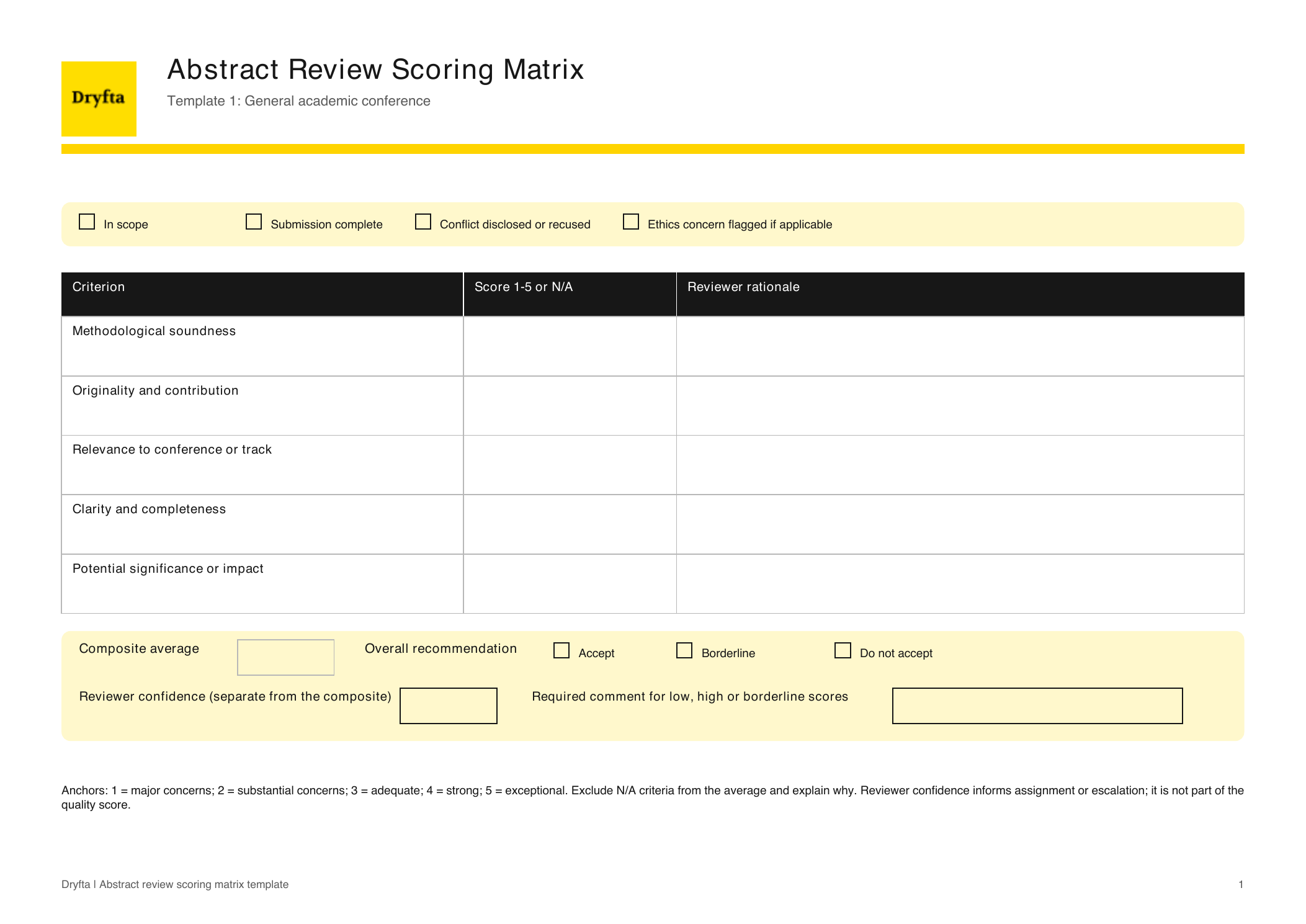
Dryfta’s abstract workflow maintains submission and co-author information in one place. That matters here because the authoritative record is the first thing a late change must touch. When it is clean and current, every later step has something reliable to copy from.
The published update on co-author features documents two ways to add co-authors in the supported workflow: database search and manual entry. Teams that want the product detail can read about Dryfta’s co-author addition features. Those who want the wider context can look at Dryfta abstract management software.
The tool does not decide the authorship question. Your conference defines who may request later changes, who approves them and how publisher deadlines limit what is possible. Dryfta holds the record and the workflow that carry out those rules.
This article makes no claim that Dryfta verifies contribution, collects unanimous agreement, detects misconduct or updates an external publisher. Those outcomes depend on the current configuration and on your own procedures. Confirm them before anyone relies on them. To see how a submission record and its co-author data work in practice, you can request a Dryfta demo.
Frequently Asked Questions (FAQs)
Can an author be added after a conference paper is accepted?
Yes, an author can certainly be added after a conference paper is accepted for publication or conference presentation. The call to do so, however, rests with the event’s key leadership, who decide the tenets of the conference’s authorship change policy. Most conferences do not encourage last-minute requests for authorship addition or deletion. Some may pay heed in exceptional circumstances. Make sure to convey your authorship change policy upfront during initial sign up and submission so your authors know what to expect.
Can the author order change after acceptance?
Changes to author order, similarly, is subject to the authorship change policy of an organization. Most conferences accommodate changes in schedule and order should the reason for requesting as such be justified in the eyes of the committee.
Is changing the presenting author an authorship change?
Not by itself. A presenting author is someone who showcases the research paper at an academic event or conference. This is regardless of if this author or other co-authors were involved in the research. Co-author can usually step in as presenters when the main author is unavailable to be present at a conference..
What if one author does not agree to the change?
When one author does not agree to a change suggested by another, this is suggestive of a classic case of misunderstanding within the team. This is fairly common in academic conferences. It is best for the organizers to leave it to the authors to arrive at a mutually decided solution to the problem. If needed, the organizers can facilitate this. Making key decisions on behalf of these authors, or favoring the judgment of one over the other, can be unprofessional as event planners.
What happens if proceedings files have already been transferred?
If proceeding files have already been transferred, it can be tough to make any changes to authorship. In such a case, it is best for organizers to politely decline any more quests for changes. Refer back to your initial authorship change policy to ascertain what circumstances could act as exceptions.