


Running a major research conference is never just about opening registrations and publishing a program. It is about managing thousands of submissions, coordinating reviewers, processing payments, supporting international delegates, building a schedule people can actually use, and giving every attendee a seamless experience from abstract submission to check-in to participation certificate delivery.
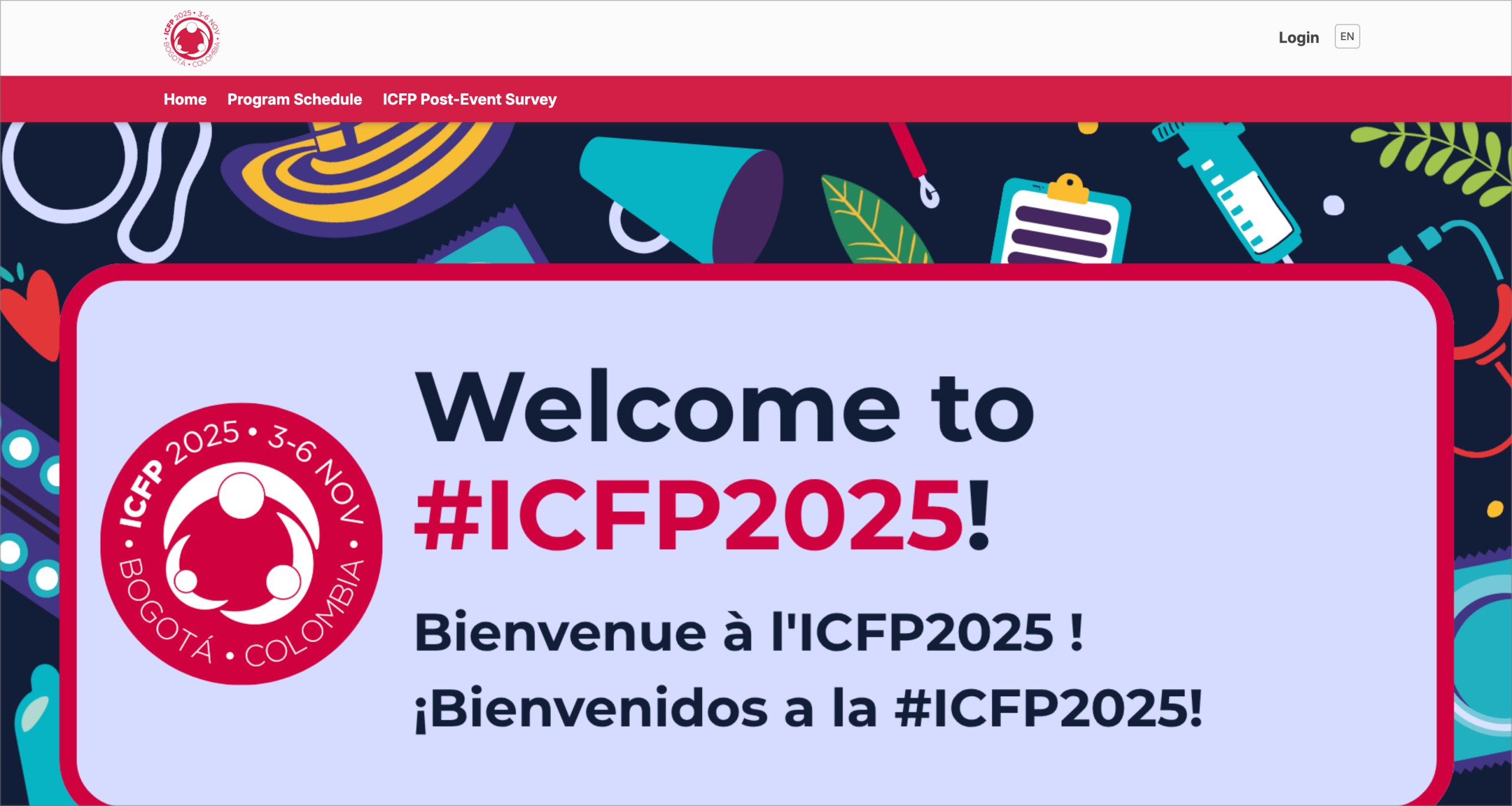
That is exactly what the Gates Institute achieved with Dryfta for the International Conference on Family Planning. As one of the world’s leading forums focused on family planning, reproductive health and rights, and sexual and reproductive health, ICFP brings together researchers, policymakers, healthcare leaders, advocates, and practitioners from around the world.
For the 2025 edition, the event required a platform that could support both scientific rigor and large scale event execution. Dryfta served as that platform. Using Dryfta’s event registration and ticketing, abstract management and peer review, event schedule builder, event app, private messaging, visa letter workflows, badge builder, and certificate builder, the ICFP team successfully managed a complex, high volume conference in one connected event platform.
ICFP 2025 by the numbers
ICFP 2025 was a large and complex global conference, and the numbers reflect that scale clearly:
-
6,400+ abstracts submitted
-
10,500+ reviews submitted
-
3,500+ attendees and speakers
-
2,000+ visa letters generated
-
1,000+ participation certificates issued
-
330+ sessions in the program schedule
-
36,100 sessions added to personal schedules
-
7,00,000+ USD in ticket sales generated
These numbers tell an important story. This was not a basic conference setup supported by disconnected tools. It was a full conference operation powered across multiple workflows, audiences, and timelines from within a single event platform.
The challenge of running a research conference at this scale
Large research conferences face a very specific operational challenge.
They need to support a scientific process on one side and a participant experience on the other. That means handling abstract collection, peer review, session planning, speaker coordination, registration, payments, visa support, and onsite readiness, while also making the event simple and intuitive for attendees.
In many organizations, these workflows are still fragmented across separate tools. Abstracts may live in one system. Registration in another. Scheduling in a spreadsheet. Certificates handled manually. Notifications outsourced to email. That fragmentation creates delays, duplicated work, reporting gaps, and a poor experience for both organizers and participants.
For ICFP 2025, the Gates Institute needed a platform that could connect every major workflow in one place.
Why Dryfta was the right fit
Dryfta is built for conferences where scientific content and event logistics are deeply connected.
Instead of forcing organizers to patch together separate products, Dryfta offers one platform where teams can manage submissions, reviewers, registrations, schedules, attendee engagement, documents, and onsite assets as part of one system.
That was particularly important for ICFP 2025 because the conference required:
-
scalable abstract submission and peer review workflow
-
international delegate support including visa letters
-
attendee engagement through mobile and personal schedule tools
-
built-in communication between participants
-
badge generation for onsite operations
Dryfta brought all of that together.
1. Managing thousands of abstracts and reviews
The foundation of any research conference is its scientific program. For ICFP 2025, Dryfta supported the submission of 6,491 abstracts and the management of more than 10,500 reviews. That level of volume demands more than a submission form. It requires a structured review environment with clear workflows, submission categories, assignment controls, scoring tools, comments, and progress visibility.
Dryfta’s abstract management and peer review system allowed the conference team to move from submission intake to reviewer assignment to evaluation and decision making in a single environment.
This matters because scientific workflows often break down when data has to move manually between systems. Reviewers lose context, administrators spend time on exports and reconciliation, and accepted content becomes harder to transfer into the program. With Dryfta, it was a more controlled review process and a smoother path from accepted research to scheduled sessions.
2. Powering registration and ticket sales
ICFP 2025 also used Dryfta’s registration and ticketing module to manage attendee sign ups and generate more than 7,00,000 USD in ticket sales.
For conferences of this size, registration is a business-critical workflow that affects revenue, reporting, check-in readiness, and participant communication. Ticket categories, delegate types, pricing rules, and confirmation flows all need to work without creating unnecessary complexity for admins and registrants.
Dryfta enabled the ICFP team to manage this within the same ecosystem used for the rest of the event. And when registration lives inside the same platform as schedules, badges, certificates, and messaging, organizers get cleaner data and a more complete picture of the attendee journey.
3. Building a program with 300+ sessions
A successful conference needs more than accepted content. It needs a program that is clear, searchable, and easy to navigate.
Dryfta’s event schedule builder was used to create and manage 330+ sessions for ICFP 2025. This gave the organizing team a central place to structure the agenda, organize sessions, publish updates, and maintain an interactive program experience for attendees.
For participants, the schedule was not just a static page. It became an active planning tool. At large conferences, attendees are often overwhelmed by choice. A static schedule experience leads to missed sessions, confusion, and frustration. An interactive, personalized schedule experience helps delegates discover relevant content quickly and build a meaningful conference journey around their goals. Dryfta helped make that possible.
4. Driving attendee engagement through personal scheduling
One of the strongest indicators of engagement from ICFP 2025 was how often attendees used Dryfta to plan their own experience. Across the event, 36,100 sessions were added to personal schedules.
That is not a vanity metric. It shows that attendees were actively exploring the program, saving sessions, and curating their own agenda rather than passively browsing.
This is where Dryfta’s event app and personal schedule functionality become especially valuable. Delegates can move beyond simply viewing the program and start using it as a live decision making tool. They can identify relevant sessions, keep track of their interests, and navigate a large event more confidently.
5. Simplifying visa support for a global audience
International conferences often carry significant visa related administrative work. For ICFP 2025, Dryfta helped the organizers generate more than 2,000 visa letters. That capability reduced manual overhead and made it easier to support delegates traveling from around the world.
This is one of those workflows that is easy to underestimate until volume becomes high. When handled manually, visa letters can consume enormous staff time and create delays for participants. When automated inside the event platform, the process becomes more consistent, faster, and easier to manage.
For a global conference like ICFP, that operational improvement is not minor. It directly supports attendance.
6. Delivering participation certificates at scale
After the event, Dryfta’s participation certificate builder was used to issue more than 1,000 participation certificates.
Certificates remain an important requirement for many professional and academic attendees. They support recognition, institutional requirements, and personal records. Yet many event teams still manage them manually through design files, and individual email requests.
Dryfta streamlined this into the same system already used for registration and attendance related workflows. That reduced administrative effort and ensured certificates could be delivered in a more organized and consistent way.
7. Preparing for onsite operations with badge builder
Dryfta’s badge builder also played an important role in ICFP 2025 by helping the team generate attendee badges as part of the broader conference workflow.
Badges are more than printed name tags. They are part of the onsite operating system. They affect check in speed, identity verification, role visibility, and the professional quality of the event experience.
When badge data is connected directly to registration records and attendee profiles, the entire onsite process becomes more accurate and efficient.
What made the difference
What stands out about ICFP 2025 is not just the scale of the conference. It is the fact that so many critical functions were managed in one connected event platform. That created a number of practical advantages for the organizing team:
-
fewer disconnected systems to manage
-
zero duplicate data entry
-
smoother movement from abstract acceptance to session scheduling
-
stronger visibility across registration, attendance, and engagement
-
reduced manual workload for documents like visa letters and certificates
-
a more consistent experience for delegates, speakers, and staff
For large conferences, that kind of operational continuity is often the difference between simply getting through the event and running it with confidence.
Why this matters for other conference organizers
Many research conferences continue to operate with a patchwork of tools because that is how things have always been done. But scale exposes the weakness of that model.
Once submission volume rises, session counts grow, and international attendance increases, fragmentation starts to slow everything down. Admin teams spend more time coordinating systems than improving the event itself.
ICFP 2025 demonstrates a stronger model. By using Dryfta as the central event management platform, the Gates Institute was able to connect the scientific workflow, the attendee workflow, and the onsite workflow in one place.
Event Platform for Large Scale Research Conferences
ICFP 2025 is a clear example of how Dryfta helps large research conferences move beyond disconnected event tech.
From 6,000+ abstracts and 10,000+ reviews to 3,500+ participants, 300+ sessions, and more than 700K USD in ticket sales, Dryfta supported the conference across every major stage of execution.
For organizers managing scientific complexity, international participation, and high attendee expectations, the value is simple: one platform, better control, stronger experience, and less operational friction.