




Once a call for papers brings in hundreds of submissions, the best abstract management software has to do more than collect files. It must keep reviewer assignments fair, flag incomplete reviews and conflicts of interest, send decisions on time, and turn accepted work into a usable program.
The best abstract management software removes those handoffs without forcing authors, reviewers, and program chairs into the same complicated interface. This guide compares ten established platforms for academic conferences, association meetings, research events, awards programs, and hybrid events.
What we mean by high volume: There is no universal cut-off. In this guide, it means hundreds or thousands of submissions, multiple tracks or review stages, or any program where spreadsheets and manual email can no longer keep assignments, decisions, and deadlines under control.
Editorial disclosure: Dryfta publishes this guide and is included in the comparison. We reviewed every vendor against the same criteria and linked to first-party product, help, release-note, or pricing pages wherever a public source was available. Features and prices were checked on September 15, 2026. Buyers should confirm final scope and pricing directly with each vendor.
Quick recommendations
| If you need… | Start with… | Why it belongs on the shortlist |
|---|---|---|
| Abstract review connected to registration, payments, scheduling, and event delivery | Dryfta, Ex Ordo, Cvent, Whova, or vFairs | Each connects content selection to a broader conference workflow. |
| A research-conference system with transparent per-event pricing | Oxford Abstracts | Its published plans cover abstract management and optional conference delivery. |
| A low-cost paper submission and peer-review system | EasyChair | It publishes free and per-submission licenses, including plans for larger conferences. |
| Flexible submissions for awards, grants, fellowships, and conference programs | OpenWater or Reviewr | Both extend beyond academic abstracts and support configurable evaluation workflows. |
| Abstracts, proceedings, and research-publishing workflows | Morressier | Its product family follows research content beyond the event program. |
What matters when submissions arrive at scale?
A long feature list will not tell you whether a platform can survive the final week of a call for papers. Before you compare brands, map the work that creates pressure for your team.
Submission rules that match the program
Check whether you can create separate forms for posters, panels, symposia, workshops, grants, and individual papers. Conditional fields, co-author controls, multiple file types, resubmissions, and late-breaking tracks become important as the program grows.
Review integrity and workload control
Your required review model depends on the discipline and event. Look for the blind-review options you actually use, conflict-of-interest controls, reviewer bidding or topic matching, manual overrides, assignment caps, and a clear way to identify overdue reviews. Dryfta’s guide to single-, double-, and triple-blind review explains the trade-offs.
Bulk work without spreadsheet detours
At high volume, saving a few clicks per submission adds up quickly. Test bulk reviewer assignment, status changes, reminders, decision emails, exports, and reporting. Ask the vendor to demonstrate your busiest workflow with realistic numbers, not a five-submission sample.
A clean handoff to the conference program
An accepted abstract should not need to be retyped into a separate schedule. Confirm how the system handles speakers, co-authors, rooms, tracks, presentation formats, session conflicts, and the public agenda. A direct link to an event scheduling system can remove days of cleanup.
Security, accessibility, and support
Research submissions contain personal and sometimes sensitive information. Ask for current security documentation, data-processing terms, access controls, retention options, backup practices, and accessibility information. Also find out who supports reviewers during deadline week and whether that support costs extra.
How we selected the platforms
We included products with a documented workflow for collecting and reviewing abstracts, papers, proposals, or speaker submissions. We then reviewed the areas that most often determine whether a system works at scale:
- Form and submission flexibility;
- Review models, assignments, conflicts, and decision controls;
- Bulk communication and reporting;
- The handoff from accepted content to sessions or proceedings;
- Integrations and broader event-management capabilities;
- Public pricing and evidence of fit for larger programs.
We did not award invented numerical scores or treat an unverified feature as present. When a vendor does not publish pricing, the table says “quote required.” A blank or limited public record is not proof that a feature is absent; it means buyers should verify it during a demo.
Abstract management software comparison
| Platform | Best fit | Review workflow | Program handoff | Published pricing |
|---|---|---|---|---|
| Dryfta | Academic and association conferences that want one event platform | Single-, double-, and triple-blind review; topic or random assignment; manual bulk assignment | Accepted abstracts can move into the event schedule | From $1,499/year in Dryfta’s 2026 pricing guide |
| Oxford Abstracts | Research conferences that value ease of use and per-event pricing | Configurable forms, reviewer assignment, progress tracking, decisions, and multi-stage options on paid plans | Conference plans add program, networking, and event delivery tools | Free; $890/event for Abstract Management; conference plans from $2,290/event |
| Ex Ordo | Scholarly societies and research-led conferences | Custom submissions, reviewer allocation, marking schemes, tracking, and decisions | Connected registration, program, and virtual/hybrid tools | Quote required |
| OpenWater | Associations and institutions with complex, multi-round programs | Configurable forms, rubrics, multi-round review, judge assignment, and optional AI prompts | Session builder, scheduler, public agenda, and integrations | Quote required |
| EasyChair | Technical and academic conferences focused on paper review | Flexible forms, bidding, assignment, blind review, discussion, rebuttal, and proceedings options by license | Program and proceedings modules are available on higher plans | Free up to 20 submissions; Professional $4/submission up to 60; larger licenses vary |
| Reviewr | Awards, grants, scholarships, and submission programs | Blind review, conflict controls, weighted rubrics, ranking, consensus, and multi-stage selection | Strong selection workflow; not positioned as a full conference scheduler | Basic $500/year plus entry fees; Standard $1,200/year plus entry fees; enterprise quote |
| Cvent | Enterprise event portfolios already using Cvent | Topic-based assignment, reviewer portal, scores, comments, decisions, and automated email | Accepted content connects to Cvent agendas and registration | Quote required |
| Whova | Conferences that prioritize an integrated event app and attendee engagement | Calls for abstracts, proposals, posters, awards, and other submission types with review workflows | Accepted submissions become sessions and speaker records | Quote required |
| Morressier | Scientific events and publishers managing abstracts through proceedings | Configurable peer review, reviewer management, auto-assignment, and reporting | Abstract Manager connects with event programs and the wider Morressier publishing suite | Quote required |
| vFairs | Hybrid and virtual events that want abstract and speaker workflows in one platform | Custom forms, bulk assignment, blind review, weighted scoring, and reminders | Accepted abstracts can become agenda sessions and speaker pages | Quote required |
1. Dryfta: Best for an integrated academic conference workflow
Dryfta is strongest when abstract management is one part of a larger event operation. Organizers can build separate submission forms, collect several file types, set submission and review deadlines, and run automated or manual reviewer assignments. Assignment limits help distribute work, while single-, double-, and triple-blind options support different review policies.
The practical advantage is what happens after a decision. Teams can notify authors, move accepted content into the program, connect speakers with registration and payments, and publish schedules without maintaining separate records. Dryfta documents a Jhpiego event that handled 2,722 abstracts and more than 4,000 reviews, which gives buyers a concrete scale reference.
Consider Dryfta if: your team runs academic, medical, scientific, university, or association events and wants abstract review tied to registration, communication, scheduling, and event delivery.
Check during the demo: smaller teams should walk through setup, permissions, and reporting with their real workflow. The breadth of configuration is useful, but it requires more planning than a basic submission form.
Pricing: Dryfta’s 2026 pricing guide lists plans from $1,499 per year.
The Large plan uses custom pricing and provides unlimited submissions, registrations and sessions for organizations with larger requirements.
Dryfta can be particularly cost-effective for universities, associations and conference organizers running recurring or multiple events.
Confirm the current plan, event, submission, and service limits before purchase. See the full Dryfta abstract management workflow.
2. Oxford Abstracts: Best for transparent per-event pricing
Oxford Abstracts focuses on the familiar research-event sequence: submissions, review, decisions, ticketing, and publication. Paid plans add customizable forms and emails, reports, multi-stage submissions, certificates, and symposium support. Organizers can also auto-assign reviewers, schedule reminders, track progress, and generate abstract books.
Its clearest differentiator is pricing transparency. The Basic plan is free, although Oxford’s help center documents limits on form questions, reviewer assignment, emails, reports, and customization. The full Abstract Management plan is listed at $890 per event, while conference packages begin at $2,290 per event.
Best fit: societies and research conferences that prefer a focused system with a low-friction entry point and published per-event pricing.
Check before choosing: compare the exact free-plan restrictions with your review process, and decide whether you need the broader conference package for scheduling, networking, posters, or virtual content.
3. Ex Ordo: Best for scholarly conference teams
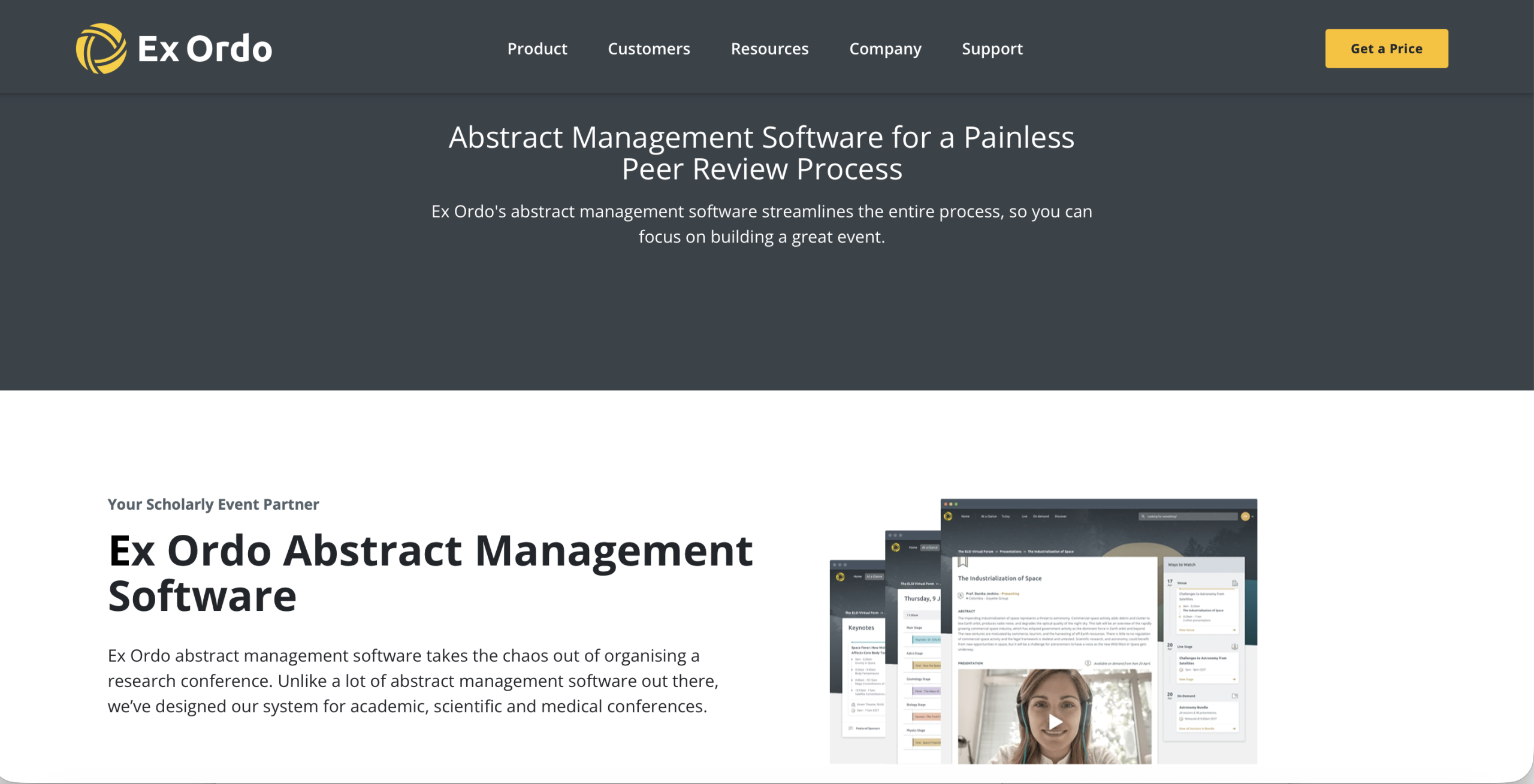
Ex Ordo is built around scholarly events. Conference teams can collect abstracts, full papers, panels, and speaker proposals through custom forms, allocate submissions to reviewers, configure marking schemes, monitor progress, make decisions, and send acceptance notices from the same system.
Its broader platform adds registration, payments, a program builder, and virtual or hybrid event tools. That makes Ex Ordo a relevant shortlist choice for associations and societies that want an academic review workflow without separating content selection from conference delivery.
Best fit: scholarly societies, universities, and research conferences with formal review and program-building requirements.
Check before choosing: Ex Ordo does not publish a standard price on the product page. Ask for a quote that separates abstract management, registration, program, mobile, and virtual-event requirements so you can compare like with like.
4. OpenWater: Best for complex multi-round programs
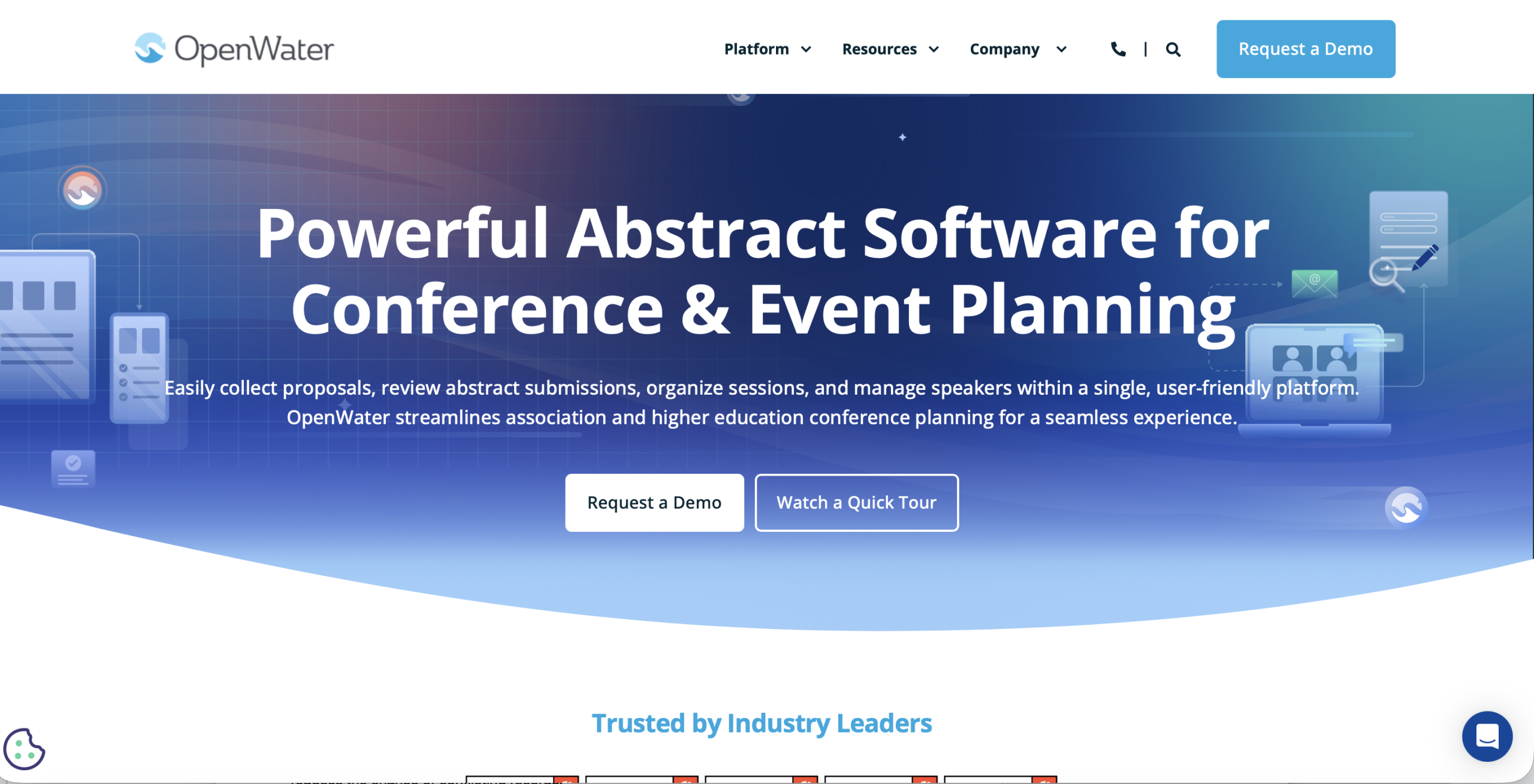
OpenWater handles more than academic abstracts. Its configurable forms, multi-round review, scoring rubrics, branded portals, email tools, session builder, and integration hub also suit awards, grants, fellowships, scholarships, and association programs.
For conference teams, OpenWater documents a workflow from proposed sessions and abstracts through review, assembly, scheduling, and a searchable online program. It also offers an opt-in AI feature that can run customer-defined prompts for tasks such as summarization, validation, anonymization, or assisted scoring. That flexibility is useful, but teams should establish human review and governance before using AI output in selection decisions.
Best fit: associations and institutions that manage several submission types or need a workflow that extends beyond a conventional call for papers.
Check before choosing: pricing is quote-based. Ask which integrations, AI usage, implementation services, portals, and event-scheduling components are included.
5. EasyChair: Best for budget-conscious paper review
EasyChair remains a practical option for paper-focused academic and technical conferences. Its documented features include customizable submission and review forms, single- and multi-track workflows, double- and triple-blind review, reviewer preferences and bidding, external reviewers, discussions, rebuttal, program generation, and proceedings integrations.
The license structure makes the trade-offs visible. The free license supports up to 20 submissions. The Professional plan is listed at $4 per submission with a 60-submission maximum. Executive and VIP plans remove the submission cap and add features such as technical support, proceedings tools, templates, analytics, and higher service levels; per-submission rates vary with volume and payment model.
Best fit: committees that primarily need rigorous paper submission and review, especially when budget matters more than a polished all-in-one event experience.
Check before choosing: identify which program, registration, proceedings, support, and media features require a higher license. Buyers looking for event marketing, attendee networking, or a modern branded app should compare the complete stack, not only the review fee.
6. Reviewr: Best for awards, grants, and structured selection
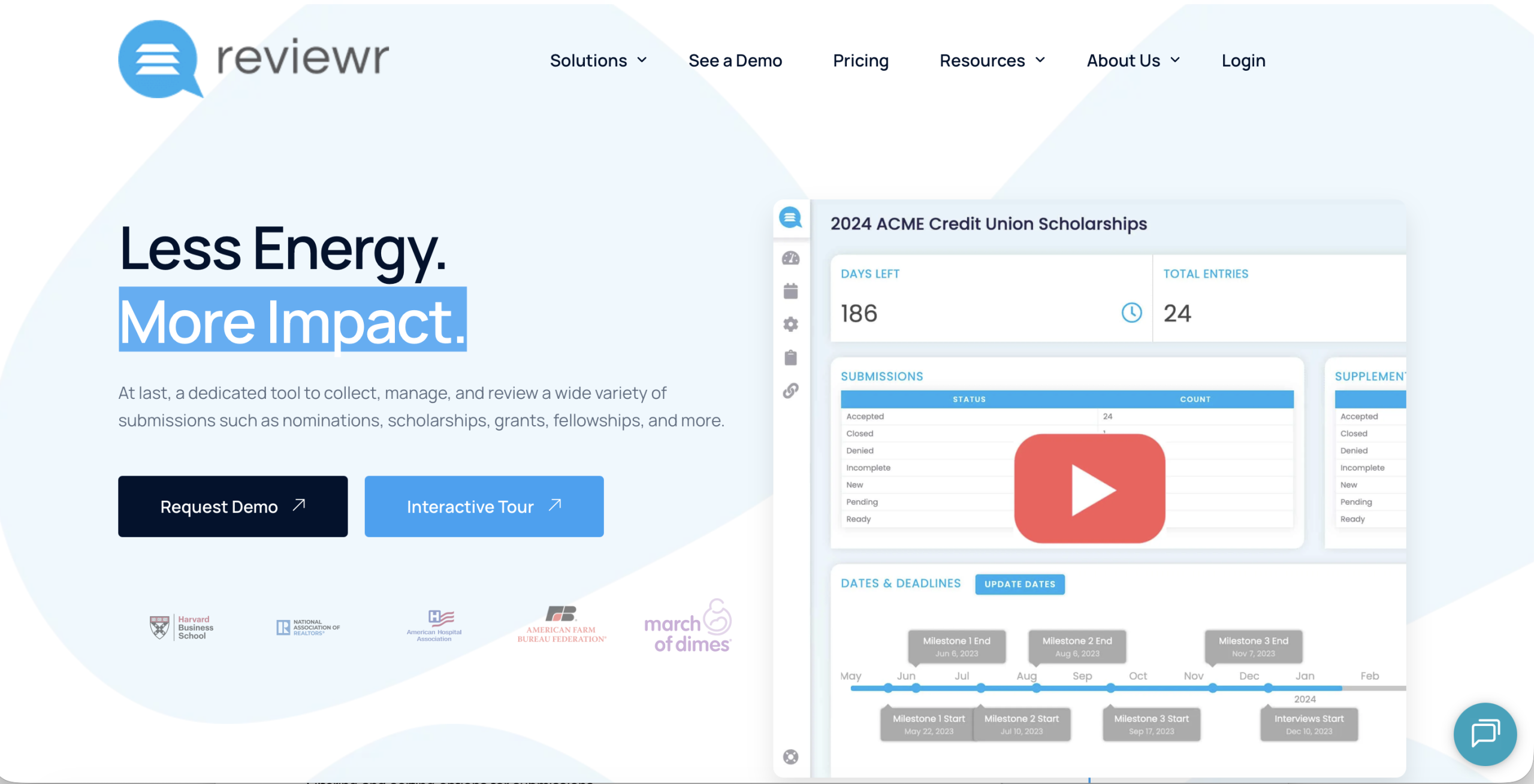
Reviewr approaches the problem as program and applicant management. It supports applicant portals, file collection, blind review, conflict-of-interest enforcement, side-by-side scoring, weighted rubrics, rankings, consensus stages, shortlists, and recorded approval decisions.
That makes it a strong candidate for awards, grants, scholarships, fellowships, nominations, and other programs where the selection process matters more than building a multi-track conference agenda. It can support abstract-style submissions, but conference organizers should verify how they will handle accepted sessions, speakers, registration, and the public program.
Pricing: Reviewr currently lists Basic at $500 per year plus $1–$10 per entry, Standard at $1,200 per year plus entry fees, and a custom Prestige plan. Published packages vary in workflow depth and integrations, so calculate the annual cost using your expected entry volume.
7. Cvent: Best for enterprise teams already using Cvent
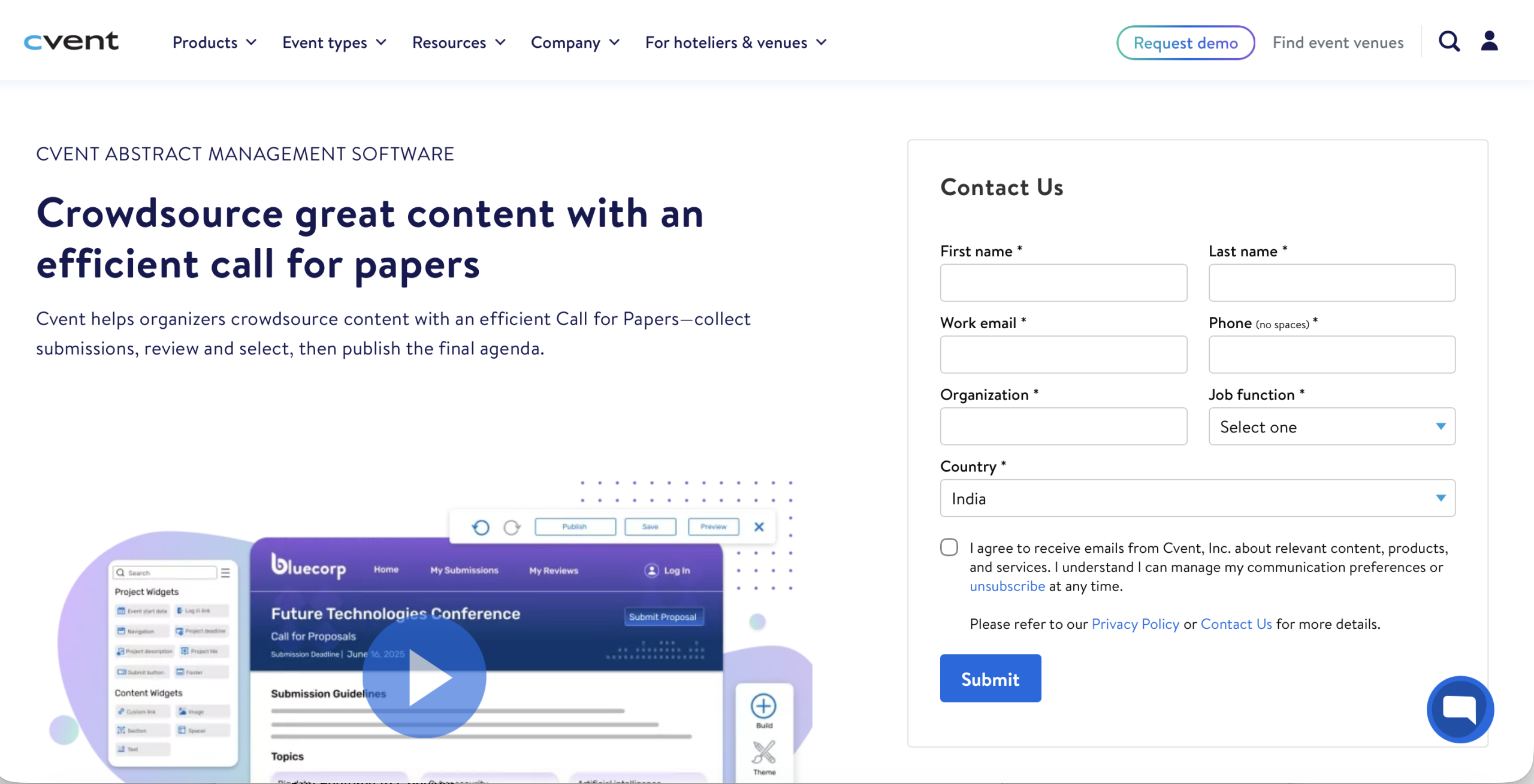
Cvent Abstract Management follows a clear four-stage path: collect, review, decide, and publish. Teams can route submissions to reviewers by topic, collect ratings and comments in a reviewer portal, monitor results, approve or decline content, notify authors, and push accepted sessions into the Cvent agenda.
The strongest reason to shortlist it is ecosystem fit. An enterprise already using Cvent for registration, speaker management, venue operations, or attendee experiences may prefer to keep content in the same environment. A smaller society buying abstract management alone should compare implementation effort and total platform cost carefully.
Pricing: Cvent uses custom quotes. Ask for an itemized proposal covering Abstract Management, Speaker Resource Center, registration, agenda tools, service, training, and any usage-based charges.
8. Whova: Best for connecting submissions to attendee engagement
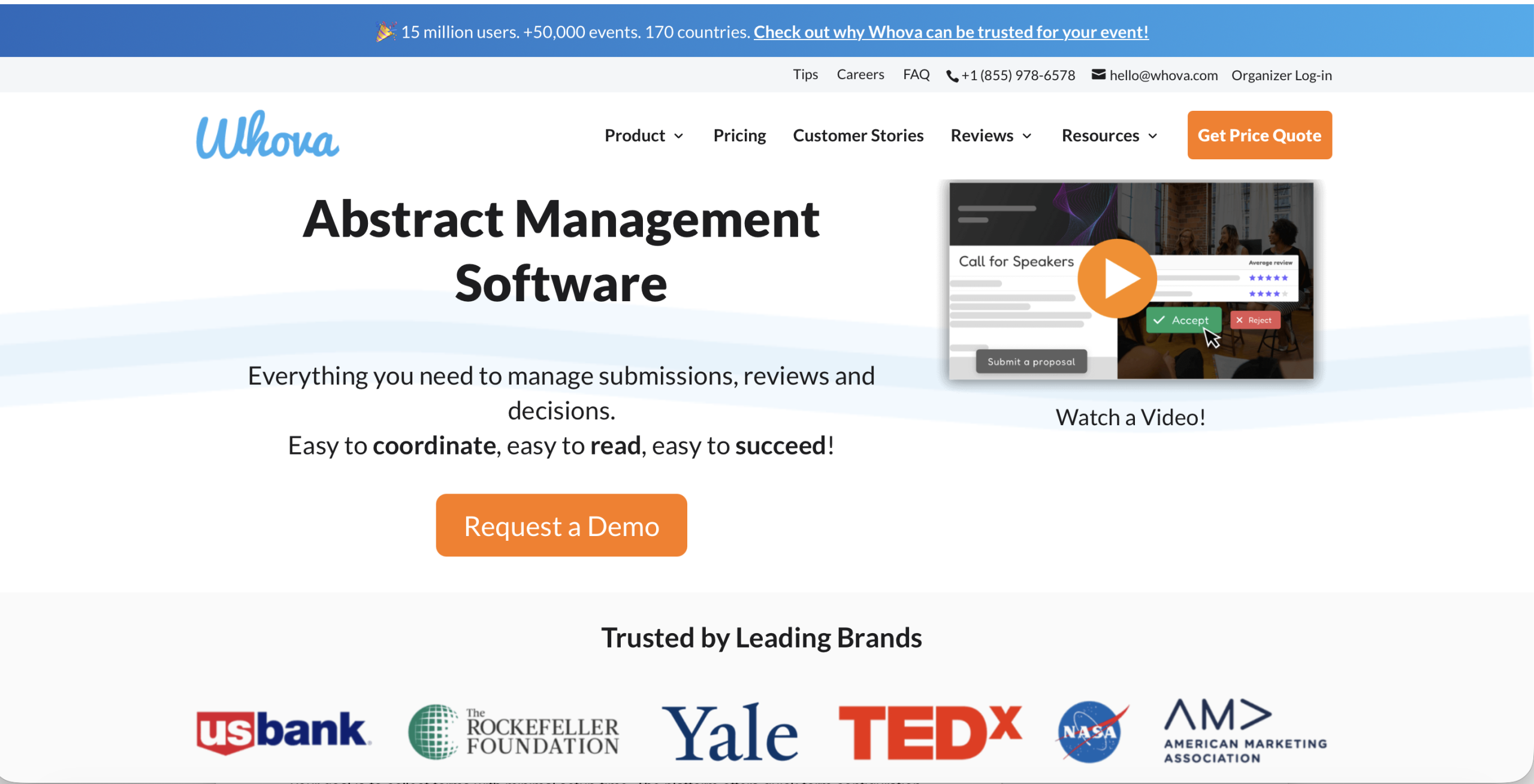
Whova supports calls for speakers, proposals, posters, demos, abstracts, awards, funding, and program applications. Accepted submissions can become sessions, while speaker information moves into the speaker center, event app, and event webpages.
This makes Whova appealing when the attendee-facing app and networking experience carry as much weight as the call for papers. The vendor also documents integrated registration and payment processing, which can reduce exports between content, speakers, and attendees.
Best fit: conferences that want submission management tied closely to an event app, agenda, speaker pages, and attendee engagement.
Check before choosing: ask Whova to demonstrate the exact blind-review, conflict, rubric, reassignment, and multi-stage workflow your committee needs. Pricing is available by quote.
9. Morressier: Best for research content and proceedings
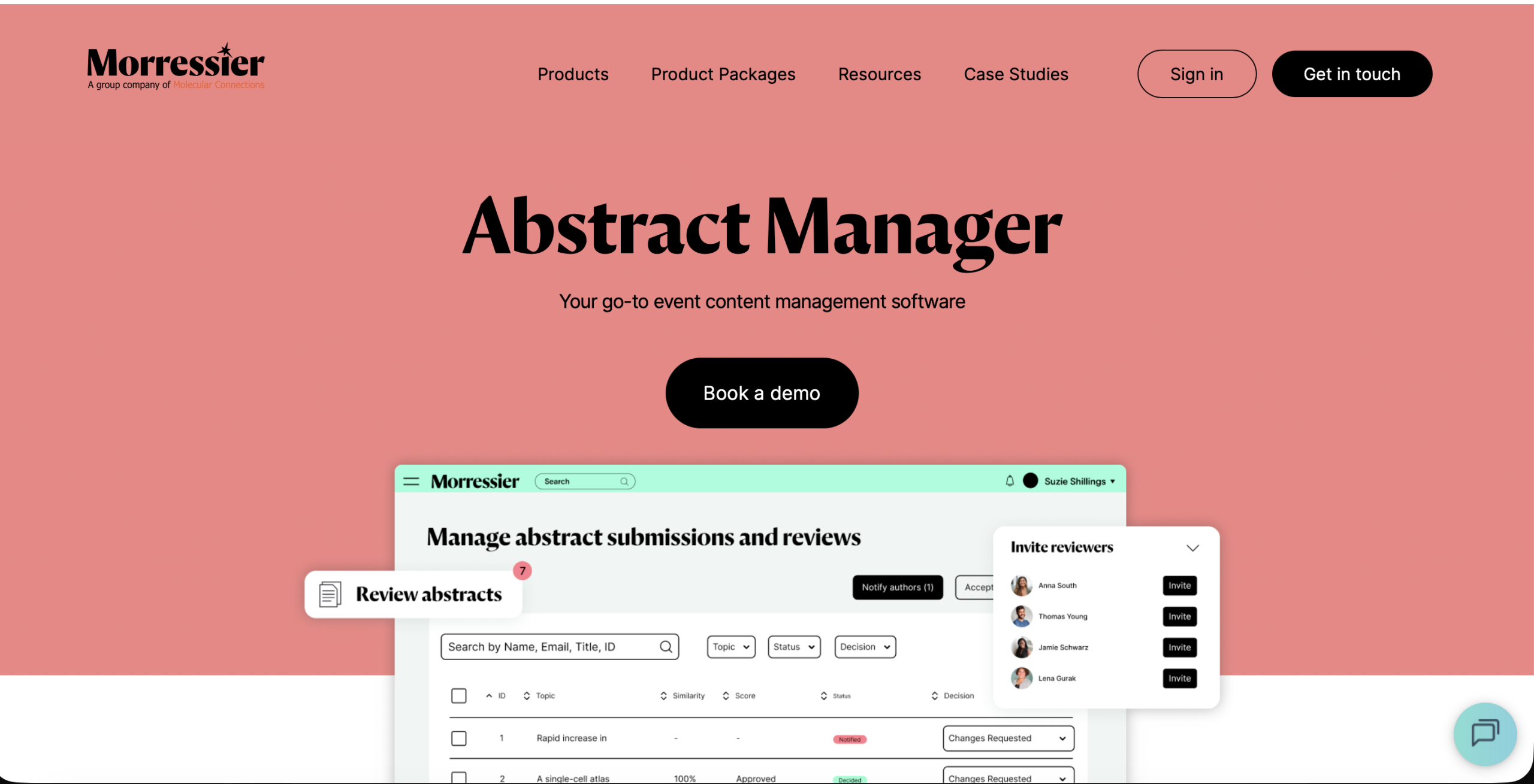
Morressier is the most publishing-oriented platform in this comparison. Abstract Manager covers calls, configurable peer review, reviewer invitations and assignment, reporting, DOI assignment, event setup, and program building. Separate Proceedings, Integrity, and Journal Manager products extend the workflow into full papers and publishing operations.
That product separation matters. Some integrity checks promoted by Morressier belong to Proceedings Manager or Integrity Manager rather than the core Abstract Manager. Buyers should map each requirement to the correct module before comparing a proposal with an all-in-one event platform.
Best fit: scientific conferences, societies, and publishers that want a traceable path from abstracts to proceedings or other research outputs.
Check before choosing: pricing is not publicly listed. Confirm which modules include peer review, identifiers, integrity checks, publishing services, posters, and event-program features.
10. vFairs: Best for hybrid and virtual event delivery
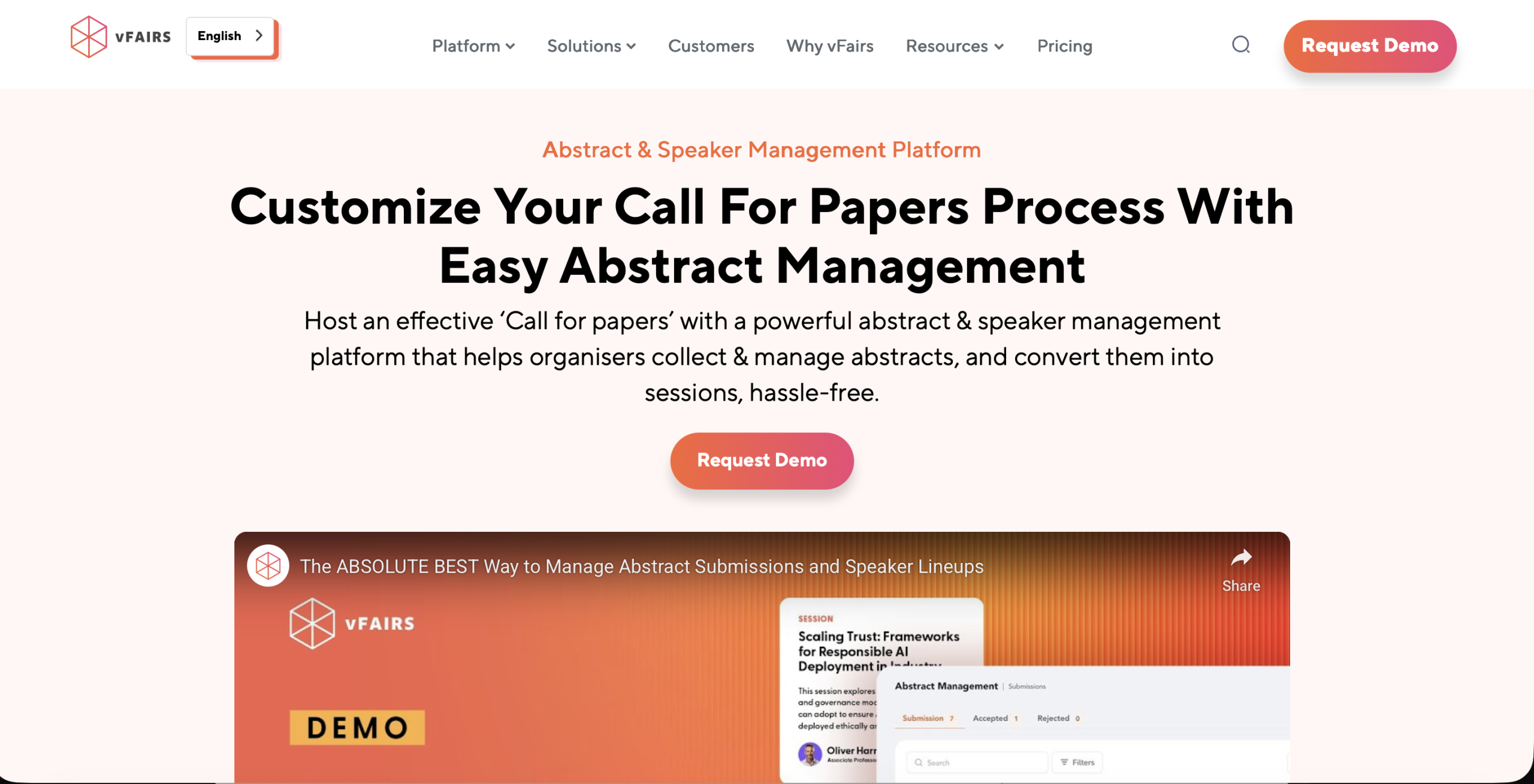
vFairs combines abstract and speaker management with a wider event platform. Its published workflow includes branded forms, conditional fields, bulk reviewer assignment, single- or double-blind review, weighted scoring, deadline reminders, and the conversion of accepted abstracts into agenda sessions and speaker pages.
For teams producing hybrid or virtual events, that connection can be valuable: the same vendor also provides registration, mobile apps, virtual venues, exhibitor tools, networking, and analytics. Organizations that only need academic peer review may find that broader package more than they require.
Best fit: conferences that need a call-for-papers workflow and substantial virtual, hybrid, speaker, or attendee-facing production tools.
Pricing: vFairs publishes package features but requires a custom quote. Confirm which abstract-management and event-delivery capabilities are included in the proposed plan.
How to choose without sitting through ten generic demos
Start with your workflow, not the vendor list. Write down the stages a submission passes through, who owns each decision, and where the current process breaks. Then give every shortlisted vendor the same demonstration brief.
- Bring a real submission form. Ask the vendor to reproduce your conditional questions, co-author fields, file rules, and submission types.
- Use realistic volume. See how the system filters, assigns, reminds, and updates hundreds of records at once.
- Test a difficult review case. Include a conflict of interest, a replacement reviewer, a late review, a tied score, and a revised submission.
- Follow one accepted abstract. Track it through notification, presenter registration, session building, scheduling, publication, and the mobile or virtual experience.
- Price the complete workflow. Include implementation, support, training, integrations, payment fees, extra events, storage, and renewal—not just the entry plan.
- Verify institutional requirements. Review security, accessibility, data location, retention, contracts, and support response times with the appropriate teams.
If a vendor cannot show your hardest workflow, a longer feature list will not solve the problem later.
Which platform should you shortlist?
Choose Dryfta when you want abstract submission and peer review to remain connected to registration, payments, communication, speakers, scheduling, and the rest of the event. Choose Oxford Abstracts when transparent per-event pricing and a focused research workflow are priorities. Consider Ex Ordo for scholarly event operations, and EasyChair when paper review and budget matter more than a polished all-in-one experience.
OpenWater and Reviewr deserve attention when the program spans awards, grants, fellowships, or complex application rounds. Cvent is a natural candidate for enterprise teams already invested in its event ecosystem. Whova and vFairs connect submissions with attendee-facing event technology, while Morressier stands out for research-content and proceedings workflows.
For a focused comparison, shortlist three platforms and ask each one to demonstrate the same real-world scenario. If Dryfta fits that shortlist, schedule a personalized demo and bring your submission volume, review stages, and program requirements. The team can show the complete path from call for papers to published schedule.
Frequently asked questions
What is abstract management software?
Abstract management software collects submissions, routes them to reviewers, records scores and comments, manages decisions, and helps organizers turn accepted content into sessions, proceedings, or other published outputs.
What is the difference between call-for-papers software and abstract management software?
A basic call-for-papers tool may stop after collecting proposals. A full abstract management system also handles reviewer assignment, conflicts, scoring, decisions, author communication, reporting, and often the handoff to a conference program.
Which features matter most for high-volume submissions?
Prioritize bulk assignment and status changes, reviewer workload limits, automated reminders, conflict controls, flexible filters, progress dashboards, decision emails, and a reliable abstract-to-schedule workflow. AI features can assist with defined tasks, but they do not replace review policy or accountable human decisions.
How much does abstract management software cost?
Pricing models include free tiers, per-submission fees, per-event packages, annual plans, and enterprise quotes. Published starting prices in this comparison range from free to four-figure annual or per-event packages. Implementation, support, registration, virtual-event, integration, and payment costs can change the total substantially.
Can abstract management software support blind peer review?
Many platforms support at least one blind-review model, but the details differ. Verify what is hidden from reviewers and authors, how uploaded files are anonymized, how conflicts are handled, and whether administrators can audit changes.
Which abstract management software is best for an academic conference?
The answer depends on the conference. Dryfta, Oxford Abstracts, Ex Ordo, EasyChair, Cvent, Whova, Morressier, OpenWater, and vFairs all serve parts of the academic-event market. Match the platform to your review model, submission volume, program handoff, institutional requirements, budget, and need for registration or event-delivery tools.
